A Short History of Quilting in Europe
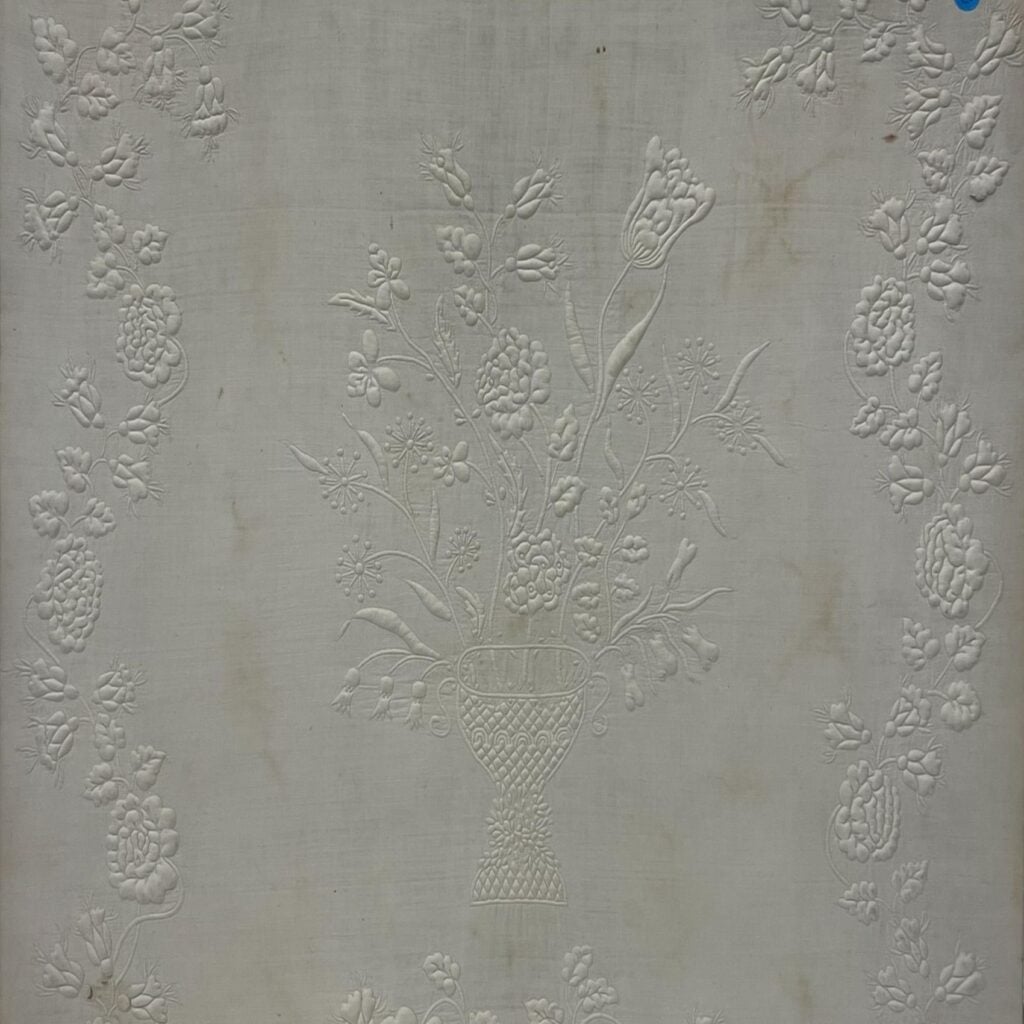
The word “quilt” summons a host of images: thrifty pioneer housewives piecing elaborate patchworks for their families; album quilts signed by every member of a community as a gift for a departing mayor or pastor, or perhaps raffled for a worthy cause; perhaps even a wholecloth petticoat worn by a colonial dame as she danced with George Washington, or a brightly colored scrap quilt made by a grandmother or aunt during the Depression. The popular image of the quilt is of the quilt is modern, calico, and American. It certainly isn’t medieval!
The problem with this familiar stereotype is that it doesn’t go far enough. Quilting may have reached its apogee in the glorious appliqued quilts of 19th century Baltimore, but it was practiced nearly two thousand years earlier. Quilted garments padded Crusader mail, quilted linens adorned Renaissance bedchambers, and quilted Evangelists were treasured at 15th century monasteries (Colby). The evidence is scattered and sometimes hard to recognize, but quilts and quilting were hardly alien to medieval Europe.
History
The word quilt is derived from the Latin culcita, meaning a padded and tied mattress similar to a Japanese futon. Quilting is a needlework technique involving two or more layers of fabric, usually sandwiched with padding of some sort, stitched together in a decorative pattern.
It appears to have originated in Asia sometime before the first century C.E. The first known quilted object is a quilted linen carpet dating from that time found in a Siberian cave tomb (Colby 1971). The central motifs (primarily animals, with abstract spirals on the borders) are worked in the backstitch, while the background is diamond quilted in a coarse running stitch. Whether the Siberians developed quilting on their own or learned it from outsiders, its advantages in such a cold climate are obvious: warmth without bulk, strength without stiffness, useable in everything from clothing to saddlecloths, and unusual enough to be traded for luxury goods.That quilted objects were indeed traded is obvious from the next oldest quilted artifact, a spiral quilted slipper found in a rubbish tip in Samarkand, a major stop on the Silk Road between China and Europe (Liddell). The backstitch technique is identical to that used in the funerary rug.
Quilting does not appear to have been done in Europe much before the 12th century, and is usually thought to have been brought back from the Middle East by the returning Crusaders (Colby 1971). However, a recent discovery from Germany indicates that quilted objects may have been known during the Dark Ages. A Merovingian tomb from the 5th century contained a wool twill pall quilted with Egyptian cotton (Rogers). Although the pall was obviously a luxury item, and almost certainly imported, it suggests that quilting was established enough in the Mediterranean to be traded to the less civilized north.
The next evidence of quilting in Europe appears in a French poem of the 12th century, La Lai del Desire. It mentions a “quilt of two sorts of silk cloth in a checkboard pattern, well made and rich” (Colby 1971) adorning a bridal bed. The 13th century German Parvizal also mentions a quilt on a bed in the Grail castle (Eschenbach), suggesting that bed quilts were fairly common in aristocratic circles in at least two countries. There is also a reference in a French inventory of 1297 to a ship captain in Marseilles owning a courtepointe, later the French word for quilt (Berenson).
Quilting clothing and armor began to appear in the 14th century, with quilted doublets and armor appearing in France, Germany and England (Colby 1971) and quilted tunics in Italy (Ibid). Quilted jacks and brigantines, often padded with metal plates, were produced by professional armorers in major cities such as Paris and London (Staniland), while the domestic articles could have been done either by professionals or individual household embroidery staffs. Quilting may have even worked its way down to the lower classes by then; a tiny 14th century Italian ivory shows St. Joseph, traditionally regarded as a peasant or lower class artisan, wearing a diamond quilted tunic (Colby). Quilting had clearly become part of the European needlework tradition.
The first surviving European bed quilts are three trapunto (or stuffed) quilts from the same Sicilian atelier. Two, one in the Victoria & Albert Museum in London and the other in the Bargello in Florence, are believed to have been made for a wedding in the 1390’s (Young), while the remains of a third, in a private collection as late as World War II, may have been made for the royal house of Anjou (Loomis).
All three show scenes from the Tristan legend, with the Anjou quilt including a border of the Seven Deadly Sins! The trio is worked in the same technique as the Siberian rug of 1200 years earlier: backstitched linen on linen around the decorative motifs, cotton stuffing in the trapunto sections, and running stitch quilting in the backgrounds. A similar quilt, possibly of silk, is shown in the Flemish Bartolomeo Bermejo’s 1450 painting The Death of the Virgin, placing quilting in the Netherlands by the 15th century (Lidz), while a German painting of 1500 shows a quilted, pieced tunic in what may well be the first accurate depiction of pieced clothing in western art (Gwinner). These early quilts and quilted objects, and virtually all surviving quilting until the 17th century, were of linen stuffed with raw cotton; if wool flocking was ever used for anything besides perhaps armor, it was far too attractive to moths to survive (Colby).
That quilting was not confined to Italy and Germany is evident from two 15th century French references. A Provencal inventory of 1426 mentions bedcovers worked with figures of Alexander and Solomon “in the style of Naples,” almost unquestionably a reference to trapunto. Sixty years later the bedchamber of no less a figure than King Rene of Anjou contained a quilt “stitched with figures of men and women” (Berenson). Although the design of King Rene’s quilt is unknown, the Seven Deadly Sins quilt referenced above featured heavily stuffed fleurs-de-lis, a device used by the House of Anjou. It is just possible that part of King Rene’s quilt survived into this century, and may still be in an Italian castle!
The Renaissance brought increased trade with the Eastern countries where quilting originated. The Ottoman Empire had a native tradition of quilted bedcovers and caftans; surviving examples from the courts of 16th and 17th century sovereigns such as Suleiman the Magnificent and Selim the Grim are worked in the running stitch on silk broadcloth and brocade, sometimes in contrasting colors (Tezcan). Court ettiquette dictated that clothing be presented to foreign ambassadors, so it is probable that European diplomats posted to Constantinople returned with quilted caftans in their baggage.
This was also the time when European countries established colonies and trading posts in Asia. India had a strong native quilting tradition and quickly began producing export work in cotton and silk (the very word calico, later the name of the favorite quilting cotton, is derived from Calcutta). Portugal in particular imported “pintadoe quilts” from its Indian possessions (Rae), as well as palampores and unquilted spreads that were later worked up into “colchas” on the Iberian peninsula (Gillow). Many of these mixed European and native design elements with varying degrees of success, and were as popular in Protestant England as in Catholic Portugal; the formidable Elizabeth, Countess of Shrewsbury, owned at least one Bengali quilt of silk and cotton (Levey) in addition to others of unknown provenance.
Other quilts appeared in inventories throughout England, and despite a tendency to refer to quilted petticoats as “quilts,” enough of these appear in linen and bedroom inventories that make it clear that these were indeed intended as bed quilts, not garments (Colby, Girouard). Henry VIII, for instance, gave his fifth queen two dozen “gold and silver” quilts from the royal inventories as a sign of favor (Rae). Even given his multiple marriages, it is hard to believe that Henry would have had two dozen quilted petticoats waiting for an owner!
These import quilts were so popular that a native European tradition seems to have arisen by the late 16th century. Elaborate whole cloth silk quilts appeared in France, Italy, England, and the Iberian countries. These often featured ships and “exotic” motifs of “Mohammedans” in loincloths, leading to speculation that at least some commemorated the great naval battle of Lepanto (Lidz). Although some were likely made in India, there is evidence suggesting that the chief source was the Mediterranean island of Chios, home to a native silk industry; the silk is not as wide or as fine as the Indian product, and the European design elements are more skillfully handled than in Indian work. A fine example was found in Cornwall in the early 90’s (Quilt Treasures), while its near twin surfaced in the Winterthur Museum in Delaware last year (Lidz).
Not surprisingly, quilting became very popular among aristocratic circles. Quilts were expensive, beautiful, and warm, all desirable qualities for the upwardly mobile in the Little Ice Age of the late Renaissance. A spectacular 16th century example was made in Germany (a trapunto spread showing fantastic beasts and birds) (Staniland), while the bed chambers of Elizabeth, Countess of Shrewsbury and her ward, Lady Arbella Stuart, contained no fewer than three quilts (in addition to enough pillows, blankets, carpets, and other linens to supply a small town for a year) (Girouard).Keep in mind that Bess of Hardwick was but a dowager countess, albeit a rich one who loved to embroider. It is hard to imagine how any sovereign in Europe, even the luxury loving Elizabeth, could possibly have topped this display. Even Scandinavia had its high quality quilts, with Margareta Leijonhufvud, second queen of Gustav Vasa, owning a silk bedcover with a pieced lining (Wettre). Quilted garments were also made, usually either petticoats or doublets (Kohler).
The true heyday of European quilting came in the late 17th and early 18th centuries, when quilted petticoats, waistcoats, bed linens, caps, and even doll clothing (Noble) became wildly popular among the upper and middle classes. By the early 19th century quilting was an established folk art in the United States, Britain, Canada, France, Sweden, and Germany (Gwinner), often with the same patchwork patterns developing independently in two countries (Wettre). American patchwork was perhaps the most elaborate in history, with several thousand documented block patterns in addition to superb trapunto, applique, and “crazy patchwork” (inspired by Japanese yosegire work) (Liddell).
Regardless of quilting’s new association with America, its medieval roots are still evident; 19th and 20th century Welsh needleworkers use patterns almost identical to those used on Chios three hundred years earlier (Rae), while the stunning Marseilles work of the 19th century is just as elaborate as the Italian stuffed work of the early Renaissance. Medieval quilting is not as familiar as its later counterparts. Perhaps it is time to restore it to its proper place among the ancient needle arts.
Techniques
In its simplest form, quilting is simply decorative stitching designed to hold two or more layers of cloth and padding together. At least three methods were used to do this: the backstitch, the double running stitch, and the running stitch.
Backstitch quilting is the oldest technique, used in the 1st century Siberian rug (Colby). It is surprisingly fast and accurate, and by far the easiest stitch for working with raw cotton wadding It eventually gave way to the daintier running stitch as better materials became common.
Double running stitch was used in the Indo-Portuguese and Chiosan silk quilts of the late 16th and 17th centuries. It looked exactly like the backstitch on the top, with the added advantage of being reversible. Several 17th century silk quilts are indeed fully reversible, with the stitching matching the color of the “top.” The most popular combination was a strong cochineal magenta top and an indigo/weld olive green back, with at least one with a pale indigo blue top and light cochineal or madder pink back (Lidz).
The running stitch was used in the Siberian rug and the Sicilian wedding quilts, but only in the unpadded background sections; as stated above, it is all but impossible to produce fine, even running stitches through lumpy raw cotton. It became more and more popular as small needles, fine cotton and silk thread, and smooth, carded cotton became available. By the 18th century only the professionals of Marseilles used the backstitch, and that primarily in clothing (Berenson). The running stitch had become the standard quilting stitch and remains so to this day.
Materials
Surviving period quilts are exclusively of either linen or silk, worked in matching thread, and stuffed with cotton. If wool was used, no example has survived. Early examples are natural linen or silk, with motifs outlined in a darker color such as brown or gold; later examples were worked to match the quilt top (Colby). Silk came into vogue in the 16th and 17th centuries, with the Asian trade. The Chios quilts were made from an unusually narrow (27″) silk inferior in quality to the Indian product, which tended to be wider (Lidz).
SCA Uses
There are several uses for quilts and quilted objects in the Society for Creative Anachronisms (SCA). The most obvious, and common, is armor. Although quilting was used for both gambesons and jacks (Gwinner), padded linen jacks cannot be made list legal. However, a finely quilted jack or arming doublet would look spectacular in court, particularly if the wearer’s arms were quilted onto the back. A better choice for a heavy weapons fighter would be a gambeson or a quilted tunic worn over plastic armor in cold weather. The only caution would be to use only cotton batts – synthetic batts do not breathe, and armor made from them could cause a fighter to overheat and suffer a heat stroke. Most pre-quilted fabric is made with polyester batts and should be avoided for this reason.
Another good choice would be quilted bedding, either pillows (excellent for beginners) or bed quilts. Bed quilts are warm, practical, and be as plain or as fancy as desired. Most fabric stores offer basic quilting classes, by either hand or machine. Machine quilting is obviously not period, but it’s possible to quilt a whole quilt in a day by machine. Virtually all modern quilts are made of cotton broadcloth or calico – again, not period, but washable, cheap, and very practical for camping. And Indian tapestries are so close to period “pintadoe” cloth that a quilted tapestry would make a fine addition to any campsite.
And of course there’s always garb. Period choices might include caftans or caps for Middle Eastern personae, doublets or bodices for later Europeans, caps for Elizabethan dames, and underwear a la Provence for Cavalier ladies who want to be complete from the skin out.
One warning: quilting is addictive. The calicos used for modern quilting are among the most beautiful cottons being made today, and who can resist beautiful fabrics? So – don’t be surprised if what begins as a single gambeson, or a way to use up scraps, turns into a full blown obsession. “Quilt pox” isn’t period, but it sure is fun….
