Early American Quilts
The roots of quilting in America stretch back to European traditions of patchwork, applique, and quilted garments, though these techniques were not yet combined into what we recognize as a quilt. By the colonial era, bed covers were made in whole-cloth styles from plain or printed fabrics, or as applique works centered on a large medallion. Most fabric was imported from Europe, and finished quilts were often purchased commercially. If you picture early quilts as a little “quieter” than later Victorian showpieces, you’re on the right track. Early American quilts sit in a transitional period between necessity and decoration.
One caution: there was no definitive decorative timeline. Quilters and their quilters were influenced by the events of the day in their area. Transportation between population centers was difficult so ideas may or may not have been shared between communities. Unless a quilt is dated and comes with a proven provenance, the best you can say is that it is “circa” certain dates. Dating clues include fabric (fiber/dye), style and technique analysis. Family history is rarely reliable but, like everything else, there are always exceptions.
Pre-1800 Quilts
Although quilting had long been known in Europe (see A Short History of Quilting in Europe), fabric was too precious in the colonies to use for quilts. Bed coverings would more likely be coverlets or thin wool blankets used in layers. Some dates are:
- 1708: Oldest wholly intact surviving quilt, done in broderie perse mosaic style
- 1726: Oldest known American-made quilt
- 1782: The eagle is adopted as a national symbol and incorporated into quilt designs
- 1783: Roller printing introduced in England, dramatically speeding fabric production
- 1793: Invention of the cotton gin spurs the rise of cotton mills in the northeast
1800-1850 Quilts
Construction Styles
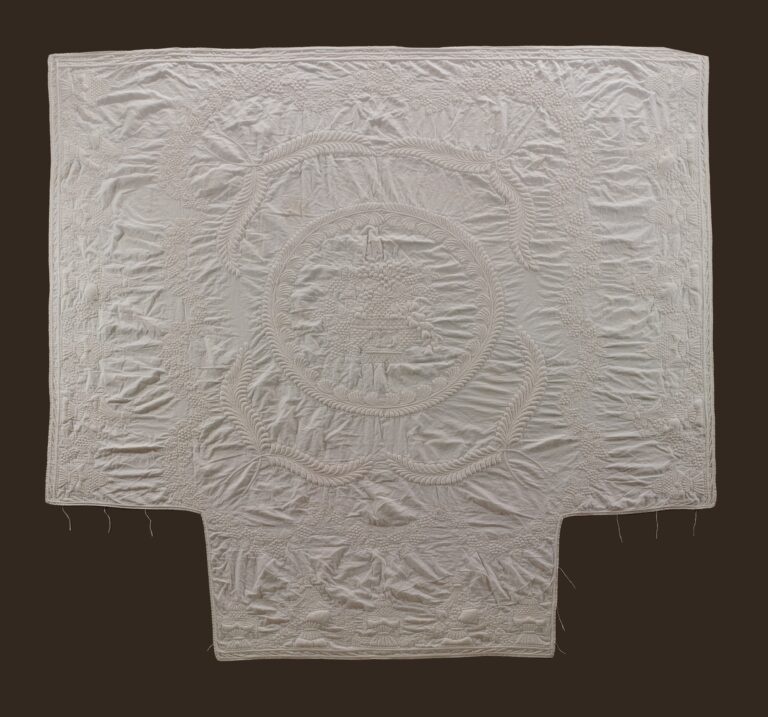
- Whole cloth quilts made from a single fabric or joined lengths to look like one piece. The design comes from the quilting stitches, not piecing. Often used expensive fabrics like imported chintz or glazed textiles. Quilted whole cloth petticoats were popular during this time period both for warmth and beauty.
- Patchwork becomes more common as fabric availability improves. Simple geometic blocks dominate, such as the nine patch or stars. By around 1800, the Nine-Patch, Grandmother’s Basket, and Pinwheel block patterns had emerged. Quilting bees were an established tradition by 1820. Sashing came into use to frame individual blocks, and American mills began producing cotton calicoes.
- Applique emerges, particularly Broderie Perse (cut-out chintz motifs appliquéd onto background). French floral fabrics were a favorite. Broderie Perse was very popular in Mid-Atlantic/Southern states, ca. 1800–1850. Botanical motifs like roses show up on “Botanical Quilts of the Mid-South”.
- Medallion and Frame Layouts often featured a central floral or patchwork design surrounded by fabric. They were built from the center out, unlike later quilts which were sewn row-by-row.
- Wool or cotton batting: Hold it to light — dark specks are cotton trash. Mechanical cleaning of cotton batting wasn’t standard until after 1900.
- Hand piecing, appliqué, and quilting: All stitching is by hand.
- Central medallion or frame layouts: Bedcovers 1790–1840 often had a centrally focused design rather than repeated blocks.
- Pieced patterns: Star of Bethlehem, Ohio Star, Bear Paw, and geometric “diamond” layouts appear pre-1850. Album/Signature quilts start 1840s–1860.
- Wholecloth & quilted petticoats: Some early quilts were cut from imported British quilted silk petticoats, reconfigured with diamond-grid quilting.
Quilting & Design Motifs
- Designs reflect everyday life. They might show household objects (like churns), or botanical forms and simple symbolic shapes
- Heavy emphasis on quilting patterns, especially in whole cloth quilts. Intricate stitching used to show skill. Quilting stitches often 8-10 per inch, frequently in linen thread.
Fabrics & Materials
- Natural fibers only, like cotton, linen, or wool easily produced in an agricultural community. It was often homespun or handwoven.
- Wealthier families, particularly in seaports, might be able to import chintz or block-printed or copperplate-printed fabrics
- Handwoven or early mill cotton + linen: Backings and wholecloth quilts often used linen or linsey-woolsey before cotton became widely available.
- Natural dyes only: Indigo for blue, madder root for red, walnut/bark for browns. No synthetic “poison green” or bright “cheddar orange” — those aniline dyes show up ∼1875.
- Natural/vegetable dyes such as Madder red, Indigo blue, browns, yellows and muted greens. Synthetic dyes (aniline) don’t expand the palette until later
- Limited by natural dyes: Indigo blues, madder/turkey reds, chrome yellows, browns, tea-dyed creams. Colors often faded or shifted. Iron/tin mordants could degrade fabric.
- No synthetic brights: If you see emerald green, mauve, or magenta, it’s likely post-1856.
- Imported chintzes & calicos: Early 1800s quilts feature finely printed English/French chintzes. By 1820s–1840s, small-scale calicos from New England mills became common
Function & Meaning
- Quilts were essential household items. They were primarily utilitarian but not necessarily plain as they also served as one of the few decorative outlets for women.
- Bed sizes changed based on who made the mattress and how it was stuffed (usually feathers). See How Mattress Sizes were Formed and Standardized. Early quilts were made for rope beds and are often narrower than modern beds.
- By mid-1800s, “Presentation” quilts were made for weddings or to honor people, not just warmth. They might be wedding quilts or dowry items, or memory pieces tied to family and migration
- Many were one-of-a-kind
- Patterns were shared person-to-person, not published
TL;DR
Pre-1850 quilts are typically hand-constructed from natural fibers using whole cloth, early patchwork, or emerging appliqué techniques. Their colors are derived from natural dyes, resulting in rich but limited palettes. Designs tend to be simple, geometric, or nature-inspired, often arranged in medallion or early block formats. These quilts were primarily functional but also served as important personal and decorative objects, with each piece reflecting the maker’s resources, environment, and community traditions.
Bibliography / Sources
- American Quilt Study Group. Uncoverings: The Research Papers of the American Quilt Study Group, Vol. 7 (1986).
- Includes papers like “Roses Real and Imaginary: Nineteenth Century Botanical Quilts” and “Signature Quilts and The Quaker Community, 1840–1860”.
- American Quilts and Coverlets Antique Identifier. “How to Identify Valuable Antique Quilts: Patterns and Stitching.”The Metropolitan Museum of Art
- American Quilts in the Industrial Age – American Quilt Museum
- Clues in the Calico: A Guide to Identifying and Dating Antique Quilts. Brackman, Barbara.
- Jane McCrae, Burgoyne Surrounded, and the Making of an American Myth – How a true Revolutionary War tragedy became an enduring American myth.
- National Museum of American History – National Quilt Collection
- National Museum of Women in the Arts. “Lending Color to Quilts.” Broad Strokes Blog, March 14, 2014.
- National Park Service – Quilt Discovery Experience
- New Hampshire Historical Society. Object ID 1974.024.01, Quilt made by Polly D. C. Knox, 1805–1844.
