Stitched into History – The influence of textiles on 19th century women
How 19th Century Women’s Lives Shaped American Textiles
The nineteenth century was a time of expansion for all Americans. As the century turned from 1799 to 1800, Americans were just emerging from the Revolutionary War and exploring their newfound political and social independence. Economically, America still relied heavily on trade with Europe, trading fur and old growth lumber for cloth and spices.
America at the Turn of the Century
The United States began the 19th century with 16 states, which stretched along the East Coast from Massachusetts to Georgia. There were five million people, primarily engaged in agriculture. The average life expectancy at birth was less than 40. Women married at about age 22 and went on to have one child every other year for an average of seven or eight children. But one child out of every 10 never made it past childhood.
The United States ended the 19th century with 45 states which stretched from coast to coast. The population had grown to 75 million people, now engaged in both agriculture and commerce. The average life span lengthened to more than 50. Women still married at about age 22, but now went on to have three to four children in a span of 10 years.
Dressed for Endurance: What Women Wore
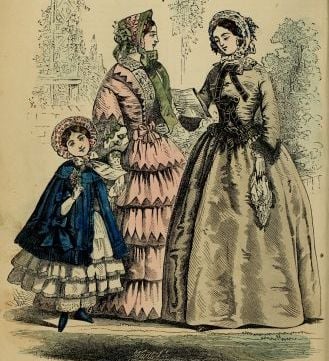
For most of the 19th century, women spent their days in severely restrictive clothing. Even servant class women wore a minimum of four layers of clothing, year-round. A woman’s clothing could weigh up to 40 pounds. It started with the chemise (a slip-type garment which served as a bra) and pantaloons (long underpants with a slit in the middle so a chamber pot could be used without undressing). These were worn under a corset with its corset cover. The hourglass shape was highly desired and no woman would even consider leaving her bedroom in the morning without being tightly laced. Over those went hoops and petticoats, the number depending on current fashion. After all that, the woman dressed in long-sleeved, floor-length dresses depending on her chores for the day.
From Flax to Fabric: Textiles Before Industrialization
The cotton gin was not patented until 1794 so the majority of fabrics used in clothing in the early 1800’s were linens, wools and silks. Fancy printed cloth could be imported from Britain, but its cost was dear. Women were far more likely to spin and weave their cloth using locally grown flax and wool than to purchase cotton from overseas.
Wardrobes for most people were necessarily small, not only because of the time needed to weave the cloth, but also due to the fact all clothing was handmade. Gowns of cotton for everyday, or silk for special occasions, had a full skirt which brushed the floor. This required many yards of fabric and extraordinarily long seams.
However, the idea that all early quilts were made from worn clothing is a myth. Not to say there weren’t any, but it is far more likely that an early 19th century quilt would be made out of fabric bought for that purpose, possibly to match bed curtains. Generally, quilts in the early 1800’s were made by wealthier women on the Eastern Seaboard who had access to a greater variety of fabrics brought in by ship. They could afford manufactured cloth, and they had the leisure to sit and sew something beautiful.
A Day’s Work Was Never Done
Throughout most of the century, women’s clothing severely restricted their activity. Armholes were cut very high, and the tight clothing of the era prevented women from raising their arms above shoulder level. Despite this, women were expected to do an incredible amount of work every day. Starting before dawn and often ending after midnight, women were responsible for all matters pertaining to running the household.
Maintaining the cook stove took a great deal of the 19th century woman’s time. Since the stove had to be kept going all day and all night, it was her responsibility to haul the approximately 50 pounds of fuel necessary for each day’s fire. She cleaned out the ashes every day, too, and kept them for use in outhouses, chamber pots and homemade lye soap.
Washday and the Weight of Housekeeping
Clothing was washed as infrequently as possible. Washing was a long involved process which started with making the soap using lye, lard and ashes, then scrubbing, boiling, rinsing and bluing (a rinse that brightened whites) the clothes in huge outdoor vats of water. Most 19th-century rural homes did not have running water, so the 200 or more gallons of water necessary for washday had to be hand carried by the woman of the household. Clothes were dried by hanging them on lines, over fences, or on bushes.
Dyes were often unreliable and sometimes after washing, clothing had to be re-dyed. In upper class homes, fancy dresses (most likely made of silk) were often taken apart and only the dirty parts washed. The dress could then be remade in a slightly different style so that the woman always had a new dress to wear to the next party.
In addition to maintaining the wood stove and feeding her family, the early 19th century woman was responsible for keeping the home clean. Without the benefit of indoor plumbing, dishes had to be cleaned with water hauled in from the well, then the dirty sink water hauled back out again. This applied to bathing as well. A Saturday night bath was a luxury. Most women made do with a splash from a water pitcher. Cleaning the gas and kerosene lamp chimneys was a daily chore, too. All this while pregnant or caring for small children.
Family Size and Women’s Limited Choices
The only recourse an early 19th century woman had to restrict the size of her family was to avoid sex. It wasn’t until 1827 that science established the existence of woman’s eggs; up to that point the popular theory of reproduction was that the child was formed from sperm grown in the woman’s body. Contraception, therefore, was focused on avoiding that sperm using withdrawal, douches and sponges soaked in spermicide. In 1839, vulcanization was perfected allowing condoms to be created from rubber. Unfortunately, the social mores of the time forbade the use of condoms for birth control. They were only used to prevent men from catching diseases from prostitutes.
There was one method of birth control which women could and often did resort to – abortion. It was a popular method of birth control. Although rigorously protested and often illegal, it was not difficult for a 19th century woman to obtain an abortion. Laws, medical opinion, and social attitudes changed during the century.
So how did a woman assert her individuality? The sad fact is that many did not. The nonstop work required of most women simply to survive took all their time and energy.
The Machine That Changed Everything
The invention and popularization of the mechanized sewing machine was a major work-saving device for 19th century women. Originally invented in the late 1700’s as a tool to make shoes, it was reinvented in 1846 by Elias Howe Jr. when he received U.S. Patent No. 4,750 for a lockstitch sewing machine. Howe’s rival, Isaac Singer, received a patent in 1851 for an improved sewing machine, and later a foot treadle for hands-free operation, and a carrying case which could double as a stand for the machine.
Singer’s primary contribution to sewing machine history, however, were his marketing techniques. An installment plan and a trade-in allowance were included in his clever marketing plan to put a sewing machine in the home of every American woman.
Quilts in Wartime
The Civil War brought a lot of changes to the life of American women. Quilts were often used to communicate the maker’s beliefs, smuggle messages through enemy lines, and raise money for the cause, as in the gunboat quilt raffled to raise money in the South. At least 150,000 quilts were made by the women of the Northern “Sanitary Commission” gathered in local groups, to give to Union troops in the field. Women on both sides made items for soldiers and fundraising fairs. In the North, women worked through local aid societies and the U.S. Sanitary Commission. In the South, some quilts were raffled to raise money for gunboats.
Mourning, Recovery, and a New Palette
Post-Civil War cotton quilts took on more somber aspects. Women had lost their husbands and sons in the war, Queen Victoria lost her husband Prince Albert and strict mourning protocol was followed. Mourning prints (also called shaker or mourning grays) of black and white, grey on grey, burgundy and deep purple were used with the madder browns (copper browns) dark chocolate, cocoa, double pink and chrome oranges (cheddar) of the period. Rich, deep, vivid colors became popular. Quilts became more utilitarian, often tied rather than quilted as women struggled with day-to-day survival.
By 1870, Singer was selling 200,000 sewing machines a year. Godey’s Ladies Book praised the sewing machine as the “queen of inventions,” noting that it would take on the drudgery of sewing so women could spend more time perfecting the beauty of their handwork. Quilts began to take advantage of straight line sewing and it was not uncommon to see a hand-pieced quilt which was machine quilted. A sewing machine was a status symbol. If a woman had one, she made sure to show it off. Frills, flounces, and furbelows started making their appearance even on cotton everyday clothing after Singer’s invention cut dressmaking time down so dramatically.
The Rise of Decorative Needlework
As the 19th century progressed, cloth itself changed the way women made quilts. In the early years, fabric was precious. Good printed cottons were expensive, often imported, and used carefully. A quilt made from new fabric was a sign that the maker had both money and access to desirable cloth. As American textile mills grew and printed cottons became easier to buy, more women could choose fabrics for color, pattern, and design instead of simply making do with what was at hand. Quilts could become brighter, busier, and more varied.
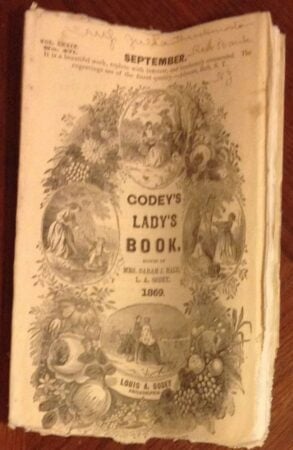
Women’s magazines also helped spread ideas. Publications such as Godey’s Lady’s Book showed women the latest fashions, fancywork, household ideas, and patterns. A woman in a small town or on a farm might not see the newest styles in person, but she could read about them, copy them, or adapt them to what she had. Over time, printed patterns, newspapers, catalogs, and mail-order companies helped quilt designs travel far beyond one family or neighborhood.
Blocks were often shared by friends and family. I have a box of blocks that was sent to a pioneer family. Each block is labeled with family information, such as “made from Aunt Sukie’s apron.”
It is also important to remember that there was no single “19th-century woman’s life.” A wealthy woman on the Eastern Seaboard, a frontier farm wife, an enslaved woman, an immigrant, a mill worker, and a hired servant all lived very different lives. Their access to time, tools, fabric, education, and even personal safety varied greatly. Some women quilted for beauty, some for warmth, some for family, some for an income they could earn from home, and some whenever they could steal a few minutes from housework and chores that never seemed to end.
As life improved, the new middle-class women found themselves with more time to spend on needle arts. Women began to take pride in decorating their home with their own hand work. Redwork became popular. Crazy quilts became a fad. These were quilts made of silk or satin and often carefully embellished with beads, embroidery, commemorative ribbons and hand painted blocks. The coming together of design influences from all over the globe at the 1876 World Exposition in Philadelphia had a pronounced influence on the design of quilts. Many quilts and embroidered designs began to show an oriental influence. “Impractical” silk, satin and velvet quilts were created using traditional styles, like the log cabin.
Women on the Rise
Things were looking up for women at the turn of the 20th century. Women who had been forbidden to enter medical school or law school in 1800 were now permitted to attend and were even admitted to the bar by 1900. Education was no longer considered improper for women. It was no longer unusual to see women wearing a special type of garment long associated with men – the cap and gown. In fact, the teaching profession which had been primarily male in the beginning of the century became mostly female by 1900. By 1900, four states (all in the West) and several other countries had given women the vote. Women mill workers had participated in several successful strikes and were now earning reasonable wages for their 10 hour days. Over three million women were now working for wages outside the home.
Although there was much room for improvement, American women were on their way.
Learn More
Women’s daily life and work
- Susan Strasser, Never Done: A History of American Housework — a full history of the chores this article only sketches, and how industrialization changed them.
- Statistics: The Changing Lives of American Women (Gilder Lehrman Institute) — the marriage-age and household-size data behind this article’s numbers.
Clothing and textiles
- Valerie Steele, The Corset: A Cultural History — a well-regarded, myth-busting look at the garment that shaped 19th century women’s days.
- Woman’s Corset, 1810–1820 (Smithsonian National Museum of American History) — a real corset with construction notes.
The sewing machine
- Elias Howe Issued a Patent for the Sewing Machine (Library of Congress) — the Howe/Singer patent story in more detail than fits here.
Quilts and the Civil War
- Civil War Quilts: Support from the Homefront (World Quilts: The American Story, International Quilt Museum) — more on the Sanitary Commission quilts and how North and South differed.
- Barbara Brackman’s Civil War Quilts blog — ongoing research on wartime quilts.
Mourning and crazy quilts
- My own Victorian Mourning Customs article, for the full story behind the mourning prints and colors mentioned here.
- My own Stitched in Silk and Secrets: The Victorian Crazy Quilt, which goes deeper into the 1876 Centennial’s influence and crazy quilt symbolism.
Dating and identifying antique quilts
- Barbara Brackman, Clues in the Calico: A Guide to Identifying and Dating Antique Quilts — the standard reference for dating heirloom quilts, written by a founding member of the American Quilt Study Group.
Women’s rights and the turn of the century
- Women’s History Milestones: A Timeline of Key Dates — for the suffrage and education gains mentioned.
