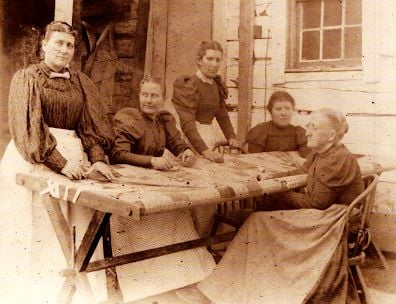
July 30 – August 1, 2004
These restored messages come from the Quilt History List, an online forum where quilt historians, collectors, researchers, appraisers, and enthusiasts discussed antique quilts and related textiles. The archive dates from 1996 through approximately 2016 and is being restored gradually. Sign up in the form at the bottom of the page if you want to know when a new page is added. Original spelling, opinions, formatting, and inactive links may remain unchanged.
Primary topics of this QHL Digest:
- Women’s History in the Classroom — A tangent on teaching women’s history (Grace Murray Hopper, Jeannette Rankin) and whether it needs a separate course. (see the article on textiles and 19th century women)
- Ceiling-Hung Quilting Frames Wrap Up — The multi-day quilting-frame thread winds down with final regional comparisons.
- Everyone’s Top 5 Quilt Books — A popular thread has members naming their five essential quilt-history and quilt-technique books.
- Clutch Quilting Technique Explained — Jocelyn Martin describes and defends “clutch quilting,” a no-hoop, no-frame hand-quilting method.
From: Margareta.Faustcec.eu.int
Thanks for the answers and links, Kim and Holice. I for one would be interested in more info, Holice! To answer Kerry: I bought the stamps last Saturday in London, in what is probably one of the biggest shops in that sector, Stanley Gibbons (on The Strand) http://www.stanleygibbons.com/ They were only A31.40 ($2-3?) per block. Here’s a link I found that describes the Amish stamps pretty well ,I
think: http://www.amishacres.com/aa_special_events/amish_quilt_stamps/about_the_stamps.htm
I agree with Kim that stamps with textile motifs are fun. I would advise people to look among the Eastern European countries (Hungary, Poland etc) as they during the communist era were keen to promote folk art – you’ll find many examples of folk costumes, embroidery and lace on their stamps.
I’vealso been lucky to find a prepackaged set of stamps with textile themes in a museum shop in Montreal!
Have a great weekend, everyone Margareta getting boiled in Luxembourg office
Date: Fri, 30 Jul 04 08:38:40 EDT | From: Midnitelaptop@
here’s a course being offered at a college: jeanL
HIS 131: Women in American History Who were these women? What is the history of their lives? How did they help shape the United States as we know it? Did you know:
,000 women participated in the American Revolution. Many were mustered out and received pensions for their military work. Prior to the establishment of colonies in the East and the opening of
the American West, Native American women were the primary negotiators, tradespeople, translators for their tribes. Female slaves wove symbols of resistance into their patchwork and quilts.
Readings provide inquiries into such issues as, women’s roles in organized movements: religious, reform (labor, welfare, birth control), family (child care), resistance (abolition), unions, education, political (League of Women Voters), health, the arts among others.
Women studied include: Anne Hutchinson (religious leader), Sarah Winnemucca (tribal leader), Sojourner Truth (resistance leader), Elinore Pruitt Stewart (Wyoming letter writer), Anita Hill (lawyer), Barbara Boxer (political leader), Lucretia Mott (abolitionist), Emma Lazarus (essayist, poet), Clara Shavelson (union organizer), Maya Lin (artist), Deloras Huerta (United Farm Workers), Carolyn Innes (gay and health activist) among others.
Women in American History is offered every year, both day and evening.
From: Judy Schwender <sister3603@>
Too bad Jeanette Rankin isn’t on the list. She was the first woman elected to the House of Representatives (from Montana) and, a pacifist, was the only house member to vote against declaring war against Japan. She is a very interesting study.
Midnitelaptop@ wrote:
here’s a course being offered at a college: jeanL
HIS 131: Women in American History Who were these women? What is the history of their lives? How did they help shape the United States as we know it? Did you know:
,000 women participated in the American Revolution. Many were mustered out and received pensions for their military work. Prior to the establishment of colonies in the East and the opening of
the American West, Native American women were the primary negotiators, tradespeople, translators for their tribes. Female slaves wove symbols of resistance into their patchwork and quilts.
Readings provide inquiries into such issues as, women’s roles in organized movements: religious, reform (labor, welfare, birth control), family (child care), resistance (abolition), unions, education, political (League of Women Voters), health, the arts among others.
Women studied include: Anne Hutchinson (religious leader), Sarah Winnemucca (tribal leader), Sojourner Truth (resistance leader), Elinore Pruitt Stewart (Wyoming letter writer), Anita Hill (lawyer), Barbara Boxer (political leader), Lucretia Mott (abolitionist), Emma Lazarus (essayist, poet), Clara Shavelson (union organizer), Maya Lin (artist), Deloras Huerta (United Farm Workers), Carolyn Innes (gay and health activist) among others.
Women in American History is offered every year, both day and evening.
Date: Fri, 30 Jul 04 09:12:25 -0500 | From: Gail Ingram <gingram@>
> > Readings provide inquiries into such issues as, women’s roles in organized > movements: religious, reform (labor, welfare, birth control), family (child > care), resistance (abolition), unions, education, political (League
I apologize in advance if my observation seems contentious to some. It is not intended to be contention, only to raise some questions that I think need to be considered when one considers “women’s studies. One of my own concerns about many women studies courses is reflected in the list above.
Why, for instance Anita Hill and not Sandra Day O’Connor, the first woman to sit on the Supreme Court bench?
Why Emma Lazarus, whose lines grace the Statue of Liberty but whose work on the whole is unremarkable and not Eudora Welty, Willa Cather, Toni Morrison, or, for heaven’s sake, Emily Dickinson, whose poetry towers and was rejected in her own time, only to be discovered in a new century?
Why Barbara Boxer and not Claire Booth Luce, Jean Kirkpatrick, or some of those western women governors who ran political shows that were often unrunnable?
And where is Abigail Adams, one of the most articulate and influential women of the colonial and early federal period, who, when her husband was helping devise a new form of government, reminded him—respectfully but very seriously—“Remember the ladies”?
Clara Barton? The young woman who helped guide Lewis & Clark (you’re right: I can’t spell her name)? Marian Anderson? Scholars like Patricia Limerick who dignified and deepened the study of women’s roles in American history? Mothers who reared all these women, modeling the courage and independence of mind their daughters showed on later stages?
Indeed, all the women who were and are the hearts of the American home, the basis for all public life? Surely one could find representatives (the mother of Dwight Eisenhower? Ronald Reagan? Martin Luther King? Marian Anderson? Richard Rodriguez? et al).
And what about Electra Webb and others like her, who saw the value of preserving the material culture of everyday homelife for future generations? Or, for that matter, the Carrie Halls and Barbara Brackmans?
Many women’s study curricula are grounded in the criteria of open and negative resistance; the primacy of public performance; and opposition to tradition. The list above suggests as much, though it is selective and one cannot know with certainty the scope of the particular program—-but representative examples are usually chosen for such lists.
Everything we’ve learned about the human brain in the last 15 years, when functional brain scans have provided a burst of new information, indicate that women tend to act diplomatically, cooperatively, rather than through open and publishable resistance. They are very poor, in general, in hitting the strike zone in baseball, but very good in bringing about change through positive, quieter means. Personally, I think any course devoted to the study of women’s roles in our history must incorporate that knowledge, which will change the focus of many curricula.
If women become uncritical judges of their own lives and history, they will not do justice to themselves.
Long way of hoping out loud that we, who also deal with material culture of the home, keep a critical eye on all myths, whether they are constructed by someone wanting an interesting lesson plan or speech or by a university department.
From North LA, where the day dawns dark and school starts in 10 days, Gail Ingram
From: Judy Schwender <sister3603@>
…or Grace Murray Hopper, who developed COBOL computer language. For more about her go to:
http://www.ideafinder.com/history/inventors/hopper.htm
From: Barbara Woodford <haq@>
Somewhere I read that those that tried treadle machine quilting sometimes had frames made up near the ceiling to hold the remainder of the quilt away from the machine. Makes sense to me.
Barbara Woodford
From: Midnitelaptop@
did anyone read the line in my original post about this course?
Female slaves wove symbols of resistance into their patchwork and quilts.
jeanL
From: “Kathy Moore” <KathyMooreneb.@>
Since everyone else is weighing in on what they remember, I will too.
Once in the early 1960s as I was making the rounds of my neighborhood
selling candy for my high school marching squad, I knocked on the door of a complete stranger and the door was met by a sweet little old lady who had a quilt frame suspended from the ceiling. She had been at work on the quilt when I knocked so it was in the lowered position. I had never seen anything like that then and I haven’t since, but I was fascinated by it. I asked her what it was and she told me it was a quilting frame. What a revelation. Nobody in my family quilted so it was new to me. The memory has never gone away.
Her house was new at the time I met her and the ceiling was not a high one. I think she lived alone and since she was short and slightly bent over, I guess it wasn’t a problem for her to walk under the quilt frame when she had it raised.
My only question is, and I’ve wondered this all these years, if the frame is suspended from the ceiling, how do you keep the frame from moving away from you when you try to quilt? In other words, how to you stabilize it so it stands still while you work?
Inquiring minds want to know!
Kathy Moore
Date: Fri, 30 Jul 04 13:40:00 -0400 | From: Barb Garrett <bgarrett421@>
Hi Jean –
I think of what I do when quilting my doll quilts as “clutch quilting” — I clutch the quilt in my left hand and needle with my right. Advantages — no hoop gets in my way, and I can quilt in any direction, always quilting right to left, just turning the quilt and grabbing a different part. Because the quilt isn’t held taut, I can flex the fabric onto the needle in the same motion as I’m pushing the needle thru the fabric. I don’t know if you can picture that — but it works for me. The one time I did it on a large quilt was a flannel log cabin.
The center square was a 5 1/2″ flower motif — by Marcus Brothers — and then there were 3 logs on each side around the flower. The logs were quilted in the ditch using a frame. I then pin based the flowers flat (I’m impatient and don’t thread baste) and outline quilted around the
flower motifs, which reminded me of crazy quilt embroidery flowers.
It worked great. I used chocolate brown thread on beige background, so
I knew I needed small even stitches, which I would not get using a frame.
I looked up the verb clutch in an on-line dictionary and it says —
To grasp and hold tightly. Also — To take firmly with the hand and maintain a hold on: That describes what my left hand is doing — grasping the quilt.
Barb in southeastern PA
From: Gail Ingram <gingram@>
In a really lovely “picture book” about Louisiana, titled “Louisiana:
A Land Apart” by Phillip Gould ( ISBN# 0-917541-01-4; available from abebooks) there is a photograph of Mrs. Minnie Lee Graves quilting in her “parlor” on a ceiling-hung frame.
Beginning with my third quilt, Miss Minnie Lee quilted the quilt tops
I made, right up to the time of her death in 1984. She had mastectomies
and returned to quilting. She lost a husband and returned to quilting.
She had no children, only nephews whom she adored, and she quilted “for the public” ostensibly for pin money, though when I knew her, her land sat atop one of the richest oil and gas veins in this part of the country and she had considerable wealth. I don’t think she ever fully realized it, though, for in the last year of her life, she discovered an old doll of hers and saw a velvet dress at Wal-Mart which she wanted for it. Yet she was “flabbergasted” at the cost—$9.00 in 1983. “That’s highway robbery,” she told me. I offered to make her a dress from the period. Nope: the one
she had seen was perfect but would have to remain perfect at Wal-Mart. So
I, who had no oil and gas under my 3 acres, trotted off to Wal-Mart and bought the dress. It gave her such joy. In all the years she quilted for me and saw my children born and growing, that was the only thing I was really able to give her in return for her wisdom, affection, and friendship—all of which were included in the cost of her quilting. Each spring, bulbs from her garden brighten mine, just as the memory of her does as I type this.
Mrs. Graves lived in Hico, a small community north of Ruston, in North Louisiana.
Gail Inram
From: Gail Ingram <gingram@>
I got the point about symbology, but I thought the bigger issue was the shoddy scholarship of such “women’s history” courses. It reveals the uncritical habit of mind of whoever planned the course. As women, we are more likely to be heard than men, and we should not let ourselves be misrepresented in these courses. We should address the dept chairperson, sending copies to university officials. At least let the university know the public is aware of what goes on there and expects high calibre scholarship.
Last year, my husband, a historian, absolutely could not persuade the
young woman who taught the women’s history course that the QUILT UGRR was undocumented and unlikely. Brackman, Dobard, et al meant nothing to her—white woman (the teacher herself was white) and “Uncle Tom” black man: couldn’t trust either. When he resorted to methods of documentation, addressing the issue of hearsay evidence, amount and kind of evidence, etc, she suspended the usual rules of evidence. When he asked if she would
permit him to join her in a debate on the issue for part of a class, as a way of showing two sides of an issue and promoting critical thought, she refused. When he asked if he might post on the bulletin board outside her ofice, Dobard’s article and information from Kim Wulfert’s www page, she refused.
I would like to think this young woman was atypical, but she is not, as the course description for the course listed suggests.
gi
From: Midnitelaptop@
i have the amazing good fortune to live just around the corner from emily’s house and about 4 blocks away from the little cemetery where she was buried….every year on her birthday a group meets at her house and walks to the cemetery… our guild had a quilt challenge regarding emily…and a wallhanging quilt of mine.. dedicated to her… won a second place ribbon…. i often visit her garden and think about this wonderful poet/woman….she is one of my all time favorites…i have pressed many flowers and leaves
in the pages of a book of her complete poems… jeanL
From: “Roberta” <rlandercei.net>
Hi all, I very seldom post, as most of the time I have only time to read the posts that interest me. But, I couldn’t pass by this topic. I live in Arkansas, and it has been my experience that usually if the frame was in a place with a lot of traffic or many people living in the house, the frames were suspended from the ceiling. If they were used occasionally, they were put between ladder back chairs. It took years for me to figure out what wore the grooves in the backs of my ladderback chairs that had been inherited from my husband’s grandmother. Here it seems that most ceilings are 12′ if they were built before central heat and air became available. Now, in the newer homes they are eight. You have to keep in mind that heat rises, and we have many more hot days than cold, and that is why most ceilings are 12′.
Roberta Anderson
From: KatieDidQuilts@
This is the method I use on all size quilts from pillow top to king — just as Barb described. I pin baste and smooth as I work. I get 18 – 22 stitches to the inch & rarely have a problem with puckering. It was called lap quilting when I was taught but I do “clutch ” the fabric with my left hand & needle with my right. Some desciptions for lap quilting use a hoop or small frame but I found this to be too awkward. I work on my kitchen table or on a sewing/work table & can take it with me if I need it to be portable. My mother & grandmother both used the 2×4 over the dining room chair frames but I’ve never had the luxury of that much space. It’s nice to hear someone else does the same method —- Kate from South Dakota
From: “J. G. Row” <JudyGrow@>
See there Gail! You’ve gone and done it again: complete thoughts, fully expressed and well and wittily written. You ought to teach English composititon somewhere! ( ;>}
Judy Ringo judygrow@
> > Many women’s study curricula are grounded in the criteria of open and > negative resistance; the primacy of public performance; and opposition to > tradition. The list above suggests as much, though it is selective and one > cannot know with certainty the scope of the particular program—-but > representative examples are usually chosen for such lists. > > Everything we’ve learned about the human brain in the last 15 years, when > functional brain scans have provided a burst of new information, indicate > that women tend to act diplomatically, cooperatively, rather than through > open and publishable resistance. They are very poor, in general, in hitting > the strike zone in baseball, but very good in bringing about change through > positive, quieter means. Personally, I think any course devoted to the study > of women’s roles in our history must incorporate that knowledge, which will > change the focus of many curricula. >
From: “Patchwork Secrets” <patchworksecrets2@>
If you could only have 5 books concerning quilts on your shelf, don’t
gasp I did say IF…lol…,what 5 books would they be?
Sharon in NC
http://home.earthlink.net/~patchworksecrets/patchworksecretsquiltpatterns/index.html
From: Donald Beld <donbeld@>
I want to thank all of you who bought raffle tickets for the wonderful Civil War reproduction fabrics quilt that I was raffling for a second time, in the tradition of Gunboat Ladies Raffle quilts from the Confederacy during the Civil War, after winning it last November.
As I have said earlier, I hoped to raise at least $00 to be split between my quilt guild’s primary charity–Option House, a battered women’s shelter; and the North Cities Quilt Guild’s charity in Placentia, Ca that originally raffled the quilt–HIS House, a homeless shelter. I sold all 500 tickets and raised a total of $2,250.00. I paid all the ticket costs, etc., myself so all of that money is going to the charities.
The winner was drawn this morning at my guild and was JO KERRIGAN, of
Rancho Pales Verdes, Ca. I do not know who she is, but think she bought her winning ticket at one of my many trips to Southern California guilds to sell chances.
Thanks, again, to you all. Don Beld
From: “Kathy Moore” <KathyMooreneb.@>
For what it’s worth, I’ve stumbled across a book review of a book on the women’s club movement in the Pacific Northwest: Organized Womanhood:
Cultural Politics in the Pacific Northwest, 1840-19 by Sandra Haarsager (Norman, Oklahoma: University of Oklahoma Press, 1997). It
looks to have many answers to questions you all have had. Participation by women leaders from the East coast is mentioned in the book review.
I’d be willing to bet it has a good bibliography for further research.
Kathy Moore
From: “Laurette Carroll” <rl.carroll@>
My top 5… Orlofsky’s Quilts in America Brackman’s Clues in the Calico and her Encyclopedia of Pieced Quilt Patterns Kiracofe’s The American Quilt Montgomery’s Printed Textiles
> If you could only have 5 books concerning quilts on your shelf, don’t gasp I did say > IF…lol…,what 5 books would they be? > > Sharon in NC >
Subject: Re: top 5 books? From: “Karen” <charter.net>
Top five? *sob* That’s way too few…but here’s my list:
1. Quilting, Colby 2. The American Quilt, Kiracofe. 3. America’s Quilts and Coverlets, Safford & Bishop. 4. Quilts of the British Isles, Rae. 5. Clues in the Calico, Brackman.
And for a bonus choice, either Homage to Amanda or America’s Glorious Quilts.
*sobs as she thinks of the other 65 she had to leave off the list….*
Karen Evans
From: “Kathy Moore” <KathyMooreneb.@>
Good start, Laurette. It’s pretty darn close to my top five, only I can’t stop with 5. There are too many other good ones out there. For
starters, I’d also add Jonathan Holstein’s book on the pieced quilt. I was just reading Orlofsky’s an hour or so ago. It is really a gem of a book! And I don’t see the book, Calico and Chintz. It’s a must have and has recently been reprinted.
Kathy Moore
From: <kerrybrack@>
holice how lucky! i would love to hear more!!!!! kerry – who was lucky to fly to melbourne for the day to see the quilt show in jeffs shed. waiting for my plane back to sydney tonight. x
But if anyone is interested I’ll write up all
From: Kathie Holland <kathieholland@>
Holice, I would also like to hear more! thanks for writing this up for all of us to read. Kathie in NJ
From: Judy Kelius <quilts@>
At 10:57 PM 7/30/04, you wrote: >If you could only have 5 books concerning quilts on your shelf, don’t gasp >I did say >IF…lol…,what 5 books would they be? > >Sharon in NC
If someone told me I had to get rid of everything but 5, I would cry and scream and threaten suicide, but these are probably the ones I would keep (obviously influenced by my preference for Pennsylvania quilts):
Kiracofe – The American Quilt (and couldn’t I include his “Cloth and Comfort” gem and count it as one?) Brackman – Clues in the Calico Herr – Quilting Traditions (Lancaster County Quilts) Roan – Lest I Shall Be Forgotten (SE PA quilts) Quiltmaking in America (AQSG papers)
So I guess these are the ones that will go to the old age home with me <GR>!
Date: Sat, 31 Jul 04 10:08:24 EDT | From: Midnitelaptop@
i have a “first day of issue” envelope with a 4 basket quilt stamp block …postmarked March 8 , 1978….from Charleston, west virginia…..the logo and address on the left side of the envelope is: science and culture center charleston, west virginia…wonder if some stamp/quilt collector might go to ebay and bid on it? but, i’ll probably just leave it and my first edition books as a legacy.. jeanL
Date: Sat, 31 Jul 04 10:27:23 -0400 | From: munsey@
My vote if I could have only 5 books (large groan here) —
Brackman, Encyclopedia of Pieced Quilt PatternsMontgomery, Printed Textiles Ruth Finley, Old Patchwork Quilts – the how to do’s are stillrelevant even if some of the history is heavy on mythologyAveril Colby, Quilting – still the best about both the history andhow-to’s of the art and mechanics of quilting; after all, Americanquilting didn’t arise in a vacuum but owes it’s existence to the Britishantecedent. (Those of you with questions about quilt basting and old quilting frames can find answers in Colby, too.)
Battle for 5th spot is still raging in my mind between Orlofsky, Quiltsin America; Colby, Patchwork; Holstein, The Pieced Quilt, and Kiracofe,The American Quilt. (I shudder to think what it would be like if I really had to choose!) However, Kiracofe is rising above Orlofsky because it addresses the current quilt revival and benefits from more recent information. Although I don’t like leaving Holstein behind. .
. . . . Or Harding, Red and White . . . . . Or . . . Well, you know.
So there you have it – my combination of books to keep my fingers busy stitching and my mind occupied contemplating the past and future art and history.
Sandra on Cape Cod
From: Patricia L Cummings <quiltersmuse@>
Kathy Moore wrote:
I’ve stumbled across a book review of a book on the women’s club movement in the Pacific Northwest: Organized Womanhood: Cultural Politics in the Pacific Northwest, 1840-19 by Sandra Haarsager (Norman, Oklahoma: University of Oklahoma Press, 1997).
* * * * * Thanks, Kathy. In checking amazon.com this morning, I see that there are a number of copies available.
Pat
From: “Teddy Pruett” <aprayzer@>
I want yall to know that I am keeping a list of your answers concerning ceiling hung frames. SO far, there have only been one or two that did not appear in the deep south. I just hate it when info like that skews my theory!
Kathy M, I know you are in Nebraska now, but you did not state where you were when you visited the lady with the ceiling frames. From your accent, I do not think it was Nebraska. Please let me know so I can add the locaiton to my list. I hardly delude myself that this is scholarly research, but it is certainly answering my question, and has opened an interesting dialogue.
Gail, my cherished friend, you must remember that a college class is only so long, and we cannot possibly discuss every notable, productive, powerful woman in American History, more’s the pity. Perhaps the answer is to take a LOT of classes, thereby increasing one’s exposure. Teddy
From: Gail Ingram <gingram@>
> Gail, my cherished friend, you must remember that a college class is only so > long, and we cannot possibly discuss every notable, productive, powerful > woman in American History, more’s the pity. Perhaps the answer is
to ta ke > a LOT of classes, thereby increasing one’s exposure. Teddy
Yes, Teddy deah, it is with great gratitude I know that a college course is only so long and that choices must be made.
I question the criteria on which those particular choices were made. I believe they are false and pc skewed, still driven by the false assumptions of late th-century women’s movement that male behaviors are the standard s by which “success” must be judged in women, that differences in male and female behavior are results of environment, not physiology. We know a
lot more about the human brain now and know that is not true. But unfortunately , most curricula do not reflect the new knowledge.
To include Emma Lazarus and not Emily Dickinson or Eudora Welty or Toni Morrison, Anita Hill and not Sandra Day O’Connor, and to leave out Abigail Adams, a woman whose power was so great it has yet to be fully understood—well, in my humble view, that course isn’t worth the paper plate it’s served on.
I would like to believe that Martha Stewart was prosecuted because she was high-profile and violated a much-violated law, that the courts determined t o prove they would prosecute anyone, no matter how powerful, who violated tha t law. But something in me tells me Martha would be out in her garden now had she been the president of a carburetor manufacturing firm, had she not been the doyen of homemaking. Hillary Clinton’s condescending remark that
she would not be home baking cookies says a lot about the values fostered
by parts of the women’s movement of the late 29th century: making a home is outrE9, dull, non-creative, something one does when she lacks the intelligence or means to do anything else; being aggresive in typically mal e ways and places is what successful folks must do.
I do not believe history supports the validity of such an assumption. The home is the cornerstone of any civilized society. It is the place where values are modeled, love and confidence instilled, coping skills taught, an d the means of cooperation in a group inculcated.
Somewhere in that list should have been some mamas like Dwight Eisenhower’ s who reared five successful, good sons, all of whom went on to do the same thing. Looking at the little house in which she accomplished that feat is humbling to me. Or like Sandra Day O’Connor’s or Emily Dickinson’s mothers . Think of Dickinson: her poetry was treated with such shattering condescension that she gave up trying to get it published. And yet she wrot e and wrote and wrote; revised (sometimes 25 times for a single poem), revised, revised. something in her would not let her accept the false standards of the particular era in which she lived. That kind of confidence comes from homes, and homes are most naturally made by the people most physiologically and psychologically equipped to make them—women.
Yes, it was a single course, perhaps an introductory course. Thus, it
is even more important to focus on the most powerful examples of women who hav e achieved their potential. And it is critically important it include the relatively new information on the unique aspects of the female brain and thus psychology.
Samuel Johnson once was invited to hear a Quaker woman preacher. He declined, saying something to this effect: “A woman preaching is like
a dog walking on its hind legs: it isn’t that it does it well; it’s just that it can do it at all.”
Despite his condescending manner, Johnson was onto something, I think. To judge women’s achievements exclusively by the standards used to judge
male achievement is to proceed from false assumptions and end up with a course like the one Jean called to our attention.
For most of my adult life I’ve worked in a public context. I’ve understood the necessity to produce good results, whether in research, writing pr, teaching, or chairing a symphony board. But I think whatever success I’ve had in jobs has come from my using skills and approaches quite different from my male counterparts’ skills. And that is what biological research indicates is true.
I don’t think women have been critical enough of the courses devoted to their history. Perhaps we are just so glad to be included in history that we’ll take anything at all, no matter how flawed. But as women, we have a unique power to incorporate information from different sources and areas of the brain. It gives women an edge in critical thinking. I just think we should use that edge.
Stepping down from the pulpit, Gail
Date: Sat, 31 Jul 04 13:35:00 -0400 | From: Patricia L Cummings <quiltersmuse@>
Gail Ingram said:
I don’t think women have been critical enough of the courses devoted to their history. Perhaps we are just so glad to be included in history that we’ll take anything at all, no matter how flawed. But as women, we have a unique power to incorporate information from different sources and areas of the brain. It gives women an edge in critical thinking. I just think we should use that edge.
Stepping down from the pulpit,
Gail * * * * * *
Dear Gail:
I repeated the whole paragraph above, in its entirety, because it is worth saying a second time!
Thank you for sharing your thoughts on this list. Your ideas often reflect your own adept critical thinking skills.
As always, knowledge equals power. In the case of the “weaker sex”, we need to empower ourselves in our own lives to be the best that we can be.
Pat
Date: Sat, 31 Jul 04 00:58:31 -0700 | From: “Judy Anne” <anne_j@>
5 books that would sustain me, books I love.
Remember Me: Women and Their Friendship Quilts
America From the Heart: Quilters Remember September 11, 01
For Purpose and Pleasure: Quilting Together in Nineteenth-Century America
The Quilters: Women and Domestic Art : An Oral History
Treasures in the Trunk: Quilts of the Oregon Trail
Judy Anne
America’s Quilting History http://womenfolk.com/historyofquilts
From: “Lucinda Cawley” <lrcawley@>
If the quilting frame is hanging from the ceiling doesn’t it sway
as people quilt on it? Cinda on the Eastern Shore
From: Gail Ingram <gingram@>
The ones I’ve seen do not “sway” unless the quilter wants them to. Naturally they have a good deal of “give,” but remain steady while work is going on. I have, however, seen at least one ceiling fram steadied on chair tops.
gi
From: Jocelyn Martin <jocelynm@>
>>If women become uncritical judges of their own lives and history, they will not do justice to themselves.
The early women’s movement focused on proving that women could do things as well as a man. It’s high time we start looking for things that traditionally women do better than men, and focus on them.
If we only study- or praise- those women who distinguish themselves by adopting the force-based male paradigm, we’re once again saying that male is better than female, that force is better than cooperation, nurturing and care-giving, that if you’re rich enough, you deserve to have your every whim met but if you’re poor you don’t deserve food and shelter.
By all means, study the women who competed on the same fields against
men and distinguished themselves- but let’s not neglect the women who decided that they didn’t want to, didn’t have to, and had more of a contribution to make elsewhere.
And let’s not perpetuate myths, either, because they’re comforting, because they fit nicely with what we’d like to believe, or because we’re too danged lazy to learn the truth. I’m re-reading HIPV, and I find myself astounded at how often questions are used, a la ‘Could it be that….?’ When the correct answer is ‘Yes, it could, but it’s far more likely it’s not.’
I’m trying to make some sort of sense of the idea of the patriarchy paradigm and the UGRR myths, but it seems to just be right there on the tip of
my brain, but no closer. Perhaps tomorrow, or perhaps someone else has seen the connection?
Date: Sat, 31 Jul 04 23:37:55 -0500 | From: “Jocelyn Martin” <jocelynm@>
>>I think of what I do when quilting my doll quilts as “clutch quilting” — I clutch the quilt in my left hand and needle with my right. Advantages — no hoop gets in my way, and I can quilt in any direction, always quilting right to left, just turning the quilt and grabbing a different part. Because the quilt isn’t held taut, I can flex the fabric onto the needle in the same motion as I’m pushing the needle thru the fabric.
Barb, That’s precisely how I quilt. I can use a hoop/Qsnap, but I cannot use a traditional frame where the work is held parallel to the floor. If I’m using a hoop, I hold it closer to vertical than horizontal, but since I’ve ‘discovered’ your ‘clutch’ method, I haven’t used a hoop. My stitches
are MUCH smaller if I’m manipulating the fabric with my left hand and needling with my right.
From: “khicks1” <khicks1@>
What an interesting question! What would be my top 5 quilt books – if forced to select only 5? I would want to select books that speak to the quilters themselves – their passion and joy of quilting – rather than
the mechanics of quilting. I would want books that talk about the living history of quilts, the legacy that quilters leave their families and communities with through their quiltmaking. So, my selection would be:
1. Always There: The African-American Presence in American Quilts by
Cuesta Benberry (1992).
2. My Quilts and Me: The Diary of an American Quilter by Nora Ezell
(1999). What a wonderful daily record of how one quilter creates her
unique story quilts, how she values her time and talent, how she determines the monetary value of her quilts, and how she incorporates
her life story into her pieces of cotton and threads. A must read!
3. A Communion of the Spirits: African American Quilters, Preservers, and Their Stories by Roland Freeman (1997). Who wouldn’t want to sew
with any one of the quilters interviewed from 38 different US states?
4. Spirit of the Cloth: Contemporary African American Quilts by Carolyn Mazloomi (1998). Glorious quilts – many one would never find a pattern to replicate.
5. We Flew Over the Bridge: The Memoirs of Faith Ringgold by Faith Ringgold (1995). I love learning how Mrs. Ringgold develops into a quilter – how she takes her incredible talents as a painter and transfers them to fabric. I like how she not only makes her quilts (collaborated with her mother), but also how she presents them in gallery, museum, classroom, and book form. Faith Ringgold even self-published a book on one of her quilt collections!
These are the books currently on my shelf – and racing out of the house with me in case of fire!
Kyra Hicks Author, Black Threads: An African American Quilting Sourcebook ——_NextPart_000_0011_01C4779C.0932–
Date: Sun, 01 Aug 04 08:57:45 -0500 | From: Gail Ingram <gingram@>
> From: “Jocelyn Martin” <jocelynm@> > > If we only study- or praise- those women who distinguish themselves
by > adopting the force-based male paradigm, we’re once again saying that male is > better than female, that force is better than cooperation, nurturing and > care-giving, that if you’re rich enough, you deserve to have your every whim > met but if you’re poor you don’t deserve food and shelter. > > By all means, study the women who competed on the same fields against men > and distinguished themselves- but let’s not neglect the women who decided > that they didn’t want to, didn’t have to, and had more of a contribution to > make elsewhere.
Personally, I believe parents should inform themselves about the critical differences in brain structure and processing in male and female children. And we should insist that our educational institutions incorporate current information about the brain in teacher training programs and in school science curricula.
It is revelatory, for instance, to watch the functional brain imaging as an adolescent male and adolescent female of similar intelligence and developmental levels try to hit the strike zone with a baseball. In the male brain, a single lobe lights up up like Yankee Stadium with only random lights flashing in the other lobe. The female brain, on the other hand has less intensity in the same lobe, but it is transferring information back and forth between the two brain lobes, partly because it is constructed to make that transfer more readily possible, with a large “transit” cord. Lots of lights on one side, a good many on other—-which permits synthesis.
The same thing may be seen when these two representative youngsters approach a problem in solid geometry or deal with a problem involving human relationships. Or, as TIME magazine showed last in an issue last winter or spring, when the stimulus is sexual. Male brain lights up in areas associated with physical gratification, female brain lights up both there and in other lobe in areas associated with emotions, social connections, etc. (Anyone surprised?)
The fundamental implication is clear: males and females process information in critically different ways, ways that make each naturally more likely to succeed in certain kinds of tasks or to approach tasks in different ways.
That does not mean women cannot hold and use power. They have done that for centuries. It just means they will approach problems inherent in using power differently. Everyone, male and female, needs to understand and use this knowledge of differences. It would appear the two are complementary, not contradictory.
As helpful as the recent Women’s Movement was, we might someday discover it created serious problems in the social framework, possibly because it
was grounded in false ideas about men and women. When I began studying how to teach intellectually gifted students years ago, I learned many things that have been discredited by more recent research into the nature of
the brain. Those texts are outdated, but some of them are still in use in
the few education schools who even acknowledge the importance of adapting teaching techniqus to the ability of the learner.
In an era when our homes are crumbling, we might aexamine how well served women were by changes in the legal system such as those involving divorce. No-fault divorce laws might work fine for the career couple who will have no children. But what about the 39-year-old mother with three children who has chosen to stay home to rear children and make a home? We all know the statistics there.
Had there been more critical questions asked in the ’70’s and ’80’s,
the movement might have had better long-term results. We are still to close to know all of those, but a flawed base of assumptions is likely to produce a flawed product.
When I hear my students talk, they all assume the average woman “has to” work when children are young. I find myself wondering, thinking about my parents’ generation, even my own generation. Maybe we only “have to” if we are unwilling to defer material pleasures until children are older. Such conclusions sometimes make me wonder if we’re really given our daughters more options or fewer.
Questioning assumptions is critical in nearly everything except religion, where faith is the appropriate starting point.
from the mother of a daughter who is an investment banker with MBA, Gail
From: “sue reich” <suereich@>
First. Why, oh why, do we need a separate history course about women? Their contributions to history should be told at the same time any history is told. In Connecticut, the libraries, historical societies, and museum are filled with books about Connecticut history. The history is all about the men. If you need to research the women, you can only find them in reference to their husbands or their fathers. Yes, the books tell about all the great wars and industries but the women of Connecticut took part in those big events also. Therefore, I would like to recommend a few additional women to study in the “history course of our dreams.” These are women I worship. I can connect with them because they had everyday lives. Yet, when the call came, they rose to greatness and made a legitimate, albeit quieter contributions to history. 1. Ruth Benton Thompson, (1742-1813), a sheep farm wife from Goshen, Connecticut. She gave up nearly all of her family’s supply of linen and quilts to the Revolutionary War effort. This was a big deal, since she made every last thread and stitch of each item. Her grandson spoke in oratory at the Goshen Church about her contribution years later. He recalled the great sacrifice this really represented to his hard working grandmother. 2. How about Ann Ingersoll Brush! She went from Greenwich, CT. to Indiana shortly after her marriage to make a new life with her husband. They
rose quickly in economic and political stature. He was a part of Indiana’s first legislature. Unfortunately, he died just before the birth of their 8th child. This forced Ann to sell the farm to pay their debts and return to Connecticut before the winter of 1826. Ann was between 6 and 8 months pregnant for the wagon trip back to Connecticut with all of her children. When she returned she had to divvy-up her children amongst the relatives. They no longer lived together again as a family. 3. Henrietta Frances Edwards Whitney was also left with the care of for young children when her husband died just eight short years after their marriage. She is better known as Mrs. Eli Whitney. Their real fortune was made in the Connecticut Armory business. The continued success of the business fell to Frances until her young son, only three, could assume the responsibility. 4. Sarah Lewis was the founder of the Sunday School in Greenwich, Connecticut. Through this organization, she dedicated her life to the teaching of her Congregationalist religion and raising monies for ABCFM missions around the world. 5. I would also recommend the Benevolent Societies of the nineteenth
and early twentieth centuries. Here in Connecticut, they work tirelessly
to pack barrels for mission, soldiers, insane asylums, old soldier’s home, the less fortunate in their own communities, privies, and additions to their churches. Let’s not forget their efforts. 6. Add to the list The Beecher sisters, Frances Willard, Prudence Crandall. These women came from the same modest beginnings that we all have and
their positive contributions to society and American history is legend. sue reich, in sweltering Connecticut. The “dog days of summer” remind me just why I could never live south of the Mason Dixon line.
Date: Sun, 1 Aug 04 11:18:28 -0500 | From: “Charlotte Bull” <charlou@>
Could we make TWO lists of favorites? List # 1: For History and Inspiration List # 2: For Making Quilts
Thus I could include Brackman’s Encyclopedia of Blocks in List # 2 and have room for both Orlofsky and Kiracofe in List # 1. Or, better yet,
3 Lists! #1 for historically inspiring pictures & history, #2 for Actual How to Do It, and #3 for the Earlier Published, older books such as Finley! Then if we added # 4 for the best Regional Studies of Specific Traditions we could zero in on our own preferred area such as Amish, or Kansas City Star, or Pioneer/Settlers.
See, Now we can own books and that would not be too many to take to the Nursing Home!!! Oh yes, List #5 could be How-to Books with CDs!!! or DVDs on Restoration!and Dear Jane blocks!
Then in each of 5 Lists I’d have a Top ONE. Just in case I had to cut to the limit i.e. The Top Five that go in my coffin with me!
By the way, a very dear friend actually was buried with her BEST effort – her final quilt! – which was a Baltimore Album Beauty!!! We all cried at their passing! (Does that start another series of comments? Sorry! It just popped up in my memory as a very sad departure! I’d prefer that my favorite quilt, one that I made, just be displayed and then donated to my guild as a Fund Raiser Raffle Quilt! My best collectible antique quilt will go to a museum.) Now how did I get to such a macabre topic? Must be a Bad Pain Day.
From: “Kathy Moore” <KathyMooreneb.@>
Teddy, I am so sorry. I forgot to mention in my description that my one and only observation of a quilting frame suspended from the ceiling was in Austin, Texas in about 1961-ish.
Does that help with your statistics?
Kathy