Turkey Red: The Brilliant Dye That Traveled the World
This page contains affiliate links. If you buy through them, I may earn a small commission at no extra cost to you. As an Amazon Associate I earn from qualifying purchases. Learn more
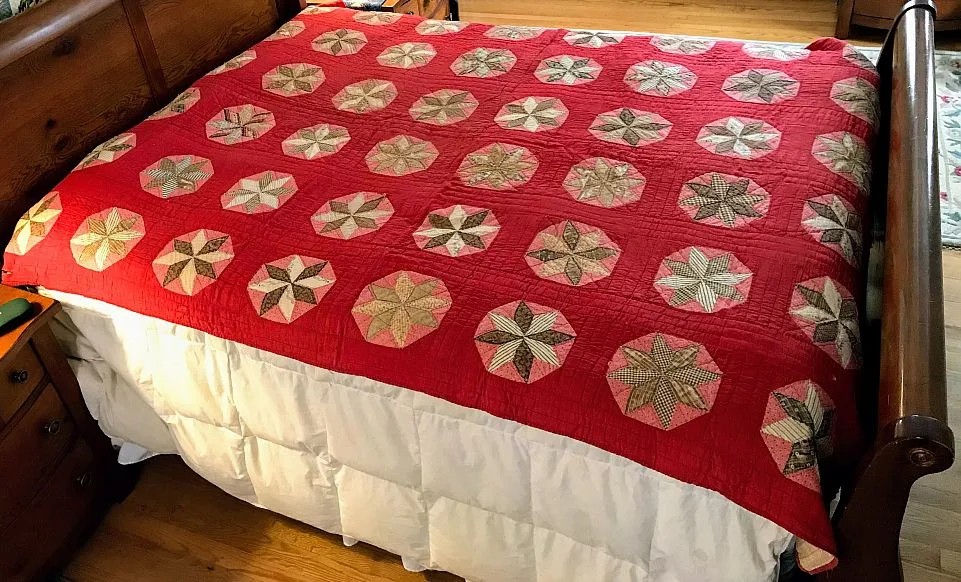
Turkey Red dyeing was a method of producing a bright red on cotton that was highly resistant to fading from light, washing, and bleaching. That made it highly prized in the nineteenth century, especially for cotton cloth and yarn.
Eastern Origins
The Turkey Red process had eastern origins and was known in parts of Asia and the Middle East long before it became an important European industry. Its exact path is not always told the same way, but by the eighteenth century the process had reached Europe, where dyers worked to copy and improve it.
The name “Turkey Red” came from the route by which Europeans associated the process with Turkey and the eastern Mediterranean.
The British Turkey Red Industry
The British Turkey Red industry began around 1785, when David Dale and George Mackintosh worked with Pierre Jacques Papillon, a French dyer, to establish the process in Scotland. In the early nineteenth century, the industry became concentrated in the Vale of Leven in Dumbartonshire.
By the mid-nineteenth century, the Vale of Leven had become one of the great centers of Turkey Red dyeing and printing. Its factories exported cloth and yarn around the world, especially to India and Southeast Asia. British manufacturers were able to produce large quantities of bright, fashionable, and relatively affordable cotton textiles, helped by industrial machinery and highly organized factory production.
The Turkey Red Process
The dye used for Turkey Red was originally made from madder root. Ordinary madder dyeing could produce red, but it often had a duller or browner cast. Turkey Red was different because it used a long and complicated process to create a brilliant, colorfast red on cotton. Turkey Red dyeing was long and complex, requiring specialized knowledge and skill.
The process varied from factory to factory, but it commonly included:
- Cleaning the yarn or cloth by boiling it with alkali.
- Treating it with oil, soda, and animal dung.
- Mordanting it with alum and sumac.
- Dyeing it with madder, often with other ingredients such as chalk.
- Washing and finishing the cloth to brighten the final color.
In the early nineteenth century, the full process could take three weeks or more. It has often been described as one of the most complicated dyeing methods ever invented. It was also famously foul-smelling. Between rancid oil, dung, steam, and boiling dye vats, this was not a delicate little teacup operation.
Over time, improvements made the process faster and cheaper. New machinery, heated drying stoves, and changes in ingredients reduced both labor and cost. Rancid olive or castor oil was eventually replaced by “Turkey Red oil,” made by treating oil with sulphuric acid. In the early 1870s, synthetic alizarin began to replace madder as the source of red dye, lowering costs even further.
Factory Work
Working conditions in Turkey Red factories were harsh. Twelve-hour days were common, often in hot, steamy rooms near open vessels of boiling liquid. Women and children made up a large part of the workforce. Some children were as young as ten.
Workers tended machinery, moved cloth, stirred dyes, and helped with many stages of production. Dyeing required constant attention, and workers had to follow instructions closely to keep each batch consistent. The work was skilled, tiring, and often poorly paid.
Patterned Turkey Red Fabric
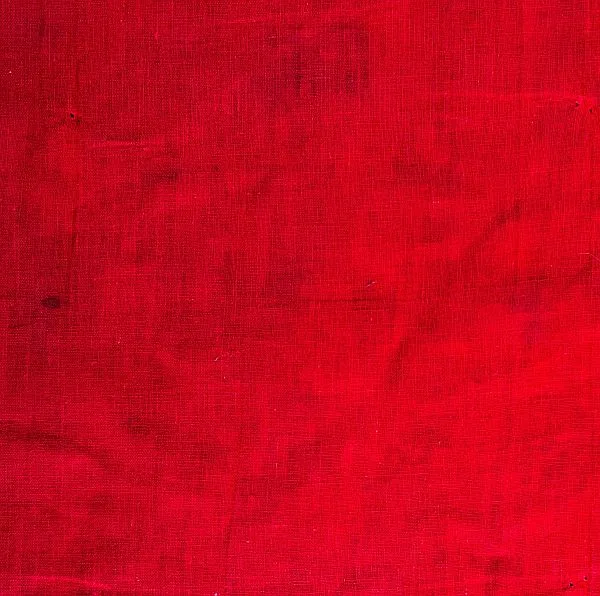
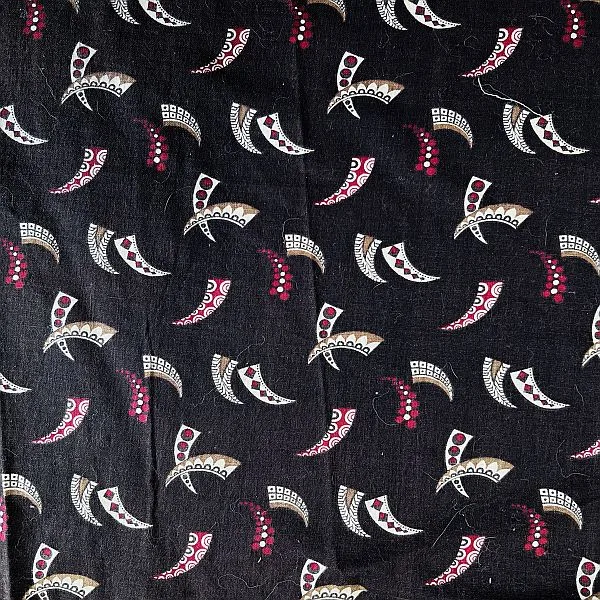
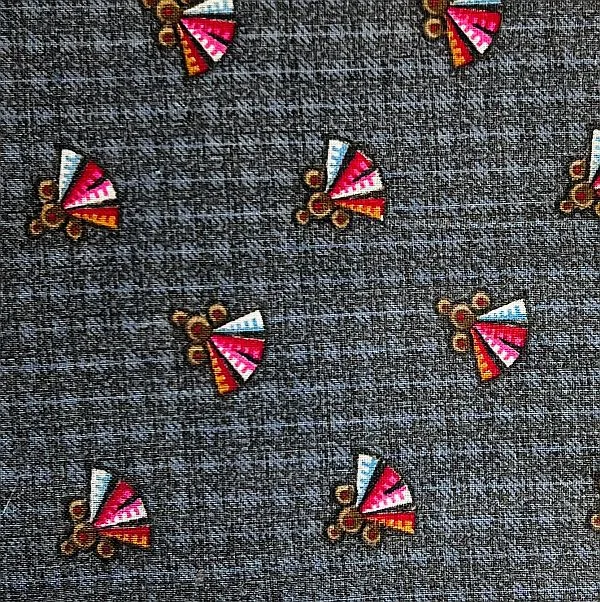
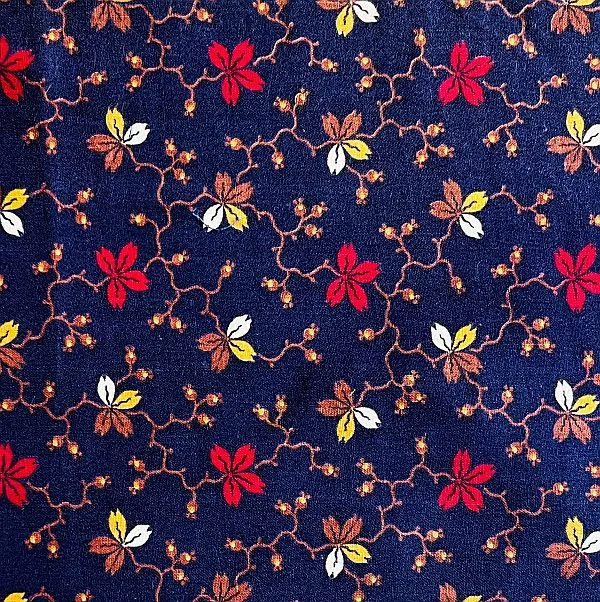
At first, Turkey Red was used mainly for plain red cloth or yarn. Around 1810, methods were developed for making patterned Turkey Red fabrics. Instead of printing red onto white cloth, manufacturers usually dyed the entire cloth red first, then removed the red in selected areas to create a design. Other colors could then be added. Two main methods were used.
Discharge Printing
Cloth was printed with a paste containing citric or tartaric acid, then passed through a bleach bath. The acid and bleach combined to destroy the red colour wherever the pattern lay. Other colours could be added into the discharge paste or overprinted afterward.
The available palette was limited: yellow (chrome yellow or Persian berries), blue (Prussian blue), black (logwood), and green (created by printing blue over yellow). Discharge-printed Turkey Red fabrics could be very striking, with the designs standing out against the red ground.
The process required skill, careful timing, and workers who understood how each chemical and dye would behave. A dyer could have a dozen dyes on at one time. Each dyer would have young assistants because the dyes had to be continuously stirred by hand.
The Lead-Plate Process
Another method used lead plates with designs cut into them. Several layers of cloth were clamped tightly between the plates, and a bleaching liquid was forced through the cut-out areas. This removed the red where the pattern was wanted.
The lead-plate process was best suited to simple designs, such as spotted handkerchiefs. These were sometimes overprinted with black.
Major Manufacturers
Three Vale of Leven companies became especially important in the Turkey Red trade: John Orr Ewing and Company, Archibald Orr Ewing and Company, and William Stirling and Sons.
These firms grew into large industrial operations. By 1859, one of William Stirling’s factories was reportedly producing millions of yards of Turkey Red fabric and hundreds of thousands of pounds of Turkey Red yarn each year. In 1898, after trade problems caused in part by tariffs on exports to India, the three major firms merged to form the United Turkey Red Company.
The Turkey Red factories were among the largest employers in Dumbartonshire and shaped local life. They provided work, but labor relations were often strained. Low wages, long hours, and difficult conditions led to bitter disputes and strikes.
Markets Around the World
Turkey Red cloth and yarn were sold in Britain and abroad. In Britain, Turkey Red yarn was often used to mark household and personal linens. Printed cloth was used for items such as shawls and handkerchiefs.
Most Turkey Red goods, however, were exported. Important markets included India, Malaysia, Java, China, and South America. The cloth was made into saris, sarongs, shawls, shirts, and handkerchiefs.
Shipments often carried colorful labels showing the maker’s or merchant’s name. These labels might include buildings, plants, animals, mythological scenes, or other decorative images. They acted as trademarks, and buyers often developed loyalty to particular brands.
Manufacturers also tailored their designs to different markets. They considered local taste, traditional patterns, and religious customs. In some places, for example, fabrics showing human figures could not be sold successfully.
Decline of the Turkey Red Industry
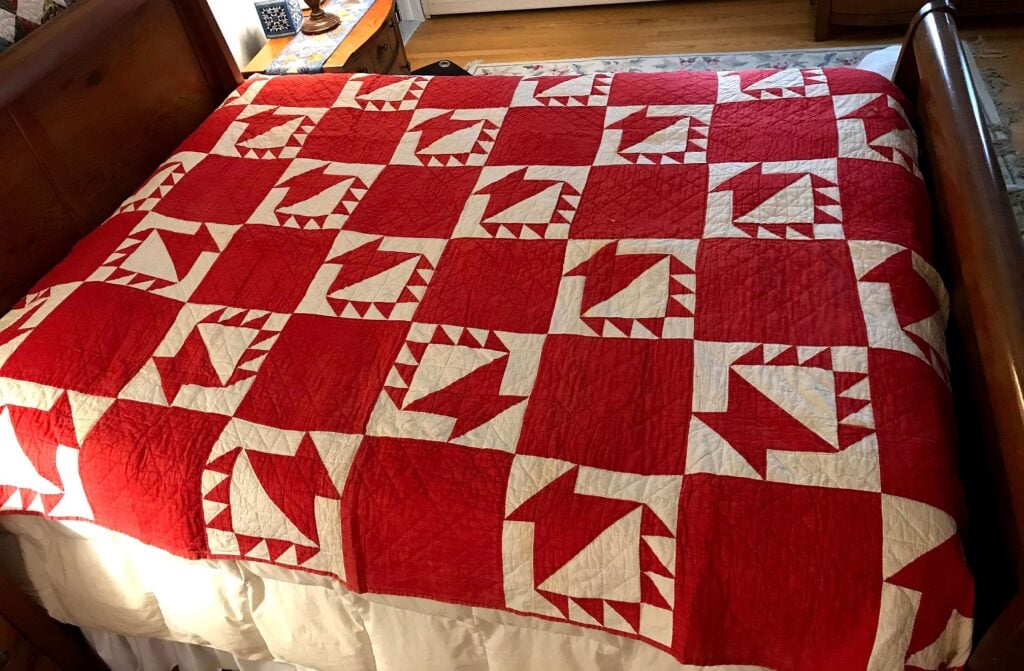
By the early twentieth century, the traditional Turkey Red industry was still active, but its future was uncertain. Synthetic dyes were changing the textile world. In 1869, chemists succeeded in synthesizing alizarin, the main coloring agent in madder, which made red dyeing cheaper and helped weaken the old madder trade. For quilt dating, this matters because a brilliant, long-lasting red may suggest true Turkey Red or synthetic alizarin, while a faded or unstable red may point to one of the cheaper synthetic substitutes that followed.
Congo red, developed in the 1880s, was one of the important new “direct” dyes, meaning it could dye cotton without the long mordanting process required by older methods. That was a great convenience for manufacturers, but convenience did not always mean durability.
Synthetic dyes like paranitraniline were less expensive to use, but far less durable — fabric dyed with it faded to a dull brick colour. In 1914, a new synthetic dye called Naphthol AS became available. It could match much of the brightness and colorfastness of true Turkey Red. The First World War slowed its adoption, but by the 1920s it had made the old Turkey Red process largely obsolete. Traditional Turkey Red production declined through the 1920s and finally ceased in the 1930s.
Turkey Red’s importance lasted far longer than the factories that made it. Its brilliant color, complicated process, and worldwide trade left their mark on textile history. For quilt historians and collectors, it remains one of the most recognizable reds found in antique quilts and fabrics.
Learn More
Civil War Quilts (blog post) by Barbara Brackman
Colouring the Nation: The Turkey Red Printed Cotton Industry in Scotland c.1840-1940
Friendship Quilts (blog post) by Barabara Brackman
The Society of Dyers and Colourists
Material Culture (blog post) by Barbara Brackman
Metropolitan Museum of Art (images)
More on Turkey Red (blog post) by Barbara Brackman
Turkey Red Dye from Nine-Patch Magazine
