April 21 – 24, 1997
These restored messages come from the Quilt History List, an online forum where quilt historians, collectors, researchers, appraisers, and enthusiasts discussed antique quilts and related textiles. The archive dates from 1996 through approximately 2016 and is being restored gradually. Sign up in the form at the bottom of the page if you want to know when a new page is added. Original spelling, opinions, formatting, and inactive links may remain unchanged.
Primary topics of this QHL Digest:
- Turkey red dye history — Members explained that ‘turkey red’ derives from Turkish red-dyed carpets popular with Victorians, and discussed how long the dye and indigo blue were both in use, complicating quilt dating by color alone.
- Dating an antique quilt — Using Barbara Brackman’s Clues in the Calico, members walked through estimating a date range (roughly 1875–1925) for a quilt based on its turkey red and indigo fabrics.
- Necktie quilt research — Several people pointed to specific books (including one by Shirley Botsford) on turning men’s neckties into quilt blocks, for someone researching the technique for a novel.
- Yo-yo quilt history — Members shared sources on yo-yo quilt history, including an AQSG Uncoverings paper and firsthand accounts of vintage yo-yo quilts made in the 1940s.
- Photo-transfer paper for fabric — A member who’d been fielding dozens of requests posted her photo-transfer paper pricing and process publicly for the whole list.
- DAR Museum and other quilt exhibits — Members shared quilt-related museum visits and asked about upcoming shows, including an African American memorial quilt seen on Antiques Roadshow.
- Quilt restoration philosophy — A restorer described her approach to restoration projects: first asking about a quilt’s past, then its intended future use, before deciding how to proceed.
Date: 21 Apr 97 08:39:13 EDT | From: “Kathryn c. Cole” <104066.3347 [at] CompuServe [dot] COM
Good Morning All:
Nancy Sentipal: I don’t know of any current quilt exhibits in the Ann Arbor Area. If you let me know when you’re coming to visit, I will see if I can find any shows that are happening.
Jane: Can you tell me more about your retreat in Hasting in September? Sounds like something I’d like to know about. TIA
Cathy: The Michigan State University Museum, which houses the Michigan Quilt Project, will incorporate the Mary Schafer Collection into the existing storage facility. I am a member of the Development Council at the Museum and we, along with administration, are moving and planning towards a new state-of-the-art museum. My goal, as an advocate for the quilt project, is space dedicated full-time to quilts and quilting activites. Now I just need to find the folks to write the checks!! If I can answer any specific questions about the Michigan Quilt Project please don’t hesitate to ask, BTW, Marsha MacDowell is the Curator of Folk Arts at the museum and is also on this list. If I don’t know an answer, I guarantee Marsha does!
Angel: I teach a class locally, Photos to Fabric, outlining the different methods of photo transfer. Each method has it’s pluses and minuses. The least expensive method is using the gel, Picture This. I have very good results using this gel, but, it is rather messy. Ami Simm’s transfer paper, Photos-to-Fabric, gives me the best results of the transfer papers. This method is more expensive. I also use my computer and print directly onto muslin–this of course is the most expensive. E-mail me and I’ll provide more details if you want. There are lots of projects you can do in addition to memory quilts–lots of fun.
Take care all,
Kitty Cole in sunny, finally! Milford Michigan
Date: Mon, 21 Apr 1997 08:50:30 -0400 (EDT) | From: KBoxmeyer [at] aol [dot] com
Kitty: I am interested in more detatils about putting picts on fabric. I am especially intrigued about the printing directly on the fabric. Does this require a special printer? inkjet vs laser? I would like to make a family picture quilt. I think both my moms (my mom and DH’s mom) would go nuts over something like this. Combining picts with samples of favorite clothes kind of idea. Please post to list. It sounds VERY useful. Respectfully, Kimberly in sunny Bristol
Date: Mon, 21 Apr 1997 08:07:51 -0500 | From: R D <holmr [at] execpc [dot] com>
The new quilt shop in East Troy, Wisconsin does not sell antique fabrics and quilts. She has several antique items she is using as displays — such as an antique bed with an antique 30’s quilt on it, and a beautiful turkey red pickle dish on the wall. She sells a few old things such as some 1930’s hats and costume jewelery. Old items are mixed in with the new items, giving the shop a very nice look — however the stuff we all like, isn’t for sale. I know Liz very well and she isn’t about to part with her antique fabrics and quilts!!! And if she does want to ….. that what her good friends are for! <G> Donna in Kenosha, Wisconsin
Date: Mon, 21 Apr 1997 12:47:42 -0400 (EDT) | From: AJSNGS [at] aol [dot] com
Hi all,
Just some quick questions. We’ve undoubtedly covered this before but I cannot seem to remember the answers! I just bought a quilt with indigo blue and turkey red fabrics in it. Where does the name turkey red come from? And for both the blue and red, does use of these fabrics pinpoint a time when the quilt was made? I wasn’t sure if these are fabrics that have been used throughout quilting or are unique to a specific time period.
Also, Jane, your getaway in September sounds wonderful! September in Michigan is perfect Fall weather so if you can go, I encourage you to be there! I’m a teacher so going away in September is NOT an option!
TIA, Nancy in rainy, cold, Virginia
Date: Mon, 21 Apr 1997 12:42:40 -0700 | From: Lynn & Debbie CUPP <lcupp [at] erols [dot] com>
Purchased at a flea market yesterday–I’ll try to describe it.
A tied embroidered crib quilt. It is tied with pink embroidery floss. It has a thin batt and is backed with a sheet marked “Klopman Mills a Division of Burlington Industries, Inc” that was brought to the front for binding/border. The blocks are set without sashing 6 across, seven down. Blocks are slightly rectangle shaped–7.5 by 8 inches. About 3 shades of a medium deep pink were used to embroider the blocks. The maker may have worked on this over a long period of time or just ran out of the pink she started with. The blocks are all worked with a lovely stem stitch (outline). Many are baskets of flowers with birds or butterflies. Some are bouquets. There are a few Kewpie doll type babies engaged in various activities:
playing a saxaphone preparing for a frigid dive riding a swan reading a book
There are circus animals–a camel and a lion, and a bear driving a car!
Also other bears, and a dog. And a family of bears and a girl walking with her dog.
Also Sunbonnet Sue type figure who is
rolling dough
sewing by hand
A Dutch girl picking tulips
A Dutch girl and boy kissing — windmill in the background
The very last row’s blocks are upside down.
Just cute as it can be and stole my heart! There are a few tiny holes and one small bright blue (ink?) spot in the middle of a SBS block.
Any ideas about the design? I’m voting for 20’s or 30’s at this time, although it seems like the design on the sheet indicates it wasn’t finished until much later.
Thanks for your help!
Debbie Cupp
http://www.geocities.com/Heartland/Plains/4280/quilting.html
Date: Mon, 21 Apr 1997 13:45:18 -0500 (CDT) | From: Cynthia A Wall <wallcyn [at] mail [dot] auburn [dot] edu>
Hi Everybody,
Me and my friends (10 of us in all) are leaving Wednesday, in two vans to the Quilting Mecca of the World!
Look for me on Thursday & Friday. I’m wearing a big white trail/safari hat with all my on-line quilt pins on it. It will also have my name. If you spot me, please stop me. I’ve had so much fun with all my guilds that I can’t wait to me you.
PS, I’m a tall red head with mucho freckles – you can’t miss me!
Cindy, in Auburn. T minus 48 hours and counting!
Cindy Wall wallcyn [at] mail [dot] auburn [dot] edu
1122 Drew Ln. Auburn, Alabama, 36830 USA
Today I will take a moment for laughter. I will find a moment or tow simply to relax and enjoy the thrill of being alive. *Daily Steps to Positive Changes*
Date: Mon, 21 Apr 1997 15:53:01 -0400 | From: quiltmag [at] mindspring [dot] com (Jean Ann Eitel)
>I’ve been reading the posts of various Michiganers ‘strolling’ down memory >lane..excited about being in touch with “home’..how about you all come to a >quilt show retreat in Hastings MI in Sept..we have some great events >planned..and we would also like to invite you to bring/send a quilt..one of >you favorites, one of your very first, one of your very worst,,and we’ll deck >the walls..If you can’t bring it..ship it, we’ll get it back to you..info >will be ready soon..GIVE ME A HOLLER IF YOU ARE INTERESTED..Jane
Jane, put me on your list. September is not booked for me and I am from Michigan. My family founded Freeland, Michigan. Others are from Iron Mountain, Michigan. I would love to go back!
Where is Hastings?
Jean Ann Eitel, Editor QUILT Magazines http://www.quiltmag.com
#quilttalk internet IRC channel – #quilttalk activities home page… http://www.quilttalk.com
Date: Mon, 21 Apr 1997 15:54:23 -0400 | From: quiltmag [at] mindspring [dot] com (Jean Ann Eitel)
Turkey Red comes from Turkish Red for the red in Turkish carpets which were very popular with the Victorians.
Jean Ann Eitel, Editor QUILT Magazines http://www.quiltmag.com
#quilttalk internet IRC channel – #quilttalk activities home page… http://www.quilttalk.com
Date: Mon, 21 Apr 1997 20:14:52 -0400 (EDT) | From: MamaBear76 [at] aol [dot] com
After being away from computer for several days (not by my own doing-in hosp. having appendix removed) I came home and read my e-mail. Well because there was so much I actually skimed over to many of them and now cannot re-locate one in particular that mentioned a guild meeting or show in Ithaca NY this next weekend – April 25-26. Could someone please fill me in. I will be in area visiting daughter in college and might be able to attend. Please contact me
MamaBear76 Liz Covert
Thanks.
Liz
Date: Mon, 21 Apr 1997 23:01:43 -0700 | From: bwblack [at] sprynet [dot] com (Barbara Black)
Nancy, from what I know “off the top of my head”, and after consulting Barbara Brackman’s _Clues in the Calico_, I would estimate that your quilt could be dated anywhere from about 1875 to about 1925. Brackman points out that both turkey red and indigo blues were used for long periods of time, and that it is difficult to date quilts from just these fabrics. She states that turkey red was used in quilts from about 1830 to 1930. If you could date other fabrics in the quilt, it would help. Of course, some quilts have much older fabrics in them than others, due to the use of scraps or old clothing. I’m not a famous expert, but I see many old quilts and I’m in a study group with knowledgable women who are known in the field. It sounds nice; I love the fabrics from this era and have many of the repros.
Barbara Wunder Black Ventura, California bwblack [at] sprynet [dot] com
~~~~~~~~~~~~~~~~~~~~~~~ I just bought a quilt with indigo blue and turkey red fabrics in it. And for both the blue and red, does use of these fabrics pinpoint a time when the quilt was made? I wasn’t sure if these are fabrics that have been used throughout quilting or are unique to a specific time period.
TIA, Nancy in rainy, cold, Virginia
Date: Tue, 22 Apr 1997 06:39:00 -0400 (EDT) | From: AJSNGS [at] aol [dot] com
Thanks Barbara, for your knowledge about turkey red and indigo blue. Kris sold me my lovely quilt and she said it’s from 1898 so I believe her! But I was just curious about those fabrics being used over a period of time. By the way, those are the only two fabrics in the quilt, other than the backing which Kris tells me is flannel even though it is a dark gray/brown stripe!
BTW, isn’t there a small book about dating quilts by a Helen Kelley? Seems I’ve heard of this but can’t recall the name. I realize Clues in the Calico is THE book to have, but that’ll have to wait until Christmas!
Thanks again, Nancy Sentipal in Virginia
Date: Tue, 22 Apr 1997 07:42:54 -0400 (EDT) | From: Harr32 [at] aol [dot] com
Dear Friends, I’ve been reading this list for a couple of months now and I made note of the quilt activities at the DAR that I should remember this for a future reference.
I;’ve just discovered that I’ll be accompanying a friend to DC for a few days in June and my days will be my own! Can anyone give me the telephone number of the DAR? I tried to find them on-line and my link did not work…
Many thanks to all of you for your inspiration and wisdom…
Dana in rainy southwest VA
Date: Tue, 22 Apr 1997 08:18:13 -0400 (EDT) | From: Qltldy10 [at] aol [dot] com
Hi Nancy et al- Yes, Helen Kelly did write a cute little (emphasis little) book on dating quilts. IMHO, there is nothing in the content of this book that is not in CLUES- there may be some benefit because of it’s size, and the pages are hard so they won’t bend or wear in your purse or bag. For me, it is a book never used, because it is all basic info already stored in my gray cells. Helen Kelly, though is a quilter/author who I love to support- I love her column in QNewsletter, always read it first. So, no regrets buying the book, just not really helpful for actually dating.
My opinion only— Beth in Maine
Date: Tue, 22 Apr 1997 07:48:45 -0500 (CDT) | From: Karen Benson <benson [at] mailbox [dot] mail [dot] umn [dot] edu>
I have been following the comments on putting photos on fabric. I have done several quilts with photo transfer. I made a full size bed quilt (that actually hangs on the wall) for my parents-in-law 50th wedding anniversary. I researched the different types of paper at length (partly because I wanted to sell the paper, which I do), but mostly because I didn’t like the stuff the local copy centers sell and use. In the Minneapolis/St. Paul area, anyhow, they do not work well. I have generally found the paper they sell sticks to the fabric (about half the time), and you need one of those big presses that t-shirt companies use to actually transfer it directly to the fabric, it doesn’t work well with an iron at home. The paper I carry works best on a Cannon color copier (you can use other copiers but that kind works best because it has the most repetitions). Also, if you are coping black and white you STILL should do it on a color copier — again because of the repetitions.
I just taught a class last weekend in this technique, and I’ve gotten calls for lots of the students thanking me because ALL the transfers worked well.
The only reason I wanted to throw my 2 cents in was because there is a huge difference in the quality of the photo transfer papers. Since you are paying about $1 a copy to copy the pictures (pricey to me), you want to be sure you are using good quality paper. Also, tell the copy center to “hand feed” the paper one sheet at a time. Otherwise it will gum up their copier and they get upset.
One more note (sorry this is so long) is that to copy even a high school graduation picture, wedding picture, etc. or any “professionally taken” picture, you need a copywrite release form. Most copy centers are getting uptight about this because of lawsuits. They seem to me to be a little paranoid, but I guess if I had been sued I’d get paranoid too.
Good luck. Karen Benson University Foundation Phone: (612) 624-1568
Date: Tue, 22 Apr 1997 09:32:59 -0400 | From: mcdowell [at] museum [dot] cl [dot] msu [dot] edu (Marsha MacDowell)
Just thought you might like to know the Michigan State University Museum has one Liberian quilt and a approximately 20 African-American quilts acquired during a research project funded a couple of years ago by the National Endowment for the Arts. We mounted an exhibit that toured the state and a book, published by the Michigan State University Press in collaboration with the Michigan State University Museum is FINALLY due out early this summer. I edited it and it contains contributions from a number of authors, including a reprint of Cuesta’s article. The book thoroughly underscores the diversity and variety of quiltmaking traditions found in Michigan. Even includes excerpts from an interview with Rosa Parks (civil rights leader/quilt). The research data (photos, tape-recorded interviews with over 50 quilts, fieldnotes, etc) compiled during this project is housed in the Michigan Traditional Arts Research Collections at the MSU Museum. I’ll let the list know publication price, ordering information, etc. as soon as it is released.
Meanwhile, for those interested in issues of cultural diversity and quiltmaking, I have edited a volume to accompany an exhibited I have co-curated on Native Hawaiian and North American Indian quiltmaking. Titled “To Honor and Comfort: Native Quilting Traditions” the book will be out in October of this year and is being published by the Museum of New Mexico Press in collaboration with the Michigan State University Museum. Culminates about a ten-year research project. The exhibit will open at the Smithsonian Institution’s National Museum of the American Indian in NYC on October 19, 1997. SITES will then travel it to several venues around the country, with a first stop in East Lansing, Michigan in late spring 1998. Seminole patchwork — and one Seminole quilt — is nominally included but there is lots on Native Hawaiians and many other tribes: Mohawk, Hopi, Sioux, Navajo, Odawa, Ojibway, Inuit, and more. Again, when I have more information about price and ordering information, I’ll let list know. BTW: the MSU Museum now has over 60 native quilts in our collection!
Marsha MacDowell
Date: Tue, 22 Apr 1997 09:29:53 -0700 From: Deanna Apfel <lily [at] pacific [dot] net> To: Karen Benson <benson [at] mailbox [dot] mail [dot] umn [dot] edu> CC: QHL [at] cuenet [dot] com Subject: Re: QHL: Transferring Pictures to Fabric Message-ID: <335CE770.FD7 [at] pacific [dot] net> Content-Type: text/plain; charset=us-ascii Content-Transfer-Encoding: 7bit
Karen, thank you for your post on photo transfers. You mention that you have spent some time finding a transfer paper that will work well with a home iron. Which transfer paper is this, and where can you buy/order it?
Thanks for the information.
Deanna in Philo, Ca.
Date: Tue, 22 Apr 1997 15:40:07 -0500 | From: gridgees [at] algorithms [dot] com (Merry May)
OK – back to quilt history! Can anyone point me to articles/books on the history of Yo-Yos? Supposedly Ginny Gunn did some research on them at one point, and I looked in the listing of papers from AQSG, but couldn’t find anything. Our local “Yo-Yo Queen” would like to have some info to fill in the quiet parts in her demo which she’ll be doing at our quilt show in October.
Thanks in advance for any (and all!) help! Take care. Merry May gridgees [at] algorithms [dot] com
Date: Tue, 22 Apr 1997 17:38:20 -0400 (EDT) | From: Quiltfix [at] aol [dot] com
I was watching the Antiques Roadshow on PBS this past Sunday and they had the neatest quilt. It was african-american, and it was in memoriam for the makers deceased twins. The symbolism was extraordinary. It was a meshing of Christianity and an African religion. There were typical things for Christians, such as the cross. I found the African symbolism intriguing. White is the funereal color. Red works in here too, somehow, but I don’t remember. Chickens are a symbol of rebirth. It turns out that there was a cholera epidemic in Baltimore, MD (where the quilt was made) at the time it was made. They are guessing that the twins, who evidently died as small children, were victims of this epidemic. Since this was an appraisal show, it was also appraised at 12 – 15 thousand (approx, the quilt was more interesting than the worth!)
There has been some discussion about being *nice* when posting to the list. I suggest that when you write, use emoticons ( :), <G>, etc.) to help demonstrate what your intent is. It is very difficult to converse when the other person cannot read your body language and hear inflections in your voice. On the other side, remember to not take things too personally, that not everything that appears mean actually *is* mean. And try to never write and then send the post immediately, especially if the emotional content can be misconstrued. I personally wait half a day, then go back and re-read it. You’d be surprised how often I revise, and I’m far from a nasty person! (It also helps with spelling).
Jean Ann, if I remember correctly (uh-oh!), the process to get this good, relatively fast red was “invented” in the area of Turkey.
Lastly, Jane-of-the-Feedsacks, would you please e-mail me some info on your club and and if there’s an identification book? I had a lady ask me this weekend about it, and I promised I’d ask. Thanks.
Y’all have a good day. I’m off to work ………
Alan
Date: Tue, 22 Apr 1997 17:46:33 -0400 (EDT) | From: HKnight453 [at] aol [dot] com
Hello all- Can anyone recommend a book which discusses how to use ties in quilting. I mean men’s neckties. This is a part of a plot in a piece of fiction that I am working on. Heather in spring (finally:)) RI
Date: Tue, 22 Apr 1997 20:38:06 -0400 | From: “Jim Twigg” <jtwigg [at] radix [dot] net
I am interested in finding information, perhaps a textbook or software, regarding the method of calculation of the amount of raw materials (cotton yarn) needed to make a finished product such as a T-shirt. For example, if I wanted to have 300 dozen T-shirts made in sizes small, medium,and large (100 dozen each) how much yarn would I need to buy ? At what width should the fabric be woven ? Is anyone familiar with this type of information ? Where would I go or whom could I contact ? Thanks for your help! You can e.mail me directly at jtwigg [at] radix [dot] net.
Jim Twigg
Date: Tue, 22 Apr 1997 23:12:06 -0400 (EDT) | From: Calicot [at] aol [dot] com
This is for Beth Donaldson, Hello. You and I have been members of TR and have traded blocks by snail mail. You sponsored a quilt retreat in BayView, Michigan. I didn’t get to go but heard lots about it. I like “lurking” here and listening to lots of interesting information. I am new at e-mail and using my computer so only join in once in a while. Welcome. Jan Carroll—Calicot [at] aol [dot] com
Date: Wed, 23 Apr 1997 02:05:22 -0700 | From: Arlene Goldberg <arlenegg [at] icanect [dot] net>
Karen, I was very interested in your post to about transfers. I had wondered if there was any difference between the paper used a Kinko’s and the paper sold by say, Ami Sims. Would you elaborate, please?
Also, I vaguely remember reading somewhere a tip regarding washing. Is it true that for transfers you shouldn’t pre-wash the fabric?
I’m planning a wedding quilt for my niece with childhood pictures of the couple.
Thank you, Arlene arlenegg [at] icanect [dot] net
Date: Wed, 23 Apr 1997 04:23:53 -0400 (EDT) | From: Baglady111 [at] aol [dot] com
Georgia Bonesteel had a tie pattern in a book..I regret not knowing if the entire book were tie patterns..she used them like the half of Dresden..check it out..Jane
Date: Wed, 23 Apr 1997 05:25:15 -0400 | From: quiltmag [at] mindspring [dot] com (Jean Ann Eitel)
Shirley Botsford did an entire book on using men’s old ties in quilts about two years ago. I would check with some of the larger book sellers like American Quilters Society to see if they have it. I cant remember the exact name of the book, but I am pretty sure it had the word “tie” in the title. QUILT magaazine reviewed it and I remember distinctly the quilt photo we chose.
If you dont have any luck with this information, you can email the QUILT customer service dept quiltaid [at] aol [dot] com to see if Susan can look it up on the index she keeps re color photos we have used.
Jean Ann Eitel, Editor QUILT Magazines http://www.quiltmag.com
#quilttalk internet IRC channel – #quilttalk activities home page… http://www.quilttalk.com
Date: Wed, 23 Apr 1997 19:40:54 +0900 | From: “Atsuko Ohta” <aoota [at] mscom [dot] or [dot] jp
Hi,
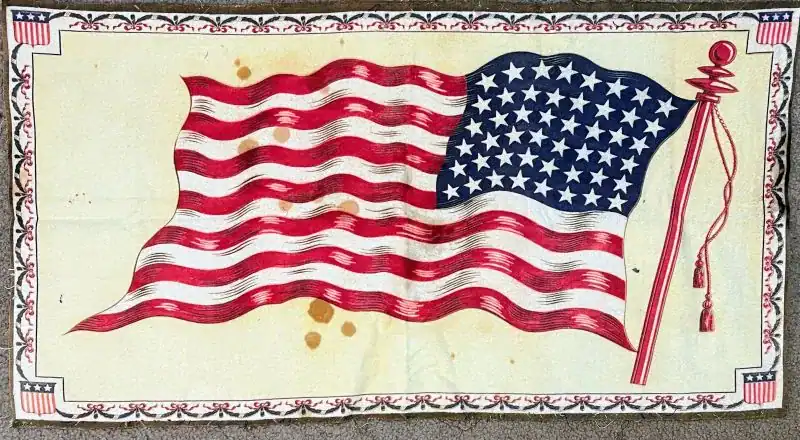
I got a wonderful cigar flannel with a Japanese Navy flag from Kris. What were cigar flannels used for? Were they very popular?
Atsuko
Date: Wed, 23 Apr 97 04:14:46 PDT | From: narmstr [at] ibm [dot] net
Dear Merry May, Nancy Sentipal, and QHLers with similar interests,
Some more well intended bibliography …
Merry … the Yo-Yo paper by Ginny Gunn is in the American Quilt Study Group’s Volume 8 UNCOVERINGS 1987 “Yo-yo or Bed-of-Roses Quilts: Nineteenth Century Origins” and in Ginny’s wonderful thorough approach to study it includes 3 1/2 pages of references! Everything there ever was to know about yo-yos (up to 1986).
Nancy … until you unwrap your Christmas presents, if you happen to have or have access to (perhaps through your guild?)1984-1985 back issues of QUILTER’S NEWSLETTER MAGAZINE Barbara Brackman had an excellent and lengthy 6 part series of articles on dating quilts. Much of the information in CLUES IN THE CALICO is included. See issues 165-170. Issue 169 is the one with information about Turkey (and other) red(s) and indigo.
We had a review of Helen Kelly’s book in the June 1995 issue of COVER STORIES. It reads …
Kelley, Helen. DATING QUILTS FROM 1600 TO THE PRESENT: A QUICK & EASY REFERENCE. (Lafayette, CA: C&T, 1995). Kelley, AQSG member and author since 1983 of the ever popular monthly essay “Loose Threads” in QNM, has been a quilter since 1940. Her chapter in QUILT WITH THE BEST (Oxmoor House, 1992) is an excellent introduction to her work and her philosophy. This pocket-size guide to: Styles, Fabrics, Fillers, Sizes, Borders & Edges, Pattterns, Signatures [application methods], Printing Techniques, and Dyes – each arranged chronologically – is based on her years of study and “every reliable printed source.” Also: Care & Repair, chart for identifying fibers by burning tests, dictionary, and *selective* bibliography. A useful and handy aid to memory when out and about; however, as with Cole’s notes, it will not take the place of personal experience with antique quilts and fabrics and reading widely and deeply. *Recognizing its limitations*, HIGHLY RECOMMENDED. 64p. 4 1/2″ x 5 1/2″ NO ILLUSTRATIONS. Printed in Hong Kong. ISBN 0-914881-95-7 $9.95US Hardcover, spiral bound.
nca
Date: Wed, 23 Apr 1997 08:14:29 -0500 (CDT) | From: Karen Benson <benson [at] mailbox [dot] mail [dot] umn [dot] edu>
I apologize for this on the net, but since I received about 60 e-mails yesterday asking how they could purchase the photo transfer, I will put one response on the net. I sell it for $10.00 (which includes the shipping) for a packet of 5 sheets of paper. I don’t know the manufacturer — I get it from a friend of a friend of a friend. All I know is that the U.S. Army uses it! If you want to get it from me, mail the check to my home at 3208 Roosevelt Street N.E., St. Anthony Village, Minnesota 55418.
Again, I apologize. Since I especially like teaching this technique at this time of the year for high school graduate gifts, wedding gifts, showers, etc., I just felt I should pass along what little wisdom I had after all the research I did on the many, many kinds of transfer paper. I wasted LOTS of money trying to come up with a kind I liked and that worked well enough to teach it.
The quilt I made for my in-laws 50th wedding anniversary will go to the Minnesota Historical Society when they die (a curator there saw it and asked if that would be possible). My in-laws have left it to the quilt collection there because it — in pictures — tells the story of Swedish immigrants to Minnesota through their family.
Anyhow — again my apologies to anyone who is offended. I only meant to share my knowledge. karen Karen Benson University of Minnesota Foundation Phone: (612) 624-1568 Home: (612) 789-0447
Date: Wed, 23 Apr 1997 10:19:40 -0400 (EDT) | From: KirkColl [at] aol [dot] com
Barbara Brackman and Terry Thompson will be offering Fabric Camp as well as their appraisal school in conjunction with the Quilt Restoration Conference in September in Omaha. It will be a four-day (including the Sunday seminar on Indigo) instead of the usual 5-days they offer in Lawrence. The difference will be dropping the one day on 20th century fabrics.
If you would like more information about the Omaha conference and camp, send an e-mail to QuiltHF [at] aol [dot] com with your U.S. Mail address or fax number. If you want to know their plans for camps in Lawrence, write to Barbara at 500 Louisiana, Lawrence, KS 66044.
Hope to see you all in Omaha in September!
Yours,
Nancy Kirk 1-800-398-2542
Date: Wed, 23 Apr 1997 10:19:43 -0400 (EDT) | From: KirkColl [at] aol [dot] com
For Julie at Yale:
There is a wonderful new book out called “Communion of the Spirits” by Roland Freeman, published by Rutledge Hill. If you can’t find it in your library, we carry it for $34.95. It may be too late for this paper (sorry, I just got back to town after four days in South Dakota with the state guild there), but it might serve as the start for the next one.
Regards,
Nancy Kirk
Date: Wed, 23 Apr 1997 10:21:10 -0400 (EDT) | From: KirkColl [at] aol [dot] com
To respond to the restoration questions:
The first question I ask when looking at a restoration project is “what is the past of this quilt?” and the second question is “What is it’s future.” The answers will provide most of the information to make a good decision about how to proceed with a restoration project.
For example, if a quilt contains a piece of grandmother’s wedding dress, preserving that particular fabric is much more important than if the quilt was bought for $2 at a sale. In the future, if a quilt is to be used on a bed, having a clean, washable quilt is much more important than if the quilt is to be used as a wall-hanging, or a fragment framed as a family relic.
Many restorers collect tied comforters to provide restoration fabrics because they can get good sized pieces with few holes. Before you cut the comforter, the major question is, should it have a future life as a comforter or quilt per se. Many comforters get badly damaged around the edges through use and from the strain of the heavy batting, so becoming an “organ donor” may be the best future for it.
Re: re-quilting old comforter tops. There is nothing wrong with the plan, but it may not be economically viable. Antique quilt prices do not include the personnel costs of hand-quilting at this point in time, and newly quilted pieces tend to have even less value in the antique side of the market. So it may not pay to invest the time in quilting. You may do better to sell the top to someone else who want to hand-quilt it themselves.
If you a interested in getting into more restoration, I’d encourage you to join the Quilt Restoration Society and come to the conference in Omaha in Sept. If you want more information, give me a call or send an e-mail.
Regards,
Nancy Kirk The Kirk Collection
Date: Wed, 23 Apr 1997 11:21:33 -0400 | From: Diane McGuire <dianemcg [at] ici [dot] net
Hi to all! I have a quilt related question. A friend wants to sell a 75 year old quilting frame in excellent condition and asked me if I could find out a reasonable price for her to ask. It is basically just four long pieces of wood, 2 are 90″ and 2 are 120″. The 90″ pieces have strips pillow ticking tacked along the side to baste the quilt to the frame. The wood strips have holes at intervals to adjust the size of the frame to the quilt. I suppose that after the quilt was tacked on to the frame it was proped up on kitchen chairs and the ladies sat around it and quilted. I thought maybe I might buy it even though I machine quilt or tie. It would be easier than pinning on the floor. Has anyone any idea how much she should ask for it or whether it would be useful for just pinning quilts together? Thanks for considering my request. Diane in SE Massachusetts where the daffodils and early tulips are dancing in the sun.
Date: Wed, 23 Apr 1997 12:29:27 -0400 | From: “Steven W. Loken” <sjloken [at] compuserve [dot] com>
to Merry May,
I have a little information on yo-yo quilts, which we gathered from our Minnesota quilt search, called Minnesota Quilt Project. I’ve entered much of the data on all the quilts in my computer, and am sharing it with researchers and the Minnesota Historical Society (one of our funders). This is, BTW, my first post to the list after lurking since digest #97, waiting for something original to add, but always learning something. The aforementioned MQP found 16 yo-yo (of 3255 total), one made 1920s, 10 in 30s, 3 in 40s, 1 @ 1950, 1970. One was called by owner “Depression record” (for the round shape?), one was medallion set with large H in center, one diamond field type set with sashing, one like Washington Sidewalk quilt pattern, rest just multi-colored random yo-yos. Most of these were made in MInnesota. I know this is very condensed info, feel free to ask more. I’ll search my db for any other inquiries on the MQP findings.
Jean in sunny, at last, Minnesota. Planted lettuce yesterday!
Date: Wed, 23 Apr 1997 12:02:05 -0500 | From: “Lang” <lang [at] wellsville [dot] com>
My mother has a yo-yo quilt she made before she was married. (married in 1945). It is backed with solid dark pink–the yo-yos are many different floral prints. They are larger yo-yos than some I have seen–maybe 1 1/2 inches finished size.
Eula Lang<lang [at] wellsville [dot] com>
Date: Wed, 23 Apr 1997 14:35:12 -0400 (EDT) | From: AMDOODAH [at] aol [dot] com
There was an article in Piecework magazine on Yo-Yo quilt history. I have all the back issues and will send you a copy of the article if you send me a snail mail address. Joan Stevens AMDOODAH [at] aol [dot] com
Date: Wed, 23 Apr 1997 12:03:45 -0700 | From: Sharon Harleman Tandy <harleman [at] micron [dot] net>
Dear Nancy, Do check with Barbara Brackman’s _Clues in the Calico_ on Turkey Red. It is a process not a color, although the brownish reds from the 1800s are usually labeled Turkey Red. from page 62, “The dyestuff was madder root….13 to 20 steps and many months” to acheive the fast, vibrant red that only the “Eastern” dyers knew how to do. The word “Turkey” comes only from the fact that Europeans called anything from an eastern area “Turkey.” “Casual observation cannot distinguish Turkey red from later fast red dyes, but the appearance of a red that has retained its brightness is a clue that the quilt was made after Turkey red fabrics became commonplace in the 1830s and ’40s.” From page 62 also. There is much to learn about that group of reds; Gosta Sandburg has just come out with another new book on “Madders, Cochineals, and Murex.” His book on Indigo is just excellent. Brackman says “Indigo, the staple natural blue dye, was the only American commercial dye crop of any consequense.” Therefore, indigo remained one of the most used colors in America and ran for a long time, making it more difficult to date. If anyone out there has any information on indanthrene, I would appreciate a reference note or a photocopy. Sharon in very rainy Boise.
Date: 23 Apr 97 17:46:34 EDT | From: “Kathryn c. Cole” <104066.3347 [at] CompuServe [dot] COM>
To Kimberly and others interested: I have a flatbed scanner which I use to scan my picture into my computer, I use Corel Paint as the software. I iron freezer paper to muslin and cut it into paper size, 8.5 x 11, which I feed into my printer. My printer is an HP 1600C Deskjet. After the transfer is dry, spray it lightly with Krylon Fixative to set. The resolution and color is very good, it does however use alot of ink. I’ve had very good luck with Ami Simm’s Transfer paper and my next experiment is to print directly on the transfer paper rather than take it to the copy store. We’ll see. Hope this helps, if you have any other questions please feel free to e-mail me directly. BTW, which Bristol do you live in?
Bye Kitty Cole in Milford Mi
Date: Wed, 23 Apr 97 22:21:13 PDT | From: narmstr [at] ibm [dot] net
Dear Heather and others with a surfeit of men’s neckties,
from COVER STORIES April 1997
Elwin, Janet B. NECKTIE SAMPLER BLOCKS (Paducah, KY: AQS, 1997) Elwin’t TIES, TIES, TIES: TRADITIONAL QUILTS FROM NECKTIES from AQS less than a year ago must have been a big success, or surely there would not be yet another so quickly to follow? In the AQS “Love to Quilt …” series, this one adds the ubiquitous FOUNDATIONS PIECING for a majority of the 17 blocks. This method is a most suitable one for controlling the bias cut of ties and off-grain backgrounds. Adds little, if you own the first title which uses some of the same diagrams and offers more detail on collecting, preparing, and cutting the ties. I expect the first is a better value, and the “swift” quilter could figure out the foundation piecing. 72 p. 8 1/2 x 11, only 3 pages of color (the quilts), templates, brief biblio. ISBN o-89145-882-4 $14.95US Softcover.
Since you are interested in using this only for a plot line … won’t include the review for the earlier title, but if you (or anyone) is interested I can provide it.
The most imaginative use of men’s ties that I know of is by Jocelyne Patenaude a quilter from Montreal, Quebec. Her tie quilts, some from silk ties and some from wool, are absolutely marvelous and have won several major prizes. Pages 48-49 of ART/QUILT MAGAZINE Issue #3 has a fascinating article by Jocelyne about the making of MENEMOSYNE (second runner up at Quilt Expo IV) while her father was dying. She says “the night my father died I was composing my quilt MNEMOSYNE in a frenzy of activity at two o’clock in the morning. Mnemosyne was the Greek goddes of memory, a metaphor for reflective, evocative memory and deep knowing. There were so many memories. I was wide awake for the inevitable, dreaded middle of the night phone call. At the first ring, with a heavy heart, I knew.” The quilt is composed of hundreds of dark green, blue and purple hexagons from recycled silk ties, “the bias edges painstakingly turned over paper patterns” to be English pieced. The glorious accompanying photo of the quilt also appeared in QNM. Can’t recommend her article too highly, for a loving “artist’s statement.”
Date: Thu, 24 Apr 1997 03:57:51 -0400 (EDT) From: NYeaton [at] aol [dot] com To: QHL [at] cuenet [dot] com Subject: Re: QHL: DAR…Again Message-ID: <970424035750_1321233369 [at] emout01 [dot] mail [dot] aol [dot] com>
The DAR has some quilts on display all the time. They are hidden in pull out wall racks so you have to look. They have a special tour of about 25 quilts and related textiles the first Thursday of most months. There is a $15 fee for this. The museum is located at 1776 D St NW # is (202) 879-3241. I suggest calling to confirm the day before, I found out when I got there that mine was cancelled. Enjoy!
Date: Thu, 24 Apr 97 08:17:47 PDT | From: narmstr [at] ibm [dot] net
Dear Rosalie,
Would have to go back to original posting to be SURE I understand exactly what you are seeking. But if it is information in general about Pennsylvania motifs, not necessarily a book about “quilts” then what about…
Lichten, Frances. FOLK ART MOTIFS OF PENNSYLVANIA. (New York: Dover, 1976) 195 illustrations, 41 in full color. ISBN 0-486-23303-0 Suspect still available, Dovers seem to stay in print … price? My copy says $3.50.
Schorsch, Anita. PLAIN & FANCY:COUNTRY QUILTS OF THE PENNSYLVANIA-GERMANS. (New York: Sterling, 1992) Lots of “good stuff” including a gallery of 200 PG country quilts (Amish, Mennonite, Lutheran, Schwenkfelder. Iconography of each motif explained. ISBN 0-8069-7432-X From the cover “pathfinding work … first book to examine quilts from the perspective of the several Christian churches and sects … explains the explicit religious symbolism of their designs” etc., etc. I have some other ideas, but maybe we should be clearer exactly what you seek as I may be taking you off in the wrong direction. Will wait for further clarification. nca
Date: Thu, 24 Apr 1997 10:11:25 -0600 | From: Elizabeth Richards <elizabeth.richards [at] ualberta [dot] ca>
Look up where Edmonton, Alberta (Canada) is and you will see why I am cluttering this paper with a special request. My DC is taking me to Boca Raton, Florida on May 17 for a week. I would like to know if there are any museums which I might enjoy, or quilt shops, or quilt restorers I might meet. Half way through the week we are going to the Gulf side because I’ve never been in Florida. We would love suggestions for B&B and snorkelling – and QUILT stuff. Many thanks . If you respond privately I won’t feel so guilty about asking for travel information. P.S.. The last tiny bit of snow in my back yard may melt to-day – but I saw 3 robbins yesterday and I ran this morning without gloves! – —————————- Elizabeth A. Richards, M. S., PHEc. Professor, Department of Human Ecology University of Alberta 301 Printing Services Edmonton, Alberta Canada T6G 2N1 phone: 403 – 492-2475 fax: 403-492.4111
Date: Thu, 24 Apr 97 09:58:10 PDT | From: narmstr [at] ibm [dot] net
Dear Rosalie,
Pennsylvania Dutch and German are definitely synonymous. “Deutsch” is the German word for “GERMAN” which is how the “tradition” began. So any references you find to Pennsylvania German quilts may lead you to what you seek. The Random House defintion of “hex signs” is “any of various magical symbols of usually sylized designs, as those painted on barns by the Pennsylvania Dutch for protection against evil spirits and now sometimes used for purely decorative purposes.”
Pennsylvania has an incredibly rich output of quilt history publications. I think it would not be an overstatement to say the best of any of the states (hope this does not offend anyone who worked hard on their OWN state project 🙁 ALL THE PROJECTS HAVE MUCH TO OFFER, but there have been so many different projects in PA and so many workers with various backgrounds to bring to the work that great things have been accomplished. All these separate PA studies have, perhaps, made regional differences – preferences – in colors, patterns, etc. more readily apparent.
Nancy (and her husband Donald) have concentrated on the Pennsylvania Dutch. Their book … Roan, Nancy and Donald. LEST I SHALL BE FORGOTTEN: ANECDOTES AND TRADITIONS OF QUILTS (Green Lane, PA: Goschehoppen Historians, 1993) 98p. 8 1/2 x 11, 70 color photos, b/w illus. ISBN 1-883801-0208 (Order direct: PO Box 476, Green Lane, PA $24.95US incl. s/h) may still be available. It is based on their 2 1/2 year “Quilt Roundup” in Montgomery County and the Goschenhoppen folk region of SE PA (about 500 sq. miles). They documented 1,553 pre-1950 quilt items.
Other possible sources … all the many publications about “fraktur” which include all sorts of “folk” decorations, and the books on PA samplers e.g. Hersh, Tandy and Charles. SAMPLERS OF THE PENNSYLVANIA GERMANS.
And one last thought … In BITS AND PIECES: TEXTILE TRADITIONS (Lewisburg, PA: Oral Traditions Project, 1991) Cuesta Benberry has a great article “The Nationalization of Pennsylvania-Dutch Patterns in the 1940s-1960s” with a very extensive bibliography. It includes a black and white photo of a kitchen from Ladies Home Journal 1947 that certainly takes me back to my childhood. We lived in a house built in 1850 in the “Western Reserve” (Hudson, OH) and my mother let me paint Pennsylvania Dutch motifs all over the kitchen cabinets! Cuesta’s bibliography includes MANY magazine articles from the late 40s on. If you have access to a library with a good collection of women’s magazines, you might well find “your inspiration.” (Problem is, I find, that MOST libraries do not have a good archive of women’s magazines. :<( Find that most depressing.)
More than you wanted to know? Librarians are bad for that! nca
Date: Thu, 24 Apr 1997 14:24:38, -0500 | From: LVQG24A [at] prodigy [dot] com ( ELIZABETH K DONALDSON)
Hi to Jan Carroll and welcome to the list. I have a Canon BJC-4000 printer and I found fabric in Best Buy packaged by Canon for use in their printers. I haven’t tried or bought it yet. There was a packet of chemicals in the package that probably sets the ink. It retailed for $35. Beth in Lansing
Date: Thu, 24 Apr 1997 14:58:15 -0400 (EDT) | From: Nancy in VA (no email given in source)
Carla, and everyone else,
If you haven’t read the book “Legacy; The Story of Talulah Gilbert Bottoms” pick it up and read it! It is a wonderful read!
Nancy in VA