April 25 – April 30
These restored messages come from the Quilt History List, an online forum where quilt historians, collectors, researchers, appraisers, and enthusiasts discussed antique quilts and related textiles. The archive dates from 1996 through approximately 2016 and is being restored gradually. Sign up in the form at the bottom of the page if you want to know when a new page is added. Original spelling, opinions, formatting, and inactive links may remain unchanged.
Primary topics of this QHL Digest:
- Fabric & pattern-book identification — members trade leads on identifying specific titles — “Flying High: The Airplane in Quilts,” Nebraska Quilts & Quiltmakers, and the various reprints of Sara Nephew’s 1930s pattern book.
- Textile conservation basics — a detailed first-post primer on cleaning and reframing antique cross-stitch samplers, plus a pointer to the AIC’s free conservator referral service.
- DAR Museum spring program — a members-only heads-up about the DAR Museum’s January–March lineup of quilt exhibits, lectures, and textile ID clinics in Washington, DC.
- Cigarette and tobacco premium quilts — a research thread on identifying quilts made from early-1900s cigarette premiums, tying in a related discussion of Grace McCance Snyder.
- The “Exposition” vs. “Exhibition” puzzle — a running debate over what to call the 1876 Philadelphia Centennial event, sparked by a museum catalog going to press.
- Feedsack identification and The Feedsack Club — ongoing sample-swapping and identification help for members new to feedsack fabrics.
- A quilt as a memorial — a moving account of friends returning quilts they’d been given at the maker’s wake, and the community’s response to it.
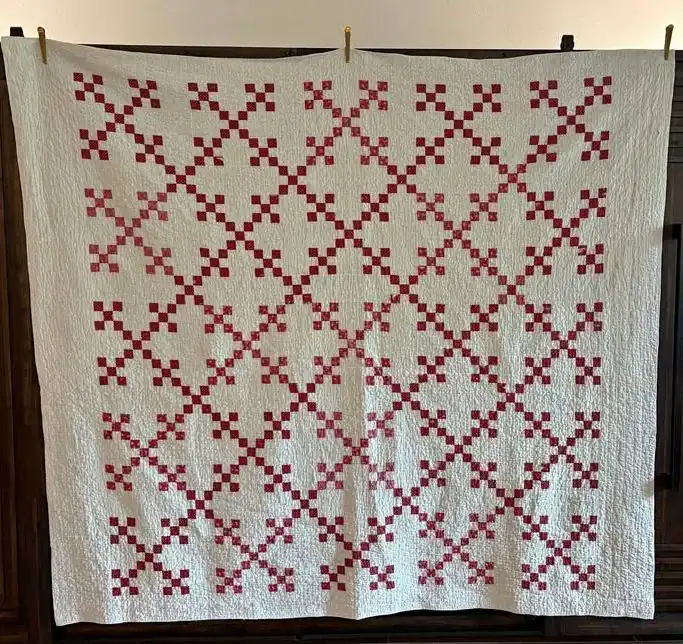
- Irish Chain quilts and maker wealth — a debate over whether an Irish Chain quilt’s fabric and yardage really signal that its maker was well-off.
- Miniature and small quilts — a request for a mailing list devoted to miniature quilts, alongside a colorful anecdote about a quilt made by a 19-inch-tall sideshow performer.
Date: Fri, 25 Apr 97 23:32:24 PDT | From: narmstr [at] ibm [dot] net
Dear Atsuko and other QHLers,
Have not noticed any reply to your question about your flannel with a Japanese Navy flag from Kris … what such “were used for” and “were they popular?” I am sure there is someone who knows far more about these than I, although we have registered several sild cigarette premium quilts in the British Columbia Heritage Quilt Project. However … I thought I would be able to find several books quickly that would contain illustrations of complete quilts made for these little cigarette of tobacco premiums, but it has not proved so easy as I thought.
Houck, Carter. THE QUILT ENCYCLOPEDIA ILLUSTRATED. (New York: Abrams, 1991) has an entry under “Cigarette Premiums” as an “early twentieth century … conscious effort on the part of cigarette companies to entice women to smoke.” Page 444 illustrates three silk flag premiums (from Joyce Gross’s collection) and an explanation that “one inpack variety of premium was a small piece of fabric eveidently intended for the use of quilters. In some brands this was a flag, usually of a cotton flannel fabric … The more elegant silk-ribbon pieces … of the same quality to be found in good ribbon of the period, often with a satin finish and with emblems …” Countries, colleges, butterflies, maps, etc. “quickly became collectibles, as did the flannel flags. The names of the cigarette companies were prominently displayed e.g. Egyptienne Luxury, Old Mill, Nebo, etc. Page 69 has an illustration of a 72″ x 78” (12 rows of 8 flannel flags) quilt made circa 1920 in North Carolina. Two of JAPAN’S flag are included! :>) But not one of the US or Canada :<(
And back to an earlier discussion of Grace McCance Snyder … while I was looking for flag quilts I pulled out …
Crews, Patricia Cox & Ronald C. Naugle. NEBRASKA QUILTS & QUILTMAKERS. (Lincoln: Univ. of Nebraska, 1991) and there is a lovely picture of Mrs. Snyder “the queen of Nebraska quilters” and outstanding plates of three of her quilts: Applique Grapes (1951), Flower Basket Petit Point (19412-1943), and Mrs. McGill’s Cherries (c1945). The grapes (10 stitches per inch & 1,000 grapes) won the purple sweepstakes ribbon at the ’51 State Fair!!! The cherry quilt has 700 perfect one inch cherries, and the petit point quilt has 85,875 pieces.
Sorry for mixing these two, but that is what browsing leads to …
nca
Nancy Cameron Armstrong, CQSG 1109 160 A St., White Rock, BC V4A 7G9; or, 330-151, 1773 H. Street, Blaine, WA 98230-5107 narmstr [at] ibm [dot] net Phone: (604) 538-7551
Date: Sat, 26 Apr 1997 09:40:50 -0400 (EDT) | From: JQuilt [at] aol [dot] com
Does anyone know of a List with members who specialize in Small/Miniature quilts? Please e-mail me at Jquilt [at] aol [dot] com TIA Jean
Date: Sat, 26 Apr 1997 09:10:27 -0500 | From: cabhoney [at] juno [dot] com (Cindy A Honeycutt)
Any good framing store, whether it’s a chain or a privately owned store, should have top quality materials. They should be able to help with any textiles or photos that need to be protected with acid free paper, etc. Cindy Honeycutt
Date: Sat, 26 Apr 1997 17:24:03 -0400 (EDT) | From: Chyral2 [at] aol [dot] com
In a message dated 97-04-26 00:01:25 EDT, you write:
<< I have some cross stitch samplers made in the early 1800s. They are framed, have glass over them, and the backs are sealed with brown paper. Where in the world would I go to have them opened, cleaned (??), and reframed with acid free framing materials???? I live in Northern Calif about 60 miles from the state capital. I am guessing that I should contact a museum but how do I know if the staff is qualified? >>
Well, this is not exactly what I imagined my first post here would be, but here goes:
Most museums, unless they are of the Winterthur, Met or Smithsonian strata, do not have textile conservators on staff. A small musem (local or county historical society) may be willing to provide you with the name of someone local, but most likely they will not be willing to vouche for their competance as it is unlikely that the museum has ever contracted with that that person for conservation services. (The textile collections at many small museums are badly stored, ill-treated, mis-catalogued and generally ignored- I put in an average of 20 volunteer hours a week at our county historical association in an attempt to undo the 60 years of neglect this facet of the collection has suffered. But enough of THAT rant…) A free referral service for conservators is available from Conservation Referral Service of the Foundation of the American Institute for Conservation of Historic and Artistic Works. (The AIC is a professional organization to which many conservators belong.) They can be contacted at: Conservation Referral Service AIC 1717 K Street, NW Suite 301 Washington, D.C. 20036
Their phone # is (202) 452-9328. (I hope this number is still good, the literature I have available at home is from 1993.)
One museum that does have a conservation lab is the Museum of American Textile History, in Massachusetts. They recently moved from North Andover to Lowell (I believe) and unfortunately I don’t have an address or phone # for them, although I should know it by heart. (They are currently conserving a wedding dress for an exhibit I am guest curating.) I will get the information on Monday and post it then.
Please be aware that wet-cleaning any sort of decorative needlework is very risky; there is no guarantee that the threads or yarns are colorfast, and ordinary wet cleaning will not eradict the rust or acidification often evident as a result of non-acid-free framing materials. Usually needlework which has been framed under glass will benefit from the old vacuum-through-a-screen technique followed by reframing with conservation-quality (acid-free) materials. An excellent how-to article on this subject appeared in one of the Nov/Dec 1993 issue of Piecework. The method described is the one used by most professionals and can be easily mastered by anyone who is comfortable with a needle in their hand. (Samplers worked on linen are generally surprisingly sturdy.) With any type of restoration or conservation, though, I always work through a “practice” piece before trying an unfamiliar technique out “for real.”
Sorry for the long (first) post, but I deeply love not only quilts but all of the textile arts; hence, I felt compelled to “share”.
Back to lurking, Cheryl (who should be writing exhibit label text instead of posting to mailing lists…..)
Date: Sun, 27 Apr 1997 08:17:39 -0400 (EDT) | From: GSALLEN1 [at] aol [dot] com
I am new to the list, but have enjoyed the great variety of topics. As a former director of the DAR Museum, I can’t resist an opportunity to rave about their quilt collection. Nancy Tuckhorn is the person to contact regarding the monthly showings and future exhibitions. Several of the quilts we wrote about in A Maryland Album: Quiltmaking Traditions, 1634-1934 have been added to the collection.
For anyone interested in other aspects of needlework – samplers, needlework pictures, etc., the DAR will open a major exhibition on this topic in December. Williamsburg will open their sampler exhibition at about the same time. In early January, the loan exhibit of the Washington Antiques Show will feature applied needlework – pockets, pocketbooks, valances, cradle quilts, pin balls, etc., plus needlework tools – all from the 18th and 19th centuries.
On the subject of needlework, does anyone know of a list similar to this one for samplers/needlework? I am keeping a registry of samplers and embroidered pictures, as well as needlework instructors, from the District of Columbia [Alexandria, Georgetown, and Washington City] and would like to get the word out. If any one out there owns of knows of samplers from that region or from the Eastern Shore of MD [another registry], I would be delighted to hear from you.
Gloria Seaman Allen -former Director and Chief Curator, DAR Museum, now independent historian, curatorial consultant, author and lecturer on the material culture/decorative arts of the Chesapeake region (all while trying to finish my dissertation on slave women who were textile artisans on Chesapeake plantations).
Date: Sun, 27 Apr 1997 07:07:35 -0600 | From: Sharp <sharp [at] gwtc [dot] net
nanday1 wrote: > > Hello all. I’m fairly new to the qhl-digest. I’ve enjoyed reading all > the posts though. I have a question. I am working on my third quilt. (I > guess that tells you how new I am at this!) Anyway, I have pieced the > complete top with the exception of the borders. I would like to have a > 2-3 inch border of a solid color all the way around the quilt then a 3-4 > inch border of a floral print, then more of the 2-3 inch border and then > a 3-4 inch border of additional floral print. The yardage that I have > on the solid color is not long enough to do the sides of the quilt > without piecing it. I thought that I would just measure to the center > of the side of the quilt and make sure that I put the seam of the border > in the center. The bottom and top would not have a seam on the border. > Will this look okay? What do you all do when you don’t have enough > length or yardage on a piece of fabric that you would like to use for a > border? I know that people do make pieced borders that have patterns to > them. I am not interested in doing that with this particular quilt. It > would take away from the quilt on this I think. I plan to stipple the > borders anyway, so I think that it would mask the seam line anyway. > Your comments or suggestions would be greatly appreciated. I plan to > work on the quilt tomorrow morning. Thanks! > > Angel
Hi Angel, Sounds like you have the right idea about piecing with a seam in center. However, an alternative is piecing in thirds, so the seam is not in direct center, the most visible place for the eye. Another alternative is to piece shades of your solids, kind of a pieced border. You can make it subtle shades, so you’ll need smaller strips of each. You can do that in many different patterns. Hope this helps. Best of luck to you. Barb
Date: Sun, 27 Apr 1997 13:15:30 -0400 | From: quiltmag [at] mindspring [dot] com (Jean Ann Eitel)
Jane how miniature does the teacher have to be? I am 5′ 2″… LOL
Sorry, couldnt resist. I teach classes in Miniature Quilting. 🙂
Jean Ann Eitel, Editor QUILT magazine – http://www.quiltmag.com
Date: Sun, 27 Apr 1997 22:46:46 -0400 (EDT) | From: Calicot [at] aol [dot] com
I have a small collection of vintage 1930 fabrics. Most are not feed sacks,however, I think that I do have a few pieces of feed sack. Here is my question: what kind of blocks would you recommend be used to sew up some of the fabric. I was given 20 large size Dresden Plates which I am currently hand appliquing onto authentic 1930s white background fabric (purchaced from the Kirk Collection). I don’t want to do another one. I found a picture of an 6″ Maple Leaf block that is used in groups of 4 with the stems pointed inward (making a 13″ superblock). Would it be appropriate? The fabrics in the picture looked like they might be 1930 but in the browns, reds and blacks. Would that pattern be odd in the pastels? Another question: What patterns would you suggest that would use up very small pieces of fabric (3″ square, for example). A lot of the quilts from that period seem to use wild assortments of colors and patterns together. Would it be appropriate use a more planned style of color? I do have some solid pieces of fabric. Do you think that I can mix them with the prints to make a tamer combination? And my last question: Do any of you know of any good books about this period–especiall ones with colored pictures? Thanks–Jan Carroll
Date: Mon, 28 Apr 1997 00:43:54 -0400 (EDT) | From: AMDOODAH [at] aol [dot] com
This may be a new category. While in Paducah, I met a family that had a full-size quilt from a minature lady. She was 19″ tall and worked for Barnum & Bailey and was a member of the Lilliputian (SP?) Society. She had a quilt made from her teeny costumes and they had it in their van. I didn’t get to see it but the story was fascinating. Their name was Smith and they were from Louisiana. I’m sure this really happened but I WAS awfully tired. Joan
Date: Mon, 28 Apr 1997 08:08:15 -0400 | From: “Jim Twigg” <jtwigg [at] radix [dot] net
Someone mentioned the book “FLYING HIGH: THE AIRPLANE IN QUILTS” by Ragi Marino. Could anyone give me more information ? I’d like to locate a copy. I have a vintage “Flying F” quilt top and I’d like to find some quilting designs to link it with airplanes and flight. Thanks !
Phyllis
Date: Mon, 28 Apr 1997 08:30:14 EDT | From: debatqps [at] juno [dot] com
Borders – I have always put my seams off center in the borders and when piecing quilt backs. The reasoning being, and I can’t remember where I heard this, that the seam is a weak spot and everyones inclination is to fold in half, putting the seam in the fold constantly and the seam will wear faster.
Debbie in NJ
Date: Mon, 28 Apr 1997 07:32:36 -0500 (CDT) | From: Karen Benson <benson [at] mailbox [dot] mail [dot] umn [dot] edu>
I honestly don’t know anything about a “funeral quilt” in its historic perspective, but I wanted to share with you the story of my friend, Ruth, who was an avid quilter and died in January of this year. She was a wonderful friend who has quilted for many many years. I was supposed to go to the MN Quilter’s Convention with her this summer — we had reserved the hotel — when she got an extremely strong case of the flu — the flu! — and died. She was about 45 years old.
At her wake, all of her friends brought back quilts she had given them. Since she was especially fond of applique, and flowers especially, her family had all the small flower quilts on stands standing amongst all the flowers surrounding her coffin (about 25 of them). Hanging above her coffin, was a beautiful quilt she had made of the nativity scene, and next to it a watercolor quilt that had a cross in the center of it. Her brother, who is a builder, had built rough free-standing quilt stands all around the room and all her full-size quilts were standing. It was like an art show. In a place of honor, next to the coffin, was a stand with her one and only quilt “trophy” that she received at the fair. But, and I’m still crying as I type this, laying over Ruth was a quilt all of her many nieces and nephews made the night before. They had gone into her “stash” (which she loved) and using wonder under cut and ironed a quilt “to go with her.” Each 12″ block was a personal message from each niece and nephew and showed the love that family had for her in such a beautiful way. Her sisters simply stitched it together and it went with her unfinished — so she “would have something to do when she got to heaven.”
I’m sorry this is so long, but it gave us so joy and enabled us to think of Ruth with a smile entering those gates with an unfinished top in her hands. I can think of no greater send-off, and no greater love than that woman had. Thanks for listening to me. karen Karen Benson University of Minnesota Foundation Phone: (612) 624-1568 Home: (612) 789-0447
Date: Mon, 28 Apr 1997 06:22:40 -0700 | From: Bobbie Lewis <bobster [at] aa [dot] net>
Hello everyone, A friend of mine brought over pictures of a quilt she wants to sell. This was done by her grandmother,we think in the thirtys. I have pictures which I can scan and send along to those that may be interested. I have no idea what this is worth so any help or interest would be great. Thank you for your time and thought. Bobbie in Seattle
Date: Unknown date | From: Cindy
Howdy All,
Have finally recovered from the wonderful experience in Paducah. I spent Thursday, Friday & 1/2 Saturday walking & talking & gaucking at all the stuff.
I did not originally intend to go “antiquing”, but after finding so many wonderful shops, I couldn’t help myself. I came home with two antique tops, and three quilts.
I even met several of you. How funny to walk into a booth by the pool, and hear, “Ok, hand over the money” in reference to spotting me in my big safari hat! I was actually a bet. Who could spot me in the throngs of quilters. Well, I sure suprised them, by visiting their booth on the first day!
Getting ready to take apart one of the quilts. There is another quilt inside, and I can’t wait to see what shape its in.
Cindy
Date: Mon, 28 Apr 1997 10:58:10 -0500 | From: bgroelz [at] ton [dot] net (Brenda Groelz)
I watched a cable crafts show last week called “Home Matters”. This show features lots of guest presenters and one last week talked about quilts. Frankly, I didn’t stick around long enough to see what her project was, but the lead-in was a hoot…well, actually, it was rather sad!
The hostess asked the presenter about what you could learn from looking at a quilt (or some such lead in). The presenter held up two quilts, one a multiple fabric, pieced Sunburst quilt, with many blocks made up of about twenty printed diamonds radiating out from the center. Get the picture? Lots of intricately sewn pieces in this quilt, lots of fabrics that appeared to be mid-late 19th century, double pinks, browns, shirting prints, possibly mourning prints.
The second quilt was a four color, Double Irish Chain. Muslin, turkey red, chrome yellow, deep green. Okay, but not as wonderful as the Sunburst.
“What can you tell us about these quilts?” the hostess asked. “Well! You see all these fabrics in this quilt?” The presenter picked up the Sunburst quilt. “You can tell the woman who made this was poor. These are all scraps. Probably from her dresses.”
“But,” she said as she picked up the Double Irish Chain, “the woman who made this one was rich, because this quilt was made from YARDAGE! And do you know what fabric cost in the mid-1800’s? $6.00 a yard! A quilt like this took six or seven yards of fabric, and this was in a time when you could build a house for$100! So, you know this woman was RICH!”
I shut off the TV. But, I should have written a letter! Why is it that the people who don’t know ANYTHING about quilt history are the ones that end up on TV?
Date: Mon, 28 Apr 1997 11:13:40 -0700 | From: Frank & Inge Stocklin <stocklin [at] erols [dot] com
Hi Phyllis
Re alphablet quilts: I have a book that I sell that is a reproduction of a 30’s alphabet quilt. Let me know if you are interested in patterns as well as quilts. Hope you checked with Kris at the Denton show; she has quite a selection of quilts and will probably keep her eye out for you for what you are looking for. Won’t go to Market this spring. Too much fabric from the Nov. show. Good seeing you at Denton. Regards, Inge > >
–
Date: Mon, 28 Apr 1997 15:02:22 -0400 (EDT) | From: Ffion
Because they don’t quilt, so they have time to talk.
Ffion
Date: Mon, 28 Apr 1997 19:14:11 -0400 (EDT) | From: JOCELYNM [at] delphi [dot] com
On 26-APR-1997 22:32:42.6 nanday1 said to JOCELYNM >on the border. Will this look okay? What do you all do when you don’t >have enough length or yardage on a piece of fabric that you would like >to use for a border? I know that people do make pieced borders that Angel, I piece it. <G> Seriously, I consider myself a ‘traditional’ quilter…and traditionally, one was about as likely to have to piece an individual piece in a block, as one was to have enough fabric to make unpieced borders. Honestly, I don’t worry about things like that. But solid fabric does show seams more prominently than prints. With some prints, making the seam on the bias can make it nearly invisible (on others, a square seam does the same thing). If it really bothers you, you could always set something in there, to make it look planned. Maybe a monogram, or a motif from the quilt, set deliberately in the middle of each side???? Jocelyn
Date: Mon, 28 Apr 1997 21:13:33 -0400 (EDT) | From: Chyral2 [at] aol [dot] com
As promised, the address is:
Textile Conservation Center Museum of American Textile History 491 Dutton Street Lowell, MA 01854
Phone # is 508 441 1198.
-Cheryl
Date: Mon, 28 Apr 1997 21:30:37 +0000 | From: “The Garretts” <bgarrett [at] fast [dot] net>
While I agree that the Irish Chain quilt indicated a certain degree of wealth, rich is a very general term, and many “comfortable” women made quilts from purchased fabric, not just the “rich.” I also am curious about comments concerning the price for a yard of fabric that was quoted – $6 per yard. I have seen store records in southeastern PA that list the prices of calico in 1819 as $.40 per yard, in 1839 as $.20 per yard, in 1849 as $.10 per yard. I am very interested in regional differences in the prices of things, and if anyone has information about prices of fabric, thread, etc, from their region during different parts of the 1800s, please post so we can compare. My personal feeling — until I get proof – kind of agrees with Brenda that $6.00 per yard isn’t accurate.
I also question the statement that 6 or 7 yards was purchased to make the quilt. We are talking 18 to 22 inch wide yardage during the 1800s I believe, so 6 or 7 yards wouldn’t make a quilt. I think Brenda’s point is well taken that this speaker perhaps didn’t know the “details” about quilts and quilting from the 1800s, so made some broad generalizations based on a few tidbits of information. This is how “romantic stories” about quilting get started and are perpetuated. Unfortunately, the general public will believe all that she said, when in fact, she probably isn’t a quilt “authority” at all. I too sometimes wonder how people get on TV, etc.
Thanks for listening to my opinions, and if anyone can share prices of fabric from their region, like perhaps the midwest or Pacific coast, I would enjoy seeing the comparison.
Happy quilting from Barb in southeastern PA <bgarrett [at] fast [dot] net>
Date: Mon, 28 Apr 1997 21:49:03 -0400 (EDT) | From: JOCELYNM [at] delphi [dot] com
On 27-APR-1997 22:47:13.5 Calicot said to JOCELYNM > I have a small collection of vintage 1930 fabrics. Most are not feed > sacks,however, I think that I do have a few pieces of feed sack. >Here is my question: what kind of blocks would you recommend be used >to sew up some of the fabric. I was given 20 large size Dresden Jan, Go to your library and inquire about interlibrary-loaning the Kansas City Star quilt pattern books. They contain copies of the patterns published in the weekly edition of the STAR from the 1920s through the 1960s. You’ll see lots of options of authentic patterns that would have been available when your fabrics were new. If you have trouble ILL’ing them, let me know, and I will try to help. The Spencer Art Museum, repository for the blocks in Hall’s book, has the KC STAR books at its library. I can get more info about them, to help you with an ILL.
Jocelyn
Date: Mon, 28 Apr 1997 21:49:12 -0400 (EDT) | From: JOCELYNM [at] delphi [dot] com
On 28-APR-1997 09:26:01.0 bobster said to JOCELYNM > Hello everyone, > A friend of mine brought over pictures of a quilt she > wants to sell. This was done by her grandmother,we think in the >thirtys. I have pictures which I can scan and send along to those that Bobbie, It strikes me as a tragedy to have this quilt leave the family. Even if your friend needs the $$$, I think she should ask her cousins if they’d be willing to buy it from her, before selling to strangers. There may be someone in the family who’d love to have it. Jocelyn
Date: Mon, 28 Apr 1997 21:49:44 -0400 (EDT) | From: JOCELYNM [at] delphi [dot] com
On 28-APR-1997 15:02:48.7 Ffion said to JOCELYNM > << Why is it that > the people who don’t know ANYTHING about quilt history are the ones >that end up on TV? >> > Because they don’t quilt, so they have time to talk. Ffion, As my mama once said (on another subject <G>): Them what can, do. Them what can’t, talk about it. Jocelyn
Date: Mon, 28 Apr 1997 21:49:52 -0400 (EDT) | From: JOCELYNM [at] delphi [dot] com
On 28-APR-1997 18:25:04.0 texas_quilt.co said to JOCELYNM > Brenda: She was right!!! Could you elaborate? Are you saying the TV expert was right? I find it hard to believe that fabric could cost $6 a yard, and a house could cost $100, in an era where women’s clothing would take perhaps 10 yards of fabric! Surely there’s something wrong in the math, somewhere! Jocelyn
Date: Tue, 29 Apr 1997 06:24:42 -0400 (EDT) | From: Baglady111 [at] aol [dot] com
In a message dated 97-04-28 23:05:37 EDT, QHL [at] cuenet [dot] com writes:
<< On 27-APR-1997 13:08:59.4 quiltmag said to JOCELYNM > We must be on the same wavelength, ’cause I wondered how small the >teacher had to be too! I’m 5’1″–would I qualify??? Jean Ann, and Jane, and Nancy,
You wouldn’t want the teacher TOO much more minuture than that. Otherwise she would not be able to be seen from the back of the room, unless she stood on a table. Which would then make her class higher education. Jocelyn >>
for nancy, jean, and jocelyn (I’m using lower case so teh sort people can read it easy without bendng their neck).,,would people this size use a yard stick or a ruler for measuring..like ‘getting the short end of the stick’?? Jane
Date: Tue, 29 Apr 1997 09:02:11 -0400 (EDT) | From: Baglady111 [at] aol [dot] com
that’s a good idea, Jocelyn..one never knows what others are thinking or doing..a lady needed $$$ so she wanted me to sell her quilt..QUIETLY i mentioned it to a family member. I bought it, her thinking it was for someone else..gave it to the family member..and somehow it made it’s way back to the owner..wonder how much she is asking…maybe a litle ( I regret mentioning little) elf would leave an envelope under her door..do museums ever buy quilts? Jane
Date: Tue, 29 Apr 97 09:36:12 PDT | From: John & Cinda Cawley <cawley [at] epix [dot] net
Our book on the quilt collection of The State Museum of Pennsylvania is going to the printer on Thursday. Each draft we have sent to the museum has referred to the Centennial Exposition in Philadelphia. They have consistently returned it to us as the Centennial Exhibition. Every reference I have seen (McMorris, Peck, Kiracofe, Warren and Eisenstat, etc.) uses the term Exposition. I have just heard from the head of publication for the museum commission that they have an original program from the Centennial Exhibition in Philadelphia and that unless I can come up with a primary source for Exposition (by tomorrow) I lose. My concern is that if we use Exhibition everyone interested in quilts will think we are wrong because everybody else calls it Exposition. Does anyone have a reference to a primary source that I could find fast or have any explanation for this confusion of terms? I have e-mailed Penny McMorris but she is not available until after May 6. Can anybody help me? Thanks. Cinda in Scranton cawley [at] epix [dot] net ——-
Date: Tue, 29 Apr 1997 10:37:13 -0400 (EDT) | From: RBCochran [at] aol [dot] com
Cinda–
Okay, here’s what I found, although somewhat disconcerting to us.
Generally, we refer to it as the 1876 Centennial Exposition in Philadelphia (p. 220, 222, index of New Jersey Quilts), but also call it the Exhibition (p. 223). However, the clincher might be the centennial quilt that appears on page 226. The caption for this quilt reads (in part):
Centennial Quilt, 1876, 72″ x 95″. Made in New Jersey. This patriotic quilt is sewn from 18 printed Centennial banners. Each of the twelve banners on the outside edge has thirteen red and white stripes and thirty-nine white stars on a blue field. The four center banners show the same stylized portrait of George Washington . . ..The remaining two banners are identical, showing a variety of flags and containing the inscription, “Flags of the Nations which participate in the Centennial Exhibition of the United States in 1876.” (click ont the picture to order.)
If the fabric is definitive, I guess you lose. But you have brought to everyone’s attention the fact that we may need to revise our usage.
Sources we used include Dee Brown, The Year of the Century: 1876. NY: Scribner’s, 1966, and others which I can tell you if you need them.
I also looked in Brackman, who uses Exposition.
Have you checked Bishop, All Flags Flying? which might have commemorative stuff in it? (I’m up on third floor and that book is in basement.) If I get a chance today, I’ll look at other sources here.
Hope this helps.
–Rachel Cochran
Date: Tue, 29 Apr 97 09:51:32 PDT | From: “Anne Doerge” <ahdoerge [at] telenet [dot] net
Quilt Designs from the 30’s by Sara Nephew, That Patchwork Place, 1988 might be just what you’re looking for. It has lots of color pictures of actual 30’s quilts, stories about their makers and lots of patterns. I love it!
Anne
Date: Tue, 29 Apr 1997 09:57:27 -0700 | From: Frank & Inge Stocklin <stocklin [at] erols [dot] com
Sotterley Quilt & Needlework Show May 28 – June 1 Sotterley Plantation, Hollywood Maryland
Annapolis Show June 7 & 8 Annapolis Senior High School, Riva Rd. Annapolis, MD
Date: Tue, 29 Apr 97 11:56:16 PDT | From: John & Cinda Cawley <cawley [at] epix [dot] net
Hi Rachel,
All this time I never realized that you were THE Rachel Cochran! New Jersey Quilts is one of the very best of the state quilt books and one of my favorites. I saw the exhibit at the Morristown Museum. Thanks for the references, I really apprecaite you help and will go immediately to All Flags Flying. I did hear from Penny McMorris who also gave me refernces which used both Exhibition and Exposition. My interest is in accuracy, bu I think it’s important to point out that we’ve all (including the Metropolitain Museum and the Museum of American Folk Art) have been calling it the Centennial Exposition when it seems the actual name was Centennial Exhibition. I really do love this kind of thing. I only wish the museum people hadn’t waited till right before the deadline to let me know. I’ll let you all know how it turns out. Cinda Cawley
Date: Tue, 29 Apr 1997 13:00:16 -0400 (EDT) | From: Quilting Heritage ListServ <qrs [at] mail [dot] albany [dot] net
Hello!
I’m back, and I will post on my experiences soon. Right now I am wading through something like 400 e-mails and an equal number of snail mails. But I thought I would mention that the Museum of American Textile History puts out a book called “Just New from the Mills” which shows early prints. It went out of print and they are reprinting it, so I am not quite sure what will be in the new version. I did send them a check to reserve the first dozen – when it comes out, I’ll let y’all know.
Kris
Date: Tue, 29 Apr 1997 15:14:55 -0400 (EDT) | From: RBCochran [at] aol [dot] com
Cinda– Just checked, ’cause I thought I saw another commemorative quilt recently This one is in Shelburne collection: 55 Famous Quilts p. 10. Made from cotton handkerchiefs and flags.Central piece of fabric clearly says Centennial International above a picture of the Memorial Hall Art Gallery and underneath the picture it says EXHIBITION Fairmount Park Philadelphia 1776 1876. And there are pictures of Main Exhibition Building, The Machinery Hall, The Agricultural Hall, and The Horticultural Hall. However, the caption refers to Exposition. Just in case you need another reference. –Rachel
Date: Unknown date | From: Nancy Evans – Nebraska Quilter
The book in question is now in print by Dover Press, under the name “Quilt Designs from the Thirties” ISBN 0-486-28156-6. The price on my book is $7.95! I bought this book about 2 years ago, but Dover prices usually remain constant. Another excellent Dover republication is “Women and their Quilts: A Washington State Centennial Tribute”, by Nancyann Johanson Twelker (27202-8) $9.95. Both a bargain at twice the price!! (IMHO) Nancy Evans – Nebraska Quilter
Date: Tue, 29 Apr 1997 17:06:40 -0400 (EDT) | From: GSALLEN1 [at] aol [dot] com
for Barb in S.E. PA
>From my MD quilt research, I have information from William Willson’s 1817 Day Book [Montgomery Co – drygoods store owner and husband of quiltmaker — see, MD Album, 50-51]
chintz – 60-70 cents/yd calico – 25-50 cent/yard sugar – 17 cents/lb coffee – 30 cents/lb Imperial tea – $3.25/lb!
The document is in the collection of the Montgomery County Historical Society and includes prices for threads, linings, bindings, etc. Also in the collection, Willson’s father-in-laws 1803 estate inventory, which includes the shop inventory for similar goods – requires converting from English pounds/shillings/ pence to American currency. MCHS also owns the magnificent quilt made by Willson’s wife, Sarah Clark.
I do not quilt, but I do think I usually know what I’m talking about after thousands of hours of eyestrain reading period documents in archives!
Gloria
Date: Tue, 29 Apr 97 16:08:27 PDT | From: “Tuck” <kyort [at] nemonet [dot] com>
To Calicot and anyone else:
How lucky you are to have a few jewels in your basket!
You didn’t say how big, nor if you like foundation piecing, just that you didn’t want to do dresden plates again.
There are all sorts of possibilities:
Fans can be paper peiced , lined turned and then machine appliqued. I have done these in very tiny sizes and they are so much fun! That little block can be turned into flowers, candy, circles, snakes, swirls, medalions . . .
for a less ambitious block try a square in square – it’s a great way to show off lots of scraps
old stand by’s like double nine patch or puss in the corner would be appropriate.
If you have Brackmans Encyclopedia (or block base) Look up Nancy Cabot’s Double Triangle. It just cries out to be done with depression scraps on a poison green backgound!
Encyclopedia of Quilt Patterns (click on the picture to order.)
Then there is bow ties done the easy way – (see the latest miniature quilts magazine on dimensional bow ties) or the Monkey wrench.
And if you are truly amitious you can always do the tumbling block or the grandmothers flower garden!!
(What i have just written is a list of my UFO’s !!!!)
Have fun!!
Date: Tue, 29 Apr 97 16:51:45 PDT | From: John & Cinda Cawley <cawley [at] epix [dot] net
Thanks to everybody who responded to my question. For the record. The official name is Centennial Exhibition. Somehow quiltbooks (including the catalogues of the Metropolitan Museum and Museum of American Folk Art) have almost consistently used the term Exposition. Merikay Valdvogel pointed out that Virginia Gunn in her paper on Crazy Quilts in Uncoverings 1984 refers to the Centennial Exhibition. In All Flags Flying (p. 30) there is a close-up of the center block of a quilt made from Centennial handkerchiefs. Printed on the fabric are pictures of various buildings and the words Exhibition Fairmount Park Philadelphia 1776-1876. The caption says, “Any woman returning home from the great Centennial Exposition would have brought back a few of the popular printed kerchiefs…”
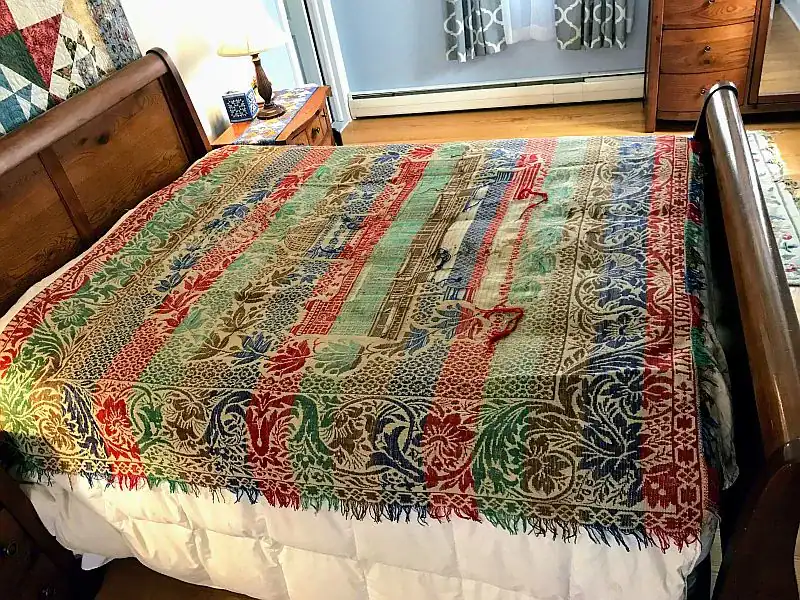
In the library this afternoon I found indications that the confusion in terms began very early on and was certainly not limited to people who were writing about quilts. Publications as early as 1878 were calling it Exposition or World’s Fair. However, publications dated 1876 called it the Centennial Exhibition. Since almost all recent books about quilts use Exposition I think the best thing to do will be to footnote the use of Centennial Exhibition.
Finding an error like this so late in the process makes me very nervous about having people pounce on us once the book is published. We have tried to be very careful but I’m sure we’ve missed some things. I must keep repeating that my co-authors on this project are Denise Nordberg and Lorraine Ezbiansky. Neither of them are on line so I want to be sure you know they exist. That way you can assume that any mistakes are their fault (VBG).
Thanks again; it’s wonderful to put out a plea and have so many intelligent people respond almost immediately. I love my computer! Cinda in Scranton
Date: Tue, 29 Apr 1997 17:04:54 -0600 | From: Elizabeth Richards <elizabeth.richards [at] ualberta [dot] ca
The Conservation Service at the University of Alberta is a fee for service part of the Department of Human Ecology (i.e. Home Economics). We are the only place in Canada that has a conservation program in textiles (both as a curatorial/conservation speciality in a BSc program and as a Masters of Science program).
The Conservation Service is a way that we share our expertise with members of the public and small and medium size musems that don’t have a textile conservator. We clean lots of samplers (and Christening gowns, and quilts and contemporary fiber art and tourist art and …..you name it. (We don’t clean some things too – like painted pictures on textiles.) (We just finished mounting a (silk) regimental color that was carried to WWI and had hung until it was shreading in a local church.) This morning I heped wet clean a gorgeous 1930’s quilt – I think from a kit – never used and never cleaned and dirty just from storage.
I think we are reputable (said of course without bias!) and are very careful with what is wet cleaned. We charge $40 Cdn per hour – which is a bonus for Americans since $1.00 US – $1.40 Cdn.
We have found from (exasperated) experience than many good art framing shops who do use “conservation” materials do not realize that a spacer should be put between the glass and the textile sample in order that the glass doesn’t press down on the textile. This is especially important with raised textiles, such as embroidery.
Chyral in #114 made some excellent comments about being careful. The one thing that a wet cleaning can do, when it is done correctly, is help to reduce the acidity of an old textile. Vacuuming alone will not do this. Often in needlepoint samplers one color will run and it takes an experienced person to clean samplers without damage.
Enough said – if I sound like a teacher – I am. I teach conservation and feel it is very important for us who work at a university to share what we learn. This is not to say that there is only one answer – there are always lots of ways to solve a problem. – —————————- Elizabeth A. Richards, M. S., PHEc.
Date: Tue, 29 Apr 1997 21:19:22 -0400 | From: Ricki Maietta <rmaietta [at] csrlink [dot] net>
Hi everyone. Just finished putting together a new list of workshops/lectures w/color pictures of class samples. Anyone want a copy, privately e-mail me.
On cigar silks & flannels – my apologies to the woman who wanted more detailed info on the cigar silk pillow at our museum. When I stopped in, they were having “important visitors” & the storage room was locked for the day. I’ll go back soon. And, I thought the flannels were just “collectibles” – like Cracker Jack toys for adults! Am I wrong – was there more to it?
Ricki
Date: Tue, 29 Apr 1997 23:50:33 -0400 (EDT) | From: KBoxmeyer [at] aol [dot] com
Dear Karen (and other “listeners”): Thank you for your post about your friend Ruth and her funeral service. Truely, the service was more than a funeral service, but a memorial service. I feel at a loss not having known her. Sincerely, Kimberly Bristol, PA
Date: Tue, 29 Apr 97 21:48:18 PDT | From: narmstr [at] ibm [dot] net
Dear Phyllis,
Review from COVER STORIES June 1996
Marino, Ragi. FLYING HIGH: THE AIRPLANE IN QUILTS.(Waupaca, WI: Stardust Publications, 1994) Marino, a quilter since 1988, is a petroleum geologist who has “put geology on hold” to raise her children. I learned of her airplane project during the time I was conducting a study of Gulf War quilts. Marino inquired about possible quilts with airplanes connected to that war, as she was involved with historical quilt research on airplane blocks. What prompted this line of inquiry? Her chairmanship of “Quilt Liberal 92” led to an exhibit of “26 airplane and rocket blocks” which debuted at the Mid-American Air Museum in Liberal, KS. This small first exhibit triggered her interest into further research which culminated in a fascinating history of the airplane quilt block, 1927-1993 and a touring exhibit (available from the air museum). Not only did she locate Vou Best � who in 1991, following Desert Storm, designed Hornet, Stealth, Phantom, and Warthog blocks � she has identified and provided an extensive 10 page chronological bibliography to 50+ plane blocks, or planes in quilts.
Following a meticulously footnoted “History of Airplane Quilts” which begins with the first blocks honoring Charles A. Lindbergh’s historic non-stop flight across the Atlantic, the blocks are presented chronologically with a history and, in most cases, a sample quilt either historical or made recently. Also included, photographs of the planes on which block designs have been based. Highly recommended and a striking example of the diverse possibilities of “quilt study.” 67p.8 � x 11 color throughout, 16p. contemporary patterns. Printed in Hong Kong. ISBN 0-929950-18-6 $17.95US Softcover
Although published in 1994, I did not learn of it until 1996 when I wrote directly to The Radley House Publishing of Waupaca, WI. They sent that and a 1/2 dozen other older tiles. I expect if you can’t find FLYING HIGH through your “regular” sources, that The Radley House might well have a copy. It is a lovely little book.
nca
Date: Wed, 30 Apr 1997 08:34:50 EDT | From: debatqps [at] juno [dot] com
Quilt Designs From The Thirties by Sara Nephews is still available and I am almost positive the price is still $7.95. We sold a bunch of tjem at the Feedsack Convention in Lancaster earlier this month.
Debbie in NJ
Date: Wed, 30 Apr 1997 09:10:02 -0400 (EDT) | From: SadieRose [at] aol [dot] com
In addition to “My Mother’s Quilts” by Sara Nephew, here are some other good books with photos and patterns for ’30s era quilts: “Twentieth Century Quilts 1900-1950” by Thomas K. Woodard & Blanche Greenstein pub by EP Dutton 1988 ISBN # 0-525-48115-X This one is photos & text, no patterns. I don’t know if it is still available to purchase, but should be through inter-library loan. “The Romance of the Double Wedding Ring Quilts” by Robert Bishop patterns & intstructions by Carter Houck pub by EP Dutton 1989 ISBN # 0-585-48477-9 Entirely focused on DWR quilts, but a good resource with probably every color & pattern variation ever seen in DWRs!! I don’t know if it is still available to purchase, but should be through inter-library loan.
Judie Rothermel, who designs the “Aunt Grace’s Scrapbag” line of repro fabrics for Marcus Brothers, has done 2 books of patterns to compliment her fabrics. The first, “Aunt Grace’s Scrapbag- Pattern Ideas for a 1930’s Fabric Collection” contains patterns & photos for 6 quilts. This book was self-published in 1992. The second, “Aunt Grace’s Scrapbag Fifth Anniversary” just came out this spring (1997). It contains patterns & photos for 13 quilts. Both give info on the AGS line of fabric. Happy Quilting!! Karan from cold & rainy Iowa
Date: Wed, 30 Apr 1997 09:16:35 -0400 (EDT) | From: Baglady111 [at] aol [dot] com
Debbie, I’ve been meaning to ask you..do you see an upswing of people buying the quilt history books more so now? More so than pattern books? and I’m glad you sold alot at our convention..Jane
Date: Wed, 30 Apr 1997 09:23:44 -0400 (EDT) | From: Baglady111 [at] aol [dot] com
Monica Novini..I’m looking for you..Jane
Date: Wed, 30 Apr 1997 14:20:25 -0400 (EDT) | From: BFquilter [at] aol [dot] com
Dear Karen, I too was greatly moved by your description of your friend Ruth and the wonderful tribute by her friends and family. In fact, I’ve thought about your post for the last few days. I shared your story with my DH and told him that when my time comes, I too would love to have my quilts displayed as they were with your friend. Thank you so much for sharing the story with us.
Barb in MN (where the Red River is finally receding but thousands are still out of their homes)