May 1 – 6 1997
These restored messages come from the Quilt History List, an online forum where quilt historians, collectors, researchers, appraisers, and enthusiasts discussed antique quilts and related textiles. The archive dates from 1996 through approximately 2016 and is being restored gradually. Sign up in the form at the bottom of the page if you want to know when a new page is added. Original spelling, opinions, formatting, and inactive links may remain unchanged.
Primary topics of this QHL Digest:
- Quilt-history books outselling pattern books — shop owners and collectors compare notes on whether history titles are now outselling how-to pattern books.
- The Centennial Exposition debate resolved — the naming confusion from the previous digest is settled with newspaper and program evidence for “Exhibition.”
- Merikay Waldvogel’s speaking schedule — an event listing for a Merikay Waldvogel lecture, plus enthusiasm for The Feedsack Club and quilt-history reading generally.
- Dating quilts by fabric color — a discussion of why so many surviving 19th-century quilts are brown, and what that says about a quilt’s age.
- Detective work behind a 250-signature quilt — one member traces the makers of a signature quilt bought at a show, turning up a personal connection along the way.
- Feedsacks beyond quilts — members list the many other household items — vests, curtains, pillows — that were sewn from feed and flour sacks.
- “Beard guards” and “whisker cloths” — a curious antique-quilt feature is identified: strips of fabric basted to the top edge of a quilt to protect it from a sleeper’s beard.
- Cheater cloth and how to date it — members share what they know about printed “cheater” fabric designed to mimic pieced patchwork, and how far back it goes.
- Museum quilt-purchasing practices — members compare notes on whether local museums ever actually buy quilts for their collections.
Date: Thu, 01 May 1997 08:32:12 EDT | From: debatqps [at] juno [dot] com
Hi Jane and all, Yes, I see an increase in the amount of history books that have sold lately BUT we are carrying more titles and I am sure that has something to do with it. Some totally unscientific observations – its mostly older women buying the books and younger women buying the reproduction fabrics, with the exception of the Aunt Grace’s book, mostly younger women buying that. Why? Good question. I sell more of the books that tell actual quilters life stories than of the state history books and I think thats because they are more personal with pictures, etc. I have had people coming out of the woodwork with their antique tops or quilts to show me or tell me about since I have been bringing my antique tops and quilts to my quilt guilds show and tell. I do a trunk show for local quilds, I bring class samples, new stuff from the store and antique quilts and the antiques generate more interest than anything else. Our guild will have our biannual quilt show next March and it will be a retrospective of the last 98 years of quilting and that has generated ALOT of interest in antiques and quilt history. ( I can hardly wait to see the ones we all did in the 70’s polyester and all!!!! hung with the ones from the early 1900s.) I have had ALOT of advance inquiries into the availability of the new RJR 1930s line (which supposedly were shipped this week so check your local quilt shops),
Debbie in NJ
Date: Thu, 1 May 1997 09:11:57, -0500 | From: LVQG24A [at] prodigy [dot] com ( ELIZABETH K DONALDSON)
Expo Vs. Exhibit: It seems like they are both correct. Could Exposition refer to the entire event and the Exhibition refer to displays at the event? Maybe that was the original intent of the organizers and since the names were so similar the two different uses became interchangeable inadvertantly? Sounds like the confusion started many years ago and it would be historically inaccurate to try and “solve” it now. The footnote can take care of it. To the authors I don’t think this one cloudy area will take away from a well researched and fascinating book. I am also working on final editing of a book and this is always a nerve racking time. No matter how many times you edit and how careful you are in the process, there is always a typo or glitch somewhere! Good luck.
Beth Donaldson
Date: Thu, 1 May 1997 17:15:03 -0400 (EDT) | From: QuiltAlive [at] aol [dot] com
Merikay Waldvogel will be the luncheon speaker at “Quilt Gathering” a one-day quilt event sponsored by Riverwalk Quilters Guild of Naperville, IL.
Place: Radisson Hotel in Lisle off I-88 out beyond Eisenhower Exwy Time: Saturday, May 10 9:00 a.m. to 3:30 p.m. Cost: $25.00 Call Helene McDonald 630-527-1633 or pay at the door.
Quilt Raffle, Charm Square Exchange, Ugly Fabric Exchange, Vendors including Quilting Books Unlimited–PLUS lunch, slide talk, show & tell of World’s Fair quilts and souvenirs!! This is a first-time event, but they already have 250 signed up. If you are in the area, come and spend the day. We can even talk about QHL fun.
Yes, that’s me blowing my horn, but it should be lots of fun. I’ll be giving my slide lecture on the 1933 quilt contest AND include all the neat stuff Barbara Brackman and I found since writing the book “Patchwork Souvenirs of the 1933 Chicago World’s Fair.” –Merikay Waldvogel
Date: Thu, 1 May 1997 19:30:34 -0400 (EDT) | From: Baglady111 [at] aol [dot] com
In reply to Debbie of my question “do you see people buying more of the books about quilters than pattern books”..I recall numerous years ago when I was about to buy yet ANOTHER pattern book..I finally realized..all I was doing was buying the same patterns in different colors..or placement..it was the colors and the designs attracting me..and had I made any of that BEAR’S PAW or HOLE IN THE BARN DOOR? NOPE!! I had ‘whatever’ patttern in every size imaginable..but what about the quilters of year’s gone by..
Merikay Waldvogel’s SOFT COVERS FOR HARD TIMES..TREASURES IN THE TRUNK (click on the picture to order) ..how fascinating to read about the makers..not competitive quilters, in most cases..many NEVER entering a quilt contest..none of them out their paddling their canoe just as fast as they could..quilters leaving behind a legacy..unbeknownst, in most cases..it’s been years since I have purchased a pattern book..I’m not surprised in the least of the growth for quilters’ history..and as Debbie mentions, the older quilters are the buyers. Took me long enough!! Jane
Date: Fri, 2 May 1997 06:41:48 -0400 (EDT) | From: Baglady111 [at] aol [dot] com
MERIKAY, please BE SURE to also take some” SOFT COVERS for HARD TIMES ” with you..I tel enough people about it!! wish I could be there..Merikay is a valued member of THE FEEDSACK CLUB..and you are all going to have a great time with her..ENJOY!! Jane
Date: Fri, 2 May 1997 08:56:14 -0400 (EDT) | From: Baglady111 [at] aol [dot] com
GGG=GOOD GRIEF GROUP..just what I needed..thanks to the posted address for the QUILT HISTORY PAGE, I have now discovered a new site and source..when I first learned how to get onto the web, my neighbor who showed me, said a glaze came over my eyes and I said, “I’ll quit my jobs, I’ll order in, and buy a tanning lamp so that no one will know I have’nt been out of my apt in 6 mos”..now with the discovery of this history site..make that a year..Jane
Date: Sat, 3 May 1997 06:55:34 -0400 (EDT) | From: AJSNGS [at] aol [dot] com
Hi all,
Was there a particular time frame in which browns were used alot in the making of quilts? My sister has a quilt that my great grandmother made and we believe it’s made somewhere around the turn of the century or slightly before. It’s mostly in various brown prints.
Thanks in advance,
Nancy Sentipal in rainy Virginia AJSNGS [at] aol [dot] com
Date: Sun, 04 May 1997 07:10:49 +1100 | From: Sven Olsson <sven [at] pnc [dot] com [dot] au>
Nancy, The browns of late last century were very popular in clothing as well as quilts. Your sister is very lucky.
Lorraine in Oz
AJSNGS [at] aol [dot] com wrote: > > Hi all, > > Was there a particular time frame in which browns were used alot in the > making of quilts? My sister has a quilt that my great grandmother made and > we believe it’s made somewhere around the turn of the century or slightly > before. It’s mostly in various brown prints. > > Thanks in advance, > > Nancy Sentipal in rainy Virginia > AJSNGS [at] aol [dot] com
Date: Sat, 3 May 1997 17:04:26 -0500 | From: “Kathy O’Meara Magnuson” <KOMQuilt [at] interaccess [dot] com>
Thanks, Merikay for blowing your horn. It’s a great opportunity and I’m really looking forward to it. There are also a variety of demos; I’m doing one on the use of Computer Programs to Aid in Quilt Design. This is usually a 2hour presentation that provides an overview/analysis of a variety of programs, both those that are intended to design quilts (Electric Quilt/BlockBase, Quilt-Pro, QuiltSOFT, VQuilt), and some that are not (like CorelDraw, Tesselmania! and KidPix). However, in discussion with the person who’s chairing the demos, it appears they’re more interested in highlighting a few of them in a very casual manner. I have a couple reservations that this will make me look less than professional and well prepared, but also don’t want to err on the rigid scale, especially since I’m getting clues that informality is the letter of the day… Heck, I might just learn this the best approach possible 🙂 At any rate, I think it’ll be a ton of fun, and I’m counting down the days…
On another note, there’s been a reply about the “official” AQSG webpage being a work-in-progress, but someone might have been referring to this page. It’s the bare bones, and is probably online without official backing or status from them (but great for promoting their existence!). From the World-Wide Quilting Page, it’s: http://www.ttsw.com/History/AmericanQuiltStudyGroup.html AND – this mailing list is highlighted on the previous page: http://www.ttsw.com/QuiltHistoryPage.html
-kom-
Kathy O’Meara Magnuson Elmhurst, IL (west suburban Chicago) KOMQuilt [at] interaccess [dot] com
Date: Sat, 3 May 97 21:29:54 PDT | From: John & Cinda Cawley <cawley [at] epix [dot] net>
Let me tell you about the fun I had on the way to Pittsburgh last Friday. At the PA Extravaganza in 1994 I bought a quilt with 250 signatures from a dealer from Kansas. She had bought it from another dealer in Ohio who told her only that it came from northern PA; I didn’t think this was much help considering how big that area is. I sometimes think that lots of people think that all the eastern states are about the size of Rhode Island.
Anyhow, this quilt is quite different from what I usually buy. For one thing, it’s very pretty (most quilts I like are sort of weird). It measures 67″ square: 25 eleven inch blocks, six inch borders of 2 inch strips of yellow on either side of a two inch strip of white. Each block has an appliqed keystone (yellow with green buttonhole stitch) in one corner and diagonally oposite a spray of embroidered golden rod. Embroidered on each block in purple are 10 names. Not all the blocks were made by the same person, but the quality of the workmanship is generally very good. It is beautifully quilted in a one inch grid. The overall effect is very spring-like. I hang it in the living room for Easter.
The colors are definitely 1930s. Since the mountain laurel was declared our state flower in May of 1934, the quilt probably wasn’t made much later than that. I think the maker intended to stress the PA connection and would have used the state flower rather than golden rod if there had been one at the time.
The names are arranged in family groups. There are 102 different surnames, some appear only once, but many are in groups of 2 or 3. One name, Gaston, appears 35 times. I knew that the quilt was probably not made in a city or large town because there are no Irish, Italian or Slavic names. I checked the soundex and found lots of Gastons around Phila., but ruled them out. The next largest concentration of Gastons was in Indiana County about 60 miles northeast of Pittburgh (definitly not northern PA). My daughter graduated from the Univ. of Pgh. last Sunday. John and I decided to drive out on Friday and check the Historical Society of Indiana County.
I’ve researched other friendship quilts but they were all of the 1850-1875 vintage where I was dealing with census records, etc. This was a whole different ballgame. The Hist. Soc. had wonderful family files with all sorts of great stuff. I started checking my list alphabetically and there they were, neatly arranged in folders. It was so exciting we skipped lunch and worked for fours hours straight until the library closed. I even found a photo of two of the signers at their golden wedding celebration.
I had assumed because of the sheer number of names that the quilt was a fundraiser for a church or grange. What we discovered was that all the people we identified (about half) are related–one huge extended family. Most of them lived in the Mahoning area of northern Indiana Co. or near Punxsutaney (yes, home of the famous Phil the groundhog). One of the ladies at the Hist. Soc. looked over the list and remembered that one of the signers kept the store near her girlhood home and that his son had died last summer. She showed me the obituary of the son (whose name was not on the quilt) and then proceeded to find me the address and phone number of the widow. I have been trying to contact this lady. No luck so far. My next question is, of course, why and for whom was the quilt made.
At this point I’m sort of hoping that DD Kathleen decides she wants to stay in Pgh so that I have an excuse to go back to Indiana (county seat and location of Hist. Soc.) soon. I am very eager to find someone who may be able to tell me why the quilt was made. Cinda in Scranton
Date: Sat, 3 May 1997 19:48:22 -0700 | From: Ellene Gravelle <gravelle [at] ridgecrest [dot] ca [dot] us>
I have been looking everywhere for “Ho for California, Pioneer Women and Their Quilts” by Jean Laury with no luck probably because it is out of print. If anyone has a copy for sale, or knows where I can purchase copy, please let me know. Since I’m a native California, I would like a California quilt history book for my library. Thanks. Ellene Gravelle
Date: Sat, 03 May 1997 21:59:17 -0400 | From: Ricki Maietta <rmaietta [at] csrlink [dot] net>
Jan Carroll asked about an appropriate pattern for using 1930s fabric. Around here what I see alot of is a sort of “Trip Around the World”, but the little squares are on point – so I think that is called “Boston Common”. I’ve seen a zillion of them, all 30s or so, lots of feedsack too. They usually have an inner border, & then a plain (unprinted) wider outer border. They are quilted with straight lines going across the squares from corner to corner, with a cable design on the border. Very bright & fun.
Ricki
Date: Sat, 03 May 1997 23:07:43 -0400 | From: “Miklos B. Lukacs” <mlukacs [at] webbernet [dot] net>
Cinda, how exciting to be able to locate the signers of your quilt. You are some sort of detective!!. Connie L.
Date: Sat, 03 May 1997 23:13:22 -0400 | From: “Miklos B. Lukacs” <mlukacs [at] webbernet [dot] net>
I just did this quilt last year. My love is scrap quilts. Lots of different fabrics and lots of color. This fit to a tee. I quilted it in and overlocking zigzag type stitch. The borders were all in muslin, with the formal type of quilting to contrast the informal splashes of color. I have received many compliments. It is the first quilt I have kept for myself in all the quilts I have made in 4-1/2 years. I enjoy it so much I have decided to make more for keeping! Connie L.
Date: Sun, 04 May 1997 01:38:10 EDT | From: nikdeb [at] juno [dot] com (Nick R Hofland)
Hi folks….
I am into quilting (fairly recently) and rather creative in my own way, and I would like to know what others have done as far as using feedsacks in quilting? I’ve noticed you mention “feed sacks” off and on in your postings. Forgive me if this seems like an off-the-wall question!
I have a lonely feedsack from my parents’ farm in Wisconsin…been saving it for years…trying to figure out what to do with it….at one point thought of turning it into some kind of wall hanging (using stretcher bars?) for the family room.
Any suggestions?
Thanks in advance….
Deb Hofland in recently rainy, hopefully soon-to-be sunny Spokane, Washington!
Date: Sun, 4 May 1997 06:55:58 -0400 (EDT) | From: Baglady111 [at] aol [dot] com
In re: to how we use feedsacks..mostly in quilts, but also vests, skirts, blouses, pillows, wallhangings, doll quilts, miniatures, curtains, table cloths, etc..actually EXACTLY the way they used them back in the 20’s/30’s..I replied openly to QHL incase others would like to hear my answer but am emailing you priavately as well..Jane
Date: Sun, 4 May 97 09:01:26 -0400 | From: Christa Sigman <sigman [at] eurekanet [dot] com>
Cinda, Are there any signatures from Winebergs on the quilt. I am related to the Winebergs in Puxatawny. I know there is another family name you should look for as well, but it doesn’t come to mind at this time. I will ask my mom.
Christa “Rockin Mama” Sigman
*Did you ever wonder why there is a highway to Hell and a stairway to Heaven?*
Date: Sun, 4 May 1997 10:33:48 -0400 (EDT) | From: AMDOODAH [at] aol [dot] com
I have been buying boxes of old quilting info whenever I can find them and just bought some things that include 3 wrappers from “Cotton Queen” Batting made by The Dominion Wadding Co. of Montreal. 2 are in only fair condition and one is perfect – inside each is a pattern for a quilt, with instructions (like Mountain Mist produces for the US). I am unsure about the year these were printed but they are clearly not new. Are there any Canadians on this list that would like to have them? I would like to keep EVERYTHING I find but I’m quickly running out of room, so these are free to a good home. E-mail me at AMDOODAH [at] aol [dot] com Joan
Date: Sun, 4 May 1997 12:43:51 -0400 (EDT) | From: Karan
Hi, everyone!! I haven’t been posting much lately, getting ready for DS#1’s graduation & party, and I have also started a new job! Still read every post & respond if I can. At our QUILT ID Day last Saturday, we saw several older quilts that had a protective sleeve over the top edge. We’ve been told this was to protect the top edge from the men’s beards. Seems like there was a humorous name for these – but I can’t think of it! Ring a bell with any of you?? TIA< Karan from warm & sunny Iowa
Date: Sun, 4 May 1997 15:55:02 +0000 | From: “The Garretts” <bgarrett [at] fast [dot] net>
Karan and interested others —
How exciting to see quilts still with the beard guards on. When we did documentation in the Goshenhoppen Area — a mainly rural German area of southeastern PA — in the early 90s we also saw beard guards. This was exciting for many of us lay people as we had not seen them before. Being so unusual, I have remembered the two I saw. When you say older quilts, do you mean late 1800s, turn of the century or 1930s? Just curious as I remember ours being turn of the century.
Nancy Roan writes the following in her book Lest I Be Forgotten, page 76 —
For our readers, we turn to International Domestic Arts Society by Nancy Brooks Pickens (Scranton, PA: Woman’s Institute of Domestic Arts and Sciences, 1923, p. 193). “Protection of comfortables — To protect comfortables from becoming soiled along their upper edge, a piece of cheese cloth (old style, not modern cheese cloth) may be attached there.”
This curious addition applied to one edge of a quilt was discovered on only two quilts examined. Neither of these examples were local quilts, but rather quilts brought into the documentation area by newer residents.
Author Nancy Roan recognized the addition from her youth in Upper Frederick Township, Montgomery County. “I recall a muslin ‘binding’ on the top edge of a patchwork comforter. This addition was removed easily and washed. I do not recall a name for this (bieard or whisker guard); it was just htere. My mother, raised in eastern Berks County, PA, also applied similar protection to blankets.
End of quote. If anyone else has information about these, please share with the list. Thanks.
Barb in southeastern PA <bgarrett [at] fast [dot] net>
Date: Sun, 04 May 1997 15:44:24 +0400 | From: Xenia Cord <xecord [at] netusa1 [dot] net>
Hello, all:
The strips of fabric loosely basted to the tops of comforts (comforters or tied quilts) and also to more formal quilts are somewhat common in central Indiana, especially on cotton quilts of the late Victorian era. In fact, I even have some embroidered and cutwork muslin pieces called quilt protectors, with finished edges. They are like wide width, short length (about 24″) sheets, finished on one edge much as fancy sheets are finished.
In more casual quilts and comforts, this strip may be a piece of printed cotton, sometimes matching some aspect of the quilt beneath, so that it was obviously intended to be a complementary part of the bedcover. One woman I asked said these were also to protect the top of the quilt from body soil, so that the quilt did not need laundering so often. (How often we see quilts with one edge fraying, the fabric soft and sometimes shredding, and with that teltale yellow discoloration.) Obviously the protectors served in stead of a top sheet.
Xenia
Date: Sun, 4 May 1997 16:48:14 -0400 | From: “Barb Burke” <bburke [at] zoomnet [dot] net>
Hi Gals, The quilt artist and author, Faith Ringgold, is coming to our community this Friday. One of her quilts, and a book by the same title is, Tar Beach. She has won the Coretta Scott King Award as well as the Caldecott Award for this book. I will possibly be driving her around to her different engagements, which I’m so excited about! I am posting to you because I have a Cassie doll (the main character of Tar Beach), which I am hoping that she will sign. If anyone else on this list has a doll which they would like signed, e-mail me privately so we can work it out. Here is a small excerp from a page in the book about Faith and Tar Beach, a story quilt. …Faith Ringgold has been a painter since the 1950’s. In the ’70’s she began to work in soft sculpture, collaborating with her mother, Willi Posey Jones, a fashion designer and dressmaker, who had a major influence on her interest in quilts. Willi Posey described watching her grandmother, Betsy Bingham, boil and bleach flour sacks to line the quilts she sewed. Susie Shannon, Betsy’s mother, was a slave in antebellum Florida who made quilts as part of her duties. Ringgold’s quilt designs echo the African-influenced, repetitive geometric design characteristic of many Early American quilts. I thought that some of you might find this of interest, especially the flour sack part! Peace,Piece, Barb
Date: Sun, 04 May 1997 21:05:03 -0500 | From: LAURA SYLER <texas_quilt.co [at] airmail [dot] net>
Lisa Erlandson wrote: > > I am trying to do some research on differing costs in various regions of the > country. I need the following information: > 1. Costs of: > piecing a top – simple, moderate or intricate piecing > applique – simple, moderate or elaborate > quilting – sparse, medium or heavy > > 2.Pricing: Do you price by the size, by the block, by the square foot, > square inch, etc. > > 3. What does a finished quilt (describe size and difficulty level) sell for in > your area? > > If you can help me, I would appreciate it. I will be happy to share my > results when they are complete. Be sure to include where you are in the > country (or outside of US!!) > You can e-mail answers to: erland [at] cooke [dot] net > Thanks!! > > Lisa: Here are some(*) of the labor costs in the Dallas area.
Piecing a top, by machine, i do not have anyone that will do one strictly by hand any more really depends on the pattern. Sorry I cant give you any more info. We have done Double -Queen Carolina Lily tops for @ $250.00, Trip Around the World, double for about the same , basically any thing we can strip piece will be about the same, add @ $75.00 for King. i just was associated with a vintage double size Dogwood top that was “barley” started. The person charged $200 to applique and finish the rest of the top. ( Saw the finished quilt at Quilt Plano this evening and it is BEAUTIFUL!!)
Machine quilting goes for $.03 a square inch retail. Hand quilting is between $.03 and $.05 a square inch depending on the pattern and needed amount of quilting. However, there are times that I quote a flat price based on quilt size. Most of the quilters that I use ( and I am always looking for more people to do hand quilting) charge additional for binding. Anywhere from $25 to $75 additional depending on edging. Obvioulsy scallops are the higher $.
Applique goes for about $25.00 a block if you are doing patterns like the Piece O’Cake Designs, Something like Pat Campbells Jacobean applique, $35. to $40. per block. I am working on a Baltimore Album and the cost is $85 per block. This is Grade A #1 Best Work Around pricing.
Finished NEW quilts (antique quilts are a whole other story) in the Dallas area can be found from anywhere from $350 simple pattern, minimal quilting to $2,500 unique design, intricate pattern heavily quilted, with no problem. Hope this gives you the info that you are looking for. If you need more please let me know. Laura
Date: Sun, 4 May 1997 22:26:22 -0400 (EDT) | From: CToczek [at] aol [dot] com
Hello everyone!
Here’s a topic I haven’t seen addressed on the List in my short time aboard.
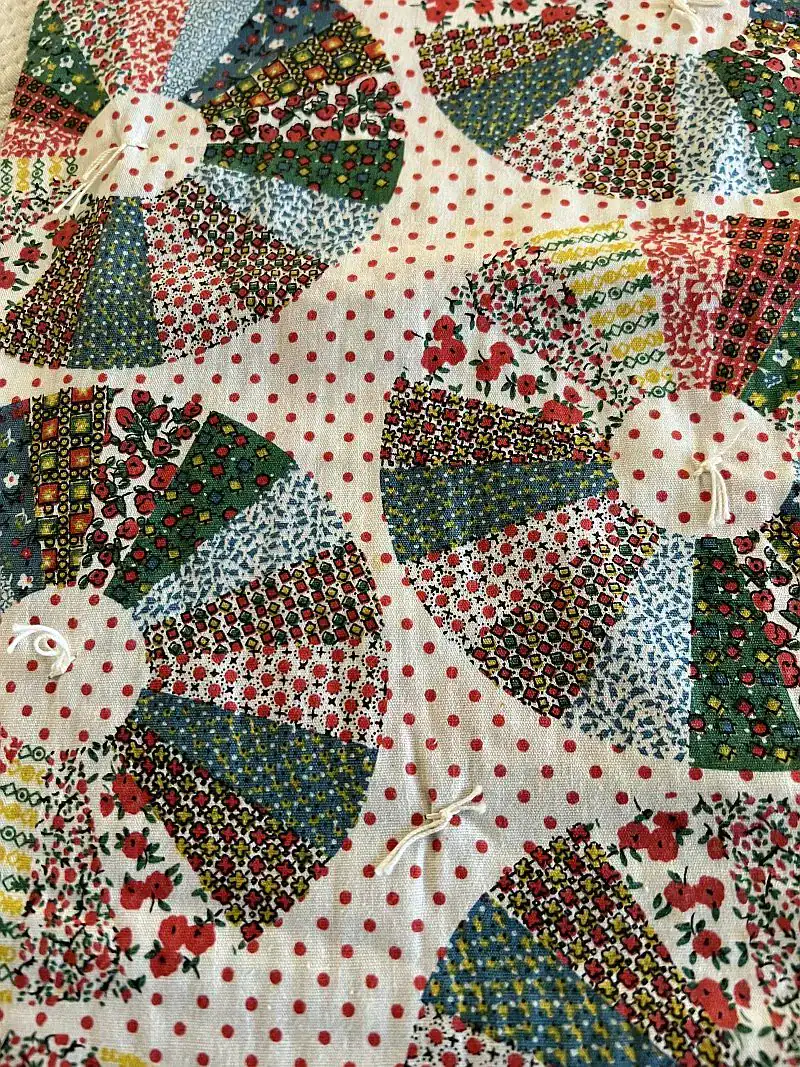
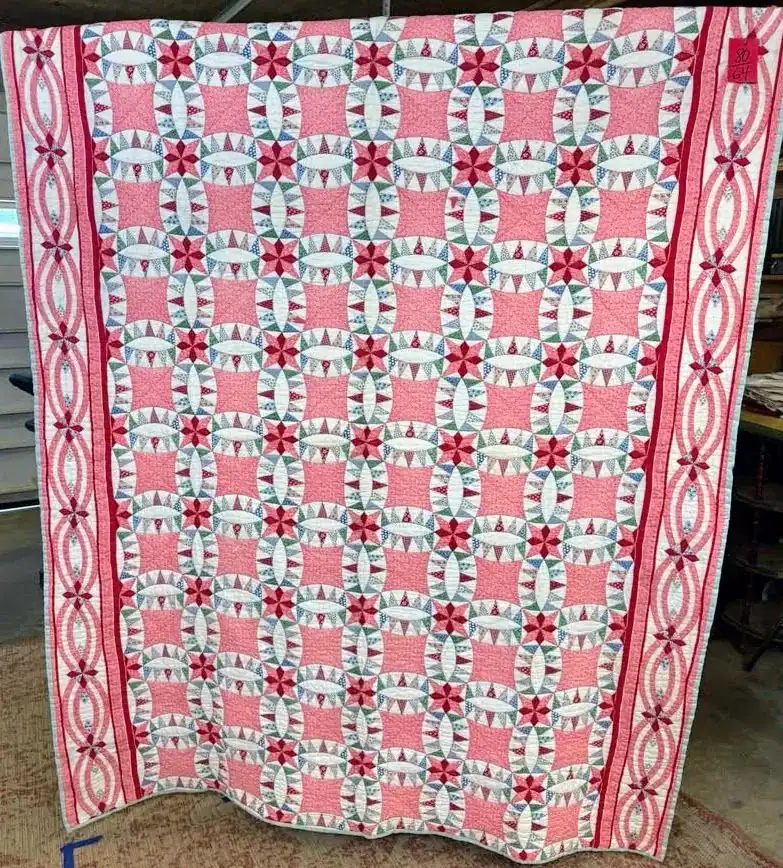
A year ago I picked up a cheater cloth quilt at a flea market; it caught my attention from a distance because of the bright 30’s look to it. Upon closer inspection I discovered it was indeed a double wedding ring cheater quilt, done in reds, yellows and kelly greens (maybe 40’s?.) It is worn smooth and faded from much use and washing, but the nice quilting stitches have held up. Needs new binding, too. I purchased it inexpensively, mainly as an oddity. I’ve read that these cheater tops were available through the Sears & Roebuck catalog. Obviously we’re talking apples and oranges here between this old cheater quilt and a hand-pieced example from the same period, but is there any value to it other than it’s oddity in my collection? Just wondering and would appreciate any commentary.
Thanks,
Carla in West Texas, still sweeping the dirt from Friday’s dust storm
Date: Sun, 4 May 1997 23:40:14 -0400 (EDT) | From: AMDOODAH [at] aol [dot] com
I often have quilts with “beard covers” basted on top edge of quilt, in fabrics similar to those found in the quilt. Last week I bought two muslin beard covers with hand made buttonholes, one has rickrack trim and one is just plain. These came from central Illinois and are the first I’ve seen that require buttons on the quilt to attach them. They appear to be quite old but little used, the date is a bit of a mystery since they are so plain. If anyone would like to buy one for current use, e-mail me and I’ll measure to see what size quilt they were made for. Joan AMDOODAH [at] aol [dot] com
Date: Sun, 4 May 97 20:55:09 PDT | From: narmstr [at] ibm [dot] net
Dear SadieRose and other interested QHLers,
An extra piece of fabric may have more than the purpose of guarding from beards. In the British Columbia Heritage Quilt Project we had 9 quilts made in the 1930s and 40s in Gordonsville, New Brunswick by Edith Pearl Jones Deplissey 1889-1973 (of Irish, Welsh, and Belgian background). Several of them had anywhere from a 2 1/2″ to 4″ piece of fabric (which matched the backing) handsewn over the sashing and binding at each end of the quilt. Her daughter’s explanation was that was “to keep the edges CLEAN.”
Re: Faith Ringgold … wonderful as TAR BEACH is, I would like to suggest Faith’s “autobiography.” This is the review from the June 1996 issue of COVER STORIES. A book that merits reading and rereading!
Ringgold, Faith. WE FLEW OVER THE BRIDGE: THE MEMOIRS OF FAITH RINGGOLD. (Boston: Little, Brown, 1995). In 1980 Ringgold designed Being My Own Woman: an Autobiographical Masked Performance Piece as a way to have an oral publication of her autobiography for which she could not find a publisher. In the Women’s Studies Quarterly XV: 1 & 2, Spring/Summer 1987 “Being My Own Woman” first appeared in print. That early 1980 manuscript, with the editorial help of Moira Roth, friend and colleague of Ringgold and Trefethen Professor of Art History at Mills College in Berkeley, has become this powerful, informative, chronicle of one African-American woman’s artistic, political, and personal struggles and successes. It makes a major contribution to the literature of cultural studies and to an understanding of so much of what has happened since the 60s for women in general, women of color in particular, and people of color in the visual arts. “Flying is about achieving a seemingly impossible goal with no more guarantee of success than an avowed commitment to do it.” After a multi-faceted career of forty years — painting, teaching, performing, speaking, and writing — Ringgold flies high with works in prestigious public and private collections, seven honorary doctorates, five published children’s books, and a continued commitment to “working in the face of adversity” to challenge racism and sexism in the art world (and elsewhere) and making dreams come true. Highly recommended. 288p.8″ x 9�” 101 b/w photos & 32p. color illus, appendix, chronology, index. ISBN 0-8212-2071-3 $39.95CAN, $29.95US Hardback w/dustjacket
Date: Mon, 5 May 1997 01:27:22 -0400 (EDT) | From: CTislander [at] aol [dot] com
Perhaps someone on this list has an idea about the strange quilt I recently acquired. I bought it through the East Bay Web Auction. It was shipped down from Canada.
The quilt (and I use that term because I don’t know what else to call it) is 70-inches x 77-inches and is made up of triangles measuring 7-inches at the bases with altitudes of 3.5-inches. Each triangle was individually constructed from a square of fabric folded diagonally. The raw edges were folded under and seamed. The completed triangles were whipped together with heavy red and yellow thread to form the 7-inch squares. The square blocks were then whipped together. The “quilt” is the same front and back.
Fabrics are: cotton prints from the 40s, satins, white pique, twills, silver-shot blue, woven cotton plaids, faille, plain blue cotton, and a really strange feeling black stuff with lime green and bright pinks (it could be a synthetic) just around the edges. Some of the triangle pieces feel thicker than others.
I’ve never seen or read about anything like this. Is anyone familiar with this method of assembly? I have a file photo (jpg or gif) which I can attach to e-mail if anyone wants to see this creation. The photo looks a lot better than the real quilt.
Christine Thresh in the California Delta ctislander [at] aol [dot] com or ctisland [at] ix [dot] netcom [dot] com
Date: Mon, 5 May 1997 05:25:00 -0400 (EDT) | From: Baglady111 [at] aol [dot] com
I have a friend in VA who does CW re-enactments..think he could help? They dress in original costume..Jane
Date: Mon, 5 May 1997 05:27:54 -0400 (EDT) | From: Baglady111 [at] aol [dot] com
I will look forward to the answer of value of the 30’s cheater’s cloth too because I have several, pristine condition, in feedsack…Jane
Date: Mon, 5 May 1997 06:24:28 -0400 (EDT) | From: Nancy in VA
To Christine Thresh and all,
I’m glad you posted on your “new” and strange quilt that you were high bidder on. I watch alot of the quilts that are auctioned on ebay and saw this one too. Let us know what you find out about it.
Nancy in VA
Date: Mon, 5 May 1997 08:54:23, -0500 | From: Beth in Michigan
Cinda, Make sure and take great notes, it sounds to me like a fascinating story and great paper for a future AQSG Uncoverings paper! Keep up the good work. Beth in Michigan
Date: Mon, 5 May 1997 08:11:59 -0500 (CDT) | From: Lisa Erlandson <erland [at] cooke [dot] net>
I have several quilts from my grandmother with a protective piece of cloth, usually a piece of a sheet, loosely stitched onto the top edge, extending down about 4 inches on front and back. She has always called these “chin guards” with the explanation that it kept the body oils off of the quilt when the quilt was used on the beds.
Date: Mon, 05 May 1997 09:28:32 -0400 | From: Ricki Maietta <rmaietta [at] csrlink [dot] net>
Jane asked if museums ever purchase quilts. I can tell you that our local museum does not purchase anything. In fact, the only thing they ever purchased was a long rifle at the insistence of the then director – & now the authenticity of that gun is in question, & I won’t go into what became of the director. So – most small, local museums really don’t have the funds for purchasing, & do rely on donations. Also, most have a “collections policy” that give guidelines for what they will accept. For our museum to accept any artifact, it must relate somehow to local history. Of course, that can be stretched quite a bit. I don’t see them selling off the Quaker signature quilt, even though that was not brought to our area unti the late 1950s! Give the museum director or curator a call & ask.
Ricki in PA
Date: Mon, 5 May 1997 10:22:50 -0400 (EDT) | From: Joan
Anxious to hear what info derives from this post. I have one too, mine is all silk prints – bright and medium scale oriental type florals and paisleys, edged with “points” that I associate with the 30’s and 40’s – but the woman that sold it to me insists it was made by her Grandmother at turn of the century. ( However, there are lots of faulty memories and family “fables” out there.) I saw a pattern for this type of quilt in a Woman’s Day magazine in the 70’s – I remember it because it seemed so unique and produced a completely reversible quilt. Joan
Date: Mon, 5 May 1997 10:28:38 -0400 (EDT) | From: AMDOODAH [at] aol [dot] com
I too would appreciate any info or book references on the use of cheater cloth. I seem to have samples from several different eras and even on both sides of a wholecloth quilt that I don’t think is American. Joan Stevens AMDOODAH [at] aol [dot] com
Date: Mon, 5 May 1997 11:33:57 -0400 (EDT) | From: Baglady111 [at] aol [dot] com
Has anyone seen the two books from NOW & THEN PUBLICATIONS entitled QUILTING NOW & THEN, and the 2nd one COTTON NOW & THEN? When we offered to take peoples products to convention because you could’nt get there, we received two books from this company owned by Karen Bates willing & Julie Bates Dock..What a delight these books are for young people..SADIEROSE, if you are interested in reviewing, I’ll see that you get a copy of each..wonderful for those little ones playing in your area while you are quilting/or bedtime reading..they got alot of attention at convention..and if Karen or Julie is reading this..I need you email address..Jane
Date: Mon, 5 May 1997 13:18:22 -0400 (EDT) | From: KBoxmeyer [at] aol [dot] com
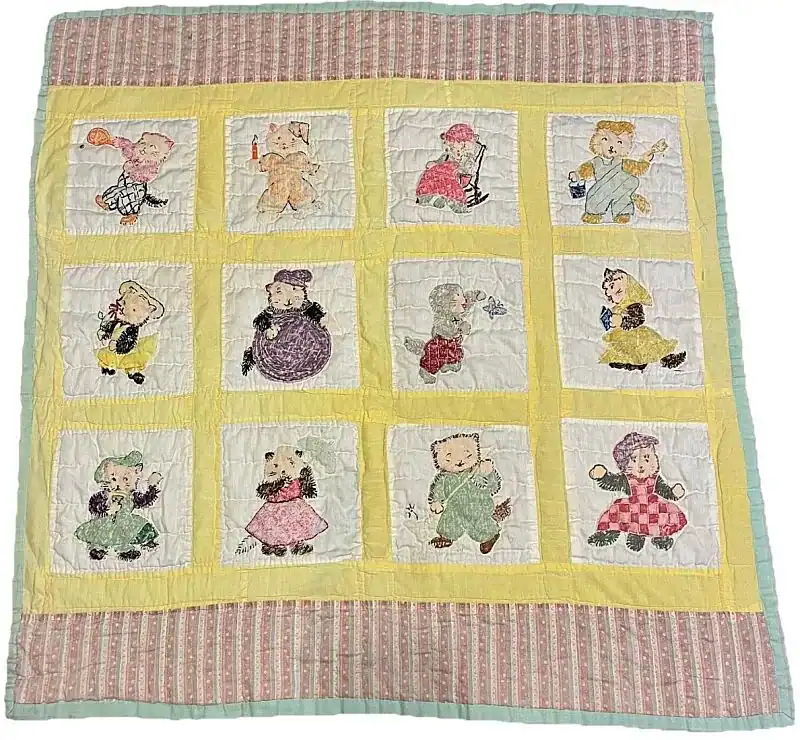
I was hunting around Ebay Auction Web today. I saw this quilt and I remembered that some of you were interested in embroidered pieces. The seller describes it thusly:
“Adorable 33″ X 38” baby quilt suitable for crib or carriage. The quilt consists of seven panels, each with a different day’s child done in embroidery by someone with a VERY fine hand. The stitches are so tiny you cannot count them without a loop. The squares are machine stitched together, and there is a flannel “receiving” blanket between the top and back of the quilt for warmth. This does have a little wear around the edges, but it is so sweet. It’s all cotton, probably used a baby crib sheet. Very soft. A real treasure. All the squares are in excellent condition. Buyer to pay priority shipping. “
Date: Mon, 5 May 1997 14:48:51 -0500 (CDT) | From: Cynthia A Wall <wallcyn [at] mail [dot] auburn [dot] edu>
Nancy Sentipal asked about a brown quilt her great-grandmother made. Being the novice, I looked up what I could in Barbara Brackman’s Clues in the Calico.
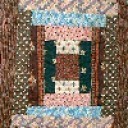
BB says, beginning on page 70, “The easiest generalization to make about brown as a clue is that it dates a quilt before the twentieth century….certain shades of brown can be a more specific clue to narrower eras, although distinguishing among the various shades takes practice…..”
Browns loss pf popularity after 1900 may have been a reaction to the earlier rage for brown charm quilts…… (there was a) distinct change in the swatch books of the 1890’s when the previously ubiquitous brown prints gave way to black. (page73)”
Continuing on page 72, “Determining if a brown fabric in a quilt was always brown is not easy. Be suspicious. Look at the patchwork design; brown leaves and stems in a floral applique were possibly gree when new. Borwn grapes and rosoes are likely to have looked fresher once. Look for evidence of the original color in the sewing and quilting thread and in the seams where the fabric may have been protected from light. The browns left after fading are distinctive; they tend to be pale and dun-colored, rather than the rick warm shades of deliberate browns……Shades likely to fade to brown were green, purple, blue & red…..”
Hope this helps. I don’t guarantee anything; I’m just getting into this area of quilts, and find it fascinating.
CIndy
Date: Mon, 5 May 1997 14:00:46 -0700 | From: “Robert E.Kypta” <vger [at] cwnet [dot] com>
I have several quilts which have “whisker cloths” on them. Some of them are rather plain just hemmed over muslin and loosely attached to the top of the quilt. I have one which is elaborately embroidered and very beautiful on a 30’s quilt. I also have another 19th century quilt with a whisker cloth that is really more like a quilt guard. It’s muslin, about 30 inches long and folds over the quilt . I think it was probably used to keep the quilt clean from soil from your hands, etc. I also have one that has the cloth just 2/3 of the way across the quilt, so it must have only been for the “misters” side of the bed. I think they are very interesting and probably a good idea when the cleanliness of the people may not have been up to our modern standards. The cloths are a nuisance when I want to hang a quilt but I don’t feel right about removing them either.
Catherine in sunny Sacramento
Date: Mon, 05 May 1997 17:08:39 -0500 | From: LAURA SYLER <texas_quilt.co [at] airmail [dot] net>
Ricki Maietta wrote: > > Jane asked if museums ever purchase quilts. I can tell you that our local > museum does not purchase anything.
Ditto that in Texas, at least the Dallas County Heritage Society for one. The other thing that I have learned in doing further research on the disposition of the Sanitary Commission quilt is that most museums not only do not have the funds to purchase quilts, but most of them do not have adequate storage facilities. The real heartbreaker is that if you donate a quilt to a museum or historical society they have the right to sell off your cherished piece at any time they wish for a “fundraiser”. The best thing to do if you are giving ANYTHING to a museum is to have it on permanant loan to them so that you do know where the piece is at *almost* all times. If they feel they can no longer care for your piece, they can return it, rather than sell it off. Just a word to the wise…..
Date: Mon, 5 May 1997 19:15:30 -0400 (EDT) | From: AJSNGS [at] aol [dot] com
To Cindy Wall,
Thank you for that wonderful information from “Clues In The Calico” by Barbara Brackman. I can hardly wait to go see my sister (well the quilt really) and check out the colors. I’ll pass this information along to my sister in the meantime.
Guess “Clues” should be on my Christmas list don’t you think?
Many thanks, Nancy Sentipal in VA
Date: Mon, 05 May 1997 18:39:16 -0800 | From: Opalka <mopalka [at] alaska [dot] net>
Barb, Is this the author of the children’s book, “Tar Beach”? The book about having a picnic on the roof top of her apartment? It is so neat to get to meet these author/illustrators. Patricia Palocco, who wrote/illustrated “The Keeping Quilt” was in Anchorage in March. She shared her story of the keeping quilt, whose shirt had been used to make “the yellow horse”, and so on and then showed the quilt to us. It made quite an impression on the children. How special that you get to meet her! Susan(in sunny Alaska where the snow has almost all melted!)
Date: Mon, 5 May 97 21:14:16 PDT | From: narmstr [at] ibm [dot] net
Dear Christine, Nancy, and other QHLers,
Now isn’t that a wonderful coincidence. Way back in 1993 I started on a what was to be another research project (following my AQSG paper on quilts made in reaction to the Gulf War) on what I described as “pot holder quilts.” Quilts made up of what appeared to be potholders, whipstitched together. Several people in a variety of places sent me information on quilts dated from as early as 1850 and as late as 1993. I have been meaning ever since I have been on QHL to write and ask for help with this project, and now … Christine has just purchased such a quilt!
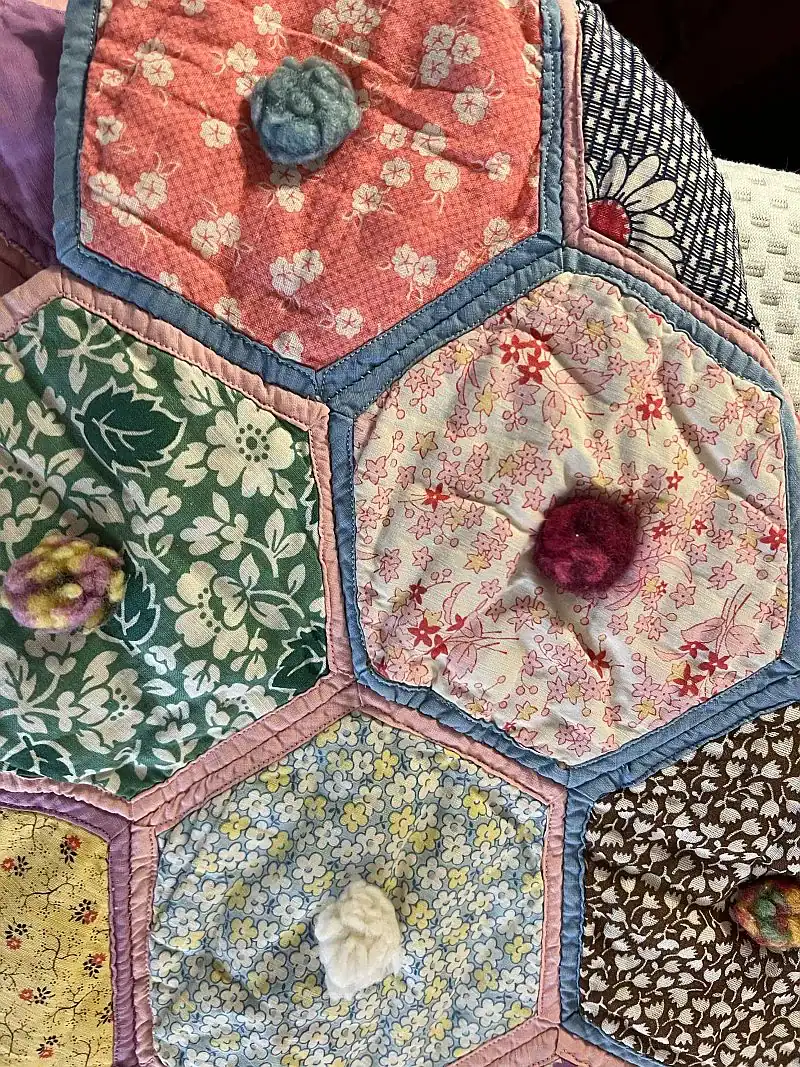
Carolyn Maruggi made a copy for herself and most generously sent me her original of GRANDMOTHER’S PATCHWORK QUILTS; COMPLETE INSTRUCTIONS FOR TWELVE OF GRANDMOTHER’S FAVORITES on page 8 has a “Crazy Quilt” made up of “triangles” from 4″ squares.
Step 1: Place a 4-inch swuare of wadding on top of quilt material; place pattern directly over the wadding and with a moderately hot iron, press back the seam allowance over the wadding, thus making a line for sewing.
Step 2: Fold in half dieagonally (sheet wadding inside) and baste along the open edges.
Step 3: Quilt along open sides -3/8″ in from edge- using a short running stitch and contrasting thread.
Step 4: Place edge of traingles together and sew with an overcast stitch. Four triangles to form a square.
Step 5: Place edges of squares together and sew with overcast stitch.
A similar pattern has appeared in other publications. Frustrating, but not unusual, these pattern books often have no dates! or publishers! mentioned. I checked Brackman’s ENCYCLOPEDIA OF PIECED PATTERNS and her list of titles includes GRANDMOTHER’S PATCHWORK QUILTS! under Famous Features (see page 523) “a syndicated, mail-order source that still sells pattern booklets from a New York address … They appear to have begun in the 1940s, probably an outgrowth of CAPPER’S WEEKLY patterns.”
The booklet has a 40s look, however one of my examples (from Teddy Pruett, thank you very much) was of a quilt made in the same triangle manner that was obviously of 30s fabric.
I am absolutely delighted to have this spur “to get at this project” once again. I would WELCOME hearing from anyone who has a “potholder” quilt … blocks of any size or shape that are bound separatedly as a “potholder” and joined by whipstitch. I would like to know as much as YOU know about the quiltmaker, quilt, and provenance. I am willing to remimburse for photographs, slides, and/or photocopies of information. Please feel free to contact me by E-mail, and/or to send photos/slides and printed information snail mail to USA or Canadian address, whichever suits best.
Hoping to hear from dozens of you! nca … excited at the prospect
Date: Tue, 6 May 1997 11:09:49 -0400 (EDT) | From: Quiltfix [at] aol [dot] com
Christine, I saw a red and white version of the same pattern down here. It was red and white (the squares were half and half). I also remember the triangles were used for a “sawtooth” border. It appeared to be depression vintage. Really interesting, but they wanted much more than I was willing to pay. Unfortunately, I don’t have any info on the pattern, but at the least, you know the pattern was wide ranging, ’cause I’m in Florida!
Regarding quilt purchases, well, I read somewhere that the Smithsonian has only ever purchased one or two quilts (one was made by someone like Michael James, if not actually him). With all the people willing to make donations, I have a feeling there is an overload, if not just the potential for it. While at the first QRS conference in Omaha, we were allowed in the storage area for a local museum. What fun! besides all these boxes and boxes of quilts (2 and 3 to a box, mind you), there were shelves to high ceilings just stacked with all sorts of neat stuff! Furniture, war memorabilia, toys, etc. But the amount of stuff was overwhelming, especially since this was an extremely large room. It also wasn’t a controlled environment. Sometimes giving over a quilt is a major matter of faith.
About what is done with a quilt after you no longer want it, well, you gotta let go. Make your decision, then give/sell to whoever, but just be realistic enough to understand that no one, not even the restoration nut next door, is going to value the quilt the way you do.
I’ve been hearing stories in the last month that are incredible. A lady was telling me how she found five quilts in the neighbor’s trash. She knocked on their door to get permission to take them and ended up with eight more! That makes 13 quilts total. Then, this Saturday, a friend was telling me about a friend of hers. It seems her friend’s MIL died recently, and while going thru the house, they came across three rainbarrels stuffed full of quilt tops (no rain)! According to the story, there are a total of 250 (no – no typos – two hundred and fifty quilt tops). Cross your fingers – I may get to see them if I’m really lucky. My friend told this lady she knew somone who might be interested in a deal (MIGHT?!?!?! Yea, right!).
Oh, the auction with that cool green and red quilt I told you about will be June 2 in Plymouth, NH. Email me if you are intending to go, and I’ll put you in touch with the auctioneer. He’ll send you a catalog. There will also be another r&g quilt, and two drop-dead samplers from the early 1800’s. I’ve seen pictures and wish I lived up there. This appears to be an auction with really good early American items. By the way, I get no money for this – we do no business (although he knows me well enough now to know to ask my opinion on quilts).
Alan
Date: Tue, 6 May 1997 12:45:06 -0400 | From: “Judy Grow” <Judygrow [at] blast [dot] net>
I returned from a weeklong trip to the Fort Worth area (visiting family) and as I do every trip, I went antiqueing, both in Fort Worth, and in Hillsboro. I came home with a wonderful quilt top from the 30’s, all had sewn in tiny pieces of green and white solids, with tiny 8 pointed stars of typical prints of the period. There are a couple of fabrics that need replacement, and a number of seams that need resewing, but when I finish it, it will be spectacular! I just has to stand in line with the other old tops ahead of it.
I also got 4 yard lengths of brown/white and black/white gingham from the turn of the century, or before. Selvedge to selvedge it is only 27 inches. I wound up paying only $9.00/yard, a pretty good price, I think.
I also added two more cast metal pin cushion shoes to my collection, also at very good prices.
All of the above from a large co-op antique mall in Fort Worth.
From Hillsboro I brought home lots of tiny pearl buttons, and 5 complete feed sacks, all different. I think I paid $6.00 apiece for the feed sacks.
I also went to my favorite Quilt Shop in Fort Worth, the Quilter’s Emporium on Vickery, and although the shop was open, it was stripped bare to the walls. The owner had taken virtually her entire shop to Padukah, which was the same weekend I was in Texas! So I had to search long and hard, but finally found a couple of pieces of yellow print to buy. Judy in NJ judygrow [at] blast [dot] net
——————————
Date: Tue, 06 May 97 11:30:00 PDT | From: “Martin, Pamela C” <pmartin [at] gdnet [dot] ucla [dot] edu>
Hi, I don’t think I sent this question to the correct address the first time — Did anyone ever answer exactly where Faith Ringgold is appearing? Thanks, Pamela Martin pmartin [at] gdnet [dot] ucla [dot] edu
Date: Tue, 6 May 1997 15:10:05 -0400 (EDT) | From: BBMorris [at] aol [dot] com
Christine The first time I visited in my MIL’s home in 1961, she was making a quilt that sounds just like the one you have. She had cut squares, folded them diagonally to make triangles, sewed them up leaving a small space to turn them right sides out, then stuffed the, with either an old nylon stocking or the leg cut off a pair of pantyhose, then whipstitched the opening closed. After she had several made, she would whipstitch them together into squares and then into designs. She made a fairly large quilt that way that was reversible. I know that after I got home (she was in VA and we lived in CA) I saved old stockings and pantyhose until we moved. I never did make one. I’m not sure what ever happened to the one she made. I never saw it again.
Barbara in GA bbmorris [at] aol [dot] com