March 12 – 28, 2000
These restored messages come from the Quilt History List, an online forum where quilt historians, collectors, researchers, appraisers, and enthusiasts discussed antique quilts and related textiles. The archive dates from 1996 through approximately 2016 and is being restored gradually. Sign up in the form at the bottom of the page if you want to know when a new page is added. Original spelling, opinions, formatting, and inactive links may remain unchanged.
Primary topics of this QHL Digest:
- Swastika & Egyptian Revival Motifs — The swastika-symbolism thread continues into a discussion of Egyptian Revival design following the discovery of King Tut’s tomb, and how it reached quilt and textile motifs.
- Dating Multi-Generation Quilt Tops — Members discuss how appraisers should date a quilt top finished decades after its blocks were pieced, coining “multi-generational quilt” for the practice. (see the article on dating quilts)
- Correcting Media Misinformation on Quilts — Members organize letters to newspapers that ran a syndicated “Walsh” story full of quilt misinformation, and separately debunk an Indianapolis Star article.
- Imported Reproduction Quilts on eBay — A member flags a run of quilts made in Singapore or Bali, then finished in the Philippines, being resold on eBay without clear disclosure.
- Dating the Bear’s Paw Pattern — A researcher asks how far back the Bear’s Paw block can be reliably documented, prompting responses citing dated 1880s examples.
- Cemetery & Mourning Quilts — A member requests general information on cemetery and mourning quilts — their popularity, materials, and associated traditions. (see the article on Victorian mourning customs)
Date: Sun, 12 Mar 2000 22:29:54 -0600 | From: Mary Waller <mswaller@>
I have a yellow and white 1920’s Swastika quilt. Both fabrics are solids and there’s a zig-zag border. It’s a very cheery quilt. I’ve also seen the design printed on fabric in a mourning print and as a double pink. There’s a red and white Swastika quilt on display at the Cultural Heritage Center in Pierre, SD, from the 1930’s. It’s also a signature quilt. The symbols are white with names embroidered in red on a red ground. There were 4 tops made like this by the same set of friends. The Cultural Heritage Center also has a postcard with the Swastika symbol, giving “Life, Love, Luck and Light” as the four L’s in the symbol.
It’s also a registered cattle brand in South Dakota, but I don’t know if it’s still an active one.
AQS printed an article on the meaning of symbols a couple of years ago (can’t reach it with the cat in my lap at the moment) and the flyfoot version is one of the symbols discussed. This symbol was used in Greece in the 8th century B.C., ancient Egypt, India, Peru, Pacific Islands and by North American Indian tribes.
Hitler was very into spiritualism and the occult and reversed the direction of the arms because he wanted to turn the world over and start a new world order.
I agree that it’s a tragedy that a symbol that stood for good luck and health for thousands of years all over the world is now associated with Hitler and his evil. It’s so graphic and easy to piece! Mary Waller, Vermillion, South Dakota, USA
Date: Mon, 13 Mar 2000 08:58:41 +0200 | From: Ady Hirsch <adamroni@>
Hi everyone
Etimologically, the term swastika is Sanskrit – svasti, well being, from su (well) and asti (being, is). Thus it is a protective symbol in Indo-European cultures and religions. The name Vashti (the Persian queen, Ahasuerus’s wife in Est. 1, 9) in scriptures has exactly the same derivation. The symbol itself appears in ancient European art and can even be seen on pre-historic pottery. In fact, the swastika was appropriated by Hitler precisely for its Indo-European connotations, to further root the ideology in early Indo-European lore. In its modern context it is indeed a chilling sight, but one should remember that prior to the 20th century it was merely a symbol of good luck.
Re Kate’s question about Egyptian motifs – although was the discovery of Tutankhamun’s tomb (1992) that triggered a flood of “Egyptiaca”, the enthusiasm for ancient Egypt began long before, as early as Napoleon’s expedition to Egypt. The various finds brought back to France caused an “Egyptianized”trend in art and architecture, a trend that as to last well into Victorian times. I don’t know about fabric motifs, but as far as decorative trends are concerned, Egyptian motifs may well predate the Twenties.
Ady in Israel
Date: Mon, 13 Mar 2000 09:43:20 -0500 | From: Richard Crandall <crandall@>
Lynn and others perhaps can help me with this. Got a call from DS in India this morning telling me about a quilt he had just bought to bring back to me. Trying to discuss an antique Indian quilt with a nonquilter was interesting to say the least. He described it as patchwork. Small blocks..half triangles set on point. The blocks are about 4″ he said. The border is a brown fabric but there is also a cream colored fabric with I believe from the description has a scalloped edge. There is a mustard yellow fabric in the quilt also. The back is a hand block print. No bat in it. Hand quilted. A couple of spots but other wise in good condition. Maybe a little restoration needed. Definitely has been used. About 4′ x 6′. The antique dealer dated it c. 1900. DS was calling to see if I wanted it for $150.00. The dealer said they could return it but…. I want it! Hope it is the real thing. What do you all think?
Carole in Maine
Date: Mon, 13 Mar 2000 08:56:19 -0800 | From: “Robins-Morris, Laura A” <lrobins@>
I think one of the biggest events that made Eqyptian themes popular was the discovery of King Tutankhamen’s tomb in the Valley of the Kings in about 1920. There were of course earlier Egyptian discoveries and earlier interest in exotic decor and design, but there was a huge response in the 20s influencing art, clothes, furniture and decorative design. Is it possible that despite the earlier date of the older fabrics, the top was actually made later in the 20s??
Laura in Seattle
Date: Tue, 14 Mar 2000 09:17:48 -0500 | From: Beth Donaldson <quilts@>
What about the opening of the Suez Canal in 1867? My grandmother’s ca 1913 treadle sewing machine has lots of Eqyptian motifs on it.
Beth Donaldson
Date: Tue, 14 Mar 2000 11:07:27 EST | From: JBaumg5539@
As a matter of fact one of the very famous toile de Jouy is called Les Monuments d’Egypte (Monuments of Egypt) and was printed around 1808 with a cadre plat (I do not know the word in English ,but it means a flat screen ). It is still printed by Pierre Frey who bought Braquenie back ,Bracquenie having bought part of the Oberkampf Manufacture and specially all the drawings, screens, copper rollers they could . A few days ago on TV they were showing a place where this fabric had been used on the walls of a large dining room furnished in the napoleonian style . (not really my taste but very impressive anyway ) The Jouy en Josas Museum has an exhibtion on the representation of hunting in fabric prints that will be on until the end of the week .
Daniele in Paris
Date: Tue, 14 Mar 2000 15:52:28 EST | From: JQuilt@
a quilter friend has a collection of blocks that were made in the 40s…. there are enough blocks to make a quilt….and she was wondering if she puts them together to make the top…would the top be an antique or would it be considered a new one?…someone told her that the last stitch in a quilt is the official date of the quilt..
could someone tell me what the answer is, that i should forward to her..
thanks in advance jean.
Date: Tue, 14 Mar 2000 17:36:55 -0500 | From: Barb Garrett <bgarrett@>
Hi Jean and interested others –
When holding documentation days, we sometimes get tops or quilts as you described — blocks from one time period, sashing or border or spacing blocks from another time period. We document the time periods for each part, but record the circa date for the quilt or top as the latest date that work was done on the item. If quilting also took place, it could be a third date and would be the circa date.
So, if we were holding a documentation day 50 years from now using our present criteria, assuming some new fabric was added to the blocks as sashing, border or spacing blocks, it would be given a circa 1990s date. If there are enough blocks so that no new fabric is needed to construct a top, it should still have the 1990s date, but probably could be mistaken for a 40s top by a later documentor if no written information accompanied the top.
Our general rule is the quilt is no older than the newest piece of fabric, and that’s the circa date it’s usually given.
Barb in southeastern PA
Date: Tue, 14 Mar 2000 15:59:05 -0800 | From: “Julia D. Zgliniec” <rzglini1@>
Dear Jean and All,
The answer is that it would be a quilt constructed of vintage blocks c 1940 (or whatever) newly set and quilted, finished whatever the date is that it was finished.
Regards,
Julia
Date: Tue, 14 Mar 2000 23:31:49 -0800 | From: quilter@
this is my first time posting and i’d like to tell you all how much i appreciate the information shared on this list. i am a beginner when it comes to dating/identifying time periods by fabrics, but the more exposure i have the more confident i feel. the internet has opened up a whole new way to learn, and i particularly enjoy the pictures and sites referenced by different people as oftentimes “a picture is worth a thousand words.” i just came from our guild meeting where the speaker gave a very interesting talk and slide show on antique quilts and new england museums and quilt shops. her name is kimberly wulfert and one of the quilts was a crazy quilt that included egyptian fabrics. she stated that these motifs were popular in the 1880s and there was a centennial ribbon included in the quilt dated 1886. one more time frame where it seems egyptian fabrics were in vogue.
patti in so.ca
Date: Thu, 16 Mar 2000 09:17:56 +1100 | From: “Kate Knight” <kknight@>
Thank you to everyone who posted ideas on my question regarding the egyptian fabrics in my quilt top. I have found your suggestions interesting and informative and I appreciate your willingness to share your knowledge.
It appears we have no definitive answer ( nothing new there !) on dating this piece, except that perhaps the range should be extended to 1880-1920.
Kate kknight@
Date: Wed, 15 Mar 2000 17:28:07 -0700 | From: “Cindy Brick” <Brickworksinc@>
I do it like this c.1940/2000 That way, the age of the blocks will be honored up front, instead of being lost in the documentation. These are often characterized as “multi-generational quilts.” Appraisers see many, though they’re not usually pointed out — it’s the fabrics, batting and binding thickness, as well as the quilting motifs, that give ’em away. For example, an awful lot of tops were finished during the Great Depression era, based on the borders and backings added to otherwise turn-of-the-century pieced tops. Happens a lot…
Cindy Brick
From: Beth Donaldson <quilts@>
I like Cindy Brick’s approach to quilt dating. Quilts that span many years is a rich tradition in quiltmaking. As documentors (the Michigan Quilt Project here at the MSU Museum) I think we need to address and respect this in our reporting. When historians research in our databases it should be a prominent part of the entry so all those old fabrics don’t get overlooked because someone had the good sense to care, clean and lovingly use them in a contemporary project. I’ve been quilting now for over 25 years and my fabric stash reflects that. Quilt researchers in one hundred years may call my current quilts ca. 2000, but they’ll also contain great fabrics ca.
1980!
Beth Donaldson
Quilt Collections Assitant
MSU Museum
Date: Thu, 16 Mar 2000 09:37:45 EST | From: Baglady111@
If one was in possession of 1920’s/30’s fabrics, some pieced and some applique pieces..but not completed…and the original owner was still living..but not able to finish the sections. how much would it deminish the quilt top for a new person to complete it? Some of the treasure is pieced but not assebled..such as DOUBLE WEDDING RING rings, Dresden plates turned but not appliqued to a background, and some tops are partly done..any ideas here??? The lady who had done this work is living and has been interviewed by the present owner…please email privately
Jane of THE FEEDSACK CLUB
Date: Thu, 16 Mar 2000 11:40:47 EST | From: Baglady111@
Well, I never epected to see so much interest and just threw out portions of the story..because of the vast reponses, I had better clarify.. this present owner stopped at a yard sale, bought a box of TREASURES..she got home NOT REALLY knowing it’s content..that box that we all want to find..
there were several quilt tops in various stages of assemblance but nothing completed..what was needed to complete was with the tops.. there were pieces sewn together for a Doulbe Wedding Ring but not sewn to form a ring..and certainly not joined to other pieces. There are Dresden Plate petals..some sewn together and some not..notes written on paper as to where she bought the fabric, how much she paid, what it is intended for..there were buttons, needles, many notions…as she kept telling me about this ‘find’…I was thinking ‘ lady, you have the beginnings of developing a program here’..so I mentioned it to her and then after more discussion I could see a book!!! I asked if she lived very far away from the town where this lady had lived and she said relatively close..the present owner didn’t know where to begin..I made some suggestions..and she called to tell me that she and a friend, who has more experience in quilting that she does, went with her..not only did they find the family..THE LADY IS STILL LIVING in a nursing home…sooooo, they were able to take pictures, a video, interview her, and show her the items, etc… Now, the present owner needs to know..NOT FOR $$$$$ VALUE..but for historical value…will she did down and quilt on the top..or finishe appliqueing it, or piecing it..and then someone YEARS from now will come along and say’ Oh!!! you should NEVER have done that!!” She has a real treasure here and she wants to be careful on all the avenues she can travel with this… Hope this explains it better..I just did’nt expect as much interest…Jane
Date: Thu, 16 Mar 2000 14:19:48 EST | From: KareQuilt@
A friend just wrote to ask “I would like to get a book/s on how quilt blocks got their names.” I know we discuss specific pattern names from time to time but, which one or two books do you QHlers think would give her the best information and the most HISTORY of the naming of patterns?
Karen Alexander
Vienna, VA
Date: Thu, 16 Mar 2000 21:26:32 EST | From: KareQuilt
Was it someone on QHL that mentioned that they were buying a few double knit quilts to document that era of fabric history? Here is one from eBay. I am attending a one day seminar sponsored by the Fairfax Park Authority tomorrow at George Mason University called, “Off to Bed! Preparing for Sleep in Early America.” I am curious to see what they might have to say about the actual “bedcoverings.” Will keep you posted.
Karen Alexander
Vienna, VA
From: Newbie Richardson <pastcraftserols.com>
O.K guys, here goes..!
Provided the items can with stand the stress/use chairs were meant to be sat on, tables to be eaten off of, clothes to be worn, and quilts to be used/displayed. The caveat is that the use of the items be judicious. The danger of being too cautious and “what ify” is that they will disappear from the cultural memory. Certainly the occasional use of a family christening gown hastens the deterioration , but the history and traditions that it represents and thus educates the next generation is well worth the risk.
The unfinished quilts should be assembled – provided the fabrics are hydrated and sturdy enough to take the manipulation. Although these are valuable historical documents…there is a plentiful sufficiency of 30’s wedding rings and dresden plates in the public record. If the graphics are interesting, perhaps one could be framed as is – “in process” so to speak while the other be completed.
In my practice I slam up against the major museums in my advocating judicious use of family textiles. If they are hidden away in acid free boxes, they will fade away in the cultural memory. I have already seen two geerations of young people who are clueless about their cultural heritage because the “good stuff” is too good for them! Remember, not everything is George Washington’s uniform or Betsy Ross’ flag! IMHO Newbie in Alexandria, Va where all the fruilt trees are in bloom!
Date: Fri, 17 Mar 2000 08:59:04 -0500 | From: Judy White <jawhitecourant.infi.net>
I definitely agree with Newbie in Virginia about vintage quilts. One of my favorite things to do is find old blocks and set them together into a quilt top. Otherwise, some of these blocks might just get thrown away or stored in a drawer someplace. Also, I think you have to use your head when doing this kind of work. Care must be exercised when handling any old textiles, and if the blocks are threadbare and/or coming apart or made if iffy fabric, maybe you want to think twice about it. I just look at the process of making generational quilts as saving a part of history. One thing I do that Newbie didn’t mention is take photographs as I work. I Photograph the blocks when I begin and at various stages of my work and, of course, at the end, making little note of documentation as I go along. I bought a Poloraoid camera several years ago for just this sort of thing. Film can be a little pricey, but I buy several packs when they are on sale. Just my thoughts.
Judy White – Ct where it is snowing again
Date: Fri, 17 Mar 2000 09:08:38 EST | From: QuiltFixer
Dear Newbie, your reply on this subject was very thoughtful and practical and expressed many of my feelings on the this. Speaking of a quilt being used, remember the wonderful crazy quilt that I was high bidder on at QRS seminar auction? The one your daughter worked on? That quilt brought $875.00 at the auction I donated it to. That money will go to good community outreach use and the quilt has found a loving home. Isn’t that wonderful! Since a number of our members went to that seminar, I will include this post to out list. You and your daughter should be proud of your part of giving this quilt a “new life.”
Toni Baumgard
QuiltFixeraol.com
The Redwork Lady
From: Mary Waller <mswalleriw.net>
To: QHLcuenet.com
In discussing the swastika designs a few days ago, I mentioned an article in the AQS American Quilter. It’s in the Fall 1996 issue. The title is ‘On Second Thought…Considering Clues to our Quilt Pattern Choices’ by Betsy Caprio, a registered art therapist. The flyfoot version, the one composed of eight Flying Geese units, is pictured and described.
Date: Sat, 18 Mar 2000 21:05:46 -0800 | From: “Beverly Dunivent” <bevquiltsprynet.com>
Hi,
I need some advice on antique/textile/historic houses in the Cleveland area. I am taking my deaf daughter on a college tour the week of March 25. We will be going to Wooster, Kenyon, and Denison starting from Cleveland (cheapest airport to get to). To really save, I have to stay over a Saturday night. I know that there is the Rock and Roll Hall of Fame – that’s for Ruth! Now what can I find to fill in the “down time” in that part of Ohio? We only do one school a day as she is so terrified of this whole process I want to keep it low key. PLease email me privately with any suggestions for this died in the wool East coaster!
Thanks and sorry to ask the whole list
Newbie Richardson in Alexandria Va.
pastcraftserols.com or 800-507-9356
Date: Sun, 19 Mar 2000 21:08:42 +0400 | From: Xenia Cord <xecordnetusa1.net>
Below is the text of an email I sent to the Indianapolis Star On 3/18/00 The “By Design” section of the Indianapolis Star printed an article on quilts that was notable only for the tremendous amount of misinformation it covered. From the first paragraph the “author” (as in “fiction”), presenting himself as knowledgeable in quilt history, repeated one falsehood after another. Universal Press Syndicate, for whom Michael Walsh writes, is notable for its distribution of comics – and the 3-column article would be funny but for the fact that readers expect credibility from their newspapers, and the untutored will accept his writing as fact.
First he bashes dealers in antique quilts for greedily snatching up America’s quilt heritage and (gasp!) selling it to collectors, acting with complete disregard for that heritage, and leaving nothing for him to see or buy in today’s antique malls. Then he lauds for their decorator function the imported quilts to be found in discount and department stores, completely disregarding the human-rights abuses that are frequently a feature of their creation in Pacific Rim countries. And then he takes a flying leap at history, even using “bullets” to attract attention to the misinformation.
*Walsh says the crazy quilt was a Colonial innovation, when in fact it was a creation of late Victorian needlewomen during the last quarter of the 19th century.
*Walsh says colonists recycled old clothing to make quilts, a “fact” he also assigns to the Depression of the 1930s. There is little evidence in the literature or in the heritage quilts available to scholars that this is true; in fact, most quilters would never consider using worn fabric to create a textile item meant for posterity. Showing a fine lack of understanding about the mechanics of quiltmaking he says worn quilts were cut up and used as stuffing (!) for other quilts. *Walsh says no other bedding but quilts was available in America until just before 1860 because blankets were not mass-produced until then. In fact by early in the 19th century woolen mills were in full production in New England, mechanizing a process that had been a staple of home production since the mid-17th century. After 1829 this country also had a vigorous coverlet industry, with professional coverlet weavers using Jacquard looms to manufacture elaborate and decorative patterned “blankets” for their customers.
*Walsh says quiltmaking became a source of shame and a sign of poverty with the rise of commercially available blankets in the late 19th century. In fact some of the finest quilts available today on the competitive market (at quilt shows, on eBay, in antique shops and malls) are those made during the second half of the 19th century. The thousands that survive point to a strong tradition in textile arts. *Walsh says quilting bees were a social function of rural isolation; attached as this comment is to his remarks about the 1930s, it suggests that only rural women made quilts, that they lived socially impoverished lives, and that they lived in cultural isolation. In fact, during the 1920s and 1930s thus country saw a tremendous explosion in quiltmaking, fueled by women’s magazines touting “colonial” needlework and feminine achievement, and aided by a rapidly growing and commercially successful kit quilt industry. Isolation? Let us not forget the impact of the radio, the automobile, the church, and women’s social groups. *Walsh says that directional symbols incorporated into quilts draped outdoors were maps for escaping slaves during the years of the Underground Railroad. Romantic as this seems, he does not explain exactly how this works. Who made these quilts, and who hung them outside in just the place where an escaping slave might see them? Who told these slaves the meanings of the symbols supposedly worked into the quilts? In fact there is no anecdotal or physical evidence in collected oral history or in the quilts of the period to suggest that any of this has a basis in fact.
*And finally, ignoring that quiltmaking in America is today a billion dollar industry supplying nearly 14 million quilters over the age of 18, he persists in assigning quilts and quiltmaking to rural women and Pacific Rim factories.
Articles like that done by Walsh fly in the face of a huge body of thoughtful and thorough scholarship on American quilt history. Literally thousands of titles are available, most written within the past 20 years. Competent researchers and scholars by the dozens are available to write credible articles on American quilt history. Why not explore those possibilities?
Date: Mon, 20 Mar 2000 06:31:25 -0600 | From: Karen Bush <Birdsongworldnet.att.net>
Hi All! I’m trying to get caught up on reading my QHL digests and saw this post RIGHT off! Storing away quilts. That’s been a little bit of a thorn for me,too!
Whenever I finished a quilt for a customer, they would say,…”ohhhh, this is TOO nice to use, I’ll store it away for ‘Best'”…??????? I understood what they meant, BUT….I would tell them, after the hundreds of hours of my hand quilting and Their time making the quilt, it was NOT going to be STORED. If so,…they couldn’t take it home! haha.. A lot of people want to make for their grandchildren and then they store it way for when the grandchildren ‘get older’. My feelings are,…if they don’t have it now, see it, feel it, WATCH it happening,…they won’t understand ‘QUILTS’….I think it would have been Wonderful if I could have watched my Grandmother make our quilts, I SURE would have appreciated them more and Not allowed them to be used for ‘under the truck’ and camping with….uuugggghhhhh…..can’t BElieve I admited that…(
Well, I got out of ‘lurk’ mode and now, going back to reading my digests and seeing what’s been happening while I was gone…) kb —
I have already seen two geerations of young people who are clueless about their cultural heritage because the “good stuff” is too good for them! Remember, not everything is George Washington’s uniform or Betsy Ross’ flag!
IMHO
Newbie in Alexandria, Va where all the fruilt trees are in bloom!
—
“About Me” http://members.ebay.com/aboutme/karenbush/ Ebay Seller http://cgi3.ebay.com/aw-cgi/eBayISAPI.dll?ViewListedItems&userid=karenbush
Date: Mon, 20 Mar 2000 12:15:28 -0500 | From: “Jan Drechsler” <quiltdocsover.net>
Go, Xenia! Let us know if they print your letter. Perhaps you need to publish the e-mail address of the Star and we could all write a short note suggesting that they need to interview Xenia for a great article on debunking myths of quilts. Or at least a correction note. We could become an e-mail vigilant quilt group. Whenever one of us finds a history problem in our area, have a QHL alert and we all write short, gentle e-mails suggesting that there is a problem and how to fix it. ‘The Ladies Corrective Quilt History e-Mail Terroristic Society.’ I’m joking……..I think.
We need some good AP wire articles or shorts on quilt history.
—
Jan Drechsler in Vermont
Quilt Restoration; Quilting teacher http://ourworld.compuserve.com/homepages/bobmills/jan.html
Date: Mon, 20 Mar 2000 12:31:38 EST | From: QuiltFixer
Many thanks to all who sent me info about the Encyclopedia of Quilting Patterns. I have ordered it. What I actually started out for is the history and dates of quilting patterns. Do any of you have some sources for me on this subject? I would like to do some research on my Redwork Quilts and other vintage quilts in my collection. I thought I had a fairly good idea of this subject, but lately, I feel much more study is called for. I do know that most of the Redwork Quilts were quilted in the 1930s and later despite the apparent age of the top. I just know that some of you have this information and resources tucked away! Any help will be appreciated.
Toni Baumgard
QuiltFixeraol.com
The Redwork Lady redworkldyaol www.redworklady.com
Date: Mon, 20 Mar 2000 14:15:23 +0400 | From: Xenia Cord <xecordnetusa1.net>
Thaks to everyone who sent me messages of support and encouragement re my email to the Indianapolis Star concerning the Walsh creative writing exercise. Just think what we could do if we all jumped at once! Sort of like getting “Quilted Northern” to alter their cartoon of quilters using knitting needles. A terrorist society indeed! If/when I hear anything back I will report to the net.
Xenia
Date: Mon, 20 Mar 2000 21:03:14 EST | From: KareQuilt
Hello QHLers,
Heads up. Here are some more imported quilts appearing on eBay. (Anyone seen these for sale before?) They are apparently being made in Singapore and/or Bali and then shipped to the Philippines for quilting. The seller clearly explains where they come from. The quilting does look gorgeous. The appraisers among us might see these begin to show up in their business sometime in the future. (Click on the thumbnails.)
Karen Alexander
Northern Virginia
Date: Mon, 20 Mar 2000 22:24:42 EST | From: KareQuilt
If everyone else would write to the newspapers in which they saw the Walsh story and send us the email address, we can all begin writing the newspapers.
Eventually this gentleman will probably get the hint, and the newspapers will have some genuine quilters they can call upon to write their quilt articles.
Here is a contact for Indianapolis. Karen Alexander, No. VA Jay Small
New Media Editor, The Indianapolis Star mailtojsmallstarnews.com http://www.starnews.com/
Date: Mon, 20 Mar 2000 21:34:31 -0600 | From: “Gail E. Hurn” <hghurnsatx.>
The reason these articles are “popping up” from many different newspapers around the country is the core of the story was a newswire story. Each local newspaper then added a little local color and chose various paragraphs for their edition.
I spoke to the reporter from the Detroit News before the article ran because
I was mentioned in the local interest portion. I was told the article was just covering how folks decorate with quilts–nothing of the misinformation in it. One of the photos is my customer and an Amish quilt she bought from me. Unfortunately, it is very difficult to get an article corrected after it has been printed.
The Detroit News article is on the web at http://www.detroitnews.com/homestyl/0002/26/lede/lede.htm Gail Hurn
Amish Quilt Connection http://www.amishquiltconnection.com
Date: Mon, 20 Mar 2000 23:19:19 -0500 | From: “John Cawley” <cawleygoeaston.net>
I think Jan has a great idea a quilt misinformation correctioe society. I had a refreshing experience on Saturday at the Chester (PA) County Historical Society. I was part of a tour from Easton and the curator mentioned that their next major exhibit is on the Underground RR. I asked to speak to him privately and my first question was whether he was aware of the quilt/UGRR controversy. He assured me that they know all about Hidden In Plain View and associated myths and intend to present nothing as fact that cannot be documented. He said they will address the popular stories in the context of family traditions. The advisory committee for this exhibit includes some of the really big names among African American scholars Henry
Louis Gates (Harvard) and Cornell West (Princeton) for starters. Chester Co. was the first free territory that runaways from eastern MD would have reached and has a rich history of abolitionist activity. The exhibit will open in 2002; the curator said they feel it will take two years to get it right.
Cinda on the Eastern Shore
Date: Tue, 21 Mar 2000 08:09:51 +0200 | From: “Jenny & John Whitehead” <jaysqhiafrica.com>
I just had to add my agreement to Karen’s mail on letting children enjoy quilts to better their education on looking after and caring for quilts. I made an eye-spy type quilt, in a log cabin setting, for our 2 yr grandson. He is inordinately proud of his quilt, it is not allowed to lie on the floor, and spends hours finding all the different object hidden in the log cabin. He certainly is learning at an early age to love and look after his quilt. I made crazy patchwork stockings for all the family this Christmas and Michael immediately started inspecting for hidden treasures (fortunately
I had stitched them in). So these will come out each year and I hope become loved family traditions. So I concur that quilts, if stored, should be stored correctly – but surely most of our quilts should be seen and used.
Date: Tue, 21 Mar 2000 06:49:47 -0600 | From: Laura Hobby Syler <texas_quilt.coairmail.net>
We do have at least one newspaper woman on this list……..
Aline Mc Kenzie where are you?????
At 1024 PM 03/20/2000 EST, KareQuiltaol.com wrote
>If everyone else would write to the newspapers in which they saw the Walsh story and send us the email address, we can all begin writing the
newspapers.
>Eventually this gentleman will probably get the hint, and the newspapers
will
>have some genuine quilters they can call upon to write their quilt
articles.
>Here is a contact for Indianapolis. Karen Alexander, No. VA
>Jay Small
>New Media Editor, The Indianapolis Star mailtojsmallstarnews.com http://www.starnews.com/
Date: Tue, 21 Mar 2000 07:00:18 -0600 | From: Laura Hobby Syler <texas_quilt.coairmail.net>
For what it’s worth, here is info on the Dallas Morning News. I have a couple more contacts but they are not “the powers that be”. The DMN is found all over so please pass the address on to your guild and have them write.
Maybe we should get a form letter or at least bullet points so that we are all hitting on the same sore spot………..
Letters from Readers
The Dallas Morning News
P.O. Box 655237
Dallas, Texas 75265
Fax 972-263-0456 (metro)
America Online DMN editor
Date: Tue, 21 Mar 2000 08:27:02 EST | From: JQuilt
i think an avalanche of e-mails is probably a good idea..just go to whatever search engine you use and put in the name of the newspaper and then go to that site and copy their e-mail address the address for the dallas morning news http://www.dallasnews.com/ los angles times http://www.dallasnews.com/ indianapolis star http://www.starnews.com/ i think people are will more readily write an e-mail than a surface mail letter jean
Date: Tue, 21 Mar 2000 08:31:23 -0600 | From: “Jill Sisson” <sissonj>
If anyone needs more information about the quilt soak, Sew News, April 2000 has an address to purchase it for $14.25 The Star Spangled Sampler & Co.
Dept SN, Box 172307
Arlington, TX 76003-2307
1-888-451-1414 0r (817) 451-2627
Jill
Date: Tue, 21 Mar 2000 10:28:26 -0600 | From: Jan Wass <jwassmuseum.state.il.us>
I am researching a quilt with Bear Paw blocks (Brackman #1879). From her book I know that it was published as early as 1897. I was wondering if anyone has seen the pattern used in a quilt reliably dated before then. I have a feeling it is an older pattern, but how old? Bear’s Paw pattern was mentioned by name in an 1883 Farm and Fireside. Can anyone help with this?
Thanks,
Jan Wass
Date: Tue, 21 Mar 2000 10:53:15 -0600 | From: Laura Hobby Syler <texas_quilt.coairmail.net>
It appears that they are wholesaling it now. I got a form letter for The Vintage Quilt and Textile Society letting me know that I could order it from them………
Laura
At 0831 AM 03/21/2000 -0600, Jill Sisson wrote
> If anyone needs more information about the quilt soak, Sew News, April 2000 has an address to purchase it for $14.25 & Co. Dept SN,
Box
>172307 76003-2307 (817) 451-2627 Jill
Date: Tue, 21 Mar 2000 12:00:34 EST | From: QuiltFixer
Hi everyone! I think my request for help on this has gotten a little off track. What I am looking for is a history or reference source of the actual stitching (quilting) patterns used on early quilts with reference to the dates that they came into favor or fashion. Not patterns of blocks. Thanks for any help!
Toni B.
QuiltFixeraol.com
Date: Tue, 21 Mar 2000 11:26:46 -0600 | From: Laura Hobby Syler <texas_quilt.coairmail.net>
Jan,
Jean Ann Eitel and I had a lengthy conversation about this subject (assinging a “start date” to a quilt pattern) over the weekend. Remember that most of the patterns (I wont make the blanket statement and say all, though it is probably true…but) we see documented in print had floated around for probably years before some aspiring writter got ahold of them to print in a magazine or newspaper. That is what makes all of this so fun and exasperating at the same time!
Please let us know what you find out.
Laura
At 1028 AM 03/21/2000 -0600, Jan Wass wrote
>I am researching a quilt with Bear Paw blocks (Brackman #1879). From her book I know that it was published as early as 1897. I was wondering if anyone has seen the pattern used in a quilt reliably dated before then. I have a feeling it is an older pattern, but how old? Bear’s Paw pattern was mentioned by name in an 1883 Farm and Fireside. Can anyone help with this? Thanks,
>Jan Wass
Date: Tue, 21 Mar 2000 15:58:14 EST | From: Baglady111
Can anyone suggest Pa patterns?? patterns that have PA in the title??or are designed for Pa?? Jane of THE FEEDSACK CLUB
Date: Tue, 21 Mar 2000 15:57:57 -0600 | From: “Alta E. Ottoson” <aottosonunlnotes.unl.edu>
In recognition of National Quilting Day, the International Quilt Study Center would like to celebrate the millions of people who play an active role in carrying on the long-standing tradition of quilting. In honor of this special day, the International Quilt Study Center is offering a private viewing of some of the quilts from the James Quilt Collection.
Please visit our special web site through this Friday at http://www.ianr.unl.edu/quiltstudy/NQD.html to view some extraordinary quilts commemorating National Quilting Day.
After visiting this page, explore the site and learn more about our upcoming exhibitions, courses being offered, and sign up to receive monthly emails announcing a new photo and description of the quilt of the month. Feel free to forward this email to other quilt enthusiasts. The mission of the International Quilt Study Center is to encourage the study of all aspects of quiltmaking and to preserve the tradition of quiltmaking through collection, conservation, and exhibition of quilts. For more information regarding the International Quilt Study Center call 402/472-6549.
— End Forwarded Message —
Date: Wed, 22 Mar 2000 10:53:34 -0500 | From: Fran Fitz <fjfitz>
In response to Jan Wass…I did a documentation of Quilts of Middletown Valley Maryland, and I found a Bear’s Paw dated in ink 1882. If you want more information on maker etc. please email me…Fran in soggy Western Maryland.
Date: Wed, 22 Mar 2000 20:10:41 -0500 | From: “Jan Drechsler” <quiltdocsover.net>
Writing to the editorial director of Univeral Press Syndicate might have a more direct effect re the Walsh quilt article. That person is the VP and Editorial Director
Lee Salem lsalemuexpress.com
1-800-255-6734
Kansas city, MO
Thanks for sending the Detroit paper website so I could read the article myself. I personally love the part where they suggest cutting up old quilts and using them as shower curtains. Think I will also make matching toilet paper covers, curtains, and lampshades before I move to the kitchen and make a toaster cover of an old quilt.
Xenia, would you be willing to copy the letter which you wrote and send it to Lee Salem?
—
Jan Drechsler in Vermont
Quilt Restoration; Quilting teacher http://ourworld.compuserve.com/homepages/bobmills/jan.html
Date: Wed, 22 Mar 2000 20:14:34 -0600 | From: “Jill Sisson” <sissonjearthlink.net>
I came across an article in Traditional Quilter, March 1999 by Cindy Ladage and Janna Seiz about high school students’ quilt and research about the Underground Railroad. The article mentions that the color black was used in signal quilts, and that a quilt hanging on the clothesline was a signal. Unfortunately, there are no references noted. The pattern, Jacob’s Ladder was used for the studet’s quilt. Has anyone read this somewhere? I’d like to know the reference materials.
Jill
Date: Thu, 23 Mar 2000 07:35:52 -0800 | From: “Robins-Morris, Laura A” <lrobinsfhcrc.org>
> I personally love the part where they suggest cutting up old quilts and using them as shower curtains. Think I will also make matching toilet paper covers, curtains, and lampshades before I move to the kitchen and make a toaster cover of an old quilt. Jan Dreschler
Thank you, Jan! Now I know what to do with that double-pink Drunkard’s Path that just doesn’t go with my living room colors. <g>
Laura in Seattle
Date: Thu, 23 Mar 2000 11:34:00 EST | From: KareQuilt
I posted the following on March 16, but have had no response to date. <<A friend just wrote to ask “I would like to get a book/s on how quilt blocks got their names.” I know we discuss specific pattern names from time to time but, which one or two books do you QHlers think would give her the best information and the most HISTORY of the naming of patterns?>> This is what I went ahead and wrote the acquaintance. If anyone has more suggestions and/or corrections, please let me know.
<<Your question about the history of the naming of block patterns is a very interesting one and we discuss it on QHL (Quilt Heritage List) frequently.
I have just posted your question on the list and asked my fellow quilt historians to give their opinions as to the best books for the history of quilt patterns.
Personally, I think Barbara Brackman’s books are some of the best for such information, especially “Clues in Calico.” “Clues” is one of the best overall quilt history books IMHO that is on the market. She addresses this question on pages 165-173. It is interesting, but we really don’t know what most 19th century women called their patterns because the names changed from community to community and again as folks moved west. We can find clues in diaries and letters, but unless they actually sketched the block, we can only guess at the design because pattern “A” can be called “Rocky Mountain” in one community and “New York Beauty” in another community. It wasn’t until magazines and commercial pattern makers began printing and selling patterns in the 1890s that specific pattern names began to be “nailed down” and stick with a pattern as we think of them today, whether it traveled about the country or around the world. The early 20th century, of course, brought an explosion of commercially produced patterns, only to be eclipsed itself by another explosion in the 1990s. Hope you can put your hands on a copy of Brackman’s book. I find bits and pieces of info in most of my quilt history books, but will wait to hear what the readers of QHL suggest about those books that might be as pithy as Barb’s. The history of pattern name is fascinating research!>>
Karen Alexander
No. VA
Date: Thu, 23 Mar 2000 09:17:22 PST | From: “Ann-Louise Beaumont” <albeaumont>
After a move from Campbell River, BC to Murray Harbour, PEI, I came across a copy of “The Refugee or the narratives of fugitive slaves in Canada. related by themselves, with an account of the history and condition of the colored population of Upper Canada” by Benjamin Drew. Boston Published by John P. Jewett and Company, 1856. This was a reprint by Coles Publishing Company, Toronto 1972, as part of the Coles Canadiana Collection. I think this book has been mentioned a long time ago on QHL, but it was a real surprise to stumble over it. I won’t give a book report here- the wealth of information from 127 men and women is very considerable. The main purposes of the book were to let Northern Americans know the exact conditions of slavery and to alert people to the scams being run by people taking money to help the poor starving refugees in Canada, but of course pocketing it themselves. As far as aid was concerned, the general concensus was that any able-bodied person could find work and be self-sufficient and that if there were cases of need, there were organizations in Canada that were handling the problems, including the True Band associations, the mutual aid societies run by the black people themselves.If people wanted to help the fugitives it was better to do so in the States, directly helping the fugitives, or helping the people who got into trouble helping them.
No detail was given about how people were guided through the URR. Those who made their way north by themselves mentioned the north star, feeling the length of moss on the sides of trees. John Adams of St. Catharines mentioned one man tying a white cloth to a pole close to his house and that if there were danger, he would send a child out to throw down the white flag. This same man gave Adams a compass, taught him how to use it since ” we had never seen one before”. The man “took his knife and marked on the compass, so that we should steer a little west of north”.
The only mention of a quilt was given by John Little who went to St. Catharines, looking for Queen’s Bush, later Peel township. “We had not a second suit of clothes apiece we had one bedquilt and one blanket, and eighteen dollars in money”. Little and his wife, Eliza are larger-than-life people. They endured brutalities in slavery, harsh conditions on the way north and then in winter cleared land in Canada, together. “My wife worked right along with me I did not realize it then, for we were raised slaves, the women accustomed to work, and undoubtedly the same spirit comes with us here I did not realize it then; but now I see that she was a brave woman.” Buxton is one of the towns where people were interviewed. I would like to thank the QHL for exposing me to Canadian history that I knew nothing about but I will learn more.
Ann-Louise Beaumont now in Murray Harbour, PEI, Canada, waiting for the snowbanks to melt.
______________________________________________________ Get Your Private, Free Email at http://www.hotmail.com
Date: Thu, 23 Mar 2000 12:57:57 -0500 (EST) | From: “Joanna E. Evans” <jevansbluemarble.net>
My family is one of three families that share an early 19th century house that is essentially a living museum. We keep the house as it was built. We use fireplaces for heat and cooking, the well for water, the outhouse, etc. The beds are stacked with old quilts, which have been heavily used. The house has been in our families since the 1950s–when my dad and two college buddies bought it from the owner who was moving into a nursing home. She left the house furnished with antiques and packed with stuff. The “boys” (as she called them) saved just about everything and added to it with purchases from antique shops. The house is in the hills of Western Massachusetts.
One of the “boys” just sent me one of the quilts for repairs. It is a red and white, pieced sunburst quilt. It is quite dirty, has several large (blood?) stains, and five substantial mouse holes. The blocks are on point. The white fabric is a plain, solid off-white. The red is a calico with flowers. The flowers have little bits of white, sort of a teal and a (chrome?) yellow. Each flower has a short stem and 2 leaves. There are vines in yellow (that don’t connect to the flowers, sort of wind around them). There are no leaves on the vines. The vine is interupted with teal spots surrounded by tiny yellow dots. Perhaps these are supposed to be tiny flowers. The background is red–pinker than turkey red, I think. The white fabric is holding up well except where the mice ate it. The red is very faded in some areas, less so in others. In some places it is quite worn–looks like its flaking in some places. Most of the staining is on the white fabric. The back is pieced from 3 strips of white fabric that is the same color as the fabric on the front and the binding, but is of a slightly looser weave. Each strip is a maximum of 24″ wide. All of the stitching, piecing, quilting, application of binding, etc., is by hand–no machine stitching.
The quilting outlines (in the ditch) the diamonds of the sunburst. There is a heart quilted in the center circle of each sunburst and filled in with vertical lines of quilting. There are parallel lines of quilting radiating out from the sunburst toward the corner of each block. In the setting triangles around the outer edge of the quilt are half wreaths of feather quilting with parallel lines in the background (joining up with the lines of quilting in the background of each sunburst). The binding is straight (not bias). It is the same white fabric as the background of the quilt. In the bottom two corners are keyhole-shaped cutouts for the bedposts. A brass hook and thread loop (with buttonhole stitching for strength) secure the corners around the posts.
The most similar quilt I’ve found so far is on page 60 of Northern Comfort. Differences include the shape of the corner cutout, the red in my quilt is all the same calico (there’s a variety in the one in N. Comfort), and the blocks on my quilt are set on point (set straight in the book). The quilt in the book is dated 1833. I’m wondering if mid-1800s would be an appropriate date for this quilt? I wish I knew more about dating fabrics… Have any of you seen the keyhole shaped cutouts? Have you seen brass hooks used to secure the quilt around the bedposts before? Does anyone know when hooks were developed?
I have Camille Cognac’s “Quilt Restoration” and will follow her suggestions on the stains. I may put some netting over the sunbursts where the red is giving out. I’ll patch the holes with white fabric and requilt it to match.
Do you all have other suggestions?
Sorry for the long post. I would love to hear any suggestions or thoughts you all have.
Joanna Evans
Date: Thu, 23 Mar 2000 20:46:58 EST | From: EGinebaugh
Hi all,
I hate to be so forward, but I must. ) I’m just a little fish in a very knowledgeable school, you know!
For the last two years, Joanna Evans has been kind enough to organize a get-together for QHLer’s that are going to be in Paducah. This year, she won’t be there because of a previous commitment. So I boldly offered to organize a dinner in her stead.
How many of you going to Paducah would like to get together at The Pines restaurant? We’ve had lots of fun in the past, and it is a very nice place. If you are interested, please email me privately, and also let me know if Thursday is a good night. (It has been in the past, but can be changed)
Hope to hear from a lot of you.
Thanks,
Liz Ginebaugh eginebaughaol.com ate Thu, 23 Mar 2000 233017 -0600
From: Russell-Hill <russhillctesc.net>
Ann-Louise,
Thank you for the mention of the book on Refugee Slaves in Canada. I am a CW reenactor and am very interested in that part of the history also. Have been bothered with the book “HIPV” but since this is not fiction it may be worth getting and reading. Thanks
Debbie in THC
Date: Fri, 24 Mar 2000 11:16:51 -0500 | From: “John Cawley” <cawleygoeaston.net>
I’ll be at the Quilters Heritage Celebration in Lancaster, PA from Wed.
till
Sat. Taking Barbara Brackman’s classes on Thus. and Fri. Who else is going? Phyllis Twigg is speaking at the Feed Sack Convention just down the road on Fri. nite. It would be nice if we could get together. I always stay at the Hampton Inn; can’t stand the noise on route 30. Be sure to try to get to the Lancaster Heritage Center downtown to see the Quilts of Lancaster Co. exhibit which opens on the 7th.
Cinda on the Eastern Shore
Date: Fri, 24 Mar 2000 10:42:49 PST | From: “Ann-Louise Beaumont” <albeaumont>
Xenia requested the ISBN for Benjamin Drew’s “The Refugee or the Narratives of Fugitive Slaves in Canada”. No matter where I look in this copy, I can’t find an ISBN. After a chat with the Murray Harbour librarian, and a call to
Coles to see if they could help (no), I have given up. However, I did go to www.abebooks.com and searched by author. There are a number of copies available in Canada and the US, and probably other book searches will turn up more.
Best Wishes,
Ann-Louise Beaumont in PEI
Date: Fri, 24 Mar 2000 18:05:40 -0000 | From: “Audrey Cameron” <audrey.cameronvirgin.net>
To: “Quilt History” <QHLcuenet.com>
Hi
Just a note to tell anyone who wishes it that the fairly new book The New England Quilt Museum Quilts with the Story of the Mill Girls – a wonderful book is available as a remainder at Hamilton Books for $7.95.(www.hamiltonbook/subject2/qui.htm) This is a good site to pick up quilt books.
Audrey Cameron in Lincolnshire,England audrey.cameronvirgin.net
Date: Fri, 24 Mar 2000 20:22:39 -0800 | From: “D Nixon” <vfrguydtccom.net>
I’m looking for ANY information on Cemetary Quilts, Mourning Quilts (or what ever name you know them as). When they were popular. Pictures of them. What they were made out of. The traditions that went along with them. And any other helpful info you have about them.
I think I’d like to make one.
thanks glenda in tn
Date: Tue, 28 Mar 2000 13:56:06 EST | From: Palampore@
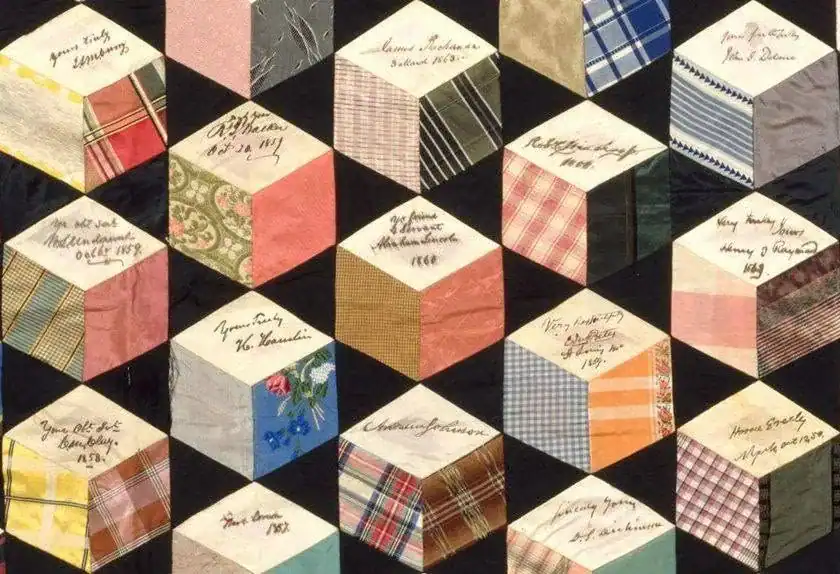
On Ebay there is a silk quilt #290293618 which is very lovely. They want $2,500 for the opening bid. The problem—–it is stated that the DAR thinks this might be the oldest silk tumbling block ever made and then on the Sotheby letter it says the quilt is ca.1890. Wonder where they got this statement regarding the DAR? That is a very strong statement from an extremely knowledgeable group. I truly think an error has occured and we need to just be aware that it does happen.
Regardless—-it is a lovely quilt. T
I read 2 very interesting articles in the AIC (Assoc. of Conservators) publication that just came out. One was on a historic house outside of Baltimore which had a quilt with a heavily damaged chintz border and they opted to paint in the lost color on crepeline. It was a very time intensive task. It was an interesting concept. Mylar was placed over the fabric. Crepeline was placed over that and then painted. Once dried the mylar was removed and the crepeline was stablized to the quilt. If you want more info. on how to research the article and read for yourself drop me a line. The book is in my car or I would give it to you now. There was another article of interest. It was on testing lightfastness and water tolerance of color photo copies and permanent ink pens. Nothing proved to be perfect but some were better than others. Pigma pens did well. Can’t remember the other names that also did well. Still, test for colorfastness labels before getting wet or if possible remove before wet cleaning. I want to recreate a quilt with the mourning prints, clarets, cadet blues based on a quilt of my grandmother’s which is in shreds. Are those reprod. prints still available? Where is the best source? Thanks for private emails on that. Sorry this is such a long email. I got a note last week from Jeananne Wright in CO and cried as I read about a quilt she made in tribute to the Columbine horror……. She is such a great quilter. She has made several quilts with her students over the years—–one in memory of John Denver, a tribute to the famous home run hitters, and in her retirement from teaching she took on the Columbine quilt. You can also see her work in a reprod. of a quilt in B. Brackman’s CW quilt book(Pea Ridge). If you get to Denver try to see the quilt. Her explanation for her choices of fabric and design were so moving. I am pretty sure it is still on display at the Rocky Mtn. Museum. Can’t place my hands on that piece of paper. When I do I will drop a note.
Must run work on a very sick quilt…….
Lynn Lancaster Gorges, Historic Textiles Studio, New Bern,NC