February 26 – March 12, 2000
These restored messages come from the Quilt History List, an online forum where quilt historians, collectors, researchers, appraisers, and enthusiasts discussed antique quilts and related textiles. The archive dates from 1996 through approximately 2016 and is being restored gradually. Sign up in the form at the bottom of the page if you want to know when a new page is added. Original spelling, opinions, formatting, and inactive links may remain unchanged.
Primary topics of this QHL Digest:
- Rattlesnake & Copperhead Quilt Patterns — Members trace a snake-coiled quilt block seen at a small Oklahoma show back to published examples and Civil War-era “Copperhead” political lore.
- Naming the “Tile Quilt” — A newcomer’s crazy-quilt variant seen on Simply Quilts sparks a search for its correct historical name and pattern lineage.
- Log Cabin, Schoolhouse & Le Moyne Star Origins — Ongoing threads dig into the documented origins of the log-cabin/schoolhouse block and question why eight-pointed stars are called Le Moyne Stars.
- eBay Dating Disputes — Members push back on an eBay Log Cabin quilt dated a century too early and debate an expensive “Enslaved African American Quilt” listing. (see the article on dating quilts)
- Swastika Quilt Symbolism — A red-and-white swastika-pattern quilt prompts a wide-ranging discussion of the symbol’s ancient, multicultural origins well before its 20th-century association with Nazi Germany.
- Research Resources: Redwork, Purple Dye & Slave Quilting — Members share book and museum leads on redwork quilts, Tyrian/imperial purple dye history, and an out-of-print book on antebellum slave quilting. (see the article on double purple)
Date: Sat, 26 Feb 2000 16:21:05 +1100 | From: Lorraine Olsson <svenpnc.com.au>
Hello All,
Thanks you all who sent me details on places to buy the Wholecloth top. Sadly my client was suddenly not in the mood to quilt (or something) and I no longer need this item.
But I do now know a litte more about what is out there!! That means it was not a waste of time (doesn’t it??).
thanks again,
Lorraine in Oz
Date: Sat, 26 Feb 2000 06:33:29 -0500 | From: “Judy Kelius (judysue)” <judychesco.com>
In case you missed this, here is a real beauty on eBay (in the Civil War category)
http://cgi.ebay.com/aw-cgi/eBayISAPI.dll?ViewItem&item=264603384. Bidding was up to $2500 last I looked, and the auction will end in a little more than three hours, so most of you probably won’t be able to bid more <GR>. A neat bit of history!
Date: Sat, 26 Feb 2000 15:08:03 -0800 | From: Julie Silber <quiltcomplex>
Hi All,
For what it’s worth, another county heard from. I agree with Judy K– they have dated that Log Cabin quilt about 100 years early. The fabrics look to me to be the printed wool challis popular cira 1870-80. Julie Silber
Date: Sat, 26 Feb 2000 18:23:24 -0800 | From: Audrey Waite <awquiltrsedona.net>
I made my semi-annual trip to the outlet mall today and couldn’t resist the book store. Found a children’s book called “The Cemetery Quilt” on the bargain table for $1. They have 9 more if anyone is interested. It’s about an 1829 quilt with coffins that get moved from the border to the center when a family member dies. A little girl goes to her grandfathers funeral and learns about the quilt.
I have collected quite a few quilt-related children’s books for my grand-daughter so couldn’t resist. Let me know if you want me to get you a copy.
Audrey Waite
Sedona, AZ
Date: Sun, 27 Feb 2000 12:32:09 EST | From: SadieRose
There is a well documented “Cemetary Quilt” (perhaps the children’s fiction book mentioned by Audrey was based on this). The quilt has appeared in several books “Quilt Digest Press” book #5, pgs. 11-13, also in “Kentucky Quilts 1800-1900 The Kentucky Quilt Project” pg. 53. Linda Otto Lipsett later did extensive research on this quilt & its maker, which culminated in “Elizabeth Roseberry Mitchell’s Graveyard Quilt – An American Pioneer Saga” published in 1995. (ISBN # 0-9629399-2-7). Here is a quote from Linda’s book that explains the purpose of this quilt “Those graves were so far away. Having to leave a child’s grave behind was a terrible thing. Elizabeth Roseberry Mitchell had suffered that, too, having to leave for Kentucky with little John Vannatta’s grave in Monroe County, Ohio. Her loss over her child’s death had been so great that she and the girls had begun making the quilt top. Their stitches had comforted them then, cutting and sewing together little pieces of “school cloaths,” appliqueing picket fences, embroidering flowers and the willow tree, cross-stitching their baby brother’s name for remembrance. Still, they had comforted themselves that Johnny was not dead, he was just “gone before.” And text from below photos of Elizabeth’s quilt
“The quilt blocks are carefully arranged. On each symmetrical side of the quilt, there are eleven LeMoyne Star blocks with very light or bleached white backgrounds (possibly symbolic of Elizabeth’s eleven children). Many of the corner and triangular pieces in the other patchwork blocks appear to have been dipped in Elizabeth’s walnut dye pot in order to contrast with the lighter ones.”
Linda reveals that not only is there a quilt, but also an earlier quilt top, apparently a “practice piece that contained design flaws and did not include the entire family.”
The top was probably begun in 1836, the year John Vannatta Mitchell died (at age 2 years, 8 mos.) – this date is cross-stitched on the top and the fabrics are from this period. Elizabeth’s son Mathias died at age nineteen in 1843.
After the death of a second child/sibling, Elizabeth and her daughters began the “Graveyard Quilt” which contains fabrics found in the first top, as well as prints from the 1840’s. There are photos of both the practice top and the quilt on pages 114-115.
Elizabeth’s quilt created a fabric record and memorial of her family, which has survived longer than even their gravestones! She also took comfort in being able to bring them all together, although in actuality, the family members were buried hundreds of miles apart.
If you are interested in reading more about Elizabeth Roseberry Mitchell, her life & her quilt… Linda’s book is excellent!! I purchased my copy at the MAQS bookstore in Paducah, KY…another source might be Quilting Books Unlimited. I would highly recommend any of Linda Otto Lipsett’s books….”Pieced From Ellen’s Quilt” is another haunting favorite of mine.
Karan from sunny Iowa
Date: Sun, 27 Feb 2000 16:28:54 -0500 | From: Dhcreatives (by way of List Mom <qrsalbany.net>)
I’m doing research on “house”, “schoolhouse”, “log house” quilt block patterns.
What is the earliest authenticated or published data that anyone has on this pieced pattern?
Some people attribute it to the 1840 William Henry Harrison presidential campaign’s log cabin symbol but that particular motif had only one chimney, usually at the back of the building with a flag pole at the front of the roof. (“Schoolhouse” is more frequently seen with the two chimneys.)
Benjamin
Harrison’s log cabin campaign motif also had one chimney and that one often has smoke coming out of it. The 1840 design definitely shows up as applique on Baltimore Album quilts complete with the cider barrel that was part of the campaign slogan but I don’t know that it is responsible for the pieced “schoolhouse” pattern. Can we assume that as the log cabin home was popular, in America, at least in the 1700s that a representational pattern was used (if not published) in the first half of the 19th century? Earlier?
On a related subject, building motifs appeared in printed fabrics i.e. commemoratives. However, it seems as if most of this fabric with American buildings for Centennials etc. was actually printed in England, for the American market. Can anyone substantiate pre-1900 building-motif printed fabric made in America and, if so, when and what.
Thanks. I’m up against a deadline and need all the help I can get on this subject.
Deborah Harding dhcreativesaol.com
Date: Sun, 27 Feb 2000 11:23:15 -0500 | From: Mary Becker <marylambmail.execpc.com> (by way of List Mom
<qrsalbany.net>)
> Dear Quilt Lovers
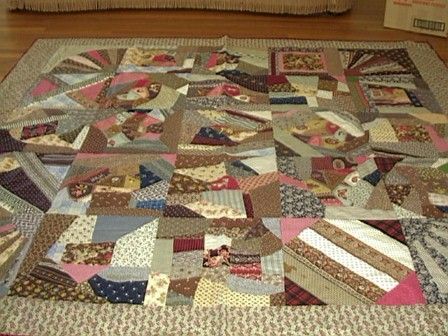
> I recently saw a bit of what was referred to as a “Tile Quilt” on an episode of Simply Quilts. I called the person being interviewed (Julie Silber) and asked if that type of crazy quilt had another name. She was unaware of any. It had the irregular shapes of a crazy quilt, but each piece was surrounded by a narrow bit of solid white. None of the quilt shops in the Milwaukee area recognized the name, nor the description I gave of it. Julie suggested I write to you to ask if anyone knew of another name, or of any mention of it in any of the quilt books. I’d love to see pictures of other examples, if that’s possible.
> Although I’ve done a lot of sewing in years past, and a minimum of quilting, I’m now immersed in papermaking, and I’d like to make a paste paper version of a tile quilt. I’ve struck out on my own, trying to reconstruct the design of the Tile Quilt as I remember it, but would appreciate any help in researching this design.
> Gratefully,
> Mary Lamb Becker marylambexecpc.com or 6147 N. Santa Monica Blvd. Milwaukee, WI 53217
Now that I have subscribed, would you please include the above message to other subscribers?
Thank you.
Date: Sun, 27 Feb 2000 18:58:15 EST | From: SadieRose
If it is of any help, house & building designs were common on counted thread embroidered samplers. Many of these motifs were appliqued on to Baltimore Album type blocks (cross over design sources??) And as in the appliqued Mariner’s Compasses and sawtooth borders on the BA quilts, these designs were in later years more often pieced than appliqued. Barbara Brackman’s “Encyclopedia of Pieced Quilt Patterns,” on pages 118-121 (pieced house motifs) includes this note, after entry #865 “Earliest
Example Although there are many house quilts attributed to the last half of the 19th century I was surprised to find that the earliest dated example I can find is 1890 – 92 in Kolter’s “Forget Me Not”, Pl. 126 (pg 102).” Earliest printed pattern Barbara lists is 1920.
(Forget Me Not – A Gallery of Friendship and Album Quilts” by Jane Bentley
Kolter, pub. 1990, ISBN # 0-915590-67-0).
The Iowa Quilt Research Project, in 1988, documented a scrap quilt that was created by Hannah Stone, for her son’s wedding. This quilt is shown on page 38 of “Gatherings – America’s Quilt Heritage” curated by Pilgrim &
Roy, published by AQS,1995. The information in this book varies some from the information in the exhibit catalog that the Iowa Quilts Research Project published to accompany an exhibit at the State Historical Society in 1990. The logo for the IQRP was a red Schoolhouse block, modified in that it had just one window, which was divided into 4 panes. (The pattern for this block was given in the April 1996 issue of Ladies Circle Patchwork Quilts magazine, along with an article I wrote about the IQRP). When Hannah Stone’s quilt was brought in for documentation, it was an immediate choice for “Poster Child” for the exhibit (as it had one “little red schoolhouse” block in the center).
Information from the exhibit catalog states
“The “House” or “Schoolhouse” pattern appeared in American quilts just before the mid-nineteenth century. It may have been associated with the log cabin of William Henry Harrison’s presidential campaign of 1840. The earlier patterns were applique work. Pieced patterns such as this appeared late in the nineteenth century, perhaps associated with the 1888 campaign of
Harrison’s grandson, Benjamin Harrison. The fabrics used in the random patchwork surrounding the schoolhouse indicate a late nineteenth century date.
…Family tradition is that it was made by Hannah Stone for the marriage of her son, Richard.”
Here is the text shared with the photo of the quilt in “Gatherings” “As individual projects collected data, trends in pattern choice, and color preferences began to emerge. The tremendous growth of public education during the third quarter of the nineteenth century resulted in the pieced Schoolhouse block pattern becoming popular with quiltmakers. An unusual medallion rendition was made during that time period in Belle Plaine, IA, by
Hannah Stone. Born in the 1860’s and known as “Aunty Stone”, oral tradition says that the quilt was specially created for the wedding of Hannah’s son…”
This quilt inspired a number of wall quilts, made as commemoratives by members of the Iowa Quilts Research Project committee (including mine). Some interesting comments are found in “Old Patchwork Quilts & the Women Who Made Them” by Ruth E. Finley, first published in 1929. Although this is
Mrs. Finley’s personal opinion…and later research has questioned some of the content of her book, here are 2 quotes of interest. Pg 194 “However, for what might be called realistic quilts there was a veritable craze, beginning about 1870. Neglecting such beautiful old pictorial designs as “Colonial Basket” and the “Garden Wreath”, women cut in silhouette every shape imaginable, to be appliqued as quilt patches. And many of the results, such as “The Old Town Pump” (Diagram No. 99) were grotesque in the extreme.
“After all, the realistic quilt merely ran true to its period. For with
1870 there had arrived an era of decadence– in architecture, furniture, silver, glass, china, decoration, dress, manners and morals.” And from page 196 “Appealing yet absurd were the pieced “Little Red Schoolhouse” quilts (Plate No. 96) that seem to have originated in New Jersey. Hopeless entirely were the appliqued “Horse Shoe” quilts (Diagram No. 100). Unlike the ‘Little Red Schoolhouse”, they have not even the saving grace of being quaint.”
So, no definitive answers on when or where or how this popular pattern first emerged on the American quilting scene. Maybe a few more ‘pieces in the puzzle” though. Good luck with your project!!
Karan from sunny Iowa & 60 degrees…can this be February??
Date: Sun, 27 Feb 2000 22:10:13 EST | From: EllynLKaol.com
Mary Becker wrote
I called the person being interviewed (Julie
> Silber) and asked if that type of crazy quilt had another name. She was unaware of any. It had the irregular shapes of a crazy quilt, but each piece was surrounded by a narrow bit of solid white. None of the quilt shops in the Milwaukee area recognized the name, nor the description I gave of it.
My grandmother worked at the church rummage store back in the ’70’s and bought me a quilt top which my mom tied into a quilt and I used for 20 years (it’s currently being restored). It’s an 1895-1910 collection of “crazy” scrap blocks, latticed in cadet blue with turkey red cornerstones. Never had a name for it but a few years back, the Quilt Engagement Calendar had a photo of a similar quilt and labeled it “a contained Crazy” which seemed to fit what I had just fine. Not sure if this was a convenient of-the-moment description or if a “contained Crazy” is a legit quilt pattern/name.
Anyone know?
Lauri Klobas
Pacific PaKarendes where it has rained again and the yard is once again in danger of sliding down the hil….
Date: Sun, 27 Feb 2000 20:31:57 +0000 | From: Bobbie Aug <qwltpro>
Xenia,
What about Bettina Havig’s book on Carrie Hall blocks? Were they not a block collectiion – HUGE – some of which she patterned in the book?
Bobbie Aug
Xenia Cord wrote
> A correspondent has recently sent me the following
> <I got a letter from an quilt historian who has been around since the
> early 50’s. She told me about a phrase I had not heard before. “Quilter’s
> Catalog” a term discribing a block collection made as a pattern record.
> Also I have heard about quilters(in the old days) making a block collection as a way to remember patterns, but now that I think about it…I can’t remember reading it. Is this a myth or is there solid evidence? It seems
> logical to me.>
> I replied that I was aware of a firm tradition of saving quilt patterns in fabric form, and that I have bought at auction boxes of single blocks, each with a basted slip of paper on which the pattern name, or the name of the pattern donor or other information was written.
> In my foggy brain I seem to remember that there has been research published on this. Can anyone shed light?
> Xenia
Date: Sun, 27 Feb 2000 20:39:56 +0000 | From: Bobbie Aug <qwltpro>
Debbie,
Without seeing your quilt…….
Contact Chris Moline in Naperville, Illinois or Sue Harmon in Naperville, Illinois. Yes, they are AQS Certified appraisers, and even if you don’t wish an appraisal at this time, perhaps they will help you with the other information you seek at a reduced price or look at your quilt and recommend a source so you can research and learn on your own.
Bobbie Aug
Debra Reynen wrote
> I acquired a full bed size Trapunto quilt at an antique shop. The dealer did not have any information regarding where it was from or how old it
was.
> I paid $450 for it, which was a lot for me, but I figured that I would probably never see one again in my life, so I bought it.
> It is in good shape overall with a couple of places that the stitching is broken and the stuffing is in a ball. I am curious on how to try to determine the date of this quilt. As far as I can see there is no date
or
> name in the quilting and of course no label. The fabric is a cream color cotton on the top and bottom.
> I am a member of this list to learn and so I only post occasionally. Without taking it to a professional for an appraisal (which I will eventually do), is there any way to determine how old this quilt is? I
have
> been adding to my library of reference books and have the Dating Fabric
book
> (which is great). But since the fabric is just cream cotton, I don’t
know
> where to start. Are there any other ways that an amateur could try to do this? Are there books that would help to identify the date from the quilting pattern?
> Any information you could provide would be great.
> Debbie (in Chicagoland area)
Date: Sun, 5 Mar 2000 10:33:30 -0500 | From: “Wayne or Ruth Fulks” <Wayne@>
Thanks to whoever recommended the book about quilters of the Catskill mountains. My husband is teaching at Sullivan County Community College in the heart of the Catskills. When this book was mentioned on this list, I asked him to go to the college library and check it out for me. It turned out that the library did not own the book. As a result of his talking to the librarian, it has now been ordered. So, thanks to this list, the book will be preserved in a very proper location for it.
Ruth in Sudbury, Ontario, Canada, missing DH in NY
Date: Sun, 5 Mar 2000 14:13:14 EST | From: SadieRose@
Two of us are hoping that someone might recognize the following lines from a poem….I think it might be by Longfellow…and I know there are more lines than these. Would love to have the whole poem, title & correct author… TIA, Karan (it’s sunny & 70 here…can this be Iowa in March??)
“I pray that risen from the dead
I may in glory stand…
A crown perhaps upon my head
But a needle in my hand.”
Date: Sun, 5 Mar 2000 15:39:41 EST | From: JBQUILTOK@
I was at a small quilt show in Newkirk, Oklahoma yesterday & saw a quilt done in a pattern they called Rattlesnake. It was a 4 patch pattern where each patch was a fan design. The blades of the fan were crooked. 3 of the patches curved around like a snake coiled up & one was curved slightly different so that the fan ‘handle’ became the snake’s head ready to strike. According to the family history, this was a political statement. During the
Civil War, southerners who joined the Union army were called rattlesnakes by the southerners. This quilt had been a wedding gift to a man from a boarder state who joined the North from his sister. Her way of saying he was still family, but she thought he was a traitor! The man worked as a carpenter & coffin maker in Kentucky before moving to Oklahoma.
Has anyone one else seen one of these or heard similiar stories? Janet (Never Miss A Quilt Show If I Can Help It) Bronston
Date: Sun, 5 Mar 2000 17:43:19 EST | From: QuiltFixer@
In a message dated 3/5/00 124035 PM Pacific Standard Time, JBQUILTOK@ writes
<<
Has anyone one else seen one of these or heard similar stories? >> How interesting! I did see a quilt just like your description in a small quilt show in Folsom, California several years ago. Only the family’s name was given and the card said it had been in the family for as long as the owner could remember. I tried unsuccessfully to get a telephone number for the person who lent the quilt, but was not successful. I was so fascinated,
I wanted to learn more about the family history and the meaning of the quilt.
Now, after all this time, here is the answer. Thank you for sharing this.
Toni Baumgard
QuiltFixer@
Date: Mon, 6 Mar 2000 10:21:26 +1100 | From: “Kate Knight” <kknight@>
What a co-incidence ! Here is one http://cgi.ebay.com/aw-cgi/eBayISAPI.dll?ViewItem&item276273445 Kate kknight@
Date: Sun, 5 Mar 2000 18:39:27 EST | From: JBQUILTOK@
The basic block for the one on E-bay (http://cgi.ebay.com/aw-cgi/eBayISAPI.dll?ViewItem&item276273445) looks very similar to the one I saw – although the one in Newkirk, OK did not have the precision in the points. And the set was 4 of the units actually resembling a coiled snake.
Janet
Date: Sun, 5 Mar 2000 19:28:47 EST | From: JoysBees@
During the Civil War, a person in the northern states who sympathized with the South during the Civil War was called a “Copperhead”, not a “Rattlesnake”, although a copperhead IS a rattlesnake. There are several poems concerning quilting, along with this one at the website below.
EKarenbeth
Grandma’s Prayer
I pray that, risen from the dead,
I may in glory stand —
A crown, perhaps upon my head.
But a needle in my hand.
I’ve never learned to sing or play,
So let no harp be mine;
From: birth unto my dying day,
Plain sewing’s been my line.
Therefore, accustomed to the end
To: plying useful stitches,
I’ll be content if asked to mend
The little angels’ breeches.
by Eugene Field
1850-189520 http://www.geocities.com/Paris/LeftBank/6865/quiltverse.html
Date: Mon, 6 Mar 2000 07:52:30 EST | From: QuiltFixer@
In a message dated 3/5/00 42949 PM Pacific Standard Time, JoysBees@ writes
<< During the Civil War, a person in the northern states who sympathized with the South during the Civil War was called a “Copperhead,” not a “Rattlesnake,” although a copperhead IS a rattlesnake.
Jackie Joy >>
I am always fascinated by the way the names of things change in the telling.
Perhaps over the years, the name of the quilt that I saw, started out to be the “Copperhead Quilt” and then changed to “Rattlesnake Quilt” when it started it’s new life in California. The quilt that I saw was definitely made out of fabrics of the right time period to have been made during the Civil War era. Does anyone have any idea where we can get more information on this pattern? Thanks Jackie for sharing the information about the Copperhead.
Toni Baumgard
The Redwork Lady redworkldy@aol www.redworklady.com
Date: Mon, 6 Mar 2000 08:36:42 EST | From: JQuilt@
this is the beginning of an article i found …..the rest of it is at http://www.historybuff.com/library/refcopper.html
On March 5, 1863, in a snowstorm, the Columbus (Ohio) Crisis was attacked by a mob of mad men.
To: explain why the soldiers attacked the Crisis it must be understood what the editor, Samuel Medary, and his newspaper represented. Medary had been an opponent of the Civil War from the beginning in 1861. He did not feel that the South’s leaving the Union was enough to fight over. As the war progressed, he became more outspoken in his criticism of the war and those who participated in it. As Medary’s pen became more outspoken with each weekly issue of the Crisis, soldiers stationed near Camp Chase, on the west side of Columbus decided that Medary should be taught a lesson for his Copperhead utterances.
jean
Date: Mon, 06 Mar 2000 08:07:10 -0600 | From: Laura Hobby Syler <texas_quilt.co@>
There is another variation of the Rattlesnake quilt in Lone Stars A Legacy of Texas Quilts 1836-1936….University of Texas Press, ISBN 0-292-74641-5 , 1986…..(for those of you who also collect the state project books) I got to work on this quilt in 1985 when we assembled the exhibit for the Texas Sesquicentennial which hung in the rotunda of the capitol building in Austin in March of 1986. It is a terribly heavy monster of a thing. The book does not attribute it’s name to the Civil War but more to the life in early Texas. The story is on page 112 and is quite interesting. One of the desendants of the maker made quilts for the public and got as much as “$1.50 to 2.50 per quilt”!!!
Laura
At 0639 PM 03/05/2000 EST, JBQUILTOK@ wrote
>The basic block for the one on E-bay (http://cgi.ebay.com/aw-cgi/eBayISAPI.dll?ViewItem&item276273445) looks very similar to the one I saw – although the one in Newkirk, OK did not have the precision in the points. And the set was 4 of the units actually resembling a coiled snake.
>Janet
Date: Mon, 06 Mar 2000 06:55:38 -0800 | From: “Julia D. Zgliniec” <rzglini1@>
Dear QHL,
There is a quilt called “Diamondback Rattlesnake Quilt” pictures in Lone Stars A
Legacy of Texas Quilts, 1836 – 1936, by Bresenhan and Puentes. c. 1986. pg 112.
I have seen several others like the one pictured in addition to the variation called Snake form the 1930’s.
Regards,
Julia Zgliniec
Date: Mon, 6 Mar 2000 09:18:03 -0600 | From: “Carol Butzke” <butzke@>
Dear Susan,
Your friendship quilt is already the work of more than one person. Many shows have a category for “group quilts” which would be perfect for your quilt with its multiple makers. The two blocks made by unknown quilters/sewers would also be considered part of the group. If the show that you are interested in entering does not have a “group” category, enter the quilt in the category that best fits its construction such as pieced, applique, mixed techniques. I would suggest that in the description that you send for the show book that you would give the information about the makers of the quilt including the two blocks made by unknown quilters/sewers. Quilt show viewers and especially other quilters enjoy reading the stories behind the quilts entered.
Hope this will be of help,
Carol Butzke
National Quilting Association Certified Judge
Date: Mon, 06 Mar 2000 16:52:37 -0800 | From: Mary Becker <marylamb@>
Dear Fellow Quilt Lovers
When Julie Silber told me about your group and suggested I write you with my question about Tile Quilts she was sure I would get a reply. I must admit I wasn’t so sure, but to my delight I was deluged with suggestions for alternate names, descriptions, etc. etc, and several excellent leads of where to pursue the subject further. I’ve tried to individually thank those who E-Mailed me for their help, but being a novice on the internet, I’ve probably missed some. So here’s my blanket thank-you to all those who have responded so generously. Thank you, thank you, thank you.
Mary Lamb Becker
Date: Tue, 7 Mar 2000 22:42:49 -0500 | From: “J. G. Row” <Judygrow@>
Another “Enslaved African American Quilt” has shown up on e-bay. If you do a search, you can search by highest priced first. This will come up second, behind a $23,000 quilt that is obviously a mistake. http://cgi.ebay.com/aw-cgi/eBayISAPI.dll?ViewItem&item=277917324 Judy in Ringoes, NJ judygrow@
Date: Wed, 08 Mar 2000 08:17:54 -0600 | From: Laura Hobby Syler <texas_quilt.co@>
I’m still waiting for documentation on when and how quilts were sold into slavery<G> don’t know where she gets these prices!
Laura
At 1042 PM 03/07/2000 -0500, J. G. Row wrote
>Another “Enslaved African American Quilt” has shown up on e-bay. If you do a search, you can search by highest priced first. This will
come
>up second, behind a $23,000 quilt that is obviously a mistake.
>http://cgi.ebay.com/aw-cgi/eBayISAPI.dll?ViewItem&item=277917324
>Judy in Ringoes, NJ judygrow@
Date: Wed, 8 Mar 2000 07:29:02 -0800 | From: “Robins-Morris, Laura A” <lrobins@>
If you’re in western Washington state this weekend, don’t miss the annual Quilters Anonymous quilt show. Over 250 wonderful quilts, lots of vendors, and more fun than you can shake a stick at!
Evergreen Fairgrounds, Monroe. Friday, Saturday (3/10, 3/11) 10am-6 pm.
Sunday (3/12) 10-5.
It’s going to be a great show. Don’t miss it!
Laura in Seattle
Date: Wed, 8 Mar 2000 16:42:19 -0600 | From: pcrews@
Since redwork quilts have been a topic of recent discussion on this list, some of you may be interested in viewing the “Quilt of the Month” featured on the
University of Nebraska, International Quilt Study Center’s web site. It is a redwork quilt from the Ardis and Robert James Collection. To view it visit www.ianr.unl.edu/quiltstudy and then click on ‘Exhibitions’ then ‘Quilt of the
Month.’
Patricia Cox Crews, Ph.D.
Professor and Acting Chair and Director, International Quilt Study Center
Dept. of Textiles, Clothing & Design
Phone 402-472-2911
Fax 402-472-0640 http://ianrwww.unl.edu/ianr/chrfs/PCREWS.htm
Date: Wed, 8 Mar 2000 16:43:29 -0600 | From: pcrews@
?Lincoln, Dept. of
Textiles, Clothing & Design and the International Quilt Study Center ar= e sponsoring two summer courses
A Century of Quilts in Women?s Lives
Seminar with Dr. Virginia Gunn
May 30-June 2, 2000 and
Fabric Interplay
Workshop with Michael James
June 5-9, 2000
For more information about the courses and how to register, visit the International Quilt Study Center?s web site http:// www.ianr.unl.edu/quiltstudy/education/coursesworkshops.html I?d love to see you in Lincoln this summer!
Patricia Cox Crews, Ph.D.
Professor and Acting Chair and Director, International Quilt Study Center Dept. of Textiles, Clothing & Design
Phone 402-472-2911
Fax 402-472-0640 http://ianrwww.unl.edu/ianr/chrfs/PCREWS.htm
Date: Wed, 8 Mar 2000 21:46:56 -0500 | From: “John Cawley” <cawley@>
The International Quilt Study Center site is terriffic! Be prepared to spend a lot of time ogling the quilts.
Cinda on the Eastern Shore
Date: Wed, 08 Mar 2000 20:48:32 -0600 | From: Jennifer Perkins <qltrstore@>
Hi All! Thanks to a very sweet Dear Janer, Bonnie Hunter, a picture of the Yellow Quilt is now on her web site! The colors are actually pretty true.
Hope you enjoy!
Jennifer in Iowa-soon to be Paducah-VBG!
http://www.quiltville.com/jennifer.html
Date: Wed, 08 Mar 2000 22:07:06 -0600 | From: Mary Waller <mswaller@>
To: QHL@
Subject: Dates for Monkey Wrench & Churn Dash Blocks Message-ID: <38C72369.4CEDFC9@>
Content-Type: text/plain; charset=us-ascii
Content-Transfer-Encoding: 7bit
I’m doing my talk, Using Color without Fear, for my guild next week. One of the ideas I give is to use fabrics typical of a certain time period. I’ve made a lot of Double Monkey Wrench/Churn Dash blocks as samples for this talk.
I decided I can painlessly inject a little quilt pattern history into this talk by not using this block for samples before its time. I may even hand-piece samples of blocks to represent pre-1850. There are two common versions of this block an Unequal 9-Patch, and an Equal 9-Patch. In the Encyclopedia of Pieced Quilt Patterns, Barbara Brackman gives a reference for the Unequal 9-Patch version (#1850) in 1884; the Equal 9-Patch version (#1646) seems to come in around 1930. Anybody have other dates for these two versions of ‘the same’ design? Mary Waller, Vermillion, South Dakota, USA
Date: Thu, 09 Mar 2000 00:24:38 -0600 | From: Jennifer Perkins <qltrstore@>
The Dead Quilts Society has a webpage that explains it better than I can! Go to– http://www.quiltheritage.com/qhfinfo.htm
Thanks for asking!
Jennifer
At 0957 PM 03/08/2000 -0800, socks wrote
>Jennifer, I think a lot of us would be interested in obtaining some information about the Dead Quilts Society??????? barb
> http://www.quiltville.com/jennifer.html
Date: Thu, 9 Mar 2000 09:20:47 -0000 | From: “Sally Ward” <sward@>
For anyone planning a trip to the UK between 5 August 2000 and 7 January 2001 (or looking for an excuse to make one <G>) there is an important (I would even say ‘once-in-a-lifetime’) exhibition to be staged at the Bowes Museum at Barnard Castle in County Durham.
There is a full descriptive article in the new issue of the Quilters Guild magazine, The Quilter (available to Guild members) but the gist of it is as follows
A unique opportunity to see a combination of the important quilts held in their store and others drawn from the unique local knowledge of the exhibition’s guest curator Dorothy Osler, who has been able to include some remarkable quilts seen at documentation days and during her research. It also brings things up to date with recent North Country quilts from ‘grassroots’ quiltmakers and selected pieces from some of Britain’s top quilt artists which ‘reflect, link with, or even challenge, notions of the North Country tradition’. Titled ‘North Country Quilts Legend and Living Tradition’, the great news is that there is to be a book published to accompany the exhibition – very welcome indeed since their previous ‘North Country Quilts and Coverlets’
went out of print.
If you aren’t local, the article suggests coupling a visit with a trip to Beamish Museum or to the Harrogate show – Quilts Uk North (16-20 August)
and/or making a weekend of it visiting the North Pennine Dales. Leaflets and brochures are apparently still at the printers and the Museum is ‘between email addresses’ <G> but you can request further information from Sarah Jane Stobbs at the Museum by telephoning (UK) 01833 – 690606, faxing (UK) 01833-637163 or visiting the current website at www.durham.gov.uk/bowesmuseum
Sally Ward.
Date: Thu, 09 Mar 2000 17:57:44 +0100 | From: “Tilde Binger” <binger.hougaard@>
I am horribly behind on my mailing, but re. purple.
It is believed that the conch (sp?) from which the “imperial purple” colour was derived (the purple that in the Roman republic was used to dye the … edge of a senator’s toga, made from wool btw) … anyway, these conchs are noted as being bought and sold in the city of Ugarit on the coast of northern Syria (about 10 km. from modern Latakia). Ugarit was a trade-centre for trade between Egypt and Hatti, between the Aegean islands (and further into the Mediterranean coastal areal) and Mesopotamia. Ugarit was destroyed just after 1200 … BCE (that is the politically correct term I understand, for those of you politically incorrect it will just be BC). SO, the “real” purple has been around for a very long time -)
Tilde in Copenhagen
Date: Thu, 09 Mar 2000 10:30:07 -0800 | From: “Julia D. Zgliniec” <rzglini1@>
Dear QHL,
There is an excellent discussion of Tyrian Purple in The Red Dyes Cochineal,
Madder, and Murex Purple by Gosta Sandberg. 1994. Lark Books. ISBN 1-887374-17-5
This is an excellent reference and the illustrations are wonderful.
Julia Zgliniec – Poway, CA
Date: Fri, 10 Mar 2000 10:47:48 -0800 | From: “Christine Thresh” <christine@>
I just ordered this out of print book from Amazon.com. Does anyone have any information about it?
Stitched from the Soul Slave Quilting in the Ante-Bellum South by Fry Christine Thresh http://www.winnowing.com/
Date: Sat, 11 Mar 2000 08:32:32 EST | From: QuiltFixer@
To: christine@, QHL@
Subject: Re QHL Stitched from the Soul
Message-ID: <d.278362e.25fba4f0@>
Content-Type: text/plain; charset=”US-ASCII”
Content-Transfer-Encoding: 7bit
In a message dated 3/10/00 104844 AM Pacific Standard Time, christine@ writes
<< Stitched from the Soul Slave Quilting in the Ante-Bellum South by Fry
Hi Christine, do you have a review or description that you can share with the list? If not, please share some information about it from others or after you get it and read it. Thanks,
Toni Baumgard
QuiltFixer@
Date: Sat, 11 Mar 2000 09:53:11 EST | From: Chyral@
In a message dated 03/11/2000 83409 AM Eastern Standard Time, QuiltFixer@ writes
> << Stitched from the Soul Slave Quilting in the Ante-Bellum South by
Fry
> Hi Christine, do you have a review or description that you can share
with
> the list? If not, please share some information about it from others or
after
> you get it and read it. Thanks,
I’m not Christine, but I’ll jump in here anyway, at least with some basic info about the book, if not a review or critical analysis. ) The book in question was published in 1990, in conjunction with an exhibit of the same name at the Museum of American Folk Art. It’s one of those at-least-one- photograph-on-every-page Dutton Studio paperbacks. The forward by Dr. Bishop cautions that both exhibit and book should be “viewed as a work in progress;” when Dr. Fry appeared on Antiques Roadshow, wasn’t there mention of impending publication of a second book?
At the author’s website (www.quiltprofessor.com) there is this information ” Many of the various roles and contributions of enslaved African women to plantation life have been swept under the rug of history. While enslaved African men have long been acknowledged as skilled carpenters, brick masons, iron makers, furniture makers, wood-carvers, and potters, women have been seen primarily in the role of the plantation “mammy” figure. This limited view of enslaved African women has made them the victim of three isms racism, sexism, and regionalism. In particular, the contribution of enslaved
African women to textile production and other craft processes has been ignored. Yet the evidence that these women produced fabric, and that they quilted, sewed, and crocheted is irrefutable. A significant number of quilts made by enslaved Africans is now preserved in fifteen states and England.
As for other textiles, many woven coverlets, counterpanes, rag rugs, bed rugs, and crocheted artifacts attributed to the handiwork of enslaved African women have now been located.
Stitched From the Soul Slave Quilting in the Anti-Bellum South was the first formal study undertaken to determine the extent of the involvement of enslaved African women in the design or craftsmanship of mid-nineteenth-century quilts. This book also has helped to determine the influence of African culture on African-American quilting styles.
Previously unrecognized enslaved African women can no longer be denied their history, a history that has been inscribed in the quilts that survive. Many record family history and legends, as they express the personal philosophy and religious beliefs of their makers. The efforts of these men and women in making artifacts both beautiful and useful remain unexcelled in design and craftsmanship. “
I believe the “Enslaved quilt” currently listed on eBay and mentioned on the list recently is from this author’s collection.
Finally, a web search gleaned these sites related to her research…… http://www.nhc.rtp.nc.us8080/ideasv52/fry.htm http://www.inform.umd.edu/EdRes/Colleges/ARHU/Depts/ArtGal/.WWW/exhibit/95- 96/ aamq/quilt.htm http://www.histarch.armstrong.edu/artifct.html
Just for fun, here is the quilt Dr Fry had “appraised” on Antiques Roadshow http://www.nhc.rtp.nc.us8080/ideasv52/fry.htm and whilst I’m at it, here’s a site with a number of links to information about African-American quilts http://www.quiltethnic.com
Date: Sat, 11 Mar 2000 10:24:32 -0600 | From: “Jill Sisson” <sissonj@>
This is a multi-part message in MIME format. ——=_NextPart_000_0067_01BF8B43.FD83B480
Content-Type: text/plain;
charset=”iso-8859-1″
Content-Transfer-Encoding: quoted-printable
If anyone is interested, there is a quilt show 17 and 18 March, at The Wright Place, Pensacola, Florida, from 9 AM to 5 PM.
Jill
Date: Sat, 11 Mar 2000 15:15:47 EST | From: KareQuilt@
RE <<Does anyone have any information Stitched from the Soul Slave Quilting in the Ante-Bellum South by Fry?>> Her website site is quiltprofessor.com
She is the same person, apparently, that is selling the $18,000 slave quilt on eBay mentioned earlier this week.
Karen Alexander
Northern VA
Date: Sat, 11 Mar 2000 17:58:21 -0800 | From: “nms” <nms@>
Hi everyone, I’ve been reading all the posts for about 1 yr now and finally decided to write. I have just returned from a lecture at UCLA held at the Fowler Museum. Elizabeth Barber was the guest speaker. She spoke on the subject of the beginnings of tapestry weaving. The slide lecture was well attended and hosted by the Gloria F. Ross Center for Tapestry Studies at the
University of Arizona. She discussed in detail the different evidence supporting weave technology from Antiquity to about 200 AD. Included in the lecture was a discussion on the evolution of sheep from food production to wool producers.
As the subject of her next writing adventure, she stated she was considering a book about myth, and how it creeps into the literature. Considering all the talk about myth vs. fact I have read posted on this list in the last few months, I thought it might be of interest to the group. Nance Searle, International Society of Appraisers
Date: Sat, 11 Mar 2000 21:13:04 -0600 | From: Mary Waller <mswaller@>
Content-Transfer-Encoding: 7bit
Recently, Lynn Gorges asked what she might be able to do at her kids’ school after “Hidden in Plain View” was used to teach in some classes. Perhaps “Stitched from the Soul” and the information at the sites given is good information to use.
I didn’t find the quilt I remembered Dr. Fry showing on Antiques Roadshow. I remember a folk art-looking version of a Baltimore Album quilt and the young appraiser from Baltimore commenting on the fur boots on a man in one block. Has she been on twice?
Mary Waller, Vermillion, SD, USA
Date: Sat, 11 Mar 2000 22:28:27 EST | From: Chyral@
In a message dated 03/11/2000 101642 PM Eastern Standard Time, mswaller@ writes
> I didn’t find the quilt I remembered Dr. Fry showing on Antiques Roadshow. I remember a folk art-looking version of a Baltimore Album quilt and the young appraiser from Baltimore commenting on the fur boots on a man in one block. Has she been on twice?
whoops! I pasted in the wrong url for that page….. It should have been http://www.pbs.org/plweb-cgi/fastweb?getdoc+roadshow+roadshow+880+0+wAAA+qu ilt
%26fry and there is supposed to be a large image of the quilt on this page http://www.pbs.org/wgbh/pages/roadshow/appraiseit/game07/images/quilt_lg.jp g but I can’t get it to load. Your milage may vary. )
Date: Sun, 12 Mar 2000 00:35:03 EST | From: PatKoerner@
A couple brought a quilt into the Rocky Mountain Quilt Museum last week to see what they could find out about a red/white Swastika quilt they had been given. I have seen quilts with this design before but when we attempted to find the design in Brackman’s Encly. we were a little stumped. The closest is #2577 on pg 319, although this quilt’s blocks had fewer borders. It seems that I have read somewhere about another name for this pattern similar to the Pure Symbol of Right Doctrine that is one of the choices given. It seems I have read an explanation of the symbal before its perversion by Hitler. Does anyone else have any information on this? Also I was uncertain of the red fabric in this quilt. At first glance I would say Turkey red. The quilt was very old and worn and the white fabric was very thin and worn.
The red fabric was solid red with no fading or wearing away of the outer part of the fiber exposing the white core as I believed was common for Turkey red.
I look forward to reading your ideas and opinions about this Wish I could send a swatch over the internet for you all to see.
I will pass on any information to the couple who brought in the quilt.
Thanks, Pat
Date: Sun, 12 Mar 2000 19:55:19 +1100 | From: “Kate Knight” <kknight@>
Hello everyone,
I recently acquired an old quilt top which is probably around 1880-1910 vintage. This assumption is based on the predominant use of indigo and shirting fabrics which are fairly common to this era. The interesting thing (for me) about this top was the maker’s use of two different fabrics which depict Egyptian heiroglyphs (sp?) and other motifs which I have not encountered before on old fabric.
Does anyone have any ideas or information which would relate this fabric to the events which were current at the time. I am guessing that these fabrics were reflecting the excitement surrounding the archaeological discoveries at
Thebes (?) etc, but my history is very rusty.
Thanks for any ideas
Kate kknight@
Date: Sun, 12 Mar 2000 09:52:07 +0400 | From: Xenia Cord <xecord@>
My Webster defines “swastika” as a term coming from Sanscrit, a design or ornament of ancient origin in the form of a Greek cross with each arm bent in a right-angle extension, known among American Indian tribes, and in India, Japan, Iran etc. When the extensions are bent in a clockwise direction the design is the one used in Nazi Germany. Brackman shows several similar designs by other names Fly Foot and Crazy Ann. Brackman’s #1027.5 Flyfoot (Brooks/Wheeler) has a referent to #1346Whirligig Design (Women’s World 1931), which refers the reader to 1130b (Finley, called “Flyfoot”) and 1339b Virginia Reel (Workbasket)
and Zig Zag (Comfort).
See also #2322 Crazy Ann (Ladies Art Co. #1650) and #2487, also from Ladies Art Co. (their # 165). Both of these have the whirling center, with additional pieces outside to fill the block.
Most of these designs set the angled arms on point. Some of these blocks spin one way, some the other. The design was known in the late 19th century, and could well have been made in the turkey red and white of the quilt referred to the museum. The design, however, has become so firmly intrenched as a Nazi symbol that quilts of this design are difficult to sell to anyone who remembers World War II.
Xenia
Date: Sun, 12 Mar 2000 11:23:24 EST | From: QuiltFixer@
Ricki Maietta (a fellow QHL member) was kind enough to send me two Redwork embroidery blocks that she found at an estate sale. The are still joined together and probably had some mates. On the cut line in blue printing is the following No. F320-50s Juvenile Quilt Blocks – Made in the USA. The question is that I am trying to date these and thought that those of you who have info about kits, etc., could help us learn more about them. They appear to me to be much later that the Redwork I am used to seeing, but “later” usually means colors other than red. Any help would be greatly appreciated.
Toni B.
QuiltFixer@
The Redwork Lady redworkldy@aol www.redworklady.com
Date: Sun, 12 Mar 2000 11:27:38 -0500 | From: “Phyllis Twigg” <ptwigg@>
charset=”iso-8859-1″
Content-Transfer-Encoding: 7bit
Yesterday I came across a utility quilt…actually a tied comforter…whose only design was made by the applique of three large letters “IAS” going diagonally down the front. I’m thinking the fabric may date the comforter as being from 1880-1900. Can anyone identify the meaning of the letters IAS?
Thanks!
Phyllis Twigg
Date: Sun, 12 Mar 2000 11:38:10 EST | From: QuiltFixer@
Rachel Greco, one of our members, is the gal to go to for information on Swastika Quilts. She does a lecture on them and has quite a collection.
You can reach her at GrandmasAttic@compuserve. Be sure and share the information you receive with the list. I, for, one find these quilts fascinating!
Toni Baumgard
QuiltFixer@
The Redwork Lady redworkldy@aol www.redworklady.com
Date: Sun, 12 Mar 2000 09:51:03 -0600 | From: “Jill Sisson” <sissonj@>
boundary=”—-=_NextPart_000_0041_01BF8C08.7AA00E40″ This is a multi-part message in MIME format.
——=_NextPart_000_0041_01BF8C08.7AA00E40
Content-Type: text/plain;
charset=”iso-8859-1″
Content-Transfer-Encoding: quoted-printable
In Bettina Havig’s “Carrie Hall Blocks” there are two swastika patterns, both on page 71. Accession 38.387 is 13.5″, the swastika everyone recognizes and is in red with a block frame in red. Accession38.305 is 11.5″ and is a stylized Dutchman’s Puzzle.
Hitler’s Swastika is a corrupted religious motif, from India, I think. There was a very good program on The History Channel in England dealing with this very subject. I’m not sure if the same programs are available here in the States.
In Carrie Hall’s book, The Romance Of The Patchwork Quilt In America,” page 95, she wrote “Two interpretations of the Indian symbol “Swastika.” Also called “The Pure Symbol of Right Doctrine,” “Heart’s Seal,” “Chinese 10,000 Perfections,” “Favorite of the Peruvians,” “The Battle Ax of Thor,” “Mound Builders,” “Catch-Me-If-You-Can,” and “Wind Power Of the Osages.”
Jill
Date: Sun, 12 Mar 2000 13:11:01 EST | From: SadieRose@
“Swastika 1. An ancient cosmic or religious symbol formed by a Greek cross with the ends of the arms bent at right angles in either a clockwise or counterclockwise direction. 2. The emblem of Nazi Germany, officially adopted in 1935.” The American Heritage Dictionary, Second College Edition A local museum asked me to research about swastika-type motifs, when one of their older members demanded a quilt be removed from an exhibit, because it had a Nazi Swastika design. The quilt was a log cabin, with the blocks set in a pinwheel arrangement. If you compared the actual Nazi Swastika (angular, clockwise) with the quilt arrangement (triangles & it happened to go counterclockwise) there was very little in common. But the evil that the
Nazi Swastika represents has contaminated any similar motifs. (The museum chose to use this as an educational addition to the exhibit, showing a diagram of a Nazi Swastika & explaining the history of this motif prior to 1935). Two books, published prior to the Nazi’s claiming this symbol, show it in a very different light
Ruth E. Finley, in her book “Old Patchwork Quilts” (published 1929)
shows several patterns which today would probably be called “swastika” types. (pages 74-75) “A much older version of this same type (Diagram No. 27) is the “Fly Foot” or “Devil’s Puzzle”. These blocks, set together without intervening bands or squares of solid color, produce a “puzzling” effect indeed. “Fly Foot” was the earlier name for this pattern, a designation difficult to account for until a single block was isolated. Then the design was seen to resemble a swastika. But what had a fly’s foot to do with that symbol of luck? In fact, the pattern is much older than the popularizing of the swastika in this country.
“Webster’s Dictionary defines the swastika as a “symbol or ornament of great antiquity” and goes on to state “Many modified forms exist, while various decorative designs, as the Greek fret, are derived from or closely associated with it. Called also fylfot.”
“As an item of the devotion of Colonial America to Greek forms especially in architecture, the “fylfot fret” was constantly used as a trim for porticoes, eaves, mantelpieces and stair-cases. It was known to all early American joiners. And what could be more natural than for an unusual and technical word like fylfot to slip into the vernacular of a shifting pioneer population as the corrupted but understandable term “fly-foot”? After this explanation had been worked out, an aged man, a country carpenter, was asked to identify the swastika-like trim on an old house built between 1785 and 1800. He unhesitatingly called it “fly-foot”, adding that he “didn’t hold with it,” because “little grooves like them ketch every speck o’ dirt an’
get to lookin’ real messy afore the paint on the rest o’ the house goes.” Carrie A. Hall and Rose Kretsinger, in their 1935 book “The Romance of the Patchwork Quilt in America” show 2 blocks on page 94, with the following description on page 95 “Nos. 21 & 8 — Two interpretations of the Indian symbol “Swastika.” Also called “The Pure Symbol of Right Doctrine,”
“Heart’s
Seal,” “Chineses 10,000 Perfections,” Favorite of the Peruvians,” “The Battle
Ax of Thor,” “Mound Builders,” “Catch-Me-If-You Can,” and “Wind Power of the
Osages.” If you are charmed by a piece of Indian pottery or a blanket of Indian design you will enjoy making a quilt from either one of these designs, which go farther back than the American Indian for their origin. These were favorite motifs of the early Egyptians.”
There is also information on the “Fly Foot” as a German folk art motif in
“Enduring Grace – Quilts from the Shelburne Museum Collection” by Celia Y. Oliver. c 1997 “One of the oldest designs is the fylfot, or pinwheel motif, which is thought to represent good and evil. The prominent inclusion of the fylfot in the center medallion of this quilt [the Sarah Johnson quilt] illustrates the assimilation of German folk designs into the non-German community.” (pg. 92)
This is an applique motif, with the design going clockwise in one block, counterclockwise in another, and both directions in the center block! Interesting to see how designs & textile motifs are influenced by political history!!
Happy Stitching!! Karan
Date: Sun, 12 Mar 2000 19:03:11 -0600 | From: “Carol Butzke” <butzke@>
Please discuss the topic of Le Moyne stars. Why are simple 8-pointed stars called Le Moyne Stars? I know who the Le Moyne family is, but what is their connection to this block design? Was it out of respect for the the LeMoynes and all they accomplished for the French? It is my understanding that there are quilts with 8-pointed stars that go back to the first quarter of the 19th century. What is the earliest quilt that you know of that uses this simple star? I have Mary Elizabeth Johnson’s book “Star Quilts” are there any others for reference? I have also heard that the English call this block Lemon star. Is there a connection there because of their dislike of the French esp. the Le Moynes or was something lost in the translation?
Also there is a quilt on e-bay that is advertised as a Pre civil war indigo quilt. They have posted some wonderful closeups of the fabric. Would someone please comment if this is indeed the time period of the shown fabric? The quilt is #278477003.
Thanks much everyone. You have so much wonderful knowledge and insight among you.
Carol Butzke