May 28 – June 7, 2004
These restored messages come from the Quilt History List, an online forum where quilt historians, collectors, researchers, appraisers, and enthusiasts discussed antique quilts and related textiles. The archive dates from 1996 through approximately 2016 and is being restored gradually. Sign up in the form at the bottom of the page if you want to know when a new page is added. Original spelling, opinions, formatting, and inactive links may remain unchanged.
Primary topics of this QHL Digest:
- Underground Railroad Quilt Update — A member shares an updated online article revisiting the Underground Railroad quilt-code claims, continuing the list’s long-running debate over the theory’s evidence. (see the article on Underground Railroad quilts)
- Rosa Parks Quilt and Blog Discussion — Members discuss a Rosa Parks commemorative quilt and a newspaper piece on quilt-related weblogs, sparking a side debate about gender framing in the coverage.
- Dating Quilts by Color and Print — A teal-colored applique border and topstitched quilts prompt members to trade notes on dating fabrics and techniques by their visual characteristics. (see the article on dating quilts)
- Baltimore Album Quilt Tradition — A member points to the Maryland Historical Society’s 2001 exhibit and catalogue as a resource for studying Baltimore Album quilts.
- Signature Quilt Bibliography — In response to a guild member’s request, the list compiles book and article recommendations on signature and friendship quilts.
Date: Fri, 28 May 2004 | From: Joan Kiplinger <jkip@>
There is a sizeable update about this subject which Leigh Fellner has added to her original article on her website. New text is in red. http://www.hartcottagequilts.com/railroad.htm I finally picked up a copy of HIPV today at the library. After following 2 years of discussion on this list, it will come in handy in helping me focus on questionable parts that I might have otherwise not picked up on.
An enjoyable holiday weekend to you all.
From: “BOBBIE A AUG” <qwltpro@>
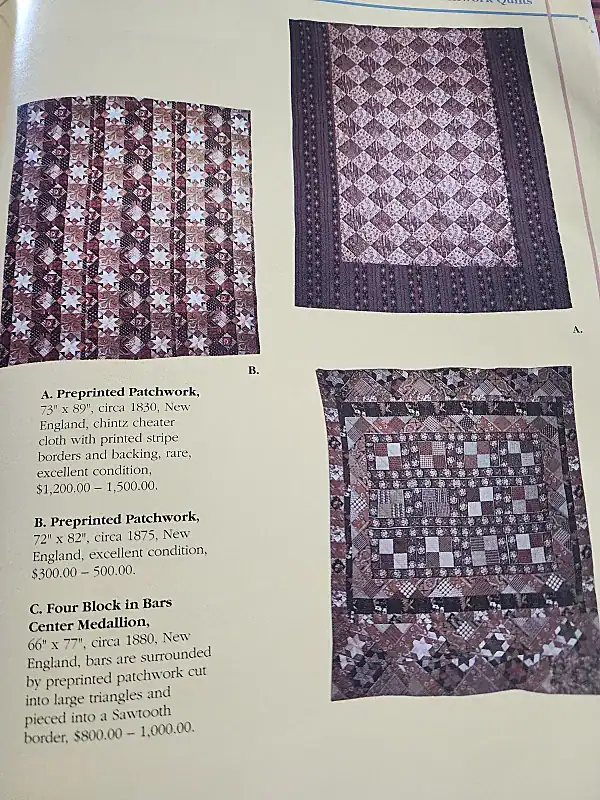
Some time ago, there was discussion about these PA (I believe) pillow top pers. The new book that I wrote with Gerald E. Roy is finally available and there are quite a few pictured, for those that might be interested. Don’t want this to sound like a commercial, so just urge your local libra ry to purchase the book. Antique Quilts and Textiles: A Price Guide to Fashionable and Functional Cloth Comforts. Collector’s Books is the publ isher.
Bobbie A. Aug Author, lecturer, teacher, AQS Certified Quilt Appraiser qwltpro@ www.BobbieAug.com P.O. Box 9654 Colorado Springs, CO
Date: Fri, 28 May 2004 17:11:15 -0700 | From: “Leah Zeiber” <leah.zieber@>
Hi all – just before our recent meeting for SCQHG I came across a reference to a “Bread Quilt” in the book Crib Quilts and Other Small Wonders (p.16). I was wondering if there is any other reference material out there regarding “Bread Quilts?” I had never heard the term before and would like to know if this type of little quilt was common? If so, was it limited to a particular area of the country? Or, could it have simply been one woman’s desire to add aesthetics to her bread making?
Appreciate your responses. Leah Zieber Temecula California
Date: Sat, 29 May 2004 | From: “Jocelyn Martin” <jocelynm@>
>For example, we do not know if red and green quilts were the most popular quilt type during the >mid-1800s because we don’t know what sort of quilts didn’t survive.
We can’t know it just from examining the surviving quilts- but period diaries and letters can be used to help answer this question. For example, what color quilts do women record in their diaries, or in letters, that they are making, or how they reacted to observing a quilt made by another. A reference like ‘Sister Susan made the most unusual quilt, red and green’ gives us just as much information as if we’d found the other quilts Susan and her sisters made. 🙂
Date: Sat, 29 May 2004 00:56:52 -0500 | From: “Jocelyn Martin” <jocelynm@>
>I’m not sure where the Rosa Parks discussion comes from; did I miss >something? whether she was trained or not,
This is, I think, the pernicious aspect of the myths we’ve seen supporting ethnic or women’s history. It’s a response to the fact that history has been pretty much the history of privelege, that people are seeking stories about those who weren’t of the priveleged groups. But those stories are sought from within a priveleged-history perspective. Instead of assuming that there are hundreds and thousands of stories about cleverly planned fights against oppression, one story gets repeated and focused on as if it were the only one, and it becomes a sort of Holy Grail. Any criticism of that story gets interpreted as an attack on the entire oppressed group it’s supposed to vindicate.
How can it possibly take away from Mrs. Parks’ actions, to acknowledge that instead of a spontaneous rebellion, it was something she and others thought about, debated, planned, and cleverly implemented? Even if she was chosen as the least-threatening and least-threatened person to take the action, it still was a risky course of action, and it took not only physical courage but moral courage to put into action what thousands knew was right but had not acted upon.
In the 18th century, it was considered acceptable to make up stories about famous people, and include them in schoolbooks as if they were true stories, if they carried a good moral lesson. But when you think about it, how insulting it was to George Washington, that a lie about him and a cherry tree was used to lecture against lying! As if there were no TRUE story about him taking a moral stand and refusing to lie even if it would protect him from punishment. Or how insulting to all the women of the Revolutionary era, that the story of Betsy Ross was fabricated to teach the lesson that women supported the Revolution, too. Why not teach about Abigail Adams and her famous ‘remember the ladies’ letter? Or about the ladies she was reminding John to remember? Why make up Underground Railroad stories, when there are REAL histories about conductors and passengers to tell?
To promote a myth implies that there is no REAL history, that we must settle for fiction or obscurity for women and ethnic minorities. That’s the tragedy about the myths- the real people, who sacrificed and suffered and died to stand up for themselves and their families and their people, drop back into the shadows. I once told a child about the Prophet Kennekuk. Not only had he never heard of Kennekuk, even though he lived only a few dozen miles from the land where Kennekuk’s tribe continues to live, he thoughtfully observed, ‘I never knew there were smart Indians.’ No one should grow up thinking that an entire ethnic group must be stupid, because there are no true stories about their cleverness and courage. I’ve heard some say that these stories do no harm, even if they’re not true, because they pump up pride. But why build pride on the supposition that there aren’t any REAL stories that will instill pride in one’s forebears, or teach other groups to respect them? That’s the most insidious influence of the privelege/patriarchial assumptions: that REAL history was made by educated white men, that there couldn’t be clever people of other races or the opposite sex, and that make-believe heros are better than nothing. Well, that’s not the choice- it’s make-believe or real, historical heros, not ‘no heros at all’.
Well, what does this have to do with quilts? Quilt history is women’s history. As we study quilts, those women who made and preserved them have a chance to step out of the shadows and be known, and we owe it to them to get the story right, not to let them be elbowed aside by a lovely fiction.
Date: Sat, 29 May 2004 07:04:17 -0400 | From: Jean Lester <jeanlester@>
Not seriously–I made one long enough ago to be vintage and even long before that book was written. Maybe that’s mine. 😉 Jean
Date: Sat, 29 May 2004 10:32:28 -0400 | From: “Nancy Roberts” <aquilter@>
After reading a newspaper article on the popularity of web logs known as “blogs”, I searched for ones on quilting. I found several, including one which had not been updated/active since 2002. The article mentioned how common it is for someone to begin, but then abandon, a blog. However, I found a current one by the creator of theWomenfolk site entitled Judy Anne’s Quilt History Web Log. It’s packed with info and photos. Possibly you already know of this one, but in case you haven’t seen it, here is the link: http://www.historyofquilts.com/weblog.html. I’m going to bookmark it, as it is updated. The latest entry is dated May 10.
The question about Bread quilts reminded me of a quilt I’ve seen by, I think, Sandy Bonsib. The quilt details the steps in bread-making and is delightful. I’m sure it’s not the answer to the bread quilt question, but it is a neat quilt so I though I’d mention it. While I did not see a photo of it on her website, I’m pretty sure it’s in one of her books. Looked through my copy of her “Folk Art Quilts” book, but it’s not in that one. Does anyone know where the photo of it is? Nancy Roberts
Date: Sat, 29 May 2004 11:18:05 -0700 | From: <chrisa@>
In case no one has mentioned this- there is a Rosa Parks Quilt made by the Boise Peace Quilt Project in 1992. It is a tribute to her as a “leading symbol of the Civil Right’s movement in it’s early days.” It can be seen in “Shared Threads” by Jacqueline Marx Atkins. It a contemporary sampler quilt of pieced and applique blocks, flying geese border, with roses, text, picture of her in the middle, and quotes from her.
Kim Wulfert www.antiquequiltdating.com
Date: Sat, 29 May | From: Palampore@
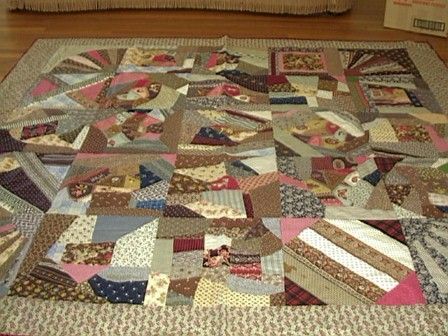
I think some time ago there was discussion about quilts that were topstitched. I recently purchased a quilt that has a great deal of the claret, cadet blue, black mourning cloth, reds, etc. It is done in a crazy quilt style, and all of the pieces are topstitched. It came from New England. I feel very confident that it was machine stitched around the turn of the century. It is not in great shape, but just thought I would put this out there in case someone is interested. Off to nurse my foot. I was doing yard work and stepped into some ground bees….. Boy it hurts! Lynn Lancaster Gorges Historic Textiles Studio New Bern, NC
Date: Sat, 29 May 2004 16:28:02 -0500 | From: Gail Ingram <gingram@>
I know teal became a popular color in late 19th century.
But why then? Vogue? new dye process?
And I’ve never seen it used in prints of the era. Was it used in prints?
Any reliable dating for first production?
Was it more popular in some sections of the country than in others?
Gail
Date: Sat, 29 May 2004 15:54:41 -0700 | From: <chrisa@>
Awhile back the list was discussing the Sanitation Quilt at the Lincoln Shrine in Redlands CA. I was able to see it and it is in great condition considering. The Sanitation stamp is clear and dark. The entire Shrine to Lincoln is quite moving. There were other textiles, a flag from the CW, with the tiny white stars forming a large star on the canton, a silk banner with embroidered letters and flowers telling of the soldiers it represented, and a blanket with initials cross stitched on it, owner known and important to the War.
Back to the quilt; An exact name for the block used to make the quilt was not determined by the list beyond the later one in Brackman’s Encyclopedia called old Italian block. I came across the exact block in two quilts, one 1865 and another 1862 shown in “Shared Threads” by Jacqueline Atkins. Both were made by a group of women, members of the Young Ladies Sewing Society in Canandaigua,NY and were signed in the middle block with at least their name, some had more and some had dates on them too. They named it Double Tie. On one of the blocks is this sentiment “Three Rousing Cheers for the UNION” The text states is also referred to as “Clara Wilson’s Album Quilt” since it was made for Clara upon her engagement or marriage it seems, on Sept. 15, 1862. The group of young women formed, started a society, in order to “meet once in two weeks and are to present each member with an album bed quilt with all our names on when they are married.” (pg. 31) This group was also known as the Young Ladies Aid Society, and they were also meant to “cultivate, enrich, and enoble [sic] our intellectual and moral natures, and to form habits of systematic benevolence….”
A similar one is also pictured- it has shorter strips forming the “X” then the Double Tie, and it is called snowflake, which is a name Brackman’s Ency. gives it too.
Kim Wulfert www.antiquequiltdating.com
Date: Sat, 29 May 2004 20:21:32 -0400 | From: Patricia L Cummings <quiltersmuse@>
Hello:
I have just posted a very long, new article about Baltimore Album Quilts on my website. Hope that you enjoy it.
Pat Cummings www.quiltersmuse.com
Date: Sat, 29 May 2004 20:30:12 -0400 | From: “Velia Lauerman” <velialive@>
In the Patchwork souvenirs book, Waldvogel/Brackman ,the picture of the original piece used in the making of the 1933 contest winner is teal . Is that correct ? Wonder if the collecter donated it to the study ? Would love to see that kind of memorbilia with the collection of those pieces. Velia
Date: Sun, 30 May 2004 07:46:32 -0500 | From: “Karen Erlandson” <quilter@>
I have a quilt dated 1849 with a print teal fabric used as the applique border fabric. Karen
Date: Sun, 30 May 2004 09:35:56 -0400 | From: Joan Kiplinger <jkip@>
I know there are many quilt kit collectors on this list and thought the following might be of interest to those trying to ID unmarked quilt patterns. Several pages of Paragon quilt patterns offered by the Local Sewing Club, 1954 are now on the eboard. http://vintagepictures.eboard.com Select first tab.
Date: Sun, 30 May 2004 11:18:54 -0400 | From: “Amy Korn” <amyokorn@>
Nancy Roberts states: “The question about Bread quilts reminded me of a quilt I’ve seen by, I think, Sandy Bonsib. The quilt details the steps in bread-making and is delightful. I’m sure it’s not the answer to the bread quilt question, but it is a neat quilt so I though I’d mention it. While I did not see a photo of it on her website, I’m pretty sure it’s in one of her books. Looked through my copy of her “Folk Art Quilts” book, but it’s not in that one. Does anyone know where the photo of it is?”
Indeed, Sandy Bonsib’s book, “Quilting Your Memories” (p.50) does in fact show “Mom’s Bread” depicting the steps the artist uses to make a nutritious bread for her family! What a clever quilt!
Date: Sun, 30 May 2004 13:23:04 -0500 | From: Gail Ingram <gingram@>
The well-respected historian David Brinkley succinctly describes the events leading up to Parks=B9 action, which, by the way, was not the first time a black person had defied the segregation policy of the Montgomery bus system . Parks had consoled a high-schooler who had earlier defied the policy, but the girl=B9s disposition and character did not lend her to be a test case. Attorneys were considering yet another candidate as a test case, but her life presented similar problems. Rosa Parks was not even in the running. Nobody thought of her as a possibility. Nobody really important knew her.
She was invited to the Highlander School at Monteagle, TN, however, where she became aware for the first time really of the processes by which change might be brought about. Highlander was something like a black political chataugua, not a real =B3training ground=B2 for active integration actons. She left invigorated, more involved in community anti-segreagation action, and with more pride. This was at the same time the Emmit Till case was rocking the nation. In these days, she heard a relatively unknown minister Martin L . King speak in her church and was further encouraged. She attended severak local meetings, educational in nature, designed to build pride and courage in black people.
Yet she was NOT =B3trained=B2 to do what she did that late December afternoon i n Montgomery. Local black leaders, Adam Clayton Powell, and others had worked out a sort of compromise with city officials: blacks would fill the bus fro m the back, whites from the front, and the middle would be available to both races. One city official admitted that it was his goal to integrate the bus lines. The bus company balked, however, and a movable sign reading =B3blacks only=B2 was placed so segregating seating could be maintained.
The evening Ms. Parks got on that bus had been a long one for her. She worked as a seamstress and alteration woman in the basement of a local store, and by the time she got off work (It was the Christmas season), she was worn out from a long day=B9s work. She missed one or two busses because they were filled. When the next bus arrived she was horrified to discover its driver was the bully who had once tossed her off a bus years before. Sh e was frightened and tired, but she had been to Highlander and had heard Dr. King and had begun to think seriously about inequities and redressing them. She paid her money, went to the middle of the bus behind the =B3colored only=B2 sign and sat down, worn to a frazzle.
Soon more whites got on and the driver ordered the blacks to move back or t o stand in the aisles. Others on the seat with her obeyed. She did not.
She was not a =B3test case.=B2 She was just tired—she remembered her grandfather sitting up all night with a loaded gun in fear of KKKers, she remembered a life of being treated disgracefully. And she was seated behind the =B3colored only=B2 sign. She was not in violation of the law.
The driver, a man named Blake, was confused, for clearly Rosa Parks was a modest, neatly dressed, upright woman—no cursing teenager this time. He told her he could have her arrested, and in a show of dignity, she used the magisterial =B3may=B2—=B2You may do that.=B2 More confused by her quiet dignity, he called two policemen. As the three conferred, Rosa Parks felt a calm descend on her that surprised her. She knew she would be arrested, but she was not afraid. The arresting officer was embarrassed and somewhat deferential, clearly regcognizing the differences in character between the bullyboy driver and the mild-manner =B3colored=B2 lady. By then most of the bus had emptied, and most who remained were black. They sat stunned into awe. I t was said you could hear a pin drop.
This time, quite by accident, the bus company had picked the wrong person.
My own guess is that Rosa Parks would not have moved had she never attended a lecture, never heard Dr. King, never become engaged in discussions of integration. She was an independent, proud woman and acting within the letter of the law. But surely the atmosphere into which she had been cast must have steeled her courage. But according to Brinkly, she ws never =B3trained,=B2 never seen as a =B3test case=B2 (most black leaders were joyful, but shocked).
In other words, it was a confluence of circumstances that led Rosa Parks to stay put that December evening. Isn=B9t it almost always like that?
So in this case =B3myth=B2 appears to coincide with empirical reality.
Gail
Date: Sun, 30 May 2004 16:57:26 -0400 | From: “J. G. Row” <JudyGrow@>
Gail,
Which Brinkley are you talking about? David the broadcaster, now deceased, or one of his three sons, one of whom is an historian.
Date: Sun, 30 May 2004 16:50:43 -0500 | From: Gail Ingram <gingram@>
Sorry: Age is showing, eh?—Douglas Brinkley, who is actually not one of his sons, though is often mistaken for such. B. did the bio for the Penguin bio series. His account fits others I have read. B. is at U. of New Orleans.
gi
From: Judy Anne <anne_j@>
Nancy,
It’s great to see that someone is finding my blog. I’ve been feeling guilty about not updating it more often.
Basically I started it to have a place to post the little things I run across like announcements, neat websites, and interesting bits of quilt history information. There are so many little thing to share that aren’t long enough to merit a whole article on either America’s Quilting History, http://womenfolk.com/historyofquilts or Patches From the Past, http://historyofquilts.com
Judy Anne
From: “Karen Quilts Texas”
Gail –
I think anyone who reads Rosa’s own account of the events of that day will also agree with you. It is sad to see respected historians, such as the gentlemen who are quoted in the NY Times article Judy brought to our attention, falling prey to our cultural bias for portraying women (as well as African Americans or persons of any ethnic origin) as not being able to think or act for themselves. We must be “trained” to do so! But that too is a “myth” … is it not.
As a longtime businesswoman in managerial roles, almost always working in concert with entirely male cohorts, I went up against it almost daily. It is still done unknowingly by many.
Karen
From: “Karen Quilts Texas”
Yes, I read your entire post, as well as the Book Review article. I’m sorry you took offense at my comments. Perhaps I should have made it clear that my concern is at the comments you took from the article. Respected they may be, but their comments would not give me confidence in their ability!
No matter how “respected” these gentleman may be, their comments are like so many that I have heard from other “respected” and (usually male) experts when discussion the actions, successes, and motivation of women involved in not just civil rights, but in many areas of endeavor. I tire of reading again and again, the discounting of any woman’s writings, words or deeds. It is pervasive in our society, and damages everyone. As a woman who spent over 20 years in business management, I was exposed to this sort of “discounting” of the works of women, more times than I care to remember.
Was she tired… well a 10 hour a day job as a commercial seamstress… probably! Was she poor – well, she was riding a bus… I think if she were well off, she wouldn’t be riding a bus to and from a job as a seamstress!
Was she motivated – who wouldn’t be… was she an activist. Absolutely, no reason to discount that, or make a comment that makes it sound as though she were not responsible for her actions! When the other two men on the bus sitting with her moved quietly to the back of the bus to stand, she made a conscious decision to stand her ground. If she were “trained”… she also did so of her own volition.
I prefer to believe Rosa’s story, not these men’s “myth making” of their own!
Would these gentlemen be of help in continuing a study of the HIPV issue? Their comments don’t make me feel too good about them!
Karen Spring, TX
From: “Lucinda Cawley” <lrcawley@>
The Maryland Historical Society’s 2001 exhibit “The Baltimore Album Quilt Tradition” featured a display of kaleidescopes in the gallery which contained the “Mathematical Star” quilts. (Lone Star quilts were sometimes called Mathematical Star in mid-19th century MD. The following is from the signage re. the kaleidescopes, ” Quilt designs in star patterns provide the only evidence that women in the mid-19th century enjoyed looking through kaleidoscopes and recreated what they saw in fabric. As yet, no Maryland woman’s account has been found that records this parlor pleasure–although we know that Americans, such as Henry Clay purchased them. In his patent for the kaleidoscope in 1817, Scottish ptics inventor Sir David Brewster pointed out its various applications in the ornamental arts. He noted that “It may be sufficient to state, that it will be of great use for architects, ornamental painters…Calicoprinters, carpet manufactureres, manufacturers of pottery, and every other profession in which ornamental patterns are required. In all these cases the pattern is perfectly symetrical round a centre.” Cinda on the Eastern Shore
From: Gail Ingram <gingram@>
My own point about the Rosa Parks issue was not gender-related, but relate d to the depth of research done by Professor Douglas Brinkley, as opposed to that apparently supporting the statements of Profs. Gates and West. Anyone wanting to review the research for Brinkley=B9s work and the difficulties he acknowledges in establishing fact from fiction in the Rosa Parks story may read the final chapter in his book, wherein he discusses his research. I am no fan of all of the Penguin Lives (Roy Blount=B9s account of Robert E. Lee i s shameful, e.g. Blount doesn=B9t come near the man whose life he is supposed t o chronicle), but this one stands out and, I suspect, will remain a classic.
The truth is I suspect Brinkley, West, and Gates might generally agree on the issue of Parks=B9 background. The issue turns on the world =B3training.=B2 Remember, this was the early days of the Civil Rights movement, before what we would call =B3training=B2 really became widespread. Parks had been noticed a t lectures on civil rights given in her church and community, and she was an independent, though quiet, woman. She was sent to Highlander, a place geare d to informing black people of their rights and building racial pride. But there are no records of her having been =B3trained=B2 in specific techniques of civil resistance, and there are no records of her having been chosen to sit still, while the two men on her seat obeyed the busdriver=B9s orders and yielded their seats to entering white busriders.
In each interview (and these were difficult because of her health) she said she was simply tired, that she was in compliance with Jim Crow law because she was sitting behind the =B3colored=B2 stand, and that she had just had enoug h injustice. She surprised herself, even more when she found herself becoming very calm and unafraid. The bullyboy busdriver himself was nonplussed by he r quiet modesty and dignity.
No doubt the Highlander experience and the lectures she had heard by relatively unknown leaders like Martin Luther King had seeded her mind, fortified her for that moment. But the moment itself was a spontaneous response to repeated degradation, if we are to believe Ms. Parks, her friends and family, others on the bus, and many news accounts of the time.
She had no entourage of attorneys awaiting her as she entered the jailhouse , where one of the policement refused to let her have even a swallow of water . No crowd of organizers outside that bus buoyed her, sang =B3We Shall Overcome.=B2 She was on her own, much as the men and women who set into motio n the revolution that ended in our Constitutiion must have been in the beginning of that struggle..
Having lived in the Deep South always, she had to have understood what that meant. After all, this was in the same time frame as the Emmet Till incident. She knew the hatred that could burn in men=B9s souls and erupt in brutality of the most unspeakable kind.
Those of us who grew up in the South know that what distinguished Rosa Park s was her failure to accept the commonly accepted customs—on this occasion, anyway. And we understand how uncommonly daring her action was. Maybe women of a certain age have a special appreciation of her behavior because they too grew up in worlds where the accepted customs in their communities demeaned them. Judging from the playgrounds of thes school where I teach, maybe women growing up even now have such an appreciation. But I think Brinkley got it right. I recommend his book, titled simply =B3Rosa Parks=B2 and published in the Penguin Lives series for $19.95. As a historian, Douglas Brinkley=B9s work will outweigh either that of West or Gates, whose tendencie s run in other directions.
Gail Ingram
From: Donald Beld <donbeld@>
Hi everyone, I promised my self that I wouldn’t write in anymore because of feedback I have received that I have no credibility on my postings; but the discussion about Rosa Parks is just too much of a coincident for me to ignore.
I have been hand piecing a quilt that I call ROSA PARKS: BREAKING THE BONDS OF SEGREGATION for two years now and just finished the top today; so I have posted it to vintagepictures.eboard.com for those of you who would like to take a glance at it.
It is done using Job’s Tear as a pattern and using reproduction fabrics, as I always do. Job’s Crown is a difficult pattern to do, so this has been my UFO the past few years. It measures 104 by 104 inches. Now all I have to do is quilt it!!!
The border contains a homage to the South African flag, as an acknowledgement of the African origins of Rosa Parks and other brave Civil Rights workers.
This quilt is part of a series of quilts I am making and designing to pay tribute to what I call Common People, with Uncommon Courage. Some of you may have seen my earlier quilt that I posted called LET’S ROLL, FLIGHT 93, HEROES ALL, 9-11-01.
The idea for these quilts comes from my interest in people, history and quilting and harkens back to the old patterns named for Barbara Freitchie, of John Greenleaf Whittier fame; who was the 19th Century’s Common Woman with Uncommon Courage. (Yes, I know it isn’t a true story.) I think Rosa Parks was the 20th Century’s; and the brave souls on Flight 93 were the 21rst Century’s. Don Beld
From: “Jean Carlton”
Hi all, A brief report and about 40 photos are now posted for LLQSG (MN) on the study group site. Hope you enjoy them. Jean Carlton
From: Dana at Material Pleasures
Hi Don, I for one, hope you don’t stop posting. I enjoy all the posts and all the different perspectives and points of view. I love the quilt top and I hope to you post the other as you finish them.
My best, Dana
From: <chrisa@>
The book from that exhibit shows some of the mathematical star quilts that I saw displayed there. They are dated from 1820 to 1845 in the book and the text states that this pattern was popular from 1830-1850 with Maryland quilters. This pattern was later known as the Star of Bethlehem. I think the Lone Star name came much later starting in TX.
The text goes on about kaleidoscopes for inspiration after it was invented in 1815. The mathematical Star quilt in the book that is dated the earliest, 1820-40, has smaller mathematical stars (sometimes called blazing star) in the four corner and filling the inner border, but there is no mention of the kaleidoscope being the inspiration.
As good as these pictures are, that exhibit was one you had to see in person. Too glorious for picture to describe. Some of the star quilts using large floral prints were hard to look at, but worth the pain. Very unique and in such bright colors and mostly excellent condition.
Kim Wulfert www.antiquequiltdating.com
<< The Maryland Historical Society’s 2001 exhibit “The Baltimore Album Quilt Tradition” featured a display of kaleidescopes in the gallery which contained the “Mathematical Star” quilts. (Lone Star quilts were sometimes called Mathematical Star in mid-19th century MD. The following is from the signage re. the kaleidescopes>>
From: Kathie Holland <kathieholland@>
Don, thank you for sharing your quilt. I love it. I would like to see your quilt LET’S ROLL, FLIGHT 93, HEROES ALL, 9-11-01 would you please post another pix of it? AND PLEASE don’t stop posting I enjoy reading your messages and appreciate reading everyones different perspectives and points of view. Thanks, Kathie in NJ
From: “Candace Perry”
Cinda, thanks for this post. I’m curious, though…in fraktur and the infamous “hex signs” or barn stars in PA German areas, the mathematical stars are the result of compass designs. I guess I don’t quite understand how the scholars have made this leap, without any documentary evidence. Candace Perry
From: Gail Ingram
My thoughts exactly (poor Candace–to be on my wavelength).
What is earliest dated/estimated date Mathematical Star? Background of maker? Place?
What links were provided other than the suggestions quoted in your original post?
Gail
From: “Lucinda Cawley”
Candace and Gail et al. Funny you should ask. There was absolutely no evidence that I could find for this leap of faith from kaleidoscope to Mathmatical Star. I suspect that MD Historical Soc. had some dandy kaleidoscopes and wanted to include them. Cinda on the Eastern Shore
While not totally quilt related, quilter Ami Simms wrote up an interesting account of her vist to the White House as an invited guest, where she met Laura Bush. She includes beautiful photos. To see this, go to http://www.amisimms.com/mrsigotowa.html. She was invited because of a quilt that she made.
Celine, in hot So.Calif.
Date: Fri, 04 Jun 2004 08:25:43 -0500 | From: louise-b <vlbequet@>
One of our guild members asked me which books have information on Signature quilts – signing, history, etc. I distinctly remember reading a book that had pictures of old signature quilts, inks, etc., but cannot recall the name or author of the book.
I have McKelvey/Cory’s book on Signature Quilts and it is helpful but not the one.
Louise Bequette
From: Midnitelaptop@
you might try this site for resources on signature quilts.. http://www.womenfolk.com/historyofquilts/friendship.htm jeanL
From: “Susan Wildemuth”
Here is a list of titles of books/articles about Signature Quilts the Iowa-Illinois Quilt Study Group compiled for our February 7, 2004 study group meeting — hope this helps: Please e-mail me if any of you have any additional titles to add to this list
Sue in Illinois
Signature Quilts – Books and Articles
Brackman, Barbara. CLUES IN CALICO. McClean, Virginia: EPM Publication 1989
ISBN: 0-939009-27-7 LCCN: 89-16873 Paperback edition.
Brackman, Barbara. “Signature Quilts: Nineteenth-Century
Trends.” QUILTMAKING IN AMERICA BEYOND THE MYTHS.
Nashville, Tennessee: Rutledge Hill Press, 1994, 20-29.
Clark, Ricky. “Mid-19th Century Album and Friendship
Quilts, 1860-1920,” in Lasansky, Jeannette(ed.), PIECED BY MOTHER. Lewisburg, P A: Oral Traditions Project of the Union County Historical Society, 1988, 76-85.
Cord, Xenia. “Signature Quilts.” BLANKET STATEMENTS. Nebraska: American Quilt Study Group, 2003.
Cory, Pepper and Susan McKelvey. SIGNATURE QUILTS: TRADITIONS, TECHNIQUES, AND THE SIGNATURE BLOCK COLLECTION. Saddle Brook, New Jersey: Quilt Publishing House, 1995. ISBN: 1-881588-14-9
Fox, Sandi. FOR PURPOSE AND PLEASURE: QUILTING TOGETHER IN NINETEENTH CENTURY AMERICA. Nashville, TN: Rutledge Hill Press, 1995.
Kolter, Jane Bentley. FORGET ME NOT: A GALLERY OF FRIENDSHIP AND ALBUM QUILTS. Pittstown, NJ: The Main Street Press, 1985
Lipsett, Linda Otto. REMEMBER ME: WOMEN AND THEIR FRIENDSHIP QUILTS. Lincolnwood, Illinois: Quilt Digest Press, 1985
ISBN: 0-8442-2650-5 LCCN: 85-9525 Paperback Edition
“Quilted for Friends, Delaware Valley Signature Quilts, 1840-55” Jessica F. Nicoll
Dorothy Cozart’s research on Fundraising quilts in Uncoverings, 1984- “A Century of Fundraising Quilts, 1860-1960”
“Quilts in Community, Ohio’s Traditions” by Ricky Clark. et al has quite a bit to offer on this subject
“Friendship’s Offering” by Susan McKelvy , if you are looking for examples and sayings
Kolter, Jane Bentley. FORGET ME NOT: A GALLERY OF FRIENDSHIP AND ALBUM > QUILTS. Pittstown, NJ: The Main Street Press, 1985