February 22 – 24, 2004
This page contains affiliate links. If you buy through them, I may earn a small commission at no extra cost to you. As an Amazon Associate I earn from qualifying purchases. Learn more
These restored messages come from the Quilt History List, an online forum where quilt historians, collectors, researchers, appraisers, and enthusiasts discussed antique quilts and related textiles. The archive dates from 1996 through approximately 2016 and is being restored gradually. Sign up in the form at the bottom of the page if you want to know when a new page is added. Original spelling, opinions, formatting, and inactive links may remain unchanged.
Primary topics of this QHL Digest:
- Xenia Cord’s UGRR Rebuttal — Xenia Cord’s detailed newspaper response to the quilt-code theory draws widespread praise and requests for permission to reprint it.
- Deep South Quilt Study Group Report — Members share and troubleshoot links to a newly formed regional study group’s first meeting report. (see the article on quilt study groups)
- Forming New Quilt Study Groups — Charlotte Bull seeks advice on starting a local study group, drawing on the Deep South group as a model.
- Antique Quilt Shopping & Sourcing — Budget-friendly antique quilt finds, an intriguing 1860s eBay quilt top, and a reconnection with a former Paris quilt shop employee.
From: Xenia Cord <xenia@>
Last Sunday in the local paper there was a long article interviewing a Friends minister who dresses in period costume and gives programs on the substantiated Quaker role here in the UGRR. Unfortunately she also includes information on ‘codes’ quilts and the UGRR. Today the paper ran my response:
Quilt research and quilt history often rely heavily on the oral anecdotes and oral memories of quilters, stories that link women with common interests to a body of shared information. This information, strongly buttressed by written memoirs, documented sources, pictures, tangible artifacts, and previously published research allows the historian to contribute to the body of knowledge that is American quilt history.
Occasionally a theory is presented that offers an engaging view of the American past; the theory may not have substance and may not be documentable in any scholarly way, but it provides a vehicle through which we believe we can understand our past. This is the case with studies that supposedly reveal hidden codes or messages in quilts. A number of popularly disseminated misunderstandings about the role of quilts prior to the Civil War in the preparation and escape of fugitive slaves, and in the Underground Railroad are at present being taught to our children.
Without denigrating the courage of those who escaped slavery, without disparaging the roles played by those who assisted in moving folks along the road to freedom, we need to look objectively at the idea that quilts played a role. The idea is twofold: that slaves made quilts on the plantations where they lived, and then displayed specifically chosen patterns in sequence, hanging the “coded” quilts outdoors as a signal that preparations should be taken for escape; and secondly, that abolitionists hung specifically patterned quilts outdoors to signal that theirs was a safe house.
Immediate questions should arise. Who on the plantations devised the “codes,” how were they disseminated, who made the quilts, where did they get the materials to do so, how were “messages” in quilts spread from one slave community to another, why were more normal means of communication not used to convey the same information? Were abolitionist quilts hung outdoors in all weather, and at night? What would happen if a Southern sympathizer hung a quilt outdoors? These are just a few of the questions that might be asked about this romanticized, unsubstantiated, illogical “history” purporting to reveal secret codes in quilts.
I searched a number of books for references to quilts, codes, and escape from slavery, and found nothing. Among them were John Hope Franklin, From Slavery to Freedom, A History of Negro Americans (3rd. ed., 1967); Eugene D. Genovese, Roll, Jordan, Roll, The World the Slaves Made (1974); Mary Frances Berry and John W. Blassingame, Long Memory, The Black Experience in America (1982); and Lawrence W. Levine, Black Culture and Black Consciousness, Afro-American Folk Thought from Slavery to Freedom (1977). In my own extensive research and documentation of black rural settlements in Indiana before 1860 (published in Wilma L. Gibbs (ed.), Indiana’s African-American Heritage (1993), I found no references to quilts in conjunction with escaping slaves who vanished into Indiana’s free black communities, or with the Underground Railroad in Indiana.
The book that started it all, Hidden in Plain View by Raymond Dobard and Jacqueline Tobin (1999), offers no documentary evidence that the theory advanced is valid, cites no independent sources (for instance, the thousands of narratives collected from former slaves by the WPA or the narratives of Harriet Tubman), and offers in illustration quilts in patterns known to have originated in the 20th century. The theory hangs from a slender thread, a single story narrated by an African American woman in Charleston, SC, whose business was selling quilts in a local marketplace, and the interpretation given it by the white teacher of Women’s Studies at the University of Denver. No surviving quilts supporting the theory have been found; other African American families have not come forth to attest to similar “code” tales in their own families.
A second book, Gladys-Marie Fry, Stitched From the Soul, Slave Quilts from the Ante-Bellum South (1990), offers briefly, without substantiation, the information that “Log Cabin quilts containing black fabric often served as signals on the Underground Railroad to identify ‘safe houses’” (legend for image no. 75, p. 52). Quilts are artifacts suggesting family and comfort; they are forever associated in our minds with the pioneer spirit and the making of the American home. Their visual imagery makes them ideal subjects for a number of educational investigations, but we must assure that the information we communicate to untutored audiences is historically accurate, and not ungrounded theory.
Now waiting for phone calls <g> – Xenia
From: Patricia L Cummings
The subject had come up as to whether or not Barbara Brackman had added something (in print) to the discussion of the UGRR. Thanks to Jan Dreschler, I was able to look in my collection of past Quilter’s Newsletter magazines and found a two page summary, “Myths of UGRR” (issue #297- 1997-p. 40-41). This article is actually a shortened, edited version of the same information that appears in Barbara’s book, /Quilts from the Civil War/ (C&T Publishing, 1997).
Since this article pre-dates the publication of Hidden in Plain View, it does not directly assess the issues presented there. However, Barbara does dispute the widely held and current-circulated myths of the day (1997), regarding the Underground Railroad, and its connection to quilts.
In accessing the NAMH site, I was amazed to see that the association of quilts and the Underground Railroad is presented as fact. My comment to them did not transmit via the Internet, from their site.
In doing some further looking online, I found the articles written by a reporter (url previously provided by Jan). This person offers advice on a number of quilt related topics, including the Underground Railroad. Her writing immediately become suspect when she refers to Raymond Dobard as “Robard”, not once, but several times in various articles. She again refers to him as “Haymond” and alternately, as “Raymond Tobin”. This from the person who says that she got some of her information from /Clue in the Attic/ by Brackman. Oh, my! Could she mean /Clues in the/ /Calico/, perhaps?). She mentions the “Wollen’s Christian Temperance Union” in New England (never heard of that one….Women’s Christian Temperance Union?– yes!). Such sloppiness of writing and uncited source materials seriously cut into the credibility factor for any of this writer’s opinions.
More egregious than typos and oversights are the glaring mistakes and false assumptions about quilt history that she imparts. These kinds of columns have no place in any newspaper in this country and are very disturbing to those of us who hold quilt history near and dear to our hearts, and it is only with the utmost angst that I even mention them here.
If this is to be a trend across the country of the unknowing writing their opinions and presenting fiction as fact, we might just as well be discussing whether we can really hear the footsteps of Santa’s reindeer on our rooftops. There will be some, those of more fanciful imaginations than the rest of us, who will swear that this happens every year. For those of us who still need to see the paw prints, we will not believe the story until we do.
From: Gail Ingram
Oh Pat, thank you for this jewel! This had been an “off” morning. The alarm clock battery failed overnight so we awoke late, I awoke with lingering cough from two-week old cold/flu, we didn’t go to church, Plus spilled coffee and a few things in that line. General confusion. Then I remembered I had better delete all the Viagra and sex-kitten spam that accumultes in my email “delete” folder. Once the computer was open, I read incoming emails as well. Voila! this gift.
I would like to secure a membership application for Wollen’s Christian Temperance Union and hoping that B. Brackman’s “Clues in the Attic” is the long-awaited re-issue or update of “Clues in the Calico,” would like to find source for that, since amazon.com does not list it. And really, how could one pass by anything written by an author named Haymond-Raymond Robard-Tobin?
I might not be admitted to the Wollen’s group, though I need to work on temperance and unity in general and no doubt would benefit from its services, but booksellers are mercenary folks and would, I feel confident, send me the books if I sent them my check.
Eagerly awaiting further enlightenment, Raye Gice Ringram in North Louisiana.
From: Kris Driessen
Thanks a lot Pat. Now all day, I am going to be singing, “Grandma got run over by a reindeer. Walking home from our house Christmas eve. You can say there’s no such thing as Santa, but as for me and grandpa we believe. She’d been drinking too much eggnog, and we begged her not to go. But she forgot her medication, and she staggered out the door into the snow. When we found her Christmas morning, at the scene of the attack, she had hoof-prints on her forehead, and incriminating Claus marks on her back.”
> If this is to be a trend across the country of the unknowing > writing > their opinions and presenting fiction as fact, we might just as > well be > discussing whether we can really hear the footsteps of Santa’s > reindeer > on our rooftops. There will be some, those of more fanciful > imaginations > than the rest of us, who will swear that this happens every year. > For > those of us who still need to see the paw prints, we will not > believe > the story until we do. >
From: Kris Driessen <krisdriessen@>
For those that are dying to know what our own Anita Grossman Solomon looks like, read the interview about her at http://www.electricquilt.com/Users/Newsletters/floppy/102/102p10.htm You can invite her into your living room if you watch Simply Quilts on March 1…
Kris
From: “Candace Perry” <candace@>
I’m interested in this quilt top on ebay because it has some relationship to our interpretive area:
1860’s-70’s QUILT TOP WITH A BIT OF HISTORY Item number: 3706022574
But I haven’t really seen anything like it from our area (SE PA; Berks/Montgomery Co. in particular) so I’m wondering if it was made elsewhere, perhaps after the woman moved away. Any thoughts would be greatly appreciated! Candace Perry Schwenkfelder Library & Heritage Center
From: Gail Ingram
Several members have inquired about a report from the Deep South Quilt Study Group’s February 6th-7th meeting. It may now be found at www.quiltstudy.com/study. Simply click on the button at the bottom of the DSQSG page. Several photos are missing because of errors in transmission, but we will fill in the gaps shortly.
It is long, but it is also the only “minutes” we have of our first gathering. This was our first meeting, and we had no designated notetaker or photographer. So the report represents a compilation of member responses and also a way of sharing photographs with one another. It also seeks to note patterns or trends we observed that might prove to characterize regional quiltmaking practices and to raise questions which we hope QHL members will help us answer.
We want to note here our particular gratitude to Kris, our listmom, whose QHL made it possible for us to find one another, and to Cinda Cawley, whose wonderfully detailed reports from the Dating Club meetings made us so keenly aware of what we were missing. We are also grateful to all the members of this list who encouraged us, mentored us in organizational plans, and sent gifts for doorprizes and name tags. (No proper southern meeting can take place without doorprizes: we don’t know if that is a regional characteristic or not.) Finally, thanks to Sally Ambrose who provided the metaphor that made us laugh when our efforts began to frustrate us. Sally noted that pulling this group together sounded to her like herding cats. The comparison was dead on, and from that point forward, we saw not the frustration but the humor.
Now we know why the Dating Club members were so adamant about getting past a roadblock of missiles which had come loose from their moorings on a truck and spilled all over a highway in Northern Virginia. That was in the dim days following 9/11/01, and at the time, I remember thinking of the stranded members who determinedly found their way around that obstacle, “Why didn’t they just turn around and go home?” Along with the rest of us who gathered Feb 6-7, I now understand the answer to that question.
Thanks from each of us to each of you who wished us well and made possible our new community. Our meeting gave us a renewed enthusiasm and focus, burgeoning knowledge of our own region’s quilts as well as of those from othr areas, and, I suspect, the beginning of research that otherwise would not have come into being.
We hope you will respond to questions which arose in the course of our gathering.
Gail Ingram
From: Joan Kiplinger
Gail — is the url correct? I get a notice it cannot be found. Congrats on getting a group together; I’m sure it was suthren hospitality at its finest.
Gail Ingram wrote:
>It may now be found at www.quiltstudy.com/study. > > > >
From: Barb Garrett
Try this — http://www.quilthistory.com/study/DSSG1.htm
From: Xenia Cord
> Joan, Gail must have gotten excited about the topic <g>! It’s not > quiltstudy, its www.quilthistory.com, then click on the link on the left > under Study Groups. then at that link click DSQSG. It’s a long and > awesome report, and the food descriptions and quilt pictures will make > us all wish we had been there! > > Xenia
Gail was jpeg-weary, eager to get away from computer because it’s mid-winter break/Mardi Gras holiday here and she’s got to complete a sampler before she can start a quilt. But maybe the error will earn her membership in the Wollens Christian Temperance Union.
And I caught that allusion to food, Xenia. Anticipated it in paragraph #1. It is a non-regional tradition. Just let us know whether you think that 1801 quilt originated in America or England<g>
Gail
From: “Elizabeth Fritsche”
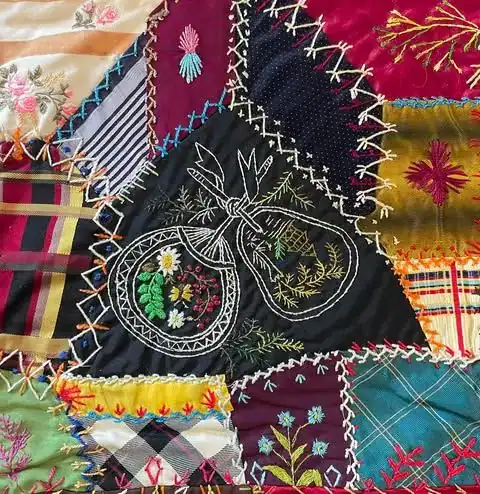
I am always lurking and enjoying our quilt conversations and I finally have a short message for everyone who feels that the cost of antique quilts is out of the budget. My sister returned from the Goodwill recently with a beautiful crazy quilt which was signed with initials and dated 1905. As with all silk quilts, there was some discengration of some of the patches, but overall the quilt was beautiful. It has a lovely border and lovely embroidery. And what did my sister pay for this jewel? $1.50!! That’s right ONE DOLLAR AND FIFTY CENTS! We live in the metropolitan Washington D.C. suburbs and I didn’t think anything cost $1.50, much less such a lovely quilt. If I get a chance to take a digital photograph I will send it out. So the moral of my little story is that if we just keep our eyes open there sill are jewels to be found.
Date: Sun, 22 Feb 2004 | From: bsythmbl@
Here is a link to the newspaper article concerning the Maine stenciled quilt auction. http://www.kjonline.com and scroll down to Waugh auction. I have no idea who bought the quilt but it went to one of four phone bidders. At the Preview, the auctioneer told me it would be going where it would be “appreciated”. I am sure Maine Antique Digest will have more details in the next issue. It is certainly a shame that the quilt had to leave Maine, but neither the local historical societies nor the Maine State Museum have the acquisition funds……….Cyndi in Maine
From: Xenia Cord
Hi, Gail – for my money I think the quilt is American, but it certainly has English influences. I wish the pictures showed more of the quilting and the border, but if the techniques are what I think, it’s American.
How’s this? Ann Moffett, b. 6 January 1782, Kent Maryland, daughter of Moses Moffett and Mary Stansbury. M. James Maloney 8 December 1819, Stuebenville, Jefferson Co., Ohio. Ann d. 10 Feb. 1883 Steubenville, buried 12 Feb. 1883, Union Cemetery, Steubenville. Mary Stansbury was from Baltimore. She m. Buckler Bond after her husband Moses d. 10 Nov. 1794. Moses was from Chestertown, MD.
May not be the same woman, but the dates would be about right, and her migration is in the right direction <g>. Maybe you could pass this on to the quilt owner, in case it’s a match?
Enjoy your Mardi Gras vacation! I am serving crepes this week to my quilters, in good French tradition!
X
From: Patricia C Crews
Xenia,
What a thoughtful response and what an impressive list of sources consulted in an effort to locate a shred of supporting information for the HIPV story. Thanks for sharing it on QHL and for taking the time to compose and send it to your local paper. I will be using it as a resource in my History of Quilts class the next time I teach it. Pat
Patricia Cox Crews, Ph.D. Cather Professor of Textiles & Director, International Quilt Study Center Dept. of Textiles, Clothing & Design 234 HE Building P.O. Box 830838 University of Nebraska-Lincoln Lincoln, NE 68583-0838 PHONE: 402/472-6342 FAX: 402/472-0640 pcrews@
From: “Teddy Pruett” <aprayzer@>
Dearest friends and fellow sleuths, I would appreciate some opinions on a quilt I saw yesterday. NOTE: CINDA!! THIS MEANS YOU!
The quilt was reputed to be from Scranton, PA, and I am pretty darned good at identifying PA quilts before they even get out of the pillowcase, but this was like nothing PA I’ve ever encountered. Well, now, in all truth it did have a brown print backing – a stripe, but that was the only thing. Oral history relates that it was made by a young boy or very young man. The entire surface of the bed sized quilt is one enormous Mariner’s Compass, done in all solids of cheddar, brown, dark green, and oxblood. There are two 4″ borders, one of cheddar and one of brown. The entire compass is machine pieced, but the compass is quilted by hand, very crudely, with one single line down the center of all points. The two borders are machine quilted in lines parallel to the edge. The batting is very thick, but I was unable to determine the fiber. I begged the lady to tell me that she was really, really from NC or Georgia, but she refused to move to the south for me.
I am rarely stumped by a quilt. In most cases when a quilt does not agree with the oral history attributed to it, I can identify the discrepancies and help the owner to understand them. But I dont know enough about this quilt to refute or support her story. I will be very appreciative for more info if any of you are familiar with quilts of this type. Teddy Pruett, Lake City, FL – where the Redbuds are out!
Teddy Pruett
From: Xenia Cord <xenia@>
Colors say it’s a NC/SC/GA quilt!! Picture?
X
From: “Brenda & Roger Applegate” <rbappleg1@>
Yes, thank you for all of your work. I am going to include it as part of the packet I give teachers when I do a quilt history talk. Brenda Applegate
From: “Sally Ward”
Not for the first time I sighed last night over the fact that my forebears didn’t do me the favour of emigrating to the States just so that I could now study quilts (and eat such interesting food) <G>. I hope you ladies realise just how lucky you are to have this vast storehouse of art and inspiration at your fingertips.
The 1801 quilt didn’t look English to me, my caveat as always being that I am only an interested amateur.
Sally W
From: “Galinette” <galinette@>
judy, are you looking for me? yes, i worked for more than12 years at “le rouvray”, the paris quiltshop. i had a wonderful time there and have met a countless number of american quilters, some very famous and passionnating, others just passing by, surprised to find american fabrics , but they were all kind and always in a good mood. the most famous one was julia roberts, who owns antique quilts herself and is a shy, bt very kind youg woman and we han a little chat. she worked on a robert altman film by the time. until now i did not even thank the members of the list who send me a warm welcome when i introduced myself, believe me, i really appriciated that! and then Karen evans told us about her dreams. i saw a yorganci guy at work in istanbul during the quiltfestival organised by my friend selma kenter agalar. breathtaking, but the man had very smelly feet…….. he showed us pictures from a yorganc made by his father for president eisenhower. as soon as i can afford it i go back to istanbul, filled up with all kind of textile treasures….. debbie kratovil, i finished the grandmother’s flowergarden is was working on when we met the last time, but it is not the one you have seen when you passed the last time. are you planning another trip? or anyone else? just let me know, we could spend some time together. i live in montmartre, great place for fabrics of all kind. so judy, if i can do something for you, let me know. will in paris, freezing today! ——=_NextPart_000_00D3_01C3FA0A.6C1A8480–
From: Xenia Cord <xenia@>
You folks are great! I have received a number of complimentary messages from people who liked what I had to say about quilts/slavery/UGRR, and several have asked for permission to pass the information on to teachers and others who might find it enlightening.
Please feel free to use the information in any way that is useful as we struggle against misinformation and creative inaccuracies.
Xenia
From: Margareta.Faust@
Hello all, Spent an enjoyable evening watching ‘Seven brides for Seven Brothers’ on TCM and noticed that many of the girls’ skirts looked like quilt designs! This is what I subsequently found on the Internet Movie Database: ‘For the brides costumes, designer Walter Plunkett </name/nm0687703/> went to the Salvation Army, found old quilts and turned them into dresses’. Shame the designer did not know much about dating quilts, as the movie is set in the 1840s and one of the girls is wearing a Crazy Quilt skirt and anyway, who would make dresses out of quilts? But they were fun to look at, in any case. Margareta
From: Joan Kiplinger
Gail and the suthren new group — what a great display of quilts. Congrats on the formation and dedication to study and larnin’.
Xenia Cord wrote:
>Joan, Gail must have gotten excited about the topic <g>! It’s not >quiltstudy, its www.quilthistory.com, then click on the link on the left >under Study Groups. then at that link click DSQSG. It’s a long and >awesome report, and the food descriptions and quilt pictures will make >us all wish we had been there! > > > >
From: “Cinda Cawley” <lrcawley@>
Teddy, Before I became “Cinda on the Eastern Shore” I was “Cinda from Scranton”-my home town. I never saw anything like what you describe in northeastern PA. How did Scranton enter into the quilt’s history? I agree with Xenia. Sounds southern to me. Can we see a picture? Cinda
From: “Martha Gilbert” 7
The suthern (suthren) is from how Gail sometimes writes to make light of herself but also to reinforce our wonderful Southern heritage we enjoy so much. Gail says all the northerners think we are so special and strong and smart. I love when Gail gets out her literary voice to make the South sound so inticing and interesting. I’m sure some of them still have reservations about how smart we are but most admire her ability to write.
Anyway that is my take on it!! Hope it is that positive!
From: Patricia L Cummings
Dear Xenia:
Thank you for sharing your very well-written letter with us.
In speaking with my son on the phone last night, he told me that there is a fictional story about the King of Denmark which recounts how the King refused to fly the Nazi flag. Being Danish, my daughter-in-law, clearly knows that such a King did not exist. Yet, to go “beyond the story”, school children are sometimes asked to find out which King this is, and in what time period he lived, much in the same way that they are told to research Betsy Ross of flag-making fame, another myth.
Perhaps part of the problem in education today is the lack of good teaching training and/or ongoing education. “Critical thinking skills” cannot be imparted to children, if teachers themselves do not have them. Sorting out fact from fiction may seem simple to those of us who know the difference. We cannot assume that children can separate fanciful tales from what is real.
Children are children and we don’t worry very much if they believe in myths. However, the teaching of history based of fictional tales is wrong, simply wrong. History is difficult enough to teach. Written history reflects the opinions of whomever is writing it, subject to his/her biases, (perhaps) limited information, and by necessity, limited presentation of facts. For example, if one fact is given, maybe ten are not…. It is always a judgement call in what to include and/or exclude in a piece of writing.
Over the last five years, I have watched this situation as the book /Hidden in Plain View/ has incubated even more ideas that exceed the original ones. This is perhaps why we just cannot leave the subject alone. Like a quilt, the book seems to be gathering more embellishments and meanings with age. The up side of the discussion is that we have all gone back to our history sources and have done more reading about the Civil War, the Underground Railroad, and have even tried, to no avail, to find supporting evidence of links to actual quilt usage for signalling.
What the discussion has devolved into is the charge that the “code” was based on oral testimony, in the tradition of the African village griot,and that this is outside the scope of the way traditional knowledge is shared (through written sources, etc.).
No extant textiles exist from the time period because they would not have stood up to rigorous use, it is said.
The information contained about in the book, about which quilt blocks were used, keeps changing, transmuted with every objection posed.
We are to believe that the geometric configurations in the code not only made a transoceanic leap from Africa to America, but that their meanings were universally understood by all in the slave community (a highly unlikely occurrence due to the fact that blacks were kidnapped from various disparate countries in Africa).
Apparently, other families have come forth to claim that a “secret code” also existed in their own families. Ozella’s niece’s “code”, though reportedly from the same family, did not match that of her aunt, nor did her genealogy, for that matter, according to one author. I am not familiar with Dr. Clarice Boswell or her book, but wasn’t she mentioned as someone else who possessed knowledge of her own family’s secret code?
In saying that this whole issue appears to be a fabrication, I feel bad. I wish it could be true because it would be a charming idea to think that quilts or quilt blocks could have aided the downtrodden, battered souls who suffered the degrading, horrible conditions of slavery.
However, I feel even worse when I realize the tenacity with which the black community is hanging onto these ideas, and how adamantly certain members of the community are defending these now accepted theories. In essence, there is a certain bonding going on between those who would believe the story (i.e. friends and disciples of Dr. Raymond Dobard), and they are following in his footsteps to disseminate the information, all the while, presenting it as fact, not conjecture, not a guess, not even a probability….fact!.
We can only continue to share what we know about the theories, and we can only continue to demand that fact be separated from fiction when it comes to any discussion of quilt history. I am happy that those of us who truly care about correct historical fact are continuing to speak out. While I will forever keep an open mind on this matter, I concur with Xenia and others, that the “secret code” and its alleged implementation, both defy logic.
Thanks for listening. Thanks also to Kris and Gail. You started my day with a chuckle.
Pat Cummings www.quiltersmuse.com
From: “Charlotte Bull” <charlou@>
Hi…I just got a call from a lady. She is NOT a quilter! She is expecting a group of ladies at a near-by Senior Center to quilt 15 blocks she inherited. She’d asked for my advice earlier. They’d told her to sash them & buy backing. She didn’t know what they were talking about so she came to me. Then she was told to buy batting. I could do these chores for her. But the big question is that now she’s been told to furnish the quilting thread. They specified a specific one that they called Green Label because it was smoother — more like it was waxed, perhaps. But I wondered this:
Is Green Label a Brand Name or just a Descriptive Phrase???
I checked my vast collection of assorted hand quilting threads and did not find any with that specific name, but I did find some with a partially green label. I even found some Vintage Quilting Thread on a solid green wooden spool! She’d not asked questions because she knew “nada”. We all live in very small town with only Walmart. She does need for me to go out of town & buy these spools, if necessary, just as she needed me to buy the backing and batting for her. So now I am asked to buy the thread. I will do that! She was a friend of my mother-in-law! We are Ozark Folk Kin!!!
I sashed the blocks for her. I used not-quite vintage fabrics from my personal collection. She chose two solid color pinks. She’d taken the blocks to the ladies when they volunteered to quilt them, not even knowing that she was expected to bring a TOP!!! Funny? Each time she calls there is another request. I have been surprised at this request to furnish thread, because all of the local pro long arm quilters furnish the thread for their work and all of the local pro individual hand quilters know what they want and buy it for themselves! Actually, the local pros all furnish the batting too!
I want to help her SAVE the Family Memories in these blocks (her mother was a close friend of my mother). I DO NOT WISH TO QUILT THE TOP FOR HER, so don’t mention that!!!! I will assist in getting the top to the old ladies who will quilt it for free as their gift in the memory of the lady who died. They do quilt for others for about $100+ per bedsize quilt. A decade ago they did it for $50. Just a few ladies left. They do fairly nice work and are always busy. They are known to take out any stitches by someone else if they aren’t pleased with them.
They won’t accept new, younger quilters. A tight knit group! So I am curious about this thread! Evidently they won’t use any other! I’ll have to make a trip to visit them at the Center and ask about it, although they are not very friendly. I was refused permission to quilt with them 20 years ago when I moved here. So were other really good, younger quilters! They won’t attend our quilt guild either! I am amused, not angered!!! It is simply their daily routine: quilt with friends, visit and eat together. Only 3 or 4 of them left! Sad!A bit of Quilt History!
However, I thought you might love to make comments & suggestions! cb
Date: Mon, 23 Feb 2004 | From: “ChrisA” <chrisa@>
Just a thought Xenia- what about sending your detailed and informed letter to NPR, in response to Dobard’s recent show. Perhaps, they would chose to interview you as the counter viewpoint on the same show. NPR gets a wide across the US audience. That would be so great!
The trouble is, there isn’t alot to say about something that doesn’t exist, so filling up an entire show may be difficult. 🙂 Maybe some additional comments that draw from your background in folklore could help the audience to se how these myths forms and carry forward as if true.
Kimberly Wulfert, PhD www.antiquequiltdating.com/tours.html Email: quiltdating@
From: “Bobbi Finley” <bobbi_finley@>
My son alerted me to this article he spotted in his San Jose, CA newspaper which is owned by Knight Ridder. I don’t know where it originated or where else it appeared, but at least its raising questions and was picked up by the paper there. Perhaps a tiny glimmer of hope. Bobbi Finley in Williamsburg, VA
http://www.mercurynews.com/mld/mercurynews/8001794.htm
From: Carolyn K Ducey
Hello everyone – Just a reminder…this week is your last opportunity to see the following International Quilt Study Center’s exhibitions. Don’t miss an opportunity to see:
“African-American Quilts from the Robert & Helen Cargo Collection,” hosted by the Savannah College of Art and Design in Savannah, Georgia.
“Indigo Gives America the Blues,” hosted by the Lentz Center for Asian Culture, UNL, Lincoln, Nebraska.
“African-American Quilts from the Robert and Helen Cargo Collection,” hosted by The Textile Museum, Washington D.C.
For more information go to: http://www.quiltstudy.org/exhibitions/current.html
Carolyn Ducey
From: Gail Ingram <gingram@>
> > The trouble is, there isn’t alot to say about something that doesn’t exist, > so filling up an entire show may be difficult. 🙂 Maybe some additional > comments that draw from your background in folklore could help the audience > to se how these myths forms and carry forward as if true.
Actually, there is a lot to say about something that doesn’t exist which is SAID to exist. Negatives are more “in” than positives, correct or otherwise. And correction of error always takes as much time as statement of error.
With the AQSG credentials, plus supporting letters/calls (calls matter) from credentialed individuals, all as temperate and factual as Xenia’s superb letter, who knows?
Since that organization aired something that has two sides, a call for fairness in the marketplace of ideas would be in order.
I say go for it.
Gail
From: “Charlotte Bull” <charlou@>
re the “thread on thread” – I just visited the ladies. The green label was, indeed, their common term for a Coats quilting thread. It does have a portion of green on the end of the spool. They told me that they did not like the spools with blue or red on the labels! This one was specifically praised for going through the tiny eyes of the needles! They do buy it at Walmart but said it was seldom available. Not much call for it at a small store, I guess. They were very willing to discuss this and they showed me the other threads they won’t use now! I guess I’ll have to go out of town to find some to give to them! But it will make a nice Quilting Tips article for my guild newsletter!
They even asked me to quilt with them. I guess I finally made their level of qualifications! Now I am an “old widow lady” too!!! I wasn’t, 20 years ago! : ) They told me it was their therapy for these 2 conditions of life! Funny thing: the 2 or 3 I knew seemed old to me 20 years ago! This Vintage vs. Antique terminology applies to ladies too, I guess!One only threaded needles for them because she enjoyed their conversations! They are currently charging $150, a generalized price as they consider not only size but amount of quilting required and whether they had to mark it. They were working on an embroidered cross stitch kit quilt and using the printed quilting design on the blocks and only a straight grid on the sashing and borders so it would be cheaper than some others. They are booked up solid. Many of the quilts they quilt are simple embroidery blocks, because those who can cross stitch don’t quilt, I was told!
But I also got them to discuss the wash vs. not wash before quilting old tops and I rather smoothly explained a few things about the Underground RR quilt fad – a guest speaker had recently given a program on a quilt she made and aged that was based on the book! They may be older than I, but they really had no idea that the Dresden Plate or Double Wedding Ring were not really pre-Civil War blocks. But they did know that Monkey Wrench was a name applied to several different designs. One did not even know the name of the war! I smiled and sweetly shared a very mild opinion. Not the time to upset their apple cart. They are just sweet old ladies filling their days doing what they can to raise money to keep a senior center available to furnish hot meals and friendship for lonely elders of the community!
They honestly did not know the name of the manufacturer of the thread…but they knew the color on the label and the quality it represented to them. And they were explicit about their reasons! An interesting side glance at quilting among ordinary small town old ladies! They were quite amazed when I mentioned computers and internet web sites! ; ))) So now I don’t feel quite as old as I did when I got up this morning! cb
From: Gail Ingram <gingram@>
Charlotte, congratulations on making the grade! I’ve loved reading your descriptions of all that has come from a single quilt—or, rather, a single set of quilt blocks.
Last night I was re-reading Dr. Dunton’s letter/article in “Land of Nod” and smiled again at his explanation of his own start collecting quilts—to learn more about them so he could use them as “occupational therapy for nervous” women patients.
Just keep remembering that “antique” outranks “vintage.”
Gail
> > They even asked me to quilt with them. I guess I finally made their > level of qualifications! Now I am an “old widow lady” too!!! I wasn’t, > 20 years ago! : ) They told me it was their therapy for these 2 > conditions of life! Funny thing: the 2 or 3 I knew seemed old to me 20 > years ago! This Vintage vs. Antique terminology applies to ladies too,
From: “ChrisA” <chrisa@>
http://www.freedomcenter.org/ This is the Underground Railroad Freedom Center. So far, so good, doing a search does not bring up the use of quilts on the railroad or HIPV. They are mentioned, along with murals, on exhibit in a school’s halls. No details about their purpose, but it’s probably the obvious, however, this was back in 2000. There is no later date in the search engine on this site. The Center is in Cincinnati and will open this summer.
Kimberly Wulfert, PhD www.antiquequiltdating.com Email: quiltdating@
From: “Quiltstuff” <quiltstuff@>
Patricia wrote > In speaking with my son on the phone last night, he told me that there > is a fictional story about the King of Denmark which recounts how the > King refused to fly the Nazi flag.
I have always heard the story of a Danish king who when told that all the Jews would have to wear the Star of David, donned one as well. But after a quick search , I realised it too was a myth
http://www.auschwitz.dk/docu/King.htm
My husband is Dutch.. and when he came to Australia he was bemused by the amount of people who mentioned the little boy with his finger in the dyke.. or Hans Brinker. Wil was totally unaware of either story but here in Oz, everyone knew of them. Just shows you how far a myth can go.
To bring it back to old quilts, can any one tell me two things??
Is there an ‘earliest date’ for fabrics with a metallic thread through them?? And would blocks made in the 1890s be likely to have that sort of fabric??.
It is a dark blue fabric with what looks like a gold metallic thread woven irregularly through it. To me it is reminiscent of some Asian fabrics.. I was interested because although I was aware of metallic embroidery, I didn’t think it was in manufactured cloth so early..
Suzy
From: Xenia Cord <xenia@>
Well, you can say you ‘heard’ it here first – in the fall, Rod Kiracofe’s The American Quilt is going to be reissued, slightly revised, in soft cover, at a cost around $30. It will be issued by the same publisher, Clarkson Potter, NY. So if you don’t have this book published in 1993, you can get one in soon.
No affiliation etc. – Xenia
From: “Judy Kelius (judysue)”
Great news – I think it is the best history of American quilts! But it will disappoint those who just paid $100 for a copy of the old one. That is what it is selling for on Amazon, etc. and copies on eBay have been bringing nearly that much too. Amazon is already selling the reprint for $19.25. Cover price is $27.50. The old hard cover edition was originally $60 – BIG difference!
At 09:56 PM 2/23/2004, you wrote: >Well, you can say you ‘heard’ it here first – in the fall, Rod >Kiracofe’s The American Quilt is going to be reissued, slightly revised, >in soft cover, at a cost around $30. It will be issued by the same >publisher, Clarkson Potter, NY. So if you don’t have this book >published in 1993, you can get one in soon. > >No affiliation etc. – >Xenia
Date: Tue, 24 Feb 2004 | From: Joan Kiplinger <jkip@>
To whomever asked about metallic yarns in fabric, I deleted your post by accident so excuse the no-name approach 🙁 — a brief summary from Fairchilds Dictionary of Textiles and Linton’s Modern Apparel and Textile Dictionary: Cloth with metallic filaments dates back to middle ages when fine gold or silver wire served as the filling. and when both warp and filling metallic filaments were interspered in fabric, it was called lame. Over time this filament has gone from gold and silver to other metal wires to acetate to foil wrapped in cellophane to various polyester aluminums to mylar. Metallics have gone in and out of fashion since the middle ages. I think the 1890s was asked about??? Many trims, laces and fabrics contained metallic filaments which usually tarnished over time. Hope this helps.
> >
From: “Charlotte Bull” <charlou@>
I would like to hear privately or publically about forming a Quilt Study Group. I have just discovered that 2 ladies (whom I know!) in AR are trying to start one that will serve our “4 state area” of AR, OK, KS and MO. I am attending the first one on Saturday. They said we’d have to discuss the following: 1. How often shall we meet, 2. Do we elect officers, 3. Do we have Dues, 4. Do we move around to various locations. 5. As a tag end comment, they did say we’d have to have a Secretary!!! So I thought some input from you EXPERIENCED folks would be helpful, They are having Nancy Hornback (KS) talk to us on early Red & Green quilts. We were told to bring 1825 to 1875 era quilts for Show & Tell.
They used generalized term “2nd and 3rd quarter quilts of the 19th century”. My poor sweet friend thought they meant 1930s! She’s so young!!! To her the 1930s is very old! : ))) She told me about this. She belongs to another guild in another state and had been notified via email. However, she learned to quilt in my guild 15 years ago. My guild and I personally were not notified. But they accepted my Reservation Request!
So I’ll be quiet! They’re willing to ramrod it! At this point I’ll try to share only personal info re known groups that you folks (my friends!) are involved in. This could be helpful. They may already be trying to get too organized. But they may also be aware of specific problems. They may already have spoken to you, or other group study leaders. But your reports have impressed me so much that I’d like to get your input!
I’m very hopeful as I’ve been considering moving back to the Easter Shore just to be able to hang out with some of you! I need to be closer to like-minded folks! I’ve been outclassed locally by really wonderful creative long arm machine quilters!!! And by teachers who adore the ragged flannel look.
A quilter who teaches machine piecing in another town came to me at our last guild meeting to ask about the process of hand piecing & drawing templates! (I was doing that while others did the Workshop on machine paper piecing!) She was totally amazed by the process of drawing pencil lines around a plastic gridded template.
Boy, what would she have thought if I’d shown her my collection of cardboard templates cut from cereal boxes or even the newspaper templates that I often find pinned to fabric pieces in old cigar boxes filled with pieces for Dresden Plates or Double Wedding Rings. My favorite box collection item consists of 1 1/2″ squares sewn together for Nine Patches using Civil War era fabrics! Yes, 3″ finished blocks – enough for a big twin bed quilt! I found them at a Vendor’s Booth at a Major Quilt Show in a big city. The Vendor was glad to find a buyer! No one else had liked them! They called to me to save them!
They will go with me to the group meeting, along with an appraised 1840 top and an appraised mint condition 1876 centennial charm quilt. I’ll squeak it into the show & tell, although it’s 1 year over the specified delineated date! May be my only claim to glory! I found it and made the seller get me written documentation from her source at an estate sale. It was made by a 17 year old girl in CT. She married and took it to AR. It remained in a trunk until the 1990s!!! I’m considering donating it to a museum in AR one of these days. I offered it to a MO museum curator who turned it down as it had no relationship to her county or area! Picky picky!
by…just realized the time! cb
From: Kris Driessen
This was posted to another group – I thought y’all would find it interesting. You can read it on line at http://snipurl.com/4p98
LEAVE THE JEWELS, GRAB THE QUILTS. There’s a new international crime pattern, and quilters are nervous. Deborah Cameron investigates.
Quilts occupy a pillowy world. Stitched quietly as expressions of beauty and love, they define patience and comfort. But not innocence, not any more. A series of night burglaries, airport case thefts, missing parcels and brazen acts of shoplifting have changed everything. Quilts now have the cachet of fine art or antique jewellery, and discerning thieves know it. Guards watch overnight at quilter’s exhibitions and teams of “white glove” ladies take the day shift enforcing signs that warn against getting too close.
The rise of quilt crime has been most remarkable in the US, where hundreds are missing, presumed stolen. And now the pattern has spread to Australia. Pam Holland, maker of Australia’s most valuable and internationally acclaimed quilt-a masterpiece worth $250,000 – is especially nervous about security. She had three prized examples stolen from her suitcase during a trip to the US last year. (http://www.sheddesigns.com.au/)
Ms Holland keeps her masterwork under high security in her Adelaide home. The quilt, which lat year won the Minneapolis, Pennsylvania and Houston quilt shows, is more than three metres wide and took 9586 hours to make. It never leaves her side when she is on the road.
“Quilters are looking at a world stage, not just an Australian stage,” Ms Holland said, “These are art pieces that are fetching enormous prices.” Jenny Bowker, a Canberra quiltmaker and internationally recognized teacher, believes thefts are being organized by people who have seen the quilts in shops.
Quilt shop owners in Mittagong, Brisbane and Adelaide – all the subject of night-time break-ins where quilts were the only things stolen – have installed alarms.
The quilter’s network – one Australian website has 1500 members – is alert to stories of theft. To protect themselves, many stitch a barcode deep into the quilt’s batting. “It is like a security tag, and short of doing all of that unpicking and wrecking the quilt, you can’t remove it,” said Ms Bowker, who had a quilt stolen by a shoplifter during an appearance at a quilt shop. There is also the heartbreak. To steal a hand-sewn quilt is to steal a memory.
The editor of Australian Patchwork and Quilting Magazine, Lorraine Moran, had four heirloom quilts stolen last August from airline baggage en route from Sydney to Brisbane. “The bit that really burns me is that for me to replace those quilts is going to take me several years out of my life and I just don’t have that many damn years left.”
Michele Hill, an Adelaide Hills quilter, was “pretty devastated” when a quilt disappeared in the Sydney post after it was photographed for a magazine feature.
When seven display quilts and two quilted jackets were stolen more than a year ago from The Village Quilt Shop in Mittagong, Alison Lim suspected a plot. Earlier that day she had rung police to report two suspicious characters in the store. “Guess what? That night….I was well and truly done over.”
Ms Lim valued the quilts at $25,000 but that was not the full extent of the loss. ” There is a mystery about the true value of these things,” Ms Lim said.
Anti-theft devices may not help. Claudia U’Prichard of QuiltEssentials in Brisbane had 16 quilts stolen six months ago by thieves who smashed through a solid wooden door.
Most were “teaching quilts’, made by experts and not for sale. Few quilts are ever offered for sale, but many are lent. And being just out of reach only adds to the desirability of a quilt.
As Ms Bowker put it: “They are very tactile and very beautiful and they have this sense of time put into them. They entreat you to touch them and they are seductive.”
From: “Cinda Cawley” <lrcawley@>
What a treat to read about the quilt weekend in LA and to see pictures. I have only one question: How could you have had so much fun without me? Sob! As far as the 1801 quilt goes, it would have been at home in Philadelphia at the turn of the nineteenth century. Right about then Philla. was the second largest city in the English-speaking world. Cinda on the Eastern Shore looking forward to the Bayside Quilters oceanfront retreat in Ocean City followed after a day at home to repack by the FVF Seminar in Bird in Hand, PA–another chapter of Quilt Nirvana
From: Kris Driessen
Ever notice once you get me started, I don’t shut up:-)) Seriously, this isn’t specifically quilt history related but since we have so many travelers on this list, I figured I would mention it.
Every year I go to a retreat held at Frost Valley NY (about an hour from NYC, deep in the Catskill mountains) They always have a featured quilter, one who represents a particular culture. (I remember Japan, Indonesia and Native American but I am drawing a blank on the rest.) Anyway, they had an Appalachian quilter lined up but she had to cancel. They asked me to recommend someone and I said (gasp) sure, no problem. Does anyone on this list have any suggestions?
I was thinking that African-American quilt historian Barbara Brown would be a good suggestion – I know she is in the DC area, does anyone know how to reach her?
Kris, wishing she could go to FVF but she signed up too late:-((
From: “Judy Kelius (judysue)”
Thanks Kris! I love the writer’s use of words to describe quilts – pillowy world, patience, comfort, innocence!
It seems to me that I hear more of new quilts being stolen, not too many cases with old ones. How many of you know of antique quilts being stolen? I especially worry about the quilts at the museum even though we have good security systems and Lancaster County has relatively low crime rates. This article inspired me to take a new look at www.lostquilts.com . . . there are a few antique ones but the great majority are newer. It’s a shame how many people who report their quilts missing don’t have photos to include!
This reminds me of an incident that happened last summer while we were getting the museum ready to open, after I had worked there less than a week. There were some workmen there to fix the elevator, and seeing a quilt across the room, they took it and laid it on the polished pine floor to protect it while they laid down their equipment! Eeeks! Luckingly, I saw it before any damage was done, and I wasn’t very graceful in dealing with them. “Can’t you read *&##*****!!!. . . this is a quilt MUSEUM!” But it just reminded me how few people realize the value of these “old quilts.” Most thiefs would be more likely to steal the toolchest.