February 28 – March 6, 2001
These restored messages come from the Quilt History List, an online forum where quilt historians, collectors, researchers, appraisers, and enthusiasts discussed antique quilts and related textiles. The archive dates from 1996 through approximately 2016 and is being restored gradually. Sign up in the form at the bottom of the page if you want to know when a new page is added. Original spelling, opinions, formatting, and inactive links may remain unchanged.
Primary topics of this QHL Digest:
- Getting Candle Wax Out of a Quilt — A member with a wax-stained quilt gets several competing removal methods — freezing first, ironing through paper, and a caution against the clothes dryer.
- What Did Enslaved Seamstresses Use as Thimbles? — A historical research question about what young African American women in 1800s plantation households used to protect their fingers while sewing, absent a proper thimble.
- In Memoriam: Jean Throckmorton Martin — Members note the passing of Jean Throckmorton Martin, niece of quilt collector Dr. Jeannette Throckmorton, and her role keeping her aunt’s collection and legacy visible.
- Finds, Announcements, and a Storybook Quilt Mystery — A grab-bag of list traffic: a hunt for a hardcover ‘Clues in the Calico,’ a Blue Ridge Mountains retreat announcement, and an applique quilt with novel-inspired storybook scenes traced to designer Marion Cheever Whiteside Newton.
Date: Wed, 28 Feb 2001 21:07:18 -0600 | From: Gail Ingram <GIngram@
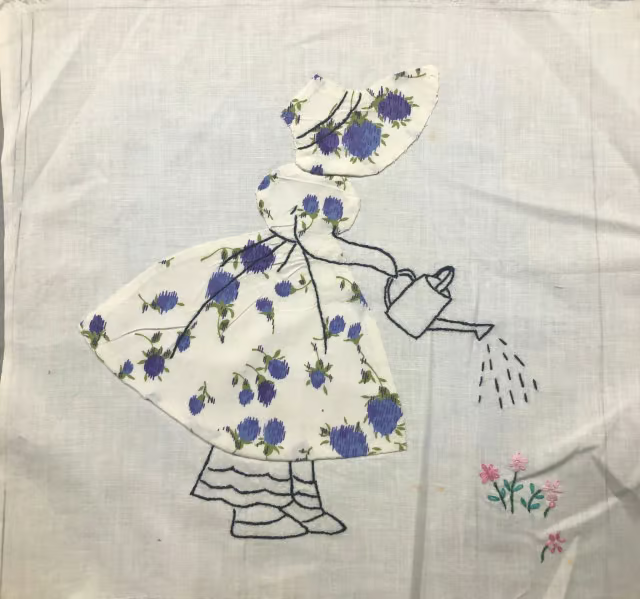
Re Susan Wildemuth’s request for contact information for Helen Ericson of Mrs. Danner’s Quilts: Mrs. Erickson is holding forth brilliantly in Emporia, KS. Her address is P.O. Box 650, Emporia, KS 66801. In fact, she is doing workshops on sunbonnet children, Ks. stars this month in Kentucky, maybe Paducah.
When I began to make quilts in the sixties, I discovered Scioto Danner, who generously helped me locate cotton fabrics (She was a Peter Pan fan) and encouraged my desire to make quilts, when quilting was not in vogue. Her little books became Bibles for me in my isolation. Later, Mrs. Ericson proved similarly generous. I had not heard from her in over a decade when, my husband and I decided to make an end-of-summer trip to the Midwest to look at quilts and history. We had only 8 days and no time to waste. I telephoned Ms. Erickson, who not only invited me to Emporia to see her collections and the Lyons County Museum collection, but also located wonderful exhibits then up in Ks and Nebraskafrom the Carrie Hall blocks to the James Collection, it was a visual extravaganza, thanks to her. I’ve often wondered if Mrs. Danner impacted others outside her region as she did me. It would be interesting to hear from others and to understand her influence. Gail Ingram P.S. I also found it amusing to learn that like another Emporia quiltmaker, Rose Kretsinger, Ms. Danner generally had her tops quilted by someone else. In the late sixties, when I asked her help in seeking a quilter, she had written me urging me to quilt my own tops so the work would be “all” mine.
Date: Wed, 28 Feb 2001 21:25:42 -0800 | From: “Colleen” <silky@
Yesterday I received a catalog that included a listing for a set of blocks that are supposed to be thee blocks for each state. This, once again, raised the question in my mind, is there any such thing as an official set of state blocks? Colleen
Date: Wed, 28 Feb 2001 23:56:00 -0800 | From: “Ellen King” <esking@
Friends, I discovered a wonderful shop in Amador City, California, that has Depression and pre-1900 quilts, quilt tops, etc. I was in heaven just looking at the wonderful examples of this wonderful folk art, most of it hand-stitched. The prices were beyond my budget, but I will probably re-visit this shop just to admire the dozens of quilts on racks and shelves. The name of the shop is Victorian Closets. The proprietor is Sally Knudson. If you are passing through this area (near Sutter Creek in the Mother Lode), it is worth the time to plan an hour stop to this little town’s shop. Ellen in Citrus Heights
Date: Thu, 01 Mar 2001 09:34:32 -0500 | From: “Judy Kelius (judysue)” <judysue@
For all you 19th century fabric lovers out there, you have to look at this quilt on eBay. The colors and prints are fabulous . . . you rarely see fabrics this early in this condition. http://cgi.ebay.com/aw-cgi/eBayISAPI.dll?ViewItem&item1412863968 The same seller has another outstanding quilt listed – indigo/white feathered star with superlative quilting. But personally I’d go for the one with the bright colors!
Date: Thu, 1 Mar 2001 21:16:04 -0800 | From: “Margot Plonk” <foustfab@
I have a very old quilt with alot of polyester doubleknit patches- any idea how old this might be? Gracie’s Wholesale Fabrics/Foust Textiles Foustfab@ Margot Plonk (704)739-3168
Date: Fri, 02 Mar 2001 22:25:43 -0600 | From: Marilyn Woodin <woodin@
Jean Throckmorton Martin–beloved neice of the late Dr Jeannette Throckmorton passed away on Feb 11. Jean championed her aunts love of quilting and kept the memory of her aunt alive. She made it her mission to see her aunts quilts–among them the famous Sunflower–were appreciated by the homes and museums they went to. She kept the history of Dr Jeannette in a large memory book and sought all published and non published things for the book. She will be missed by her loving husband Robert-daughter Suzanne-son Jeffry and his wife and 3 grandchildren and those of us who visited with her and were fortunate enough to–because of her-own one of Dr Jeannette’s quilts. Thank you for letting me share my sadness with those on this list. She wasn’t a notable in the quilt world-one of her family was–she was just one of the ones who believed quilts are important statements of life and beautiful art for everyone to share. Marilyn Woodin
Date: Sat, 03 Mar 2001 10:10:17 -0500 | From: “Judy Kelius (judysue)” <judysue@
Does anyone know if Clues in the Calico was published in a hard cover version? My paperback version is falling apart! If there’s no hardback available, I think I’ll take it to a print shop and have a ring binding added.
Date: Sat, 03 Mar 2001 10:46:19 -0500 | From: “Kris Driessen”
BLUE RIDGE MTS of VIRGINIA 5TH RETREAT AT THE LANDMARK PINE TAVERN LODGE FLOYD, VIRGINIA OCTOBER 4, 5, & 6, 2001 Step back into the late 1800’s in this rural mountain town located in the BLUE RIDGE MTS of VIRGINIA, a week-end midst the glorious golds, oranges, yellow, copper, rust, and reds of fall as a background for the local quilt and craft show, a Friday nite bluegrass jamboree, antiquing, fabric shopping at SCHOOL HOUSE FABRICS, sewing 24 hrs a day if you so desire, door prizes, make and take classes, country cooking, and meeting new friends or friends you spent the week-end with last year. The PINE TAVERN is a small privately owned landmark motel, hence we can only accommodate 18 guests. There are 7 rooms with two double beds in each unit. All have an area where you can have your coffee/tea and cereal in the morning. There is also a small cottage that has two separate bedrooms, one double bed in each room, plus a queen size sofa bed in the living room. The cottage has a front porch and each of the rooms at the lodge have a small back porch looking out over a field of pine trees. Or you might also enjoy sitting in the gazebo in front of the lodge and returning the waves of the locals heading to or coming from town. Because of the popularity of this retreat, and the fact that there is a quilt and craft show on the week-end those who attended last year have opted to come in on Thursday instead of Friday Why??? .sooo much to doâ€|sooo little time..soooo much fabric!! For those who want a week-end of NO PHONES, NO TAXI SERVICE, NO COOKING, NO DISHES, NO MAKING BEDS, NO HUBBIES, NO KIDS, (no kidding), JUST EXPLORING, SHOPPING , SEWING, SEWING, SEWING.. THIS IS YOUR WEEKEND..JOIN US IN MY HOME TOWN AND BASK IN THE BLUE RIDGE MTS of VIRGINIA DOING WHAT YOU LOVE MOST..QUILTING Contact me at baglady111@ for added information..HURRY..SPACE IS AT A PREMIUM.. there are only 14 spots left!! Jane Clark Stapel FLOYD, VA is located north of HILLSVILLE, VA, and SOUTH of ROANOKE, VA..LOOK FOR ROUTE 221
Date: Sat, 3 Mar 2001 21:54:00 -0500 | From: “John Cawley” <cawley@
On the first Thursday of each month the Daughters of the American Revolution (DAR) have a quilt study program which lasts about an hour and a half and costs $20. The program is conducted by Nancy Gibson. the textile curator of the DAR Museum on D St., NW in Washington, D.C. Last Thursday I was one of only 5 people who turned up and it was utterly wonderful. Starting with a mid-18th century blue resist wholecloth quilt from the Hudson Valley (Nancy explained that the source of the fabric, which has been found in other quilts from the same area, is a complete mystery even though it has been studied intensively for more than 20 years) and a Baltimore Album top dated 1846 which are hanging in the gallery, we went upstairs and began working our way through the quilts Nancy had chosen for the program. Nancy Gibson is as excited about quilts as any of us and extremely knowledgeable; it’s a great learning experience to see these quilts accompanied by her commentary. One of the most interesting topics we discussed was the question of terminology. What words were used to describe these quilts by the women who made them? They probably didn’t use a lot of fancy phrases. The first reference to Broderie Perse, for instance, was in the 1870s; so what did the women of the early 19th century call chintz applique (maybe they called it chintz applique!). Cording was called cording and anything stuffed was stuffed work (not trapunto). I know you want to hear about the quilts. Everything we saw was pre-1850 and we saw a lot. If you are a compulsive book buyer I can refer you to pictures of some. On the cover of First Flowerings: Early Virginia Quilts is an appliqued quilt with a border of pieced triangles (lovely Prussian blue and white) dated 1810-1820 made by Catherine Parker Custis. The central medallion is a chintz applique of peonies, pomegranates and peacocks. On p. 23 of the same book is an appliqued, stuffed and pieced quilt dated 1823 made by Amelia Lauck. The chintz applique in the center is incredibly fine and detailed; the stuffed work alternates with pieced borders to create 9 frames around the center. A couple of quilts had particularly interesting histories. There was a Baltimore Album donated by a member of the DAR who had found the quilt in a D.C. thrift shop in 1916 and cut it up to make a pair of draperies and a 9-block wall hanging for her dining room. In the 1940s she came to her senses and sewed the quilt back together–the seams are visible on the back. I think my favorite is the Basket of Flowers Medallion made in Frederick, MD by Anna Garnhart around 1850. (If you have the catalogue of the DAR exhibit in Japan see p. 64.) The elaborate floral center is surrounded by cut-out motifs, a leaf and vine border, a border of large chintz motifs and another vine and leaf border. Just to make it extra special the whole quilt is reverse applique! And she made quilts for each of 11 grandchildren all primarily reverse applique. This quilt is perfect condition; the colors are as bright as they must have been 150 years ago. How did it survive in such condition. It was given to a grandson and descended in the male line. When it was give to the DAR the family explained that the successive daughters-in-law appreciated it for its beauty, but since it had no family associations for them kept it stored so it was never used. Lucky for us! We probably saw 25 quilts, but I’m only going to tell you about one more. The only completely pieced quilt we saw was every bit the equal of its appliqued sisters. You can find it on p.p.. 31-32 of the Japanese catalogue. Around 1840 Mary Lloyd Key (widow of Francis Scott Key) pieced an unquilted bedcover that the family called Five Blazing Stars. The stars are Mariner’s Compasses outlined in green piping, one in each corner, one in the center surrounded by a series of pieced borders: first diamonds, then triangles to form a square on point and then triangles oriented to square the whole top. It’s made of scraps of all the wonderful mid-century fabrics–great to see such variety. It’s tacked to a plain cotton back of the period; it was not intended to be quilted. Mary was living in either Georgetown or Baltimore when she made this quilt, but she grew up at Wye Plantation in Talbot Co. (sometimes called the Land of the LLoyds) here on the Eastern Shore. The phone # at the DAR is 202-879-3240. If you can plan a trip to D.C. around the first Thursday of the month you definitely want to do this. One of our little group was a woman from Vancouver, B.C. who had a weekend conference and came early because she figured this was literally the chance of a lifetime. Cinda on the Eastern Shore
Date: Sat, 3 Mar 2001 22:25:28 -0600 | From: “Hope Seider” <hseider@
Does anyone know if Clues in the Calico was published in a hard cover version? My paperback version is falling apart! If there’s no hardback available, I think I’ll take it to a print shop and have a ring binding added. I don’t know of a hard cover version. The pages are popping out of my book, too! And at that price! But I think your idea is a good one — I’ll have to have mine ring-bound, too. Hope in SW Missouri
Date: Sat, 3 Mar 2001 23:39:05 EST | From: @aol.com
A friend of mine has just informed me that one of the members of her church needlework group is a quilter named Gail Binney Stiles. Does anyone know if this is Gail Binney Winslow, co-author of Homage to Amanda? My friend is going to tea at Mrs. Stiles’s house next Saturday and I’m curious to know. It’s not as if Gail Binney is all that common a name…:) Karen Evans
Date: Sun, 04 Mar 2001 06:53:17 -0600 | From: Laura Hobby Syler
Several years ago I purchased another copy at
Half Price Books (couldn’t believe I found a copy
there!). Anyway, I keep that one in my library.
The one that has the coffee cup stains,
highlighted, underlined, reference notes and
swatches stuck in (and that I had Barbara autograph
in Omaha -with stains and all-) is in page
protectors in a three ring binder. I find that this is
useful when ever we do a fabric dating class (I
can just pull those pages) and I can add my extra
pieces from my fabric dating book swatches to
“the book”. I have had lots of fun just compiling
that!
Barbara lurks on this list occasionally, she may
see this thread and reply. If not, I think it is
safe to say that the book has not been published
in hardback. There has been some talk in
reprinting the book with several “updates and
corrections”, but Barbara hasn’t spoken of that in
several years.
Laura
In finally sunny N. Texas
where the lakes that were 17 feet low are now 2
feet high!!!
Typical Texas weather!
Hope Seider wrote:
> >Does anyone know if Clues in the Calico was
published in a hard cover
> >version? My paperback version is falling
apart! If there’s no hardback
> >available, I think I’ll take it to a print
shop and have a ring binding added.
>
> I don’t know of a hard cover version. The
pages are popping out of my book, too! And at that
> price! But I think your idea is a good one —
I’ll have to have mine ring-bound, too.
>
> Hope in SW Missouri
>
> —————»§«»§«
> hseider@
> —————»§«»§«
> “We made quilts as warm as we could
> so our families would not freeze,
> and as beautiful as we could
> so our hearts would not break.”
> — pioneer mother
> —————»§«»§«
Date: Sun, 4 Mar 2001 08:46:35 -0500 | From: “Avalon” <malthaus@
I had some luck finding a book that I had been lusting for—–“Treasury of American Quilts by Cyril Nelson and Carter Houck”—-by using the personal shopper tool on ebay. It was is perfect condition upon arrival. It did take several months before I received a notice that it was listed, however. Mary in Wisconsin
Date: Sun, 4 Mar 2001 11:53:42 -0600 | From: “Susan Wildemuth” <ksandbcw@
This is a quilt-related history question. During the 1800’s, what did the young African American women who labored in plantation homes and/or loom houses use for thimbles? If they were not given a thimble to use, what did these industrious women use protect their fingers? How did they store them when they were not in use? I don’t believe I have ever read anything that addresses this issue. Thanks. Sue
Date: Mon, 5 Mar 2001 09:09:12 EST | From: Hazelmacc@
Last week Bunnie Jordan and l were invited to present our lecture an “Introduction to Dating Quilts” for an afternoon seminar presented by the Wiliamsburg Institute. It began with a lecture by their curator of textiles, Linda Baumgarten. Her slide presentation showed many of their quilts. She as well told briefly the history of Wmbg. We were then taken to the textile conservation lab where their conservator of textiles Loreen Finkelstein explained their workroom activities. We got to see a tent that they are conserving and an early “strippie” quilt that was a beauty. Then associate curator of textiles Kimberly S. Ivey took us into the storage area where drawers were pulled out for our viewing pleasure. All of this was overload, but l ventured ahead to see drawers of early chintz in small pieces. For me l had longed to see the blue thread in the selvage of chintz. What this blue thread indicates is that it was meant for export from England (they were wanting to protect their woolen industry), secondly that the fabric would be all cotton, and thirdly the fabric would date from 1774 to 1811. The last time i was at the Victoria and Albert Museum there was a small room with pieces of chintz and all had the blue thread in the selvage according to the labels; however, all pieces of chintz were framed and no selvages shown. Finally seeing this blue thread was a double treat for me! Hazel Carter Northern Virginia were we have a small amount of snow on the ground – not what was predicted.
Date: Mon, 05 Mar 2001 08:13:40 -0800 | From: Laura Robins-Morris <lrobins@
Karen asked how we’re doing in Washington state. Well, as for me and the folks I know, we’re doing fine. It was scary (probably nothing to the California folks) but it could have been a lot worse, so we all feel very lucky. The shaking and swaying was unnerving but I personally had no damage at home or at work, and I didn’t see any around my neighborhood either. There was damage to some of the older brick buildings, and the state capitol building and a few roads and bridges. And there has been a rash of TV programs and newspaper articles reminding us how to prepare for “the Big One”, yet to come. But for most people, I don’t think it had a long-lasting effect. But I guess I really should finish putting together my emergency kits for work and the car. Oh yeah, and bolt the house to the foundation! Laura in Seattle, furiously finishing a quilt that has to be turned in tomorrow for a quilt show. It could use more quilting but they want all entered quilts to have a sleeve. Big decision: quilting or a sleeve, quilting or a sleeve…
Date: Mon, 05 Mar 2001 10:31:23 -0700 | From: Alice Cruz <alice.cruz@
I need help removing a large amount of candle wax from a quilt. A hole in the back side of the candle provided a escape hatch for the hot wax, which overran the flat plate the candle was sitting on. The was has soaked entirely through the quilt in a couple of spots about the size of dimes. A huge chunk of wax has hardened on top of the quilt. The quilt is 100% cotton fabric & thread, & cotton batting. alice Alice Cruz The Quilted Chile <alice.cruz@
Date: Mon, 5 Mar 2001 11:43:24 EST | From: JQuilt@
either iron the spots with newprint paper…or a newspaper that is over 3-4weeks old or put it in the dryer… jean
Date: Mon, 5 Mar 2001 12:20:29 EST | From: QuiltEvals@
Hi, I hope Kris and everyone in the East is surviving the latest storm, stay safe and warm! I just wanted to let everyone know that the Vintage and Antique Textile Shop in Sturbridge, MA, will be presenting “Quilt Talk,” an antique quilt and textile study day on March 24. For further information, please see the web page at: http://thequiltauction.com/help/sturbridge.html We should be seeing some great pieces, and participants are welcome to bring in things to share from their collections. Mary Koval will be sending along some surprises for us to see (and buy) as well. I hope to see some QHL’ers there. Deb Roberts
Date: Mon, 5 Mar 2001 12:48:14 -0500 | From: “bonnie wilbur” <bonnie.wilbur@
I’d be cautious about putting it in the dryer. Sometimes that spreads the wax to other areas, and I’ve had wax from kids’ crayons continue to stain clothes for 3-4 loads. Bonnie
Date: Mon, 05 Mar 2001 09:50:54 -0800 | From: Laura Robins-Morris <lrobins@
QUILTERS ANONYMOUS Annual Quilt Show March 9 – March 11 10-6 Friday and Saturday, 10-5 Sunday Commercial Building, Evergreen Fairgrounds, Monroe, WA Lots of great quilts, including one by yours truly Large Merchant Mall Demonstrations Lots of great quilts Crazy Quilt Raffle Quilt Featured Artist Lots of great quilts Its going to be a great show! Don’t miss it!! Laura in Seattle (Stitching to the very last minute. Yeah, I know it needs more quilting, but hey, at least it has binding!)
Date: Mon, 05 Mar 2001 12:18:58 -0600 | From: grapes <grapes@
Well, I am not a historian, or appraiser, but I do not use a thimble on my underneath hand and I use a leather one to push with. I would guess that would be where we got leather thimbles from. Slaves or poor women who could not afford thimbles. Jo in Tx — Spindle’s Tops Machine Quilting
Date: Mon, 05 Mar 2001 13:20:45 -0600 | From: Laura Hobby Syler <texas_quilt.co@
Hi Alice, I would start by putting the quilt in the freezer (or outdoors if you are up north <G) to really harden the wax. THEN, do the brown paper bag/ iron thing. I agree with Bonnie, I would not put it in the dryer on the outside chance that you have not gotten all of the wax out. Another final effort would be to pour boiling water over the area, after you do the iron and paper bag thing. This will help flush any wax that might have found it’s way into the batting. Naturally, I’m hoping that the area this candle attacked your poor quilt is color fast, or better yet, white <G. Good luck and let us know what you try and what works. Laura
Date: Tue, 06 Mar 2001 13:10:53 -0500 | From: Newbie Richardson <pastcrafts@
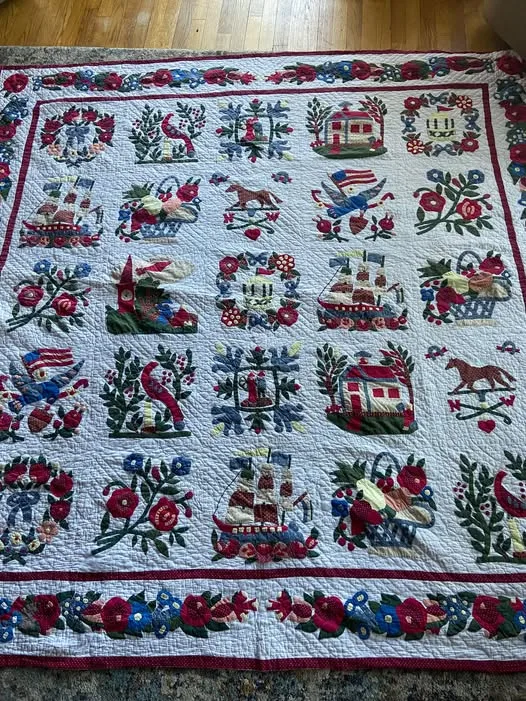
Hi guys, need some brain power. I have a freind/client/collector who has a wonderful 1930’s applique quilt that has scenes from what must be a novel. Each block is appliqued with characters in mid 19th to late 19th c. costume – in the manner of “old time folks” so popular then. It is clearly an individual’s artistic expression – not a kit. My friend thought that it was scenes from the maker’s life (there is the courtship, wedding, christening, etc. as well as more mundane scenes. In late 18th and early 19th c. girlhood embroidered pictures, the subject was frequently drawn from a popular novel. Did this happen in early 20th c. quilts as well? Thanks for any input. Newbie Richardson
Date: Tue, 06 Mar 2001 14:27:17 -0600 | From: Xenia Cord <xecord@
Newbie, this sounds like one of the wonderful designs
From Marion Cheever Whiteside. See Naida Treadway Patterson: Marion Cheever Whiteside Newton: Designer of Story Book Quilts, 1940-1965, in Uncoverings 1995 (vol. 16 of the Research Papers of the American Quilt Study Group), ed. Virginia Gunn. Among the stories she designed for applique are the Bridal Quilt (13 wedding customs From around the world), Little Women (15 story blocks. also available in 2 other formsts, with 9 or 12 blocks), Cinderella, Helen of Troy, Historic Lovers, Treasure Island, the Victorian Quilt, Wizard of Oz, and many, many nursery rhyme/Mother Goose stories.
Xenia >> I absolutely love this type of quilts and would like to do more research on them. Any chance we could get a picture of this quilt or others posted to the list. Thanks Xenia for the reference to Undercoverings. Somewhere in my boxes of unpacked things is a pattern similar to this that I found in my Mom’s sewing things. I believe it came From an order
From Ladies Home Journal. Toni B The Redwork Lady redworkldy@ www.redworklady.com ———
Date: Tue, 06 Mar 2001 15:36:50 -0600 | From: Gail Ingram <GIngram@
I have been a member of this list for only a month, but what an interesting month it has been! Today’s notes on storybook quilts reminded me I much I have learned and how much I look forward to the daily entries. Thanks to all who support and make possible this remarkable list! Gail Ingram, from the hills of North Louisiana, where the week-long rains have ended, the sky is blue, and the daffodils are in full glory
Date: Tue, 6 Mar 2001 17:33:45 -0500 | From: “bonnie wilbur” <bonnie.wilbur@
I agree, Gail. Reading this list has been such a boost for me. Every time I get discouraged because my skill levels will never approach some of the remarkable quilts winning prizes today, or because of stories like the son who nailed his new quilt over a window to block out the light for his darkroom, I am grateful to this list again. It keeps reminding me that there are plenty of quilts which have been made by unskilled people and have been through the wars and are still valued. I know that’s just a side benefit of the intelligence and experience brought to this list, but it is a reason for me to say thanks also. Bonnie
Date: Tue, 6 Mar 2001 15:38:20 -0800 (PST) | From: “Pat L. Nickols” <patlnickols@
Just a few suggestions to add to the thread going on removing wax from a quilt. The first step would be to have a ready bowl of ice cubes and some old bath towels, plus a plastic spatula. With a towel under wax area rub with ice cubes and you will see the wax clump up, some areas you could use the plastic edge to help lift the wax. If you can get to the back of the quilt repeat above steps. This method has helped me get wax out of tablecloths. Good luck and do keep us informed on (hopefully) your success. In rainy (we need it and like it) San Diego. Pat L. Nickols
Date: Tue, 06 Mar 2001 19:35:48 -0500 | From: Paul and Nancy Hahn <phahn@
I am very interested to learn more about the Williamsburg Institute Hazel Carter mentioned. Is this an annual event, or a one time seminar or an ongoing project? Also, is there a contact person for the textile conservation lab? Is this something one can arrange to tour or are there regular hours you can visit? Do you need to be a member to visit or is this part of the Williamsburg historical area tourists can visit? Nancy Hahn
Date: Tue, 6 Mar 2001 23:24:04 -0600 | From: “Karen S Bush” <birdsong@
Well, I’m going to ask a stupid question. I KNOW I’ve heard Mary Story’s name, but, from this list? Does anyone have a URL for her? Inquiring minds want to know??? Mary, if you’re on the list, and my mind has gone to mush, please don’t take it personally, I know so many ‘on line’ names, but, can’t remember if I ‘know’ her or not…just another dumb question, kinda fits my week…:/ kb www.karenbushquilts.com www.QuiltUniversity.com Member of TAS-The Applique Society Ebay seller name- karenbush