December 27 – 31, 2000
These restored messages come from the Quilt History List, an online forum where quilt historians, collectors, researchers, appraisers, and enthusiasts discussed antique quilts and related textiles. The archive dates from 1996 through approximately 2016 and is being restored gradually. Sign up in the form at the bottom of the page if you want to know when a new page is added. Original spelling, opinions, formatting, and inactive links may remain unchanged.
Primary topics of this QHL Digest:
- Amish Quilt Authenticity, Continued — The authenticity thread continues with a maker’s-history example — a 1930s–40s West Virginia quilting group — offered as a data point for what should count as genuinely Amish.
- Thimble Lore Continues — More thimble memories arrive, including a technical explainer on the recessed “knurls” or “dimples” that give a thimble its grip.
- Civil War-Era Fabric and Materials, Continued — The fabric-and-dating debate continues, including a transcribed 1863 letter from a Confederate soldier describing his own blankets and clothing — offered as primary-source evidence of what soldiers actually had on hand. (see the article on a Civil War quilt)
- Antique Sewing Tools and Notions: Reading List — In response to a query about the history of sewing notions, members recommend reference books on antique needlework tools, thimbles, and toys.
- Researching Ruth Finley’s Biography — A member shares biographical detail on quilt historian Ruth Finley drawn from a 1995 Uncoverings article, including her Akron birthplace and family background.
- A British War Bride’s Parachute-Silk Wedding Gown — A member recalls her mother’s 1945 wedding gown, sewn from parachute silk as a British war bride, alongside a separate question about a pink-and-white auction quilt. (see the article on quilting in Europe)
- Candlewicking Stitch, Answered — Following up on the earlier technique question, members identify the correct candlewicking stitch as a Colonial knot and point to a book with patterns and instructions.
- Practical Restoration and Repair Questions — Members ask for advice on repairing a double wedding ring quilt’s frayed binding and worn pieces, and separately for a source of replacement light bulbs for a vintage Bernina machine. (see the article on quilt restoration)
- List Announcements and Resources — A round of housekeeping and pointers: a plain-text posting reminder for AOL 6.0 users, a Feedsack Club conference notice, a links page to textile-related sites, and a Phoenix-area quilt exhibit announcement.
Date: Wed, 27 Dec 2000 23:36:56 -0500 | From: “Jan Drechsler” <quiltdoc@>
Mary,
Searching in books for 1860’s era quilts is an excellent idea. Your library
may be able to borrow books from other libraries if quilt history books are
not easily available. Find any of the state documentation books and search
for quilts dated in the 1860’s. Usually the pictures are clear enough to
study the blocks carefully to see what blocks were in circulation at that
time. You may even wish to narrow the selection of state books to your
region. I could send you a list of state doc books if you wish.
‘Dear Jane’ by Brenda Papadakis is a book about a quilt made in wartime.
The quilt has a ‘bezillion’ different blocks, or so it seems, and the book
has many of the patterns. I cannot say if ‘Jane’ designed many of the
blocks or if the blocks were in circulation.
Barbara Brackman recently published a book of Civil War era quilts and
patterns.
Have a wonderful journey searching though these books.
—
Jan Drechsler in Vermont
Quilt Restoration; Quilting teacher
http://ourworld.@/homepages/bobmills/jan.html
Date: Wed, 27 Dec 2000 23:04:18 -0600 | From: Jocelyn <
> Now I have a followup question if it hasn’t been discussed too often (I’m
> new, too): what techniques do we use to tell the difference between an
> authentic Amish quilt and an Amish-style quilt?
>
Bonnie,
I think you hit the nail on the head. If the sole criterion for it being an
‘Amish’ quilt is the religion of the quiltmaker, then how will such quilts
be identified in the future? FWIW, there are Amish quiltmakers who make
quilts according to ‘English’ traditions, for sale. Suppose I found a
flowery, lace-trimmed green and pink Wedding Ring quilt– would that be
correctly labeled as an ‘Amish’ quilt, because it was made by an Amish
woman– even though she would not dream of displaying it in her home, but
only made it because it sells well? Likewise, would the same quilt, made by
an African-American person be an African-American quilt? I don’t think so.
It seems that both membership in the group, plus use of traditional design
elements, would be required to qualify for the label. Which means that in
the absence of provenance about the religion or ethnicity of the maker,
quilts should be described as ‘Amish-style’ or ‘African-American-style’. I
don’t think it’s possible just to look at the work, and conclude anything,
considering the current push for historical re-creation- even if there WERE
an authentic Amish technique that existed 40 or 50 years ago, by now I’m
sure that some ‘English’ quilter has used it to create an Amish-style quilt.
Date: Wed, 27 Dec 2000 23:04:27 -0600 | From: Jocelyn <
> I am working on a lecture for my local quilt guild on
> Thimbles….and was
> wondering if anyone has any special stories or “lore” about
> thimbles….
Karan,
You probably won’t want to include this one, but I can remember telling my
home ec teacher mother NOT to hold her finger up and say ‘Put your thimble
on THIS finger, class’. Let’s see…that was in about 1970, I was 12, and
mortified. I can’t BELIEVE she didn’t know what holding up that finger
meant! <G>
>
> Hi Everyone:
>
> I am interested in learning more about the history of sewing tools and
> notions. We always hear about the invention of the sewing machine but I’m
> curious what sort of things quilters had previous to that (e.g., scissors,
> needles, pins, etc.) Where did they get what they had and how much did
> they cost? Does anyone have a good book they could suggest on the subject?
>
> Thanks,
>
Return-path: <KANSIER1@>
From:
Hi Everyone:
I am interested in learning some history of sewing tools and notions. We
always hear about the invention of the sewing machine but I’m curious what
quilters had previous to that (e.g., scissors, needles, pins, etc.) Does
anyone have a good book they could suggest on the subject?
Thanks,
Kathy in the Iced Ozarks
–
Date: Thu, 28 Dec 2000 07:25:54 -0500 | From: “fawn” <fawn@>
Food for though when considering how to recognize an Amish quilt: I am
writing about a Mabel Moore (born 1906), a West Virginia quiltmaker who
participated in a quilting group in the 1930s and 1940s in Nallen, WV, a
company town built by the Wilderness Lumber Company. The group made Lone
Star quilts which they sold to Amish customers in Pennsylvania. Etta
Kutz, who came to Nallen with her husband, was from Johnstown, PA. Mrs
Kutz used her connections in PA to market the WV quilts to Amish
families. Mrs. Kutz had exacting standards for the quilts sent to PA.
This story will appear in the spring issue of Goldenseal magazine,
published by the state of West Virginia. Fawn Valentine in the mountains
of West Virginia
–
Date: Thu, 28 Dec 2000 10:42:12 -0500 | From: Newbie Richardson <
Bravo Xenia!
At last we are back on the material cultures thread!
Please remember that the term “Civil War” is a marketing term, as any
designation of “Civil War” era immediately enhances an item’s sales
potential. Only those items that can be legitamitely refered to as
“Civil War”(War of the Rebellion, War Between the States, the Late
Unpleasantness, the War of Northern Agression, etc) are those which
were produced as a result of the conflict.
In quilting that would be those which reflect one of the
political/social/military subjects of the period. In clothing, that
would be military uniforms and any clothing that was produced “out of
the mainstream” of fashion due to necessity.
Joan Severa speaks eloquently to the deprivations of the war – both
North and South – and their practical effects on fashion and daily
life, in her book “Dressed For the Photographer”, the chapter on the
1860’s. Just as America “made do and mended” during WWII, (yes, there
were wedding dresses made from parachutes) so did the earlier
generations. Scarlet O’Hara’s dress from draperies is a “true” example.
So if we are going to dot i’s and cross t’s, then everything else from
that period is either second or third quarter of the 19th c.!
And yes, I’d venture to say that 90% of the quilts from the early 1860’s
were made from fabric produced in the late 1850’s if not earlier.
Remember, the mills produced a ton of cheap fabric! That is why fashion
could afford to champion skirts that took 10 to 15 yards of cloth per
hooped skirt! And women of every social class could afford to own one.
As for nomenclature, sure we have been lax in our semantics. Of
course no one can make a period quilt out of the period! It is only
semantic shorthand. These posts are like quick phone chats – not to be
held to the same standard as a published work. If we change this
standard, then I’ll sign off this list!
There has been quite a bit of discussion on the subject of “email” and
how it differs from written text in both tone and style. Welcome to the
21st century! Future historians will have their hands fullsorting the
musings from the facts. It is a bit like the difference in tone between
a diary and a collection of letters (only different) – I’m glad I won’t
have to be around to witness it!
Cheers and Happy New Year to all.
Newbie Richardson
Date: Thu, 28 Dec 2000 11:46:16 -0800 | From: “Bobbi Finley” <
Karan asked about thimble stories.
When I was a young girl in the early 50s, my grandparents stopped by on
Sunday afternoon and found me sitting on the living room floor, hand
stitching on a piece of clothing. (I was not yet a quilter.) I don’t know
if my grandmother was more upset that I was sewing on a Sunday (the Lord’s
Day) or the fact that I was not using a thimble! She was an excellent
seamstress, having helped to put my grandfather through veterinary school at
Iowa State University in the early teens with her dressmaking skills. She
told me that if I learned to use a thimble she would give me her gold
thimble. I did learn to use a thimble but for some now unknown reason the
thimble never came to me until after she passed away. I used it for a long
time until I punched a hole through it. It is a treasure.
Bobbi Finley in sunny California
PS to Karan: My grandparents were from Cedar Falls, Iowa.
_
Date: Thu, 28 Dec 2000 18:04:47 -0500 | From: Gail Wagner <
I must come out of lurkdom to mention a wonderful book that is a historical
novel about the War Between the States. The title is Alice’s Tulips, by
Sandra Dallas, c. October 2000. The entire book is written as a series of
letters to Alice’s sister, Lizzie. Alice is a newly-wed, living in Iowa
(the “other” side, unfortunately), with her MIL while DH has gone off to
war. The dates on her letters are from December 2, 1862, to May 15, 1865.
What makes this novel relevant to this thread is that Alice is a very
accomplished quilter and frequently discusses her quilting in the “letters”
to her sister. The author appears to have not only researched the
hardships of those years (although, granted times were much harder on the
Southern side as I seriously doubt many Southern ladies attended a tea
party in January of 1865 to be served raspberry and lemon tarts by a hired
cook), but has also well-researched quilting. Her references are listed in
the back of the book and include Ruth Finely’s Old Patchwork Quilts and the
Women Who Made Them, Marie Webster’s Quilts: Their Story and How to Make
Them, Barbara Brackman’s Quilts from the Civil War, Bets Ramsey and Merikay
Waldvogel’s Southern Quilts: Surviving Relics in the Civil War, and
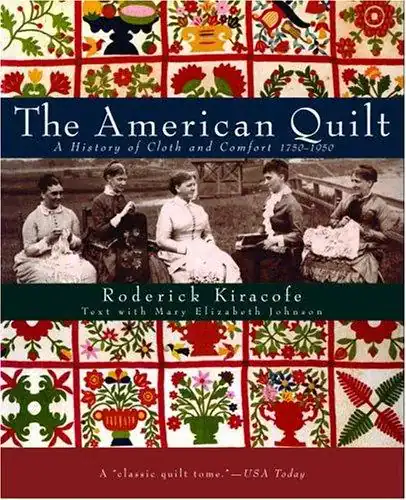
Roderick Kiracofe’s The American Quilt: A History of Cloth and Comfort,
1750-1950, just to name a few. All in all, it is a very enjoyable book
that I stayed up way too late reading last night.
Gail.
Date: Thu, 28 Dec 2000 22:19:16 -0500 | From: “Kris Driessen”
Just a quick reminder – please be sure to post in Plain Text. Those of youon AOL who have upgraded to AOL 6.0 will need to use http://www.@ topost, as AOL 6.0 sends *everything* out in HTML. Posting in HTML doublesand triples the size of the digest, which really causes problems for peoplewho pay for their download time. Not to mention the fact it sometimesshows as an attachment, which Cuenet will block. Happy New Year, everyone! Kris
Date: Thu, 28 Dec 2000 23:28:20 EST | From: DDBSTUFF@
I was at a friends home on Christmas Eve and was talking to an artist
friend of mine. He lives on an old farm and is a wood worker.
Anyway, he knows about my interest in antique quilts and he happen to
mention that somehow the former owners of the farm were related to
Ruth Findley, the writer of “Old Patchwork Quilts.”
Apparently she had stayed on the farm on several occasions and left
behind lots of material related to the book including lotsof
photographs. Sometime later, the family supposedly gave all this materialto
the University of Akron. I want to follow up on this and was wondering ifanyone
on the list had heard of any Akron connection Findley might have had?
Darwin
Date: Fri, 29 Dec 2000 00:02:18 -0500 | From: Paul and Nancy Hahn <phahn@>
Most of my favorite books on antique sewing tools and notions are British,
but they can be located here in the States: – Needlework
and Embroidery Tools, Eleanor Johnson, Shire Publications Ltd.
a small, 40 page softcover book, about $6.00
-Antique Needlework Tools and Embroideries, by Nerylla Taunton,1997
published by the Antique Collector’s Club Ltd., 200+ pages, about $40
-Chatelaines, Utility to Glorious Extravagance, Genevieve Cummins and
Nerylla Taunton, Antique
Collector’s Club, Ltd., 200+ pages, about $40
-Sewing Tools and Trinkets, Helen Lester Thompson, 1997, CollectorBooks,
160 pages, about $25
The two books by Taunton have extensive histories along with
wonderful photos for identification. The Shire book is a
great, compactintro to vintage needlework tools. The Thompson
book also has a price guide, although prices do vary greatly among
regions. Any of these would be great places to start looking for
info.
Nancy Hahn, whose head is still swarming with the incredible images of the
wonderful vintage quilts seen yesterday at Fran Fitz’s, where 14 ofus
gathered for another meeting of Fran’s Vintage Friends.
Date: Fri, 29 Dec 2000 09:05:53 +0400 | From: Xenia Cord <xecord@>
In 1995 Ricky Clark presented an article on Ruth Finley that is published
in Uncoverings 1995 (American Quilt Study Group pubs.). According to
the article, Ruth was born in Akron, where her father, Dr. Leonidas
Ebright, was postmaster (appointed by President McKinley, a personal
friend).
I quote from the article..”The socially prominent Ebrights lived in a substantial
Victorian house on East Market Street in Akron, spending summers and
occasional weekends at the Bissell farm in Sharon, fifteen miles
away.” (Darwin, is this your friend’s farm?)
The Bissell family came from Litchfield, Connecticut,to Connecticut’s”Western
Reserve” in northeastern Ohio, and the farmhouse was built byErastus
Bissell, Ruth Finley’s maternal grandfather. According toClark,
the Bissells never threw anything away, leaving centuries (literally)
of letters, documents, and memorabilia, much of which Finleyused in
the writing of her book, and much of which is still in family hands.
Newbies might be interested in further information on the American QuiltStudy
Group, its activities, and its publications. You may reach AQSG at AQSG [at] unl [dot] edu.
Xenia
Date: Fri, 29 Dec 2000 04:22:42 -0800 | From: “Maureen Flanagan”
In response to Kathy in Iced Ozark’s posting, I’ve enjoyed GertrudeWhiting’s Old-time Tools & Toys of Needlework, Dover Press, NY NY, 1971,ISBN 0-486-22517-8. The book is an unabridged reprint of the 1928 Tools andToys of Stitchery. There is a chapter on thimbles (“Thimble, Thimble, WhoHas the Thimble”, and numerous bw illustrations. Perhaps the book is available from the publisher, interlibrary loan, or onthe used book market at http://www.abe.com Regards, Maureen FlanaganAshland, Oregon *******************
Hi Everyone: I am interested in learning some history of sewing tools and notions. Wealways hear about the invention of the sewing machine but I’m curious whatquilters had previous to that (e.g., scissors, needles, pins, etc.) Doesanyone have a good book they could suggest on the subject? Thanks,Kathy in the Iced Ozarks
Date: Fri, 29 Dec 2000 13:48:42 -0800 | From: “nancy roberts” <robertsn@>
I wrote a two-part article for Quilting Today (can’t rememberthe
issue, but a few years back) on thimbles and protection forthe
underneath hand. I learned that the recessed parts of a thimbleare
called knurls ordimples. I also learned that there are “end
pushers” and “sidepushers,” referring to which part of
your thimbled finger youbalance the needleon. This may
explain thimble preferences. (This useful info wasfrom Bettina Havig.
I’m a side pusher and find the Roxanne thimbleworks well for this
style.). There was a silver company I contactedfor background. I
recall they are in NY and they were helpful,but don’t recall theirname.
If you want to know, I may be able to find the reference in the issue
of QT, but my mag collection is in another locationso it will take
some time. You may alsowant to contact a group such as the Thimble
Collectors. Manystates have a branch and they may provide you with
good infofor your lecture. An internet search may get you contact
infofor a group near you. It’s an intersting topic. Hope you enjoythe
presentation. Nancy Roberts
Date: Fri, 29 Dec 2000 15:11:11 -0700 | From: Michelle Roderick <Michelle.Roderick@>
I am new to QHL and I hope this message is appropriate for this list.
I am a newly married women and have bought my first sewing machine…..I
have been become interested in quilting. I have only done one wallhanging
and really enjoyed it….. I had decided to do a Sunbonnet Sue wallhanging
for myself. It has the four seasons on it…. just a littlebackground…..
I told my mother-in-law about what I was working on andshe showed my
a set of blocks that she has…She has approximately 50 sunbonnet sue
blocks done on unbleached muslin sheis not sure exactly the age of
the blocks, but we think they were done rightbefore she was born
which would age them at approximately 50 years old. Allthe blocks on
done by hand and have embrodery done on the strings of thebonnet. She
would like to finish the quilt by hand, but is not even surewhere to
start??She doesn’t quilt, but I think she would like to learn so that
she canfinish her mother’s quilt….do you have a
suggestion on how to get this blocks together??? I know I amasking a
lot for a email… but any ideas you may have would be greatlyappreciated…
The blocks have been stored in cedar chest over the years sothey are
in pretty good condition, but they are frayed on the edges..Thanks so
much for your time and patience….. Any books that we may find orany
suggestions… are welcome…
Michelle RoderickColorado Springs, CO
Date: Fri, 29 Dec 2000 18:43:00 -0600 | From: “Karen S Bush” <birdsong@>
I have a question. I bought a quilt at auction this past summer. I think Itold you about it already. I knew the lady who owned it, native of our areaand I really wanted it for sentimental reasons. It’s pink and white (not myfavorites, but, what the heck)…there are about l00 or more signatures onit. I thought it was a ‘retirement’ quilt for her when she retired fromteaching. That’s what the auctioneer said. Who am “I” to argue. Welll….
I’ve been looking at it. It’s in Wonderful condition. No tears, rips,etc. I was going to donate it to our local County Museum. But…
Question is….I don’t think it’s a Friendship quilt, could it be a’subscription’ quilt? They raffled it off after people ‘bought’ the blocks,signed and then sold it. The name of the area is embroidered on it, all theembroidery appears to be from the same person (names areembroidered)….but, no date, no ‘commemoration’ to this lady. It appears tobe around 50-60 years old. Not ancient, but nice. Any ideas on this??
Of course, with all the signatures, everyone assumes that it was afriendship quilt, then, the light bulb went on…well, it blinked a time ortwo, but,…just had this idea of the subscription quilt..?? kbwww.karenbushquilts.com I Break for RainbowsMember of TAS-The Applique SocietyEbay seller name- karenbushhttp://cgi6.ebay.com/aw-cgi/eBayISAPI.dll?ViewListedItems&userid=karenbush
Date: Fri, 29 Dec 2000 19:17:45 -0600 | From: “Karen S Bush” <birdsong@>
I have one comment and one question,I’d say most were ‘saved’ and scraps. Mostly scraps during and after thewar. Just a guess. The British war ships that were trying to help supplythe South, were probably full of war materials and not Cotton materials..???Although, the guns used DID use wadding…ummmm….The mind could go in alldifferent directions on this one. And, probably most opinions would be rightone way or the other.
Question- was Blue the predominant colors in this period?? I know ifthey were scraps, it doesn’t pertain, but, the nicer quilts. Seems likeIndigo was a favorite, before, during And after, and still IS with me! Thatand the ‘mourning’ shades of the blacks/browns and lavendars. ….just athought from someone who’s been lurking for months and just HAD to saySomething! haha kb> So…the question is, if during the Civil War there was not a lot of> cotton fabric being produced, and not a lot of wadding or batting, then> were the quilts we refer to as “Civil War” quilts really reflective of> fabrics from 1861-65? Or were they more likely made of saved fabrics> and dressmaking cuts from the 1850s?>> Discussion?>> Xenia>
Date: Fri, 29 Dec 2000 19:26:56 -0600 | From: “Karen S Bush” <birdsong@>
YEP…my mom was a British War bride, got married May 30, l945 to celebrate. I’ve got her wedding gown in my closet (so much for the l8 inch waist we Both used to have) and it’s made from parachute silk with…..you got it…LACE CURTAINS!!! I asked her if it was just ‘something she found in a window”..(unquote Carol Burnett)….that’s what she had, and that’s what she used. Made a Stunning gown I might add. She even made her own kid-leather shoes from scraps from a leather factory !! 🙂 kb America “made do and mended” during WWII, (yes, there were wedding dresses made from parachutes) so did the earlier generations. Scarlet O’Hara’s dress from draperies is a “true” example. www.karenbushquilts.com I Break for RainbowsMember of TAS-The Applique SocietyEbay seller name- karenbushhttp://cgi6.ebay.com/aw-cgi/eBayISAPI.dll?ViewListedItems&userid=karenbush
Date: Fri, 29 Dec 2000 23:12:58 EST | From: QultFrFn@
<< Or were they more likely made of saved fabrics
> and dressmaking cuts from the 1850s?>>
Xenia — The prints and woven patterned fabrics in the ‘Post Civil War Era’,southern, family, quilts I’m familier with are mostly copper-toned, palepurples, tans (some that might have been green at one time) with some fadedchrome yellows. Some of the prints I believe to also be of wool or linen andcotton blend.
I assume all the the fabrics to be dressmakers cuts and ‘remains’ from whatis left of the useful parts of worn garments.Nancy
Date: Sat, 30 Dec 2000 11:33:09 EST | From: Baglady111@
<A HREF=”http://members.@/feedsack1/conference.html“>Click here: Year2001 Feedsack Club Conference</A>
please visit our conference web site and come and see us in March…
Jane Clark Stapel
Date: Sat, 30 Dec 2000 16:44:49 EST | From: CarylSchuetz@
<< In response to Xenia’s message, it seems to me that (in most instances)most quilts made during the civil war years were put together and/orcompleted during the war years, but that the fabrics were manufactured beforethe war. One would think, too, that with batting and fabric being scarce, andthe war effort being first and foremost in people’s minds, and with theSanitary Commission making quilts for the soldiers….the starting of a newquilt during the war years, except for those made for the soldiers, with theuse of any new fabric would be very uncommon due to the circumstances of thetime.
Caryl
<< So…the question is, if during the Civil War there was not a lot of cotton fabric being produced, and not a lot of wadding or batting, then were the quilts we refer to as “Civil War” quilts really reflective of fabrics from 1861-65? Or were they more likely made of saved fabrics and dressmaking cuts from the 1850s?
Discussion?
Xenia
>>
Caryl SchuetzAmerican Quilter’s Society Certified Appraiser of Quilted TextilesP.O. Box 68827 Traders PointIndianapolis, Indiana, 46268
Date: Sat, 30 Dec 2000 16:51:07 -0600 | From: “Steve and Jean Loken” <sandjloken@>
Since someone yesterday mentioned that the proper stitch for cacandlewicking
is not just a French knot, I wonder if someone could give me
directions for the correct stitich, or a web-site reference. My mother
would like to do a kit she bought more accurately than just French
knots, which is what they suggest. I remember Laura said it’s a figure
8, but is that all you do on the needle? Or is it more complicated
than that? TIA Jean in Minnesota
Date: Sat, 30 Dec 2000 20:26:12 -0500 | From: “fawn” <fawn@>
A letter dated June 29th, 1863, written by Confederate soldier, =Matthew Boyd, from Camp Narrows [Matthew enlisted in Chapman’s Battery =on May 25, 1862 in Narrows,Virginia]: “I have three blankets and a =sheepskin for my bed. I sleep warm.” It has long been my hypothesis that =pioneers used animal hides for bed covering, to supplement handwoven =bedcovers.In times of necessity, such as the Civil War, it seems logical =that soldiers would use easily procurable animal hides for bedding. This =letter is in the collection of Jim Costa of Hinton, West Virginia. Fawn =Valentine (Sorry, but my Tools toolbar does not offer Options and Plain
A letter dated June 29th, 1863, written by Confederate soldier, Matthew Boyd, from Camp Narrows [Matthew enlisted in Chapman’s Battery on May 25, 1862 in Narrows,Virginia]: “I have three blankets and a sheepskin for my bed. I sleep warm.” It has long been my hypothesis that pioneers used animal hides for bed covering, to supplement handwoven bedcovers.In times of necessity, such as the Civil War, it seems logical that soldiers would use easily procurable animal hides for bedding. This letter is in the collection of Jim Costa of Hinton, West Virginia. Fawn Valentine (Sorry, but my Tools toolbar does not offer Options and Plain Text.)
Date: Sat, 30 Dec 2000 18:03:28 -0800 | From: Chris Anacker <chrisa@>
Joan,In a recent catalogue is a book called “Candlewicking & Beyond” by Gary =Clarke, that includes basic instructions, tips and design patterns. The Êtalogue also sells candlewicking thread, but doesn’t explain it or =illustrate it. The catalogue is called Needlework Shoppe by Herrschners. =They have a website- www.needleworkshoppe.com and phone is 800-441-1838.
I assumed for a long time that real candlewicking was used, and that =that was were the name came from. A textile teacher did not think so, =and we have gone back and forth on it for a year now. I was so happy to =see someone on the list say that real wicking had been used, but not =much infor was given. If that person could say anymore about the real =wicking, I would really appreciate it. i will pass it along to the =textiles teacher. I have a handmade white cotton slip, ca. 1870s, that =think has real wick forming the design across the wide border hem at the =bottom. Was it used on clothing?
Happy New Year Everybody,Kim WulfertOjai, CAA Quilter’s Journey
Date: Sat, 30 Dec 2000 22:23:22 -0500 | From: deborah babin <babin4@>
I am considering a purchase of an antique dbl wedding ring quilt. Some
of the small pieces will need replacing, of which I would just applique
a new piece directly on top.
But, the binding is also frayed. I would like to replace it. Any
helpful hints for how to do this. I am not so sure about all of the
scallops on the edge. Should I just put a new one over the existing
one?
Thanks
Debbie in Maryland (no snow today)
Date: Sat, 30 Dec 2000 22:51:37 EST | From: DDBSTUFF@
In doing some surfing today, I ran across this site containing lots of links
to various textile sites. I thought maybe, some of you might find something
that would be of interest.
<A HREF=”http://www.philau.edu/library/resources/textiles.html“>Gutman Library – Internet Textile Links</A>
HAPPY NEW YEAR
Date: Sun, 31 Dec 2000 01:18:40 EST | From: Demsing@
In case you are in the Phoenix, AZ area between January and March of 2001,
you may want to head over to Glendale and catch the Phoenix Area Quilters
Association’s latest exhibit “QUILTS THAT TELL A STORY”. This is an exhibit
of antique quilts (1850-1930) from the personal collections of members of the
Phoenix Area Quilters Association.
The exhibit runs from Jan. 13 to March 10 at Historic Sahauro Ranch in
Glendale, AZ. On Sat. Jan. 13 from 1:30-3:00 p.m., in the Fruit Packing
Shed, PAQA member and quilt historian Eileen Trestain will present a lecture
on dating antique quilts and will sign her book as well. A wine and cheese
reception follows along with an opportunity to view the small quilts which
will be auctioned off that evening begining at 5 p.m.
The exhibit houses approximately 35 quilts ranging from 1850’s red and green
applique to 1930’s feedsack as well as a small collection of doll quilts.
Additionally, PAQA will also have on display an antique quilt to be raffled
off at the end of the year. (yes, I know it’s a long wait but it’s a good
quilt!)
Located at 9802 N. 59th Ave (between Peoria and Olive), Historic Sahauro
Ranch is open Wednesday thru Friday 10-2 p.m., Saturday 10-4 p.m. and Sunday
Noon-4 p.m. Main House tours are conducted during the same hours –
$3/person. The quilt exhibit is on display in the Fruit Packing Shed and
admission is free. Lectures, book signings and reception are also free
admission.
If you have any questions, please email me at demsing@
or call me
at home at 480/961-9034. Hope to see you there.
Happy New Year to all.
Lenna DeMarco in comfy Chandler, AZ
(but I’ve got the flu, so who cares!!!)
Date: Sun, 31 Dec 2000 07:56:26 -0500 | From: deborah babin <babin4@>
I am desperate to find replacement light bulbs for my Bernina sewing
machine (1090s)
I have searched locally and on the internet. I have had no luck. Does
anyone have a source to refer me to? I understand they are made in
France.
I have been enjoying reading all of the posts re: antique quilts. I am
currently making a version of the miniature quilt from the Sherborne
Museum. Can’t remember the makers name. But, I decided to enlarge the
blocks and make it into a bed size. It is a wonderful collection of
simplified applique designs, with alternating 9 patch blocks. I am
using 1800’s repro’s.
Debbie in Maryland
Date: Sun, 31 Dec 2000 13:23:17 EST | From: ThreadDog@
I’m quoting from a story that appeared in our local Sunday Living section,
written by Laura Sessions Stepp of the Washington Post about the creators of
the comic strip, “Zits,” Jim Borgman and Jerry Scott. After covering their
collaboration, the families of the two men are discussed. Jim Borgman’s wife
Lynn died in Feb. of l999.
“In the grief that rolled though the family and community, one person
threw out a lifeline: 16 year old Dylan Borgman.
Lynn had been a quilter and had collected bolts of bright colored fabric.
Dylan suggested to his dad the day before the funeral that they cut up pieces
of his mother’s cloth and pass them out at the service….
They spent the night on the floor with their scissors. At one point Jim
said, ‘Someone will have to tell everybody what this means.’ The next
morning, wearing a gray suit and purple sunglasses purchased for the
occasion, Dylan took up the challenge.
‘When you leave here today, take with you a piece of her fabric,’ he said
in a sure, strong voice. ‘Look at its texture, its color, its individual
beauty… Every one of these pieces is a part of her mind and body…
‘One might think that her final quilt has been shattered, but there is
nothing farther from the truth. By talking about her, and sharing her
stories, and your grief, you sew each piece of fabric together…Her fabric
is there to remind you that as we find our places in the world, her quilt
will always be there to comfort us… Together we can warm the world when it
is cold.’ “
If you would like a copy of the article, e-mail me privately. I don’t have
a scanner, but I do have a copy machine.
Happy New Years
Linda Claussen
threaddog@
Date: Sun, 31 Dec 2000 10:45:14 -0800 | From: Chrystine Martin <craftyrn@>
I was given 32 Sunbonnet Sues done on Unbleached Muslin – never washed
per the previous owner, with the Sues done in 20s and 30’s fabrics. I
have found a suitable sashing reproduction solid and want to hand quilt
this – does anyone have any setting ideas or quilting ideas? I’d like
this to look like a blend of old and new and will make sure the lable
clearly states the maker and the quilter.
Chrystine Martin
craftyrn@
Date: Sun, 31 Dec 2000 13:47:00 -0500 (EST) | From: quiltsnbears@ (Textile Historian)
Signature quilts can be difficult.
Recently I attended a retirement party during which a quilt was given to
the retiring couple. The “signatures” were the names of the Board of
Directors,as well as that of the retirees, and had been embroidered by
the 5 quilt makers in cursive writing! I pity the future historian who
ends up with *that* quilt!
Roberta
Date: Sun, 31 Dec 2000 13:51:24 EST | From: Cathy Grafton <silkribbon@>
Jean the stitch used is called a Colonial knot. It is very similar to a
French knot, made with a sort of figure 8 and the needle pointing down
toward the work. Try looking it up in any good embroidery book with
pictures. Hard to describe without demonstrating it.
Cathy Grafton
Date: Thu, 28 Dec 2000 03:45:47 EST | From: KANSIER1 [at] aol [dot] com
Hi Everyone:
I am interested in learning some history of sewing tools and notions. We always hear about the invention of the sewing machine but I’m curious what quilters had previous to that (e.g., scissors, needles, pins, etc.) Does anyone have a good book they could suggest on the subject?
Thanks,
Kathy in the Iced Ozarks