May 7 – 10, 1997
These restored messages come from the Quilt History List, an online forum where quilt historians, collectors, researchers, appraisers, and enthusiasts discussed antique quilts and related textiles. The archive dates from 1996 through approximately 2016 and is being restored gradually. Sign up in the form at the bottom of the page if you want to know when a new page is added. Original spelling, opinions, formatting, and inactive links may remain unchanged.
Primary topics of this QHL Digest:
- A community friendship-block drive — regular updates on blocks, fabric, and donations pouring in for Terry Thompson after a loss, coordinated through the list.
- Restoration diary: a Sunbonnet Sue quilt — a step-by-step account of repairing a large rip in a cutesy Sunbonnet Sue quilt, tackling the hardest part first.
- Featherweight sewing machines for piecing — members trade tips on using and maintaining Singer Featherweights, including their history and a recommended reference book.
- The Rose Quilt poem and found ephemera — an appreciation of the social history captured in old handwritten notes and poems tucked away with quilts.
- A first eBay quilt purchase — a new collector shares the excitement (and identification questions) of winning their first antique quilt at online auction.
- Restoring a broderie perse medallion quilt — advice on treating a large, fragile hand-fringed medallion quilt in need of careful conservation work.
- Book club and reading recommendations — suggestions for quilt-related books suited to a non-quilting book club, including Mary Cross’s new title on Mormon migration quilts.
- A new career in quilt collections — a member starts a new job as a Quilt Collections Assistant at the Michigan State University Museum.
Date: Wed, 7 May 1997 10:32:51 -0400 (EDT) | From: IRMOCITY [at] aol [dot] com
I have not done a block and would be happy to participate. Is it too late?
Date: Wed, 7 May 1997 16:08:55 +0000 | From: “The Garretts” <bgarrett [at] fast [dot] net>
I really enjoy the social history surrounding quiltmaking and love it when I find little snippets of paper that some woman has saved. I do this all the time. In a stack of miscellaneous quilty things I found this poem. It was printed in The Youth’s Companion, May 24, 1906. Hope some of you enjoy it.
The Rose Quilt by Cora A Matson Dolson
My mother made a patchwork quilt When she was seventeen, With roses of red calico, And leaves and stems of green.
A thing of beauty it was deemed, And still it is to see, For when her quilts were portioned round, This one came down to me.
I keep it as she used to keep, In rose-leaves laid away, And only bring it forth to grace A favored festal day.
But sometimes, in the rainy spell, When orchards are in flower, I spread it on my chamber bed To while a lonesome hour.
And as I trace her handiwork, In stitches fine and true, And think how patiently she toiled, Those maiden moments through,
That flower and leaf might stay beyond The span of her own days, I think that in her self-set task She won a meed of praise.
For who of us, in song or book, Dream to outlast the hour When twenty springs have swept our graves As lives her patchwork flower?
Barb in southeastern PA <bgarrett [at] fast [dot] net>
–
Date: Wed, 7 May 1997 20:52:39 -0400 (EDT) | From: AJSNGS [at] aol [dot] com
Hi all,
I hope you don’t mind if I ask this question here. For those of you who own Featherweights, I’d like to know if you use yours to piece quilts, and to also quilt on it. I’ve heard a couple of times that they are not recommended for the actual quilting because it’s hard on the motors. I’d like your opinions please. And if you’d rather, you can e-mail me privately.
Thanks in advance,
Nancy in Virginia AJSNGS [at] aol [dot] com
Date: Wed, 07 May 1997 22:58:03 -0400 | From: “Miklos B. Lukacs” <mlukacs [at] webbernet [dot] net>scii
I will second entirely Diane’s note re the fellow quilters in Japan. How very loving and caring. We would really like to hear from you. What are your lives like? Do you work outside the home, do you have much time for quilting. Are you organized about your quilting? Etc. My nearest experience of the Japanese culture was from a young exchange student who was my son’s roommate at Central Michigan Univ. He was a delightful young man. Connie L.
Date: Wed, 7 May 1997 23:22:46 -0400 (EDT) | From: KBoxmeyer [at] aol [dot] com
Dear friends at QHL: I bought my first “old” quilt! I was the successful high bidder on ebay’s auctionweb # jga5077. (http://206.184.213.45/aw/itemfast.cgi?item=jga5077)
At this point, I don’t know much of the history of this quilt except that the top appears to be a “cheater” top rather than pieced. I saw one mention of cheater quilts in recent digests but not much more. Does anyone know when cheaters started appearing or have any other info on cheaters? The woman who originally owned this quilt, may she rest in peace, claimed it was an “old” quilt. But I know that “old” is a very relative term and would like a better definition as it relates to this quilt.
The picture on ebay is rather fuzzy and doesn’t show the pattern definition well. I have a close up jpg of the fabric if anyone would like to see it.
The quilt does appear to be hand quilted in the picture but I won’t know the quality until I receive my new present.
OOOOO, I can hardly wait. I feel like a kid in late December waiting for Christmas day to roll around!
Thanks for listening and assisting! Kimberly in Bristol, where we had to put on our heavier jackets this evening to stave off the cool night breezes
Date: Thu, 08 May 1997 16:48:34 +1100 | From: Sven Olsson <sven [at] pnc [dot] com [dot] au>
The Garretts wrote: I also loved the poem. As an avid collector of old quilts, I can really relate to the sentiment. Every time I am with my quilts I try to imagine who has held them , who has been held by them , who made them and so on. I really love them all.
Lorraine in Oz
Date: Thu, 08 May 1997 06:45:59 -0400 | From: Ricki Maietta <rmaietta [at] csrlink [dot] net>
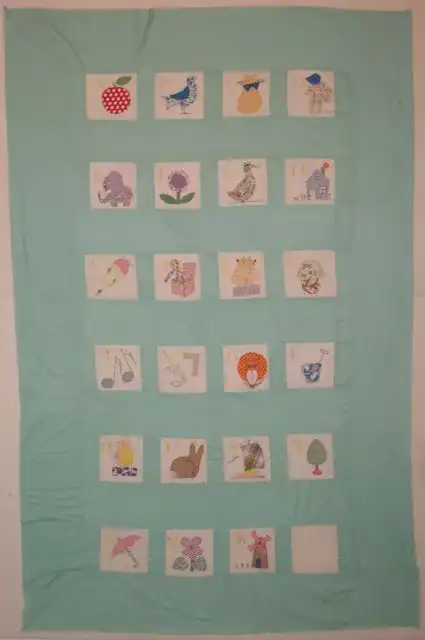
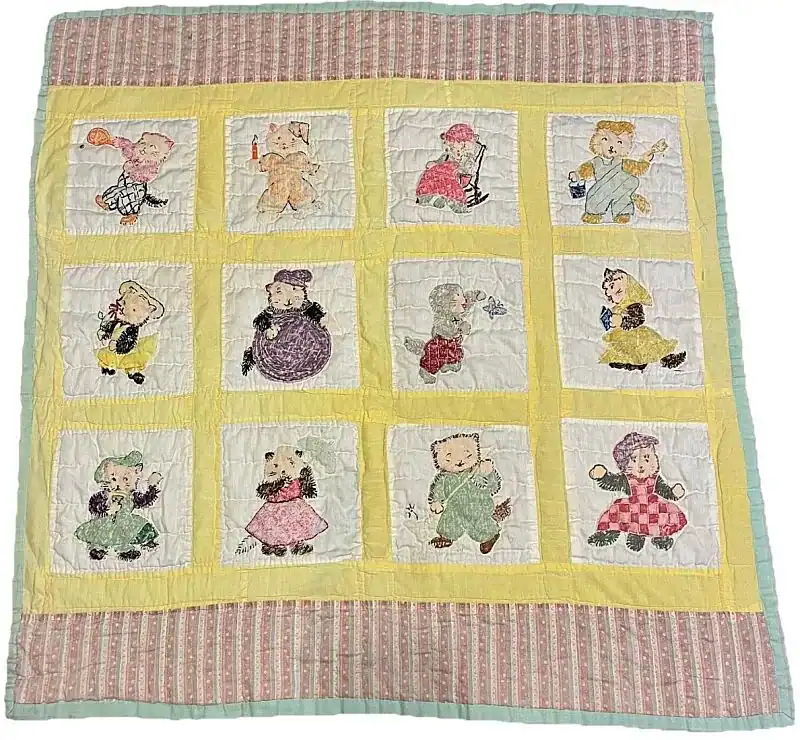
Hi everyone! Would like to tell you about my current restoration project. A woman brought me a quilt that is a cutesy Sun Bonnet Sue, made for her by her grandmother. This quilt is worn, has some embroidery missing from some of the Sue’s dresses, some quilting stitches broken & missing. But the biggest problem was the 2 foot long rip in the border. Yes, a full 2 feet of border was flapping in the breeze! I avoided working on this quilt for about 2 months – actually had 2 others to finish – but just wasn’t sure how to fix the rip. I didn’t want it to be a weak point in the quilt, & had various ideas of strengthening that spot.
Well, I decided to quit procrastinating, & JUST DO IT! And, I decided to tackle the hard part first – the big rip. Here’s what I did. Luckily, on the front, the tear is right along a seam of the border. On the back is unbleached muslin. I pulled the muslin back together & whip-stitched it together. This pulled the pieces together just a little more than originally. This gave me a scant bit of fabric to turn under on the front, to applique down. Well – on the front, you actually cannot tell the quilt was ever torn!! ( I am now patting myself on the back!) But, on the back, I had to do something.
So – I appliqued a piece of unbleached muslin over the whipped tear. The fabric matches quite well. As I re-quilt this area, the quilting in combination with the new muslin on the back should make this section of the quilt NOT a weak spot.
My only other idea was to put the muslin inside the tear & reverse applique, but I don’t think this would’ve been as strong, & would’ve “showcased” the tear instead of covering it.
Now “all I have to do” is the entire remainder of the quilt!!
Love this restoration work. I would love to hear what others are working on. Come on – I know you restorationists are out there!!!
Ricki in PA
Date: Thu, 8 May 97 08:45:19 PDT | From: John & Cinda Cawley <cawley [at] epix [dot] net>
Hi Nancy,
I use my featherweight for piecing when my little group of five meet to work on each others projects (it is so portable, after all). I quilt with it on small items, e.g. table runners, but would not use it to quilt anything big. Cinda in Scranton
——-
Date: Thu, 8 May 97 12:45:19 UT | From: “Mary Perini” <MaryPerini [at] msn [dot] com>
Dear Nancy, I do machine piecing with my featherweight several times each week…have for years. I begin EVERY work session by cleaning and oiling the machine. No problems yet. Mary P. in Hagerstown, Maryland
Date: Thu, 08 May 1997 09:18:24 -0500 | From: LAURA SYLER <texas_quilt.co [at] airmail [dot] net>
> Question – what are your opinions regarding restoring a c.1800 broderie perse > that just needs loving attention? > > Alan
Alan: I have a similar situation. It is a glorious huge medallion with a hand made fringe. There are 4 wonderful little star blocks in the corners with a wonderful little 1″ border on 2 sides that have pretty well died, along with 3-4 leaves and flowers that are in the process. I’ve got Nancy Kirk on the lookout for a chintz that would work for the little leaves and flowers, and something suitable for the little borders. But…my first response to the client was love it carefully like it is ( She wanted to have it cleaned!!GASP) At this time I’m going for the crepeline to hold it in place until we come up with something suitable ( if ever) I guess it boils down to that judgment call of when to do what the client asks and when to stand your ground & speak your heart! Let me know what you end up doing. Laura texas_quilt.co [at] airmail [dot] net
Date: Thu, 8 May 1997 10:37:26 -0500 | From: gridgees [at] algorithms [dot] com (Merry May)
If I’m not mistaken, I believe it was Sue Traudt who put the current AQSG page together. It may not be perfectly accurate, but at least we’re on-line!
Merry in N.J. gridgees [at] algorithms [dot] com
Date: Thu, 8 May 1997 12:08:03 -0400 (EDT) | From: Cindy Brick
<< Then, this Saturday, a friend was telling me about a friend of hers. It seems her friend’s MIL died recently, and while going thru the house, they came across three rainbarrels stuffed full of quilt tops (no rain)! According to the story, there are a total of 250 (no – no typos – two hundred and fifty quilt tops). Cross your fingers – I may get to see them if I’m really lucky. My friend told this lady she knew somone who might be interested in a deal (MIGHT?!?!?! Yea, right!). >>
Alan, I’d bet there are a bunch of us on this list that would be more than happy to get together for a group buy!! (Unless you want all 250, you greedy guy).
If your friend wants a good nonprofit to donate them to, I’d recommend the Quilt Heritage Foundation. They’ll keep what they can for the permanent collection, then help the others find good homes. All for a tax write-off! Contact the Kirk Collection at 1-800-398-2542 for QHF info. Cindy Brick
Date: Thu, 8 May 1997 13:29:57 -0400 (EDT) | From: KARRGR [at] aol [dot] com
This is my first post to the list but I have been in the backgroung enjoying it for several weeks now. I thought the following, taken from an AQS press release, would be of interest to the participants in the group. Although, I haven’t yet seen the exhibit, everyone I have talked to that has seen it, says it is wonderful and an opportunity not to be missed. The catalog is also terrific!
20th CENTURY QUILTS, 1900 – 1970: WOMEN MAKE THEIR MARK An Exhibition of Historic Quilts March 22, 1997 – June 29, 1997 at the Museum of the American Quilter’s Society(MAQS) Paducah, Kentucky Curated by Joyce Gross and Cuesta Benberry
Presented for the first time at one venue are 34 of the most extraordinary examples of 20th century quiltmaking. The famous quilts were borrowed from prestigious museums and noteworthy private collectors. Supplementing the exhibition are archival quilt materials that give intimate glimpses into the lives of the quiltmakers, and information that delineates the quilt-related characteristics of the period.
A catalogue illustrating the exhibit quilts published by American Quilter’s Society, is available for $9.95 + $2.00 postage and handling at P. O. Box 3290, Paducah, Ky 42002-3290.
Symposium to be held in conjunction with the exhibition June 27, 1997 – June 29, 1997 at MAQS, Paducah Symposium to be staffed by quilt historians – Hazel Carter, Bettina Havig, Erma Kirkpatrick, Julie Powell, Kathlyn Sullivan, and exhibition curators, Cuesta Benberry and Joyce Gross.
You are invited to attend the first symposium held to engage in a retrospective look and assessment of 20th century quilt history. “Engage” is the key word, for we hope all participants will bring their 20th century quilt information to share, and to vigorously discuss every aspect of quilt history of the past 100 years.
To register contact: Victoria Faoro, Executive Director of the Museum of the American Quilter’s Society, 215 Jefferson St, Paducah, KY 42002, (502)442-8856
Hope to see some of you there.
Kathy in California
Date: Thu, 08 May 1997 16:26:23 -0500 | From: Nancy Behrman <nbehrman [at] grfn [dot] org>
To Nancy, The information that you were told is correct. The FW is great for piecing, but because the motor has such a small motor they will eventually get too hot and burn out. I love to piece on mine but use one of my 99s or larger machines to use the walking foot ot to machine quilt. Hope this helps. If any of you quilters are going to be at Quilt America the end of May, my husband and I are doing the class on the “Care and Feeding of your Feahterweight” would love to have you stop before or after class and introduce yourselves. Nancy From Michigan
Date: Thu, 08 May 1997 17:13:02 -0500 | From: “J. S. Lyle” <jslyle [at] bcl [dot] net>
Nancy – I have always been told by electrical repair people that the motor on the FW is one of the toughest that you can put on a machine. The quilters that we have talked with, all have indicated that this is a fact. I’m curious as to where you found out this fact? It certainly goes against all that we know of the machine! Please advise.
Bill Lyle – in Illinois.
Date: Thu, 08 May 1997 22:58:59 -0700 | From: Nancy Cameron Armstrong <narmstr [at] ibm [dot] net>
Dear QHL friends (several of whom I need to reply to),
On Tuesday evening my computer consultant changed my computer over to WINDOWS 95, an upgraded internet connection, AND Netscape. Disaster all the way around … was unable to use E-mail, or at least I thought I was from messages rec’d. Have fallen quite behind. After spending several hours with him again this evening, all seems to be in order. TOO tired to write answers to everyone tonight, but thank those who have written about “potholders” and promise … will try to get caught up tomorrow. Lots of relearning. Back in kindergarten for a bit. nca —————————
Date: Fri, 09 May 1997 08:36:35 EDT | From: debatqps [at] juno [dot] com
I have just bought a 1930s applique quilt from a kit that is in need of more than a little loving care. Thanks Ricki for posting what you did with the tear in yours, I will probably do the same thing with mine. Unfortunately, the tear is through the front and back at the top for about 4 inches. This is a well loved and worn quilt that was definitely not for show only! The workmanship is really good, although she didn’t quilt close enough in her big flowers and the batting has bunched up underneath them. But the quilt is really pretty and I love those floral applique quilts so this is a really nice addition to my “collection”.
One of my customers came into the shop the day before yesterday and gave me a Grandmothers Flower Garden top that had been given to her that she knew she would never do anything with! I couldn’t believe it. Its in great shape, needs a bath tho, hand pieced and about a lap size. It has the nile/bile green in the paths and typical 30s prints for the flowers. There were two loose blocks with it and two blocks already attached for another row that I think I will probably take off to make the top a definite shape. I will applique those blocks to the back. I too have been told not to machine quilt with my FW. The motor was built strong to sew through anything but not for extended periods of time, it would burn out the motor. I should ask my DH, he is a service/repair tech for machines. I piece with both of mine but thats alot of stopping and starting, I machine quilt with my Elna.
Debbie in NJ
Date: Fri, 09 May 1997 01:27:42 -0500 | From: LAURA SYLER <texas_quilt.co [at] airmail [dot] net>
BrickWks1 [at] aol [dot] com wrote: > > In a message dated 97-05-07 00:53:49 EDT, you write: > >If your friend wants a good nonprofit to donate them to, I’d recommend the Quilt Heritage Foundation. They’ll keep what they can for the permanent collection, then help the others find good homes. All for a tax write-off! Contact the Kirk Collection at 1-800-398-2542 for QHF info. Cindy Brick
Cindy: I met with a restoration client yesterday that has a wonderful crazy quilt( still in several pieces)with silk ribbons dated 1884-1888. She has no one to leave it to and was excited to learn of the Quilt Heritage Foundation. After we assemble the top and bind it, and she has a little time to admire it she plans to donate it to the Foundation!! She does not want it to end up in the trash, the history of her very colorful great grandparents( both in journalism and Texas politics) make it an interesting piece, but the towns where they lived do not have adequate storage facilities for a textile piece of this quality.!!! I will probably bring it to Omaha in September!! Laura
Date: Fri, 09 May 1997 01:45:31 -0500 | From: LAURA SYLER <texas_quilt.co [at] airmail [dot] net>
By the way, I just joined the Dear Jane support group,
Date: Fri, 09 May 1997 09:50:49 EDT | From: LIZ SWARTZ <swartze [at] clpgh [dot] org>
My book club is looking for a quilting related book for one of our monthly selections. We normally read novels, but are interested in women’s history and biography. I’ve learned of lots of quilt history books from this list, but something fantastic I’ve missed. The books I’ve heard about that I think would be good candidates are “Hearts and Hands,” “Stitched from the Soul,” “Treasures in the Trunk,” and “Legacy.” Does anyone have any additions or comments about these selections. There is a quilt exhibit at our local history museum (Pittsburgh) that we will visit as well.
One last question: I’ve seen a quote on here that goes something like, “we made our quilts quickly so our families wouldn’t freeze and we made them beautiful so our hearts wouldn’t break.” Where is this from, and doesn’t anyone have the exact quote?
Thanks.
Date: Fri, 9 May 1997 08:53:34 -0500 | From: gridgees [at] algorithms [dot] com (Merry May)
For Nancy et al,
While I was in Minneapolis last week, I bought a 1972 book by Bonnie Leman called “Quick and Easy Quilting.” Chapter 4 is entitled “Triangular Puff Method,” and sounds like the technique you’re describing. It doesn’t offer any historical information – the main focus of the book is quilt-as-you-go methods.
There is also a section on Biscuit or Bun Quilts, where the top layer is pleated on each side of a square shape, and stuffed with a wad of batting. Interestingly, there was such a quilt on display in the Quilts & Other Comforts booth at Quilt Market. I’m curious to see whether they’re trying to revive this method.
Anyway, I just thought I’d share this tidbit of info – that the triangular method was still being done…. and promoted…. in the early 1970’s.
Take care. Merry in N.J. gridgees [at] algorithms [dot] com
Date: Fri, 9 May 97 13:01:22 UT | From: “Mary Perini” <MaryPerini [at] msn [dot] com>
Dear LiJoo, Featherweight sewing machines were made by the Singer Sewing Company between about 1934 and the mid 1960’s. The charm of the featherweight is its petite size, handy carrying case, and the extraordinarily straight stitch it sews.
Nancy Johnson-Srebro has authored an excellent book called “Featherweight 221 The Perfect Portable”, which tells all about them.
These web sites are a good places to go to see pictures of Featherweights and gather more info (you’ll find other links, as well) http://www.icsi.net/~pickens/ http://ttsw.com/FWFanatics/FWFanatics.html Regards, Mary P. in Hagerstown, MD
———- From:
LiJoo Sent:
Thursday, May 08, 1997 6:31 PM To:
QHL [at] cuenet [dot] com Subject:
QHL: RE: Featherweights
Pardon my ignorance, everyone. After all, I have been into patchwork & quilting for less than a year. But what on earth are featherweights?? Are they sewing machines of some sort???
Curious, LiJoo – from (VERY) rapidly cooling Melbourne, Australia.
Date: Fri, 9 May 1997 09:38:27, -0500 | From: LVQG24A [at] prodigy [dot] com ( ELIZABETH K DONALDSON)
I just spent my first day on the job at the Michigan State University Museum as a Quilt Collections Assistant…. Talk about heaven on earth, although I have seen many of the quilts in the collection I had never seen the ca. 1890’s crazy quilt with hand made, 4″ wide, linen string lace in the sashings and around the edge. I could go on forever just about this one quilt and the collection has over 350!!!!
Well now that I have this job I’m sure my husband and teenagers daughters won’t mind doing all the cooking, cleaning, housework, errands, vet visits, etc. etc. I’m sure the glazed expression on my face will be all the thanks they need!
The museum has an excellent data base for quilt research that is currently being updated to make seeking quilts easier. Marsha McDowell, the Curator of Folk Arts for the museum deserves a big thank you for her generous spirit in seeking ways to make this wonderful collection accessable to everyone who is interested. Storing, restoring, documenting, researching is a massive, expensive task that will never be finished. There is so much for me to learn. If you get the chance to donate or be involve with a musuems collection…….just do it!
Part of my job is to be the hostess and guide when groups tour the storage area. I was worried because I don’t know the collection as thoroughtly as I’d like to, but to quote Mary Schaefer “I let the quilts do the talking.” Each quilter brings their own interests to the tour and notice different things about the quilts. I’ve got to start making notes while they are there, because their insights are wonderful.
Beth in la-la Land (no not sunny Los Angeles, but gray and cloudy Lansing!)
Date: Fri, 9 May 1997 11:50:46 -0500 | From: gridgees [at] algorithms [dot] com (Merry May)
Here’s today’s update on the blocks coming in for Terry –
Today’s mail brought three more “squishy” packages, from: Sharon Harleman Tandy Lynn Lancaster Gorges, and Janet Finley This means the count is up to 43 blocks! 🙂
Someone was asking if it was too late to still make a block. The answer is, “probably not,” although at this point you’ll have to send it along to her yourself (unless you live here in South Jersey and can deliver it to me this weekend – I’ll probably wait until Monday to actually ship the box).
Anyway, we’re making 6″ (finished size) Kansas Troubles blocks, which is Brackman’s #3168; it’s also on page 79 of Judy Hopkins’ “Around the Block” book. Please try to use either reproduction fabrics, or vintage fabrics in excellent condition. The large, plain, (signature) triangle area of the block should be unbleached muslin. Please include your name, city/state and country (if other than the U.S.) in your inscription. Feel free to also include any words of encouragement or good wishes that you can fit; just be mindful of the 1/4″ seam allowance around the signature triangle area. I’ll be sending the box to Jocelyn Martin (who is on the QHL list) so she can personally deliver the blocks to Terry. If you need Jocelyn’s address, you can e-mail me privately, or e-mail Jocelyn at: JOCELYN [at] delphi [dot] com
>From what I’ve heard, Terry is living alternately with Barbara Brackman, and Terry’s daughter in Kansas City. In case you’re too late for this shipment, Barbara’s address is: 500 Louisiana, Lawrence, KS 66044 USA. I’ll be notifying her that extra “squishy packages” may be coming in for Terry.
I think that pretty much covers everything for today. Please let me know if there are any more blocks “in transit” so I can be looking out for them. And thanks once again to all who are part of this special project. Take care. Merry May gridgees [at] algorithms [dot] com
Date: Fri, 09 May 1997 14:47:37 -0500 | From: Nancy Behrman <nbehrman [at] grfn [dot] org>
Bill, My DH is a SM technition and has been know to be wrong, anyone else with any input? Certainly don’t want to give out wrong information. Nancy From Mich.
Date: Fri, 09 May 1997 10:13:54 -0700 | From: Linda Hartzfeld <linhart [at] earthlink [dot] net>
I’ve been lurking here for awhile, but the Rose Quilt Poem has brought me out of hiding. Had I been talented enough, I could have written this. It’s a lovely poem that reaches we collectors of old quilts.
Thank you
Linda Hartzfeld linhart [at] earthlink [dot] net
Date: Fri, 9 May 1997 21:54:03 -0500 (CDT) | From: akcruz [at] ix [dot] netcom [dot] com (Alfonso & Alice Cruz )>
Hi! Have been lurking and enjoying the list for a while. Ricki Maietta’s post about her current project has me out of lurk mode. (Thanks Ricki!)
I have 2 projects currently underway. The first is a applique kit quilt from the 40s. Some of the flowers & feathers are missing, so I’m replacing. I experimented with bleaching & fading fabric to get a closer match with the lavender & blue fabrics in the quilt. Interesting color changes occurred with bleach. Fading was more successful. The biggest problem I have is that the background fabric is splitting. It is very fragile – almost crisp in some places, if that makes sense. Anyone have ideas about what can be done? The owner has accepted that fact that the quilt will never be usable on a bed except maybe for display purposes, but I would like to know if there is anything that can be done.
My second project is also from the 40s or 50s. It is a embroidered block quilt – 48 state blocks (no Hawaii or Alaska). Each block has a state name in a ribbon with state flower. These blocks alternate with dark blue plain blocks. About 8 of the blocks have been completely destroyed by use. The wear pattern is “sitting on the edge of the bed”. I just found the embroidery pattern – an Aunt Martha’s and still for sale!
I’ve been trying to build my quilt restoration business. Any ideas about how to do this would be appreciated. Private email please, as this may not be of interest to most on the list. tia
Alice Cruz The Quilted Chile akcruz [at] ix [dot] netcom [dot] com
Date: Fri, 09 May 1997 23:51:04 -0700 | From: Jody Bordner <qltgrose [at] gte [dot] net>
Dear Alan,
WOW! Send some of those great finds over here to Sarasota! I have found some neat things by searching hard, but nothing like what you are talking about! Would really like to hear more about these if you get a chance to see them!
Piece, Jody
Date: Fri, 9 May 1997 21:21:00 -0700 (PDT) | From: Mary Cross <mbcquilt [at] web-ster [dot] com>
I’m new at this and not yet adjusted. But I wanted to respond to a couple of items I’ve read over the last few nights. One is suggested reading for book group. My new book Quilts and Women of the Mormon Migrations:Treasures of Transitions is now available from Rutledge Hill Press. It follows the same format as Treasures in the Trunk except that the quilts have never been photographed and studied before. The quilts date from early 1800 to about 1935. They represent the wide spectrum from which the Mormon Church sought to recruit new members for their faith – from the eastern US, Canada, the British Isles, and the Scandinivan countries. The book includes the story of the migrations as they evolve over the period from 1830 to 1900. A non-quilting book group in Portland is considering it for one of their choices for next year’s reading. Second, the potholder quilts. A couple of years ago, I donated one to the AQSG auction. I had forgotten the documentation. Now I found it again and would like to forward it on to the new owner. I can’t remember if it was Nancy Cameron Armstrong or Elizabeth Richards or someone who remembered Nancy was interested in the style.
Date: Fri, 9 May 1997 17:09:49 -0400 (EDT) | From: OhSirius [at] aol [dot] com
Dear Alan, As a recent sufferer of a nasty computer bug, I have it on good authority (direct from the troubleshooting team of AOL) that e-mail will not give you a virus. Files attached to email will. Make sure that you set up your email so that you don’t automatically download any files, and never download a file from someone you don’t know. My 16 yo did and we had a mess. We are clean now accordng to the guys at AOL. I must say that they were extremely nice, patient and very kind to a computer illiterate.
I know that I mostly lurk on the QHL, but it is so interesting reading about the projects that people are involved with. Keep up your wonderful postings! I love to read what you have to say. Sara
Date: Fri, 9 May 1997 18:27:58 -0400 (EDT) | From: Baglady111 [at] aol [dot] com
Inge, I am so delighted you posted this..I was just in IN lectuirng, my hostess had a magazine with this info init, I jotted it down and planned on posting as wel..THANK YOU and also for the sample letter..we need to share this with other digests as well, KAFFEE-KLATSCH, OZZ, and others..Jane
Date: Fri, 9 May 1997 07:01:01 -0400 (EDT) | From: AJSNGS [at] aol [dot] com
Hi Bill,
I’ve heard that the FW motor was not big enough to handle long term running (for actual quilting) from just about everybody I have asked. I believe the first place I saw that piece of information was from the Featherweight Fanatics online, but I am not 100% sure of that! I’ve had quite a few responses, both off the QHL listserv, and before that from QuiltBee online and basically they all said the same thing. Being a new quilter, and a new owner of a beautiful FW, I’m reluctant to go against these words of advice! As for where these other quilters obtained their information I don’t know. I’m sure some of them just learned from first hand experience!
Some people also mentioned that the FW was small and there wasn’t alot of room for manuvering (sp?) the quilt around. But really that’s true of many sewing machines.
Hope any of this helps.
Nancy in VA AJSNGS [at] aol [dot] com
Date: Sat, 10 May 1997 06:08:31 -0400 (EDT) | From: Baglady111 [at] aol [dot] com
I’ve been thinking of the post about writing about a stamp for quilters..if everyone would go to their quilt magazine, and I know QNL usually has something in their first few pages, and look for a story about quilters helping to support areas, causes, etc..the AIDS quilt, earthquake areas where everything imagineable is sent in, TERRY THOMPSON stories..your own guild and their charity quilts..copy that letter/realte that story..along with your letter..or, if you feel they don’t really read them but just go by quantity..just draft a form letter as Inge posted..but by golly..let’s do it..Jane
Date: Sat, 10 May 1997 07:13:10 -0400 (EDT) | From: AJSNGS [at] aol [dot] com
Beth Donaldson,
Your first day at your new job sounds wonderful! I’m hoping to see you when I visit my parents in June. I’ve already told my mother that I have to go to the museum!
By the way, I just got the Michigan Quilts book from our library (inter-library loan). It has some of the the most beautiful quilts I’ve ever seen. Are any of these quilts actually at the Museum?
Thanks, Nancy Sentipal in VA
Date: Fri, 9 May 1997 17:00:01 -0400 (EDT) | From: Quiltfix [at] aol [dot] com
Cheater cloth can be old. It’s on the back of one of my quits, c.1900. I also have read about older cheater cloth. It has been around for quite a while, saving housewives from work they didn’t feel an affinity for.
Ricki, I had a similar repair, but the poor quilt had a 17″ tear (through all three layers) right in the center of the quilt ! A c.1880 red and white Postage Stamp, sashed in white with red cornerstones. Lovingly used (read – washed way too many times), so it needed gentle treatment. But the owner’s daughter made the mistake of covering up under it. It wasn’t in place to her statisfaction, so she attempted to use her foot to move it. Rip! Put her foot through it instead.
The lady really didn’t think it could be repaired (I had no question it could be fixed – it still amazes me when someone thinks a quilt is too far gone!). What I did was to unquilt the surrounding area. Then, from the back side, I inserted an 18″x3″ piece of white fabric against the batting. I didn’t want this inserted fabric to be visible under the top itself. I folded a very small seam allowance in on both edges of the tear and blind stitched them together, always catching the new fabric underneath (the original fabric was too weak to hold the new stitching). Then I did the same basic thing to the front, but had to be careful that the piecing didn’t look too different. Then I re-quilted the area through the original materials and the inserted fabric.
The quilt was relatively strong at the repair site, and it wasn’t readily visible. As a matter of fact, the day I returned it, I was taking a photograph when someone walked into the room and asked “watcha doin’?”. I started to explain that I was photographing the repair, when I realized I was taking a picture of a shadow, not the repair! Embarassing that I couldn’t find the repair, but really exciting at the same time!
I also repaired a worn binding/border on a Colonial Lady quilt without using anything but the original fabric. I’ll save that for later. But I will say that the owner was amazed that it had the same border fabric!
Alan
Date: Sat, 10 May 1997 10:17:03 -0400 (EDT) | From: CToczek [at] aol [dot] com
Dear Jane and others who like the quilt history stories:
I just recently switched focus from the pattern books to the quilt history stories, for the same reasons Jane has already mentioned…not that those aren’t creative inspirations, but the histories bring forth so much more of the people and lives which created our cherished pieces.
I’m almost through Legacy: Talula Gilbert Bottoms and Her Quilts now. Fascinating to read the story of her farming origins…very similiar to the background of my own family in Georgia and Arkansas. A quote from the story really caught my attention when the author stated that Talula’s daughters never shared her love quilting, associating it with the hardships of their childhood. Even more reason for us now to savor the examples left behind.
Reminds me also of telling my family about my interest in quilting and fascination with old quilts. My aunt, (having experienced hard farm life first hand when my grandfather left in the 30’s to find work in the Kentucky coal mines), said “I grew up with all that. I don’t want any of that ‘old stuff’ in my house now!” My grandfather, now deceased, said, “What’s wrong, you need some money? I’ll buy you a blanket!” My grandmother, to this day, asks me ” Have you sold any of your quilts yet?” She thinks I’m ‘trying to get by’.”
Well, no one asked for my commentary, but I couldn’t help speaking up. This is a group who shares my amazement with the perspectives time has to offer.
Carla on a beautiful Texas Saturday
Date: Sat, 10 May 1997 11:02:35 -0400 | From: “Miklos B. Lukacs” <mlukacs [at] webbernet [dot] net>
Reading Carla’s letter reminds me of one of my uncles statements. During the depression of the 30’s my grandparents had a truck farm. For all you city slickers that means they raised fruit and vegetables and took them to market. It happened to be the famed Eastern Market in Detroit. They would start out at 2am every other day in order to be there when the big buyers came in. They would get for instance a quarter for a bushel of tomatoes, etc. Of course they ate a lot of vegetables. If you have a family get together and offer my uncle the dish of vegetables, he always states- That is depression food. He eats his vegetable in soup etc. but not alone as a part of the meal. Connie L.
Date: Sat, 10 May 1997 14:41:39 -0400 (EDT) | From: KirkColl [at] aol [dot] com
Terry Thompson called yesterday with thanks to everyone who has sent donations, helped to replace lost teaching samples and kept her in your prayers. She has found a rental house for the summer and is hoping to buy a house next fall. She is back in her studio working, getting ready for the Quilt Restoration Conference, and putting life back together.
You can reach her at the studio 803 1/2 Massachusettes, Lawrence, KS 66044. She said she is available for workshops and lectures in the fall — she’s a great teacher — I’ve taken a workshop with her. If your guild or shop is looking for a fall speaker, I’d recommend her highly.
Two Kansas guilds got together and made replacement models for her “Applique by the Yard” blocks she uses for her workshop and lecture on red and green applique quilts. Her samples were part of what was lost when fire destroyed the buildings on both sides of her apartment and most of her belongings were destroyed by the water and chemicals the firefighters has to use.
I’d love to be there when the friendship blocks that so many of you have made arrive! Quilters are the best.
If you need Terry’s phone number, send a private e-mail or drop a note. I hesitate to post private phone numbers on the net.
Thanks everyone.
Nancy Kirk The Kirk Collection Antique Fabrics & Antique Quilts
Date: Sat, 10 May 1997 12:59:35 -0700 | From: Diane Lockwood <dcl [at] innercite [dot] com>
Many many thanks to all who replied in wonderful detail to my question about reframing the old xstitch samplers. I have saved all your replied, suggestions, and offers. This will take a bit of research but you’ve all given me facts from which to make decisions.
I really do appreciate the reponse from this great, knowledgable group!
Diane
Diane Lockwood in Pollock Pines, Calif dcl [at] innercite [dot] com
“What I do today is important because I am exchanging a day of my life for it.”
Date: Sat, 10 May 1997 14:21:50 -0700 | From: Diane Lockwood <dcl [at] innercite [dot] com>
Cinda,
Thank you for sharing the great story of researching your signature quilt!!
Diane
Date: Sat, 10 May 97 18:51:19 PDT | From: John & Cinda Cawley <cawley [at] epix [dot] net>
Hi Liz,
Can you post the info on the quilt exhibit in PGH. How many quilts, how long it will be shown, hours, location, etc. TIA Cinda in Scanton ——-