April 17 – 20, 1997
These restored messages come from the Quilt History List, an online forum where quilt historians, collectors, researchers, appraisers, and enthusiasts discussed antique quilts and related textiles. The archive dates from 1996 through approximately 2016 and is being restored gradually. Sign up in the form at the bottom of the page if you want to know when a new page is added. Original spelling, opinions, formatting, and inactive links may remain unchanged.
Primary topics of this QHL Digest:
- African American quilt history discussion — A pointed exchange addressed stereotyping in how traditional African American quiltmaking gets discussed, alongside a report from an African American quilt exhibit in Amherst, MA.
- Spoon quilting technique explained — Members identified ‘spoon quilting’ — using a bent-handled spoon under the fabric in place of a thimble — after one person found the term in an old non-quilting book.
- Photo-transfer quilts — A recurring thread covered transferring photographs onto fabric via photocopy-shop transfer paper, including sourcing, cost, and results for memory quilts.
- Michigan quiltmakers reconnecting — Several transplanted Michigan natives traded hometown memories and quilt-show tips, including an upcoming retreat in Hastings, MI.
- Barbara Brackman’s Fabric Camp — Members requested and shared the schedule for Barbara Brackman and Terry Clothier Thompson’s Fabric Camp sessions.
- Antique tied quilt restoration questions — A member described removing old ties from an auction-bought quilt to consider re-quilting it, and asked about disassembling antique 1870s pieced blocks.
- Home insurance for a small quilting business — Members compared notes on adding a business rider to homeowner’s insurance to cover quilts and equipment.
Date: Thu, 17 Apr 1997 22:20:07 -0400 | From: “Miklos B. Lukacs” <mlukacs [at] webbernet [dot] net
Welcome to Kitty, You are another great person on this list. If you post any info about your quilt exhibit, please do so to the list. It is interesting to me and, I am sure, other Michiganders and quilters who will visit our wonderful state. You live in an interesting area. My son and his family live in the same general vicinity. Connie L.
Date: Thu, 17 Apr 1997 21:43:54 -0400 | From: Ricki Maietta <rmaietta [at] csrlink [dot] net
Hi everyone. The book >It is called “Textile Designs” by Susan > Meller and Joost Elffers. was mentioned. I got that one in Albany at the Quilt Restoration Conference last October. It’s very interesting & the pictures are great. What I’m wondering – is there an American sequel to this? While the European version is good, & I actually found a picture of my little sliver of early 1800s pillar print that I paid DEARLY for, I would find a US version much more helpful in daily quilt dating & restoration. Does anyone know of such a book, set up in much the same way?
Ricki in PA
Date: Fri, 18 Apr 97 00:05:24 PDT | From: narmstr [at] ibm [dot] net
Dear Julie, You may not be aware of this, but this is a very controversial topic that has caused much ill feeling with many people. There has been an incredible amount of stereotyping of traditional African-American quilting and an unwillingness by many academics, to recognize the diversity of AA quilting from the very beginning. Some contemporary AA quilters have made something similar to a “pilgrimage” to Africa to be in touch with roots, but there connection to African art tradition is a learned one almost as might be yours or mine.
The most recent title, and one that is highly respected by the African Americans who are quilting now is Freeman, Roland L. A COMMUNION OF THE SPRITS: AFRICAN-AMERICAN QUILTERS, PRESERVERS, AND THEIR STORIES. (Nashville, TN: Rutledge Hill, 1996)
Also essential: Benberry, Cuesta. ALWAYS THERE: THE AFRICAN-AMERICAN PRESENCE IN AMERICAN QUILTS (Louisville, KY: KQP, 1992) Grudin, Eva Ungar. STITCHING MEMORIES: AFRICAN-AMERICAN STORY QUILTS (Williamstown, MA: Williams College of Art, 1990)
and perhaps MOST PARTICULARLY an outstanding essay from KANSAS QUILTS AND QUILTERS (Lawrence, KS: University Press of KS, 1993) Chapter Seven. Chinn, Jennie A. “Africn American Quiltmaking Traditions: Some Assumptions Reviewed.”
There was an absolutely appalling article, published by a grad student of Robert Farris Thompson, in FOL ART (Spring 1994). Cuesta Benberry destroys it in her article “African American Quilts: Paradigms of Black Diversity” in THE INTERNATIONAL REVIEW OF AFRICAN AMERICAN ART volume 12 number 3.
Since you are at Yale may be taking classes with Robert Farris Thompson. In fact, maybe the work is for a class with him? R F Thompson, John Vlach, Gladys-Marie Fry, Mary Arnold Twining, Maude Wahlman, John Scully, and Eli Leon are perhaps the best known names who have perpetuated a stereotypical view of AA quilts. Another fresh look from YALE would be welcome and appreciated. I would also be most interested to know what final form your paper takes, and just how much support you find for those “links.”
Great success with your paper AND YOUR QUILT! nca
Date: Thu, 17 Apr 97 23:32:18 PDT | From: narmstr [at] ibm [dot] net
Dear Marie, I’m familiar with the City and Guilds program. It is incredible. We had Sylvia Naylor, C&G grad, teach last year at Saskatoon. Most impressive results from her students.
Trying to think of some printed materials you might find readily in UK. Miranda Innes. RAGS TO RAINBOWS: TRADITIONAL QUILTING, PATCHWORK, AND APPLIQUE FROM AROUND THE WORLD (London: Collins & Brown, 1992) has one chapter on Seminole. Good color photos of tradtional garments and directions for four bands. PIECEWORK VOL III Number 3 (magazine) May/June 1995 excellent feature article on Seminole “Endurance and Invention: the Florida Seminoles and Their Patchwork.” Good history section (including map of Florida), vintage garments, a rather ho-hum contemporary vest … and a good bibliography. Perhaps the ULTIMATE title for many, many, band patterns is Lassie Wittman. THE COMPLETE BOOK OF SEMINOLE PATCHWORK which was reprinted by Dover (Mineola, NY: Dover, 1993).
Depends on if you want to know more about the Seminoles and the history or their art, or more about how to make those fantastic patterns. If it is the latter, you really should try to find the Wittman book. If Dover does not have UK outlet, US address is 31 E. 2nd St., Mineola, NY 11501. The book is $7.95US plus $3.00US s/h in US … no idea how they bill to UK.
If you want the complete biblio from PIECEWORK article let me know. Do you have access to American Indian Art Magazine and/or American Anthropologist (magazine as well)?
A friend, Judy Villett from Edmonton, Alberta, who teaches Wearable Art classes, GAVE ME the most incredible Seminole Bomber Jacket that she had made and that I had admired. I never feel so dressed up, as when I wear that jacket (and matching skirt).
nca
Date: Thu, 17 Apr 97 23:06:32 PDT | From: narmstr [at] ibm [dot] net
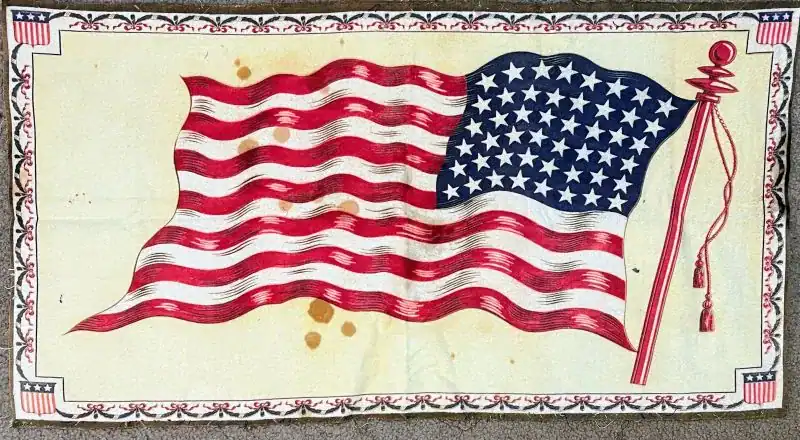
Dear Kris and any QHLer interested in detailed info on exact dates for SA flag,
Wrote to Margaret Rolfe, my dear Australian authority on quilt history (and so much more), and asked for better info. Here is her reply:
“Re: SA flag. Australia was settled as a series of British colonies, but according to my book, SA only got a flag after Australia became a Commonwealth in 1901. The flag is the Australian blue ensign with a State badge (shows a black and white magpie [also called a piping shrike], which is the state bird). The flag was proclaimed on January 1904. Australia has a long and tortuous history re: Britain, states, Commonwealth, and now coming Republic (latter my statement – can’t possibly see how Republic won’t eventually come, though the monarchists are very strong here, and the current PM is among them). SA was settled sometime in the first half of the 19C, and was not a convict colony.”
Of course the lovely thing about having that particular flag flannel more accurately dated, helps with dating the entire quilt … as in, the quilt can’t be any older than the newest piece.
Date: Fri, 18 Apr 1997 06:49:26 -0400 (EDT) | From: AJSNGS [at] aol [dot] com
Welcome to Kitty, and Hi all,
Just wondering…are there any good quilt exhibits in the Ann Arbor, MI area? I went to school there but wasn’t into quilts at the time so I can’t recall hearing about any. I’d enjoy knowing about them if they exist. Also, I will ask Kitty too. Is the exhibit at the MSU library open to the public?
Thanks for answering my regional questions! Nancy in Virginia
Date: Fri, 18 Apr 1997 07:04:30 -0400 | From: Ricki Maietta <rmaietta [at] csrlink [dot] net>
Hi everyone! I’d just like to invite you all to a quilt show! It’s June 14 & 15 – the Tiadaghton Quilt Guild of Williamsport, PA. The show will be held in the Pennington Lounge of Lycoming College. It’s our first “bigger” show – don’t know how many quilts yet, but we are having some vendors, a lecture or 2, & me on Sunday from 2-4 at a booth to help people learn about their antique quilts that they bring in (how old, how to care for, etc.).
Our guild has grown to about 100 members & this is our first show at a new location, & we’re real happy about it & anxious for it to be a success. If you would like more info, contact me.
See ya there!
Ricki in PA
Date: Fri, 18 Apr 1997 06:43:01 -0400 | From: Joan Brown <jbsews [at] csrlink [dot] net>
Hi all, Please reply to the list with the information about Barbra Brackman’s Fabric Camp. Joan Steady as she sews.
Date: Fri, 18 Apr 1997 08:35:11 -0500 | From: gridgees [at] algorithms [dot] com (Merry May)
Just wanted to give a brief report on our progress in collecting blocks for Terry Thompson. At this point, we now have 27 people who have asked for the instruction sheets (so I would presume they’re all busily making blocks, right???). Three blocks have arrived, and are all wonderful. One person even contributed a check to the Terry Thompson Fire Fund, plus a fat quarter of fabric, and a personal note addressed to Terry. Thanks so much!
Among those who requested information was a woman from Japan, who said she’d try to share the instructions with some friends. Is there anyone else out there who would be willing to make a 6″ Kansas Troubles block for Terry? If you need written instructions, e-mail me with your Fax number (US or Canada), or your snail mail address. I can also tell you that this is block #3168 in Brackman’s “Encyclopedia of Pieced Quilt Patterns” (also on BlockBase), and is also on page 79 of Judy Hopkins’ “Around the Block”. The deadline for getting the blocks to me is May 10th, so please be sure to snail mail them to me on or before May 5th to allow enough transit time. E-mail me privately if you need my snail mail address.
Keep ’em coming!
Thanks again, and please be sure to share the instructions with anyone else you know who would like to make a block – they don’t have to be in QHL or on-line or whatever.
Take care Merry Schoolhouse Enterprises gridgees [at] algorithms [dot] com
Date: Fri, 18 Apr 1997 09:04:44, -0500 | From: LVQG24A [at] prodigy [dot] com ( ELIZABETH K DONALDSON)
Dear Nancy, Yes, the collection is available for viewing. It’s not on permanent display, but you can make an appointment to see the quilts and the state of the art quilt storage facilities. Call Melanie Atkinson @ 517-353-1744 for your appointment or e-mail me and I can help you too! This museum is doing some really wonderful things to document quilts and quilters.
Kimberly, A traditional charm quilt has each piece in the quilt the same size and shape, but each fabric is different. Check Uncoverings, 1996 for “Charm Quilts: Characteristics and Variations 1870s-1990s” by Pat Nichols for an excellent historic view; and for patterns my upcoming book Charm Quilts or Jinny Beyers “Scrap Quilts”.
Kris, I’d love to see our home page have a book list and the chance to order them off the list!
Welcome Kitty, I’m sending you an e-mail, let me know if you don’t recieve it.
Beth in Snowy-gray Michigan
Date: Fri, 18 Apr 1997 09:40:06 -0400 (EDT) | From: QRestore [at] aol [dot] com
Dear Joan;
The following information I have is from the Spring-Summer 1996 newsletter of the Quilt Restoration Society (QRS);
FABRICAMP
Nov. 8-13, 1996 – April 18-23, 1997
June 20-25, 1997 – Oct. 15-19, 1997
Barbara Brackman and Terry Clothier Thompson invite you to 5 days of Intensive Fabric Study in Lawrence, Kansas, The Heart of Quilt Country. The classes will focus on dating antique quilts by identifying the colors, dyes, prints and fiber founds in the materials commonly used by America’s quiltmakers.
Tuition is $400 for each 5-day session.
Hope this information helps . . .
Victoria Montgomery QRestore [at] aol [dot] com Boise, Idaho
Date: Fri, 18 Apr 1997 23:51:08 +1000 | From: LiJoo <lijoo [at] vermont [dot] starway [dot] net [dot] au>
Hi all! I was just wondering how many of us are there on this list? I am including all subscribers, whether they post to the list, or just lurk. I have been telling some friends of mine about this great list, and wanted to tell them how many of us are on this list. WOuld be great to get an answer. THanks.
Date: Fri, 18 Apr 1997 10:27:15 -0400 (EDT) | From: JQuilt [at] aol [dot] com
I went to see an African American quilt show, at the University Gallery of the Univ of Mass in Amherst, two days ago… and saw quilts from the collection of Eli Leon of Oakland/San Francisco… The name of the exhibit is Something Else to See and it will be there until June 7th…There is a catalog published by the University Gallery but they didn’t have any copies available…
The show was exquisite….There really are no words to describe the colors, fabrics and designs…If you are in the area…DONT let this show go unseen, you wont soon forget it…It was like having some of Paul Klee’s paintings transformed into fabric.
The following is a quote from the description about the quiltmakers: ” The quiltmakers learned their “freehand” ways of working from the mothers and grandmothers..In his catalogue essay, Leon stresses the continuity of tradition passed along from one generation to the next in African-American families and suggests that these quilts express values that have African roots.”
The University Gallery is located in the Fine Arts Center of the U Mass campus… Hours are: Tues- Fri 11 AM to 4:30PM Sat &Sun 2PM to 5 PM Telephone# (413) 545-3670
Give your eyes a treat and go to see these wonderful quilts…I’m going back a few more times…. Jean Laino jquilt [at] aol [dot] com
Date: Fri, 18 Apr 1997 13:58:33 -0400 (EDT) | From: CToczek [at] aol [dot] com
Hi to Nancy, Beth and Kitty and all who have been talking about Michigan. My husband’s family lives in Hillsdale and teaches at the college there. A far cry from Texas where we are now. I’ve visited enough to know about the weather, though, and can appreciate eagerness for spring. Best wishes to the quilters up there.
Carla in Texas
Date: Fri, 18 Apr 97 16:43:40 -0500 | From: Rosalie Owen <rosalie [at] brstamp [dot] com>
— [ From: Rosalie Owen * EMC.Ver #2.5.02 ] —
Carla: We didn’t live in Michigan, but we lived in Indiana, right on Lake Michigan, in the Indiana Dunes. I remember the winters up there – that’s why I am glad we moved to Georgia. They have to make quilts up there or they would freeze in Winter. Rosalie in Blue Ridge – Georgia, that is.(and glad to be here) ——– REPLY, Original message follows ——–
Date: Friday, 18-Apr-97 01:58 PM
From: CToczek [at] aol [dot] com \ America On-Line: (CToczek) To: QHL [at] cuenet [dot] com \ Internet: (qhl [at] cuenet [dot] com)
Subject: QHL: Michiganders
Hi to Nancy, Beth and Kitty and all who have been talking about Michigan. My husband’s family lives in Hillsdale and teaches at the college there. A far cry from Texas where we are now. I’ve visited enough to know about the weather, though, and can appreciate eagerness for spring. Best wishes to the quilters up there.
Carla in Texas
Date: Fri, 18 Apr 1997 18:01:02 -0400 (EDT) | From: AJSNGS [at] aol [dot] com
Hi all, and especially Beth,
Thanks for the information about the quilt exhibit at MSU. I’ll make a point of trying to get an appt. when I’m out there so I can report back to everyone about the wonderful quilts there.
Nancy in VA
Date: Fri, 18 Apr 1997 21:30:52 -0400 (EDT) | From: JOCELYNM [at] delphi [dot] com
On 18-APR-1997 09:47:45.3 QRestore said to JOCELYNM > FABRICAMP > Nov. 8-13, 1996 – April 18-23, 1997 > June 20-25, 1997 – Oct. 15-19, 1997 > Barbara Brackman and Terry Clothier Thompson invite you to 5 days of > Intensive Fabric Study in Lawrence, Kansas, The Heart of Quilt If any of you decide to come, please email me…I’d love to meet you!
I won’t be at the camp itself, since I’m a grad student and $400 is a bit pricey for a quilt class….. Jocelyn
Date: Fri, 18 Apr 1997 22:48:23 +0400 | From: Xenia Cord <xecord [at] netusa1 [dot] net
Hi, all!
Have you seen the great article by Barbara Brackman in the May issue of Quilter’s Newsletter, on “Designs from the Melting Pot”? While the thrust of the article is that American applique owes much of its design origin to Pennsylvania German folk art motifs, the illustrations are mostly of red and green applique quilts. At Quilt America (Indianapolis, May 29-June 1) there will be, among the exhibited quits, a special exhibit of red and green quilts from the second and third quarters of the 19th century. The quilts preveiwed so far are exciting, and the collection, although not large, appears to be a good one. Most of the quilts are from private collections, but a few will be available for sale.
This show always mixes exhibits of antique and new quilts, and has other interesting displays as well – this year, an exhibit of 19th century dresses, along with dressmakers’ pattern-making tools. Everyone is welcome!
Xenia, in Indiana
Date: Fri, 18 Apr 1997 23:57:24 -0400 (EDT) | From: Peg Gilson <gilsons [at] voicenet [dot] com>
At a guild meeting the other night, a member asked if any of us had ever heard of “spoon quilting”. She had seen the term mentioned in an old (non-quilt) book. There’s no reference to it in my limited library of books. Do any of you know what “spoon quilting” is/was?
Thanks,
Peg gilsons [at] voicenet [dot] com
Date: Sat, 19 Apr 1997 16:54:28 +1100 | From: Sven Olsson <sven [at] pnc [dot] com [dot] au>
Peg, finally one that I can answer!!!! A quilting spoon looks like a deformed teaspoon, with the handle bent. It is used on the hand under the quilt to support the fabric. The bowl of the spoon fits over the flat of the thumb. No more needle stabs this way. My good friend uses this spoon all the time and her quilting is just beautiful.
Lorraine in Oz
Peg Gilson wrote: > > At a guild meeting the other night, a member asked if any of us had ever > heard of “spoon quilting”. She had seen the term mentioned in an old > (non-quilt) book. There’s no reference to it in my limited library of books. > Do any of you know what “spoon quilting” is/was? > > Thanks, > > Peg > gilsons [at] voicenet [dot] com
Date: Sat, 19 Apr 1997 07:17:42 -0400 (EDT) | From: Baglady111 [at] aol [dot] com
Peg, I have heard of spoon quilting, saw it in one of the quilt mags waaaay back somewhere..they put the spoon under the quilt and it acted as thimble..needle would hit the back of the spoon, and then you’d rock your needle to bring thread to the top again..much like a darning spool..ever use one of those? I’m sure more will come forth abut this now..interesting subject.. Jane
Date: Sat, 19 Apr 1997 07:09:05 -0500 (CDT) | From: Nancy Evans <nevans [at] nebnet [dot] net>
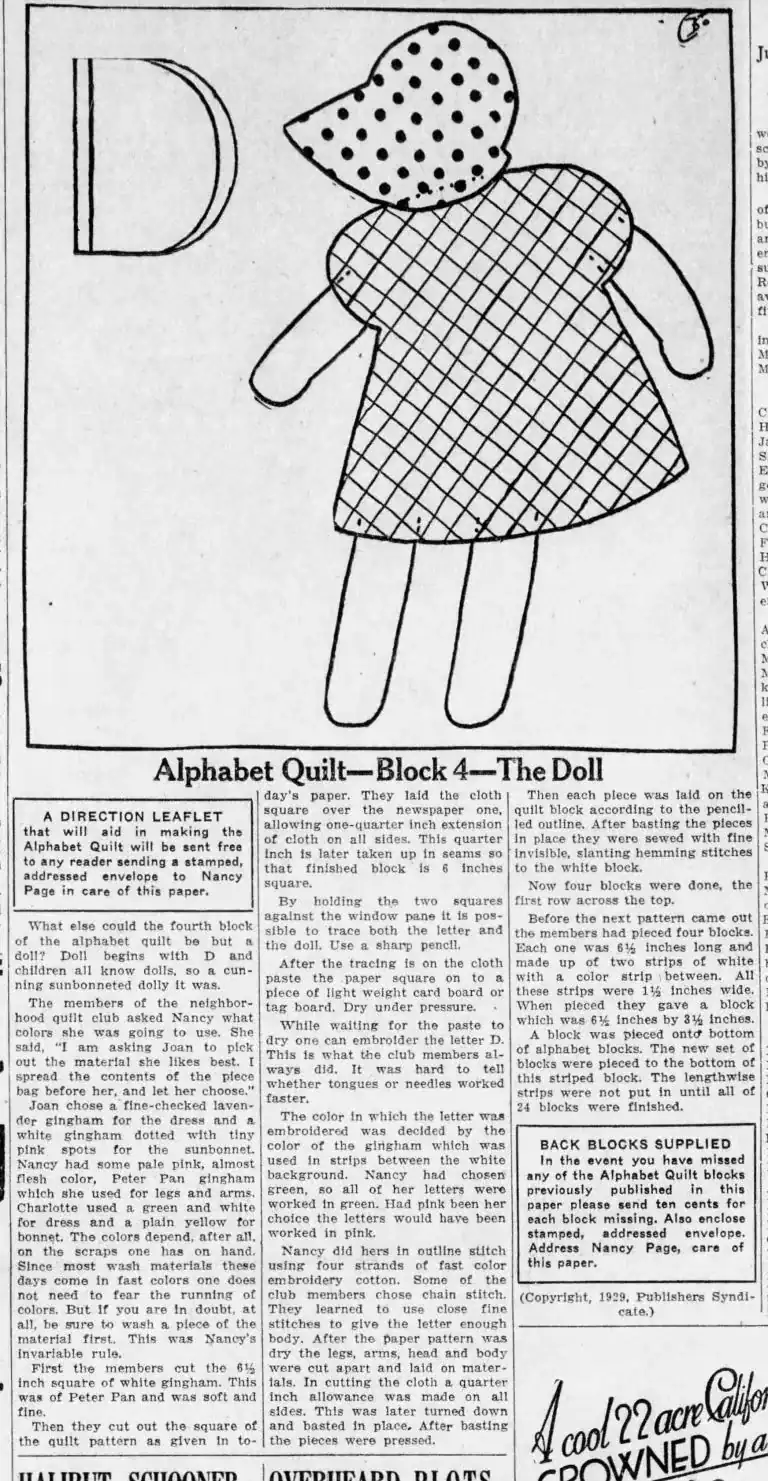
I’m sorry, I don’t remember who it was, but someone was looking for information on Nancy Page recently. I have not seen the book, but I saw a description of a book that reprints her Alphabet Blocks from the 1920-1930 era. From the description, it sounds like it is just a re-make of the newspaper pattern. It is offered in the Spring newsletter from Keepsake Quilting on page 33. Not the origianals – but sometimes this type of book is as close as we can get! Nancy Evans – Nebraska Quilter
Date: Sat, 19 Apr 1997 08:07:07 -0400 | From: “Miklos B. Lukacs” <mlukacs [at] webbernet [dot] net>
Content-Transfer-Encoding: 7bit
Each time I hear more about the indianapolis show, I am more eager. It is only about 4-6 hours away. Thanks Xenia, for more info. Connie L.
Date: Sat, 19 Apr 1997 10:05:11 -0400 (EDT) | From: CToczek [at] aol [dot] com
Dear Rosalie,
I can relate to Georgia, too. Uncle Sam had us at Ft. Benning in Columbus for five years. Beautiful area, though much more balmy than here in Lubbock where we are now. The prairie wind takes getting used to, but I like the dryer climate better. Just to throw one more state in the pot: I hail from Little Rock, Arkansas. Any other Arkansans out there?
Carla in Lubbock, TX
Date: Sat, 19 Apr 1997 10:50:21 -0400 (EDT) | From: JQuilt [at] aol [dot] com
Every once in awhile, we all have to remind ourselves that this wonderful little QHL group has many diverse members with lots of different VALID opinions….
Sometimes I notice a rather pedantic tone creeping into some of the messages sent to the group, by some of our “expert” members…The message reads as if to say, “Here is the definitive answer, write it down and try to remember it.”
Please let’s all make an effort, to welcome ALL of the opinions expressed on this list… Sometimes when I watch Siskel & Ebert reviewing the Movies of the Week…I delight in the fact that, very often they really disagree…and then I realize that my opinion is as valid as theirs…even though they are the “experts”
Time has proven that even the History books we read in High School and College…were really written from the author’s and editors point of view, as to what was important history and what was not…
I have read books and looked at the pictures of Floridian Seminole Indian(Native American) Art and books with South Dakotan Sioux Art… the styles and histories are so different… It may well be time, to stop thinking of Africa as one big country instead of a continent with many, many countries and that, maybe descendants of the different countries in Africa, also have different styles and histories…. After all we don’t say European American …we say German American, Italian American etc..
Please accept this, only, as an opinion… and that, there is no need to prove that it is right or wrong… it just might be different, than yours…. Jean Laino jquilt [at] aol [dot] com
Date: Sat, 19 Apr 1997 09:41:18 -0500 | From: “J. S. Lyle” <jslyle [at] bcl [dot] net>
You may add a business rider to your homeowners policy as has been previously indicated. However, there are several things that you should be alert to in doing this. The dollar value of the business contents coverage is very restricted and will offer very limited coverage while away from your premises. In addition, it will not offer coverage for any items that you have on premises that belong to others that you may be repairing or working on. If you are doing this type of work for others, it would be well for you to investigate a small business type policy for your business since your homeowners probably will not cover even with a business rider attached.
The business rider will not cover your own contents while away from the premises except in a very limited way. This is a common misunderstanding and if, you do a lot of traveling or moving around, it will be well for you to investigate the small business policy as well.
Your liability portion of the homeowners, also may restrict the business use coverage while away from your premises.
It is advised for any of you that are needing this coverage or have this coverage at the present time, to sit down with your agent (if you can get him or her to do so) and discuss your indivudal needs and get that agent to explain the limitations and various options available to you for proper coverage. There are too many agents out there that take an attitude of “don’t worry, you’re covered”. Don’t take this without somthing in writing in this regard for your protection.
Bill Lyle
Date: Sat, 19 Apr 1997 13:07:28 -0400 | From: nanday1 <nanday1 [at] concentric [dot] net>
Has anyone ever tried the Photo Transfer Paper to make a memory quilt? If not, has anyone used any other method of transfer photos to fabric that was successful. I’m trying to find out the best way to do this with lasting results. Any input would be greatly appreciated.
Angel
Date: Sat, 19 Apr 1997 20:57:07 -0400 (EDT) | From: RBCochran [at] aol [dot] com
Hello Michiganders– Although in NJ, my family has history of travel from NJ to MI which I continue every summer through my husband’s family. Some good quilt shops there, too. –Rachel
Date: Sat, 19 Apr 1997 21:08:05 -0400 (EDT) | From: RBCochran [at] aol [dot] com
Sometimes I’ve used a spoon on top of the quilt when I’m basting it to catch the needle as it comes out of the fabric. –Rachel
Date: Sat, 19 Apr 1997 22:36:38 -0400 | From: quiltmag [at] mindspring [dot] com (Jean Ann Eitel)
David and Marie…where do you live in England? I grew up in South Florida and spent many a happy childhood hour watching the Seminoles do their patchwork. I have some examples here stitched by the Seminole Indians. They did a particular type of strip piecing and interspersed the rows of patchwork on their garments with solid strips of fabric that had stitched on little rows of rick-rack trim. They did all of their patchwork on treadle sewing machines which they would set up in their chickees on the town square.
The colors were bright, with black background fabrics like the Amish. the garments were elaborate. I think I have a book here, I will look for it. I am coming to England on May 11…if I can find it, i will post it to you after I get there.
Chickees were round structures with palmetto rush floors, woven palmetto or wooden walls that went up about three feet…..a door opening, but no door, and a palmetto (palm) roof that look much like a thatched roof.
Jean Ann Eitel, Editor QUILT Magazines http://www.quiltmag.com
#quilttalk internet IRC channel – #quilttalk activities home page… http://www.quilttalk.com
Date: (date unknown) | From: Cathy <tovarezd [at] pilot [dot] msu [dot] edu>
Hi Beth
Welcome to the group. It was great to hear you are from Michigan. I graduated from MSU two years ago from the Hotel & Restaurant program. I am currently living with my husband of 2 1/2 years in Warren Michigan.
Congratulations on the position at the Muesum. I would be really interested in knowing about the Michigan Quilt Project. I was talking to a Quilt Shop Owner and she had mentioned that MSU was going to have a building built to house the Mary Schaefer collection. What do you know about that. If they are building something where on the campus is it going to be. Or are they just housing it in the Muesum.
Welcome again to the list. You will definelty be glad you did.
Cathy tovarezd [at] pilot [dot] msu [dot] edu
Date: Sat, 19 Apr 97 20:55:17 PDT | From: narmstr [at] ibm [dot] net
Dear Jean (other QHLers),
Your message from #107 … Sometimes I notice a rather pedantic tone creeping into some of the messages sent to the group, by some of our “expert” members … The message reads as if to say, “Here is the definitive answer, write it down and try to remember it.”
Since you made references to Seminole and African Americans … I HOPE NOT, but if I am “THE one” or even “a one” who is coming across to you (and perhaps to others) as pedantic, let me say that is certainly not my intent. When someone has asked for help on a question which I have books I can refer to written by the REAL EXPERTS on the subject, I do “the librarian thing” … I offer the bibliographic information to make it possible for the person who wants some answers (not necessarily the definitive ones) to find them in books, magazines, etc. they may be able to locate. I *do* admit to being a retired university professor; however, I work at having a reasonably relaxed writing style.
So … not to be too apologetic, I’ll probably keep on being me. I will continue as I always have to value other’s opinions and hope that I will not be seen as viewing myself as an expert but one who has a great deal to learn from others, and who wants to offer a helping hand in retun. nca
Date: Sun, 20 Apr 1997 03:13:22 -0400 (EDT) | From: Tubeywooby [at] aol [dot] com
I have successfully used the photo transfer paper you can buy at shops and shows, where you take the paper to Kinkos or another photocopy shop that does high quality color photocopying. Even with black and white or old sepia tone pictures you need to use these high quality copiers and not the black and white 5 cent kind. You give them your paper and your photos arranged on an 8 1/2 x 11″ sheet of paper. They photocopy it for $1 onto your paper. You take home the paper, careful not to wrinkle or fold it as it will leave a permanent flaw. The pictures are cut apart before ironing onto your fabric, and you can cut out images, like cut away a distracting background. The key is to not have a picture bigger than the base of your iron, because you are supposed to press a very hot iron in place for 30 seconds and immedaiately pull the paper off while still hot, hard to do if your image is larger than your iron. Also, remember to have the copy shop reverse the image, especially if there is any lettering, as otherwise it will come out backwards on the finished product. I think this is a wonderful addition to a quilt label. I plan to label all of my mothers quilts with a picture of her and also who it was made for!
BTW, the Kingwood Quilt Guild Show went very nicely this weekend, lots of neat quilts, and we had this years IQA raffle quilt on display, which was pieced by Linda Aspinal and hand quilted by Margie Freeman. Beautiful! Karen and I signed our new book, CrazyFolk, which was fun. Up at all hours of the night, Melissa in Kingwood, Texas
Date: Sun, 20 Apr 1997 09:39:44 -0400 (EDT) | From: Gail Wagner <dpw13 [at] mindspring [dot] com>
On one of my estate sale jaunts (don’t laugh Diane), I bought a box lot of patterns. After I got home and made a closer inspection, mixed in with the dress patterns are some really interesting vintage quilting things. There is an article from The Story of American Needlework about Quilting written by Rose Wilder Lane (daughter of Laura Ingalls Wilder – Little House). I have no date and I’m not sure the article is complete but there are some great close-up pics of quilts that are whole fabric quilts.
There are also two Mountain Mist wrappers with the quilt patterns on them (both used) and two Mountain Mist patterns catalogs. The catalog is not with pages like we usually think of a catalog but one large sheet that is folded up. There are 34 photos of quilt patterns to order and one photo of a quilt frame blue-print to order. I got really excited when I came across a mailing envelope from Mountain Mist with something in it, but the “something” turned out to be a dress patterns that had just gotten stuck in there.
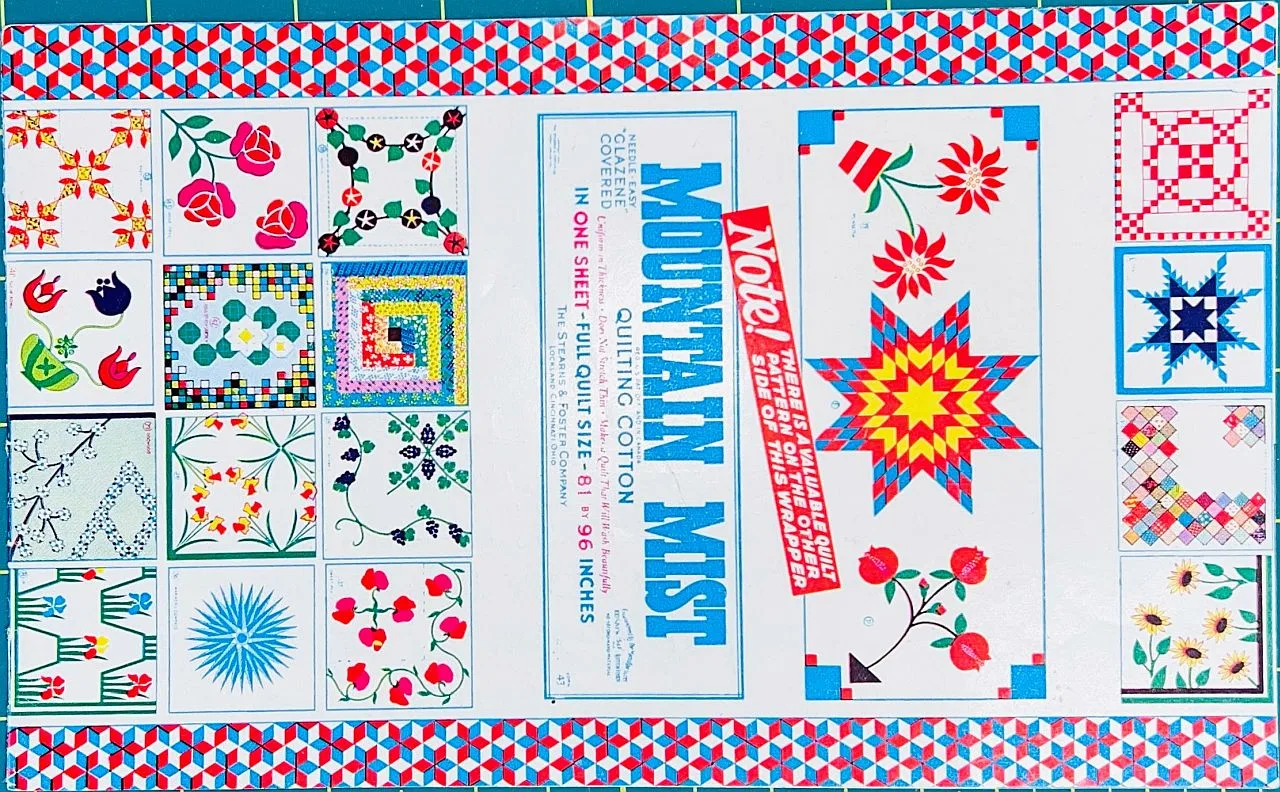
The most recent date I can find on some newspapers in this lot is 1968 and most of the clothing patterns are .75 and less.
If anyone would like a photocopy of this magazine article, I’ll be glad to send it. E-mail me privately and I’ll give you my snail mail address to send a long SASE.
Also, on the subject of AA quilts, there was a lady with one on the Antique Travelling Road Show (on PBS) last weekend. She really knew alot about the imagery on this quilt. It was really a beautiful quilt and they valued it at $15,000 if my memory serves me correctly. I’m sorry but I don’t remember where they were on this particular stop.
Gail.
Date: Sun, 20 Apr 1997 10:49:33 -0400 (EDT) | From: Calicot [at] aol [dot] com
Hello from a former Michigan native. My home town is Petoskey and I would love to chat with anyone from that area or from anywhere in Mi. My mother and sister still live in Petoskey. Another sister lives in East Tawas. My husband’s people are from the UP, Finns from Amasa. I miss Michigan very much even after all of these years so I return every year to visit my family and Lake Michigan. I didn’t learn to quilt until I moved to Ilinois and have no family history of quilters. It would be nice to hear about Michigan traditions. Thanks. Jan Carroll Calicot [at] aol [dot] com
Date: Sun, 20 Apr 1997 11:07:29 EDT | From: debatqps [at] juno [dot] com
We have done classes on Memory quilts using the transfer paper. We have had some really gorgeous wallhangings done. They are very time consuming however and the papers are not cheap! One lady is doing one of her mother and father and has transferred their marriage license, engagement announcement from the paper, pictures, train tickets her mom had saved, Its going to be really neat. Another lady did one for her neighbor who has been like her mother and she embellished with silk ribbon embroidery, charms, rosettes, embroidery, you name it. Gorgeous.
Debbie in NJ where it snowed yesterday and tomorrow will be in the high 50s . . .
Date: Sun, 20 Apr 1997 12:48:15 -0400 (EDT) | From: RBCochran [at] aol [dot] com
Hello former Michigan native– I can believe you DO miss Michigan. We get there only a couple weeks each year and look for Petoskey stones in Higgins Lake. Hope that doesn’t make you too homesick. I think following the Michigan Quilt Project’s progress will teach us all about Michigan quilting traditions. –Rachel in NJ
Date: Sun, 20 Apr 1997 13:06:14 -0400 | From: mcdowell [at] museum [dot] cl [dot] msu [dot] edu (Marsha MacDowell)
Just thought you would like to know that the Michigan State University Museum has a very fine rag rug and related materials collection, developed under the direction of Dr. Yvonne Lockwood. Rugs are stored in the same top-notch rolled storage system that Beth Donaldson mentioned in previous note, and slides, tape-recorded interviews with weavers and loom makers, and fieldnotes are in the MSU Museum’s Tradtional Arts Research Collection. A traveling exhibit is also available for rental and display at small museums. Appointments can be made to view the collections and arrangements to book exhibit can be made by contacting the MSU Museum, 517-355-0368.
— Marsha MacDowell, Curator of Folk Arts, Michigan State University Museum
Marsha MacDowell
Date: Sun, 20 Apr 1997 12:22:07 -0500 (CDT) | From: Nancy Evans <nevans [at] nebnet [dot] net>
I bought an old tied quilt at an auction with the intent of dismantling it for either re-doing as a traditional quilt, or for use in restoration projects. I have completely freed it of its original ties now, and am left with:
1. the double four-patch top, pieced from fabrics which (I believe are no newer than 1925
2. the old backing, which is in absolute shreds from age and filth
3. an inner “comforter”, the stuffing of the quilt. It is a whole cloth comforter within the original, and the interior of this is a double layer of old blankets
My main question is this: What do I do with the patch top to get it to come clean? The fabrics are cottons, mostly, with some silks, etc. thrown in for good measure. Some of the cottons are not color fast, from what I can tell, since there are places where red has bled onto white or lighter fabrics. I know this is not a particularly valuable piece (I think I paid $2 for it), but I am thinking that a number of the fabrics could be used in the restoration of a Birds in the Air that I have & would like to see repaired.
I am thinking maybe Synthrapol, to keep the dyes from doing any further damage? Or something else? Also, for you restorers out there: am I on the right track in using these fabrics for my Birds in the Air? They appear to be about the same era, many indigos and black mourning prints and maroons. And, what about taking apart comforters to re-make as quilts? I know that I would need to document the fact that this was done, if I wanted to re-sell, but my Birds is just a family piece that I would like to see restored. However, I have a couple of others that I wouldn’t mind un-tying, then quilting for sale. Is there a market for this type of piece, or is it better to leave as a tied quilt?
One of the reasons I would want to re-quilt some of these is that the battings used were as described above, very heavy, and I personally think that they will be too heavy to wash very many more times without totally destroying the fabrics. I would like to resurrect them as cotton-batt quilts, with either regular quilting or utility quilting of some sort. My main focus is to save the fabrics, along with the designs, of these old every-day quilts.
Please don’t be afraid to tell me if I’m on the wrong track here! I’m just wanting to learn what I can do to preserve these older pieces. I am a quilter that so far has mostly worked with new fabrics, or with unused vintage fabrics in new quilts, and this is my first real project for restoration.
Well, TIA for any help some of you can give me on this!
Nancy Evans – Nebraska Quilter
Date: Sun, 20 Apr 1997 13:41:29 -0400 (EDT) | From: AJSNGS [at] aol [dot] com
Hi to everyone, and especially this is for Marsha from MSU,
Thanks for your post about the rag rugs at MSU. I hope to come see you all when I’m home in June. I’ve been to the Museum many many times growing up and never realized what a neat place it is! (I remember the mummified Indian girl).
Thanks again, Nancy Sentipal in Virginia
Date: Sun, 20 Apr 1997 16:48:05 -0400 (EDT) | From: Baglady111 [at] aol [dot] com
In reading all of these ‘displaced Michigan’s’ so scattered over our country..I onll hope SOME OF YOU stay put to come to our retreat in Hastings, MI in Sept..and for those of you who have lkeft, hope you’ve left a trail so you can find your way back for our first time ever outing..Jane <baglady [at] aol [dot] co>
Date: Sun, 20 Apr 1997 20:39:18 -0400 (EDT) | From: CToczek [at] aol [dot] com
Hi All,
As long as Nancy from Nebraska brought up such good questions about tied quilts, I’d like to throw in some of my own questions.
I just purchased, washed (with Orvus) and pressed some 1870’s blocks. 25 patch design with OLD shirting prints. So far, so good. My question regards the difficulty I had deciding which way to press the seams. Is the procedure of seaming and pressing ‘toward the dark’ and pressing seams to one side a recent invention? Or was this particular quilter not concerned about which way her seams went; she even pressed many of them open? I’m just now beginning restoration of old pieces, like Nancy, and I wonder if I will encounter more seam problems.
Thanks, Carla, Lubbock TX