Telltale Textiles: Indigo Fabrics
This page contains affiliate links. If you buy through them, I may earn a small commission at no extra cost to you. As an Amazon Associate I earn from qualifying purchases. Learn more
Every quilt carries clues about when it was made, if you know where to look. Telltale Textiles is an ongoing series digging into the fabrics, dyes, prints, and construction details that help you answer the question that matters most: is this old quilt worth saving? This entry: indigo, the enduring blue dye whose prints, color combinations and patterns of wear can help reveal an old quilt’s history.
What indigo is and how to spot it in a quilt
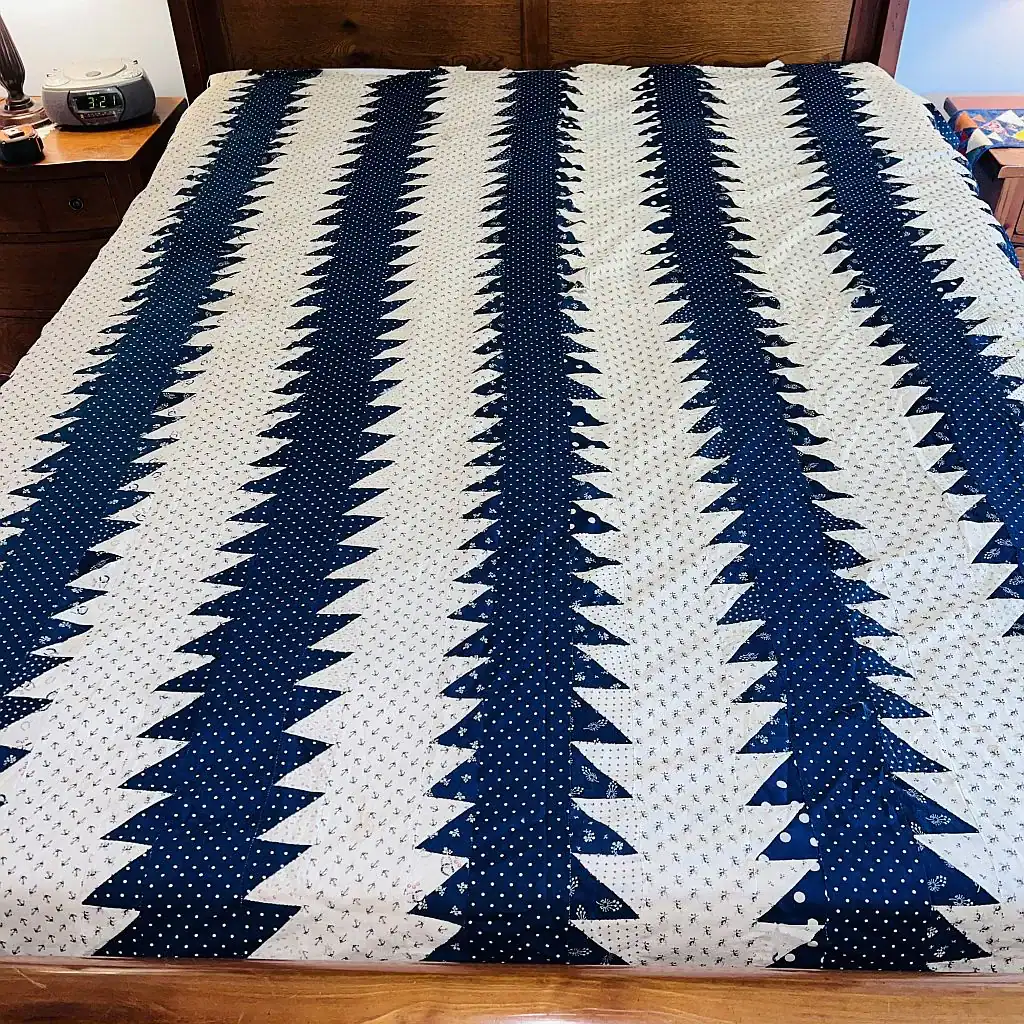
If you have found an old blue-and-white quilt in an attic, indigo may be one of your first dating clues. Indigo is one of the oldest and most colorfast dyes in the world. Unlike many early plant dyes, it usually retains its rich blue color for generations. Early indigo is a deep, rich blue, almost violet or black.
Unfortunately, indigo cannot date a quilt all by itself. It was used for centuries in many parts of the world, and the color remained popular long after synthetic versions became available. To estimate a quilt’s age, consider the indigo along with the quilt pattern, construction methods, quilting designs and other fabrics.
One useful clue is the way the blue has worn. Indigo coats the surface of the fibers rather than permanently coloring them all the way through. On a well-used quilt, folds, edges and raised areas may become noticeably lighter, while fabric protected inside seams remains dark blue. If possible, gently examine the fabric inside a loose seam or along the back of a turned-under appliqué. A darker blue in these protected areas may indicate indigo wear rather than ordinary fading.
How a green plant produces blue dye
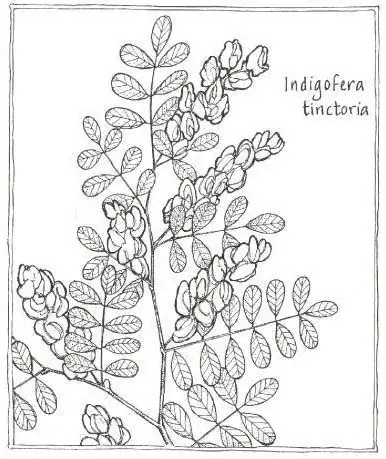
Natural indigo can be obtained from several plants. One of the most important is Indigofera tinctoria, a shrubby member of the legume family that has been cultivated in warm regions of Asia, Africa and the Americas.
Here is a curious connection: Indigofera tinctoria belongs to the pea family, as does the butterfly pea flower used to make bright blue tea and color-changing Indigo Gin. However, the plants produce their blue colors through different pigments and processes. Butterfly pea flowers release blue-purple anthocyanins when steeped, while true indigo dye must be coaxed from green leaves through fermentation, oxygen and a little chemical wizardry.
Fresh indigo leaves do not look like a blue dye waiting to happen. The leaves are soaked and fermented in water. The liquid is then stirred or beaten to introduce oxygen. As it reacts with the air, the blue pigment separates and settles to the bottom as a thick “mud.” This material can be pressed into cakes and dried, making it easy to store and ship.
Before it can be used to dye cloth, the dried indigo must be prepared in an alkaline vat. The liquid in the vat looks yellow-green rather than blue. Fabric taken from the vat also appears yellowish or greenish at first. As the cloth is exposed to oxygen, it gradually turns blue. One dip produces a relatively light blue. Repeated dipping and airing create progressively deeper shades. This process is called vat dyeing.
When an old indigo fabric appears faded, the color may actually have worn away from the surface. Rubbed edges, fold lines and other exposed areas become lighter first, while protected fabric stays dark. Later synthetic blue dyes may fade more evenly, so the pattern of wear can help identify an older indigo-dyed textile.
Why old indigo prints look the way they do
Indigo could not be applied to cloth in the same easy manner as many other dyes. Textile printers developed several ingenious ways to produce blue-and-white designs. Each process left a somewhat different appearance, giving today’s quilt detective another set of clues.
Blue-resist prints
To make a blue-resist print, the printer applied wax, starch or another paste to the areas that were meant to remain white. The cloth was then dyed in an indigo vat. When the resist was removed, the protected design appeared white against the blue ground. Some resist processes used more than one treatment to produce both light and dark blue areas. Depending on the method, the finished fabric might have a blue background with white figures or a white background with designs in several shades of blue.
Large blue-resist fabrics were often made for curtains, upholstery, bed hangings and other household furnishings. When these textiles became worn, unfashionable or no longer useful for their original purpose, their best sections might be preserved in a quilt. Look for them in whole-cloth quilts, large center panels and borders. Occasionally, they were cut into smaller pieces for patchwork.
Reusing an older furnishing fabric means the cloth may be considerably older than the quilt. That is an important attic-quilt warning: the date of a fabric is not always the date the quilt was made. One example appears in Mary Cross’s Quilts of the Mormon Migration. The blue-resist fabric had reportedly been part of bed curtains and a valance belonging to the quiltmaker’s mother in 1810. Incorporating treasured household textiles into a quilt was one way to preserve both the fabric and its family history.
Discharge-printed indigo
Discharge printing worked in the opposite direction. The cloth was first dyed solid blue. A chemical paste was then printed onto the surface to remove, or discharge, the color in selected areas. If you have ever splashed bleach on a pair of blue jeans, you have seen a rough, accidental version of this effect.
Discharge printing produced many of the familiar blue-and-white cotton prints found in quilts dating from approximately the 1890s through the 1910s. These fabrics were colorfast, practical and well suited to frequently washed clothing and household textiles. Discharge prints could closely imitate older resist-printed fabrics but were generally easier and less expensive to manufacture. This is another reason the design alone may not provide an exact date.
Penciled calico
Some early printed fabrics were finished by hand. After the main design was printed, small areas of color were added with a brush or “pencil.” Blue details were sometimes applied in this way when the available printing process could not produce all the desired colors.
Because hand-finishing was slow and expensive, penciled blue may appear only in small details, such as leaves, flowers or decorative accents. It is most often associated with eighteenth- and early nineteenth-century printed cottons. You may encounter small pieces in broderie perse appliqué quilts, where carefully cut printed motifs were arranged and stitched onto a background.
China blue, toile and Toile de Jouy
Some blue pictorial fabrics are described as China blue, toile or Toile de Jouy. These terms are sometimes used rather loosely, so it helps to look at the fabric rather than relying only on a label.
China-blue printing involved applying specially prepared indigo to the cloth and then developing the color through additional chemical processing. Copperplate and later roller-printing methods made it possible to create finely detailed scenes, landscapes, flowers and figures.
These fabrics were often intended for furnishings and bed hangings. Like blue-resist furnishing fabrics, they might later be reused in whole-cloth quilts, center panels, borders or other large sections. A dramatic pictorial fabric can look very old, but reproductions have been manufactured many times. Check whether the printing appears consistent with the quilt’s construction and the wear on its other fabrics.
The rise of blue-and-white quilts
Blue-and-white cottons appear throughout American quilt history. By about 1840, quilts made deliberately in a blue-and-white color scheme had become fashionable as well as practical. In many earlier examples, indigo prints were paired with solid white cotton. Some quilts borrowed their overall arrangement from woven coverlets, with repeated geometric designs in the center and flowing appliquéd borders around the outside.
Later in the nineteenth century, small figured shirtings increasingly took the place of plain white fabric. From the 1830s to the 1880s, you might see rich, solid mid-tones or deep navy backdrops featuring small white or pale blue geometric figures. A quilt that appears blue and white from across the room may reveal tiny dots, flowers, stars, stripes or other figures when examined closely.
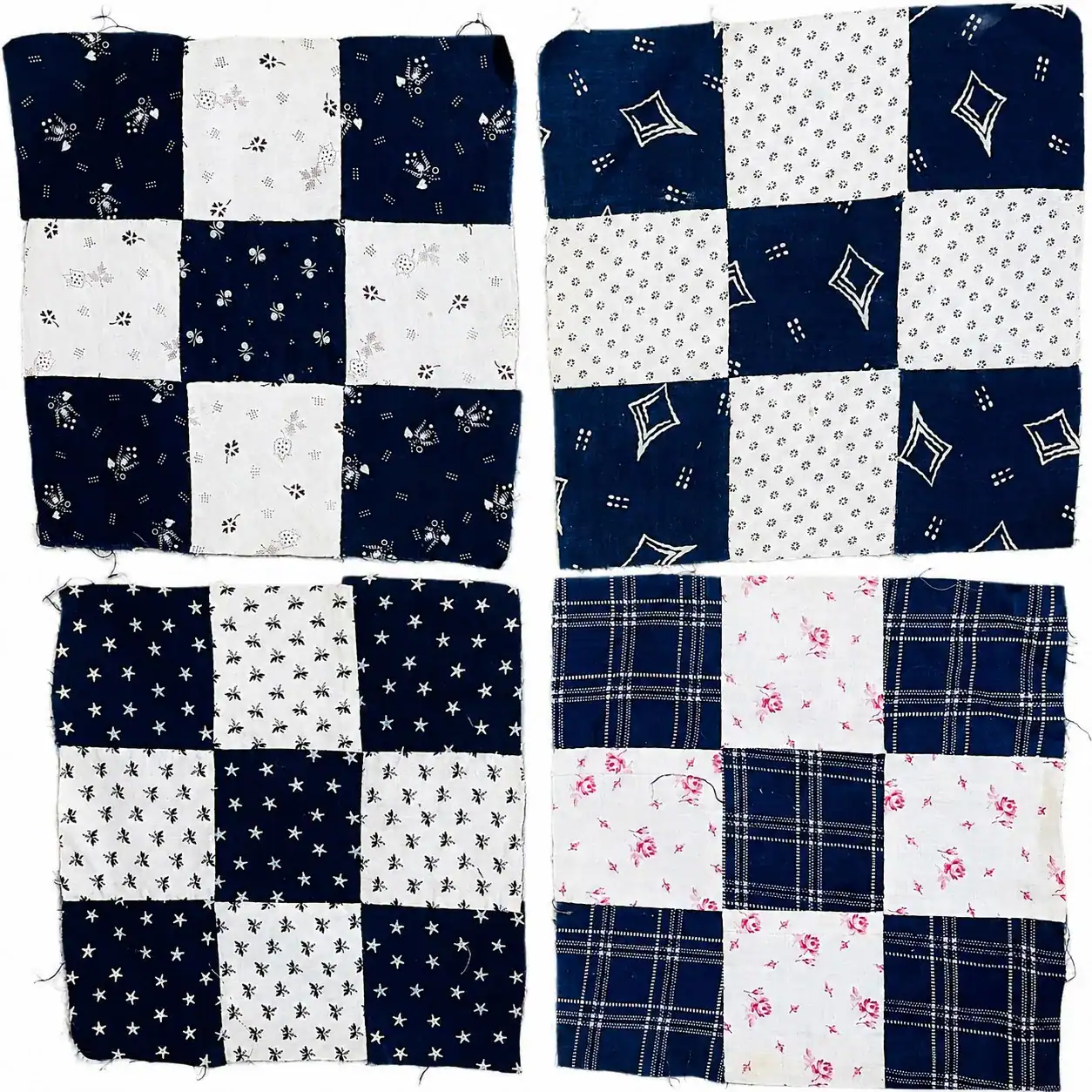
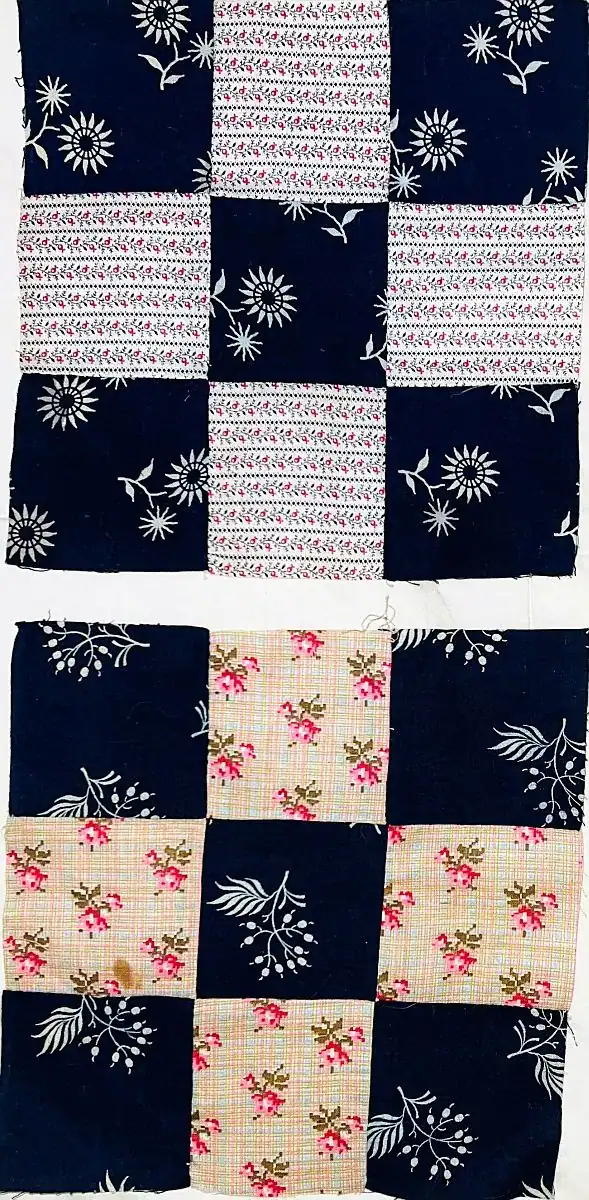
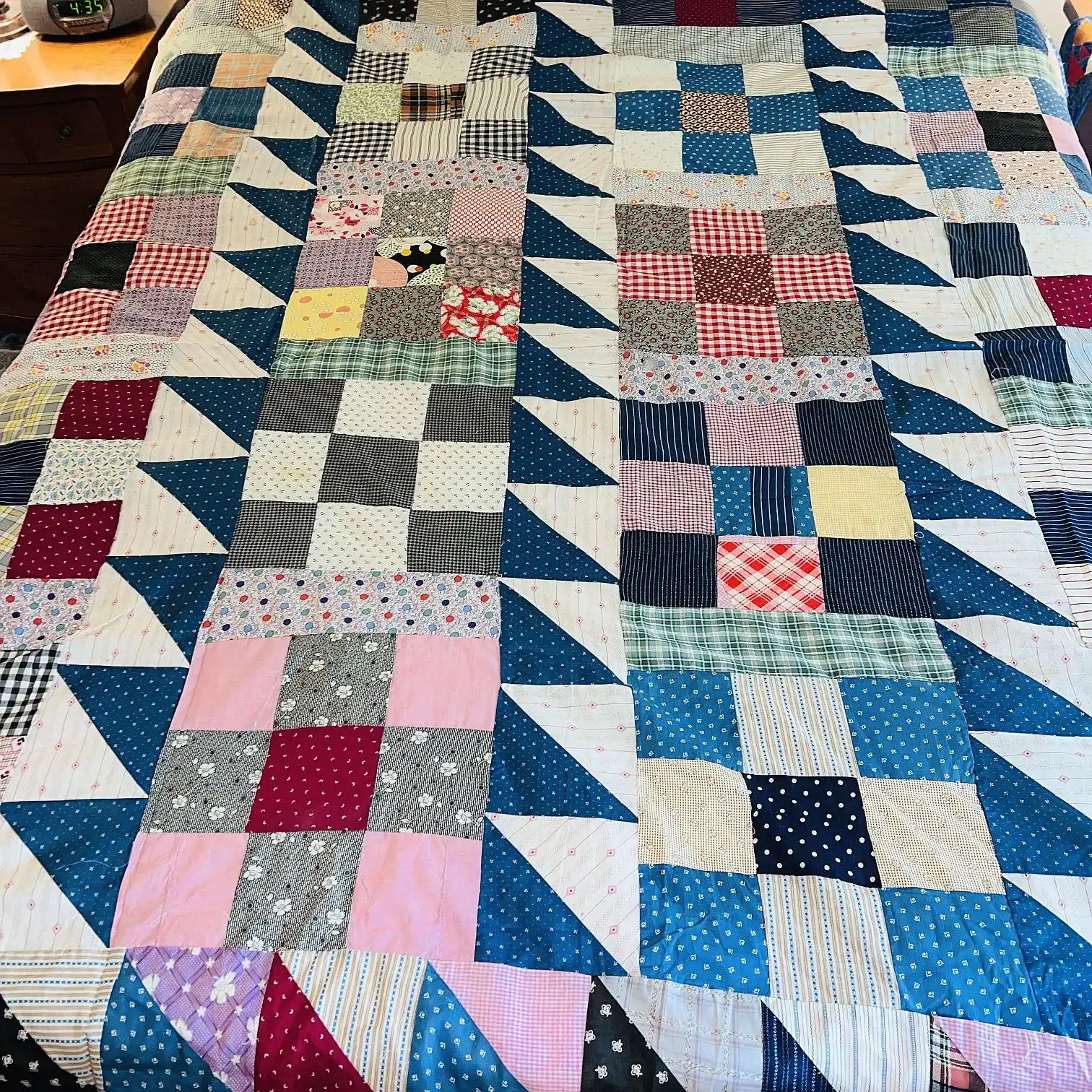
Factory-printed indigo fabrics became especially affordable and popular from approximately 1890 to 1920. They appear in many sturdy, everyday quilts made in Four-Patch, Nine-Patch, Bow Tie, Log Cabin and other straightforward patterns. Some were simply quilted, while others were tied rather than quilted. Around the turn of the twentieth century, indigo was also used in the dark cotton quilts popular at the time. These quilts combined navy blue with colors such as wine red, black, brown and cadet blue.
Cadet blue was particularly fashionable from about 1880 to 1925. It is a softer, grayer blue than deep navy indigo and was frequently printed with white. If your quilt has a muted gray-blue appearance, cadet blue may help place its fabrics within this general period.
The arrival of synthetic indigo
German chemists developed commercially successful synthetic indigo near the end of the nineteenth century. It was less expensive and more consistent than plant-grown indigo and quickly transformed the international dye industry. By the early twentieth century, synthetic indigo had largely replaced natural indigo in industrial textile production. Quilt historians often use the early 1920s as a practical dividing point.
Indigo-blue fabric manufactured in the United States after that period was probably colored with a synthetic dye. There is an important catch: natural and synthetic indigo can look virtually identical. A deep blue fabric is not automatically old, and it may be impossible to determine by sight whether its dye came from a plant or a laboratory.
World War I also disrupted the international dye trade. When the war began in 1914, German companies supplied much of the world’s manufactured dyestuff. The Allied blockade cut off that supply and encouraged rapid growth in the American chemical-dye industry. After the war, American manufacturers gained greater access to synthetic-dye formulas and production methods. Textile mills could offer reliable shades of pink, yellow, green, aqua, peach, lavender and blue. These colors helped create the cheerful floral, geometric and conversational prints associated with quilts of the 1920s, 1930s and 1940s.
Surrounding fabrics may be more useful than the blue. Deep indigo paired with brown, wine red or black may point toward one period, while indigo combined with clear pastel prints may suggest another.
Indigo Today
Natural indigo has never completely disappeared. Artists, historians and growers are reviving traditional cultivation and dyeing methods, sometimes at historic sites connected with the crop’s complicated history.
Reproduction-fabric companies continue to make prints inspired by antique blue-resist, discharge and China-blue textiles. Some manufacturers use historic designs or even antique printing equipment. These fabrics allow today’s quiltmakers to create remarkably convincing historical quilts, but they can also confuse future quilt detectives.
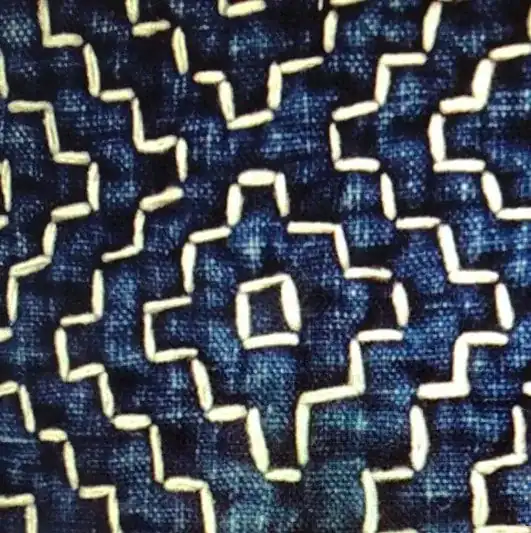
Japanese indigo traditions have also had a strong influence on modern quilting and fiber art. Boro textiles celebrate patched and repeatedly mended cloth, while sashiko uses distinctive stitching, often worked in white thread on an indigo-blue ground.
Indigo remains popular for the same reasons it appealed to generations of earlier quiltmakers: it is durable, versatile and beautiful. That also means a blue-and-white quilt is not automatically an antique. Date the entire quilt, not just its bluest clue.
Learn More
Andover Textile History Notes: Indigo Dye by Margo Krager for Andover Textiles
The Blue that Enchanted the World by the Smithsonian Magazine
Early Indigo Dyeing & Printing Methods Online Quilt Magazine
Indigo Prints: Resist and Discharged Figures Barbara Brackman
Indigo in the Fabric of Early South Carolina by the Charleston County Public Library
Indigo is Making a Comback in South Carolina by the National Geographic
Pillar Prints Digression into Indigo Resists Barbara Brackman
You might also enjoy: Early Use of Natural Dyes in Textiles, Turkey Red: The Brilliant Dye That Traveled the World, Telltale Textiles: Turkey Red, and Telltale Textiles: Double Purple.
From the Quilt History List
Members of the Quilt History List were talking about indigo long before this page was written. Here is what they had to say, in their own words:
- May 28 – June 1, 1997: Dyeing & Fixing Indigo
- May 24 – 31, 1999: Reproduction Fabric and Indigo Sources
- March 28 – April 5, 2001: Natural Dyes & Indigo
- March 31 – April 9, 2003: Working with African Indigo Fabric
- June 7 – 24, 2003: Dating a Quilt by Its Indigo (or Not) Blue Fabric
- November 30 – December 3, 2003: Identifying a Discharge-Print Indigo Fabric
