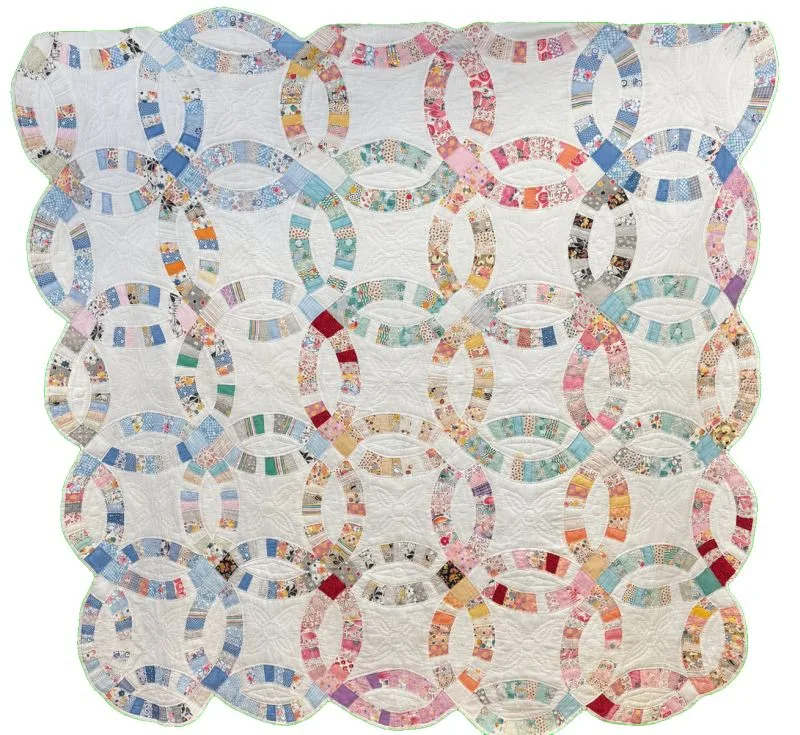
March 31 – April 9, 2003
These restored messages come from the Quilt History List, an online forum where quilt historians, collectors, researchers, appraisers, and enthusiasts discussed antique quilts and related textiles. The archive dates from 1996 through approximately 2016 and is being restored gradually. Sign up in the form at the bottom of the page if you want to know when a new page is added. Original spelling, opinions, formatting, and inactive links may remain unchanged.
Primary topics of this QHL Digest:
- Working with African Indigo Fabric — Members who bought African indigo cloth from a quilt-show vendor trade washing and shrinking tips, with a Swaziland connection adding personal history. (see the article on indigo fabrics)
- Jacqueline Tobin’s Talk on *Hidden in Plain View* — Notes from the author’s appearance at the Bloomington Quilters Guild are shared with the list.
- “Humility Blocks” in Mennonite and Amish Quiltmaking — The earlier thread on deliberately imperfect blocks continues, with a Kansas Mennonite and Amish quiltmaking book cited as a source.
- A Quilt Pictured in Kretsinger’s “Romance of the Patchwork Quilt“ — A member asks for help identifying a specific quilt shown in the classic Hall and Kretsinger book.
- Researching 19th-Century Southern Fairs and Expositions — The earlier request for sources on Southern fairs and expos in the late 1800s continues, narrowing toward specific published references.
Date: Mon, 31 Mar 2003 22:50:32 +0800 | From: “Roberta Geanangel”
Try USCD the FFA film library. They have a copy listed and may let you borrow it. Roberta in Florida
Date: Tue, 1 Apr 2003 10:09:19 -0500 | From: “Teddy Pruett”
When my last son-at-home was young, we were approached annually with the Science Fair project dilemma. Of course, my brain thinks in textiles, so we made two projects that were sorta/kinda but not really related. When he was very small, we took fabric swatches of cottons and poly blend cottons, and wanted to prove which was the more lightfast. We used plaids, so that we would have a broad color range in one swatch. We put the control pieces in a folder to keep them dark. Then put swatches on the counter, on the screened porch, and outside by the pool. I guess you know the results – the poly looked fantastic, the cotton was crap. But it was a simple project for a little guy.
When he got a bit older, we decided to experiment with insulation. We put boiling water in a bunch of pint Mason jars, and left one without the lid, one lidded, one lidded and wrapped in newspaper, one in a pile of plastic grocery bags, put one down in an insulated cooler – and wrapped one in layers of quilt batting. Then we timed how long it took each of them to get to room temp – (whatever we figured that was). Yep – you guessed it – the quilt batt was the winner. What impressed me most, however, was that between the two jars with no insulation at all, the one with the lid stayed hot ages longer than the one without a lid. Longer than I would have thought. Now I use lids when boiling water..Teddy Pruett
Date: Tue, 1 Apr 2003 07:08:24 -0800 (PST) | From: Kris Driessen
In todays mailbox, I had a ton of unsubscription notices from the cuenet robot telling me they had unsubscribed people because of a message sent that was infected with Exploit-MIME.gen.exe. The problem is that this is one of those viruses that replicates itself by sending itself to everyone in a persons address book, with a fake return address of someone else in the address book.
Having said that, I would appreciate it if you would check your hard drive using your own virus checker or one of the free ones that are out there such as the one at http://housecall.trendmicro.com/housecall/start_corp.asp or http://www.freedom.net/onlineviruscheck/
Also, you **must** check your E-mail client settings. If you post with any sort of MIME or HTML pretties, the cuenet robot will detect the attachment and unsubscribe you just in case you are trying to send a virus to the list. If you don’t know how to change your settings, use the HELP button on your E-mail client, or try http://www.@/help/email/nomime.html If you have AOL 7.0 and can’t change your settings, you need to post through http://www.@. Or upgrade.
Lastly, if you post but don’t see your post come through, double check to make sure you didn’t send it to QHL-digest@ instead of QHL@. The QHL-digest address is only for subscriptions. Sometimes I catch misposts and sometimes I don’t. If you sent your post to the proper address but it doesn’t show up, double check to make sure you are using the address that is subscribed. If you are, you have probably been mysteriously unsubscribed by that blankety-blank virus. Just sign back up again.
Kris
Date: Tue, 1 Apr 2003 09:05:23 -0600 | From: “Jeff ‘n Sheri Lesh”
I have just received 6 meters of indigo from some friends that just came from South Africa. I was going to wash it in Retayne, but just wanted to double check before I did that making sure that was the right way to set the dye. I don’t want to wreck it. I am anxious to have some time to work on EQ and design a quilt using this wonderful fabric. 🙂
Thanks for your input.
Sheri from Iowa
Date: Tue, 1 Apr 2003 12:44:09 EST | From: Midnitelaptop@
i put an order into kris driessen’s store heritage quilts… and i was amazed and pleased with the verrrry fast service… not associated etc…. jeanL
Date: Tue, 1 Apr 2003 14:20:45 EST | From: ZegrtQuilt@
“Les Mosaïques d’Etoffes: A la Recherche de l’Hexagone”
Mosaic textiles: In Search of the Hexagon
Two exciting patchwork exhibitions in search of the hexagon will occur in venues in Normandy near Rouen, France opening on May 16, 2003
The first, an exhibition of historical patchwork pieces, with the hexagon motif, will include examples from various countries of the Western world (France, United Kingdom,U.S., Netherlands, Sweden, Switzerland, Australia, Norway) These “Mosaiques d’Etoffes” (fabric mosaics in English) , to quote the historical term used to designate them in the past, in French speaking countries, date from the early 1800’s to the 1930’s and have never been gathered together by a museum in France or anywhere else in the world. This exhibition will be presented in the superb Musée des Traditions et Ar ts Normands housed in the Chateau de Martainville.
The purpose of this exceptional gathering of historical pieces and its accompanying catalogue is to allow a better understanding of the evolution of techniques and styles in mosaic piecework in European countries but also in the western world This exhibition is curated by noted French textile expert Janine Janniere, a member of the prestigious textile organization Centre International d’Etudes des Textiles Anciens (C.I.E.T.A). Ms. Janniere= published an article on her research in The Magazine Antiques in December 1995 At the same time in a nearby regional museum, le Musée Industriel de La Corderie Vallois, there will be an exhibition of contemporary hexagon quilts= selected by France Patchwork (The French Quilt Guild).These textiles were chosen from a national contest organized on the hexagon pattern. It will be of interest to view the current expressions of this historical motif which has inspired so many women in Great-Britain and the rest of the western worl d from the 18th century to the present.
The 2 exhibitions will be open from May 16- October 27 2003 Hours of visit: Musée des Traditions et Arts Normands au Chateau de Martainville: Everyday, except Tuesday ,from 1Oh-12h30 AM, and from 2PM-6PM (closed on Sunday morning). Tel: 33-(0)2 35 23 44 70 Musée Indusqtriel de la Corderie Vallois: Every day from 1h30PM to 6PM tel: 33-(0)2 35 74 35 35
Hi Sheri I have tons of these – what I do is soak them overnight in a solution of 1 cup salt + 1 cup vinegar in 2 gallons of very hot water. Next morning I rinse the fabric (the amount of blue dye that comes out has to be seen to be believed) and machine-wash on a gentle cycle. After the wash they lose the stiffness and vinegary smell they seem to have, and become wonderfully soft. Enjoy – if your fabric is made by Da Gama, these are authentic repros printed on the original 19th century plates from Manchester, bought by the Da Gama textile manufacturers sometime during the Ninties (the nineteen Ninties, that is). Ady in Israel
Date: Wed, 2 Apr 2003 11:14:09 -0600 | From: “Kathy Moore”
Hi all. I’ve been lurking for some time learning from you all. I’m a grandmotherly graduate student at the Univ. of Neb., Lincoln in the Textiles department working on a master’s degree in Textile History and Quilt Studies. I’ve been doing some research for a paper and ran across a reference to something discussed in February on this list. On the 21st Teddy Pruett posted a comment about “toilet covers” and I seem to recall some discussion about what that meant. Well, I may have found the answer. Sally Garroutte’s paper “Marseilles Quilts and Their Woven Offspring” written for Uncoverings in 1983 notes that some variations of machine woven imitation Marseilles quilts from the 19th and 20th centuries had common names like “toileting or toilets”. Hope this information helps.
Kathy Moore, Lincoln, NE
History” <QHL@> Subject: Indigo Message-ID:
Dear Sheri & all, There was a good article about these African fabrics in the defunct Lady’s Circle Patchwork Quilts ( Dec. 1992 – # 85). As Ady mentioned a good wash or two in a salt/vinegar solution is recommended. They do discharge color in the 1st wash so don’t put them with whites!
I have used the original Manchester, England fabrics as well as the Africa ones & only washed them as normal. They come out soft & lovely. There are also red & brown & maroon “indigo” patterns available.
Look on the back of your fabric for the printing logo to see if it is “3Leopards ” or “Cats” I used the logo pattern as part of my name label on the finished quilt.
Have fun with your yardage.
Go to www.africanfabrics.co.uk for a little information & a collection of indigo pattens for sale. No affiliation just a source.
Below is a note from a Planet Patchwork article “Quilting in South Africa”
“We do have a few locally produced fabrics, and we tend to use these for our quilt backings. They are not as detailed in their printing and tend to be rather ‘stretchy.’ However I must mention our cotton blue and white fabrics which are only made here. It is commonly called the ‘German print.’ An Indigo dyed cotton fabric was brought to South Africa by German settler women in the mid-19th century and traders began importing this fabric from Europe. Xhosa women gradually also started using this fabric for clothing. A German factory developed a cheaper synthetic indigo dye in the 1890s and the fabric was manufactured in Czechoslovakia and Hungary. When this manufacturer emigrated to England in the 1930’s the fabric was then made in England under the ‘Three Cats’ trade name. In 1982 Da Gama Textiles first started production of German Print in SA, in the Eastern Cape, under the ‘Three Leopards’ logo, which is the African version of the ‘Three Cats.’ The recipe for the dye is a closely guarded secret and it is a synthetic, unlike the original indigo dyes. There are many different designs printed on these fabrics, which are usually blue but may also be printed in maroon and brown. The Xhosa ladies still wear these dresses.”
Audrey Cameron in Lincolnshire, England audreycameron@
Date: Thu, 3 Apr 2003 07:21:32 -0600 | From: “Jeff ‘n Sheri Lesh” <jefflesh@>
Thanks for several of your suggestions.
This is what I ended up doing. I washed part of it at a time in a regular cold wash with Orvus and then rinsed each batch twice.
Then I did Retayne following the directions for it. So hopefully it will be fine now. The inside of both my washer and dryer have a detection of blue in them. The dye that runs is incredible.
Yes, it is DeGama. I described to my friend in great detail what to look for and described the big round stamp on the back. She said they were so cheap that she bought me two meters a piece instead of just one. 🙂 I was sooo excited!
Sheri from Iowa
Date: Thu, 3 Apr 2003 07:25:27 -0600 | From: “Jeff ‘n Sheri Lesh”
I am finally reading the Benni Harper mysteries and am loving them. I am currently reading the 2nd one, the Irish Chain. On page 200 in the story they refer to a Gold Star Banner, that was put in the window during WWII.
Thought some of you that are collecting information on this might like the reference.
Sheri from Iowa
Date: Thu, 3 Apr 2003 12:53:57 -0500 | From: “pepper cory”
Hello friends-There are many of us on this list who’d rather sniff a dusty antique quilt than the finest perfume and we (notice I included myself-) have largely ignored the growing area of contemporary art quilts. My attitude-formerly-could have been summed up in a simple sentence, “With so many great old quilts and patterns out there, why would I want to go and invent something new?” But recently exposure to a friend’s work is pushing me toward a more expansive appreciation of the craft. I have a friend who is a dedicated art quilter. Once a month at a local coffee shop we meet with three other ‘quilt-y’ souls and catch up, show our work, bitch-n-stitch, and eat dinner. The art quilter, name of Jean Baardsen, always comes with an interesting idea and a different slant on things. Just last week Jean put up her own website that chronicles her textile work over a period of several years. I was most impressed and thought QHL members might like to check it out. To see Jean’s work (she does not sell it-) go to http://www.uncommoncloth.com . Upon seeing her website I wondered how well (or not-) I was recording my own work. Food for thought. Pepper from the Carolina coast
Date: Thu, 3 Apr 2003 12:51:36 -0600 | From: Ivy Marla <Marla.Ivy@>
Hello everyone,
One of my coworkers is planning to hang a Persian Rug that her grandmother gave her. But she and her husband are having difficulty deciding what hanging method will hold the rug (approx 40-45 pounds) without damaging it. Would a sleeve attached to the back work or is the weight prohibitive?
I am usually a lurker but I know this is the group to come to on matters of conservation… even though this isn’t a quilt.
Thanks, in advance for your insight. I’m on the digest so you can email me personally at marla.ivy@ if you don’t feel the group would be interested.
Marla Ivy in Austin Texas where the temperatures are already in the 80s. (if we could just keep them there it would be a delightful summer : )
Date: Fri, 4 Apr 2003 15:51:59 -0500 (EST) | From: Teri Klassen
———- Forwarded message ———- Date: Thu, 3 Apr 2003 14:52:47 -0500 (EST) From: Teri Klassen <teresak@> To: qhl@ Subject: HIPV
Jacqueline Tobin, author of Hidden in Plain View, spoke to the Bloomington Quilters Guild April 1. Following are some notes from her talk. She said she had no information from her original source (Ozella McDaniel Williams) or from her own research that any quilts were taken on or used during any Underground Railroad journey. Rather, she said, slaves on the plantation used quilts with certain patterns when they were preparing to run away as devices to help them remember things they needed to know for the journey. For instance, a Monkey Wrench would remind them they would need certain tools, actual as well as spiritual. “The patterns are only there to help you memorize the clue.” She talked a lot about how certain cultures in Africa use signs and symbols to trigger memories. Also, Ms. Tobin said “the veracity of the story” that she heard from Mrs. Williams is such that it should not be taken to apply outside of Mrs. Williams’ family or geographicallocation (Mrs. Williams lived in Charleston, South Carolina, I’m not sure where her ancestors lived). She said that friends of hers are working on a Harriet Powers documentary, and that they believe she was trying in her quilts (made in the 1890s, I believe) to “communicate many things other than Bible stories.” She also talked a lot about the Prince Hall (African-American) Masons, and their signs and symbols. She said that certain patterns that did not exist before the Civil War but that are mentioned in the “code” did not refer to actual quilt patterns, but rather were a way to signal information to people, i.e. Double Wedding Ring might refer to the ringing of a church bell or to the Double Irish Chain pattern (which was around before the Civil War). She said some mistakes in the book were made by the publisher, for instance a mention of Dresden was supposed to refer to a town in Ohio and Ontario, not to the Dresden Plate pattern. She said that African griots, charged with keeping cultural stories, have a memory board (lukasa) with beads and nails that trigger memories of certain stories. She said quilts also are like that, with fabrics that trigger memories of certain things. She showed some African symbols that look a lot like quilt patterns, i.e. Crossroads and Hourglass. After the presentation, the quiltshop owner who had brought 40 copies of HIPV to sell after the talk quickly sold out. It is interesting to me that many of the quilt patterns that Ms. Tobin mentions as part of the code are ones that I think of as popular ca. 1880s, many of them for utility quilts: Monkey Wrench (Churn Dash), Shoofly, Bowtie, Bear Paw, Log Cabin, Drunkard’s Path… Mrs. Williams was born about 1923, so her grandmother, who is said to have passed this information on to her from slave ancestors, might have been quilting around that time. Also, slaves on many plantations surely would have been hard put to find the materials, space and time to execute 10 quilts illustrating these code patterns. – Teri Klassen
Date: Fri, 4 Apr 2003 16:28:55 -0500 (EST) | From: Teri Klassen
The book on Kansas Mennonite & Amish quilters (also some from other states) that mentions humility blocks is Mennonite Quilts and Pieces, by Judy Schroeder Tomlonson, 1985. She quotes a quilt-owner on p. 33, “My Missouri grandmother made this quilt… The star in the corner is misconstructed, with the white pieces signalling an obvious error. This error was likely made on purpose. It was a tradition earlier to maker an ‘error’ in each quilt because,it was pointed out,”Only God is perfect.’ These errors were made to demonstrate your humility.” It’s not absolutely certain that she knew what was in her grandmother’s mind, but 8 of the 9 blocks in the quilt are perfectly consistent. On p. 76, the author says “Within several Mennonite branches, tradition also required the quiltmaker to make an obvious error to demonstrate her humility – only God was perfect. However, that Missouri quilt seems to be the only one in the book with a humility block,so who knows? The author is of Mennonite background herself. I never heard anything about humility blocks from my Kansas Mennonite grandmother, although she considered humility an important virtue. – Teri Klassen
Date: Thu, 3 Apr 2003 14:52:47 -0500 (EST) | From: Teri Klassen
Jacqueline Tobin, author of Hidden in Plain View, spoke to the Bloomington Quilters Guild April 1. Following are some notes from her talk. She said she had no information from her original source (Ozella McDaniel Williams) or from her own research that any quilts were taken on or used during any Underground Railroad journey. Rather, she said, slaves on the plantation used quilts with certain patterns when they were preparing to run away as devices to help them remember things they needed to know for the journey. For instance, a Monkey Wrench would remind them they would need certain tools, actual as well as spiritual. “The patterns are only there to help you memorize the clue.” She talked a lot about how certain cultures in Africa use signs and symbols to trigger memories. Also, Ms. Tobin said “the veracity of the story” that she heard from Mrs. Williams is such that it should not be taken to apply outside of Mrs. Williams’ family or geographicallocation (Mrs. Williams lived in Charleston, South Carolina, I’m not sure where her ancestors lived). She said that friends of hers are working on a Harriet Powers documentary, and that they believe she was trying in her quilts (made in the 1890s, I believe) to “communicate many things other than Bible stories.” She also talked a lot about the Prince Hall (African-American) Masons, and their signs and symbols. She said that certain patterns that did not exist before the Civil War but that are mentioned in the “code” did not refer to actual quilt patterns, but rather were a way to signal information to people, i.e. Double Wedding Ring might refer to the ringing of a church bell or to the Double Irish Chain pattern (which was around before the Civil War). She said some mistakes in the book were made by the publisher, for instance a mention of Dresden was supposed to refer to a town in Ohio and Ontario, not to the Dresden Plate pattern. She said that African griots, charged with keeping cultural stories, have a memory board (lukasa) with beads and nails that trigger memories of certain stories. She said quilts also are like that, with fabrics that trigger memories of certain things. She showed some African symbols that look a lot like quilt patterns, i.e. Crossroads and Hourglass. After the presentation, the quiltshop owner who had brought 40 copies of HIPV to sell after the talk quickly sold out. It is interesting to me that many of the quilt patterns that Ms. Tobin mentions as part of the code are ones that I think of as popular ca. 1880s, many of them for utility quilts: Monkey Wrench (Churn Dash), Shoofly, Bowtie, Bear Paw, Log Cabin, Drunkard’s Path… Mrs. Williams was born about 1923, so her grandmother, who is said to have passed this information on to her from slave ancestors, might have been quilting around that time. Also, slaves on many plantations surely would have been hard put to find the materials, space and time to execute 10 quilts illustrating these code patterns. – Teri Klassen
Date: Thu, 3 Apr 2003 19:52:29 -0800 | From: “Julie Silber”
HI All,
Julie Silber here. Any QHL-ers going to the Chicago (Quilts, Inc.) show next week? We’ll be there (vendor booth, The Quilt Complex) and would love to say hi and put faces to some names.
We’re also taking an exhibition called “True Blue: 19th Century Indigo and White Quilts” with 20 pretty nice examples.
Hope to see you! Julie
Date: Fri, 4 Apr 2003 05:59:16 -0500 | From: Debby Kratovil <kratovil@>
many thanks for the reminder to pull my African fabrics out. I lived in Swaziland for 3 years and since it was bordered on 3 sides by South Africa, you can bet that I bought a lot of this fabric. That was pre-quilting days but I was sewing at that time and created a few items, including several long skirts (this was in the 1970s). My husband has been asking for his African quilt for 20 years and I guess it’s about time. Maybe my hesitation was due to the fact that I knew how difficult it is to get all that indigo to bleed itself out before stitching something permanent. I will try the suggestions mentioned. This is a great list for someone who is not necessarily a history buff, but I love the “fabric junkies” among you who steer me toward professional treatment of our fabrics, both old and new. Debby — Debby (with a “y” and not “ie”) Kratovil http://www.quilterbydesign.com
Date: Sat, 5 Apr 2003 11:36:46 -0500 | From: “judygrow” <judygrow@>
Very timely. I am off to Lancaster tomorrow for the last day of the quilt show, specifically to buy more African indigos for a huge applique project that will use (probably) nothing but .
I’ve subjected my indigoes to at least 2 complete cycles in my washer with double wash and double rinse in each. The water finally ran clear and there is no color on the inside of the tub.
Judy in Ringoes, NJ judygrow@ Glancing out the window at a bright male cardinal on a dogwood, and ambling about off in the distance, another dreaded groundhog — whose days are numbered!
—– Original Message —– From: “Debby Kratovil” <kratovil@>
Maybe my hesitation was due to the fact that I > knew how difficult it is to get all that indigo to bleed itself out > before stitching something permanent. I will try the suggestions > mentioned. — > Debby (with a “y” and not “ie”) Kratovil > http://www.quilterbydesign.com > >
Date: Sat, 5 Apr 2003 13:28:15 -0800 | From: “Julie Silber”
Hi, Julie Silber here. I have heard from several QHL people who WILL be in Chicago for the Quilts Inc show next weekend. We have arranged for me to do a special “curator’s walk-through” of the blue and white quilt exhibition (“True Blue: 19th Century Indigo and White Quilts”) on Saturday at 1 p.m.
The quilts are from my parents’ collection, gathered over about 30 years and I have been designated the “curator.” Please meet at our booths (#1544-46, The Quilt Complex) about 12:45 p.m. on Saturday. Bring anyone you want. Sounds like fun to me!
E-mail me privately if you need more details.
Thanks, Julie Silber
Date: Sun, 6 Apr 2003 09:43:03 +1000 | From: “Lorraine Olsson” Oh!
Oh! Please can someone bring me!!!!
Oh well……………. maybe another time……..
Lorraine in Oz
Date: Sat, 05 Apr 2003 23:12:56 -0500 | From: “Jan Drechsler” <quiltdoc@>
Debby and Judy,
We will look for a photo of your finished quilts. I’m patient, but not as patient as your husband, Debby.
Jan — Jan Drechsler in Vermont Quilt Restoration; Quilting teacher www.@/~bobmills
Date: Sun, 06 Apr 2003 08:51:36 -0700 | From: Denise Clausen
Its been a long time since I have participated in the QHL discussion group. Much has happened in that time, like completing a Bachelors degree from Linfield College, Oregon, starting a pattern design and calligraphy business and being given a teaching assignment at the International Quilt Show in Houston.
In my spare time… I am still researching quilts of various subjects and wish to rejoin the group to expand my knowledge in the quilt and to reestablish conntections with quilter friends.
All my quilting best Denise Clausen Former Director of the Latimer Quilt and Textile Center
Date: Sun, 6 Apr 2003 16:23:53 -0400 | From: “Neal and Julie Crossland”
I too bought the beautiful African Indigos from a Quilt Show Vendor. I followed the instructions carefully and sewed the sides with my serger. I then washed several times with orvus and did extra rinses. I starched and press them and then after several months, I cut into them for a quilt. As I was pressing the piecing, I could smell a waxy odor. The color was transferring to my light ground pieces and also to my ironing surface. I have the quilt finished and there are visible places where the color migrated during pressing. I am going to wash it with synthropol and dye magnet when it is quilted but am not holding my breath. I think my water was not hot enough to remove the wax. If I had a fresh piece, I would probably put them in boiling water to remove the wax before washing. My washing machine doesn’t have the setting of Hot wash, only warm. You may not want the wax going through your pipes though. Just thought I’d share my experience as the fabric may be cheap in South Africa, but it’s not cheap from the quilt vendors in the US. Julie from NH.
Date: Sun, 6 Apr 2003 16:55:13 EDT | From: Litwinow@
WIth 5-7 inches of snow predicted thoughts of spring are difficult. Seeing the fabulous 20’s to 40’s quilts at the Kalona, IA (20 miles south of I-80, and home to Sara Miller-AMish crib quilts), at the Kalona Quilts and Textiles Museum. 3 Dr. Jeannette Throckmorton quilts, one the “Sunflowers” ( 1 of the century’s 100 best quilts) plus Marie Webster quilts and Kit Quilts and pastel quilts of all kinds. Also, for those not going to AQS, the annual Kalona Quilt Show and Sale is April 25 & 26. Cathy in Iowa
Date: Mon, 7 Apr 2003 09:55:23 -0500 | From: “Jeff ‘n Sheri Lesh”
Since you all were such good help regarding the indigo. I have a question about some bark cloth I was given. I have enough to make a jacket out of it, so I was wondering about washing that first before I cut into it. Should I do that or not?
BTW, this is a vintage piece, I would guess from the 1950’s. It has a light yellow background and then quite large red/pink foxgloves, a white/pink day lily, green foliage and blue/white mum type flowers.
I was going to do the Spring Jacket by P3 Designs, if anyone has seen it. I had seen it made up in vintage type fabric, very cute.
Sheri in the middle of a snowstorm in Iowa 🙁
Date: Mon, 07 Apr 2003 11:21:29 -0400 | From: Joan Kiplinger <jkip@>
Sheri — If this fabric is all cotton, you would be wise to wash/shrink before using, not dryclean. If selvage contains information such as Sanforzied or pre-shrunk, you can expect up to 1% shrinkage. If there is no information, you can expect at least 3% shrinkage. In addition, consider if barkcloth is cretonne or sateen; inexpensive cretonne was usually heavily sized. Also many barkcloths in latter 40s and 50s were blended with rayon. Plus consider all the invisible dirt which has penetrated fabric in 50 years or so. See below for more on barkcloth which may be of help to you.
Joan Osnaburg Part 2 http://www.fabrics.net/joan1202.asp
Date: Mon, 7 Apr 2003 11:32:18 -0500 | From: gingram@
> > Subject: Re: A Question about Quilt in Kretsinger’s “Romance…” > > Hi, Denise – > > Are you a member of the American Quilt Study Group? If so, see my > article on the Emma Ann Covert quilt in UNCOVERINGS, Fall 1994: “Will > the Real Emma Ann Covert Please Stand Up? > > Ricky Clark > rickyclark@ > I don’t have that issue of UNCOVERINGS, Ricky, though now I will order it. Meanwhile, would you mind summarizing its substance for us, now that you’ve aroused our curiosity?
From the owner’s name, I always assumed it was owned by a relative of Hall and thus might be in the collection of the Spencer Museum, Kansas University.
thanks, Gaye
Date: Mon, 07 Apr 2003 13:20:51 -0400 | From: Eileen Doughty
<img align=”left” alt=”click on this image to see it close up” border=”2″ height=”133″ src=”./03090_files/BFD_small.jpg” width=”100″/> friend of mine, who does repair and restoration, showed me a very interesting quilt that came to her recently. I posted some images on my website at http://www.DoughtyDesigns.com/BFD.html .
It apparently was made in honor of the Brooklyn Fire Department and is dated 1895. I assume it is Brooklyn, New York. There is some Irish influence evident in the quilt also, such as an Irish harp block. It is mostly log cabins, with some very unique hand-painted blocks.
I am mostly curious about the blocks with the eagle and the American flag-motif shield. Has anyone ever seen anything similar? Are there any books with similar designs pictured or described?
Unfortunately the owner has no provenance for the quilt <gnashing of teeth>. He bought it from a dealer, it was not passed down through his family. And no, it isn’t for sale! Just wanted to share an unusual and beautiful quilt with all of you.
Eileen Doughty
Date: Mon, 07 Apr 2003 10:33:46 -0700 | From: Judi Fibush <judi@>
Eileen,
What a treat. How sad not to know the maker’s name as such a lovely piece of work it was and is. Thank you for letting us see it
Judi Fibush
Eileen Doughty wrote:
Date: Mon, 7 Apr 2003 23:34:36 +0100 | From: “Sally Ward”
Forgive me if you all know this site well, but I just discovered it through a small article in Mar/April 2003 Fibrearts magazine and had to share <G>. Of particular delight are the Costume Institute and the ‘Antonion Ratti Textile Collection’.
http://www.metmuseum.org/collections/index.asp
Sally W Yorkshire, UK
Date: Tue, 8 Apr 2003 09:56:56 -0400 | From: “Candace Perry” <candace@>
I think that sort of shield/eagle device is pretty common in the 19th century…it shows up in all manner of decoration, on letterheads, etc. The NYC Fire Museum would be THRILLED to see those images. The curator there is Peter Rothenberg or Rothenberger…these sort of folky representations are just wonderful! Thanks for sharing! Candace Perry Schwenkfelder Library & Heritage Center
Date: Wed, 09 Apr 2003 15:30:18 -0400 | From: Palampore@
I am trying to obtain information about fairs/expos in the South during the last quarter of the 1800’s. I got my initial information from a Smithsonian site about fairs/expos. If any of you have any info. I would be most appreciative. I know that there was an event such as this in Charleston, Raleigh, Memphis, and Atlanta. It was an effort to improve the economy and to help the cotton industy. I am trying to find out what exactly they did at these events. Did they exhibit or sell quilts????? Cinda, please email me. I can’t get through to your system for some reason. Will it ever stop raining? The Ark might be in our near future! Pepper and I began doing digital shots of teal/brown/orange quilts on Monday. I hope to shot my quilts Friday, and then we will post them on my site. Lynn Lancaster Gorges, New Bern, NC