November 18 – 24, 1999
These restored messages come from the Quilt History List, an online forum where quilt historians, collectors, researchers, appraisers, and enthusiasts discussed antique quilts and related textiles. The archive dates from 1996 through approximately 2016 and is being restored gradually. Sign up in the form at the bottom of the page if you want to know when a new page is added. Original spelling, opinions, formatting, and inactive links may remain unchanged.
Primary topics of this QHL Digest:
- Mystery Antler Quilt — A red-and-white applique quilt for sale on eBay sparks a running debate over whether its motif represents moose or elk antlers, live oak leaves, or something else entirely, with members trading photos and tree-book research.
- Redwork and Crazy Quilt Exhibits — Members discuss an upcoming Redwork and Crazy quilt exhibit in Colorado and debate the ethnic and regional origins of redwork embroidery techniques like tambour and outline stitching. (see the article on redwork and outline embroidery)
- Starting a 4-Block Applique Quilt — A member new to applique decides to start with a 4-block pattern rather than a full Baltimore Album, and gets book recommendations for 4-block quilt history and patterns.
- Dating a McCall Kaumagraph Pattern — A member asks for help dating an early McCall transfer pattern envelope marked “Kaumagraph,” leading to a discussion of early 20th-century transfer pattern companies. (see the article on dating quilts)
- Kansas City Star Pattern Index — A member researching a project asks whether a complete index exists of the Kansas City Star’s quilt patterns published between 1928 and 1961.
- Movie Prop Quilt Trivia — A tangent on “How to Make an American Quilt” leads to trivia about multiple identical props being made for films, illustrated by the well-known story of the five pairs of ruby slippers from The Wizard of Oz.
- Scissors Motif on an Appliqued Quilt — A member asks about the meaning of an appliqued open-scissors motif on a red/green Whig Rose quilt, prompting comparisons to swag-and-bow patterns and reference to a documented example from York County, PA.
- Resources for Documenting Quilts — Members share resources for quilt historians and documenters, including online genealogy databases for tracing signature-quilt names and a recommended book on hand stitches used in textile conservation.
Date: Thu, 18 Nov 1999 23:52:45 -0600 | From: Russell-Hill <russhill@>
Hi all, I have been reading the thread lately about teaching the teacher. I agree. I am a former teacher and a reenactor of the periods 1830 up through the Civil War and so many people do not have the correct ideas of history. Since I have been reenacting I have learned so much of history. I was also lucky enough to be brought up in a history rich area of the country New England where we know that life was hard but I think so many think that the colonists suffered. A walk through Boston will prove that housing was comfortable and life in the city was not bad. Go into Plymonth Plantation and take a look around not bad either, sure there were dirt floors and very few windows of glass but gee it was a brand new community and supplies where not plentiful. People who come and see our living history camps of the early Texians are amazed that they would have had a bed, carpets, a nice tent, good dishes if the wagon had a safe trip, maybe even a tea service of silver. I have even heard of a report that some even brought their chandaliers with them. Why not the southern settlers brought their slaves so why not some of the nicities that they were used to. It was planned that they were to build they plantation home as soon as the first crop came in. It was not so bad living under canvas for the first year knowing that you were starting a new life in a new country, The Republic of Texas. For some the land was free if they had fought in the war. The public think we had a terrible time fighting indians at every turn. Not so in the town where I live Fredericksburg, TX the founder made a treating with the Comanches and it has never ever been broken. 150 years later we resigned it. So as a former educator I say make the teacher realize, of course in a gentle way that she needs to get or do more research before she make a statement such as what she had. Tisk tisk. Debbie
Date: Fri, 19 Nov 1999 01:04:19 -0500 | From: “Judy Grow” <Judygrow@
Lynn, Thanks for pointing out that really nice piece of “redwork”on e-bay, #202239515. I don’t think the dealer knows what he/she is talking about, though. First he/she calls it Turkey work. Then he/she calls it candlewicking. It is definitely neither. Although the scrolling designs look like the mid century passementerie decoration on garments, (Newbie would know best) I tend to view the pieces as Eastern European. The bird, especially, doesn’t look anything like an American Eagle. Who’s to say that it wasn’t worked in the US by Roumanian, or Greek, or even Turkish immigrants, drawing on their indiginous embroidery tradition. It certainly isn’t in the American tradition. I will bet that the designs are worked in chain stitch. In American garments they would have been middy braid, couched down. Judy in Ringoes, NJ judygrow@
Date: Fri, 19 Nov 1999 06:48:57 EST | From: [from unknown]
<< The Crazy quilt exhibit is called “Heart’s Memory,” and is showing at the Primedia Gallery in Golden, CO (the offices of SewNews, QNM, Quiltmaker, McCall’s Quilting) through the end of December. I was asked to curate it, and Toni kindly agreed to let me borrow her Redwork Crazy >> I don’t know if any info on this exhibit curated by Cindy Brick in CO..but thought it would be good to bring it to your attention..CINDY is a talented gal with many facets in quilting..plus I am sure you have read alot of her articles in leading quilt magazines..anything she puts her touch on..flourishes.. The referral to Toni Baumgard, The Red Work Lady from CA..so this should be quite an exhibit..two winners exhibiting together..A MUST!! If you need info on the site of the exhibit, contact CINDY at <brickworks@> Jane of THE FEEDSACK
Date: [date unknown] | From: QuiltFixer@ (Toni B.)
In a message dated 11/18/99 10:11:47 PM Pacific Standard Time, Judygrow@ writes: << I will bet that the designs are worked in chain stitch. In American garments they would have been middy braid, couched down. >> Tambour work was popular in France in 1850. It is a form of chain stitching. So now, we have several origins suggested. There is a lot of crossover from one ethnic group to another in embroidery, especially, in early work, in our country. Redwork or Turkey Red Work is not as narrow a design as many people think. In other words, there is more to Redwork than Penny Squares. Toni B.
Date: [date unknown] | From: quiltsnbears@ (Roberta Geanangel)
In a needlework book published in1882 there are instructions for Outline Embroidery:trace a number of squares and work with crewel stitch,join the squares to make a bed covering.Outline Embroidery is an adaptation of Indian and Oriental work in crewel and stem stitch. Tambour Work was later called Indian Chain Stitch and worked upon muslin. Though wool had fallen from favor as used in embroidery work and silk was “in” by the 1880’s in England,wool was still used in the states and silk floss was being sold door to door by pedlars. Crewel work was popular until the early 1900’s. The star does not appear to “belong” with the rest of the design. Another turn of the century needlework book has designs that resemble the flowers on the star block (which are also in a 1960’s book on crewel work). I’m going to hazard a guess : I think it’s late 1800’s,silk and wool crewel work from published designs,I also think the star replaced another figure.Perhaps the star was a vehicle to display the French Knots or Knot Work (hard to tell what they are).The bird’s tail has some also. Just an educated guess,I agree with everyone else,no money on this one unless you can see it in person. Roberta
Date: Fri, 19 Nov 1999 09:27:39 EST | From: Chyral@
In a message dated 11/19/99 1:01:05 AM Eastern Standard Time, Birdsong@ writes: > I have kind of a ‘duh’ question. I’ve always wanted to do a Baltimore > Album quilt. Well, I think I’ll stick to a Four block first. But, …I > was told that the Baltimore Albums used Prints???? I always thought it > was solid reds and greens. But, I was shown a good reproduction of the > prints, and they were in CHROME yellows/Greens and Red prints!?????????? > I don’t know if I could LIVE with those colors!! Tell me it aint So!??? Sorry, ’tis exactly so…… there were some solids used, but most antique BAQ’s used a variety of printed fabrics…… Often, the printed design was integral to the design of the block, i.e. the ubiquitous mid-century blue ombre print used to make a appliqued compote seem more realistic, or the petals of a flower being strategically cut out so as to take advantage of the shading in the fabric for the illusion of 3-dimensionality….. BTW, I’ve been working, off and on, on a BAQ project of my own for (let’s see…….) about 8 years….. a “real” BAQ was a very very high-style quilt, made by someone with access to the best materials, with a tremendous amount of leisure time…. a Baltimore-styled quilt from outside of the city would be more likely to utilize solid fabrics. (I can post the list of published sources of good photographs that I’ve found and which have been helpful in my project….) Appliqued four-block quilts using predominantly solid red and green fabrics were popular at about the same time as the Baltimore, and were (I believe) more of a “provincial” thing. They also differed from the quilts being made in Baltimore in that the same block repeated four times, as opposed to (generally) each block in a BAQ being different. There are two books that I can think of off-hand that focus on this type of quilt: one is “Quilted Gardens: Floral Quilts of the 19th Century” by Ricky Clark, the other is “Roots Feathers and Blooms: 4 Block Quilts, Their History and Patterns Book 1” by Linda G. Carlson. Sorry for the ramble-y tone of this post…. I just woke up! Cheryl
Date: Fri, 19 Nov 1999 07:15:08 -0800 | From: “Christine Thresh” <christine@>
I can’t get over the “world-wideness” of the world wide web! Answers from Ady in Israel and comments from Jenny in South Africa on an Egyptian textile I bought from Canada. Amazing. I don’t have any idea how old my Egyptian panel is. The applique stitching is quite good but some of the fabric has fallen apart. I think I am going to find a place to hang it here at home now that I’ve learned something about it. It is quite charming. I’ll leave the pictures posted on the temporary web page at http://www.winnowing.com/egypt.html for others world wide who might want to comment. I added Ady’s information to the page. Christine on an island in the California Delta
Date: Fri, 19 Nov 1999 11:52:39 -0800 | From: pastcrafts@
For those of you who do not know me, my real, given name is Newbie – short for Newbold, an old Quaker family name from Philadelphia. It is unfortunate, from my point of view, that my name has come to mean a new user of the internet! Cheers, Newbie Richardson in Alexandria, Va.
Date: Fri, 19 Nov 1999 22:33:27 -0600 | From: Karen Bush <Birdsong@
Thanks for the tips, guys! Think I’ll start with the 4-block. I LOVE applique, but, I don’t want to get over-whelmed…I wouldn’t know which block to Start with on a BA…and the 4-block seems a little more do-able with my schedule.
I’ve got some reproduction prints to use for the BA…and, they might just stay in the drawer for a while! hahaha…Geeze,..THEY’D wake you up in the morning with NO problem!!! REALLY bright! ok…now, I’ll have to get my Roots and Feathers and Blooms book out and see just WHAT I’m going to do. Of course,..I’d HAVE to be a ‘little’ different! I never Could go ‘by the directions’…haha..:) kb 
“Quilted Gardens: Floral Quilts of the 19th Century” by Ricky Clark, the other is “Roots Feathers and Blooms: 4 Block Quilts, Their History and Patterns Book 1″ by Linda G. Carlson.
Ebay Seller, User name: karenbush- http://www.idahoquilt.com “Quilt As Desired” the book of Basics and Beyond of Hand Quilting…,
Date: Sat, 20 Nov 1999 00:53:11 -0500 | From: “Judy Grow” <Judygrow@
Date: Sat, 20 Nov 1999 07:47:36 -0500 | From: “jawhite@” <jawhite@
Hi everyone. Friday, I spent the day in Lowell, MA visiting the ATHM and the NEQM. I have been to the quilt museum many times and that’s always fun, plus the fact that there is a great museum shop there and the present exhibit is very good. However, the ATHM was a real treat, and if you haven’t been and are within driving distance, you should try to go. Besides special exhibits which change, they have a permanent exhibit about the production of textiles which is really good with sound effects, etc. This covers 300 years of American textile history; the production of flax and wool and cotton; tools, printing, etc. Everything you want to know. During the time I was going through the exhibit,I was really traveling upward through the building, but I didn’t really notice it until I exited through the weave shed where they are making cloth, into the spinning wheel exhibit which I had had to look up to see when I came in the entrance. The changing exhibit at the present time is 50 years of Hollywood styles – dresses from the movies. I believe Elizabeth Taylor had a 12 inch waist when she made Raintree County. The dresses are in amazingly good condition, but they are all so tiny. There is a costume from Claudett Colbert’s Cleopatra which could be worn today as formal wear, but most are very dated. Even the gingham dress from the Wizard of Oz is there but no ruby slippers – I believe they were auctioned off at Sotheby’s some time ago. It was a delightful day. Judy White – Ct
Date: Sun, 21 Nov 1999 01:29:58 -0500 | From: “Judy Grow” <Judygrow@
Oak Leaf Variant? Not. http://cgi.ebay.com/aw-cgi/eBayISAPI.dll?ViewItem&item=199009683 If you even just glance at this red and white quilt you will see that there is no way this could be an oak leaf. Instead, I quickly recognized that the design is based on the rack of an elk or moose! No joke. At Judy Roche’s grand show and tell last week she showed a red on white applique quilt, circa 1850, done in the Hawaiian applique style which she collected in Maine, and there was no way that the shapes could have been ferns or foilage of any kind. They were definitely based on the rack of some great northern animal — elk or moose — I get them confused. The minute I saw this quilt, the image of Judy’s quilt was quite clear. I’ll bet now that I’ve pointed it out, you’ll not be able to see the design any other way. Has anyone else seen anything like that design? And that sure looks like a ginko leaf appliqued between the blocks, — yes? What do you other quilt historians think about the 1850 date for large applique (single) pieces. Judy said that since bolts of fabric were being shipped all over the country by then, there was no reason it couldn’t be that early. Judy in Ringoes, NJ judygrow@ 

Date: Sun, 21 Nov 1999 15:12:21 -0600 | From: “Carol Butzke” <butzke@
Date: [date uncertain — see note] | From: Debby Kratovil <kratovil@>
I am interested in finding an accurate index of ALL the Kansas City Star patterns which appeared in that newspaper from September 1928 until sometime in 1961. I don’t need pictures or the patterns. I know someone on this list has mentioned it before. I have a project in the works and I’m not a quilt historian, and want to reflect as much accuracy in my project as possible. Thanks! Debby Phil & Debby Kratovil Priority Associates Washington, DC
Date: Sun, 21 Nov 1999 17:44:06 -0600 | From: “Schmidt” <brian_jen@
I asked the seller about this quilt, suggesting that the design is one based on antlers, and here is the reply I received: >Thanks for your input, but I researched this pattern, and found several >references in pattern books. Another clue, are the smaller leaves decorating the >rest of the quilt. I wonder which pattern books she’s referring to. Anyone have an idea? Jennifer
Date: Sun, 21 Nov 1999 18:58:06 -0500 | From: paul hahn <phahn@
I haven’t been to the Smithsonian for awhile, now that my boys are grown, but the Ruby Slippers resided in a “permanent” showcase next to Fonzie’s jacket, Edith Bunker’s chair and Mr. Rodger’s sweater. I never remember seeing Dorothy’s dress there, so perhaps they were separated long ago. It was one of my boys’ favorite stopping places during the 1970’s and 80’s. I sure hope they are still there! Nancy Hahn, Bowie, Maryland
Date: Sun, 21 Nov 1999 17:30:36 +0000 | From: Bobbie Aug <qwltpro@>
Judy, yes these would most resemble moose antlers, but I do think these are live oak leaves. But, more fun to think in terms of critters! Bobbie Aug
Date: Sun, 21 Nov 1999 18:59:33 -0600 | From: “Schmidt” <brian_jen@>
I sent her a message asking about her reference books right after I emailed all of you with her first response. So, if she writes back again, I’ll let you know.
Jennifer
Date: [date uncertain — see note] | From: Laura Hobby Syler <texas_quilt.co@>
Why don’t you email her back and ask for references. Tell her that several of your textile historian friends are quite curious about the quilt and we are stumpped at locating the pattern in the reference materials that we have on hand. There are so many sources and patterns are so easlily over looked ( took me 3 months to do the pattern ID section of the AQS appraisers entry exam!) Lets see what she says. I, however, would be hard pressed to call it an oak leaf or even a variation there of! The antlers thing is just too perfect ( and now too funny!) Let us know if you get any detailed information out of her. Laura
Date: Sun, 21 Nov 1999 18:56:16 -0600 | From: Laura Hobby Syler <texas_quilt.co@>
I had to show my husband this quilt and get his opinion. Before half of the large photo was finished downloading he said ” It’s Bullwinkle! Where’s Squirrel??” LOL Laura
At 05:44 PM 11/21/1999 -0600, Schmidt wrote: >I asked the seller about this quilt, suggesting that the design is one based >on antlers, and here is the reply I received: > >>Thanks for your input, but I researched this pattern, and found several >>references in pattern books. Another clue, are the smaller leaves >decorating the >>rest of the quilt. > > >I wonder which pattern books she’s referring to. Anyone have an idea? > >Jennifer
Date: Sun, 21 Nov 1999 19:49:48 -0500 | From: “Judy Grow” <Judygrow@
Bobbie, Really? Do live oak leaves have that weird shape? I’ll have to go to my tree book to see. However, assuming the quilt was collected in PA, where the dealer is, Maine and moose are as equidistant as the south and wherever live oaks live. I really want the blocks to be antlers. Judy in Ringoes, NJ judygrow@
Date: Sun, 21 Nov 1999 19:45:09 -0600 | From: “Schmidt” <brian_jen@>
Okay, here’s her answer. Now, all you with the vast quilt history libraries can try to find her reference and let the rest of us know your opinion.
Jennifer “The Standard Book of Quilt Making” by Marguerite Ickis page 106 published in 1946 Schmidt wrote: > Thanks for the reply. Out of curiosity, which pattern books did you refer > to? Thanks. > > Jennifer >
Date: Sun, 21 Nov 1999 20:55:36 -0500 | From: “Judy Grow” <Judygrow@
Rats! DH just got out his trusty tree book, and we found the Post Oak most resembles the 199009683 quilt. Bobbie, Live Oak looks nothing like this — it is not deeply lobed at all. Post Oak is a white oak. No more moose dreams. Judy in Ringoes, NJ judygrow@
Date: Sun, 21 Nov 1999 19:04:26 +0000 | From: Bobbie Aug <qwltpro@>
Well, at least I was partially correct! We don’t have oak trees much in Aspen and Pine country! Bobbie Aug in Colorado
Date: Sun, 21 Nov 1999 23:31:53 -0500 | From: Gail Wagner <dpw13@>
Date: Sun, 21 Nov 1999 23:11:30 -0800 | From: “mfm” <treetop@
Five identical pairs of ruby slippers were made for “The Wizard of Oz.” I don’t know where all five have landed today, but we keep hearing about them because were so many. It is common practice in the movie biz to have multiples made of (main) character’s shirt, dress, hat, etc. Patty McCormick said for the movie “How to ….American Quilt” she and her team made multiples of each quilt. and that’s all I know, molly
Date: Mon, 22 Nov 1999 10:54:22 -0600 | From: Kathleen <iweave@>
Date: Tue, 23 Nov 1999 01:25:03 -0600 | From: Jennifer Perkins <qltrstore@>
I saw one pair of Dorothy’s red slippers in Disney World in Orlando in the Movie theme park (name doesn’t pop into memory right now) in the Grauman’s Chinese Theater “Movie Ride”. Have a picture to prove it! Also have a picture of Minnie’s quilt with the blue ribbon on it from her house 🙂
Originally from Kansas….Jennifer from Iowa
Date: Tue, 23 Nov 1999 18:15:28 PST | From: “Ann-Louise Beaumont” <albeaumont@
Since I was away when the Egyptian applique discussion started, I hope you don’t mind my belated contribution. A couple of years ago I bought one at Brimfield, MA. It was really falling apart, but I fell in love with the warhorses and chariots. When I went to Quilt Canada 98 in Vancouver, I showed it to the Canadian Quilt Study Group because I thought I had something similar to the photos in Marie Webster’s “Quilts: Their Story and How to Make Them”(I have the 1990 new edition, but it was first published in 1915). According to Webster, these brightly coloured appliques were made for the tourist trade in Egypt as souvenirs. The reprint contains a biography of Webster with a charming photo of her dressed in a costume of Egyptian wallhangings. At the CQSG, Margaret Rolfe told me that these are found in Australia. British and British Commonwealth soldiers as well as tourists took these souvenirs home with them.I suspect that one of these wallhangings was used in an interior scene of the Australian movie “Picnic at Hanging Rock”. One was purchased in Toronto and the Museum of Textiles, and now resides in British Columbia. Kristy Miller told me that she knew of one in Seattle. The 1922 opening of Tutankhamun’s tomb was an additional boost to the production of these wallhangings as commemoratives.The Heritage Search of the Quilter’s Guild recorded 2 of these wallhangings.”Quilt Treasures of Great Britain” has a nice picture of one on page 167. At the March 1999 quilt show of the “Hands Across the Valley Quilt Guild in Amherst MA, Sydney Henthorn and I had a mini-exhibit of our finds. I had since found another one of geese and their herder. Sydney showed 9 of hers. I wish I had a scanner to show you my photos of the exhibit. Apologies for the length, but these are such fun. I am so impressed that Ady can read these. Best Wishes Ann-Louise Beaumont in Campbell River, BC, Canada.
Date: Wed, 24 Nov 1999 06:02:29 -0600 | From: Shirley McElderry <tigersoup@>
Could anyone on this very special list help me to date a McCall pattern? I have the original package of a quilt pattern that is labeled “McCall Kaumagraph Transfer” and the number is 1835. There is no copyright date on the envelope. I know that early (1910) transfer patterns were called “kaumagraphs” because there was a “Kaumagraph Company” in New York advertising in various periodicals. This quilt pattern shows various appliqu�d animals, with alternate blocks of embroidered letters. I bought the appliqu�d blocks, set them together, and just yesterday finished the quilting and binding. One of the blocks was a kicky little giraffe made of orange and white checkered fabric! Thanks in advance for any help, and Happy Thanksgiving to all. Shirley Mc from Iowa
Date: Wed, 24 Nov 1999 07:02:49 -0200 | From: “John Winbigler” <twinbig@>
I just wanted to say that more than a million genealogy files are on the net, and some of the sites are GENDEX, ancestry.com, Surname Helper, Rootsweb, and cyndi’s list. One could just type into the search engine on these sites the names from a signature quilt and find family trees. good luck, tracey winbigler, monmouth, il twinbig@
Date: Wed, 24 Nov 1999 09:33:22 EST | From: Cml791@
I know the scissors motif on quilts has been discussed in the past but I need a quick review. I recently purchased a red/green 4-block Whig Rose with a green vine border that has 28 pair of red scissors (open) appliqued on it. I’ve never seen this design used as a border, has anyone else? Was a conclusion made as to what the open scissors meant on a quilt.
I’m finally getting back to quilting and research after AQSG and Houston and visiting in Colorado for 3 weeks with my first grandson, who graciously waited to be born until after the Houston show. He didn’t want me to leave but I told him I would be back in January. Carolyn in N. Texas
Date: Wed, 24 Nov 1999 11:33:47 EST | From: Cml791@
Hi Pepper & Laurette, I think these are really scissors. The angle where the blades are crossed is about 2 inches down from the bottom of the handles. Wouldn’t the swag & bow motif have the streamers coming directly down from the bow part? The scissors are about 7 1/2″ long. The quilt came from York Co. PA and I am finishing up on the documentation form that was sent to me. Carolyn
Date: Wed, 24 Nov 1999 11:52:45 EST | From: Palampore@
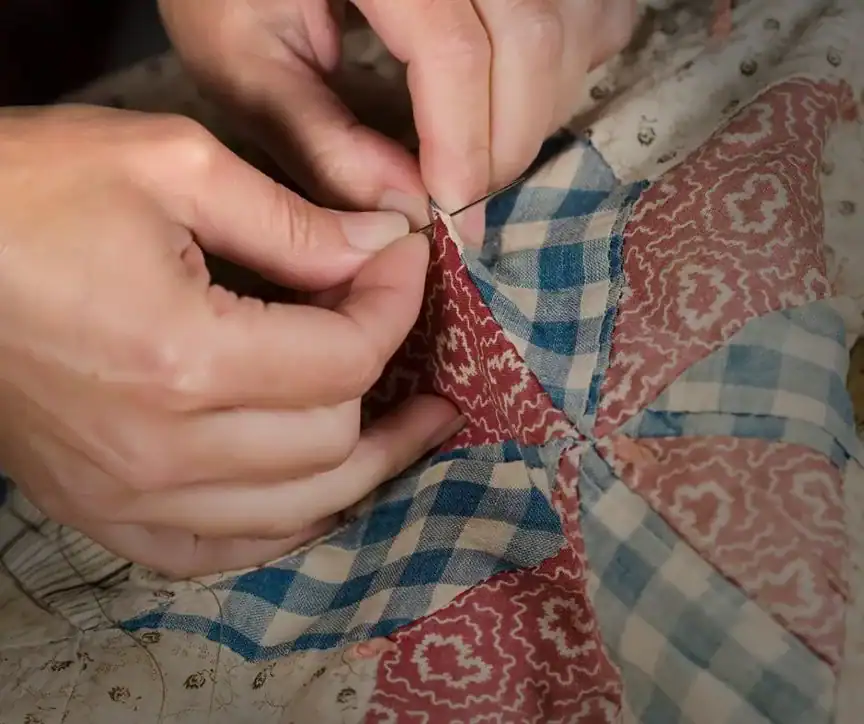
I promised this info. to a QHL person but as I began to send the message I realized that many of you might like to have this. A very helpful book—-Directory of Hand Stitches Used in Textile Conservation put out by The Textile Conservation Group, Cathedral of St. John the Divine, 1047 Amsterdam Ave., New York, Ny 10025 I bought this years ago and think it was $20 – $25. A great site—-Kent State University–Paisley Shawls Happy Turkey Day, Lynn Lancaster Gorges, New Bern, NC