May 27 – June 1, 2000
These restored messages come from the Quilt History List, an online forum where quilt historians, collectors, researchers, appraisers, and enthusiasts discussed antique quilts and related textiles. The archive dates from 1996 through approximately 2016 and is being restored gradually. Sign up in the form at the bottom of the page if you want to know when a new page is added. Original spelling, opinions, formatting, and inactive links may remain unchanged.
Primary topics of this QHL Digest:
- Quilting Quality & Diversity Debate — A member pushes back hard on dismissing an entire category of “quick quilting” as lesser, arguing quiltmaking today is more diverse than ever.
- Silk Manufacturing History in America — Sparked by a Metropolitan Museum article on the Adeline Harris Sears autograph quilt, members trace the rise and fall of early American silk mills from Connecticut to Michigan.
- Ancient & Medieval Floor Mosaics as Quilt-Pattern Precursors — A member’s Sistine Chapel floor observation leads others to Ami Simms’ book documenting quilt-like geometric patterns in old Italian and Roman floor mosaics.
- African American Quilt History & Scholarship — Discussion of Harriet Powers and the journal IRAAA points members toward further research on African American craft art history.
- Scholarly Standards for Quilt History Writing — A recurring bibliography-and-citation thread debates how rigorously amateur and academic quilt history writing should document its sources.
Date: Sat, 27 May 2000 08:44:32 +0200 | From: Ady Hirsch <adamroninetvision.net.il>
Hi, everyone
Just to clear up a few things –
Monika, why not discuss “insovable” issues? I doubt anyone here presumes to settle any issues once and for all, and see no harm in airing (different) views. Isn’t that what the list is all about?
My main gripe was not the existence of quick-made quilts, but rather the fact that they’ve become the norm, and are pushing aside the more traditional quilts, at least in major shows and magazines. I’m not denying quick quilts have their uses and their place. However, the newer generations of quilters are educated (if that’s the correct term) to regard speed and so-called “creativity” (being “artistic”) as the be all and end all of quilting, and in most cases this comes at the expense of a solid backgroud in technique. Even the great Picasso (and do forgive the presumptuous analogy) mastered the classical techniques of painting before venturing farther afield…
I think the main problem is that due to the substantial cash prizes in major quilt shows, a lot of people are making quilts designed specifically to win competitions, rather than as a means of personal expression. Magazines also tend to encourage this typs of quiltmaking, since they have to produce a new issue every 4-8 weeks, and are in constant need of new projects and photographs to fiil the requisite no. of pages. I personaly enjoy making quilts for the sake of making quilts, will never win any competitions (for the simple reason that my quilts are made to please me, not cater to the taste of some judge, and certainly not to promote a new line by some fabric manufacturer) and am content with that. For perspective, all you have to do is look at the magazines from the 70ies – whatever was cutting-edge, state of the art then, is now pathetic at best. The only quilts that have withstood the test of time are technically superior, well made, “invested” ones.
I was amazed to see a quilt by the Dutch quilter who won 1st prize in Quilt Expo II in the Hague (1992, I think). THAT quilt was a masterpiece, both technically and design-wise – you may remeber it, a blue and white applique of an urn with birds and flowers, inspired by Dutch Delft tiles. What she had this year was the epitome of the above phenomenin – a mishmash of fabrics quickly put together and machine quilted for the Bernina Award competition. Realy sad, when you consider this woman is a superb quilter. And this is what modern quilters are taught quilting is all about. ….
Happy quilting
Ady
>Ady
Date: Sat, 27 May 2000 07:53:44 -0400 | From: List Mom <qrs>
Doreen’s daughter, Megan, posted a note on our bulletin board that she is auctioning some of her moms fabric. She is auctioning under the name Meganspeck.
Kris
Date: Sat, 27 May 2000 11:43:42 EDT | From: AlineMcK
Saw this on ebay… A historian’s question would you have picked out all the papers the way she did? The result is interesting, but still… (I know the answer to the second thing she did….NO polycotton!)
Aline
Date: Sat, 27 May 2000 13:26:15 -0400 | From: “Nancy Roberts” <robertsnnorwich.net>
Karen’s heartfelt comments caused me to do some thinking about “quilt history in the making,” so thank you for that, Karen. I’ll offer my thoughts as follows.
Karen wrote I don’t know how many times I’ve gone to the quilt shop and have seen models on the walls for the new classes, and people lining up for ONLY that fabric that’s in the model. ????? I know a lot of people need help with color and putting it together, but,…who made the “Rules” of color?
Possibly the ‘why’ lies in personal style. In a way it’s similar to cooking. I usually follow a recipe while I know many others who improvise with whatever is on hand in the kitchen. Both approaches have advantages and neither is “wrong.” In quiltmaking, a shop model is the magnet, drawing people to a particular pattern. That’s cause for celebration from a pattern designer’s point of view! Making one just like the model is a safe avenue for many quilters–after all it’s the fabric and use of color that drew them to the pattern in the first place. Often quilting teachers like to encourage creativity in their students, but just as often the student says she wants to make quilts just like the teacher’s. I believe it’s less about rules, and more about goals.
K.B.-But, what’ s the Hurry on getting the quilt made and on the bed or …in the show..??
Again, differing priorities and lifestyles may be the answer. Time is a precious resource and quilters need need to pick and choose their priorities. Mothers with limited time for quilting, the desire to make a personal gift and a deadline for completing it, more projects underway than there is time to complete…. the scenarios for desiring quick results are limitless.
K.B.- It’s supposed to be a relaxing, creative out-let for the artist in All of us. Isn’t it?
Maybe not always. There can be times when the relaxation part is enough. That’s when many quilters may find it convenient to use fabric collections from one manufacturer in a quilt–something that has not always been an option. The hum of a sewing machine is often music to the ears. It’s relaxing no matter what the project I’m working on. I don’t see that quilters are creatively intimidated by rules, either. My view is that it’s simply about the wide range of options available to today’s quiltmakers. I find that replicating a vintage quilt using today’s fabrics is both relaxing and creative even though I’m not the artist who came up with the design. Today’s “flavor-of-the-month” may not be so different from quiltmaking “crazes” of the past. We use those trends to date quilts and styles, and future quilt historians may do the same (except we’re a lot more aware of the need for documenting quilts, so their research won’t be as challenging!).
And in another department, if you don’t mind reading an example of “the beat goes on” regarding messages in quilts, here’s one from a Florida newspaper. It’s from a business interview with an entrepreneur who offers machine quilting in a small shop
“Stitches and theads tell stories–stories of love and stories of freedom. Quilts were used in dowries for yourng girls when they got married. Quilts were hung on the line to let slaves who had escaped know which houses were safehourses. So they have been used as more than a way to have warmth.”
Have a nice weekend all. nancy
Date: Sat, 27 May 2000 13:38:40 -0400 | From: Alan Kelchner <quiltfix>
You cannot, repeat *cannot* dismiss an entire segment of quilting purely on the qualities found in particular quilts. The lumping of all quilts under a quick-quilting schlock umbrella is as offensive to me as any racial stereotype. This discussion only highlights that people have preferences in what they view. Quilting is as diverse as it has ever been, even more. And that diversity includes quality and speed. One only needs to watch eBay to realize that for every finely crafted vintage quilt, there are dozens of coarsely crafted vintage quilts – the equivalent of today’s quick-quilting. People have always wanted a faster way to make quilts. And maybe these quilts done in a faster time frame doesn’t suit one’s expectations. Yet to dismiss another’s work because of the time it takes is being very narrow in viewing the quilt world. I have a very odd take on quilting overall. I’m male, which skews my view when compared to the general quilting population (everyone else is usually female). I collect antique quilts that I find attractive, no matter the quality of the workmanship. It’s the quilt itself that counts. I study quilts and quilters, being very interested in why the quilter made the quilt. I restore quilts, needing the ability to repair conservatively and appropriately. And I make quilts – art quilts. Wild screaming work that would make my grandmother faint. Currently I make small quilts with naked humans on them. “Paintings”, as the form is the main subject. Because of this view, I am very aware that the quilt world as a whole has this double-standard stereotype that drives me nuts. On one hand are the traditionalists who demand fine hand piecing and quilting in traditional patterns and tasteful colors. They cannot fathom why anyone would make something quickly, much less quilt with a machine. On the other hand are the art/contemporary quilters who can’t imagine why you would bother consuming your time with all that handwork, limit yourself to those dull and boring colors, or follow the fine-craftsmanship rules. And the two sides are fairly rabid about the other. One bad-mouths the other constantly and it drives me nuts! We have to understand that – no matter what quilting has been – at this point in time the quilt world has changed tremendously. We aren’t going back, but at the same time we cannot ignore where the craft came from. I have the strangest experiences at shows. If you follow me, you can find me drooling over that Best Handquilting Award quilt. But at the same time, I’ll stop dead for art quilts like “Petroglyph”, an major winner at AQS recently. This woman’s machine work is incredible, along with her vision. And art quilts are just about one thing. Art. They are not made for the bed. They are the physical manifestation of someone’s artistic expression. Their value as a quilt doesn’t lie in the craft of vintage quilts and the need of the bedcovering to last, but in the reality of their modern viewpoint. Quite often artists are not concerned with the life-expectancy of their work. And frequently they aren’t concerned with the rules.
Many make the mistake of ignoring the rules as a reason to not learn them, which I don’t advocate. A local artist is making this mistake, and she isn’t going to get far unless she learns her craft. I also really don’t think that traditional quilt shows are the proper venue for artwork. But don’t assume, because the workmanship isn’t what you do, that it is inappropriate. It’s just different. You don’t have to like it, that’s all. Personally, I believe in fine craftsmanship, no matter what you make or the techniques you use. And I still handquilt. And I’ve been doing it with #5 pearle cotton lately. In bright rainbows of colors. With big-honking needles.
Quick quilts have their place. But don’t lump modern work all under this. Don’t forget artists like Michael James and Nancy Crow, whose work is part of the Smithsonian’s collection of quilts. There’s a reason they were *selected*. Rather than hold all quilts to an old standard, we must hold the divisions to standards appropriate to their category.
“The Art Quilt”, by Robert Shaw, is a must for any self-respecting quilt historian. Heck, the book’s to die for. But if you want to learn the history of art/quilts, gain access to it. When you look at the work, remember to suspend your ideas of what a quilt “should” be, and enjoy them for what they are. Sheesh, if making quick quilts is bad, what then about the quilt at Strasbourg that was designed by Christian LaCroix, but made by others? <laughing>
Alan
Date: Sat, 27 May 2000 15:34:46 -0400 | From: “John Cawley” <cawleygoeaston.net>
I just read an article by Anita Peck in the Metropolitan Museum Journal #33 (1998) about The Adeline Harris Sears Autograph Quilt. Adeline collected signatures (360 of them) from everybody who was anybody in the 1855-1865 period and created a quilt of silk Baby Blocks. Peck writes, “…during the 1850s there were no American mills capable of producing the fancy silks found in the quilt.” My question is When did American mills begin producing silk?
Cinda on the Eastern Shore
Date: Sat, 27 May 2000 15:13:12 +0400 | From: Xenia Cord <xecordnetusa1.net>
In 1810 Rodney and Horatio Hanks of Mansfield, CT, operated a very small business manufacturing silk thread – the first silk manufacturing business in America. It survived only briefly. But in 1829 the Mansfield Silk Company was established and operated for 10 years, making yardages and fringes of silk.
About the same time Gamaliel Gay of Poughkeepsie invented a power loom for silk weaving, and it was used by the Rhode Island Silk Co. in Providence; by 1815 silk manufacturing was also being done in Philadelphia. The most successful manufactory of silk was in Paterson, NJ, and was begun in 1838 by Christopher Colt, of the pistol mfg. family, in one of their factories. In 1840 it was purchased by a company from New York, and the business remained successful into the 1850s, manufacturing first piece goods and then sewing silks. Also during this time there was considerable speculation in mulberry trees; like all hot commodities, this one went bust when it was realized that the country had neither the climate nor the temperament for raising silkworms. (excerpted from Early American Textiles, by Frances Little, NY 1931.)
Xenia (it’s raining in Indiana, so I didn’t have anything else to do!)
Date: Sat, 27 May 2000 16:51:53 -0400 | From: “pepper cory” <pepcorybmd.clis.com>
Lots of folks had a go at silk manufacturing in the 1800’s. One such operation that went bust was in Belding, Michigan. Anyone remember seeing Belding/Corticelli on an old wooden spool? The mulberry trees couldn’t survive the Michigan winters (neither could I-). Then the Shakers, ever the innovators, tried their collective hand at silk manufacturing and managed to produce a few silk items at (I think-) the Pleasant Hill community in Kentucky. There are a few extant silk plaid handkerchiefs in Shaker collections and these were rare enough even then that they were given as ‘love gifts’ between members of the community.
Pepper Cory
PS-the absolute best crazy quilts I’ve seen are often from New Jersey. Living near silk mills gave quiltmakers in NJ unusual access to lovely fabrics.
Date: Sat, 27 May 2000 21:51:05 -0500 | From: “Karen S. Bush” <Birdsong>
The reason I posted the questions, and ponder today’s ‘quilt world’ , or, a part of it, is, as follows.
I’ve finally gotten to the point that I retired last year from the quilting frame, and NO, it was NOT relaxing…it was a ‘career’ and 26 years was enough of hand quilting…but, Now, I’m into making the quilts, learning the piecing, by machine (something ELSE I said I’d “NEVER ” do) and hand applique, which,…I LOVE doing.
I have a friend who is JUST starting quilting, the piecing part. She’s an artist by profession and wants to create,design, mix mediums, textures, has Lots of ideas. So, at 5l, she’s gotten a new machine and taking classes.
Baby steps. But…
the shops for the classes are always wanting her to sign up for challenges, and swaps, and Round Robins, etc. I know there’ s alot of that out there, and people love them, but, ….the TIME limit is CRUNICHING! I just wondered….why.
If it’s a group of friends wanting to do projects like this, it should be relaxing and stress-free, so it’ll also be Rewarding! Satisfaction is the goal, not speed and getting 43 quilts a month out. (exaggeration there, slightly)…She’s also been told “THIS is the way…not Your way…that won’t work”(needless to say, I told her My view on the subject) I’m having the time of my life, finally getting to work with all the fabrics I’ve collected just WAITING for ‘retirement’ and all the NEW fabrics out there, just AWESOME…to work with.
I’m just looking at it in a new light, now. I was ALWAYS under the gun, 7 days a week, 70 hour weeks, to meet publication deadlines, etc…and didn’t have time to even SEE the quilts, or Want to see the quilts after I was finished. I tried hard to come up with new quilting designs to reflect the style of the quilt, not easy when your mind is mush, but,…quilts didn’t leave this house unless they were done the Best I could, and, hopefully…Unique quilting designs ….I managed to get 3 full size out a month, most of the time….geeze, wonder Now how I did that! haha.. Now, it’s FUN time, and just wish the ‘word’ would get out to some of the frustrated beginners,…that’s the KEY…you have to enjoy/have fun or….why bother? Ok…just fell off my soapbox, so, I guess it’s time to shut up for now 🙂 kb
Oh, and if you’re wanting to see what’s going on in MY neck of the woods, here’s a page of the sky over my house last night…THREE tornados in one night…ughhhhhh…Good ‘ole Springtime in Missouri…:/ http://www.geocities.com/busherwoman/Astorm.html http://members.ebay.com/aboutme/karenbush
Date: Sat, 27 May 2000 23:05:14 -0400 | From: Barb Garrett <bgarrett>
Janet wrote —
> Maybe we should organize a ‘historic methods’ show somewhere & only allow completely hand made quilt to be entered
Hi Janet and others —
I’m catching up on some of my reading and while I agree with most of what you said in your post about mass production of quilts for shows, etc, I’m concerned about the above statement. You seem to be stating that “historical methods” and “completely handmade” are synonymous. This just isn’t true. While PA Amish quilts circa 1890 are fabulously hand quilted, they are machine pieced and the binding is usually machine applied. And late 1800s machine quilted quilts can be truly fabulous. One of the best applique quilts I’ve ever seen — except Baltimore album and some red and greens, which are both in a class by themselves — was an 1880 PA German 4 block floral — all machine appliqued in the tiniest stitches, every edge turned under, and then machine quilted. Definitely not a quilt in a day project, but doesn’t fit the handmade description.
Just my thoughts on “old historical methods”.
Barb in southeastern PA
<bgarrettfast.net>
Date: Sat, 27 May 2000 21:52:06 -0600 | From: “Dale Potter” <dpquiltstelusplanet.net>
Hi everyone!
I am mostly a lurker, but I do love the conversations that go on on this list.
I am un-lurking to ask a question……
A couple friends and I make Friendship Quilts (Charity quilts) for the local seniors – delivered 28 to the Extended Care Unit of the hospital on May 9th and now are working on lap quilts for the 35 residents at the local Seniors Lodge….we made the local newspaper when we delivered the ones on May 9th and we asked for donations of time, fabric, batting, etc….. Well, yesterday we received 4 LARGE boxes and 2 smaller boxes of goodies. Some are the famous fortrel quilt tops (ready to be finished) some fortrel blocks ready to be sewn together and then the BEST of all, completed blocks, partial completed blocks and cut squares of 1930’s and 40’s fabrics….We are thinking these are too valuable and/or fragile to make into quilts for the seniors (all their possessions are washed by the hospital staff, etc. – high temps. etc.).
Our questions – do we make them into completed quilts and sell them for supplies for our Friendship Quilts or do we offer them for sale as they are? I am NOT an expert at dating yet and I think these are feedsack type fabrics. I have a scanner and can send a jpeg to someone who can help me date them.
HELP – we want to know what to do with them??!!
Dale Anne
Red Barn Inc.,Quilting & Tea Room
P.O. Box 36
OYEN, Alberta T0J 2J0 Canada (403) 664 – 3274 dpquiltstelusplanet.net
Date: Sun, 28 May 2000 06:00:52 +0000 | From: Bobbie Aug <qwltpro>
Cinda,
We were never really successful with silk worms in this country. Wherever it was tried (Eastern/Southern part of US), it was the wrong climate. I have a silk shawl that was imported from China in the early 1880’s for the Maytag family (washing machines). By that time, we had a healthy import business with China.
Bobbie Aug
John Cawley wrote:
> I just read an article by Anita Peck in the Metropolitan Museum Journal #33 (1998) about The Adeline Harris Sears Autograph Quilt. Adeline collected signatures (360 of them) from everybody who was anybody in the 1855-1865 period and created a quilt of silk Baby Blocks. Peck writes, “…during the 1850s there were no American mills capable of producing the fancy silks found in the quilt.” My question is: When did American mills begin producing silk?
> Cinda on the Eastern Shore
Date: Sun, 28 May 2000 10:10:53 -0400 | From: Lesters <jeanntomutkux.utcc.utk.edu>
I personally enjoy an energetic discussion of different opinions. It makes life and the list much more fun. Just so it doesn’t get personal. Let’s face it, we probably wouldn’t agree on what to wear, why should we agree on quilt designs or techniques. I always learn more from disagreements than agreements.
Love these lively interactions!
Jean
Date: Sun, 28 May 2000 11:33:28 -0500 | From: Shirley McElderry <tigersouplisco.com>
In researching mail order remnant companies a few years back, I found some information about silk companies. According to “Lamb’s Textile Industries of the US” there were 67 establishments in the US manufacturing silk goods in 1850, and by 1911 the second country in the world in the production of woven silk materials.
A “Child Life” booklet copyright 1913 has the “Story of Silk” and tells of the silk culture starting in America in 1622. It tells of the life cycle of silkworms (you may not want to go there) and of the manufacture of silk goods.
The Northhampton Silk Co. in Florence, Mass (Corticelli) dates back to 1838. The Heminway & Sons silk factory was founded in 1849. Belding Brothers was a relative newcomer; established in 1857. All the above mentioned silk companies merged with Brainerd & Armstrong; but that is a whole ‘nother story. Whether these companies produced “broad silk” (dress goods) or silk threads, only, is another article for speculation, and another good research subject.
Shirley Mc from Iowa
Date: Sun, 28 May 2000 12:50:19 -0700 | From: “anne datko” <datkoa>
For members in the Washington, DC-Baltimore area, Patchwork Quilt Guild invites you to a book signing with Kathryn Berenson, a leading expert on antique French textiles, and author of “Quilts of Provence” and “Piques de Provence.”20
Ms. Berenson will speak about French quilted needlework and quilting motifs in French Provencal quilts, illustrated with slides. She will sign copies of her books, which will be available for purchase.20 More information about Ms. Berenson can be found at:
www.kathrynberenson.com
Thursday, June 15, 2000 – 7 PM, Chevy Chase Community Center, Connecticut Ave. NW and McKinley St. (two blocks south of Chevy Chase Circle).20
If you plan to attend, or for more information, please call 202-363-2650.
Date: Mon, 29 May 2000 00:55:48 -0700 | From: Lou Ann Schlichter <hartwrmrwest.net>
I mostly lurk and learn but find the “Quick quilt” thread very interesting. I am a quilt shop owner, Heartwarmers Mercantile in Ojai, CA, and deal with both old and new quilts daily, Mostly 20-40’s quilts are coming from under the beds, but sometimes we get an older treat. I appreciate all that I learn from this group and quote you on a regular basis.
I often hear ” this isn’t a real quilt because it isn’t hand quilted” and I enjoy showing them a quilt on display dated 1880 and made in Kansas with top stitched applique. I do point out that the quilter only machine appliqued the straight pieces and then hand appliqued the curved pieces. She was a master hand quilter. I also share that sewing machines were pretty new and she may have been 1st on the block to have one and that she may have been banished from her guild. #:> As a retailer, I need to be open to all types of quilting and am quite aware of the time crunch everyone experiences and that includes the retired people. My main objective is to keep people quilting, not to just pay my rent, but to continue the craft.
I find many customers do not have “quilt history” in their families and I love to introduce any form of quilting to them, whatever suits them. Many of them get interested because they have purchased or been given a “dreaded import quilt”. They love them and begin to think maybe they can quilt too.
My feeling is that hand quilting is top of the line and other techniques have value too. It depends on the use of the finished product. If I felt I had to hand quilt every sample for the store, I wouldn’t have many samples and might intimidate many future quilters. I often machine quilt in the ditch and hand quilt where it shows. I always encourage enjoyment of the process and remind them this is a blanket and no one I know has ever given back a quilt because the points don’t match! Infact, you would be hard pressed to get a gift quilt back regardless of the technique or quality.
I will return to lurkdom and enjoy the discussions….all of them. Remember, we will have no historical quilts in the next century if we set too many rules. When I see a quilt top from Kentucky made in the 20’s from tiny hand pieced scraps of feed sacks, I love it for what it is…..an unfinished blanket made the best they could with what was available to them and a chance today, to view history in their social context.
Warmly…..very hot in Ojai the last few days
Lou Ann Schlichter, Proprietress
Heartwarmers Mercantile
–
Date: Mon, 29 May 2000 08:28:50 EDT | From: QuiltFixer
Thanks for posting Xenia’s answer to the list. The thing I find most frustrating about the list (and other lists) is that people will ask really good questions that I want to know the answers to and everyone writes back only to the originator of the question. Not what I think of for the list — but that’s a personal thing. Thanks for sharing with the list.
Barb Garrett >>
Hi Barb, finally getting caught up with some of my E-mail. I agree with you, I think we need to follow through and post up to the list if we get a good answer to a question posted there. Some people are shy about posting to the list because they think the “experts” will jump on them if they don’t agree with their comments and unfortunately that does happen, but the whole idea of the list is to share thoughts and opinions and bits of information. Sometimes we have to agree to disagree. 🙂 Sometimes I find the most interesting facts out by getting an answer that is close to the question but not quite there. This is really true in my question and answer period after my Redwork Lecture. Sometime a picture emerges after hearing almost the same story over and over of memories or stories told by Grandmothers, etc. Fascinating! Provable? Probably not, but usually some sense to it. A great feeling that there is a regard for the past and how women worked and lived. Lets keep looking for those answers, sharing the possibilities, and most important keep an open mind and a happy and caring heart. 🙂 Toni B.
QuiltFixeraol.com
The Redwork Lady redworkldyaol www.redworklady.com
Date: Mon, 29 May 2000 08:43:31 EDT | From: QuiltFixer
In a message dated 5/24/00 5:44:24 AM Pacific Daylight Time, xecordnetusa1.net writes:
<<
Toni, don’t want to rain on your parade, but here’s a thought: a company that marked its muslins with a blue stamp such as you (and I) describe would probably have done so over a long period of time, so isn’t it true that the best you could hope for is the LATEST date on which they would have done so? (The year the company closed, for instance).
Xenia >>
Wanted to share Xenia’s advice about this subject. I agree with her, but the mystery is intriguing and somehow I will find the time to try to determine when the company closed or stopped using that stamp. If any of you come across this small bit of information while looking for something else, please let me know. Many thanks to Xenia for sharing her information, I know she is a very, very busy lady and additionally a very nice person too! It important to treasure those nice people you meet along the way. Toni B.
QuiltFixeraol.com
The Redwork Lady redworkldyaol www.redworklady.com
Date: Tue, 30 May 2000 01:35:54 EDT | From: EllynLK
… or at least I HOPE it is!
First off, one of the things I love about this list is how many incredibly talented experts in the fields of textiles and quilts daily share such a wealth of knowledge here! I have learned so much from you all!! Second, I also love the fact that this list ends up in so many corners of the quilt-loving globe… Australia, France, Canada, England, the U.S. and Israel. This broadens everyone’s perspective as to what may be going on beyond our own fences. If there are more countries represented, I wish people would speak up and say hello and tell us where they are from. I love reading about archaelogical finds and in most books, whether spoken or not, you get the feeling that there is one particular item the archaeologist would love to find– the “grail” of their profession, a find that would stun the world.
Just a silly hypothetical– what, to all of the resident experts– would be THE historical find in Quilt-dom? What would be the greatest, most instructive or historically fascinating thing that could be found that relates to quilts? Is there a “missing” quilt that has been written about but never seen? Or is there some “missing link” that would tie something ancient to modern quilting? Would it be a cache of quilts by some historical quilter? Or remnants of a quilt that dated back a couple thousand years– so we could SEE it and KNOW our ancestors were likewise employed as are we? I have been reading about historical finds of ancient beads– and being that quilts are perishable, textiles disintegrate and the chances are not good that anything would ever be found– but I wondered what you all thought would be THE find to just throw the world of quilting on its ear? (It’s obvious that my crazy TV schedule is lightening up– I know have time to THINK about pleasurable things that may be utterly frivolous!!) And– as ever, thanks to EVERYONE from EVERYWHERE for their valuable contributions to this list!!!
Best,
Lauri Klobas
Pacific PaKarendes, California where baby birds have hatched outside my window and peep like crazy for their supper!
Date: Tue, 30 May 2000 16:53:33 +1000 | From: Lorraine Olsson <svenpnc.com.au>
Please take this with the humour that is meant!!! Wouldn’t it be great to find that REAL UGR quilt ………
Bug smiles from Snowy Australia
Lorraine in Oz
Date: Tue, 30 May 2000 05:36:48 -0400 | From: Debby Kratovil <kratovilhis.com>
“
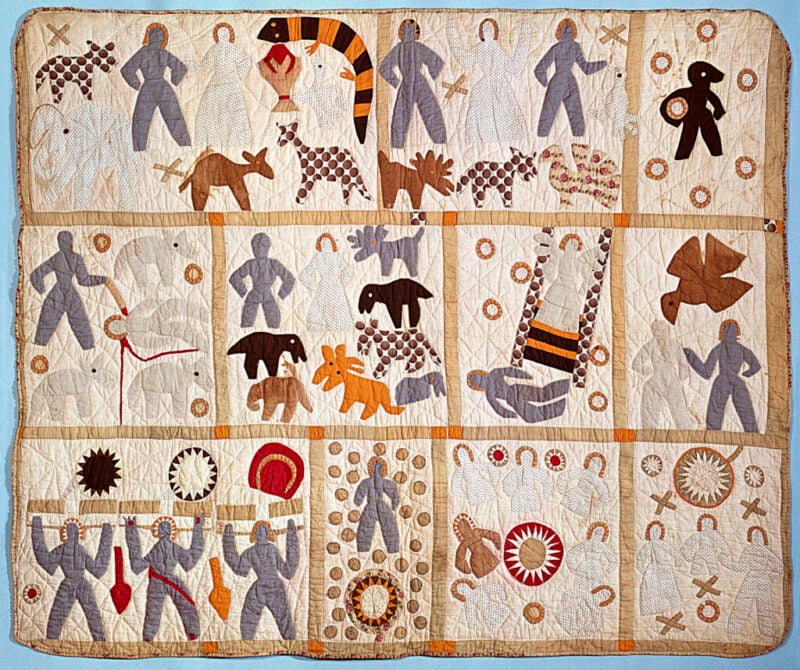
visiting the home of my daughter’s friend (who is about 26), I noticed (of course) a beautiful quilt on her couch. I recognized the patterns but also knew immediately it was “new”. It took a few seconds to realize it was the Harriet Powers Bible Quilt, which was redone by the Smithsonian a few years back. It was so much fun to look at this close up (since we can’t touch the real one). I told her a little about it and that I would get the information about each of the 11 (?) panels, ie, the Biblical reference in each. I found a picture of it in one of my quilting books, but no explanation of each panel. Anyone on this list direct me to where I can find this?
Also, she immediately saw that I might have some information about two Double Wedding Ring quilts she inherited from her grandmother. They were lovely, mostly composed of feedsack fabrics. I was amazed at one of them – I had never seen such fat batting used in such an old quilt. And the grandmother HAND QUILTED through all of that. The other one used a thin batt. The fat quilt was already draped over her second couch, and when she ran to get the other one, she came into the living room carrying one of those zippered PLASTIC blanket protectors!! I told her how that is a big No No, and that if she wants to store that quilt (which is very worn), a large cotton pillowcase is the way to go. (Please don’t lecture me on archival tissue paper, etc – this is not heirloom quality, etc) It was fun to see this young woman so excited to know a little about those quilts and her love for them and her desire to actually use them in her home. This is my approach to common type quilts: use them, enjoy them. Having them out in your home brings constant memories of the loved one.
Debby Kratovil
Paper Piecing Patterns & More!
http://www.his.com/queenb kratovilhis.com
Date: Tue, 30 May 2000 08:48:29 EDT | From: Chyral
In a message dated 5/30/00 5:33:57 AM Eastern Daylight Time, kratovilhis.com writes:
> visiting the home of my daughter’s friend (who is about 26), I noticed (of course) a beautiful quilt on her couch. I recognized the patterns but also knew immediately it was “new”. It took a few seconds to realize it was the Harriet Powers Bible Quilt, which was redone by the Smithsonian a few years back. It was so much fun to look at this close up (since we can’t touch the real one). I told her a little about it and that I would get the information about each of the 11 (?) panels, ie, the Biblical reference in each. I found a picture of it in one of my quilting books, but no explanation of each panel. Anyone on this list direct me to where I can find this?
I know of two books about the Powers Quilts.
“Stitching Stars, The Story Quilts of Harriet Powers”, by Mary Lyons, is a well-illustrated children’s book which emphasizes biographical information and the larger context of the 19th century rural Southern African-American experience. There are explanations of some, but not all, of the blocks from each of the Bible Quilts.
The better of the two is “Harriet Powers’s Bible Quilts”, by Regenia Perry, a large format book with *wonderful* close-up photographs of most of the blocks and the text of Powers’ own explanation of the blocks, with some editorial elaboration. This book is out of print, unfortunately.
Some other sources of information are:
“Wrapped in Glory: Figurative Quilts & Bedcovers. 1700-1900” by Sandi Fox, has four or five pages of information about the Bible Quilts, including the transcribed explanations of the blocks as given by Harriet Powers. The last chapter of Gladys-Marie Fry’s “Stitched from the Soul” links the images in several blocks of the quilts to verifiable events. And to tie this all into another recent topic, both of the Powers quilts are constructed using machine applique. Discuss amongst yourselves…… 🙂
-Cheryl
Date: 30 May 2000 15:09:59 +0200 | From: Audrey Cameron <janedeanealtavista.co.uk>
Hi All,
Does anyone know the author, price, & where it can be obtained – the book Australian Quilts – A Directory of Patchwork Treasures reviewed a couple of issue back? TIA Jane
Date: Tue, 30 May 2000 09:59:12 EDT | From: Chyral
There was an interesting article in yesterday’s New York Times, the gist of which is that publishers of both serious academic and trade books are moving toward eliminating bibliographies and other supporting documentation from the actual printed volume, in favor of providing that information for a limited time, on the Internet. The reasons for doing so seem to boil down to “paper costs money, and bytes are cheap” and, “No one reads that stuff, anyway”. Anyway, a quote by one author interviewed for the piece:
“If what’s on the Internet doesn’t last forever, then we’ve lost power,” she said. “If the academic apparatus disappears, then we’re moving back to an earlier period when authors weren’t citing sources and could just say whatever they wanted. We’re coming out of an industrial-oriented society that wanted everything to be added up and quantified into a virtual society where that’s less valuable.”
really resonated with me, since that “earlier period when authors weren’t citing sources and could just say whatever they wanted” is something the field of quilt history is still struggling to overcome.
(The text of the full article is online at
<http://search3.nytimes.com/search/daily/bin/fastweb?getdoc+site+site+25244+0+ wAAA+bibliography> You may have to register with the site to access it….)
-Cheryl
Date: Tue, 30 May 2000 14:30:05 +0400 | From: Xenia Cord <xecordnetusa1.net>
I don’t know how others approach scholarly writings, but one of the first things I do is to check the resources. I am often looking for certain citations that I feel should be included in a work of the sort I am reading, and if they are absent, I tend to be somewhat less accepting of the writing. The other reason I check is to look for additional sources so that I can follow the writer’s documentation back to the original myself. Since most citations are brief, I figure there will be more material pertinent to the subject in the original writing – material that the present writer didn’t or couldn’t include for various reasons. And in footnotes or endnotes there is often more specific substance than in the sentence bearing the notation number. If this material is now to be posted temporarily on the internet, what will happen to scholars who years from now delve into those writings for an understanding of our time? They will be resourceless (is that a word?). I see this rumored move as a dangerous one for scholarship.
Xenia
Date: Tue, 30 May 2000 15:33:07 -0700 | From: Kathleen Reyes <kwiltlvr>
Hello List,
In some not too distant future, people may only type instead of write, never hold a book in their hands and get all their learning from computers. That time is not quite yet. Some of us have access to the info highway, many do not. Listing sources only on the net assumes that everyone has a chance to see the information. It disregards a huge population. And I completely agree with Xenia, the curious minds of the future will be most frustrated.
Kathi in Calif.
Date: Wed, 31 May 2000 07:35:41 EDT | From: Bethquilt5
Dear All,
The Holy Grail of Quilts?
The missing Underground Railroad Quilts if they exist!
Bibliographies not in the book-I don’t read every book from cover to cover when I buy them. Many of my quilt history books sit on my shelf until I need information on that specific topic. If I don’t look at the book for over a year I’m sure I wouldn’t be able to find the footnotes on the internet because quilt history books go out of print so fast! Keep bibliographies with the text!!!!
Beth Donaldson
Date: Wed, 31 May 2000 08:14:23 -0500 | From: “Jeff Lesh” <jeffleshnetins.net>
Also about the bibliography thread. Can’t believe that the academic world would tolerate that. I really hope that the publishes rethink that. It seems to me to be a very shortsighted decision with a very negative impact on the future writings. We have a hard enough time now determining whether something is accurate, case in point being, UGR thread. At least you knew where they got some of their resources whether you agreed with their conclusions or not.
My humble opinion,
Sheri
Jeff/Sheri Lesh jeffleshnetins.net
Date: Wed, 31 May 2000 11:10:18 EDT | From: KareQuilt
Xenia wrote: << If this material is now to be posted temporarily on the internet, what will happen to scholars who years from now delve into those writings for an understanding of our time? They will be resourceless (is that a word?). I see this rumored move as a dangerous one for scholarship.>> I echo Kathi and Xenia. IMHO, this is a very serious issue and I think all concerned scholars should be writing the publishers and voicing their opinions. Or write the NY Times and let them pass the letters on to the publishers. Imagine buying a used book for research and not being able to access the author’s sources!!! Imagine not having a computer and doing research (some don’t!). Would libraries carry digital bibliographies indefinitely? Would we be able to plug into those from home? This truly is a huge concern! I hope scholars all over the country write the publishers and raise a holy ruckus!
Karen Alexander
Northern VA
Date: Wed, 31 May 2000 11:59:47 EDT | From: KareQuilt
For those of you wanting to know more about the issues extant within the ongoing discussion of possible African influences in American crafts (quilts or others), I encourage you to read Vol. 11 No. 2 (1994) of the International Review of African American Art. I am sure the bibliographies in these articles will lead you to other sources as well.
Here is a run down of the articles covered in this particular issue. Under the heading History and Theory: (1) A Celebration of the African American Legacy in the Visual Art, (2) Spiritualizing Craft: The African American Craft Art Legacy; (3) Mediating the Natural: Craft Art and African American Cultural Expression; (4) African Retention’s in African American Quilts and Artifacts (the Harriet Powers quilt is included in the discussion); and (5) Quilts as Communal Emblems and Personal Icons (Powers quilt also discussed at length). Under the heading Applications And Practice: (1) Living in a Glass House, Passing through Glass: the Art of Therman Statom, James Watkins and John Dowell, Jr., (2) Bridges and Temples, (3) Journey into Art, (4) Traditions: Ipetumodu, (5) The Ashe Effect: African Retentions and Adaptations in the “Afro-Raku” Pottery of Curtis Tucker and Yvonne E. Tucker, (6) An African American Designer Model Home, (7) Reflections of African Craft Artist, (8) Slurry, Shell and Spruce: The Nitty Gritty Satisfactions of the Lost Wax Process, (9) Protecting the Integrity of Art and Crafts. Contact: IRAAA, Hampton University Museum, Hampton, VA 23668. (804) 727-5308.
Karen Alexander
Northern Vir
Date: Wed, 31 May 2000 12:56:43 -0500 | From: “Gail E. Hurn” <hghurnsatx.>
I don’t know if this qualifies as an archeological discovery, but it certainly amazed me!
I just returned from a tour of Europe that included the Sistine Chapel at the Vatican. While everyone else was looking at the ceiling, I was fascinated by the floor. It is marble laid in the FOURTEENTH CENTURY in geometric shapes that we know as quilt patterns–square within a square, circular flying geese, Ohio star, etc.
Does anyone have information concerning this? Would love to find a picture of the floor since we were not allowed to take a photo inside. If anyone has one, please contact me.
Also, found similar stone work on the outside of the church at Pisa, Italy.
I do have a photo of it.
Gail Hurn
Amish Quilt Connection http://www.amishquiltconnection.com
Date: Wed, 31 May 2000 13:48:45 -0600 | From: Terri Ellis <tquilts>
Hi Gail and all,
I also was fascinated with the tile floors in Italy, and other European countries. I think it was Ami Simms who wrote a book a few years ago about quilt patterns from the old Italian floors, but I can’t remember the name of it.
Sharon Tandy, good to hear from you! I hope you have a speedy and complete recovery, and who needs that old gall bladder anyway!
Terri Ellis
Date: Wed, 31 May 2000 16:57:08 -0400 | From: “Deborah R. Grayson” <deborahg>
Thanks Karen for reminding me of this issue of IRAAA. I have another suggestion for folks interested in this topic. Please see Uncommon Beauty in Common Objects: The Legacy of African American Craft Art. The book was put out by the National Afro-American Museum and Cultural Center in Wilberforce, Ohio. It is getting more and more difficult to find but is still available. I did a search on bibliofind to get it. Now I’ve got a question. In researching African American women’s quilting traditions I often find that I get a little more than annoyed with the insistance by some scholars that there is a direct influence/ connection between African and African American quilting/textile traditions. THis gets talked about to the detriment of other cultural/artistic/political influences. WHile I won’t deny that there may be some influence I am wondering if the connection is one that is overstated. Could it also be that AA quilters are doing something different in their works beyond, other than, in addition to African influences?
Deborah in GA
Date: Wed, 31 May 2000 20:24:37 -0700 (PDT) | From: Cindy Brick <brickworksincyahoo.com>
RE: Xenia’s comments on scholarly writing:
I have been on the other side, and it is most difficult. Even when you cover as much territory as possible, you’re well aware that 1)you probably missed something, and 2)years from now, some new information is going to come out that you should have known about NOW. Either way, you’re going to come out of it looking not quite as intelligent as you would like to be thought of…
So what’s to be done?
The logical answer is, of course, DO YOUR HOMEWORK and research, research, research before you write any kind of authoritative comment on anything. Keep your mind open to alternative possibilities. And NEVER be so dogmatic that you are not willing to consider those possibilities. (You may not agree with them, but you MUST consider them.)
Another question you must also ask, when reading older books, is what access those authors had. Yup, check their bibliographies, for one thing. But also ask what quilts they may have been seeing that we don’t! For example, Florence Peto’s wonderful book (now very rare) is larded with 18th and 19th century pieces that we can generally only dream about. Xenia, I know you’re not disagreeing with what I’m saying here…I guess I had to put in my two cents worth. This issue has been particularly important to me probably because of my research in Crazy quilts — there are so many assumptions about their origins, styles, etc. that are taken as gospel truth, WITHOUT knowing why, that it could drive you stark buggy crazy. Figuratively speaking, of course!
Cindy Brick
Date: Thu, 01 Jun 2000 13:58:22 +1000 | From: Lorraine Olsson <sven@>
Hi All,
This notice has just appeared on the Southern Cross Quilters group list. Maybe there will be visitors coming to Australia that might be interested.
I know I will certainly be visiting!!
Lorraine in Oz
Historic Australian Quilt Exhibition
> A show of Historic Australian Quilts, presented by the National Trust of
> Australia (NSW) and curated by Dr Annette Gero, will be held from 5 June to 22 August , 2000 at Old Government House and Experiment Farm
> Cottage, Parramatta in Sydney, Australia.
> Old Government House, Parramatta, Sydney (which was the first residence of the Governors of the Colony of Australia), will house about 60 historic quilts, all with Australian histories or associations. Although there were far fewer quilts made in Australian than in the USA, quilting and patchwork was an integral part of women’s needlecraft in early Australia.
> As a British colony it offered little scope for decorative arts for the convict women transported to Australia, but there were also women who were wives of government officials, emancipists, immigrant free settlers and, by the 1830s when the community had evolved into a wealthy society, these women of the colony had the time and means for patchwork decorative art.
> Like the USA, quilts were continued to be made till the early 20th century with many exhibited in National Fairs and celebrating local events.Many of the fine early quilts quilts reflect our British origins.
> The quilts exhibited will range from one quilt made by a convict women, to quilts made by early Governors wives such as Lady Fitzroy, (who left behind an unfinished quilt in her work bag when she died when her carriage crashed into a tree in the grounds of Old Government House in 1847… rumour has it that she was eloping!! ).Many early quilts contain chintz from the 18th century , similar to the early English and East Coast American quilts appliqued with broderie perse. There are also Australian crazy quilts, showing life as it was on the land in Australia in 1880-1890’s with cicadas, kangaroos and emus and many place names . The exhibition includes many late 19th century silk quilts in graphic patterns and also felt nursery rhyme quilts of the 1940’s .Some quilts were made by
> Australian men during the during WWI and II. One remarkable quilt was made with toothbrush handles as needles in a Prisoner of War camp in the 1940, another made for a cricket match in 1896 in Hobart, Tasmania. There are also waggas, more utilitarian quilts made out of necessity during the world wars or the depression, which include socks and worn out clothes, often covered with pretty cretone. Some wonderfully graphic utilitarian quilts are made from old flannel pyjamas. Something for everyone.
> Put the dates in your diary. An exhibition not to be missed, June 5 to 22
> August, 2000.
> The exhibition will be open 7 days a week from 5 June to 22 August from 10 am -4pm. Admission $10 (Aust ) to both houses. Concession $8
> A beautifull 96 page publication of the quilts in the exhibition with full colour photos of the quilts and lots of detail of the fabrics (full page details) and photos of the makers will be available, published in
> conjunction with the exhibition .price $22..
> For exhibition enquires contact Old Government House Phone 02 9635-8149
> Annette Gero can be contacted by e mail; A.Gero@
Date: Wed, 31 May 2000 22:54:23 -0500 | From: Valerie Davis <vpse@>
Dear Gail,
According to an art history book on my shelf, the Sistine Chapel is late 15th c. (begun in 1475) and mentions briefly the colored marble inlaid floor. The geometrical patterns of the floor actually come from a long tradition among Roman marble workers. The differences in the patterns were very practical, they were to divide the church space into specific uses. (i.e.. presbytery, altar, space for the faithful to sit etc.) I have one picture which only poorly shows the patterns from a distance. Anybody else have a better picture they could scan? Valerie
Gail E. Hurn wrote:
Date: Wed, 31 May 2000 22:04:46 -0600 | From: “Dale Potter” <dpquilts@>
>Hi everyone!
>I am mostly a lurker, but I do love the conversations that go on on this list.
>I am un-lurking to ask a question……
>A couple friends and I make Friendship Quilts (Charity quilts) for the
local
>seniors – delivered 28 to the Extended Care Unit of the hospital on May 9th and now are working on lap quilts for the 35 residents at the local Seniors Lodge….we made the local newspaper when we delivered the ones on May 9th and we asked for donations of time, fabric, batting, etc….. Well, yesterday we received 4 LARGE boxes and 2 smaller boxes of goodies. Some are the famous fortrel quilt tops (ready to be finished) some fortrel blocks ready to be sewn together and then the BEST of all, completed
blocks,
>partial completed blocks and cut squares of 1930’s and 40’s fabrics….We are thinking these are too valuable and/or fragile to make into quilts for the seniors (all their possessions are washed by the hospital staff, etc. – high temps. etc.).
>Our questions – do we make them into completed quilts and sell them for supplies for our Friendship Quilts or do we offer them for sale as they
are?
>I am NOT an expert at dating yet and I think these are feedsack type fabrics. I have a scanner and can send a jpeg to someone who can help me date them.
>HELP – we want to know what to do with them??!!
>Dale Anne
>Red Barn Inc.,Quilting & Tea Room
>P.O. Box 36
>OYEN, Alberta T0J 2J0 Canada (403) 664 – 3274 dpquilts@
Date: Thu, 1 Jun 2000 01:26:31 EDT | From: Demsing@
Gail,
I don’t have a photo or info on the floor of the Sistine Chapel (sure you could find it in art/architectural history texts) but I know that Europe is filled with quilt pattern surprises. I spent one summer in London taking pictures of the tiled front steps of the row houses. Quilt patterns every one!! It was delightful.
By the way, did anyone catch the Dear Abby or Ann Landers (one of those two) letter from a family who had an old family afghan (I’m thinking maybe quilt??) from the 20’s that had a swastika pattern in the center. They asked what to do with it and Ann’s reply was “Throw it in the trash!” I hope someone enlightens her as to the history of that symbol. I’d be curious to see the afghan (am I spelling that right????)
Lenna in AZ
Date: Thu, 1 Jun 2000 02:08:34 EDT | From: BukiQuiltr@
Talk about lurkdom, I haven’t posted for a long time!!!
Gail,
I was the same way on a tour of Italy. We visited so many churches and cathedrals and here I was looking at the floors ( I was enjoying the artwork as well ) from St Peters to the small churches in towns all around the country. As a matter of fact when I was in St. Marks square in Venice, I asked the person at the counter in the little shop in the church if they had books or pictures of the floors. He looked at me like I had totally lost my mind. But he did have some postcards!
I guess it’s true that everything is new again at sometime.
Dee Pitthan in Rockford, Il.
Date: Thu, 1 Jun 2000 03:05:14 -0400 | From: “sue reich” <mreich@>
Gail, Valerie and all,
In 1983, I had the privilege of spending two weeks in Rome. My DH loves the architecture of churches and cathedrals. In Rome, you can find one on every block. Santa Maria Maggiore was the first church we saw in Rome. Now, when most people enter such an amazing edifice, their eyes are directed upward at the magnificent spires and buttresses, stained glass windows, statuary. My eyes were fixed on the most beautiful mosaic floors I had ever seen. Quilt patterns were everywhere! Flying Geese, Compass Star, Variable Star, Orange Peel, intricate cable woven quilt designs, ovals, baby blocks, you name it and it was there in cut marble. The floors resembled giant sampler, patchwork quilts. (As a quilter, I struggled to make these same designs with fabric. I could hardly imagine the difficulty making the same designs with marble.) I gasped “look at the quilts!” My husband and the two others we were travelling with thought that my jetlag had done me in. They didn’t see a quilt in sight. I began to feverishly snap pictures of the floors. One of the church guards came over to me and watch totally puzzled. He spoke some English and questioned what in the world I was doing taking pictures of the floors. He has never seen anyone photograph the floors before.
Over the next two weeks, I photographed the floors in the churches of throughout Rome. Besides the Vatican, the mosaic floors can be found in almost every church, the oldest, the smallest and the grandest. San Giovanni Laterno has the best. Some of the mosaic quilt patterns even continue up the walls. It is my understanding that churches throughout Italy have these same mosaic floors, but I can only speak about Rome. I searched for two weeks for information, in English about them. There was a school called Cosmati. This is also the name of the design, the Cosmati-style. I did find a book that addressed this mosaic style and the school, briefly. I’ll send its name in a separate mailing. In the mid-1980’s, Judy Dales made a quilt that closely resembled the floors of the Roman churches. It was shown in Quilters’ Newsletter. She was living in New Jersey then. I was fortunate to contact her by mail and share with her the photographs of those floors. A quilt book was published with more designs and details in the 1990’s.
I strongly urge any of you travelling to Italy to take the time to see them. Seeing them makes you believe, there is nothing new under the sun. I don’t know if there is anything else as old that so closely resembles the patchwork quilt. There must be a link between the floors and the patchwork quilts we make and cherish.
sue reich
Date: Thu, 01 Jun 2000 08:32:34 -0400 | From: Beth Donaldson <quilts@>
I just received my copy of “Down By the Old Mill Stream” in the mail. On page 21 is a medallion style quilt ca. 1840. The authors suspect the quilt was “renovated” around 1838. Some of the oldest colonial quilts are thought to be made from re-cycled pettticoats. We all agree that many, many quilts have been and still are, being made from recycled clothing and fabric. It seems by taking old quilts and returning them to clothing we’re coming full circle!
Beth Donaldson
Date: Thu, 1 Jun 2000 08:52:29 -0400 | From: “Marlene O’Bryant-Seabrook” <marlobs@>
For several years, I have been fascinated with Harriet Powers and have done extensive research on her life. My “tribute” quilt, based on her quilt owned by the Boston Museum of Fine Arts, has been a part of the “A Communion of the Spirits” Exhibition since it opened in January 1997. It is presently at the San Diego Historical Society. For a look at both quilts and some of the cosmological and climatological documentation, click on20 http://www.awod.com/gallery/rwav/marlobs/powers2.html Be certain to click on the “Leonid” link.
I’d love to have you click on “Home” and visit the rest of my site.
Marlene in SC
Date: Thu, 1 Jun 2000 08:53:58 EDT | From: CToczek@
I have the book by Ami Simms called Classic Quilts, Patchwork Designs from Ancient Rome. ISBN# 0-943079-03-9, Mallery Press. 1991
While the book may have been overlooked by the general quilting public (many patterns represented are common–ninepatch and flying geese) it is fascinating from a historical point of view. Ami included photos (black and white) of the original mosaic tile floors from Ostia Antica, an ancient Roman port town (founded sometime between 338 and 317 B.C.) How strange to see the patterns I consider to be 300 years modern used in so ancient a setting. The House of the Fishes, 4th century A.D. shows the remains of a pinwheel mosaic tile floor. Who might have been the first person/persons to transfer those tile patterns to fabric? Which came first, the chicken or the egg?
Carla
West Point
Date: Thu, 1 Jun 2000 09:58:40 EDT | From: SSQuilt@
Hi,
I have some quilt kits that belong to a neighbor. She would like to sell them and I want to make sure she gets a fair price Does anyone have an idea to their value.
1. Bucilla No. 3376 Regency. I think this one is from the 1940’s. It’s slightly stained, partially completed, has all of the Peri-lusta floss and the instructions.
2. Paragon 01190 Oak Leaf , king size. I’m not sure about the age on this one. The fabric looks to be the 40’s but no sure. Has the Peri-lusta floss kit, instructions and is in nice condition.
3. Progress Applique kit 1543 Priscilla, I’m going to guess 60’s for the age on this one. It’s all complete with the gingham applique fabrics , etc. 4. Bucilla, Baltimore Album cross stitch. I think this is from the 70’s. King size with the thread pack included.
Thanks,
Gay Bomers
Date: Thu, 01 Jun 2000 23:59:12 +1000 | From: nomad1@
Dear All,
I do hope that some of you QHL’ers are hopefully coming to Australia for the Olympics and hopefully coming earlier, so that you can savor our beautiful country : ) I too, like Lorraine would like to encourage you to attend the exhibition held at Old Government House and Experiment Farm Cottage in Parramatta. As I live in Parramatta, please do let me know if you are visiting as I would love to extend my hospitality and guide services : ) to quilt shops, sights etc. It will be a super treat to meet more QHL’ers : ) The quilts are positively drop dead gorgeous-I fell in love with this beautiful broderie perse quilt with fabulous work. Positively droolesome to the max. I am happy to hear that it is found in the publication to go with the exhibition! : ) Yes, there will also be a publication to be released with the exhibition..on the history of antique Australian quilts with lots of colour plates and full colour plates of all the quilts and of the details of the fabrics. .It will be about $22 US, selling at cost price whilst the exhibition is on but more expensive afterwards (RRP is $35)..
Dr Annette Gero who is a biochemist-an associate professor, to be exact is also a serious quilt maniac, who caught the quilt bug when she went to harvard as a research fellow 26 years ago. She returned home and started researching Aussie quilts and thus lit the flame Down Under. She has also written in AQSG’s Uncoverings. So here is a wonderful opportunity too see some of her wonderful collection as well as those belonging to The National Trust etc. A little bit of history from the exhibition details for those interested :
Old Government House, Parramatta, Sydney (which was the first residence of the Governors of the Colony of Australia), will house about 60 historic quilts, all with Australian histories or associations. Although there were far fewer quilts made in Australian than in the USA, quilting and patchwork was an integral part of women’s needlecraft in early Australia.
The Australian quilts are quite different to American quilts but equally spectacular! As a British colony, started in 1788, Australia was founded as a penal colony, after the cessation of transportation of convicts from
England to America in 1783. It offered little scope for decorative arts for the convict women transported to Australia, but there were also women who were wives of government officials, emancipists, immigrant free settlers and, by the 1830s when the community had evolved into a wealthy society, these women of the colony had the time and means for patchwork decorative art. Like the USA, quilts were continued to be made till the early 20th century with many exhibited in National Fairs and celebrating local events.Many of the fine early quilts quilts reflect the British origins of Australia.
Hope to see you there! Hiranya from Parramatta, Sydney, Australia : )
Date: Thu, 1 Jun 2000 12:12:46 -0400 | From: “pepper cory” <pepcory@>
For what it’s worth: I’ve thought for a long time that the flowering of geometric patchwork in England (and thus the US-) might be directly related to two factors: all those Roman mosaics uncovered in the 1700 and 1800’s in the English countryside plus the trinkets and gifts (like little mosaic boxes from the Far East) brought back by British soldiers stationed overseas. Archaeology as a scientific endeavor–as we know it today–didn’t exist in the 1700’s. The uncovering of ancient artifacts was rather a gentlemen’s sport. Something along the lines of A) find the mosaic floor B) invite your friends to see it C) maybe charge a pence or two for ‘viewing’ the mosaic and D) cover it back up or dig it up and cart it to a museum. I think that British needleworkers rather suddenly were exposed to a great many designs they hadn’t considered before for patchwork. The tiles floors at Fishborne (outside Chichester, discovered only in the 1960’s) ) and the mosaic floors on display at Coldchester castle look to me like quilt ancestors! Is it too far a stretch of the imagination to think there’s a relation here? Today we see it in Judy Mathieson’s prizewinning “Bristol Stars” quilt, inspired by the tile floor of Bristol Cathedral.
Date: Thu, 1 Jun 2000 13:17:26 EDT | From: JBaumg5539@
Gail ,
I know of a WONDERFUL book published by the Bibiotheque Nationale here in Paris wich is called Sols :St Marc de Venise by Andre Bruyere(floors :St Marco of Venice ) .He is a photographer who got permission to go and make photos of the floors of the St Marco church .He explained when the book came out that he was on a stool and someone was moping the floor so all the colors would show really well . There a lot of different floors and he says no one ever notices them because there are so many people in the church .To each picture on the left side of the book ,there is a text by a writer on the right side wich the author thought corresponded well with the picture (IMHO needless ….) But there are lots of different patterns shown in different angles .It is a very expensive art book but the pictures are really gorgeous ! After it came out there was a real fad for quilts made from these pictures here .
Alan ,
I think you do not know about the Lacroix quilt .First of all let me point out that he did it in a tradition that has lived here in europe since the middle ages were an artist makes a drawing and a crafter interprets it in his own medium .Hence all the wonderful tapestries like the Dame a la Licorne Then I also seem to remember that Lacroix was asked by an association for disabled children to draw a quilt .(some of ladies in the association are quilters ) Then the drawing was divided into small squares wich could be bought by anyone for $8 and had to be sent back finished in any technique .The only compulsary thing was that it had to be made in red . All the pieces were then sewn together by a group of volunteers .All the names of the participants were in a hat ,drawn and a happy (very happy ) lady won it .It is 4mX4m and stunning !!!!! .The money went to the association Lacroix is one of the only persons here who always points out that the inheriatge of women of the past is invaluable .He has done a lot for textile crafts and for the revival of all the traditions ,like boutis etc… He does not despise so called ladies handwork.On the contrary he always points out how inspirational it always has been to him .
I like both the man and his work ,do I sound like it ?? VBG Daniele in Paris
Date: Thu, 1 Jun 2000 15:28:56 EDT | From: QuiltFixer@
In a message dated 6/1/00 11:29:24 AM Pacific Daylight Time, QuiltFixer writes:
<< Subj: Re: QHL:
Date: Thu, 1 Jun 2000 17:30:06 EDT | From: @aol.com
Maybe. However, a lot of these patterns had been on church floors for centuries. The one place where everyone was expected to go was church, so it’s entirely possible that these patterns were known to needleworkers long before the antiquarian boom of the 18th century.
Also, there are several suspiciously block-like embroidery designs in a Germany needlework pattern book from the early 1600s, including one that looks exactly like the Star of Lemoyne. These patterns could be used for embroidery, lacemaking, quilting…just about any sort of needle art. Finally, several patchwork designs were in use before the 18th century. Split Rails shows up in painting by Luca Signorelli in the National Gallery in Washington, Triangles was used by Buddhist monks in the 9th century CE, and there’s Phillipe de Vignuelles’s letter of 1507 describing the tapestry he pieced from bias cut patches (either strips or diamonds). There may well be a connection between Roman remains and the sudden flowering of patchwork, but it might also be attributable to better technology that allowed for precision cutting of pieces…
Karen Evans
Date: Thu, 1 Jun 2000 17:37:34 EDT | From: KareQuilt@
New website for kids that talks about quilting www.americaslibrary.gov
Click on “Join America at Play”
On left hand side of screen click on “Stitch A Quilt” If you want to send a quilt postcard to someone, paste this address in your tool bar (whatever its called <g>) and then follow directions. http://www.americaslibrary.gov/pages/jp_quilt_scrap_pc_send.html Karen Alexander