January 28 – February 1, 2002
These restored messages come from the Quilt History List, an online forum where quilt historians, collectors, researchers, appraisers, and enthusiasts discussed antique quilts and related textiles. The archive dates from 1996 through approximately 2016 and is being restored gradually. Sign up in the form at the bottom of the page if you want to know when a new page is added. Original spelling, opinions, formatting, and inactive links may remain unchanged.
Primary topics of this QHL Digest:
- Treadle Stitches as a Dating Clue — A trip report about vintage-quilt collecting on a group excursion leads into a detailed thread on using treadle-machine stitch length and uneven stitching to help date a quilt. (see the article on dating quilts)
- Imported Reproduction Quilts, Continued — The earlier debate over imported reproduction quilts continues, including whether they’re appropriate gifts, why historic sites sometimes sell them, and how sellers should disclose origin.
- eBay Quilt Buying: Disclosure and “Sniping” — Members discuss whether eBay sellers of reproduction quilts adequately disclose that they’re new, and one member explains the practice of bid “sniping.”
- Quiltmaking Taught in Prisons — A note that Marie D. Webster’s granddaughter taught quiltmaking to inmates leads to members sharing other examples of quiltmaking programs in women’s prisons, past and present.
- Why Quiltmaking Fell Out of Fashion — and Revived — Members trace mid-20th-century shifts in home decor and the later Colonial Revival/Bicentennial-era resurgence of interest in quiltmaking.
- Quilter Spending, Quilt Turnings, and List Notices — A grab-bag of shorter items: a QNM survey on how much quilters spend annually, a description of a “Quilt Turning” event, a new regional study-group forming, and an African American quilt exhibit announcement.
Date: Mon, 28 Jan 2002 22:18:18 -0500 | From: “Cinda Cawley” <lrcawley@>
Once again Hazel Carter and Bunnie Jordan organized an
outstanding
excursion into quilt history. The Fabric Dating Club (it’s much more
fun to
drop Fabric from the name and see the quizzical looks that women “of
a
certain age” get when we announce where we are off to). Yesterday
our topic
was “Quilts of the 1930s.” It seemed like we all had lots of those.
Not
only quilts, but blocks (my favorites had names and dates
embroidered),
quilt pieces, feed sacks, fabric appeared from bags and pillowcases.
You
probably couldn’t have named a pattern from the period that someone
sitting
around that table couldn’t have whipped out to show.
One of the regulars seemed to have at least one of just about
every
pattern: Grandmother’s Flower Garden (in several sizes of hexagon and
a
couple of different sets), Double Wedding Ring, Dresden Plate,
Nosegay, Trip
Around the World, Roses a la Anne Orr. Another collector had an
incredible
collection of kits: Magnolia, Roses, Apple Blossoms, Basket of
Flowers and a
delightful crib quilt with babies floating on clouds.
I was fascinated by the story one woman told about her mother who
married in 1932. The bride was an artist and very modern. Her
mother, the
teller of the story’s grandmother, desperately wanted to give her
daughter a
quilt. She made a double wedding ring in which each arc is a rainbow
of
solid colors typical of the period. The quilt is stunning, but
considering
it’s unused condition probably didn’t strike the young modern’s
fancy. She
received a second quilt (Posy) which, not surprisingly, was also
unused.
I just got an email from our official historian and photographer,
Karen
Alexander, saying that we had the largest attendance ever, 31. One
of those
was Carol Crandall, QHL member from Maine, who read my last account
of the
Dating Club and since she was visiting in Charlottesville, VA decided
to
join us. Our next meeting will be Sat., March 23. I do think
quilters are
the nicest people. Hazel suggested that we might want to support the
“Adopt
a Quilt” project at the International Quilt Study Center at the
University
of Nebraska. You can adopt a quilt for $250. An envelope went
around the
table and came back to Hazel with more that $300 in it. I wonder if
they’ll
let our quilt come to visit us (G). I always say that I do have some
friends who aren’t quilters, but I feel sorry for them.
Cinda on the Eastern Shore
Date: Mon, 28 Jan 2002 23:27:51 -0500 | From: “Jan Drechsler” <quiltdoc@>
Gloria wrote: “…treadle machines in reference to early dating for
quilts.
I know the stitches could be uneven…”
Feed dogs were invented fairly early on, I am too tired to get up and
double
check but probably by the 1860’s. It is feed dogs that move the
fabric
evenly and has nothing to do with the treadle mechanism per se. My
grandmother’s 1913 Singer treadle which I now own made the most
beautiful
even stitches, the evidence is in the christening gown I have from
1916.
You may be thinking about the control of the speed or stopping the
machine
which is tricky at first. And it is possible that not every early
machine
made perfect stitches. Just like today’s new Singers, Brothers, etc.
<VBG>
—
Jan Drechsler in Vermont
Quilt Restoration; Quilting teacher
www.@/~bobmills
Date: Mon, 28 Jan 2002 21:26:29 -0800 | From: “Christine Thresh” <christine@>
Gloria Hanrahan<gloria@> wrote: . “My reference books all
mention
treadle machines in reference to early dating for quilts. I know the
stitches could be uneven.”
And, she said: . “I purchased an older quilt top that was being advertised as the late 1880’s. It
appeared to me to be made in the 40’s by looking at the fabric, but
the borders and blocks are obviously machine stitched. There is no uneveness of the stitches, so I feel it would have had to be done
with an electric machine.”
I don’t think it is possible to tell stitches made on an electric
machine
from those made on a treadle. The old treadle machines make fine,
even
stitches. I have three of them from the early 1900s (Singer,
Franklin,
Wheeler & Wilson). It does not matter how fast or how slow you
treadle, the
stitches are even.
Christine Thresh
on an island in the California Delta
Date: Mon, 28 Jan 2002 22:38:54 -0700 | From: “Debbie Guidi” <dlguidi@>
> Hi,
>
> I generally sit in the background & just absorb all of the
knowledge on
the list, but I did want to comment on this post in VO2 #24. I have
only 2
examples of quilts that have been machine quilted earlier than 1900,
but, I
have been piecing and quilting quilts on both treadle machines & hand
crank
machines for the past 2 years. I have never yet, in my experience,
come
across one of my projects that has come up with an idenitifiably
“uneven”
stitching pattern that would allow me(with 15 years of quilting
experience) or anyone else that I would show these items to, to label
them
as non-electric machine made based on the evenness, or lack thereof,
of the
stitching. I have several different types & manufacturers of
machines,
from my 1890’s German Wertheim handcrank (which is a clone of
Singer’s
Improved Family or “Model 12” machine) to my youngest, an English
Jones
handcrank dating to about 1926 and use them all. I can not see any
identifiable variance in stitch evennesson any of them, and, yes, I
have
checked with a magnifying glass. In fact, I just recently finished a
queen
sized Dresden Plate quilt on my 1905 Singer VS27 treadle, which
stitches
more evenly than my brand new Husqvarna Viking Rose.
>
> Many electric machines made by at least the Singer Manufacturing
Company
(a good example, since so many millions were made & sold) before
probably
WWII were actually treadle or handcrank models that were refurbished
with
an add-on, belt driven motor. Then, during the war years of WWII,
many
machines were turned in to Singer for refurbishing to electric mode
because
machines were not even produced during the early 1940’s. So, many of
the
“electrically” machine stitched items that are being examined may
actually
have been stitched on machines that were originally people-powered.
While
many areas of the country may not have had electricity until the
1960’s, I
don’t think that this is an accurate method of trying to determine
the date
of a piece of quilting history.
>
> Debbie Guidi in Peoria AZ
>
> dlguidi@
dlguidi@
Date: Mon, 28 Jan 2002 22:03:21 -0900 | From: “Gloria Hanrahan” <gloria@>
Thanks so much for the information. I am sure I have read about the
uneven stitch concept since I’ve not seen a treadle used. Now I wish
I had asked to keep my grandmother’s machine. It just never occured to
me years ago that I would want it for anything other than “antique atmosphere”. At least it went to my cousin.
Date: Tue, 29 Jan 2002 06:10:21 -0800 (PST) | From: Ark Quilts <quiltarkmv@>
Read with interest the comments about the treadle
sewing machines. I know several Amish quilters who
ONLY sew on treadles and with my experiences from
trying to sew on them, the expertise of the person
operating the treadle peddle probably contributes to
the consistent size of the stitching as well as the
mechanism used to form the stitch. Shuttle stitch
mechanisms produce consistent stitching as long as the
treadling power is also consistent. Needless to say,
my past attempts at treadle machine sewing make my
Amish friends giggle and laugh. There is a
hand-eye-foot coordination skill required to sew on
the treadles. Most of us familiar with electric
machine sewing have a difficult time making the
adjustment! Connie Ark
__________________________________________________
Do You Yahoo!?
Great stuff seeking new owners in Yahoo! Auctions!
http://auctions.@
Date: Tue, 29 Jan 2002 09:27:27 -0600 | From: “Debby Rake” <dsrake@>
Gloria was asking about black quilting thread. Amish quilters often
used black thread for their quilting, no matter what color the quilt.
However, this would usually be hand quilting, not machine.
Date: Tue, 29 Jan 2002 09:38:49 -0600 | From: Laura Hobby Syler <texas_quilt.co@>
Import quilts also make good “replacement” quilts for divorce
situations
<VBG>…(as in He ‘aint gettin the GOOD ones!)nuf said <VVBG>
Laura
Date: Tue, 29 Jan 2002 11:24:28 EST | From: Kittencat3@
The worst, the absolute worst, is when historic sites sell these
wretched quilts. I saw some at Historic Deerfield right after the
lecture by Lynn Bassett. I know expense is an issue for non-profits, but
better that they not sell quilts at all than that they sell junk with
two stitches to the inch!
Lisa Evans
Easthampton, MA
Date: Tue, 29 Jan 2002 08:59:42 -0800 | From: “Laurette Carroll” <rj.carroll@>
>>>I have never yet, in my experience, come
across one of my projects that has come up with an idenitifiably
“uneven”
stitching pattern that would allow me(with 15 years of quilting
experience) or anyone else that I would show these items to, to label
them
as non-electric machine made based on the evenness, or lack thereof,
of
the
stitching. I have several different types & manufacturers of
machines,<<<<
Hello,
I also knew from experience with my old Singers that the feed dog
mechanism keeps everything going along evenly and smoothly. But I had
heard the *uneven stitch theory* also and one day decided to do an
experiment with my treadle and hand crank machines. I sewed on a
piece
of paper using different speeds and pressures. The stitches were as
even
as could be. My then, 5 year old grand daughter was here that day and
I
had her do the same experiment, sewing slow and fast. Her stitches
were
also even and matched the ones I had sewn. The foot pedal or hand
crank
had nothing to do with the stitches except to control the speed.
Laurette Carroll
Southern California
Look to the Future with Hope
Date: Tue, 29 Jan 2002 12:30:24 -0500 | From: “Candace Perry” <candace@>
Greetings:
First allow me to thank Cynda for her kind words about our quilts —
it was
a mutually beneficial meeting, as I was looking for some free advice!
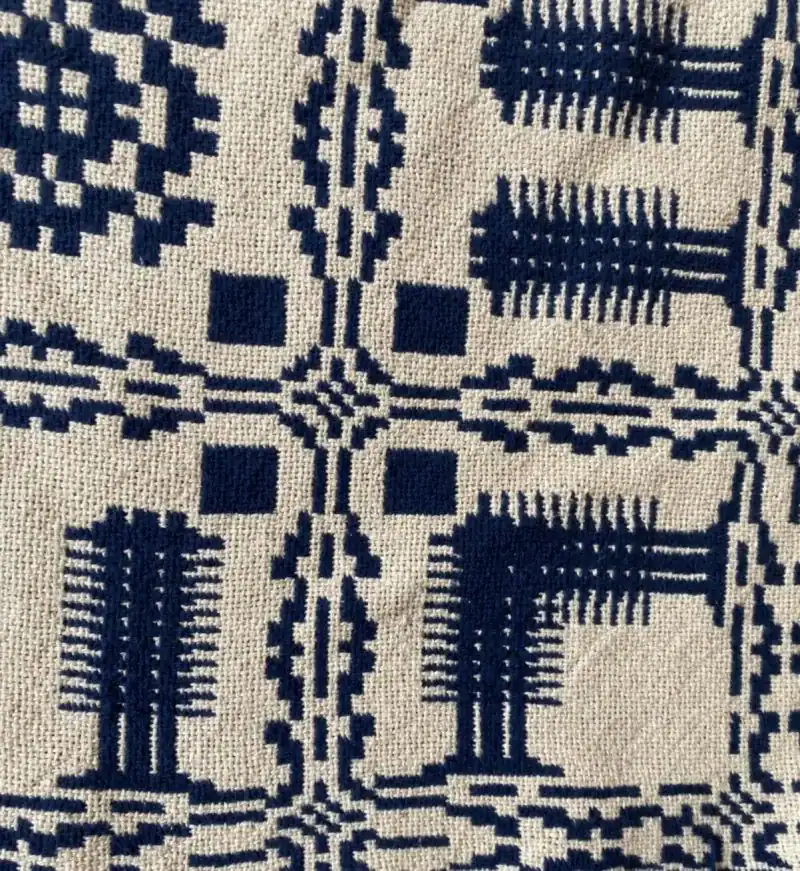
And now I’m looking for more…And I hope this hasn’t been covered
somewhere
in the list, or perhaps someone can refer me to a book…I have the
idea in
my head that the PA Germans are relative latecomers to quilting
(1820s?1830s?) having adopted it from their English neighbors. Woven
coverlets seemed to be the bed covers of choice for them, as scholars
indicate. Can anyone out there either confirm or argue this theory? Also, I
am wondering about the identity and the current location of the earliest
documented PA German quilt, not simply made in the southeastern PA region,
but actually attributed to a PA German.
Our exhibition, Patterns of Pennsylvania: Quilts from the Heritage Center
Collection, runs from April 1 to August 31. We are planning several programs
that should be of interest — more to come on those. I’ll also have webpage
on our site at www.schwenkfelder.com in the next couple of weeks.
Thanks for your help!
Candace Perry
Schwenkfelder Library & Heritage Center
Date: Tue, 29 Jan 2002 13:10:56 CST | From: jocelynm@
> received a second quilt (Posy) which, not surprisingly, was also
unused.
Cinda,
My mother made her first quilttop in 1924, her last c. 1933. She’s
now
quilting them. They were left unquilted at the time because of lack
of
money to buy batting and backing- all the money the family had for
those
things was needed for quilts that were going to be used RIGHT NOW,
not
for hope-chest quilts. Then, after my mother married, her mother had
already moved to town, leaving her ceiling-hung quilt frame behind,
and
besides, as my mother said, ‘Quilts were so old-fashioned! We wanted
new
things.’
I guess that after the years of the Depression (not that my mother’s
parents had all that much money BEFORE the Depression <G>), with all
the
‘use it up, wear it out, make it do’ economies, the young brides
wanted
to celebrate the prosperity of the 40s and 50s, even if the quilts
were
brand new and didn’t re-use scraps.
Date: Tue, 29 Jan 2002 13:12:30 CST | From: jocelynm@
> Does anyone COLLECT these quilts? I don’t know what to do with
it.
> I won’t
> carry it in my shop, and ,…Really don’t want it on my bed. not
real
good advertising for my business :/ kb >
Karen,
OTOH, I think it would be EXCELLENT advertising. Hang it up with a sign
on it, ‘Don’t be fooled by cheap imitations! Get a quality quilt here!’
Jocelyn
Date: Tue, 29 Jan 2002 13:15:44 CST | From: jocelynm@
On Fri, 25 Jan 2002 22:48:33 -0500 seater@ wrote:
I never expected
> the “fad” to last this long!
>
>
Susan,
I wouldn’t expect it to stop! People love quilts, and the majority of
people don’t know how to make one or don’t have someone to make them
for
them. What else are they gonna do? And if you don’t understand WHY
the
custom-made quilts are so pricey, an imported quilt seems like a
bargain.
My sister has one, and she knows what my mom and I think about it.
<G>
But unless we make her one, she’s likely to keep on using an import.
The
good part is, she doesn’t have to worry about what the grandbaby does
to
it. <G>
Jocelyn
Date: Tue, 29 Jan 2002 11:58:49 -0800 (PST) | From: [not recorded in source]
I confess……….I cannot sew very well on a treadle
sewing machine & I have several that are in wonderful
condition………obviously, the hand-eye-foot skill
is one I don’t have. Treadle sewing is not my best
work & no wonder my Amish friends laugh at me! I
create more problems than uneven stitches when sewing
on the treadle.
As for collecting the imported quilts, when television shows like A&E’s “The Collectors” recommend that people who can’t afford to collect antique quilts buy the imports instead………..nuff said. Read the propaganda on the package labels for some of the imports………..most claim them to be of “heirloom quality, etc.”………dubious to a quilter, but
“I-saw-it-in-print words of gold” to nonquilters.
Personally, I think imported quilts make good covers
for antique quilts to protect the antiques from
damage!
C Ark
Date: Tue, 29 Jan 2002 17:36:03 EST | From: Midnitelaptop@
is everyone else annoyed with the add for the largest casino and the
smallest
video camera that pops up ..before you can actually get to the
website.at
soooo many sites…about.com and geocities used to be the worst
offenders..now those to ads are everywhere..
jean
Date: Tue, 29 Jan 2002 19:10:13 -0500 | From: “Alan R. Kelchner” <quiltfix@>
I dunno, y’all. I’ve recommended the imports many times.
Why?!?!?!?!?!
I’m approached a few times a month about making someone a quilt. My first
question is, “Do you want a bedspread – something that you’ll change in
three years – or do you want an heirloom?” If the answer is bedspread, I sweetly suggest they go to the local department store. I’m also quick to point out that those quilts will self-destruct fairly quickly. But I’m not about to waste my time on a quilt someone won’t want when their decor changes.
And do I feel guilty? Not in the least. But, like it or not, I do know that imports serve a purpose.
Alan
Date: Wed, 30 Jan 2002 00:53:22 -0500 | From: “judygrow” <judygrow@>
With help from Judy Roche I figured out how to finish my antique quilt top for the chuppa for my son’s wedding and today I bought all the fabrics. I got an almost perfect match for the green, a decent double pink, and another repro print that will work perfectly without looking too new. Now I just have to get it done — besides all the other stuff that has to get done (my jobs). OK, that’s the quilt related part.
NQR here………..
Many of you already know that we are having the wedding here at our old house. After 16 years of living with DH has decided that now is the time to remove the 3 layers of paint from the 56 (!) walnut balusters on the staircase! Besides all the other stuff that has to get done (his jobs). It took him 6 hours today to (mostly) get 5 of them stripped. Have you any idea what my house is smelling like today — and will smell like until he gets this job done? And it was so warm today he was able to keep the hallway window open!
Real reason I am writing here………….
If you’d like to see and read about the lovely young couple, they informed us tonight that they are part of an article in the latest issue of the magazine, “Marie Claire”, hot off the presses. It’s the March issue, with Rebecca Romijn-Stamos (am I so out of touch? I don’t know who that is) on the cover, all in brilliant turquoise. Should be at a newsstand near you within a week if it’s not already.
They are on pages 136 and 140. I haven’t seen the magazine yet, so I can’t comment except to say that Carin says Justin looks really “hot.”
The article is about How Many Relationships various couples had before marriage. They liked the fact that Justin and Carin had met in high school and then met again years later and only then fell in love. Carin says the article is somewhat true, but dumbed down and the angle is sort of strange and not really what they had discussed with the writer. Such is journalism.
They did a photo shoot in November; put Carin in designer clothes (which she didn’t get to keep) and did hair, makeup, music of their choice, and yes, even a wind machine.
I guess I’ll have to fly all over town tomorrow to get a few dozen copies! But you don’t have to — you can just page through it at the magazine rack in the store!
Judy in Ringoes, NJ judygrow@
Date: Wed, 30 Jan 2002 09:50:11 EST | From: Midnitelaptop@
has anyone gone to that website just in time for valentines day? i don’t download attached or go to websites that i’m not familiar with… jean
Date: Wed, 30 Jan 2002 11:54:58 -0800 (PST) | From: Ark Quilts <quiltarkmv@>
Some of you are probably members of eBay……have a question for you……It is becoming increasingly annoying to bid on an item and have someone place a bid in the last 2 seconds of the auction and outbid you. A phone line internet connection takes more than 10 seconds to place a bid, those using a T-1 line connection can be faster. Auctioning software must be out that there that “detects” the high bid & can overbid the top bid by just a few pennies in the last 3-6 seconds of the auction. Does anyone know the names of any type of software that does this? I was under the impression (incorrectly perhaps) that auction management software could not do that to eBay auctions……….however, experience indicates something else…Any pearls of wisdom? Thanks-Connie Ark
Date: Wed, 30 Jan 2002 14:17:13 -0500 | From: “Jan Drechsler” <quiltdoc@>
Another comment on treadle stitches, if you can stand it! Numerous times on e-bay, the seller comments:
‘This quilt is very, very old, I’m no expert on quilts, but this was clearly made on a treadle machine, looking at the stitches, blah, blah, blah…”
From the number of times I have seen this, red flags go up in my mind. The first one being a disclaimer of expertise leaving seller innocent if quilt is not exactly as represented. The second is that since the stitches are poor enough to comment on, it could only be the treadle machine (Ohh, the quilt is soooo old) and not a poorly adjusted machine or other user error.
The first few times I noticed this, I politely wrote and explained about treadles. Then I caught on and realized that I could do this forever on e-bay. Buyer beware and a good return policy.
—
Jan Drechsler in Vermont Quilt Restoration; Quilting teacher www.@/~bobmills
Date: Wed, 30 Jan 2002 14:47:52 -0500 | From: “Jan Drechsler” <quiltdoc@>
Cinda, I am sick and tired of hearing about your glorious trips and the monthly Fabric Dating Club and the drool will shut down my iBook if I am not careful!!!!
Check out your maps, quilters. I volunteer to begin the NE Fabric Dating Club. My home is conveniently located at Exit 1 of I-91, just at the border of south-eastern VT, south-western NH, and north-western Massachusetts.
I don’t have as many yummy quilts as our Baltimore area friends but I can bake yummy desserts. And we do have a lot of Massachusetts and NH folks actively involved in documenting quilts and working on books. It would be fun to meet more Vermont and Connecticut folks.
Please e-mail me DIRECTLY with your ideas, comments and meeting time suggestions. I will set up a mail list so we don’t use the QHL list.
And Cinda, I hope you know I’m kidding! Your notes and comments to QHL are wonderful and something more of us should do. Thank you.
Jan — Jan Drechsler just outside of Brattleboro, Vermont Quilt Restoration; Quilting teacher www.@/~bobmills
Date: Wed, 30 Jan 2002 19:40:33 -0500 | From: “Cinda Cawley” <lrcawley@>
Jan, I think it’s great that you are starting a group in the Northern Reaches! Just promise to share your finds with us on QHL. Good luck! Cinda
Date: Wed, 30 Jan 2002 19:51:57 -0500 | From: “Cinda Cawley” <lrcawley@>
Fran’s Vintage Friends Textile Seminar in Bird In Hand (Lancaster Co.) PA, March 15-17, is the perfect way to observe National Quilting Day. We will have a wonderful time, learn a lot, shop for fabrics and antiques, eat, look at quilts, look at more quilts and, if there’s anytime left over, look at more quilts. Fran and her Vintage Friends would love to share the fun we talk about on QHL. You can get the details on Phyllis Twigg’s website www.quilt-appraiser.com.
Cinda on the Eastern Shore
Date: Wed, 30 Jan 2002 20:13:38 -0500 | From: “Kris Driessen, QuiltBus.com” <oldquilt@>
> >From kinhistorian@ Wed Jan 30 11:28:19 2002 >From: “Sharie Paulson” <kinhistorian@> > >I am looking for a picture of “Old Maid’s Patience” quilt. > > From a newspaper article 30 Mar 1877 – >”Miss Hattie Graham, of Linesville, has just finished a quilt called the >’Old Maid’s Patience,’ containing 10, 080 pieces. > >Hattie was my great grandmother’s sister. > >Thanks >Sharie >Oceanside, CA
kinhistorian@
Date: Wed, 30 Jan 2002 21:29:34 EST | From: KareQuilt@
Can someone refresh my memory (as well as give me a source “inprint”) as to what the dollar figure was that the QNM survey revealed is spent by quilters in all aspects of the quilt industry? What was the year? Has the figure been recently updated? Was the quote “a 1.2 million industry?” Thanks.
Karen Alexander
Date: Wed, 30 Jan 2002 21:07:19 -0600 | From: “leigh/hcquilts” <hcquilts@>
What you’re referring to is known as “sniping.” I’m a sniper myself; I have no inclination to show my hand hours or even days before an auction ends, and after having discovered several competitor bidders tracking the auctions I was bidding on to find the “sleepers”, I realized there was no other way to go. It’s a fact of online auction life – just like not jumping into the bidding first thing at a RL auction. You wait until after the recreational bidders have their fun, and *then* you step in.
Now unless you are Kreskin, there is no way to “detect” somebody else’s maximum bid. One would think in any case that your maximum bid would be determined not by what somebody else was bidding, but by what the item is worth *to you*. Moreover, although the high bid may appear to be “a few pennies” more than the second-highest bid, that’s no indication of what the high bidder’s maximum bid is. S/he may have bid $5,000 on a $50 item just to make sure nobody outbids her. (I know several people who bid this way. Not for the fainthearted, but it guarantees you the item – unless of course you end up bidding against somebody *else* who’s also bidding $5,000 on that $50 item.)
Anyway, if you don’t want to actually snipe manually (still the best way; I’ve got it down to 4 seconds before end-of-auction using a modem that absolutely creeps, but no, I’m not going to share that trick), try www.vrane.com for free sniping software.
Date: Wed, 30 Jan 2002 20:51:24 -0800 | From: Audrey Waite <awquiltr@>
Reprint of the article is at this URL:
http://www.antiquequiltdating.com/article1005.html
I think the figure is 1.8 BILLION!
Audrey Waite in snowy Sedona, AZ
Date: Wed, 30 Jan 2002 20:16:37 -0800 | From: “Christine Thresh” <christine@>
Karen Alexander asked about the QNM Survey of quilters. I believe it was done in 2000. The URL for the survey I have is: http://www.quilts.com/survey.htm
Christine Thresh on an island in the California Delta http://www.winnowing.com
Date: Thu, 31 Jan 2002 09:13:13 -0400 | From: Terry and Sara Chisholm <family.chisholm@>
I don’t know anything about software, but I do know that my father, who has a dial up connection, has a timer (separate from his computer) that uses to count down to the hundreth of a second on auctions that he’s interested in. He’s learned when to submit and has the “last minute bid” thing down to a science. He has been pretty successful at being the last minute high bid on an item. My guess is that it just depends on how fanatical you’re willing to get.
I bought him the timer, and he thinks it was one of the best gifts he’s ever been given, but I can tell you that there’s no timer anywhere near MY computer!
Sara Chisholm, in sunny, but cold NS
Date: Thu, 31 Jan 2002 14:42:20 +0000 | From: MARK POWER <mpower@>
Dear Folks, I’m a bit of a lurker, in the case of this discussion list I hasten to add! So you probably won’t remember me. Anyway, on the BBC recently, there was an item on “Woman’s Hour” about male prisoners who are quilting as part of their rehab/productive use of time process. Part of the commentary concentrated on the fact that the quilters were males in an all male envirmenemt performing a task usually attributed to women. Prisoners interviewed commented on the sense of pride and relaxation their quilting gave them. I was wondering if anyone know of any similar projects in the US, both past and present, involving prisoners of either sex? Please let me know.
Best Wishes, Mark
Date: Thu, 31 Jan 2002 12:17:13 -0600 | From: Xenia Cord <xenia@>
Rosalind Perry has said that her grandmother, Marie D. Webster, taught quiltmaking to inmates of the Indiana Woman’s Prison – sometime in the 1920-30s, I believe.
Xenia
Date: Thu, 31 Jan 2002 12:58:00 EST | From: Midnitelaptop@
there was a show on simplyquilts(last year) about a quilter, lani longshore, who taught women prisoners to quilt…
her address on the hgtv site is ….lanil@ jean
Date: Thu, 31 Jan 2002 10:03:00 -0800 | From: “Sharyn Woerz” <ontheriver@>
I remember the article very well Karen, it was $1500.00 per year average spent by today’s quilters. And an average of $10,000.00 dollars worth of fabric. For me it was a wake up call. I don’t have anywhere near that amount of fabric and it’s still more than I’ll use in my life time. As a matter of fact I have bought exactly 4 yards of fabric since October of 2000. Amazing. And I’ve hardly made a dent in my own fabric since then.
RE: Ebay last second bids, I sell a lot on Ebay. There is NO software that can tell what your high bid is, but there is Sniping software that will place a last minute bid for you if you are not on the computer. If you will read the community forums on Bidding this is covered a lot. The best advice from both Ebay and bidders is decide what your absolute top bid is, place a Proxy bid and walk away. #1 this keeps you from getting into a bidding war and then having buyers remorse. #2 it is a form of protection against sniper bidding in that if they bid the same high bid as you, yours will take precedence, having been placed first. And some of that last minute bidding may be any number of proxy bids coming into play based on someone’s last minute bid. So to someone else the bid you placed may seem to come in the last few seconds. Your Proxy bid will never go higher than one increment more than the bid lower than yours, a very safe and sane way to place bids. And remember Ebay IS an auction, not a store, so those who bid at the last moment have just as much right to the item as you do.. they were just willing to pay a little bit more. Good Luck and happy bidding 🙂 blessings, Sharyn in Kalama Blessings, Sharyn in Kalama “Reminding one another of the dream that each of us aspires to may be enough for us to set each other free.” – Antoine De Saint-Exupery
Date: Thu, 31 Jan 2002 13:34:27 EST | From: Midnitelaptop@
you might try just going to google.com and putting in hattie graham…
jean
Date: Thu, 31 Jan 2002 20:50:13 -0500 | From: The Dougherty Family <dttes@>
Hi, all! I received this query from a quilting friend, and don’t have any clue as to the answer. I don’t even know what it is, despite what he says! Can anyone shed some light? Please post to the list. I will be sending replies on to Gerald and will include your name and position, but omit the e-mail address. If you prefer to remain anonomous, let me know and I’ll do that too, but I thought he might need to cite his sources.
Thanks, Teri Dougherty Central Indiana
Date: Fri, 1 Feb 2002 16:07:32 +1300 | From: “Anne Scott” <nzquilter@>
Our local quilting guild (Wellington Quilters) in New Zealand has been going to the local women’s prison every Saturday for at lest 8 years, teaching inmates to quilt.
It is a very successful programme all around. The prison authorities are happy with the sense of satisfaction inmates gain and guild members report that they learn from the teaching experience as well. One former inmate began teaching quilting in her home town when she was released.
Often the quilts are brought along to guild meetings to show – as members contribute fabric. Sometimes the maker is seeking a particular colour or design for her border fabric and uncompleted tops are shown. Some have never sewn while others are already quite skilled having worked as machinists in factories. Use of colour is significantly different from that of most guild members. Black is common – perhaps a commentary on the maker’s situation.
Cheers
Anne Scott Editor New Zealand Quilter www.nzquilter.com
Date: Thu, 31 Jan 2002 22:24:02 EST | From: Kathlash@
Last autumn as part of our Autumn on the Farms weekend we hosted a “Quilt Turning”. I had seen this done at a local quilting guild’s annual show. At their show they had an antique iron bed layered with approximately a dozen quilts, all supplied by members of the guild. The members also supplied any known information about the quilt, such as if it was made by Great Aunt Tillie during the Depression, etc. Two women wearing white gloves “turned down” each quilt as the speaker finished talking about it, to reveal the next one. When she had finished talking about all of them, the ladies relayered them on the bed for the next show. I believe they had scheduled two shows during the day.
Our version at the museum was done a bit differently. First of all, in order to eliminate putting undue stress on the quilts by having them hang over the sides of a bed we set up several tables so they could lay flat. I chose twelve quilts from the museum’s collection, dating from 1834 through circa 1900. I talked about each quilt’s method of construction (i.e, English paper piecing, foundation piecing, applique), the fabrics used and how that can help determine date, and discussed provenance when available. It was a wonderful experience, one I plan to repeat again this season.
The “turning” simply comes from the “turning down a bed” expression used. Calling this mini-quilt show a “quilt turning” did confuse many people. I spent a fair amount of time explaining that…
Kathleen Lashley Domestic Crafts Program Coordinator Old World Wisconsin
Date: Fri, 1 Feb 2002 10:44:47 EST | From: KareQuilt@
I don’t have any insight on the history “Bed turnings,” but I have a question about its use today. I store most of my quilts this way….but on a queen size bed so the quilts do hang over. Would it be easier on the quilts if I folded them in 3rds and laid them across the width of the bed and stacked them, making about 3 piles side by side? (The piles would necessarily be at least 8 quilts high.) Or are the quilts better off spread out (not folded) and hanging over the edge?
Karen Alexander
Date: Fri, 01 Feb 2002 11:08:41 -0600 | From: “Jennifer Van Haaften” <jasvanhaaften@>
Could someone on the list please recommend fabrics designed and/or produced in Australia and/or quilting patterns recognizable as Australian? Please reply off list. Thank you for your help.
Date: Fri, 1 Feb 2002 14:21:19 -0500 (EST) | From: Teri Klassen <teresak@>
All are invited to the Monroe County Historical Society Museum for an exhibit of quilts from African-American families in the Bloomington, Indiana, area. It is open now (for Black History Month) and runs through March 22. A shuttle will run from the Indiana Heritage Quilt Show (Feb. 28 to March 2) to the museum. There are 60 quilts, tops and comforters from 20 different families, also photographs and biographical information on the makers. The quilts date from the 1870s to 2001. Admission is free. An opening reception is 2-4 p.m. Sunday, Feb. 10. The museum is at 6th and Washington streets, one block east of the courthouse square. Hours are 10-4 Tuesday through Saturday, 1-4 Sunday, closed Monday. For more info call the museum at 812-332-2517, or me at 812-332-1368. Quilts were loaned by: James “Bert” O’Bannon, Mary Terry, Mary Jo Longstreet, Suzanne Faulk, John & Helen Drake, Curtis C. Jackson, Sr., Betty Bridgwaters, Joni Clark, Cathy Rogers, Vivian Finnell, Ernestine Winters, Pat Efiom, Mary Gomez, Jim & Liz Mitchell, Arletha Dabney, Jim & Doris Sims, Bonnie Collins, Brittany Cheri’ Laffoon, Beverly Calender-Anderson, and Carrie Lee Bing. — Teri Klassen
Date: Fri, 01 Feb 2002 18:14:04 -0500 | From: “Kris Driessen, QuiltBus.com” <oldquilt@>
Leigh sent me this comment in reference to the article at (http://www.quilthistory.com/dating_quilts.htm) where I stated, “When the war ended, the interest in handmade items waned. Women were joining the work force in unprecedented numbers and had no time to make bedding.”
Unfortunately, labor statistics don’t support your theory. In the five years from 1940-45 the number of women in the work force increased by 50 percent to include about 45% of the total female adult population. In the two years following WWII, the female work force population dropped to less than 32%. Over the next 25 years, the number of women employed outside the home gradually crept up by an average of only one-half of one percentage point per year until it finally approached WWII rates. Since 1974, the increase has averaged about 1 percentage point per year. http://www.bls.gov/opub/rtaw/pdf/table05.pdf So if we believe that quilting activity decreased from WWII to the mid-1970s, it appears that such decrease is in proportion to the number of women working outside the home. And as the number of women not working outside the home has (WWII, 1974-present), quilting acitvity has In other words, there’s no correlation between women’s employment outside the home and quilting popularity or productivity.
She makes an excellent point! She goes on to suggest that possibly fashions in home decor and clothing (e.g. the Colonial Revival of the 1920s which stimulated interest in quilting during that period, a similar revival in 1976, and the popularity of calico prints for clothing in the mid-1970s which again made them available for quilting) were responsible for the decline of quilting after WWII.
What do y’all think?
Kris
Date: Fri, 1 Feb 2002 18:51:12 -0500 | From: “Phyllis Twigg” <ptwigg@>
It is my understanding that quilts became less fashionable or even thought of as “old fashioned”. Ready-made bedcovers showed you had style and, in some cases, a feeling of relative wealth. When did the popularity of electric blankets begin?
Date: Fri, 1 Feb 2002 18:55:26 EST | From: Kittencat3@
I think it’s a) the Colonial Revival and the Bicentennial, b) the 70s emphasis on handwork as opposed to machine made, and c) the feminist movement’s emphasis on handwork as a neglected expression of female artistic talent rather than an old-timey hobby done by little old ladies. Note that a lot of the art quilters of the 70s and later come from a fine arts background and bring very painterly qualities to their work (I’m thinking particularly of quilts like “Glorious Lady Freedom” and some of Karen Crow’s and Yvonne Khin’s work).
I also think that the so-called Populuxe movement of the 1950s and early 1960s worked against quilting; everything was new, modern, and machine tooled (just look at the cars and the high end interior design), with very sleek, very simple lines. The only handwork allowed was “tribal” (African or South American) or Scandanavian wall hangings and rya rugs, and all the fashionable fabrics were synthetics or blends. The counterculture of the 1960s and 1970s reacted against the synthetic and the Populuxe by returning to organic foods, wooden rather than steel or plastic furniture, and natural fibers, including calicoes.
Just my two cents…
Lisa Evans
Date: Fri, 01 Feb 2002 19:08:00 -0600 | From: Xenia Cord <xenia@>
Here’s another little bit of grist for the mill – I seem to remember that there was a man named Hayes, from Indianapolis, who was head of the Hayes commission charged with determining decency in the movies. “Hollywood beds” were a fashion because picturing 2 people in bed together was not decent. Doris Day and Rock Hudson held hands over the space between their twin “Hollywood” beds, as I remember. (And remember the furor over Lucille Ball/Lucy Ricardo’s pregnancy? Even the word “pregnant” couldn’t be mentioned.) Those twin beds might have had something to do with lessening interest in quiltmaking, because who wanted to do the same thing twice!
Just musing – Xenia
Date: Fri, 1 Feb 2002 20:19:26 EST | From: Kathlash@
If you look at the styles popular during this time period, i.e. boomerang tables, etc, everything had hard edges, even the upholstery fabrics used at the time were not made for the tactile experience, I think this may partially explain its loss of popularity at the time. Couple that with the fact that our Moms, though “stay at home” was the choice of most I knew, were busy making us “baby boomers” and “home making”. I remember my Mom sewing curtains, making home made doughnuts, and fresh squeezed orange juice, but no quilts. The style seemed to be matching curtains and bedspreads, from my recollection, having been born in ’52.
Kathleen Lashley