September 24 – October 1, 2001
These restored messages come from the Quilt History List, an online forum where quilt historians, collectors, researchers, appraisers, and enthusiasts discussed antique quilts and related textiles. The archive dates from 1996 through approximately 2016 and is being restored gradually. Sign up in the form at the bottom of the page if you want to know when a new page is added. Original spelling, opinions, formatting, and inactive links may remain unchanged.
Primary topics of this QHL Digest:
- Quilt-Flag Etiquette After 9/11 — In the weeks after September 11, members debate whether cutting up or incorporating a real American flag into a quilt is disrespectful, drawing on historical precedent and formal flag etiquette guidance.
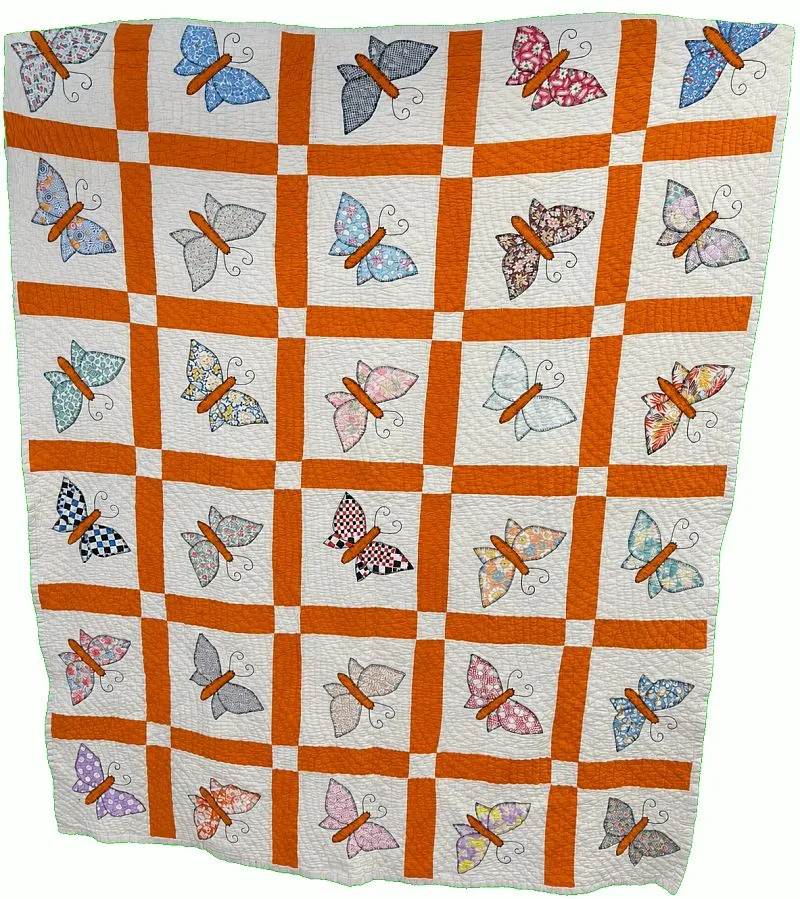
- Why Kit Quilts Took Off — A discussion of why pre-cut and pre-printed kit quilts became so popular in the early 20th century, comparing them to the more recent watercolor-quilt fad and the appeal of ready-made fabric coordination.
- Finding a Qualified Quilt Appraiser — Members point newcomers toward AQS-certified appraiser listings and the QuiltHistory site’s own appraiser directory. (see the article on quilt appraisers)
- A Study Group’s Visit to History House — Cinda Cawley recounts a Vintage Friends of Fran research trip to the Allegany County Historical Society in Cumberland, MD, cataloguing a strong regional quilt collection including an 1817 stuffed-work star quilt. (see the article on quilt study groups)
- Flying With Sewing Tools Post-9/11 — With new airport security rules just in effect, members trade reports on which quilting notions (scissors, seam rippers, knitting needles) are and aren’t being confiscated at the gate.
- Is There Such a Thing as a Quaker Quilt? — A member questions whether ‘Quaker quilt’ is a meaningful category, prompting responses about Quaker textile traditions and inscribed silk quilts.
Date: Mon, 24 Sep 2001 22:23:34 EDT | From: Windquilt@
Newbie writes:
>>You should not cut up real flags or wear
>>them – but fabric with the design printed on it is fine to use for
>>clothing and decoration.
My question is – what if I make a flag or a flag look-alike from
solid-colored cottons. Would that be considered a “real” flag? Or a
decorative item? I haven’t seen this addressed on the etiquette sites,
perhaps because the Q-and-A was not prepared by a quilter.
Any ideas?
TIA.
Nancy Blake
Visit the New England Images 2002 websitehttp://www.newenglandimages.org
Date: Tue, 25 Sep 2001 04:47:04 | From: “Anne Copeland” <anneappraiser@>
I think that many things contributed to their popularity. Having coordinated fabric, or all the scraps available quickly without having to build a collection; having access to fabric ready to sew whether you had a car or were geographically close to a fabric shop; and whether you had access to someone to “teach” you quiltmaking or not, or whether you had made a quilt before or not, you could believe you could still make a quilt that you could be proud of may be just some of the reasons. Quilt kits in one form or another were available before the advent of the automobile.
I was thinking of something that can perhaps equate in some ways with the popularity of the kit quilts–the phenomena of the watercolor quilts of today. Once this type came out, it became almost an overnight success, with everyone, experienced quilter or not, wanting to make one. One thing is that this quilt type could go with almost any decor, whereas say, a Southwest style quilt would have a very limited popularity for decor purposes. The kits of the time in most cases, fit well with the decor in everyone’s homes. These watercolor kits could soon be bought in kit form and this would appeal to many people who would not be able to pick all the fabrics required without help. The skills required to sew simple squares together were minimal, and yet the completed quilt would be a handsome (at least to many) piece with almost the look of an art quilt.
Another angle I to which I have given much thought (and personal trials) was that despite the fact that the kits came with many “aids” to help the quilters, many of them were not that easy to complete. I personally owned a kit quilt that was a copy of a quilt from the Titus-Geesey museum, TheSunflower (which was an abstract rather than representational pattern) wasjust such a kit. Try as I might, I could not get those marks on theapplique pieces to truly match with the marks on the background fabric,which may be why the kit was never finished.
Also, I have heard tales of people cutting out all the pieces at once, only to become overwhelmed trying to sort them out, and giving up before the kit was completed. So even though they were kits, they did require some level of skills. And appliqueing is not that easy to master without an instructor, unless you are a quilting wizard (OK, some of YOU might be, but NOT me). I did eventually manage to master the art of applique, but not without a great many difficulties.
Peace and blessings, Annie
Date: Tue, 25 Sep 2001 05:51:51 | From: “Anne Copeland” <anneappraiser@>
Thank you so kindly, Diane. I remember when we were doing our research, how very difficult it was because we didn’t have the internet (can you believe it now???), and all of the really good resources were so far and so few between. I am glad that others too have done their work. As I noted, I would sure like to see all of our books and articles published, because there is a need for all of them, as you noted. I know that I can never read too many books on a subject in which I am interested.
I wish we could self-publish. Many years ago, I self-published a pumpkin cookbook because I also could not interest publishers even then because they believed it was too specialized, though they all liked it and were mosten couraging. I took a second full-time job in exchange for the printing, and printed up and sold most of the books that were printed. Didn’t make much money at all since I had to do all the advertising, mailing, etc., but the book WAS in Books in Print, and that did generate some requests on an ongoing basis.
I think all of us who have written good works have been affected in this way at one time or another. It is frustrating to work so hard and so long, and then have your work come to naught because of a lack of a publisher willing to tackle something a little different. But I can understand it all from an economic standpoint. Well, maybe one of these days before we are all long gone. Peace and blessings to all of you, Annie
Date: Tue, 25 Sep 2001 07:09:52 EDT | From: DDBSTUFF@
Hi Everyone;
I just want to thank all of you who wrote with the names of appraisers in North Carolina. Is there a complete list of US appraisers anywhere on the WWW?
Thanks,
Darwin
Date: Tue, 25 Sep 2001 07:41:20 -0400 | From: “Kris Driessen, QuiltBus.com” <oldquilt@>
Why yes, Darwin, at the QuiltHistory site:-))
I listed all appraisers that I knew of or sent me their names at http://www.quilthistory.com/quilt.htm. I know there is a list of AQScertified appraisers on line, but I don’t know where exactly. Try http://quiltappraisers.org/paaqt%20members.htm.
Kris
Date: Tue, 25 Sep 2001 08:29:51 -0400 | From: Newbie Richardson <pastcrafts@>
Xenia, The history of mass manufacturing in the US really goes back to the textile mills in Lowell. Then to the Civil War and the revolutionary concept of interchangeable parts introduced by (I think) Remington in the production of guns. The same concept was used by the Union to make “standard” uniforms for the army. Those standards are still in use today for men’s wear. Henry Ford just continued the idea in a more “advanced” way! Kit houses were the intermediary stage between individual builders and developers. Can we then say that quilt kits were the intermediate step between “home made” and industry made? I do not remember that there many factory made quilts much before WWII – other than the machine quilted satin spreads of the 1930’s and 40’s. Just thinking out loud! Newbie
Date: Tue, 25 Sep 2001 09:55:20 -0400 | From: “Cinda Cawley” <lrcawley@>
Peggy Armstrong, Barb Garrett, Phyllis Twigg and I (all Vintage Friends of Fran) spent Saturday at the History House in Cumberland, MD (home of the Allegany Co. Historical Society) at the request of Vintage Friend Suzanne Cawley who has undertaken a documentation of the Society’s quilt collection with the help of members of the local quilt guilds. We were asked to comment on historical signifcance, dates, conservation, etc. and to suggest ways that quilts could be displayed during a special exhibit planned for March through Oct. of 2002.
Peggy will be returning tomorrow with Fran who is going to advise on preserving the Crazy Quilts.
We had a wonderful time; in addition to the quilts the Society gave us a delightful lunch in elegant surroundings and a fascinating tour of the Victorian mansion which is restored to the 1880s period. But, it was really all about the quilts and there are some beauties.
“Best of Show” went hands down to an enormous Blazing Stars quilt (8 point stars composed of 45 degree diamonds) with stuffed motifs in the alternate plain blocks, initialed and dated 1817 with cording, a chintz border and, the icing on this glorious cake, a handknotted fringe on all four sides. The row of diamonds next to the point of each star is made of the background fabric so that the points float away giving the quilt a particularly airy appearance. The quilt is very acidic; our recommendation was that it should be sent to a professional conservator for wet cleaning.
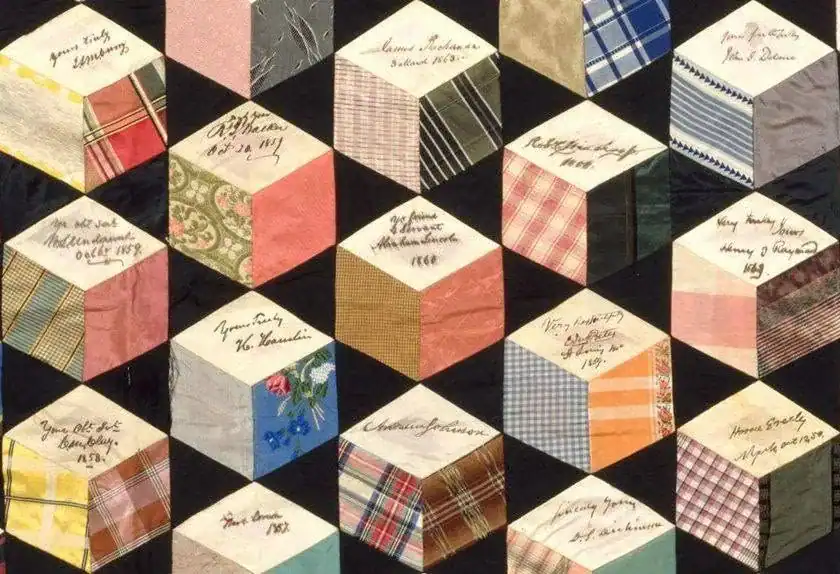
If you look on a map you will find Cumberland in the “waspwaist” of Maryland sandwiched between West Virginia and Pennsylvania. During the early 19th century the town was far more important than it is today. It was the terminus of the National Road, our first super highway, which ran from Baltimore to Cumberland. No doubt the ladies of Cumberland had access to the best of everything. We certainly found evidence of this in the quilt collection. There was an early silk mosaic (c. 1840) backed by a subtle dove colored plaid that said “Quaker,” Although we have no proof, it certainly could have come from Philadelphia.
A brilliant red wool wholecloth quilt with a linen back shouts New England. There is a lovely applique album quilt dated 1852. We may be looking at what brides from the big cities brought with them to the edge of civilization (G).
The Pennsylvania German influence (the National Road was heavily used by the PA Germans to take their crops to market in Baltimore) is represented by a quilt in a pattern that was new to all of us. It’s a very sadly worn four-block applique circa 1850 (definitely a Dead Quilt ).
The four large blocks are hearts composed of diamond shaped leaves decorated with small hearts in turkey red or cheddar scattered randomly. The border is a serpentine vine with tulips. This is not prissy Baltimore applique; this lady was doing what I always think of as PA country applique: simple, sturdy flowers sitting firmly on inch-wide stems. I know I’m forgetting some of the details. Perhaps “Cousin Suzanne” will correct me. Almost all the red has deteriorated, but the quilt still makes an impact.
Suzanne and her committee have decided to recreate the quilt, not once, but twice. One copy (machine applique) will be a raffle quilt for the History House to use as a fundraiser; the other (done by hand) will be a recreation of the original to be a permanent part of the collection. They also hope to sell the patterns. I think the patterns would be a great success; the quilt is so unusual and the applique is fairly simple. Even I, who have no pretensions as an appliquer, would love to make a single big block as a baby quilt.
In the mid-twentieth century Cumberland had a factory that produced “Celanese” much of it used for parachutes during W.W. II. Naturally the quilters of the town made quilts of “Celanese.” We saw enough of these to recommend a local history exhibit featuring the quilts and photos etc. relating to the industry. Most of these quilts were fairly pedestrian, but one Pineapple Log Cabin made of brightly colored ribbons was absolutely charming.
Of course, there are Crazy quilts; as I said, Fran is making a special trip to check them out. Naturally, there were exciting details on some of the Crazies: a James G. Blaine campaign ribbon from 1876, a bandana from the election of 1888 with portraits of Benjamin Harrison and Levi Morton, a “Stevensgraph” ribbon (Barb Garrett will explain) celebrating Gerorge Washington. One quilt which can only be described as a “Novelty” might have been a banner from a local fraternal organization; it has a silk Confederate battle flag in each corner. Always so many more questions than answers!
Suzanne will surely keep us posted on the quilt exhibit at History House. They have an exciting lineup of quilt related events planned and the pattern project should be of interest to all of us.Cinda from the Eastern Shore whose motto is since I wouldn’t hesitate to go ten miles to see one antique quilt it makes perfect sense to go 300 miles if I can see thirty. The roundtrip to Cumberland from Salisbury was 560 miles–well worth the effort!
Date: Tue, 25 Sep 2001 13:10:52 -0400 | From: “Gibson, Nancy” <ngibson@>
Washington, DC, September 21, 2001—The DAR (Daughters of the American Revolution) Museum presents a book signing and presentation by noted collector and dealer in antiques quilts Stella Rubin on October 10, 2001 at10:00 am.
Author Stella Rubin, a nationally known dealer and collector with 25 yearsof experience in the quilt world, shares the secrets of the professionals as she shows how to assess value in a quilt. Treasure or Not? How to Compare and Value American Quilts is more then just a survey of quilts, but is a master class in evaluating these works of art. The book is aMiller’s-Mitchell Beazley book published by Octopus Publishing Group, Ltd.
Stella Rubin has been an avid collector and dealer of antiques since 1977.She has exhibited at the New York City Fall Antiques Show, The Baltimore Museum Show, the Delaware Antique Show (Winterthur Museum) and many others. She has sold quilts to many private collections and institutions such as the Metropolitan Museum of Art, the DAR Museum, the Smithsonian Institution and the Museum of Fine Arts in Houston. She lectures frequently.
The program is free, but reservations are requested. For more information call Nancy Gibson at (202) 879-3238 or email her at ngibson@<ngibson@> .
The DAR Museum has an outstanding collection of objects made or used inAmerica prior to 1840. To fulfill the goals of the DAR–education, preservation and patriotism–the museum holds educational programs throughout the year. This program is being held in conjunction with the DARMuseum Quilt Guild.
Date: Tue, 25 Sep 2001 20:25:47 EDT | From: Trimble4@
<< I know there is a list of AQS certified appraisers on line, but I don’t know where exactly. >>
Try the AQS web site, under the appraiser information listing. I can’tremember if the list is there or if it’s a link to somewhere else (andbecause of an anti-virus glitch, I can’t go look for you right now :-{), butI’m sure that’s where I found it.
Good luck!Lori in Mass.
Date: Tue, 25 Sep 2001 17:55:40 -0700 (PDT) | From: Judy Schwender <sister3603@>
The Betsy Ross site with the instructions for cutting a 5-pointed star has a link to flag etiquette. Checkout:
http://www.ushistory.org/betsy/flagetiq.html
Also, try a google search for American flag etiquette. There is a lot of info out there. Some of this discussion comes back to the notion of free speech, and artistic license. The question maybe: are you creating a pieced flag as an entity unto itself? or are you creating a pieced flag that will be incorporated into a larger artistic expression? Based on what I have read, the first option would require the same treatment any American flag is due, the second would allow you more leeway. Monica Calvert’s “Glorious Lady Freedom”, grand prizewinner of The Great American Quilt Contest, in Celebration of the Statue of Liberty Centennial, 1986,utilizes an American flag in its design, and the World Trade Center towers as well. No one will argue that the flag is portrayed the least bit disrespectfully in this quilt. Norman Rockwell portrayed the American flag in many of his covers for the Saturday evening post- although in a realistic manner. A more abstract rendering of the elements of the flag is more likely the route a quilter would go. Didn’t Jasper Johns also portray the flag in his paintings? Anyone else? Judy
Date: Tue, 25 Sep 2001 21:35:21 -0700 | From: Gail Ingram <GIngramtcainternet.com>
Last week I saw part of a program on HGTV which highlighted “story
quilts,”
perhaps made by a New Englander. I believe the feature was on homes
or
decorating, but the part I caught focused on the homeowner’s quilts
(That’s
what they say on HGTV—“homeowner,” not “homemaker,” but personally
I think
this woman was a true homemaker as well as the owner of the home)
Now, I’ve mislaid the pad on which I noted the name of the program
and of
the quiltmaker.
If anyone else saw/recalls the program, I would appreciate its
name/host/quiltmaker.
Gail Ingram
Date: Tue, 25 Sep 2001 22:48:53 -0400 | From: Lynne Humphries-Russ <lynnehrsimplegiftspress.org>
I read the recent posting by Cinda Cawley regarding the quilts at the
Allegheny County Historical Society in Cumberland. It sounds
wonderful
and I can’t wait to see it. I’m thrilled to know that there is such a
good collection of quilts that I can see nearby – and in a local
historical society! Thank you for the hard work.
Please allow me a moment of historical accuracy, however. The
original
National Road STARTED in Cumberland, Maryland. The National Road’s
TERMINUS was Vandalia, Illinois. Later it ran on to St. Louis. The
road
that ran from Baltimore to Cumberland eventually was added as part of
that road but all of it was built by private or local funds, if it
was
“built” at all. It was part of an old trail. The condition of the
“built” portions of the stretch from Baltimore to Cumberland was of
widely varying quality, depending on the builder. The federal
government
didn’t claim it until much later than the part of the National Road
than
ran west from Cumberland over the mountains. While it WAS a super
highway for the day, the crushed stone that was its first surface
would
be a bit difficult on cars today! Yes, Cumberland was of great
importance because of its place on the National Road but rather as
its
start, not its finish.
Thanks for listening to my historical spoutings.
Lynne
Date: Wed, 26 Sep 2001 07:17:13 -0500 | From: “Ann G. Hubbard” <ahubbardcdoc.net>
Was it someone on this list who had asked about the quilt engagement
calendar. Amazon has this listed for sale. #256 Quilt Engagement 2001
Calendar by Cyril Nelson. It is $12.55.
Ann from Lake of the ozarks, MO
Date: Wed, 26 Sep 2001 14:51:17 CDT | From: jocelynm@
I seem to remember that the modern
> incarnation of flags lies in the heraldic traditions of midieval
Europe.
Which were a very practical matter! There was no such thing as a
royal
army- the army the king led was made up of the soldiers supplied by
his
noblemen, who led their own followers into battle. If the King
assigned
the Duke of Whereever to lead the right wing of the army, the Duke
was
there, with his flagbearer. When the flag moved, the footsoldiers
could
tell which way to go; hearing new orders in the crash of battle was
impossible. It also made it possible for knights to see which of
their
allies might need a little help, by watching for the flags and then
assessing the fighting going on around them. In theory, so long as
the
nobleman or his lieutenant (place-taker, in French) was on the field,
the
flag stayed with him to be a focus for the troops.
Not to mention the use of flags to communicate between ships, in
later times.
Jocelyn
Date: Wed, 26 Sep 2001 15:48:05 EDT | From: SSQuilt@
Hello,
We are getting ready to begin stamping the old Wurzburg applique kit
quilts
again and in going through some of the old boxes I came across a
record book
that I’m hoping an expert on the list can help me figure out. The
book lists
who quilted all of the model quilts. The name Caden I of course
recognize but
there are many, many listings that say Frost. The addresses given for
Frost
show that letters and merchancise goes to Levi, KY. Wire messages to
Booneville, KY and freight and espress to Beattyville, KY If this
rings a
bell with anyone I’d sure appreciate any information you can supply.
In
addition to some local entries the names “VanKuiken” and “Coba” (or
Caba)
appear but the majority were sent to Caden and Frost.
Thanks,
Gay Bomers
Sentimental Stitches
Date: Thu, 27 Sep 2001 00:31:19 +0100 | From: “Sally Ward” <Sally.D.Wardbtinternet.com>
Has anyone encountered a problem like this, and do you have any
advice?
TIA, Sally W in UK
<After a recent attempted break-in, my DGDs quilt was smothered in
small
<splinters of glass. I’ve vaccuumed and shaken it and now wonder
whether
<there is a foolproof way of ensuring that all the glass has been
retrieved.
<What should I do?
Date: Wed, 26 Sep 2001 21:14:04 -0400 | From: “Cinda Cawley” <lrcawleydmv.com>
I may have inadvertently sent this message before it was
finished.
I’m sorry.
Peggy Armstrong, Barb Garrett, Phyllis Twigg and I (all Vintage
Friends of Fran) spent Saturday at the History House in Cumberland,
MD
(home of the Allegany Co. Historical Society) at the request of
Vintage
Friend Suzanne Cawley who has undertaken a documentation of the
Society’s quilt collection with the help of members of the local
quilt
guilds. We were asked to comment on historical significance, dates,
conservation, etc. and to suggest ways that quilts could be displayed
during a special exhibit planned for March through Oct. of 2002.
Peggy
will be returning Tuesday with Fran who is going to advise on
preserving
the Crazy Quilts.
We had a wonderful time; in addition to the quilts, the Society
gave
us a delightful lunch in elegant surroundings and a fascinating tour
of
the Victorian mansion which is restored to the 1880s period. But, it
was really all about the quilts and there are some beauties. “Best
of
Show” went hands down to an enormous Blazing Stars quilt (8 point
stars
composed of 45 degree diamonds) with stuffed motifs in the alternate
plain blocks, initialed and dated 1817 with cording, a chintz border
and, the icing on this glorious cake, a handknotted fringe on all
four
sides. The row of diamonds next to the point of each star is made of
the background fabric so that the points float away giving the quilt
a
particularly airy appearance. The quilt is very acidic; our
recommendation was that it should be sent to a professional
conservator
for wet cleaning.
If you look on a map you will find Cumberland in the “waspwaist”
of
Maryland sandwiched between West Virginia and Pennsylvania. During
the
early 19th century the town was far more important than it is today.
It
was the terminus of the National Road, our first super highway, which
ran from Baltimore to Cumberland. No doubt the ladies of Cumberland
had
access to the best of everything. We certainly found evidence of
this
in the quilt collection. There was an early silk mosaic (c. 1840)
backed by a subtle dove colored plaid that said “Quaker,” Although
we
have no proof, it certainly could have come from Philadelphia. A
brilliant red wool wholecloth quilt with a linen back shouts New
England. There is a lovely applique album quilt dated 1852. We may
be
looking at what brides from the big cities brought with them to the
edge
of civilization (G).
The Pennsylvania German influence (the National Road was heavily
used by the PA Germans to take their crops to market in Baltimore) is
represented by a quilt in a pattern that was new to all of us. It’s
a
very sadly worn four-block applique circa 1850 (definitely a Dead
Quilt
). The four large blocks are hearts composed of diamond shaped
leaves
decorated with small hearts in turkey red or cheddar scattered
randomly.
The border is a serpentine vine with tulips. This is not prissy
Baltimore applique; this lady was doing what I always think of as PA
country applique: simple, sturdy flowers sitting firmly on inch-wide
stems. I know I’m forgetting some of the details. Perhaps “Cousin
Suzanne” will correct me. Almost all the red has deteriorated, but
the
quilt still makes an impact. Suzanne and her committee have decided
to
recreate the quilt, not once, but twice. One copy (machine applique)
will be a raffle quilt for the History House to use as a fundraiser;
the
other (done by hand) will be a recreation of the original to be a
permanent part of the collection. They also hope to sell the
patterns.
I think the patterns would be a great success; the quilt is so
unusual
and the applique is fairly simple. Even I, who have no pretensions
as
an appliquer, would love to make a single big block as a baby quilt.
In the mid-twentieth century Cumberland had a factory that
produced
“Celanese” much of it used for parachutes during W.W. II. Naturally
the
quilters of the town made quilts of “Celanese.” We saw enough of
these
to recommend a local history exhibit featuring the quilts and photos
etc. relating to the industry. Most of these quilts were fairly
pedestrian, but one Pineapple Log Cabin made of brightly colored
ribbons
was absolutely charming.
Of course, there are Crazy quilts; as I said, Fran is making a
special trip to check them out. Naturally, there were exciting
details
on some of the Crazies: a James G. Blaine campain ribbon from 1876, a
bandana from the election of 1888 with portraits of Benjamin Harrison
and Levi Morton, a “Stevensgraph” ribbon (Barb Garrett will explain)
celebrating Gerorge Washington. One quilt which can only be
described
as a “Novelty” might have been a banner from a local fraternal
organization; it has a silk Confederate battle flag in each corner.
Always so many more questions than answers!
Suzanne will surely keep us posted on the quilt exhibit at
History
House. They have an exciting lineup of quilt related events planned
and
the pattern project should be of interest to all of us.
Cinda from the Eastern Shore whose motto is since I wouldn’t hesitate
to
go ten miles to see one antique quilt it makes perfect sense to go
300
miles if I can see thirty. The roundtrip to Cumberland from
Salisbury
was 560 miles–well worth the effort!
Date: Wed, 26 Sep 2001 21:06:54 -0500 | From: Marcia Kaylakie <marciarkev1.net>
Hi All,
I am off to NJ tomorrow with DH to do a check on his mom, who has
Alzheimers disease. Since DH is the guardian, we travel quite
frequently so
I will let you know what goes through Austin, Houston and
Philadelphia. I
am taking no chances and just packing my quilting in the
check-through. I
did make my MIL a quilt for her birthday, which is going tomorrow. It
is
from the One Block Says It All book and came out quite nicely! A
Desert
Star in pinks and purples (her favorite colors) I was pleasantly
surprised
with the results of that book, we did make the top in just over 3
hours
from start to finish, and I quilted and bound it in 1 week! the quilt
measures 60″ x 60″, and I am quite pleased with the result. I have
decided
to read on this trip and will probably nap as well. When I see how
things
go on the first part, I may decide to try quilting minus scissors on
the
way back. I have been enjoying the discussions on kit quilts as I
own a
few myself. TTYL, Marcia Kaylakie
Date: Thu, 27 Sep 2001 10:41:18 -0500 | From: Laura Hobby Syler <texas_quilt.co@>
Please go to
www.quiltappraisers.org
for a complete listing of certified appraisers of Quilted Textiles
It is broken down by state.
Laura Hobby Syler
Richardson, Texas
Certified Appraiser of Quilted Textiles
Member of Professional Association of Appraisers of Quilted Textiles
(PAAQT)
Date: Thu, 27 Sep 01 12:30:30 -0600 | From: woodford <haqgalenalink.net>
DaDaaaaah!
I put fresh lemon juice on the smuches, left in sun for few seconds,
rinsed in clear water and voila! I had instead of black smuches,
light
smuches, which I consider much better and capable of being dealt
with.
However I am waiting to see if this treatment on silk causes
deterioration so have a work in progress. Will report again later.
Thanks to Meg Mooney for her words and to quilt97.
Hurrah, skipping down the walk, Barbara
Date: Thu, 27 Sep 2001 14:34:10 -0400 | From: “J. G. Row” <Judygrowrcn.com>
You don’t need a scissors or even a nail clippers to cut your thread.
All you need is your tooth floss in its little white container.
The cutter is perfect.
AND……a bonus!
You can open those packages up when you have used up the floss and
either
wind your sewing thread on the core, or even insert a bobbin,
pre-wound with
your correct color. (Some narrow bobbins will fit some containers,
but not
all.)
If you floss your teeth often and empty lots of those little white
plastic
containers you could have a whole rainbow of threads to work with on
your
trip, and wouldn’t that get folks wondering! You could even store a
needle
in each container. But — don’t open the containers too often —
the
little cutter thingie is not inserted permanently and will ultimately
fall
out. Ask me how I know that!
Judy in Ringoes, NJ
judygrowrcn.com
Just back from flying Delta Philly to Atlanta and then back for a
trade show
that was cancelled!
Guess who didn’t know that? ARRRGGGHHH!
Now what terrorist would want to do away with 18,000 picture framers?
Date: Thu, 27 Sep 2001 17:24:15 -0400 | From: “anne” <datkoa@>
charset”iso-8859-1″
Content-Transfer-Encoding: 7bit
Has there been a discussion on the list re lighting for sewing rooms?
I’m
hoping to get basement re-done for my quilting and the issue of how
much
light and what kind has been puzzling me. Builder has just mentioned
halogen lights – of the appropriate ‘temperature’ (he said this
refers to
similarity with natural light) – as being better than fluorescents
since
they can be dimmed. Shopowners, those with studios have any
experience they
could share? Many thanks. AnneD
Date: Thu, 27 Sep 2001 22:33:19 -0400 | From: “Suzanne Cawley” <ccawleyalleganyinternet.net>
Lynn Humphries-Russ wrote:
I read the recent posting by Cinda Cawley regarding the quilts at the
Allegheny County Historical Society in Cumberland. It sounds
wonderful
and I can’t wait to see it. I’m thrilled to know that there is such a
good collection of quilts that I can see nearby – and in a local
historical society! Thank you for the hard work.
Please allow me a moment of historical accuracy, however. The
original
National Road STARTED in Cumberland, Maryland. The National Road’s
TERMINUS
was Vandalia, Illinois. Later it ran on to St. Louis. The road that
ran from
Baltimore to Cumberland eventually was added as part of that road but
all of
it was built by private or local funds…. Yes, Cumberland was of
great
importance because of its place on the National Road but rather as
its
start, not its finish.
From Suzanne:
In Cinda’s defense, she had a lot of information to absorb on
documentation
day and no time to take notes…..so her post was from memory two
days
later. She was probably thinking “terminus” because we also
discussed the
fact that the C&O Canal, which travels northwest from Washington, DC,
has
its terminus in Cumberland. Travel on the C&O Canal as well as the
National
Road brought a lot of traffic through Cumberland…..which probably
accounts
for the fact that this Western Maryland community is the home of a
great
collection of quilts from its glory days in the 19th century. I will
continue to post information (and questions) as this documentation
work
continues….and hope that many of you will be able to travel to
Cumberland
next year to see the collection in person.
Date: Fri, 28 Sep 2001 20:55:28 -0700 | From: “Anne Papworth” <papworthichips.intel.com>
Hello All,
> Kit houses were the intermediary stage between individual
builders
and
> developers. Can we then say that quilt kits were the intermediate
step
> between “home made” and industry made? I do not remember that
there
> many factory made quilts much before WWII – other than the machine
> quilted satin spreads of the 1930’s and 40’s. Just thinking out
loud!
> Newbie
Newbie Richardson’s posting got me thinking about when quilts were
first mass-manufactured. The earliest reference I can come up with
is
an advertisement in the August 24, 1871 issue of “Sheldon’s Weekly
Dry Goods Price List”. The ad lists “Honey Comb, Fancy Jacquard
and Imperial Bleached Comfortables and Quilts”. Has anyone ever
seen what one of these “quilts” looks like? I can find no reference
to
mass-produced quilts prior to 1871, nor from 1872 to the 1930’s.
Anyone else??
Anne Papworth
Date: Fri, 28 Sep 2001 02:35:50 -0400 | From: “J. G. Row” <Judygrowrcn.com>
got the
following in reply…..
>My sister recently had her dental floss removed from her purse. She
had put
>a piece in to floss her teeth after eating and they took it. Jane
So, is that a prank post? Or do you think someone actually removed
her
dental floss as a potentially dangerous weapon? Will any of you who
do
travel soon with a floss container let us know? I just can’t
believe it is
true!
Judy in Ringoes, NJ
judygrowrcn.com
Date: Sat, 29 Sep 2001 08:03:14 -0400 | From: “Glenn Hardy” <hardygoeaston.net>
I would like to hear whether the airlines are allowing you to fly
with
needles. When I made reservations on Southwest last week, I was told
scissors would be taken away and so would needles. Have any of you
tested this? I also wonder if they are taking brooches off the
passengers because of the sharp object.
Julianne in cooler Maryland
Date: Sat, 29 Sep 2001 08:32:05 EDT | From: Xroadclown@
the bast thing to do is call and ask. they took a friends knitting
needles
away before the attack. Maybe we will just have to learn to talk to
people
again, or read a good book!
“Loves mansion is built in the places of excrement”
…………………………………fromYeats’
Date: Sat, 29 Sep 2001 17:15:51 +0000 | From: quiltsnbears@
I flew home Thursday (9/27)and believe me security is
being very careful of what is allowed on a plane.My
husband is diabetic and carries an emergency needle.At
first they refused to let him retain the needle,but I
stressed that this was a medical emergency device.After
a bit of consultation it was decided that an agent would
walk us through security with the needle in plain view.
My husband was told to obtain an authorization from his
doctor for our next trip on October 19th.
We had left Orlando on 9/11 to fly to Dallas and then on
to Seattle. We were diverted to Shreveport at 10:06 AM
EDT and parked in a field since the 557 was too big for
the airport. After two days in the Residence
Inn,compliments of AA, we decided to drive the remaining
2500 miles to WA.American Airlines and Marriott were
wonderful.In the midst of their own suffering they took
very good care of all of us.AA refunded the MCO-SEA
portion of our ticket and Marriott refunded our paid in
full Seattle reservation.
On our return the three airports we passed through were
very quiet, the lines were slow and there was a real
show of security personnel.Even the passengers were
quiet.There was no joking and laughing.Considering that
the flights into and out of Orlando are usually noisy
and kid loaded it was all rather spooky!
Take a book,put the sewing in your checked luggage.
Roberta in FL
Date: Sat, 29 Sep 2001 15:05:26 EDT | From: SadieRose@
Hello,
We have a new quilt shop opening in town, and the owners asked if
I knew
of any e-mail lists for shopowners. I seem to remember one called
Quilt Biz.
Can anyone tell me if this list is still going, and how to
subscribe??
TIA, Karan from sunny Iowa
Date: Sat, 29 Sep 2001 18:35:31 -0400 | From: “Jan Drechsler” <quiltdoc@>
Judy,
Probably there are already urban legends on the net regarding
checkpoints.
Thanks for the dental floss container tip. My husband will wonder
why I am
flossing 10 times a day in the next two weeks before the ASQG meeting
but
that will just be our little secret.
Last night I found an unopened package of a Clover brand needle
threader
with a miniscule cutter and I may have myself a new orange necklace.
I am
planning to bring a small needle with me and if they take it at the
gate, so
be it.
Keeping my hands busy when I am nervous about flying is very
important to
me. And I have a few long waits.
And think how clean my teeth will soon be!! (Are you in cahoots
with my
dentist who is always nagging me to floss)?
Jan Drechsler in Vermont
Quilt Restoration; Quilting teacher
www.@/~bobmills
Date: Sat, 29 Sep 2001 21:46:30 -0400 | From: “pepper cory” <pepcorymail.clis.com>
Hello all-I’m a Travelocity subscriber and get their email
newsletter. Go to
Travelocity’s site and they have a link for Tips for Traveling With
Increased Security. It’s worth reading and makes sense. What is
evident is
that things that seem like potential weapons might alarm one security
guard
while the next one may think that it’s OK. In other words, there’s
latitude
and personal interpretations of the guidelines. They did specifically
mention manicure kits as vertbotin. The other info–how to pack,
coming with
ID, having a copy of your E-ticket–make sense. Hope this is helpful.
Pepper Cory in coastal North Carolina
Date: Sun, 30 Sep 2001 22:53:22 -0400 | From: Eileen Doughty <QuilterDoughtyDesigns.com>
I joined the Quilt Biz list a few months ago. you should be able to
sign up by going to this web site:
i believe the list owner will send you an email asking you about your
quilting background and professional status – are you a designer,
quiltmaker, appraiser, etc. I think the list does try to weed out
the
casual quilter.
as lists go, there is not much ‘chat’ going on – i think everyone is
too
busy running their business to go off-topic!
eileen doughty
http://www.DoughtyDesigns.com
Date: Sun, 30 Sep 2001 22:57:26 -0400 | From: Eileen Doughty <QuilterDoughtyDesigns.com>
Since i’m posting something else today, i will introduce myself as a
new member of this list. i live in northern Virginia. i’ve been a
quilter for over 13 years, and for most of that have worked in landscapes,
taking commissions.
i joined the list because i recently started to help a friend do some
quilt restoration, and i know from time to time we may want some
advice
from those with more experience!
eileen doughty
http://www.DoughtyDesigns.com
Date: Mon, 01 Oct 2001 10:22:20 -0500 | From: Laura Hobby Syler <texas_quilt.co@>
Up until a year or so ago, Quilt Biz was *the* site for shop owners,
designers, teachers, in other words, quilting professionals to chat,
share ideas, info and generally pick each others brains. It was
really valuable for those of us that do not own or work in one specific shop
to see what the trends and wants of shops all over the country were.
Then FabShopNet, open to quilt shop owners only, came on the scene.
Shop owners wanting to converse only with other shop owners jumped ship
(and if I’m not mistaken, the original owners of QuiltBiz retired) and the
whole tone of the site changed. I decided not to renew my
subscription for my business because the discussions were not of a nature that I
felt were beneficial to me. That is not to say that QuiltBiz is not a
worthy site…it’s just changed dramatically from the original concept of
the list. Your shop owner friend should check out the FabShopNet as well.
Sorry, since I’m no longer a shop owner, I don’t have information on
how to join. Maybe someone else will offer that.
Laura Hobby Syler
Certified Appraiser of Quilted Textiles
Quilt Restoration Specialist
Teacher, Lecturer, Author
Contributing Editor for Harris Publications, QUILT Mag, et al.
Date: Mon, 1 Oct 2001 17:06:30 -0400 | From: “pepper cory” <pepcorymail.clis.com>
Hello all-I’ve just purchased an unusual quilt in the Star of the
West pattern. It is deep teal and brown…silk! The back is an almost
iridescent rougher weave brown/blue silk and the fraying binding a Christmas
green silk. The only quilts in these colors silk that I’ve seen were Quaker
quilts. I can’t get a story on provenance out of the seller (they’re
being coy-). Anyone out there recommend reading (pictures would be lovely-)
on
Quaker quilts?
Thanks for your time-
Pepper Cory
Date: Mon, 01 Oct 2001 14:53:37 -0700 | From: “Julia D. Zgliniec” <rzglini1@>
Dear Pepper and QHL,
I can recommend:
Of The Best Sort But Plain: Quaker Quilts From the Deleware Valley
1760
– 1890.Patricia J Keller, Brandywine River Museum. Chadds Ford, PA.
It is a well done survey with references and additional reading
suggestions.
Regards,
Julia Zgliniec
Date: Mon, 1 Oct 2001 18:14:21 EDT | From: JQuilt@
i’ve been a quaker for 40 years and i’ve never heard of a quaker
quilt….the
only reference i’ve heard about fabric…is from an old
(101yrs)birthright
quaker , from iowa…she told me that her mother wore mostly grey
dresses…very plain and never anything decorative…..i’d be very
interested
in any history you find out about quaker quilts…
jean
Date: Mon, 1 Oct 2001 20:12:15 -0400 | From: “Martha Wroolie” <mwroolie@>
Several months ago I downloaded an article from a website
(www.Findarticles.com) on Quaker quilts. It was published in The
Magazine
Antiques, August, 1999 and was by Patricia J. Keller. The article
title is
Quaker Quilts from the Delaware River Valley, 1760 – 1890. Hope it
is still
available there.
Martha Wroolie
Atlanta, GA
–
Date: Mon, 1 Oct 2001 17:18:10 -0700 | From: chrisajetlink.net
Jean and Pepper,
there is an article in Antiques Magazine, August 1999, also by
Patricia J.
Keller that was most interesting and informative. It is called
“Quaker
Quilts from the Delaware River Valley, 1760-1890″
Keller discusses the quilts they made and as well as bought from
professional quilters and upholsterers in Phil. between those years.
She
also discusses how their plain and simple doctrine can reconcile with
the
owning or making of elaborate quilts. It is most interesting. They
made
their quilts to fit both their religious framework and their
self-expression
or “conversation”. This is a Quaker concept that described the way a
Quaker
used their religious beliefs in their everyday material life. This is
a very
simple explanaination of a concept that I am unfamiliar with, so
please
forgive any misrepresentation, and read the article yourself. She
goes into
it for several paragraphs.
She says that silk quilts, pieced or whole cloth, were made by them
in that
region in the 19th century. This set them apart from most others in
New
England who were using cotton at the time. They used undyed wool
rather than
cotton batting too. They also made silk pieced blocks in the 2nd and
3rd
quarters of the 19th C. Sometimes the silk was brocaded.
Kimberly Wulfert
Ojai, CA
www.antiquequiltdating.com