August 30 – September 1, 2006
These restored messages come from the Quilt History List, an online forum where quilt historians, collectors, researchers, appraisers, and enthusiasts discussed antique quilts and related textiles. The archive dates from 1996 through approximately 2016 and is being restored gradually. Sign up in the form at the bottom of the page if you want to know when a new page is added. Original spelling, opinions, formatting, and inactive links may remain unchanged.
Primary topics of this QHL Digest:
- Catalogne and Cotonnade Coverlets — Members compare Quebec catalognes with the cotonnade quilts of Acadian Louisiana, cite a 1999 Uncoverings paper on the subject, and a European linguist traces the word back to 1635.
- Dating the Cathedral Window Pattern — Appraisers and shop owners report classes and patterns from the 1970s and 1980s, while others point to older names like Pincushion and Save All and a 1973 McCall’s technique article. (see the article on dating quilts)
- Blue Lines on Kit Quilts — A question about removing pre-printed blue lines leads Xenia Cord and others to explain that the lines cannot be washed out and are useful proof that a quilt began as a kit.
- Naming Patterns by Orr and McKim — List members identify a pattern called Colonial History as a McKim design from 1926 and match a quilt to Anne Orr’s work and the Lockport Cotton Batting Company’s Cross Stitch Bouquet pattern.
- Spinning Dog Hair and Rag Weaving — A stray thread about spinning Great Pyrenees hair and coats woven from dog hair shares space with talk of Swedish rag rugs and other utilitarian woven fabrics.
- Books, Calendars and Online Finds — Members hunt for a 2007 quilt engagement calendar, praise Google’s book search, and cheer a new searchable database covering 26 volumes of AQSG Uncoverings.
Date: Wed, 30 Aug 06 07:32:11 -0400 | From: joan kiplinger
Gail — I just haven’t been myself since Pluto left the system so my thought process is fuzzy these trying days. 😀 So in this mode, as I recall and generally speaking, one of the chief sources of revenue and fame for each town, province, etc. was its textile business. Seems there were always restrictions to protect loom and spinning formulas and imports. But as nationalization unified and defined a country, intra and inter boundary commerce changed accordingly. There is or was a saying that Europe ends at the Pyrennees, much to the consternation of Basque and Iberian. However, it’s difficult to stomp out an influence as it travels geographically. The more I research textiles, the more I feel like I am in a Fellini movie.
Gail Ingram wrote:
Joan, that is my point: is there Spanish/Catalonian/Barcelonian influence on these French home-woven textiles? And, of course, are they related?
I seem to recall that in the very early 18th century, there was a controversy between England and the Catalonian textile manufacturers because the latter were turning out inferior (acc. To Brits) and less expensive copies of the Indiennes and selling them to the American market. Am not sure of the source of the cotton/coton but it is unlikely that it was local. They were involved primarily with printing the textiles in that period, I believe. I will have to locate my notes because my research was in history, not textiles, and it was a while back. Before 1744, Alexander Pope’s death.
Date: Wed, 30 Aug 06 04:42:13 -0700 (PDT) | From: Ark Quilts (quiltarkmv)
Dear Julie– Just going on memory, I believe the pattern was called “Colonial History” and it was from the 19’s & probably in 1 of her pattern catalogs. C. Ark NW Ohio
Date: Wed, 30 Aug 06 12:29:54 +0000 | From: albeaumont
Gail has asked if there is a connection between the cotonade fabric and quilts of Acadian Louisiana and the catalognes of Quebec. I am not a weaver, but as a casual observer, don’t see much of a connection myself. If you go to: http://www.canadiantapestry.ca/en/det-T04_29_1.html which is on the Textile Museum of Canada site, you can see examples of catalognes, with accompanying information. A catalogne doesn’t need tying or quilting to maintain its integrity. It is more in the hand-woven rag rug category. Unfortunately, the origin of the term “catalogne” is not addressed at the Textile Museum site. When I was in Quebec, I didn’t think to ask about this. One thing I will mention is that I was led to believe that Quebec was primarily settled by immigrants from the north of France, while Catalonia is in the north of Spain, which doesn’t answer anything at all.
Best Wishes, Ann-Louise Beaumont in Greeley, CO
Date: Wed, 30 Aug 06 07:39:13 -0500 | From: Laura Syler (texas_quilt.co)
Debbie, I know that we ran a ton of classes on CW quilts from 1980 – 1985 at my shop in Dallas. Some of the articles, directions and photographs of CW quilts that I have in the file start in 1978. Granted, I started quilting/collecting in 1978…. Laura
Date: Wed, 30 Aug 06 08:08:19 -0500 | From: Jean Carlton (jeancarlton)
I may have missed it in this discussion but has anyone mentioned the research paper on this topic in the 1999 Uncoverings? The title is Three Louisiana Acadian Cotonnade Quilts: Adding Pieces to a Puzzle by Jenna Kuttruff; pp. 63-86. (I am creating a searchable database for all 26 volumes of this publication of the American Quilt Study Group and am excited to validate my work by being able to USE it)!
Jean
Date: Wed, 30 Aug 06 17:50:32 -0300 | From: Barb Robson
Does anyone know if there is going to be a 07 Quilt Engagement Calendar? For the last 2 years Barnes and Noble has had one. I emailed them, as I didn’t find it on their website but just got a generic email back saying to keep checking their website. I have Googled the subject, checked Amazon.com and ca as well as calendars.com. All I come up with in the “Engagement” format is the “Quilt Art ‘ one. I have all the old Cyril Neslon ones and the B&N ones. I love using them, does anyone have any information? I guess with all the Blackberries out there these kind of calendars aren’t needed anymore.
Thanks
Barbara Robson Fox Point, Nova Scotia
Date: Wed, 30 Aug 06 18:02:04 -0400 | From: Sharon in NC (patchworksecrets2)
I think this may be what you are searching for.
http://www.williamsburgmarketplace.com/webapp/wcs/stores/servlet/
07 American Quilt Calendar
http://www.piecemakers.com/products/pm/calendars.html Piecemakers Quilt Calendar, Times and Seasons
Date: Wed, 30 Aug 06 18:07:01 -0400 | From: Sharon in NC (patchworksecrets2)
http://www.americanquilter.com/items/index.php?typesearch&searchcalendar&imageField.x6&imageField.y4
Third one down is the same as what Barnes and Noble carries and much cheaper if you have an AQS membership.
Date: Wed, 30 Aug 06 17:48:53 EDT | From: DDBSTUFF
Does anyone have a good solution for removing the pre printed blue lines the are used in kit quilts and patterns?
Thanks,
Darwin
Date: Wed, 30 Aug 06 18:27:10 -0500 | From: Xenia Cord (xenia)
Darwin, the blue lines on old kit quilts won’t come out – that’s the simple answer. What we have to do is re-think their presence as evidence that the quilt is indeed a kit, and that these marks are desirable because they are proof.
Well – it’s a thought!
Xenia
Date: Wed, 30 Aug 06 19:05:31 -0700 | From: Julie Silber (quiltcomplex)
Hi All,
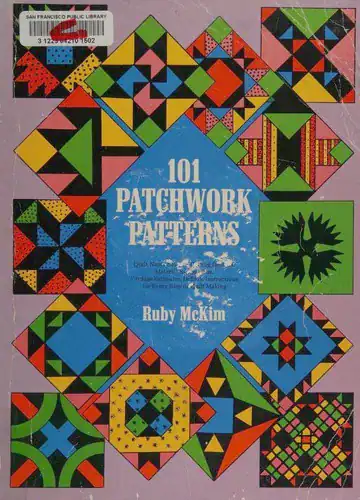
I asked about an “American History” design yesterday and got several speedy, helpful answers. It is a McKim pattern called “Colonial History” and, according to Karan Flanscha, was published in 1926.
Here’s Karan’s reference: Colonial History (McKim) (150th anniversary of the USA) Sept. 5, 1926
Tonight I went onto eBay — and LO AND BEHOLD, there is one put up for sale just today by Mark French (french72)! (I have no connection.) For those who want to see an example, it is eBay # 290024693778. Should be up there right near the top if you search for Antique Quilts.
Thanks to all (Kathi, Jan, Karan, Sandra, Merikay and Melissa) for the great and generous responses!
Julie Silber
Date: Thu, 31 Aug 06 01:30:25 -0400 | From: Roberta (Bobbe) Benvin (quiltsndogs)
In reply to Debbie Russell’s post of 8/29: just off the top of my head (without rushing to look through any books) wasn’t the “Cathedral Window” pattern known as “Pincushion” in the early to mid-1800s?
Bobbe Benvin
Date: Thu, 31 Aug 06 07:29:45 EDT | From: RFKerr
Debbie – The Cathedral Window pattern became very popular in the 1980’s but it was around prior to that time…. Would be interested to know what your research turns up. I recently appraised two CW quilts. One was a typical 1980’s version and the other was circa 1950 with tiny yo-yo’s at each intersection. Very sweet but it was still a CW quilt and in poor condition. In addition, I have a small CW piece in my collection that is constructed from 1940’s feedsacks with solid pastel centers. Mary Kerr AQS Certified Appraiser Woodbridge, Virginia
In a message dated 8/31/06 12:14:26 A.M. Eastern Standard Time, qhl writes:
Debbie, I know that we ran a ton of classes on CW quilts from 1980 – 1985 at my shop in Dallas. Some of the articles, directions and photographs of CW quilts that I have in the file start in 1978. Granted, I started quilting/collecting in 1978…. Laura
Laura Syler Certified Appraiser of Quilted Textiles Richardson, Texas —– Original Message —– From: “Debbie” russhill To: “Quilt History List” qhl Sent: Monday, August 28, 06 10:15 PM Subject: [qhl] Cathedral Window Quilts
I am working on a Cathedral Window quilt. I did a search but ended up with out the answer I wanted on dating them. When do they date to? Thanks so much. Debbie Russell russhill
Date: Thu, 31 Aug 06 09:01:21 -0400 | From: Paul and Nancy Hahn (phahn)
I’ve thoroughly enjoyed this discussion as I try to carry some of these in my shop. I find them in VT and Maine and when first introduced to them, they were referred to as, ” French-Canadian bed rugs.” This is how I’ve continued to label them. Now that I have learneed their name, will someone please tell this non-French speaker how to pronounce “catalogne.”
Yes, Laura, they are so popular with folks wanting a casual, beachy, room effect, as most of the ones I’ve had were white backgrounds with denim or French blue, sherbert pinks/raspberry and yellows. In fact, one blue/green tweedy bed rug I had, I swear if you closed your eyes, you could hear the ocean. I have kept one large, no center seam plaid for our casual, near the beach place in Dataw, SC and absolutely love it! However, be aware that since these were made for on the bed use, they don’t all lay perfectly flat-think large Lone Star quilt top that you can’t figure out why they didn’t finish and quilt it, until you lay it out on the floor! The person I usually purchase them from claims her mother basted a few large, rubber jar sealing rings along the underside edges and corners to keep it in place. (So, even in the 1940s/50s they were using the bed rugs on floors.) Then after she would wash it, she would snip the basting threads and then apply the rubber rings to the other side so the rug would wear evenly. I anchor mine under the sofa legs and the table, but do watch carefully when a less sure-footed neighbor visits. A rug pad anchors it but it still ripples slightly.
I’m thinking “cot a loan.” Am I close?
Nancy Hahn
Date: Thu, 31 Aug 06 09:05:51 -0400 | From: joan kiplinger (jkip)
Nancy — if pronounced ala high school French, it would be cat-a-lonya or lonyeh. Hence the Catalonia connection.
Paul and Nancy Hahn wrote: I’m thinking “cot a loan.” Am I close?
Date: Thu, 31 Aug 06 15:22:42 +0000 | From: Margareta.Faust
Hello all, Your European linguist here! It’s documented in 1635 in the sens “woolen blanket”. More specifically it’s indicated as a dialect word in Quebec for ‘fabric with a multi-colored weft’, esp. ‘a rug made from such a fabric. The origin is ‘from the proper noun Catalogne’, i.e. Catalonia in Spain. So far one of the main French dictionnnaries (Petit Robert). I still wonder what the connection is. I also checked a couple of French textile dictionnaries but it wasn’t listed. Incidentally, the word may be even older, 1635 being the date of the first French dictionnary. I’ll keep looking… Margareta in Europe
Date: Thu, 31 Aug 06 10:15:31 -0400 | From: Candace Perry (candace)
One of our volunteers has a tradition of Cathedral Windows in her family. I know her mom made one, and I think perhaps (though I’d have to check if you are interested) her grandmother also. Our volunteer is about 70, and has been working on hers for years. It’s magnificent. Candace Perry Schwenkfelder Library & Heritage Center
Date: Thu, 31 Aug 06 09:12:35 -0500 | From: Kathy Moore (kathymoore)
Jean said, “I am creating a searchable database for all 26 volumes of this publication of the American Quilt Study Group and am excited to validate my work by being able to USE it!”
Thank you, Jean. This is something I’ve had on my list to do, but just can’t find the time. Work…family…research…always other priorities.
My questions: Are you planning to make this searchable database available to others? What program are you using?
Now if we could only find a way to make all the issues of Uncoverings available online…
Hopefully, Kathy Moore Lincoln, NE
Date: Thu, 31 Aug 06 13:46:03 +0100 | From: Sally Ward (sallytatters)
Did anyone else know that Google will now look up texts for you to read and, where in the public domain, print out?
http://books.google.co.uk/
I couldn’t resist typing ‘quilt’ in the search box, and found this description of a sewing group that ended in greasy disaster.
http://tinyurl.com/m64jo
So many interesting things, so little time <G
Sally Ward
Date: Thu, 31 Aug 06 15:17:15 +0100 | From: Sally Ward (sallytatters)
That link in English (found it in the small print)
http://www.canadiantapestry.ca/en/det-T04_29_1.html
Sally Ward
Date: Thu, 31 Aug 06 10:36:58 -0400 | From: Patricia Keller (berrett)
Dear List Friends,
This is not quilt related, but since it is fabric related, I’m hoping I’m not stretching the rules too far in writing to this list.
I a QHL member and mostly lurker, but today I am writing on behalf of Kory Berrett, Objects Conservator at Berrett Conservation Studio in Pennsylvania. We are attempting to locate vintage silk velveteen or short-napped velvet , burgundy, to replace fabric mounted on several 12″ square frames. The fabric that is on them is a very worn silk velvet, very short nap, that has reached the end of its life. The frames belong to a museum collection and they wish to have the fabric replaced, and want replacement fabric as close as possible in fiber and appearance to the original. The original is a very short-napped silk velvet, like a velveteen, in a blue-toned burgundy (as opposed to an orange-toned burgundy.)
If anyone can help me locate vintage silk velvet, short napped, in burgundy, please contact me off-list. I will be most grateful.
Sincerely,
Pat Keller
Patricia Keller, Curator Berrett Conservation Studio 401 Covered Bridge Lane Oxford, PA 19363 berrett (610) 932-2425 phone (610) 932-8955 fax (voice contact required prior to sending fax)
Date: Thu, 31 Aug 06 10:00:51 -0500 | From: Charlotte Bull (charlou)
Re the Blue Lines on Kits: Like Xenia says, just accept them. I was told to quilt on them exactly as that was the only way to hide them! I once was also told that pencil lines on a vintage quilt validated it as being Unused and in Mint Condition and therefore worth the asking price! Also, that this proved that it was NOT a kit but original! soooooo…… cb
Date: Thu, 31 Aug 06 16:39:28 +0100 | From: Sally Ward (sallytatters)
The message which contained the original link was rejected by Lyris for quoting too many lines, so my last post didn’t make much sense.
I had asked a French friend about the word, and she sent me that link in explanation. She also wrote
It looks very much like what we call ‘lirette’, weaving rags through a cotton chain, a technique I tend to associate with Swedish folk art. May be ‘catalogne’ is the Canadian French for our French French ‘lirette’?
I’ve now asked her about the pronunciation <G>
Sally Ward
Date: Thu, 31 Aug 06 17:50:59 +0000 | From: Margareta.Faust
Yes, Sally, the dictionary I’ve quoted actually has a link to ‘lirette’. And it sounds pretty much like the Swedish rugs called ‘trasmattor’ (‘rag rugs’). Folk art? I don’t know – Ikea still sells them, and you’ll find them in almost every Swedish corridor or kitchen! Margareta
Date: Thu, 31 Aug 06 13:39 -0400 | From: Bill Volckening (williamvolckening)
Hi All,
My apologies for being so quiet lately. Work and life have been a bit chaotic this year (in a good way), and I haven’t had time to participate in the discussion or read the messages as much as I’d like to.
I wanted to weigh-in on the blue lines issue with kit quilts because I think I have a slightly different perspective. As some of you may know, I’m sort of an on-and-off collector. It’s not my occupation or by any stretch my whole life – but it is one of the many things I enjoy.
Back when I first joined the list, I was researching an autumn leaves kit quilt. Many of you were very helpful leading me to resources to help identify it. During that process, I discovered that the blue lines were indeed printed on the quilt fabric.
I was very intrigued by and excited about the blue lines because they represented definitive evidence of one of the inherent qualities of kit quilts of that era. I never saw the blue lines as a drawback and never considered looking for a way to wash them out. In fact, I was primarily concerned with preserving them – just like an unwashed quilt with pencil lines.
Anyway, that’s my 2 & 1/2 cents. Hope everyone’s doing well!
Cheers, Bill Volckening
Date: Thu, 31 Aug 06 14:18:26 -0400 | From: Judy Knorr (jknorr)
Debbie, In the late 60’s I was an Extension Home Economist for Cooperative Extension in Illinois. When my first son was born in March, 1969, some of the nurses and nurses aides who worked at the hospital were Extension members. My son was early and had to remain in the hospital for several extra days. I was allowed to stay with him. These ladies asked me if I had ever made a Cathedral Window block and when I told them I hadn’t, they brought their fabric and needles and taught me how to make it in the hospital! I had not seen the method before and I grew up in Ohio with a rich quilting history. My how times have changed! Would a patient be in the hospital long enough to learn a craft?? Judy Knorr
Date: Thu, 31 Aug 06 12:36:56 -0700 | From: suereich
Yesterday, I was in one of my favorite second-hand book stores in Davis Square, Somerset, MA. The art book section is always especially good. One of my finds is a book called “Arkansas Made Volume 1” by Swannee Bennett & William Worthen, published by The University of Arkansas Press in 1990. I purchased the book for the 35 pages are devoted to some really nice Arkansas quilts. The majority of the quilts are from the collection of the Arkansas Territorial Restoration, now the Historic Arkansas Museum in Little Rock, other big contributor, the Drew County Museum, and The Old State House Museum. All of the quilts featured have provenance to Arkansas. Just an fyi to add to Gail’s list. sue reich
Date: Thu, 31 Aug 06 14:45 -0700 | From: Marilyn Withrow (marilynquilts)
I have been searching for the name of a pattern which other appraisers tell me is by Anne Orr in the late 1930’s or early 1940’s. I had the dating correct, and thought it was a kit, but they helped me by identifying the designer. We can’t come up with the pattern name yet, however. It is a pieced block pattern, looks very modern, not at all the typical 1930s GFG or other floral patterns. If I can figure out how to do it, I’ll get a picture up to see if anyone out there can identify it for me. Thanks.
See if this works. http://www.flickr.com/photos/42438381N00/?saved1 Any idea as to the name of this pattern?
Marilyn Maddalena Withrow Professional Quilt Appraiser, Judge, Historian, Designer and Speaker Oregon State Coordinator, Home of the Brave Project www.marilynquilts.com www.footscreekfarms.com
Date: Thu, 31 Aug 06 16:21:47 -0700 (PDT) | From: Dana Balsamo (danabalsamo)
Hi Marilyn, It is definitely Anne Orr pattern. Orr made a few of those little square quilts. It stemmed from her cross stitch designs and crochet designs. I have several old lace ephemera pattern books and thought I found a similar pattern in filet crochet…no title, just ‘Luncheon Set”. But then I remembered The Lockport Quilt Pattern booklet had an Anne Orr affiliation or something. So I am looking though my copy and there are several loose sheets from “Replicas of Famous Quilts and Modern Designs” put put by Lockport Batting Co. One has a picture of your quilt. It is titled Cross Stitch Bouquet. The book is dated 1942. I scanned a pic that I will email you privately with it. And anyone else who would like it just let me know and I will gladly email you as well.
My best, Dana
Date: Thu, 31 Aug 06 18:15:01 -0500 | From: Susan Wildemuth (ksandbcw)
Hi Marilyn —
It seems like we have more in common than Albia, Iowa. I have a quilt exactly like this.
My quilt and the information on how I acquired it — recently appeared in the August 06 issue of the PIECES OF TIME — the Iowa Illinois Quilt Study Group’s quilt and textile magazine — page 15-17.
The name of this pattern is Cross Stitch Bouquet. It is a Lockport Cotton Batting Company pattern – a “possible” uncredited Anne Orr pattern circa 1930-1940. I have a Lockport Batting leaflet with a picture of the quilt on it. Merikay Waldvogel wrote a little bit about this pattern in her 1990 UNCOVERINGS paper entitled “The Marketing of Anne Orr’s Quilts.”
E-mail me off list if you would like a Xerox copy of the leaflet.
Sue in Illinois
Date: Thu, 31 Aug 06 -0400 | From: Teddy Pruett (aprayzer)
I’ve appraised a lot (LOT) of CW quilts, and the great majority – geez, did I just write that dreadful redundancy? ANd is redundancy even a word? Nothing like showing ignorance before a thousand or so of your closest friends…….anyway, most of the ones I have seen were made inthe 1950’s and 1960’s, or in the 1960’s with 1950 fabrics. I am sure someone, one of these days, will find an article in an old BH&G or some other household magazine that set off the CW explosion.
Teddy Pruett BTW – I’ve decided I have found a new batting for my next quilt. Being the proud new owner of not one but TWO Great Pyrenees dogs, nearly 300 pounds betwixt ’em, I have a neverending source of mountains of long, long white hair.
_________________________________________________________________ Windows Live Spaces is here! It’s easy to create your own personal Web site. http://spaces.live.com/signup.aspx
Date: Thu, 31 Aug 06 21:49:13 -0400 | From: Sharon in NC (patchworksecrets2)
Here is an interesting article with a mention…(70’s) http://rs6.loc.gov/ammem/qlthtml/qltip.html
This one refers to them as “fairly new” (1984) http://www.mtnlaurel.com/Crafts/quilting.htm
(1970’s) http://learning.loc.gov/cgi-bin/query/r?ammem/qlt:field(SUBJ+band(Pattern++Poplar+Leaf))
Sharon in NC
Date: Thu, 31 Aug 06 -0500 | From: Karan Flanscha (SadieRose)
Here is some info I have located on Cathedral Window technique: I have a ‘McCall’s How To Quilt It!’ magazine from 1973, which has instructions for “Cathedral Coverlet” or “Cathedral Window” which calls the technique a ‘quilting variation’. The copyrights listed in the front of the magazine go back to 1953 (although I can’t tell if they have reprinted this same magazine repeatedly, or if it is a copyright for the magazine name, with different contents). Mary Ryder Kline wrote “Cathedral Window- A New View” which was published by That Patchwork Place in 1983. She has one page of history, which states: “The earliest printed instructions to be found to date were in an article that ran in the Iowa Farm and Home Register of June 1956. Accompanying the article was the sketch that is redrawn and printed here (shown at the top of the page). As you will note, little advantage was taken of the bias edges of fabric that surround the windows. (Text with the drawing: “Traditional Cathedral Window assembly: sketch redrawn from an article by Rosabelle Heiffner, 1956”). “Quilter’s Journal, Winter 1979, carried a rambling account of the earliest known beginnings. They reported that a quilt answering the description of Cathedral Window was seen at the Chicago World’s Fair of 1933. Until a little over 10 years ago, the pattern was known variously as Daisy Block, Mock Orange Blossoms, Attic Window and Pain-in-the-Neck. History can be so unkind!” Barbara Brackman, in her “Encyclopedia of Pieced Quilt Block Patterns” shows #460 in the Three Dimensional Pieces section: Daisy Block, Aunt Martha 1933; Attic Windows, Old Chelsea Station; Cathedral Window, Iowa Farm & Home Register, 6/56; Pain in the Neck Quilt, Quilter’s Journal 1/80. Happy Stitching!! Karan
Date: Thu, 31 Aug 06 21:33:46 EDT | From: JLHfw
Dear Teddy, My friend Thelma Zwiener, of Brenham, Texas, also has a Great Pyrenesse who is the official goat dog. Do you as well have goats? Or just the wonderful dogs? Janet in Fort Worth
Date: Fri, 1 Sep 06 00:02:10 -0500 | From: Jean Carlton (jeancarlton)
Kathy Moore asked: > My questions: Are you planning to make this searchable database available to others? What program are you using?
Yes. It will eventually be available – probably through the AQSG site in a link or something. Haven’t worked that out yet but it’s in Excel – hope to have it done and demo it’s use in Hartford this October at the annual AQSG seminar. Jean
Date: Fri, 1 Sep 06 13:15:16 -0400 | From: Pepper Cory (pepcory)
Sometime in the late 1970’s I was rummaging in a junk shop in Chicago and came across printed directions for a quilt that looked like Cathedral Window but was called ‘Save All.’ The amazing thing was that the whole pattern (when unfolded, about the size of a Mountain Mist wrapper) and that it instructed you to stuff each pocket of the pattern with a used but clean piece of panty hose! In addition, there were numerous scriptural passages written all over the instructions (margins etc.) and admonitions to donate to a gospel church on the south side of Chicago! If anyone’s ever bought a bottle of Dr. Bronner’s peppermint shampoo (with all the scriptural references written around the label-http://www.luckyvitamin.com/018787765647.html ) you’ll understand what this one-of-a-kind quilt pattern looked like. Panty Hose! In my 11 years of living on the North Carolina coast, voluntarily wearing panty hose in this clammy climate is not an option. I got out a new in-the-box pair the other day and tried to put them on but the elastic went totally “crunchy” and dissolved into crumbles……guess it’s been a while! Pepper Cory (who is intensely grateful that we got mucho rain but not flooding from Ernesto last night)
Date: Fri, 1 Sep 06 12:03:42 -0400 | From: Lucinda Cawley (lrcawley)
Teddy, forget about batting. My sister Dodo, who was never part of the main stream (we always blamed it on her name), once had a coat woven from dog hair in a college art class. She was neither dog owner nor weaver just a sucker for the offbeat. Actually the coat was rather attractive if you could get past its origins. Cinda on the soaking Eastern Shore (thank you Ernesto)
Date: Fri, 1 Sep 06 10:49:42 -0700 (PDT) | From: Laura Fisher (laurafisherquilts)
catalogne–pronuciation I think is cat- a- loin (at least that’s what the dealer from Quebec called them)
Same technique of weaving rags into a utilitarian fabric has been used throughout the world. Swedish rag rugs are one iteration, though I have always seen them in single strips, not sewn together to form a larger rug or bed cover.
The most glorious rag weavings I have ever seen are Japanese–fine fine silk rags in the narrowest strips and most wondeful color combos, woven into small square cloths to place under a tatami table, or else joined together in several panels, and sometimes backed with patchworked indigo-dyed fabrics, to make really yummy textile finds. If any of you get the Maine Antique Digest, my ad this month (“Global Warming…”) has textiles from all over the world, and I included a Japanese futon cover of 4 panels; I have never found a Japanese one where the stripes align across the joined panels, it’s all random; only in some of the Canadian catalognes is there attention to symmetry of color placement. On my bed sometimes in the winter is an all wool catalogne, one of only two I have ever found! I’ll try to have some photos posted to my website in the next week or two of catalognes and Japanese pieces.
Laura Fisher
Date: Fri, 1 Sep 06 11:29:18 -0700 | From: Marilyn Withrow (marilynquilts)
This list never fails to amaze me. Thanks to Dana and Sue and others, I now know the name of this quilt pattern and more information on Anne Orr than I had previously known. Thanks so much to everyone for sharing your knowledge. I hope I can do the same for you sometime. M Marilyn Maddalena Withrow Professional Quilt Appraiser, Judge, Historian, Designer and Speaker Oregon State Coordinator, Home of the Brave Project www.marilynquilts.com www.footscreekfarms.com