November 12 – 16, 1997
This page contains affiliate links. If you buy through them, I may earn a small commission at no extra cost to you. As an Amazon Associate I earn from qualifying purchases. Learn more
These restored messages come from the Quilt History List, an online forum where quilt historians, collectors, researchers, appraisers, and enthusiasts discussed antique quilts and related textiles. The archive dates from 1996 through approximately 2016 and is being restored gradually. Sign up in the form at the bottom of the page if you want to know when a new page is added. Original spelling, opinions, formatting, and inactive links may remain unchanged.
Primary topics of this QHL Digest:
- Threads of History Book — Members discuss the Collins book on historical textiles, broadsides, and how political and commemorative fabrics connect to quilting.
- Broderie Perse Research — Continued research into broderie perse with dictionary definitions and period references to the technique’s development. (see the article on early American quilts)
- Southeast Asia and Hawaiian Quilting — Members heading to Southeast Asia and Hawaii ask for tips on textile museums, quilt shops, and regional traditions to look for.
- Civil War Quilts and the Swamp Fox — Discussion of Francis Marion the ‘Swamp Fox,’ Civil War-era quilting references, and historical quilt patterns. (see the article on a Civil War quilt)
- Kansas City Star Patterns — A member shares dates and details of the Kansas City Star newspaper quilt-pattern series that ran from 1928 through 1961.
- Irish Chain Pattern History — A member asks about the origins of the Irish Chain quilt pattern.
- Quilter Identity Request — A member posts six images of an unidentified quilt seeking help with provenance, dating, and the maker’s identity.
Date: Wed, 12 Nov 1997 07:48:56 0400 | From: Xenia Cord
<xecord [at] netusa1 [dot] net>
Hi, Phillis and QHLers: Collins’ book Threads of History, is indeed a great resource. Too bad it is out of print.
A broadside is a printed one page leaflet or flyer, often political, sometimes in verse. It takes its name from printing tradition, referring to sizes of paper rather than the matter printed thereon. A broadsheet or broadside, folded in 4 equal sections, yielded quarto sheets or pages. In folk tradition, a broadside was a printed ballad dealing with topical situations in traditional form.
Xenia
Date: Wed, 12 Nov 1997 08:06:55 0400 | From: Xenia Cord
<xecord [at] netusa1 [dot] net>
Dear Audrey:
Lucky you! There used to be a collection of quilts called the Wilcox quilts on Kauai, at Grove Farm. They are both Hawaiian and anglo. The Baldwin Home museum at Lahaina, Maui, had some anglo quilts on the beds, and a few Hawaiian. On Oahu, see the Queen Emma Summer palace, operated by the Daughters of Hawai’i, the Mission House Museum, the Honolulu Academy of Arts, and most importantly, the Bernice Pauahi Bishop Museum.
Xenia
Date: Wed, 12 Nov 1997 08:42:40, -0500 | From: LVQG24A [at] prodigy [dot] com ( ELIZABETH K DONALDSON)
WOW! A big thanks to Alan. I can’t believe how interesting the list has become. Two reasons I can see: Alan’s slightly cranky post has gotten us off our delete keys and onto the entire keyboard and now that all the autumnal conferences are over some of our most knowledgeable members have time to share again. Thanks to all! Beth Donaldson
Date: Wed, 12 Nov 1997 09:40:06 -0500 (EST) | From: Tmauvlus [at] aol [dot] com
Hi, All – In order that my face not be too red, nor my reputation compromised, I must let you know the following. As Alan and I uncovered the Marion signatures, I noted that “Somewhere in the depths of memory there is a folk hero named Francis Marion – the Swamp Fox – but I can’t remember if it was the Revolutionary War or the Civil War.”. It was a bystander who insisted that it was the Civil War. There. Am I out of trouble with the quilt authority history police??? Teddy Pruett
Date: Wed, 12 Nov 1997 08:52:36 -0800 (PST) | From: Jackie Joy
<jjoy [at] med [dot] unr [dot] edu> <qrs [at] mail [dot] albany [dot] net> Rhymes
On Sun, 9 Nov 1997, Quilting Heritage ListServ wrote:
> Does any one else have any historical stories? > > Kris
Packed away somewhere, I have a copy of “The Annotated Mother Goose.” It was full of such stories which were fascinating. It is about 30 years old, but somewhere there must be another copy.
As for the weasel, this is what I remember: (provenance: Iowa of the 1940’s)
All around the carpenter’s bench, The monkey chased the weasel. The weasel stopped to smoke a cigar; Pop goes the weasel.
and (sung with a cockney accent)
‘Alf a pound of tuppenny rice, ‘Alf a pound of treacle, Mix it up and make it nice, Pop goes the weasel.
Jackie Joy Reno, Nevada jjoy [at] med [dot] unr [dot] edu
Date: Wed, 12 Nov 1997 13:28:22 -0500 | From: Pat
To Alan and Teddy: Delurking here to discuss the Civil War quilt and the Swamp Fox. If my memory (fed by the Walt Disney show on Francis Marion an embarrassing number of years ago) serves me correctly, the Swamp Fox was a Revolutionary War patriot whose claim to fame was harrassing the British redcoats.
Good luck with further quilt dating, Pat Mc in Bucks County, PA
Date: Wed, 12 Nov 1997 13:45:08 -0500 (EST) | From: Quilt97 [at] aol [dot] com
Hi Debbie,
I have checked out the following book through interlibrary loan: How to Make Upside-down Dolls, by John Coyne and Jerry Miller. The books gives a brief history of the origin of these dolls and includes patterns for ten dolls, including Cindarella, Little Boy Blue, Little Red Riding Hood, Goldilocks, Mother Hubbard, Little MIss Muffet and others. Publisher Bobbs-Merrill, ISBN 0-672-52157-1.
Thanks for the information about the other book – I’ll see if I can find it also.
Elisabeth
<< I have patterns for the Red Riding Hood/Wicked Wolf doll and Waking/Sleeping dolls. I believe I found them in an old Sunset book I checked out of the library – I think it is called something like Soft Toys and Dolls. >>
Date: Wed, 12 Nov 1997 13:54:45 -0500 (EST) | From: Sue
<erroof [at] alpha [dot] wcoil [dot] com>
If this is a duplicate I’m sorry I have been having trouble with my e-mail, don’tknow if it is working or not.
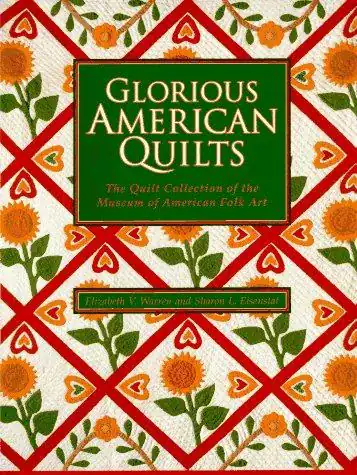
Hi All, I have a copy of AGQ that I paid $25 for at Walden Books several years ago. I hadn’t looked at it for a while and decided to leaf throught it last night. Plate 37 is a “Masonic Ribbon Pieced and Embroidered Quilt” c. 1890. In the summer issue of “Quilt Restoration” Lisa Marie Ellsworth asked about KT silk ribbons and this is an outstanding example. My Pastor (a member of nearly every fraternal organization) said a Pilgrimage was an “annual conference” and the “breast ribbons” were supplied by your chapter. He said everyone attending a conference would have worn one of these ribbons as identification.
Another great book is “Treasury of American Quilts” by Cyril I. Nelson & Carter Houck. While I was leafing through this one I found two pictures of log cabins with “Black” centers. On page 62 is a Streak ‘o Lightning c.1910 in dark red and green, very Amish looking and made in PA. On page 91 is a Barn Raising in silk and velvet c. 1890, center and half of the block is black. This book originally priced at $35. was purchased for $12.98.
The next book “The American Quilt Story, The How-to and Heritage of a Craft Tradition” by Susan Jenkins & Linda Seward is one third history, one third pictures and one third patterns. On page 190 is a photo of a Carpenter’s Square Quilt. Two years ago I made this quilt for my Dad the carpenter. It turned out great, but the cutting instructions for the borders are all off by 1/2 inch. Not a big deal unless you cut your borders first, which I did, and have to go back and buy another yard of the “right” solid red material four weeks later. On page 98 is a paragraph about Ann Orr, and on Pg. 99 a photo of Ruby Short McKim’s Iris Quilt, and a finished quilt kit called Round-up Time. The book was first published in London in 1991 then in the US in 1995. I found it on the discount table for $10.
FYI I learned both verses of PoP goes….(mulberry bush not cobblers bench)…to sing along with the music of a jack-in-the-box (a toy from the early 50’s). At the end of the second verse the clown would pop out.
Sue in cold, but sunny NW Ohio
Date: Wed, 12 Nov 1997 14:08:07 -0800 | From: Sharon Harleman Tandy
<harleman [at] micron [dot] net>
QHLers, My friend, Ruth, from Idaho Falls, ID, is visiting Williamsburg the week of December 7th. If you know of q. displays, exhibits, shows, museums in that area could you please e-me quick and short notes and I will forward them to her. I realize the Renwick and the DAR have been mentioned repeatedly, but I have no opportunity to get to that area, YET, so have never saved that information. TIA, Sharon, Quilts & Answers, Boise, Idaho.
Date: Wed, 12 Nov 1997 14:29:27 -0600 | From: Maury Bynum
<maurybynum [at] textileconservators [dot] com>
Hi All.
I will be in the Roanoke Va. area this weekend–Where is the good antiquing and quilt hunting/museums in the area??Thanks, Maury Bynum
Date: Wed, 12 Nov 1997 16:57:11 -0500 | From: “Phyllis Twigg”
<ptwigg [at] radix [dot] net>
Xenia, are you saying that the “broadside” items in the Threads of = History book are printed on paper ? No cloth involved ? I was under the = impression that everything in the book had to do with “threads ” of some = nature. (By the way, I am borrowing this book from the library, a good = source of out-of-orint books.) Thanks, Phyllis
Date: Sun, 09 Nov 1997 13:43:04 -0500 | From: Alan
<quiltfix [at] bellsouth [dot] net>
Lisa, how old is that book? Can’t debunk without giving me all the facts! <G> If it is older than the Connections episode, maybe something came along to prove it….. Also, what about non-written versions? Before the printing press, books were awfully expensive – I can’t imagine they’d have written down the meaning of nursery rhymes!
Date: Wed, 12 Nov 1997 18:39:08 -0500 (EST) | From: JOCELYNM [at] delphi [dot] com
On 11-NOV-1997 21:29:25.8 Kittencat3 said to JOCELYNM >But the earliest known version of that nursery rhyme is 19th >century, according to the Oxford Book of Nursery Rhymes, and the >refrain was originally “Hush, hush, hush! We all fall down.” It has >nothing to do with the Black Plague. Sorry 🙁 Lisa, A couple of points to consider: While the earliest written version may be 19th century, that doesn’t mean that it might not have been around earlier. The Victorians were extremely fond of the Middle Ages, AND of ‘reconstructivist history’. In other words, they niced things up. <G> Since ‘hush’ is nicer than ‘ashes’, I have to wonder if the recorded version were someone’s effort to take an old folk poem, and make it more acceptable for children. We all learned it as ‘ashes’….it sort of stretches the imagination that if it were a poem written in the 19th century, that the lyrics could have gotten so corrupted so fast and so universally. After all…with the pop goes the weasel rhyme, we got several versions, and we know it dates back to at least the 17th (I had heard 16th). You’d expect several versions to arise over several centuries…but not ONE version that completely supplants the original, in one century. In other words, I intend to go on believing my myth. <G> Jocelyn
Date: Wed, 12 Nov 1997 21:38:56 -0500 | From: LDH312 [at] aol [dot] com >Date: Wed, 12 Nov 1997 12:52:38 -0500 (EST)
I hope that someone on the list can help me. I received this letter today, along with six graphics files that I have uploaded to http://www.quiltart.com/crazy.html
I don’t know how to answer this question regarding this crazy quilt and thought perhaps one of you would be able to help. Please send all replies to LDH312 [at] aol [dot] com.
Thanks! –Judy Smith
> >
Date: Thu, 13 Nov 1997 17:01:49 -0500 (EST) | From: JZgliniec [at] aol [dot] com
Dear Alan and All, The recent discussion of Broderie Perse caused me to look it up in one of my references:
The Dictonary of Needlework S.F.A. Caulfeild and B.C. Saward ISBN 0 907854 10 9
My copy is a facimile edition of the second edition of the book published in 1885. The first edition was in 1882. The book was originally published on London.
” Applique, Broderie Perse – A modern work, founded upon ancient and true applique, but differing from it in the nature of the material used and the labour bestowed:”
The applique technique is then described.
“in Broderie Perse the applied pieces are shaded and colored pieces of chintz or cretonne, representing flowers, foliage, birds and animals in their natural colors. These require no backing and are simply pasted upon a colored foundation and caught down with a Feather or open Buttonhole Stitch. Broderie Perse was practised 200 years ago, and then fell into disuse. It is capable of much improvement from the patterns ordinarily sold and though, by reason of its attempting to imitate round objects in nature, it can never attain an art value, still it could be made a more harmonious decoration than it is at present.”
They go on to discuss the “faults ” of chintz and its contrast with the background fabrics. I am not sure what they might have been looking at when they discuss the esthetics as the Broderie Perse quilts I have seen cause me to hyperventilate.
I thought this was very interesting. 200 years from 1882……..well you do the math. That puts the date in Alan’s original 1735 timeframe. I have never seen one or know of a published one dating that early………….
I thought the entry in the dictionary was interesting as it is the earliest ref. I have to the technique being called by that term. In general, I have had no quibbles with this source and no reason to think it is not an accurate statement of what was known at that time by these authors.
Regards, Julia
Date: Thu, 13 Nov 1997 17:52:52 -0500 | From: Cathy Hooley
Does anyone know the history of the Irish Chain pattern?
Thanks –
Cathy Goose Tracks Quilts – Broadalbin, NY http://www.albany.net/~gooset
Date: Sun, 02 Nov 1997 06:16:10 -0800 | From: Biz Storms & Alan Hibben
<quilts [at] inforamp [dot] net>
Greetings all. Seems my recent message was ill-informed. Appologies to all. Diane, thanks for the address for checking virus rumors. Have contacted IBM Canada and they are now checking. They advised me to still be extremely wary of ANYTHING that doesn’t look familiar. Also, while PENPAL and JOIN THE CREW are on the list, the last virus mentioned is not. Biz from Toronto.
Date: Thu, 13 Nov 1997 20:04:37 -0500 (EST) | From: WLEDU [at] aol [dot] com
Found this on the web:
http://www-tradoc.army.mil/rotc/mmi.html
Marion Military Institute, the oldest military junior college in the nation, was founded in 1842. The name honors General Francis Marion, the Revolutionary War “Swamp Fox.” The ROTC program was first offered at MMI in 1916 when the institute was designated as an Honor Military School with Distinction by the Department of Defense. In 1963, MMI allowed women to obtain fulltime student status during the regular school year for the first time and has remained fully coeducational since then. The U.S. Army Early Commissioning Program was established in 1964. Graduates of Marion Military Institute continue to reflect the quality of education and character building inherent in the MMI experience. Alumni are found in all walks of life – from medical professionals to government officials; from nationally known attorneys to prominent educators; from small business entrepreneurs to captains of corporate America; and from civic leaders to agricultural experts. Of our alumni who graduated within the last ten years, 64 percent have served in the military and 89 percent of these have been commissioned officers. Two hundred and ninety-nine of the alumni have attained the rank of Admiral in the Navy and Coast Guard or General in the Army, Air Force, and Marine Corps.
Winnie
Date: Thu, 13 Nov 1997 22:41:56 -0500 | From: Ricki Maietta
Theresa – regarding you 1858 quilt from Hughesville (probably PA) – I think it IS!
Hughesville, PA is about 20 miles east of Williamsport, PA AND – near Hughesville is a little town called Pensdale (lots of Quakers). There is a road there called “Narber-Fry Road” – looked at a house for sale there once (built in 1790s – maybe the house where your quilt was made!!)
This is a little TOO exciting!
Ricki in PA
Date: Fri, 14 Nov 1997 07:45:54 -0500 (EST) | From: Kittencat3 [at] aol [dot] com
The Oxford Book of Nursery Rhymes was published sometime in the late 70’s or early 80’s, and it traces “Ring Around the Rosey” to (of all things) a Kate Greenaway book published in 1881. The actual rhyme bears zero resemblance to anything I’ve ever read about the plague, including medieval sources; I was a medieval/ Renaissance literature major in college, and accounts of the plague are either horrifying prose about corpses heaping up in the streets, stories to amuse aristocrats who fled the cities (and the rats and the fleas – see The Decameron by Boccacio), or poems like William Dunbar’s “Lament for the Makers,” which lists all of his fellow poets who died young.
Also, only the rich could afford herbs to ward off disease, at least in the cities where the plague broke out, and the herbs were carried in sachets or stuck into pomander balls. “Pockets” were separate little cloth bags that were tied around the waist (thus “Lucy Locket lost her pocket/Kitty Fisher found it”).
The Greenaway version reads as follows:
Ring-a-ring-aroses, A pocket full of posies, Hush! Hush! Hush! Hush! We’ve all tumbled down.
There’s been a lot of strange theories about nursery rhymes, most of them pretty far fetched. The majority of what we now think of as “Traditional nursery rhymes” probably aren’t much older than the Victorians or the Regency period in England. Sorry….:(
Lisa Evans Easthampton, MA [in the middle of a nasty sleet storm]
Date: Fri, 14 Nov 1997 11:04:32 -0500 (EST) | From: TeresitaF [at] aol [dot] com
Ricki (and all)
Thanks for your postings concerning my quilt.
How exciting!!!! Oh, I would have loved to see that house…if she didn’t live there she probably knew the people who did.
I found an address for a Narber family in Hughesville, PA (rural route box, maybe a farm???). I’m a little nervous about contacting them…considering the size of the town, etc. I’m sure they must be related in some way. The next time I’m up visiting my family, I’m going to try to drive over to Hughesville and spend the day looking through anything I can get my hands on that may shed some light into the lady who made this quilt.
How would I go about getting a hold of a 1860 census? This project is really turning out to be a great bit of fun!
Bye for now…
Theresa in OK
Date: Fri, 14 Nov 1997 11:19:18 -0800 | From: Anne Copeland
The Mormon Church, if there is a larger one nearby is often a wealth of information. They need to have a geneology library, but I found one in the Los Angeles, and was amazed at the records I found, from every state in the US. They had records of household inventories, and included slaves and household linens in many of these. I can’t remember if they had a census or not, but you can write the Census Bureau and find out where such information would be located. They may even have a web site.
Good luck with your research. Hope this helps you.
Anne Copeland
Date: Fri, 14 Nov 97 15:40:48 EST | From: “Bob Mills”
One of my quilting students came to class this week bringing two old quilts that she had from her parents. She mumbled that it was ok if I didn’t want to see them and that I would think she was crazy for trying to repair them.
The first one was baby blocks and belonged to a ‘great-great’ grandmother(not sure of details) and that it was carried out to Ohio on a covered wagon by the woman. A lot of it was shredded and my student, while in a body cast some years ago, had replaced many of the pieces with ‘old looking fabric,’ and made the quilt slightly larger and rebound it. She was afraid that she had ruined it, although her dad had used it to wrap furniture in, etc. her repairs were nicely made, but more fabric was disintegrating. I suggested she applique pieces over the disintegrated ones. She wants to be able to put it on a bed and cherish it.
Her second quilt was a log cabin-with wool centers made out of her great-great grandfathers wedding coat. Guess what color the centers were? Black. The centers were proportionately large compared to the small blocks. Lots of silk, wool, etc. fabrics but not too many were shredded. She had already picked out the ties and backing and basted on a muslin inside and a new cotton backing and will tie the quilt back together. This one has very narrow strips-about 3/4″ and is a big quilt.
My advice to her this week will be to find out more dates and names and places of her relatives so she can add to the quilt’s history.
We had just played with log cabin blocks the week before in class, arranging them in all different designs, so this was a treat for everyone to see.
Jan Drechsler in gloomy, rainy NJ
Date: Fri, 14 Nov 1997 16:26:03 0000 | From: “The Garretts”
One of the ladies I do volunteer work with was a mill owner’s daughter growing up. I started asking about her memories of feedsacks and she agreed to be interviewed by me — couldn’t believe I thought she had something interesting to tell about. Most of what she said reinforced things I had previously heard, but first hand hearing is nice. For those who are interested , a summary of my notes follows —
Alice, born 1927, eastern Lancaster County, PA, father acquired mill from his father-in-law in 1934. It was a flour, feed and grain mill, and being a miller was a full time job. Economic condition – average, not poor. Family was medium conservative Mennonite — cape dresses, prayer coverings with loosely tied ribbons, men in black plain suits, drove cars and trucks.
The family lived across the driveway from the mill. Alice remembers going with her mother to pick out bags for dresses. With 5 daughters, they got first choice. Her mother was good at sewing and they were never ashamed of their dresses. Girls wore feedsack dresses til joined church — age 15. Ladies did not use feedsacks for their cape dresses. Her brothers did not have shirts of feedsacks.
Alice remembered making and using pieced comforts — “they are knotted”. They were often 4 and 9 patch, not alot of detail, made from scraps, knotted, flannel or feedsack back, inside was an old comfort with new top or old blankets. After she was married (1949) she bought comfort batting for her children’s and grandchildren’s comforts.
Quilting was a big part of her mother’s life. Had parties at home for aunts and friends. Enjoyed playing with kids that came along — would sometimes get into trouble. When she got older she would thread needles and help with the tying, but never helped with the quilting. Her mother went to sewing circle at church (Mennonite) once a month where they would quilt and knot comforters.
She remembers both Plain and non Plain families using feedsacks. Most were farmers, but she and her sister also remember selling feedsacks — for 20 cents each they think. She said her father emptied the 100 lb sacks and mixed the contents with other stuff and they flattened the sacks and sold them.
She helped in the mill and drove trucks to make deliveries in the 40s. She would get fabric either with her mother or father. She remembers women coming to the mill and picking out bags, and whole families coming, especially the girls to pick their fabrics. Men did also come alone.
Items she remembers from feedsacks — Girl’s dresses — yes Women’s dresses — no Boy’s shirts — no, but knows other families did Underwear — no, but her grandmother made slips and underwear, her mother did not Dishtowels — yes Quilts — yes Curtains — yes Pillowcases — yes Sheets — no, but her mother-in-law had done this Stuffed animals — yes Doll clothes — yes, from her mother’s scraps
Her 4 younger brothers would play mill — they had a rigging set up in a window to hoist the bags inside like dad did — Alice and her sister would make 5″ by 5″ bags for the brothers using mom’s scraps — both printed and plain — and fill them with spilled grain from the floor. The boys would load these bags onto their toy trucks and hoist them inside, just like dad.
Married in 1949, she did not use feedsacks as a young married, and didn’t make any clothes for her children from them. Her dad still owned the mill, but the only feedsacks she used were for dishclothes, which she got from her mother, not from the mill. She doesn’t remember them being used as fabric after her marriage.
I loved the the story about making the toy feedsacks for her brothers. Alice is a dear and said she will ask her sisters when they get together if they remember anything else. She finds the interest in feedsacks humerous and when I showed her the feedsack top I had just pieced she found numerous prints she recognized. That was fun for both of us. Her memories of feedsacks seem to be happy ones — it was the fabric everyone was using, because it was there and available.
Thank you for reading, I hope it was interesting.
Barb in southeastern PA <bgarrett [at] fast [dot] net>
Date: Fri, 14 Nov 1997 17:05:33 -0500 | From: Judy Smith
..who helped Lauriie better identify her silk log cabin… She now has a handle on what she has and what she should do with it… BTW, I KNEW it wasn’t a crazy quilt…<G> –Judy
-Judy
Date: Fri, 14 Nov 1997 17:15:22 -0500 | From: DeSchuit [at] ix [dot] netcom [dot] com
Barbara, Thank you for sharing the feedsack story from Alice. I don’t contribute much to this group but I learn alot. I am a wannabee or a should have been. — Kathy in NH 🙂 DeSchuit [at] ix [dot] netcom [dot] com “Families are like quilts: lives pieced together, stitched with smiles and tears, colored with memories, bound with LOVE.”
Date: Sat, 15 Nov 1997 04:25:02 -0600 | From: [from unknown, signed “Laura”]
Judy: Glad I could be of help. Has she found anyone locally to appraise it? Laura > > > We invite you to become a Charter member of the Vintage Quilt & Textile Society. An organization devoted to the study and sharing of information on vintage quilts, textiles and related topics. Monthly newsletters, local meeting for those available and annual conference. For more information contact: Laura Hobby Syler Lisa Erlandson Vintage Quilt & Textile Society 2401 Blue Cypress Richardson, TX 75082 vqts1 [at] airmail [dot] net Please include snail mail address for complimentary copy of newsletter
Date: Fri, 14 Nov 1997 16:05:21 -0800 | From: nikdeb [at] juno [dot] com (Debra L Hofland)
I’d love to hear any answers to this topic too, since I’ve recently fallen totally in love with nine-patches.
Deb in Spokane
Date: Sat, 15 Nov 1997 14:02:02 -0800 | From: nomadic one
<nomad1 [at] ibm [dot] net>
G’day QHL’ers, Just a quick note to say I have not popped off the face of the earth! Just that gremlins seem to have taken over our computer & I never know what is going to happen next. I have been off air for yonks.So if you are waiting for a reply & have not heard from me, please do remail. I am slowly wading through those that were waiting there on the server. TTFN, Hiranya Loder from Sydney Australia where we are already roasting, though its still supposed to be Spring! >^..^<
Date: Sat, 15 Nov 1997 00:21:54 -0500 (EST) | From: JBQUILTOK [at] aol [dot] com
QuiltFixer [at] aol [dot] com wrote: >My favorite quilt is a baby quilt that Barbara Brackman believes is about >1840. It is the light double pink in the sashing and many chocolate brown >prints in the bow ties. I just wonder if this quilt was made for a baby >that died as the quilt is in such good condition and looks as though is was >carefuly put away and not brought out for a long, long time.
It was not unusual for unmarried women to spend their time making clothing, etc for future children. I read of a stash of baby clothes found in the attic of a spinster. Apparently she spent a great deal of her reproductive years planning to have the best dressed child in town. They were all carefully stored in a chest in the attic. Friends or relatives could also have made the quilt & then had a falling out with the intended mother. (I kept a baby quilt I’d made for charity for about 5 years because I loved it too much to just give it away. If my stepson and his wife I like hadn’t had a little girl a year ago, it would still be in my closet!)
It’s kind of fun to speculate on the past, isn’t it?
Janet
Date: Sat, 15 Nov 1997 00:43:14 -0500 (EST) | From: JBQUILTOK [at] aol [dot] com
Laura Hobby Syler asked about the dates of the Kansas City Star patterns. These ran from 1928 thru 1961. The first pattern printed was a 15 inch Pine Tree. There were 1,068 patterns which included 4 series quilts (Santa’s Parade, Memory Bouquet, Horn of Plenty, and Happy Childhood). Central Oklahoma Quilters Guild collected all of the patterns & made samples of each. The individual blocks & the series quilts are usually shown at our every-other-year quilt show in August.
Date: Sat, 15 Nov 1997 21:24:12 -0600 | From: Laura Hobby Syler
<texas_quilt.co [at] airmail [dot] net>
JBQUILTOK [at] aol [dot] com wrote: > > Laura Hobby Syler asked about the dates of the Kansas City Star patterns. > These ran from 1928 thru 1961. The first pattern printed was a 15 inch Pine > Tree. There were 1,068 patterns which included 4 series quilts (Santa’s > Parade, Memory Bouquet, Horn of Plenty, and Happy Childhood). Central > Oklahoma Quilters Guild collected all of the patterns & made samples of each. > The individual blocks & the series quilts are usually shown at our > every-other-year quilt show in August.
Thanks for posting this to the list. I’ve had several people e-mail me privately asking for any responses. VQTS will be doing several articles in the Dec newsletter based on our upcoming meeting (Nov 21) on Feedsack Quilts (YES! Jane, aka “Baglady111”, will be there) and depression era patterns. TA… Laura> > >
We invite you to become a Charter member of the Vintage Quilt & Textile Society. An organization devoted to the study and sharing of information on vintage quilts, textiles and related topics. Monthly newsletters, local meeting for those available and annual conference. For more information contact: Laura Hobby Syler Lisa Erlandson Vintage Quilt & Textile Society 2401 Blue Cypress Richardson, TX 75082 vqts1 [at] airmail [dot] net Please include snail mail address for complimentary copy of newsletter
Date: Sat, 15 Nov 1997 09:23:41 PST | From: “Tammy Western”
<tsw31 [at] hotmail [dot] com>
Hello,
I’m building my own web page and I was wondering if anyone knows of a good web site with clip art, backrounds, gif files, etc…. I have some but I’m still looking…
http://www.geocities.com/Heartland/Prairie/3824
Thanks for any help you can give!
Tammy in WV (PS-if you visit me, sign my guestbook please!)
_
Date: Sat, 15 Nov 1997 19:16:12 0000 | From: “The Garretts”
<bgarrett [at] fast [dot] net>
Last week I spoke to the Women’s Fellowship of a local church — I give a talk on the social history of quiltmaking illustrated by 50 historical doll quilts I have designed and made — and one of the women said she grew up 1 block from my circa 1800 house. The ladies invited me to visit their bazaar which was today and while talking to this woman about her 50 year old memories of the community, another lady sat down and joined in and started talking about the local feed mill. This perked up my interests so while she ate her breakfast, I took some notes — not a formal interview, but interesting facts none the less. It is truly amazing where you can find information. The only thing I said to get her started was — tell me about using feedsacks when you moved to the farm.
Ruth married in 1939 and moved to a farm with no electricity and no bathroom in northern Chester County. Lived there 5 years and moved to a neighboring farm with electricity. Her feedsack remembrances are as a young married farmer’s wife.
The mill they dealt with was James’ Mill — now a beautiful residence. When she visited, the owner’s son George would say “which colors do you want today”. She could only afford to buy 2 bags of chicken feed at a time, so George would set aside the other 2 matching bags for her to pick up “next week when the milk check came in.” That’s how she got enough matching ones to get a dress. She said she made plain simple straight dresses from the feedsacks, and also curtains for the farm house.
She thinks the bags of chicken feed cost $3 or $3.50. Sometimes she would tell her husband to “pick out something nice” when she didn’t go to the mill. He would say “I don’t know what you like” so she would usually go with him. When she didn’t and if he brought something home not to her liking she would “make a dress to wear only in the barn.” (She said this with a smile)
Ruth is 80 years very young, and seemed very happy with her remembrances of using feedsacks — she didn’t indicate that they were terrible to use, but did admit that they were very poor and being German you used what was available. Unfortunately, breakfast was about over, and she had lots of people wanting to talk to her, so we never got to talk quilts, except she said …
Her grandmother’s quilting group at church — a Lutheran Church in Shafferstown, PA — either Lancaster or Lebanon County I think — would hang quilts around the walls that they had made during the year when the church had their Thanksgiving Dinner. The quilts were for sale, and people would buy tickets for the family style dinner held the Saturday before Thanksgiving during the 1930s — she remembers attending as a teenager — and all the quilts would sell. Her mother never attended the quiltings — she said all the women were over 65 who quilted.
I hope I can arrange to meet with her again. She has opened up some interesting new areas. I had never heard of the mill owner holding bags for you til next week, but she freely offered that piece of information, and when I asked her about it she indicated that it wasn’t all that special of treatment. Old time small town friendliness, I guess. One question I have if anyone knows of receipts, account books, etc — what was the price of a 100 lb bag of chicken feed in the 30s and 40s. Thanks.
Thanks for reading, and I promise no more feedsack postings <grin>.
Barb in southeastern PA <bgarrett [at] fast [dot] net>
Date: Sat, 15 Nov 1997 19:08:13 -0500 (EST) | From: JOCELYNM [at] delphi [dot] com
favorite quilt
On 15-NOV-1997 00:51:44.8 JBQUILTOK said to JOCELYNM > It was not unusual for unmarried women to spend their time making >clothing, etc for future children. I read of a stash of baby >clothes found in the attic of a spinster. Janet, When my mom introduced me to quilting, she also introduced me to the concept of the ‘hope chest’. Unmarried girls were supposed to spend their free time (as opposed to the time they owed their mamas, doing mending and making clothes for the household) making linens for their future home. I’ve read of quilting traditions that said that if a girl didn’t have a dozen quilttops in her hope chest by the time she turned 21, she’d never marry! <G> In areas that had this tradition, it was apparently the custom not to quilt the tops until the girl was ready to marry, possibly due to the lack of storage space in her parents’ home. The parents would host a quilting bee, and at the bee, the girl’s engagement would be announced, as the women worked on HER quilts, not her mother’s, for the first time. Additional bees would be held as needed to get the dozen quilts quilted, and to provide her with all the accumulated wifely wisdom of the community. <G> Let’s see…as of last night, I have 5 quilttops…which probably explains why I’m unmarried! <G>
Jocelyn
Date: Sun, 16 Nov 1997 17:40:14 1100 | From: LiJoo
<lijoo [at] vermont [dot] starway [dot] net [dot] au>
> >Thanks for reading, and I promise no more feedsack postings <grin>. > >Barb in southeastern PA ><bgarrett [at] fast [dot] net> >
Hey, Barb! I am really enjoying the feedsack postings and if you have more to tell, I would want you to continue. If others on the QHL are not interested in hearing more, then, Barb, please e-mail privately to me to tell me more, because I find it all very fascinating and interesting.
LiJoo Melbourne, Australia – where I should be studying like mad for my exams and not writing this! 🙁
Date: Sun, 16 Nov 1997 01:40:07 -0500 (EST) | From: ROM1026 [at] aol [dot] com
In a message dated 97-11-15 23:37:55 EST, you write:
> Ruth is 80 years very young, and seemed very happy with her remembrances of
> using feedsacks — she didn’t indicate that they were terrible to use, but
> did > admit that they were very poor and being German you used what was available. > > Hi all, My Aunt was just over and we were talking about quilting. She told me she started sewing with feedsacks. She could not wait to go and buy the sacks and make something. She remembers loving a shorts pattern. It was neat to hear her talk about Feedsacks. Jane have you ever run across a shorts pattern? I would love to find one for her. Thanks Pat in rainy and brrrrrrrr NJ
Date: Sun, 16 Nov 97 20:35:17 PST | From: John & Cinda Cawley
<cawley [at] epix [dot] net>
Hi Sharon, Your friend will want to go to the Abby Aldrich Rockefeller Folk Art Musem while in Wmsburg. Also the Wallace Museum of Decorative Arts. This in addition to the restoration proper. I love Wmsburg. Christiana Campbell’s Tavern is my favorite of the restoration’s restaurant. Their spoon bread is fine. Cinda