September 23 – 28, 1998
These restored messages come from the Quilt History List, an online forum where quilt historians, collectors, researchers, appraisers, and enthusiasts discussed antique quilts and related textiles. The archive dates from 1996 through approximately 2016 and is being restored gradually. Sign up in the form at the bottom of the page if you want to know when a new page is added. Original spelling, opinions, formatting, and inactive links may remain unchanged.
Primary topics of this QHL Digest:
- Copyright and Book Titles — Extended thread on whether book titles can be copyrighted, the difference between copyright and trademark, and how these distinctions apply to quilt pattern names like “Stack and Whack.”
- Quilt Show Insurance — Members share findings on insuring quilt shows for theft, damage, and liability, including options through NQA chapters, State Farm, Lloyd’s of London, and homeowner’s policies.
- Vintage Fabric Pricing Survey — Lisa Erlandson polls the list on current prices for vintage fabrics and how they are sold (by the yard, by the piece, etc.).
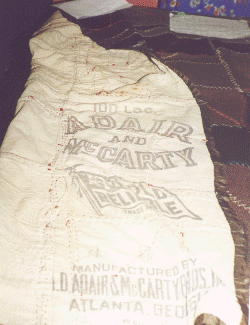
- Feedsack Memories and Collecting — Barb Garrett continues collecting feedsack recollections for the archive, and members share personal stories of feedsack use in their families. (see the article on the feedsack story)
- Looney Quilting Laws — Jean shares highlights from a QNM article listing absurd local laws related to quilting across the United States.
- Dating Fabrics Book Announcement — Kris announces that Hickory Hill Quilts is now carrying the new Dating Fabrics reference book. (see the article on dating quilts)
Date: Wed, 23 Sep 1998 21:27:44 EDT | From: Qltldy10 [at] aol [dot] com
Jean,
I’m days behind in my mail, so I hope someone else told you this… but… name of the book I have is Forties Fabrics, by Joy Shih, a Schiffer Design Book. Schiffer Publishing, 77 Lower Valley Road, Atglen, Pa. No phone number. Other books by same publisher: Fun Fabrics of the 50’s, Funky Fabrics of the 60’s, Couture Fabrics of the 50’s,and other books on vintage clothing (my italics, vintage equated to 60’s is kind of scary to me…). For those of you who have never seen them, the fabric books are mostly just photos, and close up shots at that. I only have the 40’s one, cause the other ones have photos of the stuff still in my closet (ok, not quite, but in my sisters closet!).
Beth in Maine qltldy10 [at] aol [dot] com
Date: Thu, 24 Sep 1998 00:33:40 -0400 | From: “Judy Grow” <Judygrow [at] blast [dot] net>
Maury,
From what I just learned in Omaha at the Quilt Restoration Conference, long narrow quilts were usually made for the hired hands — to cover a tall man in a narrow bed.
Harvest tables are long and narrow indeed, but until Martha Stewart and Ralph Lauren, I don’t believe women regularly covered their tables with them.
Judy in Ringoes, NJ judygrow [at] blast [dot] net
Date: Wed, 23 Sep 1998 22:37:13 -0700 | From: Audrey Waite <awquiltr [at] sedona [dot] net>
I am amazed that two authors can have books by the same title. You mentioned David Small. There’s also “Sewing on the Line, Fast & Easy Foundation Piecing” by Lesly-Claire Greenberg. I would think copyright laws would protect a book title.
Audrey in Sedona, AZ
Date: Thu, 24 Sep 1998 01:32:02 -0400 | From: “susanlk” <susanlk [at] erols [dot] com>
Re: musty smell and exposure to sun…I often hang my quilts on a line (if they are sturdy enough) with a sheet UNDERNEATH them and sometimes on top of them as well to protect against UV. The warmth of the sun and the ionization of the air around the quilt are still effective as is the fresh air blowing around. Also hanging the quilt bottom side facing the sun is another way to protect the quilt top while still getting fresh air and sunlight. Also, please bear in mind that the bad smell of the FW case is probably due to the strange glue they used to attach the fabric liner to the wood case. IMO efforts to get rid of that odor are temporary and leaving it in the sun or in a hot car or with a dryer sheet in there are all temporary fixes, but may indeed be helpful. SusanlK
>***************************************
Date: Thu, 24 Sep 1998 07:15:01 -0400 | From: Debby Kratovil <kratovil [at] his [dot] com>
At 10:37 PM -0700 9/23/98, Audrey Waite wrote:
>I am amazed that two authors can have books by the same title. You mentioned David Small. There’s also “Sewing on the Line, Fast & Easy Foundation Piecing” by Lesly-Claire Greenberg. I would think copyright laws would protect a book title.
the full title of David Small’s book is “Quilt Foundation: sewing on the lines”. Lesly-Claire Greenberg’s book’s title is different. Also, straight from her mouth, her book is due to be reprinted soon (it’s been out of print). She is the mother of all modern paper piecing/foundation piecing. There is an article about her in the upcoming issue of Miniature Quilt Ideas due out the first of October.
Debby Kratovil — Quilter By Design
http://www.his.com/~queenb
Paper Piecing Patterns & More!
Mac Pfaffie 7570
Date: Thu, 24 Sep 1998 08:27:19 +0100 | From: “Karen L Martin” <marti1kl [at] mail [dot] cmich [dot] edu>
One of my favorite memories is being at the farmhouse table and the fish quilted in the cloth in primary colors by my Mennonite great grandmother.
She also had lillies in yellow adn white applique, and a “fancy” for the dining room with black-eyed susans. These were all used up. I remember being so sad when she said that the fish had “seen their better days.” My mother had very little appreciation for quilts, and very little has survived in the family.
Karen
—
Karen Martin, Executive Secretary
Speech Communication and Dramatic Arts
333 Moore Hall
Central Michigan University
517-774-3178 (voice)
517-774-2498 (fax)
Email Karen.L.Martin [at] cmich [dot] edu
*–*–*–*–*–*–*–*–*–*–*–*–*–*–*–*–*–*–*–*–*–*–*–* “…just as the pieces of the quilt are sewn together with interlocking stitches, all people are linked together in the fabric of our world.”
–Teresa Gustafson
*–*–*–*–*–*–*–*–*–*–*–*–*–*–*–*–*–*–*–*–*–*–*–*
Date: Thu, 24 Sep 1998 06:41:30 -0700 | From: susan silva <woody [at] ior [dot] com>
Greetings!
Can anyone give me information about a quilt show in Kalispell Montana this weekend? (Sept 26th). Just happen to be going that way and heard through the grapevine that there is a show. My dh will indulge me (i hope).
Thanks for any info….susan in spokane
Date: Thu, 24 Sep 1998 09:54:22 +0000 | From: Jocelyn <jocelynm [at] sw1 [dot] socwel [dot] ukans [dot] edu>
> I am amazed that two authors can have books by the same title. You mentioned David Small. There’s also “Sewing on the Line, Fast & Easy Foundation Piecing” by Lesly-Claire Greenberg. I would think copyright laws would protect a book title.
Audrey,
There used to be such a tradition, and of course authors want unique titles because they don’t want you to buy someone else’s book by mistake. <G> But the incredible volume of books being published makes it impossible to require that each book have a completely different title. After awhile, all the logical titles are used up. Some titles were used by little-circulated and now out-of-print books; sometimes two books are developed by different publishers with the same name. I think the only limits are when you do it to defraud the public. For example, I couldn’t publish A Second Stack-n-Whack, even if Bethany Reynolds hasn’t trademarked the name as her own, because it would be clear to anyone that the only reason I’m using that title is to cash in on her fame and trick the public into buying my book. It also would interfere with Bethany’s ability to sell her 2nd SnW book.
<G>
Jocelyn
Date: Thu, 24 Sep 1998 09:41:11 -0700 | From: “fall” <fall [at] teleport [dot] com>
<teresa [at] execpc [dot] com>,
Hi everyone!
I just have to junmp in on this one as it is such an interesting topic. I’m working on my 8th book, and from what I understand about book titles, is that they are not copyrightable. That is, unless it’s under a trademark. For instance, a book called something like “How to Play Basketball” has a pretty generic title, and this type of title is not copyrightable. However, if the book is titled “Basketball for Dummies” the series itself is tradmark protected and no one else can use that name without a nice (make that icky)
legal battle.
It does come from the fact that title ideas are kinda limited, and they’ve all been used in one form or another. It is kind of a bummer, though, when I walk into B&N and ask for a book that I THINK I know the title for, only to find out there are 6 or 7 similar titles.
Oh well! Just another mystery of life, eh?
Best wishes to everyone, and happy quilting!
Cheryl
Date: Thu, 24 Sep 1998 13:40:52 EDT | From: Lalalawyr [at] aol [dot] com
<< I would think copyright laws would protect a book title. >>
Nope – you cannot copyright a book title, or any sort of title. Sometimes you can get trademark protection for a title, but that’s not at all automatic – you have to be very well known for that status.
Melissa
Date: Thu, 24 Sep 1998 13:45:24 EDT | From: [from unknown, signed “Melissa”]
In a message dated 98-09-24 01:48:54 EDT, awquiltr [at] sedona [dot] net writes:
<< I would think copyright laws would protect a book title. >>
Just a funny footnote illustration about how you cannot copyright or protect a title –
A friend went to a wedding, with the standard “Wedding Singer” sort of band. A woman made a request for “Dancing in the Dark,” intending to dance to the popular song from the 40s.
The band did a lounge-style version – of the Bruce Springstein song! LOL From my friend’s imitation of the band, and the woman’s reaction, it must have been hilarious.
Melissa
Date: Thu, 24 Sep 1998 13:59:39 EDT | From: Lalalawyr [at] aol [dot] com
In a message dated 98-09-24 11:07:16 EDT, jocelynm [at] sw1 [dot] socwel [dot] ukans [dot] edu writes:
<< I think the only limits are when you do it to defraud the public. >> No, this is not accurate, legally. (I just love it when non-lawyers start making these legal statements ;-).
The reason you probably could not use “Stack N Whack” is because it may have acquired trademark status. This doesn’t have to do with defrauding the public (although the reasoning is similar enough that it could confuse non-lawyers). It has to do with confusion as to the source – i.e., thinking you were buying Bethany Reynolds’ next book.
There are several considerations which go into trademark, and I’m not going to get dragged into another lengthy legal discussion with non-lawyers about these issues, as happened on another quilt list.
Suffice it to say that titles are generally not protectible, under copyright, trademark or any other legal theory. If authors and publishers want to avoid using titles which are similar to existing books, that’s because of their own marketing reasons – almost never because of legalities.
Melissa
Date: Thu, 24 Sep 1998 14:04:08 EDT | From: Lalalawyr [at] aol [dot] com
<< I’m working on my 8th book, and from what I understand about book titles, is that they are not copyrightable. That is, unless it’s under a trademark. >> Copyright and trademark are distinct and different – so you can’t say that a title might be copyrightable “under trademark.”
<< For instance, a book called something like “How to Play Basketball” has a pretty generic title, and this type of title is not copyrightable. However, if the book is titled “Basketball for Dummies” the series itself is tradmark protected and no one else can use that name without a nice (make that icky)
legal battle. >>
Titles, in general, are not protectible – doesn’t matter whether they are generic, or very specific and unique.
You have to meet certain tests to get trademark protection, and it’s not that easy to establish. If the “Dummies Guides to ….” has trademark protection, it would be because they are so well known (including their cover layout, colors, etc., which is distinctive) and identified with a particular source, level of quality, etc. – not because of the title itself being unusual or non- generic.
Melissa
Date: Thu, 24 Sep 1998 14:02:16 -0500 | From: “Lisa Erlandson” <erland [at] cooke [dot] net>
OK you vintage fabric shoppers out there – this is a quick survey: Not counting the incredible bargains you always write about – what kinds of prices are you finding on vintage fabrics – and how are you buying?? Is it per small piece, per yard (or feedsack) or what. I will report back my findings to the group.
Thanks for the use of the hall
Lisa in Texas where it is still in the upper 90’s (Did someone say Autumn?)
Date: Thu, 24 Sep 1998 14:10:13 -0500 | From: “Lisa Erlandson” <erland [at] cooke [dot] net>
I asked about quilt show insurance last week and several people requested that I share my findings – here’s what I have found out so far:
1. It is very expensive
2. NQA does offer coverage if the guild is a chapter of NQA and if they are a sponsor of the quilt show
3. Many quilt shows have the entrants sign a “release of liability” and forego the insurance. (I wonder if that would really hold up?) 4. Bill and Jean Lyle of our own QHL are insurance agents 5. Most quilt guilds have a contact within their group that is involved in insurance.
This is as far as I have gotten – haven’t had a chance to actually contact any insurance agents for quotes – I’ll let you all know about that process too.
Lisa
Date: Thu, 24 Sep 1998 15:26:44 -0500 | From: Swede <kittyboxers [at] toledolink [dot] com>
Have you guys tried Lloyd’s of London? We’ve used them to insure a [non-quilt] show involving a celebrity (for liability, no-show, etc.). Also to insure a table belonging to Marilyn Monroe on display in our gallery.
I believe they also indemnify concert promotors against rain and such.
Worth a look-see.
Date: Thu, 24 Sep 1998 22:04:53 -0700 | From: “Nancy” <fwfans [at] btc-bci [dot] com>
Hi all,
I know I haven’t actively participated in this group for a long time but with our schedule the way it is I just haven’t had the time. I do try to read everyday when we are home but sometimes that just is not possible. So bear with me because I need some suggestions.
OK it has taken me forever to get this baby quilt done now I need some help. This quilt was a love project for a family member and the quilt need some special care washing before it goes back to the owner. It has masking tape residue on it that has been there for an unknown length of time some sooty looking spot and various other areas that are going to need some attention. I do have the formula for the buttermilk bath and have not had time to try and besides was wondering if there is anything special that I should do before I put the soaking to the test? Your help is greatly appreciated.
Nancy from SW Michigan fwfans [at] btc-bci [dot] com miquilter [at] usa [dot] net
FW-Care Page:
http://fwfan.home.ml.org
Date: Thu, 24 Sep 1998 23:48:27 -0400 | From: Anthony Jones <ajones2 [at] tampabay [dot] rr [dot] com>
Actually you could call your book Stack and Whack. What’s trademarked is her technique.
Your Stack and Whack Quiults could be about making
Victorian crazy quilts. Same wirh Sex for Dummies; what’s trademarked is the look, layout, and content. You could certainly write a mystery novel and call it Sex for Dummies.
The current copyright/trademark frenzy is a particular soapbox of mine and no flame is intended. But, I’m worried how ramant commercializaton is going to effect the future of the art.. If our ancestors hadn’t freely shared patterns and ideas, we’d have a pretty miserable legacy today. Where are the new patterns our generation will pass on? At the same time, an artist has a right to profit from her original intellectual property. It really presents a dilemma. I recently saw a copyright on a pattern for a plain log cabin barn raising quilt. I wonder, was this an issue in the 19th Century or early 20th Century? I can’t imagine how many Kansas City Star patterns were reproduced and sold or entered in contests. Does anyone know what the pattern designers of the past thought?
Date: Thu, 24 Sep 1998 22:54:44 -0500 | From: Mary Waller <mswaller [at] iw [dot] net>
Last week, I asked my State Farm agent about insurance for short-term special events, such as quilt shows, and State Farm won’t do this kind of policy.
Mary Waller
Date: Fri, 25 Sep 1998 00:05:12 -0400 | From: “Judy Grow” <Judygrow [at] blast [dot] net>
To Lisa,
Price depends on what you are buying. Last Spring I payed $90.00 for an 18″ x 28″ piece of early chintz, and about the same for a full repeat of a toile in beat up condition. But I only payed $60.00 for yardage of an 18″ wide solid blue chintz, in pristine condition, and $25.00 for a large piece of an early yellow calico.
At a place I’ve written about here, “Jan’s is now Jean’s” I’ve bought 1930’s and 1940’s yardage for $4-5.00/yard.
In Omaha I saw fabrics for up to $300/yard at the Kirk Collection, but also in Omaha one of the attendees brought in a bolt (10 1/2 yards) of an 1850 brown that she picked up for under $5.00/yard.
While I was in Omaha my well trained DH spied a whole-cloth chintz quilt in a local antique co-op made circa 1850. She agreed to hold it until I returned because, as she said, I was a quilt enthusiast, and not a d__n decorator! When I got home I went to see it and brought it home. The thing about this quilt is that it is the same chintz on the front AND the back, and has not been washed. The quilting is mostly gone but the fabric is in very good condition. If I ever fall on hard times I can unpick this quilt for the approximately 18 yards of early chintz and retire, if I can get what the Kirks are getting for early fabrics.
Judy in Ringoes, NJ judygrow [at] blast [dot] net
Date: Fri, 25 Sep 1998 07:35:51 EDT | From: Kittencat3 [at] aol [dot] com
<< I would think copyright
>laws would protect a book title. >>
Uh, no. The *text* can be copyrighted. The *title* cannot. There are several examples of novels with the same or similar titles (I personally know of at least three, all by different authors, called “The Book of Ruth,” not to mention the Hebrew Scripture).
Lisa Evans
Date: Fri, 25 Sep 1998 07:12:31 -0500 | From: Laura Hobby Syler <texas_quilt.co [at] mail [dot] airmail [dot] net>
Anthony, My GM and her generation that I had the priviledge of knowing when I was just getting into quilting tried to out do each other by giving sharing patterns and designs. I can only imagine that when Ruby McKimm sold her design to the newspaper she wrote it in her ledger and moved on, delighted to see one made up somewhere. As to the soapbox , I whole heartedly agree! If I remember correctly, the whole issue really began back in the early ’80s(?) with Maria McCormick Snyder’s “Chrysalis” quilt…it appeared in Houston…a gentleman (engineer type-arent they always?) attending the show for the first time with his wife was so taken with all the wonderful geometric drafting, that he went home, played around and came up with the pattern (not intending to ‘copy’ Maria’s quilt.not even remembering exactly what he had seen or just *where* he got the idea..according to him, just dumb luck). It was submitted to QNM (my his oh so proud wife)…long story short, she sued the pants off of him. There has been an ongoing discussion on the QuiltBiz list about “should shop owners ask permission from the pattern designer to make kits up with their pattern…seems that one designer demands a fee. Further more, if you make a quilt with XXXX’s pattern and sell it, you must first have permission and purchase a liscense agreement…We pretty much beat that dead horse. This stuff has gotten so silly…It’s just as bad as throwing LOL’s in jail for selling raffle quilt tickets…raffle, ahem, donation quilt ticket sales were illegal in the state of TX until one of the Dallas guild members DH, who was a long term State Senator introduced a bill to “keep his wife and her LOL quilter friends out of the county pokey”.
Quilters are, by nature, some of the most honest, trusting, and giving people that you will ever find. Too bad the world of “big bidness” has gotten in the way
Laura
.>The current copyright/trademark frenzy is a particular soapbox of mine
>and no flame is intended. But, I’m worried how ramant commercializaton is going to effect the future of the art.. If our ancestors hadn’t freely shared patterns and ideas, we’d have a pretty miserable legacy today. Where are the new patterns our generation will pass on? At the same time, an artist has a right to profit from her original intellectual property. It really presents a dilemma. I recently saw a copyright on a pattern for a plain log cabin barn raising quilt.
>I wonder, was this an issue in the 19th Century or early 20th Century? I can’t imagine how many Kansas City Star patterns were reproduced and sold or entered in contests. Does anyone know what the pattern designers of the past thought?
Date: Fri, 25 Sep 1998 08:18:04 EDT | From: Qltldy10 [at] aol [dot] com
While I’m not sure if continuing the insurance thread is really “on topic”…
I’ve never been known to hold back…so-
I am a “professional speaker”, and also help folks put together conferences- When insuring for loss from a “non event”, that is, cancelling a conf, Lloyd’s of London is the only insurer I’ve ever known. This kind of insurance pays the speakers, plane tickets, and all of the costs to get ready for the event, fees for the hotels, etc. These policies can be written to cover for things like weather, or for things like cancelling for lack of enrollment. In a quilt show, though, not only might you want to cover for the former, you might also want to cover for loss of quilts (like when the roof collapses from the weather)…I don’t know if you could get/afford a policy to cover for theft… and I bet not any insurer would do a short term but pretty risky policy like that… I’m thinking that for most of the quilts on display, they could be covered by the owners homeowner policy, although probably with some specific wording… And, be aware that depending on the policy, quilts may be insured only for the value of the fabrics, not the time or estimated sale value. For instance, If you were showing a quilt which was then stolen, and it didn’t have a for sale signn it, it’s probable the owner could only recover the 100.00 in fabric, not the 1,000 you could have gotten had you tried to sell it. (BTW, same with insuring when you mail a quilt you made with the USPS). You can see how difficult it would be to try and estimate the value in a room full of quilts- and why there might not be much interest in writing such a policy for theft or acts of God/nature.
Bottom line, show insurance is bigo buckos, and most of the folks I work with, doing major events (like 100’s of attendees), can’t afford it.
Beth in MAine qltldy10 [at] aol [dot] com
Date: Fri, 25 Sep 1998 11:51:49 +0000 | From: Jocelyn <jocelynm [at] sw1 [dot] socwel [dot] ukans [dot] edu>
> sharing patterns and designs. I can only imagine that when Ruby McKimm sold her design to the newspaper she wrote it in her ledger and moved on,
Laura,
FWIW, McKimm was actually employed by the Kansas City Star as their designer. I don’t know if she had other duties on the paper. But she was the first of 3 people to handle the KC Star quilt patterns. She did most of her own designing, but her successor started including patterns sent in by readers, and the third editor used readers’
patterns almost exclusively.
McKimm’s attitude probably was different from the average quilter’s, in that she was employed for her designs, whereas a lot of the other designs were submitted by women who were ‘paid’ with the thrill of having their design chosen and their name in print. The KC STAR didn’t even archive the patterns, they were considered so insignificant! At the time, it was just ‘women’s work’… nobody got protection for needlework designs. That was for men who wrote serious books…..
Jocelyn
Date: Fri, 25 Sep 1998 15:13:21 EDT | From: Lalalawyr [at] aol [dot] com
In a message dated 98-09-25 04:50:22 EDT, ajones2 [at] tampabay [dot] rr [dot] com writes: << Actually you could call your book Stack and Whack. What’s trademarked is her technique. >>
I’m sorry, but you are mistaken. Techniques cannot be trademarked – they cannot be protected in any way, shape or form.
The instructions for a particular technique could be copyrighted, of course – but not the technique itself.
Names, however, can achieve trademark status through usage (with or without registration, which only establishes certain presumptions). So it is entirely possible that “Stack N Whack” could be trademarked, and this would preclude others from using this title.
I’m sure, for example, that if someone tried to use “Quilt in a Day” as a book title, they’d hear from Eleanor Burns’ lawyers. It’s a well-known series of books (as well as a television show, and her quilt store), so I think it would be pretty easy to establish the criteria for trademark status for that title/name.
Whether or not “Stack N Whack” has achieved trademark status is a factual and legal question, and sometimes this issue is far from simple – but as a lawyer who deals in intellectual property issues daily (and has done so for 16 years), I’m certainly not prepared to say that someone else could use it. << Same wirh Sex for Dummies; what’s trademarked is the look, layout, and content. You could certainly write a mystery novel and call it Sex for Dummies. >>
Maybe – maybe not.
It depends on whether there was a plausible argument that you were using that title in order to capitalize on the popularity of the “Dummies” series. Assuming that the “Dummies” series has trademark status, you’d almost certainly have to spend big bucks to defend a lawsuit if you tried to do this – so most publishers wouldn’t even go down that road.
But, of course, most book titles don’t have trademark status – which is why you will see multiple books with the same titles.
<< But, I’m worried how ramant commercializaton is going to effect the future of the art.. If our ancestors hadn’t freely shared patterns and ideas, we’d have a pretty miserable legacy today. Where are the new patterns our generation will pass on? At the same time, an artist has a right to profit from her original intellectual property. It really presents a dilemma. >> The copyright laws strike a balance in the issues which concern you, and they’ve been operative for a couple centuries without significant problems, either to designers/artists or to the general public.
Copyright protection is meant to encourage designers and creative people to come up with new designs and art, because they are allowed to profit from their creations. After all, how many people would write a book, if anyone could publish the same book and make money from it?
But there are limits on copyright protection (such as the duration of the term, and the “fair use” doctrine), and this ensures that the artist/designer does not keep a monopoly on a given work indefinitely, or in all circumstances.
Besides, many quilt designers either write books and/or publish the patterns – and this permits individuals to make the same quilt for personal use (just not for resale or any other commercial/public use). So hobbyist quilters really aren’t being deprived of these new designs for the most part. Personally, I don’t see the same problem you do with copyright protection. Eventually all quilt designs and patterns and books pass into the public domain. In the meantime, we generally have the benefit of the work of quilt designers in one fashion or another – even if only as inspiration. << I recently saw a copyright on a pattern for a plain log cabin barn raising quilt.>>
Just because you saw a copyright notice on that quilt does not mean it has any copyright protection. Copyright only protects what is unique and new – not anything pre-existing (whether public domain or under someone else’s copyright).
The log cabin block is clearly in the public domain, and the barn raising setting isn’t protectible anyway. So at best, the copyright in that quilt might protect that exact combination of fabrics, colors, block pattern, etc. And in all likelihood, it protected nothing – the quilt maker was probably being overzealous and/or unknowledgable to put the copyright notice on.
Melissa
Date: Fri, 25 Sep 1998 16:05:25 EDT | From: Lalalawyr [at] aol [dot] com
In a message dated 98-09-25 08:16:04 EDT, texas_quilt.co [at] mail [dot] airmail [dot] net writes:
<< It’s just as bad as throwing LOL’s in jail for selling raffle quilt tickets…raffle, ahem, donation quilt ticket sales were illegal in the state of TX until one of the Dallas guild members DH, who was a long term State Senator introduced a bill to “keep his wife and her LOL quilter friends out of the county pokey”. >>
I can see some very valid reasons to exempt charitable organizations from lottery laws. But state legislators are well aware of charitable raffles when they draft the laws – this is not a new phenomenon. So if they didn’t see fit to exempt charitable raffles, then you’re stuck with that law until you change it.
If a state senator changes lottery laws to permit raffle quilts – well and good. Until this happens, though, people should either obey their state’s law or be prepared for the consequences if they break them. And, of course, lobby to change the law if they wish – but not just moan about how unfair it is and how it shouldn’t apply to them.
Besides, a few quilt guilds facing fines for raffle quilts might be the best way to get a state’s law changed. (And btw, the law will look at the substance of the transaction – changing the name from a raffle quilt to an “opportunity quilt” or a “donation quilt” won’t shield you from prosecution). I really can’t see an argument against quilt guilds being aware of, and hopefully compliant with, laws relating to their shows, whether it is qualifying as a charitable organization under tax laws, or the potential liability from a slip and fall.
<< Quilters are, by nature, some of the most honest, trusting, and giving people that you will ever find. Too bad the world of “big bidness” has gotten in the way >>
I have quite a different perspective on this whole issue. I don’t think it is a matter of “big bidness” getting in the way of those nice little old lady quilters (though I hate this image, being barely middle aged, and having quilted since I graduated from college! ;-).
I think it’s a matter of some quilters wanting to do what they darn well please, and thinking that laws should be crafted to suit them personally. They want to ignore the very real and very valid reasons behind these laws. (Btw, I’m talking in a general sense – not meaning to insult anyone posting with different views).
Copying a quilt design and selling the pattern (or selling the quilt itself) is exactly the same, both practically and legally, as taking a copyrighted painting and putting it on greeting cards or cross-stitch designs. I find it quite odd that quilters usually understand the need to stop the latter, but some think they should be able to do the former.
I think that people have the right to profit from the fruits of their labor, and that quilters have sometimes taken advantage (perhaps unknowingly, perhaps deliberately) where they shouldn’t.
It doesn’t mean the law should be changed – it means people should learn the reasons behind the law, and how to stay within its bounds, rather than getting their knickers in a twist when they break it and there are consequences. It’s patently unfair to the people who publish quilt magazines and books and patterns, or to the people who design and write for those outlets, if one person buys the original and then a dozen make photocopies. (Btw, this is very different from passing around a single book, or a clipping, which is legal, as long as copies are not made).
The publishers, designers and writers all have the right to make a living. The quilt designers have the right to control their designs – to decide how and when and where they will license or permit their use. If you take the financial incentive away (or even decrease it significantly by unauthorized copies and uses), what makes you think you’re going to have all the lovely books and magazines and designs which are now available? Copyright protection does not stifle creativity – it has the opposite effect.
The technology that has made copyright infringement easier (photocopiers, VCRs) has given many people the idea that they have the right to infringe, just because they can and they want to.
In my view, the law hasn’t changed, nor does it need to be changed – the problem is some people’s sense of entitlement to disregard it when it suits them. I can’t see any reason for quilters – or any hobbyists – to have some sort of special dispensation from copyright laws.
Melissa
Date: Fri, 25 Sep 1998 19:01:55 EDT | From: QuiltEvals [at] aol [dot] com
Hi – Dorothy Osler, the e-mail address I have for you is not working, and someone in the UK very much wants to meet with you about a teaching project….please e-mail me with an updated address.
Thanks for letting me barge in..
Deb Roberts
Date: Fri, 25 Sep 1998 19:29:33 -0600 | From: Sharon Harleman Tandy <harleman [at] micron [dot] net>
Nancy and all QHLers,
Almost forgot to tell you; in Omaha at the Conservation Workshop in the Gerald R. Ford Conservation Center, Deborah Bede from the Minnesota Historical Museum’s conservation facilities (try saying all that fast!) told us that not only had she never heard of the buttermilk ‘thing’ but that it would have terrible long-lasting effects on textiles due to the fatty acids in the milk. Short-term whitening may be enough of an advantage for some quilts but not if you want them to last very long. Hate to dampen the enthusiasm for this ‘recipe’, especially since I haven’t gotten around to trying it yet) but feel we should know all sides of issues and techniques. Sharon Harleman Tandy, Quilts &
Answers, Boise, Idaho.
Date: Fri, 25 Sep 1998 22:13:13 EDT | From: Kittencat3 [at] aol [dot] com
Content-transfer-encoding: 7bit
One thing to add to Melissa’ s excellent summary – you can parody away to your heart’s content, and by and large, you’d be safe. A pamphlet satirizing Stack N Whack is fair game…..
Lisa Evans
Date: Fri, 25 Sep 1998 22:41:57 -0400 | From: “Judy Grow” <Judygrow [at] blast [dot] net>
I just found this in my local paper, and have not been yet, but will try to go next week and report back:
“Russian Fiber Art, Rider University Art Gallery, Lawrenceville, NJ, 609-895-5588, or 609-896-5168.
Opening reception for a traveling exhibition of work by prominent Russian textile artists Natasha Muradova, Ludmile Uspenskaya, and Ludmila Aristova curated by Princeton artist Joy Saville. The artists will also take part in a panel discussion in the gallery on Thursday, October 8, at 7:30 PM. Show continues to October 25. Free.
Monday thru Thursday 2 – 8. Friday thru
Sunday 2 – 5.”
Three things —
First — I believe Uspenskaya and Aristova have been featured in QNM. I may be wrong, but that is my recollection.
Second — Joy Saville is a Princeton area QUILTER. The Russians are QUILTERS also.
Third — This newspaper calls them all ARTISTS! Ain’t that wonderful. This paper makes no distinction. Forward thinking, eh what? (Or did they just print the news release verbatim?)
Judy in Ringoes, NJ judygrow [at] blast [dot] net
Date: Sat, 26 Sep 1998 00:06:42 -0500 | From: Mary Waller <mswaller [at] iw [dot] net>
If I understand my homeowners’ and business insurance policies correctly, my quilts are covered against theft by my insurance when they’re in my home, in my car when I’m in it and in my car when the car is “secured” (windows closed, doors locked etc) and if signs of forced entry are evident. But as soon as I turn them over to someone else, as in entering them in a quilt show or shipping them, they are no longer covered by my insurance. Another reason quilts need to be appraised: so that in case of loss or damage, their value beyond the price of the materials, has been documented. A separate rider on your insurance policy may be needed, just like if you have expensive jewelry, art, antique china, John Lennon’s Rolls Royce, etc.
Mary Waller
Date: Sat, 26 Sep 1998 08:21:22 EDT | From: JQuilt [at] aol [dot] com
Officer while you’re giving me a ticket … that car that just went by, has a kidnapped child inside…or
In 1866 Jean-Francois Millet painted a famous painting titled Noonday Rest..in 1889 Vincent Van Gogh painted the same painting…in 1910 Pablo Picasso painted the same painting..the first one is owned by the Museum of Fine Arts in Boston, the second one is owned by Paris Museum and the third one is owned by the Museum of Modern art in NY…..
Let’s not get carried away with the major ramifications of, some quilter copying a block pattern and then selling the quilt or some guild selling a raffle quilt.
Enough! let’s get on with quilting stuff..
jean jquilt [at] aol [dot] com
Date: Sat, 26 Sep 98 08:16:23 PDT | From: “Christine Thresh” <christine [at] winnowing [dot] com>
> Besides, many quilt designers either write books and/or publish the pat=
terns –
> and this permits individuals to make the same quilt for personal use
(just not
> for resale or any other commercial/public use). So hobbyist quilters
really
> aren’t being deprived of these new designs for the most part.
I am a small-time quilt block designer and a former publisher of fiber art books. Our copyright attorney told us that the actual pattern drawing= s and the specific instructions were the items we had a right to protect against copying. As I understand it, people can make quilts from patterns= and sell them, but they can NOT make copies of the pattern drawings and instructions and sell (or distribute) the patterns as their own. This mak= es sense to me.
Christine Thresh
http://www.winnowing.com/
Date: Sat, 26 Sep 1998 13:08:46 EDT | From: Lalalawyr [at] aol [dot] com
In a message dated 98-09-25 22:15:01 EDT, Kittencat3 [at] aol [dot] com writes:
<< you can parody away to your heart’s content, and by and large, you’d be safe. A pamphlet satirizing Stack
N Whack is fair game….. >>
Not necessarily – you’re mixing trademark and copyright issues. And please note the “by and large” qualification, and get legal advice if you’re thinking of publishing anything (including on the Net). #1 – What constitutes parody can be quite tricky.
Political satire, of course, is the easiest to justify on First Amendment grounds, since political speech is really the main thing the Constitutional framers had in mind to protect. (All of this relates to U.S. law, of course – I know that there are people all over the world on these lists). Outside of that, there is a four part test articulated in the “Pretty Woman” case (i.e., a test to see whether you have a parody that can be justified by “fair use,” which is an exception to copyright protection). But these guidelines are quite subjective and quite difficult to apply in many situations. So you might think you had a parody and still find yourself defending a lawsuit.
#2 – Copyright and trademark are quite different, so the “fair use” argument for a parody that might apply in to a potential copyright infringement does not apply if you are using someone’s trademark. You may still have a First Amendment argument, but it is not as clear cut. There is a tort known as “trademark disparagement,” so you have to look at that issue, which is not the same analysis as for copyright.
Melissa
Date: Sat, 26 Sep 1998 13:09:48 EDT | From: Lalalawyr [at] aol [dot] com
In a message dated 98-09-26 08:21:22 EDT, JQuilt writes:
<< In 1866 Jean-Francois Millet painted a famous painting titled Noonday Rest..in 1889 Vincent Van Gogh painted the same painting…in 1910 Pablo Picasso painted the same painting..the first one is owned by the Museum of Fine Arts in Boston, the second one is owned by Paris Museum and the third one is owned by the Museum of Modern art in NY….. >>
Using a copyrighted work for inspiration is not the same as copying it or making a derivative work in the copyright sense.
Van Gogh did not do an exact copy of Millet’s painting, and Picasso did not do an exact copy of either Van Gogh’s or Millet’s – nor did they use enough of the prior work(s) to constitute a derivative work. No copyright issue at all – so the analogy does not hold.
<< Let’s not get carried away with the major ramifications of, some quilter copying a block pattern and then selling the quilt or some guild selling a raffle quilt. >>
Some people may think this is a nothing issue in the quilt world – but if it were YOUR work being infringed, and your livelihood being potentially impacted, I’m quite sure you would feel differently.
In general (and not meaning Jean personally), it seems to be those who want to do as they please without consequence who minimize the importance of these laws.
So when you get hit with a copyright lawsuit for infringement, or given a fine for an illegal raffle, try the defense of “it’s just not that big a deal in the scheme of things” – and see how far it gets you.
Melissa
Date: Sat, 26 Sep 1998 13:17:32 EDT | From: Lalalawyr [at] aol [dot] com
In a message dated 98-09-26 11:28:32 EDT, christine [at] winnowing [dot] com writes: << As I understand it, people can make quilts from patterns and sell them, but they can NOT make copies of the pattern drawings and instructions and sell (or distribute) the patterns as their own. >>
The second part is correct, but the first is incorrect, unless your pattern includes some sort of blanket permission to sell quilts made from the pattern. Otherwise, this is not permitted under copyright law – you could make a personal quilt from that design/pattern, but not sell it. Of course, this is assuming the design itself is copyrighted, and not just the pattern pieces and instructions. If it is a public domain design, then anyone is free to make and sell the quilts made from that pattern – but not the pattern pieces and instructions.
In addition, there may be very little which is copyrightable about the pattern pieces. Needless to say, you can’t protect a square, a right angle triangle, etc.
Melissa
Date: Sat, 26 Sep 1998 23:04:20 -0500 | From: QLTRSTORE [at] harlannet [dot] com (Perkins, Jennifer)
Dear Friends,
I got the best surprise today when my Dating Fabrics book arrived from AQS-hot off the press! I haven’t read the text part yet, but the pictures and organization are wonderful!! I think this book will quickly become as important as Brackman’s “Clues in the Calico” and Encyclopedias. I had the great fortune to meet Eileen Trestain at the Quilt Restoration Conference earlier this month, and she is a dear sweet person. She has really put together a treasure, and the colors are so good! I know she sent back the proof sheets quite a few times to the printers until they got it right.
If you want to see what Civil War fabrics are like for you Dear Jane quilts, this is the book to get!
Enjoy!!
Jennifer in Iowa
Date: Sun, 27 Sep 1998 18:34:13 EDT | From: AZquilter9 [at] aol [dot] com
Melissa and QHL,
Thank you, Melissa, for the information that you have been so generously sharing on the copyright laws. I realize for some, this may not be important, but for those of us who may be contemplating doing things for publication, it is important on two levels.
The first level is to make sure that whatever we do not be in violation. I believe most quilters do not violate copyright laws intentionally, but from lack of correct information concerning the law. Usually this information comes to us from a well intentioned, but misinformed non-lawyers. The second level is to protect our creations from being “stolen” by someone else, who probably doesn’t realize they are in violation of the same law. Quilters are generous in sharing, but some are also trying to make a living through their creations and should be allowed to earn what is rightfully theirs.
I know what the hourly rate is for a lawyer in our area and so appreciate your generosity in keeping us honest and out of trouble.
My apologies to those who aren’t interested in this area. I promise to quietly lurk when the topic is something that isn’t of particular interest to me. I learn so much from this list even when it’s something I didn’t know I wanted to learn.
Thanks to all of you who share.
Lois
Date: Sun, 27 Sep 1998 20:40:41 EDT | From: JBQUILTOK [at] aol [dot] com
A recent thread on copyright contained this statement:
<< So when you get hit with a copyright lawsuit for infringement, or given a fine for an illegal raffle, try the defense of “it’s just not that big a deal in the scheme of things” – and see how far it gets you.
I just got back from the Oklahoma Quilters State Organization’s Fall Retreat. We’ve had a lot of problems in our state about raffle quilts. They are not legal & the ‘buy a piece of candy for a dollar & get a chance on the quilt’ is not legal either. One of our wonderful members contacted a legislator & he is in the process of attempting to get the law amended so that non-profit organizations are exempt. (There are a couple silly exemptions on the law books now, so we stand a good chance of getting this one!) It’s supposed to be introduced in January, so if you live in Oklahoma, please writing to your senator &/or representative & ask them to support this! And if you don’t live in Oklahoma, please don’t assume that because everyone does it, it is legal. Check yourself instead of blindly trusting your organization wouldn’t do it if it weren’t.
Penalty in OK was raised to a felony!
Janet
Date: Mon, 28 Sep 1998 07:57:12 -0500 | From: “Kris Driessen, Hickory Hill Quilts” <oldquilt [at] albany [dot] net
I have been delaying making the announcement that we carry Dating Fabrics until it came out – those of you in Omaha know that it was delayed due to the addition of more fabric and a change in binding. But it is here! Not as large as “Textile Designs” but I would say every bit as useful. And we do offer a QHL discount (which doesn’t show, I subtract it when the order comes in.) Here is the blurb: DATING FABRICS; A Color Guide 1800 – 1900. Improved before it was even released, this book now has 205 pages showing over 1,000 color swatches to help you recognize, identify and date vintage American fabrics as used in quilts and clothing. This pocket size book (5 1/2″ X 8 1/2) book is now priced at $24.95.
Order it on line at http://www.hickoryhillquilts.com/heritage.htm
Thanks!
Kris
~:*:~:*:~:*:~:*:~:*:~:*:~:*:~:*:~:*:~:*:~:*:~:*:~:*:~:*:~:*:~~:*:~:*:~:*:~:*:
http://www.HickoryHillQuilts.com
Antique Quilts, Vintage Fabric, Quilt Heritage Books,
Reproduction Fabric, Bottle Kits and Quilters Dream Cotton Batting.
PO Box 273, Esperance NY 12066
Phone: 888-817-6577. Fax: 518-875-9141
~:*:~:*:~:*:~:*:~:*:~:*:~:*:~:*:~:*:~:*:~:*:~:*:~:*:~:*:~:*:~~:*:~:*:~:*:~:*:~
Date: Mon, 28 Sep 1998 09:08:53 EDT | From: Baglady111 [at] aol [dot] com
Date: Mon, 28 Sep 1998 08:17:00 -0300 | From: KAREN BUSH <Birdsong [at] worldnet [dot] att [dot] net
I’ve been in lurk mode lately and have been reading the copyright discussions. I think it IS important to all for any kind of original works,etc, to know the laws along with just plain ‘ol good manners. Yes, quilters ‘as a whole’ are considerate of others as far as giving credit, well, at least ‘wondering’ if they should give credit for a specific work that was used and then taken to different levels with their own ideas added to the work. Right.
Having said that, I’m talking about NEW work, not the traditional patterns and designs.Have you ever been to Houston? When the “Primitive” styles started taking off like hot cakes about l0 years ago, Everybody jumped on the band-wagon and started designing the same style. Same style didn’t constitute ‘infringement’, but, some of the ‘new’ patterns are SO close that it looks like the original designers work with someone else�s name on them.
It’s a touchy situation. You don’t hear about lawsuits and copyright infringement because l) the hassle 2) the bad publicity (these people are trying to make a living with these patterns,etc and want NO bad publicity) 3) the expense of lawyers 4) and just because. NOT that they don’t have the ‘right’ to. Each pattern in EACH book has to be given it’s own separate copyright to truly protect the design/pattern. NOT just the book as a whole. I don’t know the legal jargon, although, I Should, but, I’m talking about ‘first hand’ knowledge/situations. Not from my own works, or book, but some friends are in the middle of this right now. It’s sad,it’s bad for business, and in general will give the quilt world out there a black eye. Although, it’s time that there are limits put on just how much a designer can be copied for monetary gain by the copier. Original designer #l has a book of designs collaborated with designer #2. Designer #l owns the company and EMPLOYEES designer #2 with her designs in the book,etc. BUT, designer #l owns the design by Legal right as owner of the company, meeting all the financial demands of publishing said paterns, shelling out the money for the running of the business and all the expenses, AND the salaries of Designer #2…along with paying royalties to #2 for the sales of the book. It’s getting confusing just trying to Explain this! Just think what it will be like in court!
Designer #1 has put up with all of this for YEARS because it’s just not worth the bad feelings in the quilt world. I’ve picked up a catalog of new patterns over the years and having a harder and harder time discerning WHO’S designs I’m looking at….Since #l has had so much success, there are DOZENS of new companies popping up with her original basic designs, and it’s hard to tell which ones are hers and which are ‘rip offs’. I call them rip offs because some of them haven’t changed or designed anything of their own work on the basic design ONE IOTA…and, as far as the ” 20% change” or you can change a border, etc, to be “legally correct” is NOT correct.
`
As far as Log Cabins, Nine Patch, the traditional desigsn, I believe they are for “Public Domain” or whatever the phrase is for the older patterns who have out lived any copyrights. Those are impossible to copyright as they are passed down for so many generations now, and probably never DID have a copyright. But, since the laws, designers have tried to protect their OWN designs. NOT to keep the work for themselves, but, when they design it’s always in the back of their minds to maybe to a ‘series’ of the same in more books. Without the copyright and if people are going to copy, outright copy, then, they lose their livelihood. Actually, it’s NOT a sticky or confusing issue. It’s just as much a legal issue as if someone went out and designed a car or anything else using the exact same parts, style, etc, as, say Ford Escort, or anything else. Quilts and all the businesses that have developed from quilts, quilting, books, designs, etc, shouldn’t be minimized just because they ARE quilts. No more than any other commercial product. I applied for a copyright for my book. NOT because I thought this would prevent it from being copied. I don’t figure on people NOT going to the Xerox and making copies for classes, etc. That’s already happened. That’s NOT to say it’s right, I just can’t ‘police’
this activity and instead of pulling out my hair, I just have to classify it as “flattering” that people l) willing to take the consequences of infringing on my copyright if they’re caught 2) several have called to ask if they can use it for classes they’d like to give from my book, and I usually answer, “of course, as long as each member of the class buys a book 3) or,…no, you can’t write your OWN book by using my book as a “guide”….that’s one’s already come up…Accchhh…!! Using it for ‘ideas’…I can’t do anything about, and if it helps them write their OWN book, fine. BUt, to use my work, word for word, …..don’t THINK so!!
My friends have learned the hard way, that copyrighting a BOOK doesn’t protect the individual designs IN the book. Each one has to be copyright protected. Ugh…But, for a court case #l DOES have a leg to stand on, unlike #2 who has blatantly used the designs for her OWN book. (her justification is that SHE designed for #l and is using her own designs for later books) Sounds good, sounds right, but NOT legal… The Quilt-world is basically and generally a friendly world to be in, but, business is business no matter WHAT the business is. IT’s a livelihood for Thousands and when that livelihood is copied, that means someone ELSE is benefiting from someone else’s hard work. Whew…guess all I should have done is given you the URL to do the research on this instead of my diatribe, but, it’s Not a nice situation for my friends right now, and it’s getting nasty out there in the markets,etc. That’s a shame.
Anyway, the URL for all of this and the information for copyrights, what constitutes “original” works,etc, is
http://lcweb.loc.gov/copyright/ To KNOW if it’s safe to use a pattern/design or whatever for commercial purposes, there’s always a die-hard method….CALL the DESIGNER!! Ask for permission. It’s the Only fair way, and they will usually grant permission by letter(if, in fact, they grant it), so you can have it in your file to protect yourself. I’ve done this and the designer is usually quite impressed by the fact they were actually ASKED! Enough, I’ve taken up a whole digest by writing ANOTHER book on this.
Sorry it took up so much space, but, this IS an important issue and the more new companies benefiting financially, the more this issue is going to come up. kb (out of breath and probably said Too much) 🙁
Date: Mon, 28 Sep 1998 08:18:36 -0500 | From: Mary Waller <mswaller [at] iw [dot] net>
I spotted one “Fruit Basket” dinner plate in an antiques shop. This is the design for Nebraska’s Grace Synder’s Fruit Basket quilt with the 8 bazillion (approximately!) pieces and on the cover of her biography, “No Time on My Hands”. It’s in very good – excellect condition and I’d be happy to get the plate if anyone here would like it; $10 would cover cost and shipping in the U.S.
Mary Waller
Date: Mon, 28 Sep 1998 11:08:32 -0400 | From: Barb Garrett <bgarrett [at] fast [dot] net>
Today’s feedsack memories come from 2 QHL members. My thanks to them for sharing. If you have memories to share and preserve in the feedsack archives, an information form can now be e-mailed to you, and returned to me the same way.
Fran was born in Newark, Delaware, in 1922. Fran said she has only one memory involving feedsacks, it is from her childhood, and is not a good memory. She grew up in Washington, D.C., and spent several weeks each summer with a cousin, who was a dressmaker in Wilmington, Delaware. One year Fran’s cousin made her a dress with matching panties from feedsacks. Fran hated the dress because all her friends were “city” girls, too sophisticated to wear anything like that. Claire was born in Nebraska in 1932, and her memories are also those of childhood. She was born and raised on a feed farm in rural Nebraska, one of 7 children and says she has wonderful memories of farm life and town activities which centered around the local Catholic Church and school.
Her mother would use her chicken and egg money to purchase the staples that came in feedsacks. When they had 3 sacks alike, her mother would take the children to Anna, the local dressmaker, and she would make their dresses. Claire remembers always being thrilled. Her mother used only white feedsacks for tea towels and aprons.
Claire also shared that her husband worked in a flour mill during high school. He remembers the women who came in and knew exactly what colors and prints they wanted, and woe to him if one of the bags got a tear in it when he was loading the sacks into the car.
Barb in southeastern PA
<bgarrett [at] fast [dot] net>
Date: Mon, 28 Sep 1998 09:17:19 -0700 (PDT) | From: Marilyn Maddalena <marilyn [at] crl [dot] com
Re quilt show insurance: The Chapter does have to be a member of NQA to purchase the quilt show insurance. Chapter dues are $25.00 annually for a new chapter, with a $17.00 annual renewal fee. Individual memberships are $17.00 per year. There are many benefits to NQA membership; among them is the quilt show insurance. We did a National Quilting Day show in the shopping mall and it cost us $25.00 for one day. You can purchase additional coverage for damage to the quilts at a very reasonable rate also. Our guild’s insurance company had quoted me $150.00. So,
NQA is “cheap at twice the price” plus you get the Quilting Quarterly — I do have an affiliation; I’m Publications Chair for NQA. But it’s certainly worth looking into for both Chapters and individuals. Marilyn in Sacramento. Their e-mail is nqa [at] erols [dot] com.
Date: Mon, 28 Sep 1998 14:07:38 EDT | From: BrickWks1 [at] aol [dot] com
<< If I remember correctly, the whole issue really began back in the early ’80s(?) with Maria McCormick Snyder’s “Chrysalis” quilt…it appeared in Houston…a gentleman (engineer type-arent they always?) attending the show for the first time with his wife was so taken with all the wonderful geometric drafting, that he went home, played around and came up with the pattern (not intending to ‘copy’ Maria’s quilt.not even remembering exactly what he had seen or just *where* he got the idea..according to him, just dumb luck). It was submitted to QNM (my his oh so proud wife)…long story short, she sued the pants off of him. >> I also remember this story, but according to my files of old QNMs, the engineer never said that he had specifically seen Maria’s quilt. SHE was the one who said he did — he just said he came up with the idea. What was the outcome of the suit? I’ve always wondered that.
When I was working at QNM, we were forever running into this kind of situation. Case in point: when the Colourwash method first came out, and was promoted as Deirdre Amsden’s original thought, a lady from Australia wrote QNM demanding that we say SHE came up with the idea first. Who knows…at any rate, we used to joke a lot about there being a “quilt ideas pipeline” floating above us, and people tapping into the same idea. I think there may be more than a grain of truth to this.
NOW the people I personally have trouble with are the ones who use a pattern, and/or make an exact copy of a famous quilter’s quilt (including colorways), then promote it as their “original design” or own piece. (There is, in my mind, a big difference between a copy and an attributed interpretation. I.e., writing right on the quilt, “I was influenced by —- in making this quilt.)
Do you remember, more than a decade ago, when a lady copied Jinny Beyer’s Star of the East (the Good Housekeeping contest winner), practically thread for thread, then won a top prize in an AQS competition with it? I saw it in one of their “Prize Winning Quilts” compilations, and felt very nauseous…in that book, there was not ONE MENTION of Jinny and her quilt. I don’t know if AQS ever publicly addressed this wrong, but it has bothered me all these years.
One final thing on the Kansas City Star and other quilt columnists — please bear in mind that many, many (if not most) of their designs were actually redraws of patterns already in existence. So even they could not argue that all of their work was “original.” I do not think that this was, at least for traditional patchwork, even an issue at that time. Just considered “sharing.”
Cindy
Date: Mon, 28 Sep 1998 14:25:53 -0500 (Central Daylight Time) | From: Mary Persyn <Mary.Persyn [at] valpo [dot] edu>
In Indiana, with some paperwork, you can get permission to raffle a quilt. The Charitable Gaming Division of the State Department of Revenue handles it. Filling out the paperwork is less stressful than worrying about the guild members being arrested for selling chances on a quilt. The bottom line, however, is whether the local prosecutor, states attorney, or whatever they are called in your area, thinks that raffles by not-for-profits are worth prosecuting.
Our guild has gotten the NQA insurance for our last several shows. We ask the members to value their quilts themselves, reminding them that an insurance co. may not put the same value on a quilt that you do. We then add up the values and take out that much insurance. We also get “slip-and-fall” insurance for the show through NQA. The last time I did it, the insurance was relatively easy to get since the agent through which NQA works is used to doing quilt show insurance.
Just my $.02.
Date: Mon, 28 Sep 1998 19:27:59 EDT | From: JQuilt [at] aol [dot] com (Jean)
I don’t know of any sites, but I do have a copy of an article from Quilter’s Newsletter Monthly, NOv. 91, called “Looney Laws Concerning Quilting”, by Robert W. Pelton. He states that:
1. It is illegal to quilt in a cemetery in Bowman, NOrth Dakota. 2. In Bicknell, Indiana, it is illegal to smoke a cigar while making a quilt for a kid’s Christmas gift.
3. In Hackberry Arizona, you cannot be caught dipping snuff while quilting 4. In Upperville, VA, it is illegal to quilt on a Sunday if you are a woman who is single, widowed, or divorced.
5. In Chumuckla, FL an individual can be charged with “willfull slothfulness” ” for quilting on church property while a worhsip service is in session.” 6. You must have special permission from the sheriff in Attica, IA to buy, sell or trade quilts “after the sun goes down.”
7. In Franklin, KY an old law prohibits quilting after dar, 8. In Marion, SC an old law says that a girl can’t marry unless she proves her womanhood by providing her future husband with 3 quilts. These quilts must first be brough to her prospective mother-in-law for approval.
9. “Any woman working with others on a quilting project in Bluff, UTah, can wear heels measruing no more than one and one-half inches in height.” 10. If you’re a woman in Penninsula, OH you can’t sell your quilts at a roadside stand while wearing patent leather shoes. The fear is that “men ‘might look at the reflection’ in the woman’s shoes and thereby ‘see something they oughtn’t.'” 11. You can’t eat peanuts while working on a quilt in Schurz, NV. 12. In Kidderville, NH you can’t sell quilts in your front yard while reading the newspaper.
13. In Tranquility, NJ, it is against the law for a woman to be heard whistling while quilting on the Sabbath.
14. In Old Furnace, MA, a woman is banned from “working on a quilt if she’s wearing ‘body hugging’ clothing or ‘clothing that clings to her body.'” 15. In White Horse, NM you’re not allowed to sell quilts between “the curb and a building on any street.”
16. In Okanoggan, WA it is against the law to carry quilts “down Main Street in a wheelbarrow.”
17. In Clarendon, TX there is a law that states an attorney can be barred from practicing law if he refuses to accept a quilt for his legal fees. 18. Persons in Nekoma, NC who photograph people at craft shows while they are making quilts on the Sabbath can be fined and put in jail. 19.In Lowes Crossroads, Delaware, housewives arent’ allowed to swap quilts at noon in the town square.
20. In Hickory Plains, Arkansas, a married woman isn’t allowed to make quilts on Easter Sunday.
I don’t know about any of you, but if I ever need legal help I’m heading for Claremont, TX.
Nancy Schott
Date: Mon, 28 Sep 1998 19:27:59 EDT | From: JQuilt [at] aol [dot] com
thank you Barb for those “feedsack memories”
I would love to read a book comprised of feedsack memories and anecdotes…maybe Jane or someone she knows will write one someday.
jean jquilt [at] aol [dot] com