April 7 – 19, 2000
These restored messages come from the Quilt History List, an online forum where quilt historians, collectors, researchers, appraisers, and enthusiasts discussed antique quilts and related textiles. The archive dates from 1996 through approximately 2016 and is being restored gradually. Sign up in the form at the bottom of the page if you want to know when a new page is added. Original spelling, opinions, formatting, and inactive links may remain unchanged.
Primary topics of this QHL Digest:
- Teaching Quilting to Beginners — A member starting a quilting circle for near-beginners asks for guidance, and a newcomer from Charleston introduces herself.
- Unusual Double Wedding Ring and Import Quilts — A question about an oddly-pieced double wedding ring quilt turns into a discussion of how to distinguish imported reproduction quilts from vintage ones.
- Log Cabin and Eagle Medallion Pattern Research — Kris Driessen fields two forwarded reader questions on log cabin quilt-square origins and an 1800s Eagle Medallion applique pattern.
- Reproduction Fabric Sources — Members trade recommendations for reproduction-fabric shops to help a group researching an 1877 farmhouse restoration project.
- A Patriotic Quilt on eBay — J.G. Row flags a striking red-white-and-blue quilt for sale on eBay, opening what becomes a running thread about its origins.
- “Six Million Stitches” Deadline Reminder — Kris Driessen forwards Mary L. Tod’s reminder that submissions for the commemorative book project are due April 20.
- French Quilt Expo Location Mix-Up — A member asks whether a quilt exposition is in France or Houston, and others clarify it’s the Strasbourg expo.
- Quilt Restoration How-To — A newcomer asks how to get started in quilt restoration work and receives detailed advice on skills and pricing. (see the article on quilt restoration)
Date: Fri, 7 Apr 2000 13:55:37 EDT | From: JoytoRose@
Having recently formed a quilting circle (most participants have had only a few lessons in quilting) and having little knowledge of the Internet I am seeking some information on the following; 1 A website (or other source of info) which focuses on Church quilting groups. I want to have some models to go by as I work with the group to set goals for donation quilts, create a mission statement, etc. This does not have to be elaborate. We are just looking for as much feedback as we can get. 2. Pictures and patterns of full-size quilts made for especially newlyweds and crib sized quilts for newborns. Looking for traditional patterns and pictures (hopefully with instructions).
Date: Fri, 7 Apr 2000 20:47:13 -0400 | From: “Marlene O’Bryant-Seabrook” <marlobs@>
I am Marlene O’Bryant-Seabrook of Charleston, SC , a newcomer to the List. Most of my quilts are based on subjects that I research. I’ve, also had a paper published in the American Quilt Study Group’s Uncoverings 95. In the past few days, I’ve read several postings in the Archives that refer to “Hidden In Plain View”. With no interest in affecting anyone’s view of the book, I’d like to share some information related to the research/study/interest that I have devoted to the Gullah culture. ( Because of my long term lack of knowledge of the depth of the culture, I have done a redemptive six quilt – Gullah Series). To understand the Gullah people causes one to see some things quite differently from many others, including the vast majority of African-Americans. I am certain that this is the reason that my reaction to the Ozella Williams story has been so different. My initial doubt was related to whether she had “authorized” Tobin to tell the story, not in whether the story was true. In the many encounters when I spoke with her – or knew of her speaking with others – she always insisted that what she said was not to be written. No one will ever be able to determine if the story is totally true. I do believe, that even if it is not, it was told to Ozella by her elders. I heard her tell it or saw her telling it to others too many times to believe that – with no desire to profit monetarily or in any other form – she made up the story for conversation. I’ve heard references to the fact that she was educated. Believe me, education does not negate the mindset of the Gullah culture. The language that they use may sound different, but, the customs remain the same. M.D.s, J.D.s, PH.Ds, etc. who are the direct descendents of the Africans brought from the Rice Coast of West Africa to the Sea Islands for the purpose of planting, cultivating, and harvesting rice are still Gullahs. Being a Gullah has nothing to do with the language that they now speak or the amount of education they have acquired, it’s purely based on lineage. Also, knowledge of the situation in which the Ozella story took place makes you aware of how possible things were on the Sea Islands — even though they may have been impossible elsewhere. Because the climate/terrain was conducive to growing rice and the Europeans lacked the related knowledge, they specifically brought captured Africans from the same area–The Rice Coast– and kept them together in areas isolated by water from the mainlands. That is how they were able to retain, to this day, – the Africanisms of their language and culture. The ancestors of African Americans in other parts of South Carolina and the rest of the country came from various parts of Africa and because they did not have a common language/culture, they adopted Americanisms more readily. The Gullahs could converse in a somewhat common patois because of their common general origin. But, the real reason that Gullahs were able to “get away” with things, deemed impossible, is because they were virtually unwatched. Because of malaria, Europeans could not live on the islands, so, they moved inland and enslaved Africans literally ran the plantations with a few whites -whose lives must not have been much more important than the enslaved- who were left as overseers. That is why, until recent years, African-Americans owned almost all of the waterfront property–Hilton Head, Dafuskie Island, Seabrook Island, etc. – that has now become so attractive to the wealthy. In addition, I have been told by Ozella Williams’ niece and nephew that their ancestors were a preacher and a mid-wife who were allowed to go to neighboring plantations when their services were requested. This allowed extraordinary access. I saw Jacqueline Tobin when she spoke on John’s Island about a month ago and said to her publicly that it is crucial that she tells her audiences that this is “A family code story”, not “The African-American code story”. She agrees. I cannot attest to the veracity of “Miss Ozella’s” (that’s what I called her) story, I just know that if anyone could have pulled it off, a Gullah would have the been logical one to do so.
The Gullah “quilt code story” is not nearly as extraordinary as the “song story” which has been told in the documentary, The Language You Cry In”, seen on PBS. In the early 1930s, Lorenzo Turner, a linguist who cataloged over 3,000 African words/names among the Gullahs, discovered Amelia Dawley in a remote Georgia fishing village. She could sing a five line song in Mende (a Sierra Leoneon language) even though she did not know the meaning of the words. In the 1990s, Joseph Opala (anthropologist), Cynthia Schmidt (ethnomusicologist), and a Sierra Leoneon linguist discovered a woman, Baindu Jabati, in a remote Sierra Leone village who still knew the song which had been taught to her by her grandmother. The song was a dirge once performed at graveside ceremonies before Christianity and Islam were introduced over a century ago. It was passed down among the females because birth and death rites are women’s responsibilities in the culture. A later visit to Georgia revealed that Dawley’s 69 year old daughter, Mary Moran, knew the song. In 1997, she and her family went to Sierra Leone for a “homecoming” where the two women tearfully sang together. When the 90 year old village chief was asked why a Mende woman, captured more than a hundred years ago, would have preserved that particular song, he stated, “That song would be the most valuable thing she could take. It would connect her to all her ancestors and their continued blessings. You know who a person really is by the language they CRY in.” (Last sentence is old Mende proverb) In 1998, I met Mrs. Moran and her young granddaughter who has been taught to sing “the song.” Compared to their story, the story of ten quilts does not seem far-fetched at all. The direct connection between Sierra Leone and the Sea Islands has been shown on PBS in the documentary titled, Family Across the Sea.” The Hunter University (New York) Exhibition, of which I was a part a couple of years ago, was aptly named The Amazing Grace of the Gullah People. I apologize for the length. Marlene O’Bryant-Seabrook marlobs@ http://www.awod.com/gallery/rwav/marlobs
Date: Sat, 8 Apr 2000 09:23:29 EDT | From: JQuilt@
here are 2 tips i use and thought i would pass them along 1.whenever i have an arc/curve in an applique piece i use my pinking rotary blade … it works much better than clipping the curve.. 2. whenever i am hand pieceing a fairly long seam, every so often i back stitch once or twice…that way if the seam has to be ripped/unsewn i only have to rip out the spot that needs fixing, instead of the whole seam jean
Date: Sat, 8 Apr 2000 14:51:09 -0400 | From: “Martha Duff” <Martha@>
I went to the Quilters’ Heritage Celebration Quilt Show in Lancaster PA yesterday. The quilts this year seemed to me to be the most beautiful yet. The workmanship on many of the quilts was incredibly outstanding. I saw quilt after quilt with no ribbon that I could not believe had no ribbon. The competition was fierce and the winners were spectacular! That’s the way I saw it. This show was both exhilarating and exhausting. The vendors were great too. There were several vendors selling antique quilts, fabrics, and sewing items. I particularly enjoyed looking at the old toy sewing machines that I saw at several booths. I regret that I didn’t make it to the Feedsack convention nearby. I’ve already made plans to get a room next year and spend two days so that I can take in both shows and some of the other Lancaster area attractions. The show will be open from 11-4 tomorrow for anyone close enough to make the trip. Martha Duff Silver Spring, MD
Date: Sun, 9 Apr 2000 07:35:20 EDT | From: JBQUILTOK@
I just got home from a quilt show in Muskogee, OK. There was some nice work at the show, but I saw something really different in an antique mall on the way home. It was a double wedding ring – not terribly old (maybe 1960’s or 70’s). The arcs were traditionally pieced in shades of blue, but the center contained a pieced Ohio star. Anyone know a pattern source for this? Or was it more likely innovative on the part of the maker? (I don’t buy quilts & won’t be going back that way for about 6 months, but for you collectors – it was in good condition & priced at $165. One of the malls just south of Muskogee on US 69) Janet – hoping to see plenty of unusual quilts at Paducah Friday
Date: Mon, 10 Apr 2000 09:41:40 -0400 | From: Newbie Richardson <pastcrafts@>
Marlene, Thank you for your very insightful analysis of the African -American quilt code as expressed in Hidden in Plain View. We are indeed a nation of subcultures – a fact that gets overlooked more often than not. I think that we must be more diligent in identifying regional/cultural differences and sources when examining any American history before the mid- 20th c. Current “american” culture is really a product of the homogenization brought about by the GI Bill, the interstate highway system, and television. This homogenization (a trend that was started in the late 19th c and completed in the 1960’s – to speak very broadly) has caused at least one if not two generations of educators to teach “generalized” history from their mid to late 20th c. point of view. Case in point in his day Jesse James was not a common criminal so much as an unrepentant, unsurrendered Confederate still fighting the Federals by attacking the institutions of the Federal Government railroads and banks. We must always try to place people and their actions within the context of their cultures and points of view. You did the list a great service. Newbie Richardson in Alexandria, Va – where we had an inch of snow yesterday!
Date: Mon, 10 Apr 2000 10:50:17 EDT | From: QuiltFixer@
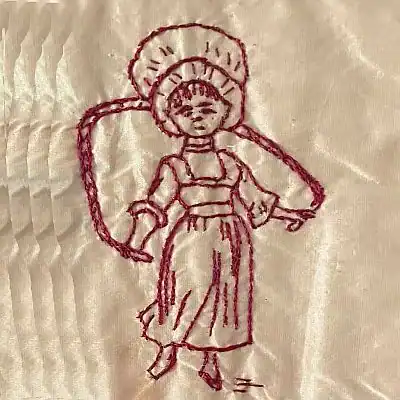
I am looking for a vintage flour sack (feed sack) that has embroidery patterns printed on it to use as a teaching tool. I will pay up to $75.00 for one. In any of you come across one in your estate sales, etc., would you help me out with this? Those in the East and the Midwest have a much better chance of finding one than I do here. Greatly appreciate it!
Toni Baumgard
The Redwork Lady redworkldy@aol www.redworklady.com
Date: Mon, 10 Apr 2000 20:10:36 EDT | From: JBQUILTOK@
>this does sound like one of the imported quilts that you can buy new for a lot less than that.. No, this was not a Chinese import. It had older fabric, good stitching & held up to some use and a washing or two. Janet
Date: Wed, 12 Apr 2000 08:16:57 -0400 | From: “pepper cory” <pepcory@>
I am so proud! Our quilt guild has finally joined the 21st century and as of today has its own web site! If you’d like to see the Crystal Coast Quilt Guild site, go to http://www.geocities.com/quiltey_2000/guild/quilters.html . We are really pleased with the site and welcome comments. The Donation Quilt has been our recent big project and you can see it by clicking on Donation Quilt on the left-hand menu of the site. More about the quilt–it’s a one-of, never-to-be-made again design. My friend Prahba and I drafted the compass, basing it on an 1840’s quilt top belonging to Lynn Gorges (aka Palampore to QHl’ers). The surrounding borders are sailboats (pieced and appliqued) and the corners are anchored by the four lighthouses along our coast (Ocracoke, Bodie, Hatterras, and Cape Lookout). The outer border was a blinger to do and I’m surprised my guild friends are still talking to me! The appliqued wave tops all around the quilt were not their favorite project…By the way, the applique and all the quilting is by hand! Please notice we welcome entries to our annual show from non-guild members. If you’re coming to vacation along the NC coast in May, we’d love to see you at our quilt show. Cheers from the Carolina coast- Pepper Cory
Date: Sat, 8 Apr 2000 08:48:12 EDT | From: JQuilt@
ever since watching that wonderful movie “Daughters of the Dust” i have been fascinated with the stories and histories of the Gullah culture..thanks for the great website that tells me more jean
Date: Sun, 09 Apr 2000 15:22:48 -0400 | From: Alan Kelchner <quiltfix@>
Jean, thanks for that pinking-rotary cutter tip. Now I’ll have to buy one, I guess <g>. I always appreciate those little bits that you might not come up with yourself. ALan
Date: Mon, 10 Apr 2000 14:17:31 +1000 | From: Sven Olsson <sven@>
Just my 2 cents worth, but this does sound like one of the imported quilts that you can buy new for a lot less than that.. Can’t wait ot hear from other folks. Lorraine in Oz
JBQUILTOK@ wrote > I just got home from a quilt show in Muskogee, OK. There was some nice work > at the show, but I saw something really different in an antique mall on the > way home. It was a double wedding ring – not terribly old (maybe 1960’s or > 70’s). The arcs were traditionally pieced in shades of blue, but the center > contained a pieced Ohio star. Anyone know a pattern source for this? Or was > it more likely innovative on the part of the maker? > > (I don’t buy quilts & won’t be going back that way for about 6 months, but > for you collectors – it was in good condition & priced at $165. One of the > malls just south of Muskogee on US 69) > > Janet – hoping to see plenty of unusual quilts at Paducah Friday
Date: Tue, 11 Apr 2000 17:30:36 -0400 | From: “Kris Driessen, Hickory Hill Quilts” <oldquiltalbany.net>
>I’m writing a project on LOG CABIN quilt squares. Do you have any imf. as to >the 1st quilt found, what was it made of, year it was found???? Any imf. >would be much appriated, THANKS Sandra Blwdwant2baol.com
Date: Tue, 11 Apr 2000 17:32:37 -0400 | From: “Kris Driessen, Hickory Hill Quilts” <oldquiltalbany.net>
>Was wondering if you knew of a pattern or a book that I can purchase that has >the 1800’s Eagle Medallion applique pattern in it. >Thank You Sue suetonybyelectric.com
Date: Wed, 12 Apr 2000 18:56:05 EDT | From: KareQuilt@
Can anyone give me a website for actually viewing fabric reproductions of this era and/or suggest pattern names that I can pass on to these quilters in Highland NC that just wrote to me? thanks, Karen Alexander <<A group in Highlands, NC is restoring a farmhouse circa 1877. A group of us are interested in making a quilt to donate to the project. What colors, designs, etc of fabric and quilt patterns would have been used in this area at that time? Do you have source suggestions for reproduction fabrics? >>
Date: Wed, 12 Apr 2000 18:10:29 -0500 | From: “L’etoile du Nord” <josiemtekstar.com>
http://www.reproductionfabrics.com This is one of the best spots on the internet for repros, from 1775 through the 50s! The shop is Patchworks of Montana, they are fast, dependable and will answer e-mail questions. Kris Driessen, our List Mom also has repros on her Hickory Hill website. Jo in Minnesota —– Original Message —– From: <KareQuiltaol.com>
> Can anyone give me a website for actually viewing fabric reproductions of > this era and/or suggest pattern names that I can pass on to these quilters in > Highland NC that just wrote to me? thanks, Karen Alexander > > <<A group in Highlands, NC is restoring a farmhouse circa 1877. A group of
Date: Thu, 13 Apr 2000 00:48:49 -0400 | From: “J. G. Row” <Judygrow@>
http://cgi.ebay.com/aw-cgi/eBayISAPI.dll?ViewItem&item01523426 A simply super patriotic red white and blue quilt! Has anyone any knowledge of the pattern being out in the public? Or was this just a super patriotic quilter! OOOOOOH! I love it! (but I’m not bidding — feel free.)
Judy in Ringoes, NJ judygrowblast.net
Date: Fri, 14 Apr 2000 08:20:52 -0400 | From: “Kris Driessen, Hickory Hill Quilts” <oldquiltalbany.net>
Hello everyone, We are nearing the deadline of April 20 for all projects to be sent in for the book “Six Million Stitches.” Please share this reminder with other lists that you participate in that might have people who had committed to participate in this project on them. I have almost 30 projects at this time, with many more still to come. Techniques represented include Assisi, blackwork, beading, cross-stitch, crochet, embroidery, needlepoint, and quilting. There are many, many lovely and unique designs — and truly inspiring creations — which will be a delight to Judaic stitchers when our book is completed. Your project will help us reach this goal, so don’t delay — send it in now. Mary Tod 8 American Ct. Baltimore, MD 21228-5304 Please do what you can to get your project in as soon as you can. I will do my best to let you know when it arrives, but I will let you know that I am going to be away from April 19 to May 4, so I probably won’t be in touch with you during that time. My husband will be home to receive your packages during my trip, and if anything is urgent, I will have email with me, so please let me know about any problems. Have a Happy Pesach, Mary http://www.quilthistory.com/judaic_stitchery.htm
Date: Thu, 13 Apr 2000 07:03:21 -0700 | From: “nms” <nmsjps.net>
Nylander that was posted to this list within the last few months. I don’t recall the name of the person that suggested this reading, but it is a good reference book and I thank that person. I purchased it directly from the National Trust for Historic Preservation on the internet. Hope this helps. Nance Searle International Society of Appraisers
Date: Thu, 13 Apr 2000 11:11:33 -0400 | From: “pepper cory” <pepcorybmd.clis.com>
Hello all, I’ve corrected my mail settings so hopefully my messages to QHL won’t be in HTML Mime anymore. I apologize if I messed up anyone’s QHL posts. Thanks to Kris for her advice. Several of you have asked the dates of our guild’s quilt show–it’s on the guild web site at http://www.geocities.com/quiltey_2000/guild/quilters.html but for your immediate information, it will be May 19-21 (the same dates as the Spring Quilt Market in Minneapolis so I can’t be at my own guild’s show!) About that patriotic quilt–MacArthur was a 5-star general but I think the quilter took artistic license and didn’t show every star. This is assuredly a during-the-war-or-right-after quilt. Notice the two gold stars? This quiltmaker was a mama who lost two boys in the war! I hope someone will research the quiltmaker-it’s obvious she put her heart into this quilt! Pepper Cory
Date: Fri, 14 Apr 2000 16:18:08 -0400 | From: “pepper cory” <pepcorybmd.clis.com>
Hi folks- Two things I need help with and QHL’ers being so-o-o knowledgeable, I hope some of you will reply privately to me with some answers. First inquiry I recently purchases a silk knit sweater on sale. Lovely thing, but on a warm day, reeks like somebody opened a tin of bad sardines! I must have had stopped-up sinuses the day I bought the thing! Advice on getting the fishy smell out of silk would be MUCH appreciated. Second item I’ve written a kids’ book (only barely quilt related-) and have lined up an illustrator. Somewhere I read (here?) that the procedure is to submit your book proposal with a couple of illustrations…correct? Anyone in QHL land have experience or advice for me? Thank you ahead of time- Pepper Cory in North Carolina
Date: Fri, 14 Apr 2000 17:10:02 -0400 | From: Christine_Grantpch.gc.ca
The mention last week of a quilt from Buxton, Ontario now on exhibit in Pennsylvania prompted me to forward these web addresses. I work for Parks Canada in Ontario, and some of the UGRR sites in the province are National Historic Sites. The first address below is from our Parks Canada web site and includes a map showing the locations of the sites. I’m sure that many of you live nearby and may want to consider a visit. The next address is from The African Canadian Heritage Tour, Underground Railroad Network, which includes links to many of the historic sites. The third address below is specifically for the Buxton National Historic Site and Museum, the people who lent the quilt. The web sites don’t talk about quilts or quilting, although there is a picture with several quilts at the Buxton Museum web site. I thought that many of QHLers would nevertheless like to know more about the Underground Railroad in Canada. Chris in Cornwalll, Ontario http://parkscanada.pch.gc.ca/ugrr/main_e.htm http://www.africanhertour.org/ http://www.africanhertour.org/buxton_national_historic_site_&_museum.htm
Date: Fri, 14 Apr 2000 18:22:23 -0400 | From: Sasha Mullally <smullallyUpei.CA>
Message-id <434C54C54F6acad1.cs.upei.ca>
Content-type text/plain; charset=US-ASCII
Content-transfer-encoding 7BIT
I need some help removing what look like oil stains from a quilt my mother gave me. Dry cleaners were not able to help. The quilt is one she made for me when I was a very little girl and I would like to keep it in as good condition as possible. Please advise, all quilt experts out there! Thanks, Sasha Mullally in PEI, Canada Collective Experiences & Knowledge! The sharing helps fuel dreams to become goals.
Date: Sat, 15 Apr 2000 09:40:23 EDT | From: Tubeywooby@
saw this on nine patch news UNDERGROUND RAILROAD QUILT CODE STORY SEARCH Submitted by PMAMAPACKaol.com
Hi all…Thanks for continually sending such a quality newsletter…it takes me a week to go through every site! I have a request. I recently returned to college after 3 decades to finish my degree and have to do a research paper. I’ve started it on the Underground Railroad Quilt Code. I have read the book by Raymond Dobard, Hidden In Plain View, and have, in fact, met and talked to him briefly. Since my paper won’t be as involved as his book, I thought I’d like to try another direction and see if any of the on-line quilters have any oral histories to share. I’m looking for stories that you, or someone you know may have heard passed down from a grandmother about using quilts as a signal to runaway slaves in the 1800s. There is so much folklore attached to this, I think that there truly must have been families who sheltered escaped slaves and signaled the location of safe houses by hanging certain quilts on the line or fence. Also, there are stories of quilts being made with maps stitched into them. If anyone can help me with this project and would be interested in being interviewed via e-mail, please let me know. It’s really fascinating and I’d be happy to share the results with you all at a later date. Thanks to you all for your help and the forum to request help.
Sincerely, Sherry Packevicz, PMAMAPACKaol.com
Date: Sat, 15 Apr 2000 17:22:35 EDT | From: KareQuilt
Just discovered a new & interesting website where you can post mistakes found in publishing quilt making directions! http://ttsw.com/MainQuiltingPage.html Scroll down until you see “Quilting Errata” and click on it. This is what it says “Find an error in a quilt book or magazine, post it here and help other quilters. Or, if you have a question about a possible error in a pattern, here’s a place to get it answered. Be it a diagram or directions, mistakes can happen. Here’s a place to find out if there’s a problem.” Karen A. in VA
Date: Sat, 15 Apr 2000 20:55:20 -0500 | From: “quilt97” <quilt97interconnect.net>
I don’t read or speak French; can anyone tell me if this list of speakers refers to a quilt conference in France or in Houston? http://www.francepatchwork.com/quilt_expo.htm I am trying to contact Ann Fleeton, from Ireland. Does anyone have an address for her? “Irlande Ann Fleeton – Confirence Couleur et texture inspiration dans les peintures du dibut du XX hme sihcle” Thank you. EKarenbeth
Date: Sun, 16 Apr 2000 09:26:28 -0500 | From: “Jill Sisson” <sissonj@>
go to http://www.quilts.com/ . The website listed didn’t work for me. It shows the expo at Strasbourg, France. The article says the official language of the expo is english but some presentations will be in french, for those wishing to attend. Whoever attends will automatically receive a brochure for the 2002 expo. The prices listed don’t seem too high. You can go to CNN for the current exchange rates. France is a lovely country. Jill —– Original Message —– Sent Saturday, April 15, 2000 855 PM
> I don’t read or speak French; can anyone tell me if this list of speakers > refers to a quilt conference in France or in Houston? > > http://www.francepatchwork.com/quilt_expo.htm > > I am trying to contact Ann Fleeton, from Ireland. Does anyone have an > address for her? > > “Irlande > Ann Fleeton – Confirence Couleur et texture inspiration dans les > peintures du dibut du XX hme sihcle” > > Thank you. > > EKarenbeth > >
Date: Sun, 16 Apr 2000 11:03:12 -0400 | From: denise nordberg <quiltdivausnetway.com>
Hi EKarenbeth, The quilt conference you had questions about was held in Strasbourg, France April 4-9. It said that the official language was English but that some of the presentations might be in French. I think the mixup with “Houston” is that the original “press release” was last year from Houston. Denise (nee) Rocheleau in NE Pennsylvania
Date: Sun, 16 Apr 2000 18:53:07 -0400 | From: “J. G. Row” <Judygrowblast.net>
This is how things work on QHL. First, this was posted by Elizabeth. >I don’t read or speak French; can anyone tell me if this list >of speakers >refers to a quilt conference in France or in Houston? >http://www.francepatchwork.com/quilt_expo.htm Well, I can’t see a shortcut without clicking on it to see where it will take me. At the site I clicked around until I came to http://www.francepatchwork.com/fortunes_de_provence.htm where I found an article by Odile Berget about a show at the Museum of Printed Textiles of Mulhouse. It was illustrated with photos of early textiles. But, my high school French is at least 40 years behind me and I couldn’t understand a word of the article ; well, hardly a word. A little sidetrack here. Last week I won (really bought) a selection of study fabrics on e-bay. The seller called herself “toile piquee”. In our e-mails back and forth for addresses, I told her I thought her real name sounded familiar, and asked if I knew her. Was I embarrassed when she told me that perhaps her name, Kathryn Berenson, was familiar because she had written a book called “The Quilts of Provence, and I might possibly know it.” Well, after I got back to floor level, and apologized and complimented her profusely about the book, which is one of my very favorites, and yes, I have owned it since almost the day of publication, we finished our business. Two days ago her e-bay package came. Last night I sent her the first url listed above, and asked >Someone posted the following site on QHL, and I went >there. I’ve got a few >questions I hope you can answer. >http://www.francepatchwork.com/fortunes_de_provence.htm >Couverture piquee — what does that mean exactly? You >are toile pique — I >know what a toile is, and I know what I have always thought >of as pique >fabric — sort of a waffle weave cotton. Well, the fabrics >pictured on >those pages obviously aren’t that. So what does that >mean in that context? >My high school French from 1957 is not serving me here at >all.
Today there was an answer in my mailbox. Kate has given me permission to post it to QHL Judy in Ringoes, NJ judygrowblast.net > Dear Judy, > Thanks for steering me to that web site. I didn’t know re the article and > actually I helped curate that exhibit, and the book Pique de Provence is from > that exhibit; I wrote two chapters, due out in June, in French only. > > Toile piquee translates literally as stitched cloth, and is always a > reference to a quilted textile. We call fabrics pique when they are dimpled, > as you said, but they originated as woven imitation of stitched work. > Here’s the article > Quick translation Fortunes de Provence (forgive the syntax) > > For several more months the Museum of Printed Textiles of Mulhouse will offer > us a new exhibition. It welcomes a hundred pieces from the private > collection of Andre-Jean Cabanel. This farmer from the Languedoc has been > for a long time a passionate lover of antique ProvenC’al textiles. > > The presented works (certain of them are very big, a corded bed cover of 10 > square meters) come from the end of the 18c up to about 1870, date when the > appearance of the sewing machine made disappear the work of hand stitching. > > The pieces collected by M. Cabanel benefit from the immense archives of the > Museum. This permits a study of the use of textiles in the south of France. > The huge Beaucaire Fair (once a year in Beaucaire for centuries) was the > central point of exchange, profiting by the proximity to the port of > Marseilles, the aperture to world trade. > > Fromthe 17c, the embroiderers (as quilters were called) used fabrics from > India, printed and painted, to create (couvertures piquees) quilted bed > covers, corded bedcovers (boutis) and quilted clothing. (Actually, I have > records indicating quilted clothing as early as the Crusades.) At this time, > taking into account the costs of fabric, they were decorative pieces that > indicated the consumer’s social class. If the great condition of the > exhibited pieces is astonishing, it is mostly because they were never used or > washed. And because the bedcovers, etc., made up the dowry and were passed > on from generation to generation. (That’s kind of true.) Some of them, made > in ateliers were certainly gifts made for governor’s wives (this they took > from my book, hmmm). Others, stored in armoires, served only as decoration > hung from balconies on Feast Days (not really true, they were hung, yes, but > also used). > > The collection presents fabrics from India from the 18c, replaced by fabrics > replaced by those manufactured by French and others. Printed textiles came > from England, Italy (not really), or other regions of France. The biggest > manufacturers were in Rouen, Nantes, Jouy and certainly from the Alsace. > > The 19c century was a time for technical advancement, the printers discovered > the processes for turkey red (madder root), and blue resist then how to print > in several colors (well, that’s pretty simplified). Since 1850 the printing > process became easier and less expensive, the opening of department stores > and catalog sales democratized the ability to acquire textiles. But the > motifs remained varied. That which we call a ProvenC’al print today is not > really such. Many pieces in the exhibit with important motifs are shown with > the original designs for them, telling the history of France or political > movements of the epoque, like the war for Greek independence. > > After 1870 the Alsace was reattached to Germany, but that did not stop > commerce. That’s when we see the appearance of “cashmeres and printing on > silk and wool. (That actually started earlier.) > > >From the point of view of technique (this is my part) one finds exhibited > boutis (corded broderie de Marseille) of a refinement of execution and a > richness of decor truly exceptional. They were made in professional ateliers > but there are other pieces more naive b jupons > (quilted petticoats, meant to be seen) and wedding quilts. > > The quilted bed covers are generally quilted (matelassC)) in a diamond grid in > the body, single or double line. The borders incorporate motifs like > chevrons, cables or leafy swags. > > >From 1820 the archives of the Museum allow us to see scarf prints used as a > central square for a quilt, surrounded by a border of another cloth (hmmm.) > > This exhibition sheds light on the unique historic patrimony (funny it’s a > male word) of Provence now open to the whole world. It is integrated into the > permanent decoration of the Museum (not true, the exhibit moves to Jouy > outside Paris in September). > > Les Boutis > This is made from two fabrics, usually white, stretched over a frame. A > design is stenciled on one side, along the lines of which one makes > stitches….actually Judy, better described in my book, stitch along the > lines, reverse the frame, insert cording into the design channels and > compartments to raise the motifs in high relief, my words, not theirs. > Traditionally cording, not batting was used to fill design compartments. > Like the cording in sweat pant waistlines. > > Les matelassC)s ou piquC)es Basically, quilting with a batting. No additional > stuffing. > > The book catalog, PiquC) de Provence, is due from EDISUD in June, in French > only, I wrote two chapters, other stuff. >
Date: Sun, 16 Apr 2000 20:18:38 -0500 | From: Jocelyn <Jocelynmdelphi.com>
> > Hi folks- Two things I need help with and QHL’ers being so-o-o > knowledgeable, I hope some of you will reply privately to me with some > answers. First inquiry I recently purchases a silk knit sweater on sale. > Lovely thing, but on a warm day, reeks like somebody opened a tin of bad > sardines! I must have had stopped-up sinuses the day I bought the thing! > Advice on getting the fishy smell out of silk would be MUCH appreciated. Pepper, Sad to say, I think your best option is to return the sweater. My sister had this happen, and tried everything. It was apparently the dye in the silk (a dark jewel tone). She had the same shirt in another color, with no ill effects. But every time this particular color was worn, it reeked. I don’t know if it were a combination of her body chemistry and the dye, or if the dye itself were defective. The store took it back, even though it had been worn, because they considered it defective merchandise.
Date: Mon, 17 Apr 2000 12:42:35 +1000 | From: “Mannings” <mannings@>
Hi Pepper, I am an Australian member of the QHL – I live in Sydney, so I’m probably not the ideal person to answer your request for help! I’m sure your suggestion to submit your manuscript with a couple of illustrations is a good one. However, I just wanted to say to you, don’t give up if you are rejected! I spent four years researching and writing a book illustrating Australia’s quilts in public places and how they may be seen. It was not the standard ‘how to’ book that publishers love, and I was also more ambitious in wanting a lovely hardcover rather than the usual 90 page soft cover. I published it myself and while there were certainly difficulties, there was also the wonderful freedom of being able to over-see every part of production. I’m thrilled with the result and look like going to reprint. If you have faith in what you’ve done, think about this as a possible alternative. Jenny Manning Author, ‘Australia’s Quilts A Directory of Patchwork Treasures.’
Date: Sat, 15 Apr 2000 18:08:13 -0400 | From: List Mom <qrs@>
>Glancing at the front page of the Sunday comics in the Washington Post, >I caught sight of the “Flashbacks” panel by Patrick M. Reynolds. It’s a >weekly history tale retold for young readers. This week’s was titled, >”The Quilt Code.” The first of the two pictures shows 2 female slaves >in a cabin, cutting and stitching at a quilting frame while a well >dressed white woman stands at the door looking in. The caption is, >”Before the Civil War, slaves in the US were denied an education lest >they get ideas about freedom. But, owners were pleased when their >slaves took up crafts such as QUILT MAKING. (author’s caps) Unbeknownst >to the owners, the quilts contained secret codes which aided slaves in >their escape to freedom. The 2nd picture shows a cabin with 2 elderly >slaves at the door. Three quilts are draped over the picket fence in >front of the cabin. Six slaves are walking by with sacks slung over >their shoulders, glancing at the quilts on the fence. The caption >continues, “Quilts were “left out to dry” with the codes exposed to >signal an upcoming escape or to give directions to escapees who were >passing through.” The blocks monkey wrench, wagon wheel and tumbling >boxes (those hanging on the fence in the picture) are explained what >they meant in the code. In small print on the bottom of the panel, it >relates that more info can be gathered by ordering the book, HIPV, >directly through the comic illustrator. > >Was this comic printed outside the Washington, DC area? As mentioned >here before, this was now stated as fact, no mention was made that this >may be one family’s oral tradition or code. Thousands of children >probably saw this with their morning bowl of cereal. I’m sure it will >soon be a discussion topic in many classrooms. > >Nancy Hahn, Bowie, Maryland > >
Date: Tue, 18 Apr 2000 214120 -0500
Date: Tue, 18 Apr 2000 21:41:20 -0500 | From: Russell-Hill <russhill@>
Ladies and Gents, I come to you all again asking questons. This came from someone on another list and I said I woud ask you all for your thoughts. This is one way to get the correct info out. These ladies do Civil War Reenacting. Thanks Debbie copy to follow I have been working on that Gettysburg quilt for some time & still am a ways from being done with it. My daughter & I have come up with some questions in the quilting area & wondered if any one could help us out. She is working on a log cabin quilt (all by hand too) & had heard the story that the black square in the middle meant the house was a safe place for runaway slaves. Is there any documentation for this story? Now she just heard from a friend that the only way to get the black fabric was from a slave as they were the only ones that knew how to dye fabric black. We are wondering if this is true & if so could someone tell us where we might find documentation of it too. We want to tell the stories right when we share at events.
Date: Wed, 19 Apr 2000 11:21:06 -0400 | From: “John/Karen Finck” <finck@>
I am very interested in restoration work and have done a few things locally. I have good applique skills and love detail. How does one start in this direction, restoration? I have many books on the subject but I am hesitant to call myself a restorer. Any suggestions on direction? Karen Finck in nh Tea Time Quilts– finck@
Date: Wed, 19 Apr 2000 12:26:19 -0500 | From: Laura Hobby Syler <texas_quilt.co@>
Karen, It took me at least 8 years of doing quilt restoration before I called myself a restoration specialist. I started “fixing” clients quilts when I had my quilt shop back in the early ’80’s and then continued to do it after I sold it and was at home with my 2 babies. Only after great cajoling by friends and students did I start to refer to myself as a restoration specialist. Here is my recommendation Start slow, work on only things that you are sure you can handle. Consult with those of us that have been doing it for a long time and you’ll be ok. Make sure you follow a couple of cardinal rules 1) Document everything that you do 2) Use period fabrics when appropriate, reproductions when necessary. 3) Protect the integrity of the quiltmaker and his/her original intention 4)Try not to do anything that cant be undone. Even though I had one of my first restoration customers at the shop stop payment on a check because she “couldn’t find where I’d repaired the quilt” – her DH did ask her where the hole went – the work should blend well enough and replicate the quiltmakers style so much that the repairs are not immediately evident. If you can follow those rules and you are honest about what you can and cant do, and honest about how long it will take you – You’ll do fine. Good luck and we are always here for suggestions and advise…..like you really had to ask <G> Laura At 1121 AM 04/19/2000 -0400, John/Karen Finck wrote >I am very interested in restoration work and have done a few things locally. >I have good applique skills and love detail. How does one start in this >direction, restoration? I have many books on the subject but I am hesitant >to call myself a restorer. Any suggestions on direction? >Karen Finck in nh >Tea Time Quilts– >finck@ > >
Date: Wed, 19 Apr 2000 14:54:55 EDT | From: EGinebaugh@
Hi all, This is a trial by fire for me. My first web page! Please let me know if anyone has problems with it, and I’ll do my best to get it corrected. There were two that didn’t get in the photos. Carol Rittenberry has a little of her showing in one picture. She was sitting to the right of Dorothy Stish. And since I took the photos, I didn’t get in many of them. ) But that’s ok. I like being behind the camera. ) If I have any naming errors, please let me know that, too. It was an enjoyable evening for me, and I hope we can do it again next year. <A HREF=”http://members.aol.com/eginebaugh/QHLdinner/qhl_dinner.htm”>QHL Dinner</A> Enjoy! Liz Ginebaugh
Date: Wed, 19 Apr 2000 18:10:10 +0100 | From: “Sally Ward” <sward@>
I have just received the following detailed information about the forthcoming exhibition at the Bowes Museum, Barnard Castle. For anyone who can be in the area (or the country?<G>) at the time this is an unprecedented exhibition and will be well worth the detour. Sally W
> > Thank you for your enquiry about our forthcoming exhibition. I have > pleasure in sending you details as attached. If you would like to know > more about Dorothy’ Osler’s book or any other items listed below, please > contact me at the following e-mail address – bowesmuseum@ and > I will get back to you as soon as possible. There is also a colour > brochure that can be sent to you through the post > > North Country Quilts – Legand and Living Tradition > 5 August 2000 – 7 January 2001 > The Bowes Museum, Barnard Castle, Co Durham England > > A major exhibition tracing the tradition of quiltmaking in the north of > England over the last 250 years. > > The exhibition provides an historical overview from 1780 to the present > day, establishing connections between the quiltmaking tradition and the > current quilting revival as evidenced by the work of established British > quilt artists and local quilters. > > A major exhibition curated by Dorothy Osler > > For Dorothy Osler the leading authority on North Country Quilting, this is > a dream come true. Using her extensive knowledge, she has brought together > the finest quilts held in both public and private collections. > > Many quilts have never been shown before > > Alongside The Bowes Museum’s own fine collection will be quilts from > Beamish Museum, Tullie House Museum, Carlisle, The Shipley Art Gallery, > Gateshead and The Quilters Guild Heritage Collection. A major feature will > be quilts from private lenders, most of which are being shown for the first > time. > > This exhibition is a ‘must see’ according to Dorothy. ‘Not only the > exhibtion, but The Bowes Museum itself, a sumptuous venue in a beautiful > setting, with its large picture galleries given over to quilts for this > unique event.’ > > More than 80 quilts are on display > > Over 80 quilts will be shown plus smaller displays featuring quiltmaking > tools, pattern templates and techniques, and quilts by Northern Industries > Wookroom scheme in Barnard Castle, made for the luxury market in the > 1930’s. > > The Exhibition will encompass > > * Historic quilts – representing the northern quilts making heritage by > tracing the development of this regional style. > * Contemporary quilts – from the ‘grassroots’ quilters, revealing that > the tradition is still alive and potent in the North. > * Art quilts – a selection from Britain’s top quilt artists that > reflect, link with, or challenge notions of the North Country > tradition. > > Quilting legends – from Joseph Hedley to Amy Emms > > North Country Quiltmaking has had its share of quilting personalities and > the exhibition will focus on quilting legends like Joe Hedley, George > Gardiner, Elizabeth Sanderson, Mary Lough and Amy Emms. > > A feast of pattern and colour > > The most stunning aspect ofthe exhibition will be the quilts themselves – a > feast of fabulous patterns and rich colours of different quilt types > wholecloth, strippy, pieced (patchwork). But above all, it is the > sculptural quality of the quilting patterns, created by stitching through > the fabric layers, which is the special strength and legacy of the North > Country tradition. > > A superb new quilt book will be available. > > A book of the same title will accompany the exhibition, written by Dorothy > Osler. Fully illustrated, with about 80 colour plates, it will expand on > the themes of the exhibition and include useful sections on the designs and > techniques of quiltmaking. > > Special Events > > Find out how quilts were made, watch various quilting demonstrations or > attend a workshop to learn how to design and make your own quilt. > > For times of demonstrations and further details of the events please email > Bowesmuseum@. > > General Information > > The Bowes Museum in the style fo a French chateau, has a magnificent > collection of fine and decorative arts. There are over 30 galleries of > painting, ceramics, furniture and textiles from every country in Europe. > > Open every day 11am-5pm except Christmas Day, Boxing Day and New Years Day > > Museum Admission including quilt exhibition > Adults – ?3.90, Concessions – ?2.90, Family Ticket – ?12.00, Children under > five are free. Pre-booked group visits 10% discount > > Facilities > Ample free parking for Cars and Coaches > Museum Shop and Cafe > Wheelchair access to most of museum including exhibition, shop and cafe, > access to most of the gardens > > Location > The Bowes Museum is located in the market town of Barnard Castle, Teesdale. > By Road 25 miles South of Durham City, 11 miles west of Scotch Corner > (A1/A66). > By Rail Main line station – Darlington (London Kings Cross Intercity > Service 2 hrs 30mins) > By Air Nearest Airports – Teeside (22 miles), Newcastle (45 miles) > Regular buses from Darlington > > We are happy to supply further information about the locality, with things > to do, Bed and Breakfast, car hire etc upon asking. >