October 13 – 18, 2000
These restored messages come from the Quilt History List, an online forum where quilt historians, collectors, researchers, appraisers, and enthusiasts discussed antique quilts and related textiles. The archive dates from 1996 through approximately 2016 and is being restored gradually. Sign up in the form at the bottom of the page if you want to know when a new page is added. Original spelling, opinions, formatting, and inactive links may remain unchanged.
Primary topics of this QHL Digest:
- eBay Feedback Reliability — Members debate whether eBay’s buyer/seller feedback system can be trusted, sharing experience with fraud, feedback manipulation, and how the system evolved.
- Machine Quilting on Antique Pieces — A professional machine quilter defends the practice against the assumption that hand quilting alone signals authenticity or quality.
- AQSG Seminar Recap — Several members who attended the American Quilt Study Group seminar in Lincoln share highlights and reconnect with list friends.
- Redwork and Chain Stitch Identification — A member asks about a chain-stitch redwork technique seen in Texas Hill Country German communities; another identifies it as Tambour stitch. (see the article on redwork and outline embroidery)
- New Member Introductions — Two new subscribers, including a researcher starting a documentation project, introduce themselves to the list.
Date: Fri, 13 Oct 2000 22:50:33 -0500 | From: “Steve and Jean Loken” <sandjloken@>
I recall a while back someone giving a formula for soaking linens in an Efferdent solution. I checked the archives and all it had was what I’d saved, namely using it with a Q-tip on small stains. I’d never soak a whole quilt, but some friends asked for the soak formula for linens. I couldn’t remember the time, proportions or the water temp. Please remind me – it sure worked on my old linens. Jean in MN
Date: Sat, 14 Oct 2000 10:02:38 +0100 | From: “Sally Ward” <Sally.D.Wardbtinternet.com>
I am very interested in the comment about checking users comments on eBay as my suspicious mind wondered whether these will all be totally genuine. Do eBay have a record that the writer actually has completed an eBay transaction with the person they are commenting on? Sally Ward, UK
Date: Sat, 14 Oct 2000 20:45:53 +1000 | From: Lorraine Olsson <svenpnc.com.au>
Hello Sally, I have been buying on eBay for over 3 years and I assure you the feedbacks are genuine. It is now impossible to leave feedback without completing the sale. I have had mixed sucess with eBay, leaning to the positive side about 85/100. I have bought many many quilts, and have some real gems. Mostly this was in the early days, when the prices were lower and the quality higher. I am in Australia, and I paid Airmail on most parcels, so the US postal service loves me. The Aussie dollar is so low now that I am not buying, but am selling a few small things here in Oz on eBay. It is a bit like gambling. Only bid what you are prepared to lose and really study those pics. Learn to read the photographs. It does not take long to look deeply into the picture and see what is really there. I never bid on anything that mentions needing repairs, or has Mouse Chews! Cheers Lorraine in Oz Sally Ward wrote:
Date: Sat, 14 Oct 2000 07:02:33 -0400 | From: “Judy Kelius (judysue)” <judysuemail.com>
In eBay’s early days the feedback system was not reliable – anyone could leave feedback for someone else, regardless of whether they had any dealings with the person. People pumped up their own feedback for illicit purposes, and others left negative feedback for no reason. This was changed some time ago so that you can leave feedback only in relation to a COMPLETED transaction (you will see the item’s number right on the feedback). Of course, this can still be taken advantage of by cunning people, for example those who bid on their own items under a second ID, but I think you will find the vast majority of current feedback is trustworthy. If there is negative feedback, it is useful to read the actual feedback before assuming it is negative against the seller. For example, I sell on eBay and had one negative feedback eons ago. If you went way back and found the actual comment, you would find it was retaliation for a negative feedback I had given to a deadbeat bidder. eBay has also taken steps to stop this – now if someone doesn’t pay, the seller can file a NPB (non-paying bidder) report, and this goes on the buyer’s record. Three of these from three different sellers, and the buyer is kicked off. The biggest problem with feedback in my opinion is that so many people don’t bother with it!
Date: Sun, 15 Oct 2000 08:20:21 -0500 | From: Laura Hobby Syler <texas_quilt.co@>
My brain is temporarily fried trying to get things finalized for Houston classes and lectures. Does anyone remember the name that is given to the type of redwork done in a chain stitch…I cant seem to locate my notes on the subject. We see it here in Texas, primarily in the Hill Country, most often associated with the German communities…. TIA, Laura In N. Texas where summer is trying to come back and we are still praying for rain.
Date: Mon, 16 Oct 2000 13:03:33 +1000 | From: “Kate Knight” <kknighteisa.net.au>
Laura, Sometimes it is referred to as Tambour stitch. Kate kknighteisa.net.au
Date: Sun, 15 Oct 2000 12:16:32 -0500 | From: “Suzie Diver” <sdiver@>
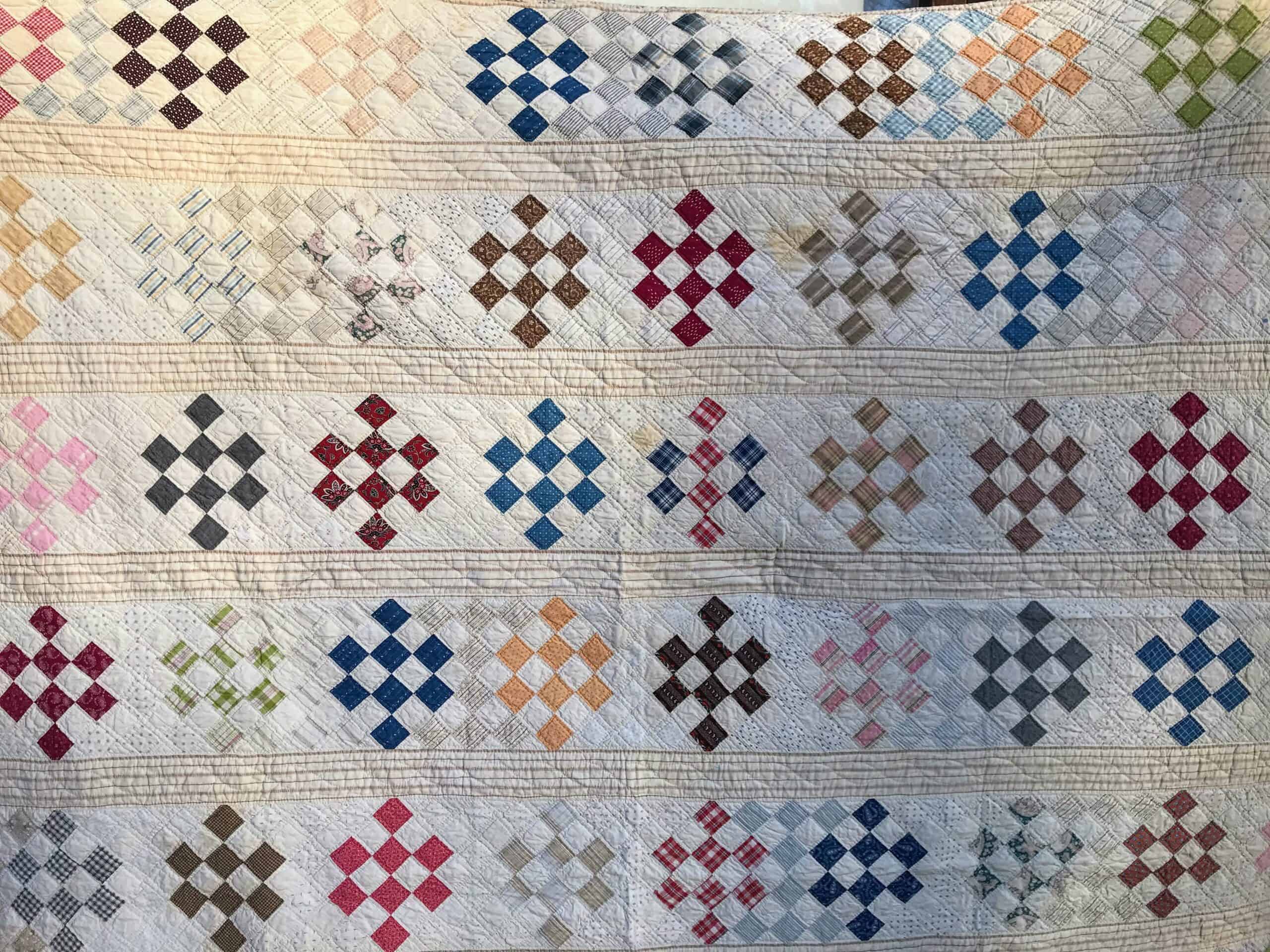
From auction description: “This looks like a 19th century calico 9 Patch top that was machine quilted 20-30 years ago. 72″ x 89″ Classic calico blocks in blue, brown, black are set with a cheery red striped background, making a zigzag through the rows of blocks. Eight blocks are of the bowtie pattern, also in calico. Never used or washed. This would be wonderful for everyday use in the kids room or the weekend cabin. As you know, machine quilting, while not necessarily collectible, wears well.” http://cgi.ebay.com/aw-cgi/eBayISAPI.dll?ViewItem&item=460899533 This bothers me. A lovely old quilt top…quilted like a modern bedspread. Don’t get me wrong, I’m not totally *against* machine quilting. <smile> Just feel like this quilt wasn’t the right place for it. 🙁 Wondered what y’all think? Suzie Diver **************
Date: Mon, 16 Oct 2000 02:05:37 -0400 | From: “J. G. Row” <Judygrowrcn.com>
Our very own Barb Garrett was a consultant on the York County, Pa. documentation book, which has just been published by Schiffer. It is called “Quilts The Fabric Of Freindship”. Schiffer published the Lancaster County book last winter, and this one is as gorgeous! It is $29.95, ISBN 0-7643-1195-6. I sent my check plus shipping to Barb and I received my copy from her on Friday. A wonderful book! Congratulations, Barb. Hope you had a wonderful time at AQSG. Lucky dog! Judy in Ringoes, NJ judygrowrcn.com
Date: Mon, 16 Oct 2000 09:35:07 -0400 | From: [from unknown]
Hello, For those of you who are keeping track, there is a pale quilt on the wall in an early scene in “The Tao of Steve”. Since it was a movie, and not a video, I couldn’t rewind for a second look! Perhaps someone else could identify a pattern. Chris Grant Cornwall, Ontario – enjoying the fall colours.
Date: Mon, 16 Oct 2000 15:14:29 -0400 | From: “John Cawley” <cawleygoeaston.net>
I’m back from Lincoln after a marvelous weekend at the AQSG seminar. A large and very happy group of QHLers gathered for breakfast on Sunday morning. Karen Alexander has the names and she’ll tell you about that. I’ll tell you about the seminar in some detail so that if you’ve never been lucky enough to attend you’ll have an idea of what you’re missing. I arrived in Lincoln, NE on Thursday afternoon. The first event was the opening of a special exhibit, Patterns of Though: Quilted Constructions by Michael James in the textile gallery of the University of Nebraska. It was fascinating to see many examples of Michael’s work hung chronologically. The most recent pieces are very different from what I’ve always pictured when I think “Michael James.” Friday was heaven. The day always offers a choice of optional tours and making that choice is always painful because you can’t do them all. I chose to visit the NE State Capitol which is a virtual gallery of mosaic, murals and decorative art. Many of the geometric designs are evocative of quilt patterns (I never did figure out id this was deliberate). We even got to see the governor (purely by chance). After lunch came the really good stuff. We went to the home of Mary Ghormley to see her quilt collection. Her home is a wonderland of quilts of all sizes and eras, but her passion is mid-nineteenth century. There was a feathered star in turkey red with glorious stuffed work and quilting in parallel lines one sixteenth of an inch apart. There was an enormous c. 1825 broderie perse chintz quilt. We saw a succession of red and green appliques, including one on which the name “Lucinda” appeared twice in the quilting. I tried to convince Mary that this had once belonged to my great, great grandmother and therefor should come home with me, but it didn’t work. The house is filled with finished quilts, tops, doll quilts, a collection of doll beds–something wonderful everywhere you turn. Mary and her husband treated us like friends, encouraging us to explore the house and the textile treasures. We had time to check out the exhibit at the seminar site which included contemporary quilts by the sponsoring guild, wonderful antiques and Bobbie Finley’s “Chintz Challenge.” The formal seminar program began with dinner Friday night. All the events were in the Nebraska Center on campus where we were staying. Michael James gave the keynote address about the beginnings of the Art Quilt movement.. After dinner there was an auction to benefit AQSG. Great things were sold including a top-of-the-line Pfaff. The highlight of the auction was a quilt made by Xenia Cord titled “So Long It’s Been Good to Know You” illustrating the demise of the Beenie Baby complete with attached Beenies meeting their ends in a variety of ingenious ways, e.g. a giraffe Beenie choking on a necktie, a Beenie as roadkill complete with tire tracks. Hilarious! This quilt is part of a running joke the other half of which is a quilt called “Gross Stuff” in honor of Joyce Gross. Gross Stuff will reappear in the auction next year; the top bidder gets to keep the Beenie quilt. (Am I spelling Beenie Babies correctly? I’ve never been bitten by that particular bug. Saturday we heard three papers in the morning. Xenia in her serious mode presented “Textiles and Cooperative Commerce in Colonial America: The Example of William McCormack.” Later she showed me the green leather account book dated 1751 which inspired the project. Karen Gabbert reported on contemporary quilters in Idaho in “Petting the Fabric: Medium and the Creative Process. Lauren Horton’s paper was “An ‘Old-Fashioned Quilting’ in 1910.” After lunch I cadged a ride with Carolyn Miller to see two exhibits in down town Lincoln. My only serious criticism of the organizers in that they didn’t provide any sort of shuttle service for the largely carless attendees to see these exhibits. “Fantasy Flowers” is 13 applique quilts (one pieced Pine Tree and one crazy) from the James Collection. Breathtaking! I can’t do justice to the glorious quilts I saw. There is going to be a catalogue available after the first of the year. The exhibit will be traveling east to the Johnson Museum at Cornell (Ithaca, NY) next summer. I plan to see it again there. At the Nebraska Historical Society we saw Nebraska quilts; the high light was Grace McCance Synder’s basket quilt (the one that looks like petit point). Dinner on Sat. was at “topic tables” where the conversation focused on a particular subject. I had chosen “chintz.” The discussion leader was Sarah Dillow. I learned a lot. After dinner we had Show and Tell. I had brought by Rolling Stone inscribed and signed by the calligrapher William Gross which was shown along with two other professionally inscribed Rolling Stones (not Mick Jagger). I am hoping that other quilts inscribed by calligraphers will come to light. At Show and Tell Debbie Cooney, Joan Hamme and Barb Garret had an amazing story about the York County Project (Dawn Heefner is another QHLer who was instrumental in this documentation and the accompanying book). Debbie showed a quilt which she bought at auction which was made of a double palampore set with chintz; Joan Hamme showed a quilt which she bought at a different auction composed of a single palamore with chintz borders. Barb Garrett pointed out how they had realized that Joan’s quilts was really one third of Debbie’s which had been cut off and rebound. How spooky! Read all about it in the newly published Quilts: Threads of Friendship! Sunday morning we had the final three papers: “Hubert Van Mehren and Home Art Studios” by Susan Price Miller; “‘Better Choose Me’: Addictions to Tabacco, Collecting and Quilting, 1880-1920” by Ethel Ewert Abrahams and Rachel K. Pannabecker; “Creating a New Tradition: Quilting in Tonga” by Phyllis S. Herda. Lots to think about and I’m anxious to read the papers in Uncoverings 2000. The seminar ended with lunch and the drawing for the opportunity quilts, a wonderful antique Carpenter’s Wheel donated by Sarah and Byron Dillow. I haven’t mentioned the Silent Auction (at which I spent way too much money and got some super stuff,fabric, books, a quilt top, vintage blocks) or the book sale at which AQSG member authors sell their books. Hot off the presses and highly recommended are Fawn Valentine’s West Virginia book and not one, but two great new books from PA. Trish Herr’s “Quilting Traditions” about Lancaster Co. quilts and “Quilts: the Fabric of Friendship” from York Co. which was in such great demand that the lucky few that had it were hiding it in brown paper bags (the shipment from York didn’t arrive). Sorry to have gone on so long and I know I haven’t included everything. It was quilt heaven, even at the airport where quilters occupied most of the seats in the waiting area and practically filled the commuter flight to Minneapolis. I got to come all the way back to Baltimore with Fran and her Vintage Friends Mary and Peggy. I Next year AQSG meets in Williamsburg, VA. Now, just how great do you think that’s going to be? Cinda back on the Eastern Shore
Date: Mon, 16 Oct 2000 15:40:04 EDT | From: Xroadclown@
the article was long, but who cares!!! I just wanted to jog everyone’s memories… that Ithaca will be hosting its’ bi-enniel/bicentenial quilt show this summer from July 27-29. The weekend is called Continuing the Tradition, and it includes the fanciful flower exhibit from the James Collection. so keep an eye posted, or if you’d like more information as the time draws closer, please contact me directly! thanks, melanie
Date: Mon, 16 Oct 2000 22:57:54 -0500 | From: Jocelyn <Jocelynm@>
Suzie, I used to feel as you do about machine quilting- but then I learned that machine quilting is really nothing new. From the time home sewing machines were available, there were quilters who used them to machine quilt their tops. There are even quilts that were hand-pieced, then machine-quilted! My guess is that the maker bought the machine while she was piecing the top (or, at any rate, after she’d hand pieced it but before she’d gotten it hand-quilted!) So it isn’t a matter that, necessarily, a person has created an anachronism by machine-quilting an old top. Also, I used to think that all machine-quilting was ‘like a bedspread’. I’ve since seen machine-quilting that was definitely a work of art. Different from hand-quilting, but requiring no less skill. Stippling and trapunto, for example. There are also commercial machine quilters who do very ornate work. If you’ve not seen it, you can email me for the webaddress of my favorite machine quilter.
Date: Mon, 16 Oct 2000 21:22:42 -0700 | From: “Eileen Trestain” <ejtrestain@>
It is not unusual for old quilts to be very sparsely quilted, especially very nice appliqued ones.
Date: Tue, 17 Oct 2000 06:44:44 -0500 | From: “Suzie Diver” <sdiver@> <**big smile**>
Actually, I *am* a professional machine quilter. I used to feel that machine quilting was ‘cheating’, but then, like you, I saw some wonderful work done. It can be gorgeous. And doing it well is not easy. This particular quilt on eBay, though, is a pantograph pattern like a bedspread (old top, new quilting) would have and it bothers me. Don’t know if it should, but there it is…. I bid on it with the intent to take the quilting out and hand quilt it, but it went over what I was willing to pay — sold for $137. I have a string pieced 30’s/40’s top that I bought and machine quilted in an allover freehand pattern. I love it — we cuddle on the couch with it and it’s great. It is serving the purpose it was intended to serve. So, I’m not saying than any ‘old’ top shouldn’t be machine quilted, just that maybe not all should. But that is just my opinion. In fact, it may be just a personal prejudice against pantograph designs….<grin> Thanks for sharing yours, Suzie —– Original Message —–
Date: Wed, 14 Jun 1961 06:27:35 -0500 | From: TRShepard <
Hi everyone! I’m new to this list and have a research project that I’m starting up (with some gusto), and will also take the opprotunity to introduce myself here. My name is Tami Shepard. I reside about 40 miles NW of Ft. Worth, TX (I imagine I’ll be heading to Ft. Worth shortly to see what books the library has for this research). I drive truck (18-wheeler!) part time, have horses, dogs, chickens, rabbits (over 80!) and a cat (we were just adopted by the cat showing up here). My mother and step father are involved with Civil War Re-Enactments (in fact, they operate a suttlery at these re-enactments). This interest of theirs, and my interest in sewing quilts, has ended up being combined to an interest in the quilts of the era. I have learned that some quilts were used as symbols for those on the Underground Railroad! I’m interested in learning when various block patterns were first documented as being sewn (anything that was available before the Civil War was of course available during the Civil War). Also, interested in the history of the names of the quilts, and any symbolism of the quilt block. I do have a list of some books that I’m going to be hunting down for this research, and would also be interested in any book recomendations, web sites (URL’s) and so forth that relate to this subject matter. What is great, is that with me just getting going on this research, I have all ready come up with information that my mother & step father did not know (they did not know about the Monkey Wrench being used to tell slaves to “get there tools together”, the use of a black center in the log cabin to say that there was a safe haven for run aways and so forth). Sorry so long. Tami
Date: Tue, 17 Oct 00 10:43:15 -0600 | From: woodford <
Hi, I’m sorry I missed those of you who were at the AQSG breakfast get-together. I had to leave in a rush Saturday night. At Show and Tell, I rushed up with my mystery quilt, but couldn’t stay to get feed back from folks, so I’m going to see if any of you QHLers can help. This is a triple Irish chain quilt made of wool challis in patterns and plain. The backing is wool, as is the batting. It is dated 1884 on a piece of twill tape. Some of the fabric is wearing, and when I finally looked beneath this, I found that each piece of the pattern has another fabric under it. Each square is double and sewn to the next square as one. In other words each seam has four fabrics within. Some of the inner fabrics are: white with a small red print, an indigo and brown plaid, a tan print. The large squares of the pattern have blue twill on top and an unusually woven beige piece underneath. Because of the thickness, or some other reason, it is quilted rather crudely and unevenly. I can’t figure out why anyone would make a quilt this way. I’m thinking of taking the whole thing apart and looking for messages between the layers. Anybody have a clue? Thanks, Barbara Woodford historic-american.com
Date: Tue, 17 Oct 2000 14:30:31 -0500 (Central Daylight Time) | From: Mary Persyn <Mary.Persyn@>
The latest issue of the Chronicle of Higher Education in its _Chronicle Review_, Oct. 13, 2000, has an “end paper” that has two pictures from West Virginia Quilts and Quiltmakers and a quote from the text by Fawn Valentine. The headline is “Memories as Stitches in Time”. Congratulations, Fawn, for going “mainstream.” Mary
Date: Tue, 17 Oct 2000 15:07:10 -0500 | From: Jennifer Perkins <qltrstoreharlannet.com>
Hi All! So nice to meet so many of you at AQSG! Just visited the Cranston Print works site and read the article about log cabin quilts. Does anyone want to write to the author?? http://www.cranstonvillage.com/visitor/visitors.htm Jennifer in Iowa
Date: Wed, 18 Oct 2000 06:40:23 -0700 | From: “patsquilts” <patsquilts@>
Dear Fellow Quilters: The last week of October (28th) to Sunday Nov. 5th I will be in Charleston , Columbia, and Beaufort So. Carolina and Savanna Georgia. Do any of you have any suggestions on shops to visit? I like to buy old blocks (30’s), new fabric (30’s reproductions), patterns, antiques in general (kitchen and sewing utensils) and get some history in. Any suggestions?? We will have our own car. Thanks!!!!!!!!!!!!!!!!!
Date: Wed, 18 Oct 2000 09:18:06 -0400 | From: Debby Kratovil <
About 8 years ago I came upon two 1930’s quilt tops (scrap and feedsack) in a stinky thrift shop, full bed sized FOR $10 EACH. After I got myself under control, I bought them and took them home and spent days in a dream state wondering how I was so lucky. I basted the first and began hand quilting it (they were both hand pieced, except for the borders). The second I sent off to my favorite machine quilter. The second has been loved and enjoyed these past 8 years. The first still sits with the hand quilting half done. Actually, it sits somewhere in this house, lost. I moved from one state to another in August and tho I think I’ve unpacked every box, that quilt remains “lost”. It would have been packed with the other quilts had it been finished. What I’m trying to say is this: those 1930’s quilt tops were intended to be quilted and used. I don’t make heirloom quilts, just quilts to be loved and used. My other feedsack quilt was also machine quilted. It was my college daughter’s comfort last December when she had foot surgery. Every morning I pray that today will be the day I find that lost, half quilted 1930’s quilt. I intend to push it through my sewing machine and FINISH IT. It is so lovely and I can’t enjoy it if it isn’t finished. Please Lord, make it today! Debby Debby Kratovil Paper Piecing Patterns & More! http://www.kaper.org/queenb kratovil@
Date: Wed, 18 Oct 2000 14:11:27 -0500 (EST) | From: Teri Klassen <teresakbloomington.in.us>
Hi, I am new to the list. My name is Teri Klassen, I live in Bloomington Indiana and collect quilts, mostly utility quilts because they’re the only ones I can afford. also I read books on quilt history. our public library has a great collection of quilt books, including all the Uncoverings. anyway, for the record, I have two pre-1900 quilts that are machine-quilted, both seemingly with a template – perhaps by an upholsterer? one is a red, white and blue Churn Dash, maybe 1880s, maybe from one of the Dakotas. the quilting is rows of little 3-leaf clover shapes, alternating up and down. the other quilt is kind of a bars or bricks pattern on the front, blue and white. The machine quilting is quite tight and goes all over the place, sometimes doubling back on itself instead of in rows, but it also looks like a repeating pattern with lots of loops might have been used. got it at an antique mall a bit east of here.