November 29 – December 5, 2000
These restored messages come from the Quilt History List, an online forum where quilt historians, collectors, researchers, appraisers, and enthusiasts discussed antique quilts and related textiles. The archive dates from 1996 through approximately 2016 and is being restored gradually. Sign up in the form at the bottom of the page if you want to know when a new page is added. Original spelling, opinions, formatting, and inactive links may remain unchanged.
Primary topics of this QHL Digest:
- What Makes a Quilt Work (or Not) — Nancy Roberts gathers opinions on design and construction elements that make or break a quilt, drawing responses on craftsmanship, color, batting choice, quilting quality, and binding.
- Presidential Signature Quilt on eBay — Members discuss an expensive Pineapple Log Cabin quilt with signatures attributed to Rutherford B. Hayes and Elizabeth Cady Stanton, its History Channel appearance, and concerns about authentication.
- Antique Quilt Magazines and Publications — Maria Elkins asks about magazines devoted to antique quilts, prompting recommendations for Piecework, AQSG’s Uncoverings, NZ Quilter, the upcoming Antique Quilts magazine, and the Vintage Quilt and Textile Society newsletter.
- Mothball Odors, Paint Crocking, and Quilt Care — Practical questions about removing mothball chemicals from stored quilts, preventing dark wall paint from crocking onto displayed quilts, and the dangers of mothball exposure. (see the article on stain removal)
- Sandra Mitchell Remembered — Shelly Zegart shares news of the passing of Sandra Mitchell, a noted Ohio quilt dealer, and her irreplaceable contribution to the quilt world.
- Oral History and Fabric Prices from the 1860s-1870s — Judy Row shares daybook entries listing calico, gingham, and cottonade prices from 1865-1879, prompting definitions of cottonade from textile reference works.
Date: Wed, 29 Nov 2000 06:08:14 -0800 | From: “nancy roberts” <
I’d like your opinions on elements in a qult design or construction that you believe detract from it’s appeal. Quilters are sensitive to the idea that there are “rules” in quiltmaking, but there are standards and art principles that allow a quilt to “work”
or to fall short of being generally appealing. Based on all of the quilts you have seen over the years, what differentiates those that work from those that don’t? I’m preparing an article on the topic and would appreciate your input. If you have any thoughts, I’d appreciate your posting them here and sending a copy of your post to my e-mail address as well. Thanks for your help. Nancy —————-
Sent from a WebBox – http://www.webbox.com
FREE Web based Email, Files, Bookmarks, Calendar, People and
Great Ways to Share them with Others!
Date: Wed, 29 Nov 2000 09:42:34 -0500 | From: maria [at] lostquilt [dot] com (Maria Elkins)
Can anyone tell me how to get rid of moth ball odors that now clings to a quilt that was stored in moth balls? Airing the quilt outside did not seem to help. Also, is there any good way to deal with a stain that may be blood, other than just soaking in cold water?
Maria maria [at] lostquilt [dot] com http://www.lostquilt.com/
Date: Wed, 29 Nov 2000 10:03:29 -0500 | From: “anne” <
Could someone please post information on the current quilt exhibits in
Lancaster and York? I have an opportunity to go there Saturday but am = not exactly sure where the exhibits are. Many thanks. Anne D.
Date: Wed, 29 Nov 2000 11:12:16 EST | From: QuiltFixer [at] aol [dot] com
In a message dated 11/28/00 6:55:43 PM Pacific Standard Time,
QHL-Digest-request [at] cuenet [dot] com writes:
<< My mother embroidered a set of 50 state birds and flowers block transfers in the late 1970s. She purchased the designs as paper transfers. After she finished the embroidery, she gave them to me to set into a quilt. I had trouble fitting all 50 blocks into one quilt. It made so much more sense to use 48 blocks--6 across and 8 down. So I left Alaska and Hawaii out of the quilt with the intention of making them into pillows. Haven't found the time to do that yet. Our quilt has been labeled--but just a word of warning that someone else might have done something similar. The use of 48 blocks is not a reliable indicator of a pre-1959 quilt.
Jan Wass >>
Jan, this is an interesting story about your using only 48 of the blocks.
It’s a good reminder that when we are studying quilts they may not be what they seem to be. Did you use many different colors on your quilt, or just the very basic ones? The colors on these quilts can be a clue to their age, but in the case of my quilt, the maker thoughtfully embroidered her first name and the year 1938. If only I could clone myself and have more time to go off on a hunt for 1938 coloring books. I imagine there are not too many of those around! 🙂
Toni B The Redwork Lady redworkldy [at] aol [dot] com www.redworklady.com
Date: Wed, 29 Nov 2000 19:15:19 -0000 | From: “Sally Ward” <Sally.D.Ward [at] btinternet [dot] com>
> I enjoyed and learned a lot about the Durham quilts, which, if I have
> this right, were done after WWII.
Well, the nomenclature ‘Durham quilt’ is a tricky one and open to different interpretation and debate. Whilst its true that one aspect of ‘Durham’ wholecloth quilts was the deliberate revival of the craft by the Government to give women employment at that period and in that area, it was a revival, not a commencement, as the much earlier examples of (often more highly skilled) quilting in the exhibition demonstrated. The exhibition was also making the point that a North Country quilt (a better term than the narrow definition of ‘Durham’) is not necessarily a wholecloth quilt (nor vice versa, for that matter)
Sally W
Date: Wed, 29 Nov 2000 14:18:01 EST | From: [from unknown, signed “Karen A.”]
Lots of interesting quilts on eBay this week with political connections! This is one of the minor but interesting ones.
http://cgi.ebay.com/aw-cgi/eBayISAPI.dll?ViewItem&item=508762087
Karen A.
Date: Wed, 29 Nov 2000 11:21:52 -0800 | From: Tamara Williams <
This message is in MIME format. Since your mail reader does not understand this format, some or all of this message may not be legible.
——_=_NextPart_001_01C05A39.A09DD6F8
Content-Type: text/plain
Hi All – There is an E-Bay auction I need some advice on. The link is :
http://cgi.ebay.com/aw-cgi/eBayISAPI.dll?ViewItem
&item=508111149
It is a Pineapple Log Cabin signed by a bunch of 1880 circa folks.
Including Rutherford B. Hayes and Elizabeth Cady-Stanton. The appraisal was done by someone at the auction house who is not a quilt specialist. It is very expensive, and I think I’d like to bid. I am concerned the price is too high for an OK Pineapple Log Cabin, and seems low for all those signatures. Any thoughts? please mail me directly at :
Tamtw [at] earthlink [dot] net
Thanks!
Tamara Williams
Date: Wed, 29 Nov 2000 20:57:04 -0500 | From: Alan Kelchner <
Nancy, Craftsmanship. Pure and simple. And it doesn’t mean that you follow every rule every time, or even most of the time. But that you spend the time learning how to do your art well before you go off willy-nilly “breaking rules”. It amazes me at the number of artists who claim to be breaking rules, when they don’t even know them. Case in point is a local artist, new to her craft. She has a lot of chutzpah – not even having completed her first year of quilting, she approached “the”
museum in town about having a show. They said no, of course, being much more interested in having Picasso. But this woman WILL NOT take a class, learn how to seam and stitch. She’s so afraid of being “influenced”
by others, she suffers from producing crap. Sorry, I’ve seen her work, and it’s not good. We are influenced by everything in our lives.
Influences are good. It’s copying that’s not (I don’t refer to using patterns, but actually plagiarizing someone’s work).
And immerse yourself in books on quilts, art, and anything else that excites you. Take art classes, even if you stink. I’m always amazed at what I learn in classes (usually not what I came to learn). Take a color class, one for quilters, or one for other artists. Learn how colors interact and react with each other. Using all brights can be as boring as using all dulls. Your negative spaces should be as stimulating as your positive spaces. You should learn how to create balance and tension in your composition. Learn why your composition does/doesn’t work. And once you’re accomplished, TEACH. All that knowledge is no good if it only resides in you. And I’m talking about sharing, not giving classes. I’ve been teaching classes, but the thing that’s meant the most for me lately is helping people create panels for the AIDS quilt.
I helped finish one this past weekend, and the guy who thanked me had tears of gratitude in his eyes. That is a hell of an incentive to keep sharing my talents.
And never stop exploring your craft. You never know what you will end up including in your work. Follow my link below, under work in progress, and see where my quilting has gone lately.
Alan
Date: Wed, 29 Nov 2000 21:33:21 -0600 | From: Hollis E McCright <
I had forwarded the info on the Bowes site to a friend and she would like to email Barbara Woodford with some questions, etc. Does anyone have her email address? You may send it to me privately or may post it.
Hollis McCright who lives in Lubbock TX and may have 70 deg weather on Thursday!?!?!?!?
hmccright [at] juno [dot] com
Date: Wed, 29 Nov 2000 23:12:04 -0500 | From: “Peggy O’Connor” <mnoc [at] brinet [dot] com>
I’ve just painted a room where I hang an antique quilt (actually, several quilts that I rotate). The new paint is dark, and I’m wondering if it could crock onto the quilt backing. I thought I’d let the paint (latex) dry for a week before hanging the quilt – but should I do anything else? Anybody have any experience with dark paint and quilts?
Thanks, Peggy in NC
Date: Wed, 29 Nov 2000 20:22:29 -0800 | From: “Melissa Devin” <
At the very end of History’s Lost and Found tonight (History Channel), they showed the presidential quilt with signatures that is listed on Ebay. But I am pretty disappointed in their presentation. No mention of who it was authenticated by, nor did they even have the name of the pattern correct. It was presented on a quilt rack in which it had to be bunched up and folded over on. For something with an opening bid of $4,000 (and not even the reserve price) they did a poor job of presenting it IMO.
http://cgi.ebay.com/aw-cgi/eBayISAPI.dll?ViewItem&item=508111149
Melissa mldevin [at] aa [dot] net
Date: Wed, 29 Nov 2000 23:23:51 EST | From: [from unknown, signed “Karen Evans”]
If you’re even slightly concerned about crocking, test the paint by lightly rubbing a piece of cotton against the wall where you’re planning to hang the quilt. If there’s color, you might want to consider repainting the wall in question.
Also, I would think it would depend on what type of paint you’re using…a high gloss enamel would be far less likely to crock than a flat paint, and a scrubbable paint designed for bathrooms and kitchens would be better than one intended for marbling/ stenciling/glazing effects. Other thoughts: a lot of the crocking would depend on how far from the wall you hung the quilt. I have my prize winner hung from a curtain rod, so it’s about two inches out from the wall instead of flush against it.
Another thought: you could tack a sheet to the back of the quilt for further protection. You could also do something clever like measure *exactly* where you plan to hang the quilt and put up plain wallpaper to match the paint, with a decorative border around the edges of the quilt. Either way the quilt would never touch the paint, rendering the whole idea of crocking moot…..
Hope this helps!
Karen Evans
Date: Wed, 29 Nov 2000 22:28:10 -0600 | From: “quilt97” <quilt97 [at] interconnect [dot] net>
I recently bought a book “Talking Dirty with the Queen of Clean,”
by Linda Cobb, at Target. While she does not specifically discuss mothball odor, she does say that “for those of your looking for a foolproof product you can purchase to use in eliminating all odors with success, I highly recommend the product ODORZOUT. This is a 100 percent natural product that stops many odors almost on contact – odors such as urine mold, mildew, etc. Made of blended natural zeolite minerals, contains no perfumes, and is safe for use around children or pets.”
I have not tried this product, and have no affiliation with it or the book.
I bought the book when I read a solution for removing rust from clothes:
apply undiluted lemon juice and lay the garment in the sun. Haven’t tried it yet, but wish I’d known of this potential solution in times past.
Hope this helps.
EKarenbeth
Date: Thu, 30 Nov 2000 06:44:57 | From: “Anne Copeland” <
As a quilt appraiser and a judge at numerous quilt shows, I think I have some pretty good ideas of things that don’t work, and am glad to share. I think when women or men make quilts, the time that it takes to make a quilt should be heavy consideration, for we generaly spend a lot of time even on those “quick” quilts. That time, once spent, should generate something worthy of all that time.
One thing that does not work is poorly thought out machine quilting–i.e.
quilting that really does little or nothing to enhance the overall quilt design and in many cases, even seems at great odds with the design, or actually obliviates the design! Why take the time to piece or applique a great quilt only to have it ruined by the quilting.
I think never enough can be said about quilting. Another thing that does not work is an uneven amount of quilting over the quilt so that the quilt surface is unintentionally distorted or does not hang flat.
Another thing that does not work often, believe it or not is batting. The wrong batting choice can result in the batting “bearding”
unattractively from the quilt top. Such a shame after so much work on the quilt. Many poly batts (not all) have this problem. I would suspect that if a looser weave fabric is used in the top, and quilting opens up the weave, that could also cause the problem.
And also, as far as batting choice, it is sad to see an inappropriate batting used for a quilt. For example, when an antique quilt is quilted with polyester batting, it rarely looks right.
Another batting problem that does not work is to start basting a newly unfolded batting in a quilt and quilt it. Those deep fold lines in the batting will stay and stay and stay, and Judges hate those!
So that I don’t hog all the potential answers (though I have plenty more to share if anyone wants to know), I will end with binding. A binding that is mitered and does not have the corners sewn down, or a binding that does not lie flat, or a fat binding on an otherwise flat quilt, or a ruffly or pleated binding (not pleated intentionally) are some of the things that do not work with regard to binding.
Cheers, Annie
__
Date: Thu, 30 Nov 2000 06:37:46 -0500 | From: Barb Garrett <bgarrett [at] fast [dot] net>
Someone requested information about the wonderful quilt shows in southeastern PA. If you can’t get to both before the end of the year, and you are coming to the Lancaster Heritage Show the middle of March, plan to visit the York exhibit then — it’s worth the trip. And if you haven’t seen them yet, the books for the 2 counties which led to the exhibits are wonderful — lots of pictures plus personal stories.
The show at the Lancaster Heritage Center lasts until the end of
December. Use the following link to their information page for a map, driving directions, hours, etc.
http://www.lancasterheritage.com/information.cfm
The show at the York Heritage Trust is until March 31, 2001. They are located in downtown York at
250 E. Market St.
York, PA 17403
717-848-1587 open 10 to 4:30 daily except
Closed Sunday and Monday
Barb in southeastern PA bgarrett [at] fast [dot] net
Date: Thu, 30 Nov 2000 08:32:35 -0500 | From: maria [at] lostquilt [dot] com (Maria Elkins)
Are there any magazines on antique/vintage quilts? Which quilt magazines do you subscribe to? I am more interested in learning about historical quilts and techniques than in how-to directions and patterns.
Date: Thu, 30 Nov 2000 08:36:41 -0500 | From: “Lynne Humphries-Russ” <
Okay, you ladies have done it this time! I’ve been lurking for a while now and thoroughly enjoying all the postings. But one of them really captured me. You see, I’m an oral historian and a director of music ministry at a medium-sized church. Obviously, with my belonging to this list as well as my lust for quilting in general, I also have an interest in quilt history. My work in both history and early American religious music has led me to an unbounded interest in the Shakers. Now you have caught me even further with the suggestion that more research needs to be done on Shaker quilts. And she’s off!
If anyone has any suggestions, I’m very willing to investigate them. My premise for now is to compare Shaker and other radical sect quilting to other quilting of the 17th -20th centuries. That premise will change as
I investigate and narrow my focus. Please feel free to comment.
Thank you all for a wonderful list.
Lynne Humphries-Russ
Date: Thu, 30 Nov 2000 07:43:37 -0600 | From: “Karen S Bush” <
GREAT question, and if not….WHY not!????? Other than the McCalls Vintage magazine, IS there any out there?? kb www.karenbushquilts.com
Member of TAS-The Applique Society
Ebay seller name- karenbush
—– Original Message —–
From: “Maria Elkins”
To:
Sent: Thursday, November 30, 2000 7:32 AM
Subject: QHL: Antique quilt magazine?
> Are there any magazines on antique/vintage quilts? Which quilt magazines do > you subscribe to? I am more interested in learning about historical quilts > and techniques than in how-to directions and patterns.
>
–
Date: Thu, 30 Nov 2000 07:38:06 -0800 | From: “Julia D. Zgliniec” <rzglini1 [at] san [dot] rr [dot] com>
Dear QHL, While not strictly about quilt history, Piecework by Interweave Press does cover all types of needlework and usually has something of interest related to quilts. It is an excelent publication, includes small projects to experience the techniques and has wonderful photos. I recommend it for anyone interested in any type of historic needlework.
Julia, in Poway, CA
Date: Thu, 30 Nov 2000 09:24:26 -0800 | From: Chris Anacker <chrisa [at] jetlink [dot] net>
Blanket Statements is the quarterly publication/newsletter from the American
Quilt Study Group and the topics are historical in nature, regarding quilts, women, techniques, fabrics and patterns. It is not in color like a magazine, but the articles are very informative and current. AQSG also publishes a yearly journal of several reserach papers on quilts and quilters, many of which are historical. To get the newsletter, join AQSG, the journal can be purchased. They have a web site and are well worth your time.
Kim in Ojai, CA
Date: Thu, 30 Nov 2000 17:16:19 -0800 | From: Audrey Waite <
Nancy:
My feeling is that color is of the upmost importance. My first quilting lesson was from a very competent and wonderful person but her sense of color was lacking. She did beautiful quilting but the finished product was so-so. I think this “rule” applies to antique as well as new quilts. If you don’t get the fabric colors/values doing the work for you, the most outstanding craftsmanship is wasted.
Audrey Waite
Date: Fri, 1 Dec 2000 16:06:03 +1300 | From: “Anne Scott” <nzquilter [at] xtra [dot] co [dot] nz>
Maria asked – Are there any magazines on antique/vintage quilts?
I edit and publish New Zealand Quilter magazine and from time to time we – like a lot of other quilt magazines from all over the world – run articles on antique quilts or collections of quilts.
In our next issue we have seven quilts from a Museum collection featured.
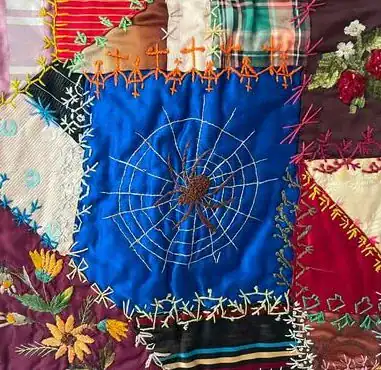
They date from 1770 through to the late 19th century. It’s interesting that despite the length and difficulty of sea travel, the magazines of the late 19th century made their way (fairly rapidly) to New Zealand and Australia and that some of the quilt trends were happening here at almost the same time as you were experiencing them in North America. There are certainly some crazy quilts with spide web, and all the special details that your crazy quilts have.
Anne Scott Wellington, New Zealand www.nzquilter.com
Date: Fri, 01 Dec 2000 03:19:42 | From: “Anne Copeland” <
Hello Maria, Good to read your post again.
Mothballs are extremely toxious, and care should be used to do some cleaning process to remove the odors. To simply put it in fresh air may not be enough to remove the dangerous chemicals, which if they have come in direct contact with the quilt, could have been absorbed.
Years ago I remember reading a newspaper story of three sisters who had stored their bathing suits in mothballs during the winter. They took them out, and went straight into the pool. Within a very short time, two of the sisters died, and the third was critically ill. It was a combination of the mothball chemicals that had been absorbed by the suits and the chlorine in the pool.
Best not to take a chance. Annie
_
Date: Fri, 01 Dec 2000 03:25:00 | From: “Anne Copeland” <anneappraiser [at] hotmail [dot] com>
One especially good magazine is not per se a quilt magazine, Maria, and that is Pieceworks. It is available at most big newsstands, and also at quilt stores. It has some terrific in-depth articles on quilts and quilt types. It is so choc full of good information on virtually every kind of needleart that anyone who is a serious student of vintage and antique quilts should look into it. Also, they probably have the back issues available, and ALL are worth reading. Cheers, Annie
Date: Fri, 01 Dec 2000 03:35:23 | From: “Anne Copeland” <anneappraiser [at] hotmail [dot] com>
Just can’t resist tossing another one in–the lack of unity, unless it is well-handled, creates a disjointed looking quilt. Sometimes the maker thinks that adding a similar shape, such as a circle around each block, adds unity, but the fact is that it does not. Unity, as I think Audrey mentioned, involves more, such as color unity. Cheers, Annie
Date: Fri, 01 Dec 2000 08:28:08 +0400 | From: Xenia Cord <xecord [at] netusa1 [dot] net>
“Postage Stamp” is a loose designation for small pieces, anywhere from
1/2″ finished and up. Probably 1″ x 1″ finished is standard, if there are any standards to be expressed, but we all know that postage stamps exist in a lot of sizes. Depending on who’s describing, and for what reason, “postage stamp” can mean pieces as large as 2″ squares or even 3″ squares (look on eBay, for instance!).
Xenia
Date: Fri, 01 Dec 2000 18:32:56 +1100 | From: Lorraine Olsson <sven [at] pnc [dot] com [dot] au>
My question of the day is…….
What size does a fabric piece have to be in a quilt , to be described as “postage stamp”?
I await your replies with bated breath!
Lorraine in Oz
Date: Fri, 01 Dec 2000 08:54:58 -0600 | From: Susan K Bleimehl <sbleimeh [at] students [dot] wisc [dot] edu>
Let me put in another plug for “Uncoverings”, the compliation of papers from the American Quilt Study Group. (http://www2.h-net.msu.edu/~aqsg/) On their site in the Publications screen, they list all of their authors and titles of the articles. In doing research on the 1830’s era quilt this past semester, I looked through most of the issues from this organization.
They were wonderful. I think my favorite was the article on mystery novels that in some way had quilts or quilt makers as an integral part of the story. Since I love reading mysteries, I photopcopied that article for future leisure time reading, which I have none at the moment. Some useful articles to me for my research project were the Bayliss quilt article, the article on dating quilts using thread, some written on the New England region and those on Baltimore album quilts. In Wisconsin, the magazine is held in the University library and in the Milwaukee Public Library system.
It is likely that wherever you live, there is a collection in your state somewhere. Go to your local public library and check into the interlibrary loan system. I think you will find the effort rewarding.
Susan sbleimeh [at] students [dot] wisc [dot] edu
Date: Fri, 1 Dec 2000 07:50:56 -0800 | From: “nancy roberts” <robertsn [at] norwich [dot] net>
Quilting Today or Traditional Quiltworks published a special isse on antique quilts. Unfortunately, I can’t remember how long ago or what it was called. It was within the past year I think.
While it’s not a series, you may find a copy of the issue helpful.
Contact the publisher at 800 628 8244 and they’ll be able to tell you more. They also have a new book featuring the block patterns for a lovely red & green applique quilt, one that contains patterns for vintage quilts and the book on feedsack quilts that shows quilts from members of the feedsack club. I’m away from home, so unable to look at my issue of the antique magazine to give you more specifics.
Thanks for all of the valuable comments on my previous question of what doesn’t work is quiltmaking. Nancy
—————-
Date: Sat, 2 Dec 2000 06:20:37 -0500 | From: Debby Kratovil <kratovil [at] his [dot] com>
Somehow my post of a few days ago got lost in cyberspace. I have pieced 15 mini Underground Railroad blocks in blue and white(finished size
3-3/4″)
and want to arrange them with alternate plain red squares. Is there any rhyme or reason to the orientation of the blocks so that the “ladder” of the Jacob’s Ladder (another name for this block) goes a certain way?
Thanks, Debby
Debby Kratovil Paper Piecing Patterns & More!
http://www.kaper.org/queenb kratovil [at] his [dot] com
Date: Sat, 02 Dec 2000 08:07:23 -0500 | From: Alan Kelchner <quiltfix [at] mail [dot] jax [dot] bellsouth [dot] net>
We had an opening ceremony for the Names project yesterday. I was an opener. When the ceremony was through, I went to examine a quilted panel that caught the “historian’s” eye. The background was a one-layer Rose of Sharon with four buds, repeated all over. Looked like it should be a newish comforter, but I went and looked anyway. It wasn’t, it was even hand quilted. I was rather surprised to find someone had cut down a c1870 appliqui quilt to make this 3’x6′ panel. There were drawings, writings (in indelible marker), and a few photo-transfers applied to the panel. The surprise welled quickly into admiration for his loved ones. This young man, whose name I don’t remember, was absolutely loved by his family and friends. He died of AIDS, and to memorialize him, his family used an heirloom – “the quilt was made softly and lovingly by his great-great-grandmother” !!
We should all be so well loved.
Alan need to wipe my eyes – again.
— Alan Kelchner
Skitzofrenya Quiltworks http://skitzofrenya.artistnation.com
Date: Sat, 2 Dec 2000 14:34:04 EST | From: ZegrtQuilt [at] aol [dot] com
I am sad to have to tell you that Sandra Mitchell,the noted and long time quilt dealer from Ohio,passed away today of a massive heart attack. Her loss is immeasureable and her story from the earliest days of quilt buying incredible. We will all miss her presence as a vital part of the quilt scene. Shelly Zegart
Date: Sat, 02 Dec 2000 14:19:52 -0600 | From: Jocelyn <
Nancy, 1. When the scale of the fabrics is poorly balanced (eg, lots of very large prints).
2. When the scale of the fabric is poorly matched to the pattern (eg, large prints used in very small pieces).
3. Bad color combinations. Sometimes it’s a matter of the fabrics are too much alike, so the quilt is too drab or vivid. But after I started writing this, I thought about some of the 1970s and 1870s quilts I’ve seen- which work, despite the color combinations, because the colors are RIGHT with each other. Using a color that just screams a particular era, whether it’s the 70s, 30s, or Civil War, with fabrics from other eras—well, I’ve not seen that ‘work’.
Other times, it’s just an unpleasant color combination, or one fabric that makes you wonder if the maker were wearing sunglasses when she picked it out of a dark closet.
Several years ago, I did a Color Challenge quilt….you had to make 2-color blocks, in each of the possible combinations of red, orange, yellow, green, blue,purple, white, cream, brown, pink, grey and black. I was astounded at some of the combinations I’d thought would be gosh-awful, which turned out marvelously, and at some I thought would be a piece of cake to do, but somehow the block just didn’t work. I learned that there’s no combo that just can’t work, if you have the right fabrics.
>
Date: Mon, 04 Dec 2000 07:51:17 +0400 | From: Xenia Cord <
In Florence Montgomery, Textiles in America 1650-1870, she says:
“Cottonade: Orignially plain, also serge, or twill woven, all-cotton fabric made with single yarns and heavy filling. Made in solid colors, checks, stripes, plaids, etc. and used for dress goods, tablecloths, and, with the stronger grades, trousers (Harmuth). Coarse, heavy cotton fabric, an imitation cassimere (Textile Mercury Dictionary). Among the Acadians of Louisiana, cottonade was ‘the general clothing weight fabric, falling in the blue-white-brown color range (Glasgow, p. 341).”
[pp.206-7]
This Montgomery book is a useful tool, being mostly an encyclopedia of fabric terms and kinds, and is not pricey, like Printed Textiles is.
Xenia
Date: Mon, 4 Dec 2000 01:08:43 -0500 | From: “J. G. Row” <Judygrow [at] rcn [dot] com>
I did a local oral history today at a friend’s house. A couple of months after she bought the farm a year and a half ago she had a knock on the door and a lovely older woman (Jane) introduced herself and told Ilona that she, Jane, had been born and raised on the farm, and indeed it had been in her family from the 1760’s until her father sold it in 1959. Would Ilona mind if she looked around. Ilona happens to be the chairman of the local Historic Preservation Comittee(township), so of course she invited the woman in. Today Ilona gave a brunch for the Historic Preservation Society (private) and Jane was the featured speaker. She brought photo albums and other pertinant things and spoke for over an hour on what it was like growing up in our farming community — I have it all on tape and now the hard part, the transcription, starts. However, I looked through the day book of her great-great-grandfather, wherein he wrote down every credit and every debit in his life. I copied a few items you might find interesting:
on 21 December 1865
1 1/2 yards calico @$.38/yard paper of hair pins — $.05 paper of pins — $.10
13 3/4 yards gingham @ $.125/yard — $1.72
1 3/4 yards drilling — $.22
5 yards cottonade @ $.20/yard on 28 April 1866 and the days following–
3 yards muslin @ .28/yard — $1.40 goods for repairing dress — $ .82
1 spool cotton, 1 skein silk — $.15
1 pattern — $.15 pins — $.15
1/2 yard dress goods — $.25 on 29 May 1879
9 1/4 yards calico @$.0625/yard — $.58 {prices sure dropped after the war!}
3/4 yard muslin @$.07/yard
15 buttons — $.15
4 yards chintz @$.10/yard — $.40 to making dress by Rachel — $.40 (per day)
Can anyone tell me what “cottonade” is?
Judy in Ringoes, NJ judygrow [at] rcn [dot] com
Date: Mon, 04 Dec 2000 10:21:08 -0600 | From: Marcia Kaylakie <
Hi All, Regarding an earlier discussion on KC Star patterns and Nancy Page
Quilt Scrapbook , would someone please contact me off-list to tell me where i might order these again. I do know about Dorothy Mae’s but i believe that there was another source for both. Thanks, I think this could be a Christmas present from DH if I get the info now 🙂 Marcia Kaylakie
Date: Mon, 4 Dec 2000 17:57:24 -0500 | From: “sue reich” <mreich [at] ibm [dot] net>
This is for Judy and any other interested textile enthusiast,
From my bible of textile terminology, Fairchild’s Dictionary of Textiles
Cottonade: A coarse, heavy cotton fabric woven with three-harness, left hand, warp faced twill; given a firm finish and sometimes napped on the back. The colorings and finishes resemble woolens and worsteds; in solid colors, resembling whipcord and worsted suitings, and stripes resembling coverts. Used for trousering, cheap suiting, work clothes, base for rubberized fabrics, heavy linings, etc. Next obvious questions; what is a covert? There are three definitions given but I think the one that most helps is #1. Covert: A medium to heavy weight worsted or cotton suiting or topcoating fabric with a diagonal twill produced by a warp face weave… Often waterproofed and used for raincoats.
I guess you had to be there to fully recognize the fabric in question, but alas, we can only rely on the dictionary. Hope this helps. sue reich from very cold Connecticut
Date: Tue, 05 Dec 2000 08:55:55 -0500 | From: Newbie Richardson <pastcrafts [at] erols [dot] com>
Judy, From Florence Montgomery’s “Textiles in America”
Cottonade:Originally plain, also serge, or twill woven, all-cotton fabric made w/ single yarns and heavy filling. Made in solid colors, checks, stripes,plaids, etc. and used for dress goods, table clothes, and with the stronger grades, trousers. Coarse, heavy cotton fabric, an imitation cashmire. Among the Acadians of Lousiana, cottonade was the general clothing weight fabric, falling in the blue-white- brown color range.
Newbie
Date: Tue, 5 Dec 2000 10:05:54 -0600 | From: [from unknown, signed “Mary in Wisconsin”]
Someone was inquiring re: Bird Patterns on quilts and the time frame these were popular. Here is a site on ebay with a set of patterns for bid.
Mary in Wisconsin
1.
Item #: 518232751
Item: VINTAGE VOGART BIRDS OF US QUILT TRANSFERS Price: US $4.00
Bids: 0 Started: 12/03 23:25
URL: http://grass.ebay.com/go/101/12797998/1/518232751
Date: Tue, 5 Dec 2000 10:19:43 -0600 | From: “Avalon” <malthaus [at] idcnet [dot] com>
I also remember a discussion of Barkcloth. Here is an ebay site for a bolt of unused tropical barkcloth.
Mary in Wisconsin
Item #: 518198809
Item: UNUSED BOLT 22 YDS 1940’S TROPICAL BARKCLOTH Price: US $19.99
Bids: 0 Started: 12/03 22:01
URL:
http://grass.ebay.com/go/101/12797998/1/518198809