February 8 – 22, 2001
These restored messages come from the Quilt History List, an online forum where quilt historians, collectors, researchers, appraisers, and enthusiasts discussed antique quilts and related textiles. The archive dates from 1996 through approximately 2016 and is being restored gradually. Sign up in the form at the bottom of the page if you want to know when a new page is added. Original spelling, opinions, formatting, and inactive links may remain unchanged.
Primary topics of this QHL Digest:
- French Toile Fabric Websites — Members share and update links to French sites selling reproduction toile fabric, including Le Rouvray and other Paris-based sources.
- Historical Pincushion Filling Materials — A missing pincushion insert prompts a wide-ranging discussion of period filling materials — horsehair, sand, sawdust, and emery — used in antique sewing accessories.
- Debating the Log Cabin Pattern’s Origins — A discussion of the Log Cabin block’s disputed origins ranges from British and Scandinavian antique examples to a tangent on Egyptian mummy imagery in 19th-century design.
- 1980s Designer Fabric Lines — Members recall early designer/reproduction fabric lines from the 1980s, including work for Concord and the American Classics line, and the shop-owner relationships behind them.
- Remembering Quilt Historian Lucy Hilty — News of quilt historian Lucy Hilty’s death prompts members to share personal memories of meeting her at quilt symposiums.
- Barbara Brackman’s Hall of Fame Induction — Members celebrate news that quilt historian Barbara Brackman is being inducted into the Quilters Hall of Fame.
- Equipment Tips for Oral History Interviews — A member preparing to record oral history interviews asks for recommendations, and others suggest small, unobtrusive tape recorders.
Date: [date unknown] | From: <QultFrFn@>
Sent: Tuesday, February 13, 2001 6:27 PM Subject: Re: QHL: Re: Origin of the Log Cabin Quilt pattern
In a message dated 2/14/01 2:08:35 AM, chrisa@ writes: <<Egyptian craze>> The British attraction to mummies can also be attributed to their late 18th early 19th c. need for cotton. The English printing industry imported ‘lesser’ mummies for the cotton wrappings — for use in their 100% cotton-rag papers. (Just think of that when you admire a really old ‘first edition’!) The log-cabin, snails shell, spiral image is almost a universal element of design. It’s right up there with ‘sun’ images for age and use. The image in fabric/cloth/quilts is something that should be easier to trace. Nancy
Date: Mon, 19 Feb 2001 13:14:00 -0600 | From: Laura Hobby Syler <texas_quilt.co@>
Nancy, I had a similar experience at Quilt Market about the same time. I opened the shop in Sept of 1980 and by ’82 we were doing lectures at Market for the “How to Run a Successful Quilt Shop Series”. Only because of that did the Hoffman rep agree to “let me buy” the entire line. (Like he didn’t want my $$???<G>) He just couldn’t understand what we as quilt shop owners wanted with garment fabrics. I know that he told us that Karey had invited him to come to Market, and that she assured him that he would be suprised! We bought everything he sold us! Even the orange fabrics that I was sure would sit on the shelves flew out the door. And as you say, such a breath of fresh air after having to live with Peter Pan, VIP and Concord’s little calico prints. BTW, someone else just mentioned Cranston coming into the picture late in the 80’s. Actually, Cranston is the parent co. for VIP. In 1980 when I first opened we bought from Peter Pan, Ely & Walker, White Rose (solid colors, great Amish Line) VIP, Concord and a couple of other smaller lines. Concord was by far the best for quiltmaking. Joan Kessler and eventually her daughter were staff designers for Concord….micro dot designer, as well as the “strawberry print” that has been ripped off by several other companies. Unfortunately, Ely & Walker closed it’s doors after over 50 years in the mid ’80’s ( I sold the shop in ’85 and I believe it was in ’86 or ’87) VIP and Concord have really dropped the ball quality wise. I’ve lost track of all of the lines, but with greigh goods such as the kind the Maywood and Hoffman use, we are indeed getting pickier and pickier!! And I agree, what an interesting thread <G> this is! Thanks for asking the question Judy! Laura in sunny N. Texas where the drought is “officially” over!!!
Date: Mon, 19 Feb 2001 16:01:03 -0500 | From: “Peggy O’Connor” <mnoc@>
I have a vintage double wedding ring quilt that I would like to hang, but I am wondering how to keep the deeply scalloped edges (the edge of the “ring”) from folding over. Any suggestions on how to keep these sides on a plane with the rest of the quilt? Peggy in NC where the early daffodils are blooming
Date: Mon, 19 Feb 2001 16:55:17 -0600 | From: Jocelyn <Jocelynm@>
Judy, How about Jinny Beyer? She’s the first designer I’ve heard of by name. I suspect that the naming of designers came about only after they became famous in the ‘real world’ as pattern designers, teachers, or historians.- that is, at the point their names were familiar enough to the public, to be a draw for the fabric. My earliest exposure to JB fabrics was prior to my last move (which took place January 1995) so I’d guess that 1993 would be a good estimate. >
Date: Mon, 19 Feb 2001 18:53:20 EST | From: QultFrFn@
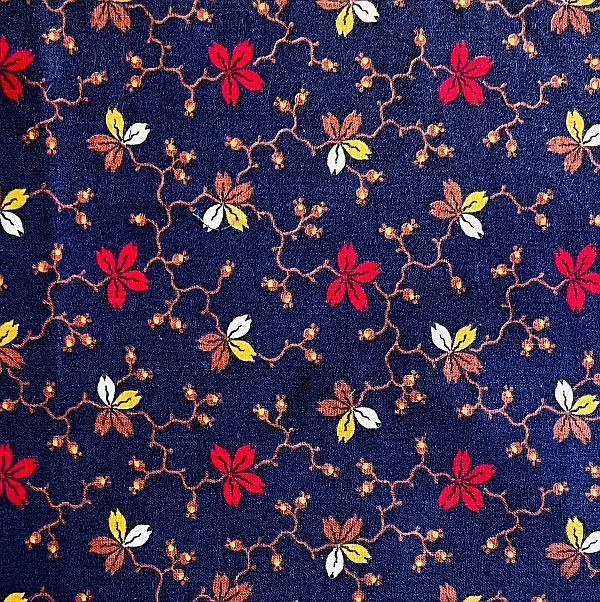
Laura — Remember “that” medium-large brown/multi print that we all called the million $$ fabric? That was a Concord. They also produced it in a blue. They may STILL be printing that one…at 20 years+. I don’t think quilters coming into the art/craft within the last 10 – 15 years have any idea how much the independant quilt shops changed the look of quilts today…simply by demanding, buying, and teaching their customers how to use non-calico cottons. Nancy AZ
Date: Mon, 19 Feb 2001 19:10:43 -0600 (CST) | From: Mary.Persyn@
I’m going to be in Newark NJ on a business trip next week and may have Friday afternoon off. I’m going to be staying close to the Newark Museum of Art and was wondering if anyone knows if they have any quilts on display. I own a copy of “Quilts and Counterpanes in the Newark Museum”, published in 1948, and they seemed to have a nice collection at that point in time. Does anyone know anything about the current status? Thanks, Mary
Date: Mon, 19 Feb 2001 21:19:15 -0600 | From: Marcia Kaylakie <marciark@>
HI All, Well, nothing like seeing the home folks on the Antiques Road Show from here in Austin! Did anyone else see that magnificent crazy quilt? Quite something! Can’t wait to see next week’s installment. Marcia Kaylakie, Austin (of course) Tx
Date: Mon, 19 Feb 2001 22:05:12 -0600 | From: Jennifer Perkins <qltrstore@>
Do those of you who went to AQSG remember Ethel Abrahams’ quilt made of printed selvages? I know it was displayed at Paducah last year, too. She has as her oldest printed selvages several from the 30’s, I believe. She’s in the AQSG book, you could contact her for more information if you’re really researching! Jennifer in Iowa
Date: Tue, 20 Feb 2001 08:32:38 -0500 | From: “Kalmia@” <
I heard recently that Lucy Hilty died on Saturday, February 11. Her health had been failing, particularly in recent months, but she was able to spend a treasured day with her long-term quilting friends at the Point Bonita retreat in January. She died in the comfort of her home in the company of a Hospice nurse. Details are not yet available, but a memorial service is planned at her home in Kensington, California, probably on Sunday, March 11. For those who did not know her, Lucy was born to a Mennonite family in Ohio, eighty-something years ago. After retiring from her career as a kindergarten teacher, she became one of the early quilting teachers on “the circuit” in the late 1970s. She developed a reputation for fine hand-quilting and elegant quilting designs. She was one of the featured quilters in Pat Ferraro’s classic film “Quilts in Women’s Lives.” Lucy was one of the founding members of the American Quilt Study Group and served on that group’s board of directors during its formative years. She also participated in a Berkeley-area group called the Crazy Quilters. I hope others will post what they remember about her, because she touched so many of us in so many ways that a single eulogy would be an insufficient portrait. Through my friendship with Lucy I met her sister Agnes, who lives not too far from me in South Carolina. When Agnes celebrated her 80th birthday some years ago, she invited my husband and me to join her extended family for the celebration. I remember that various family members were amazed that Lucy and I had been good friends for many years, even though we lived on opposite ends of the country. I remember thinking then about how so many of my close friendships have developed through a shared interest in quilts and their stories. I can only echo what Agnes wrote to me: “She leaves a large hole in my life and I think many friends will miss her.” Laurel Horton
Date: Tue, 20 Feb 2001 09:02:52 -0500 | From: Merry May <Inspectr@>
What wonderful news that Barbara Brackman is FINALLY going to be inducted into the Quilter’s Hall of Fame! I think it’s long overdue. She’s my hero! 🙂 — Merry May (a.k.a. Inspector Cluesew) Schoolhouse Enterprises http://planetpatchwork.com/storefront.htm http://www.cluesew.com Email: Inspectr@ Toll-free (US & Canada): 1-888-84 GEESE / 1-888-844-3373
Date: Tue, 20 Feb 2001 08:50:17 -0800 | From: Chris Anacker <chrisa@>
Speaking of Jeff Gutcheon, he wrote about cotton fabrics in August, 1990 in his book called “A Quilter’s Guide to Printed Fabric, Probably more than you ever wanted to know about making cotton prints for quilters in the 1990s” He said he bacame a commercial printer in 1983. He also says “Quiltmakers can take a fair bit of credit for the resurgence of interest in cotton prints from 1975 to 1990, and this interest will continue.) Kim Wulfert Ojai CA aquiltersjourneytours@ From: “pepper cory” <pepcory@> I’ve been off-line for a few days so I hope these comments will not be too out of date. The print from Concord that we’ve all bought is a medium-size crowded floral print and at last market, Concord still printed it in a brown and a navy ground. A Concord salesman once told me that print had gotten a Coty award–it was the first cotton print to have over a million yards printed. Some time has passed since then and I wonder if sales of that favorite print would be like the ever-changing sign at McDonald’s–you know the one: when they got over a million hamburgers sold, they just started saying “billions and billions.” He also told me that within the industry, the salesmen called that Concord print “arsenic and old lace.” Referring to the age and purpose of the print I suppose and type-casting all quilters as LOL’s (Little Old Ladies). Can’t wait to be an LOL (considering the alternative-) From sunny and windy coastal North Carolina- Pepper Cory
Date: Wed, 21 Feb 2001 16:57:19 -0600 (Central Standard Time) | From: Mary Persyn <Mary.Persyn@>
A while back someone on QHL mentioned an exhibit catalog titled “Minnesota Quilt Project Presents Discovering Ourselves in Minnesota Quilts”. I ordered a copy. Now, a web friend is trying to track down a copy and the phone number given on the back of the book is disconnected. Is the person who originally handled this book still on the list? Does anyone know if there are still copies available, and where? Thanks, Mary
Date: Wed, 21 Feb 2001 18:40:20 EST | From: KareQuilt@
I am getting ready to buy new recording equipment and I would appreciate the experienced opinion of those who have used tape recorders for doing field interviews as well as telephone interviews. What type of machine do you recommend? Do you recommend the “mini” tapes or the regular-size tapes? What kind of transcribing machine do you use? This is going to represent a substantial investment for me! Thank you. Karen Alexander Independent Historian Press Secretary, The Quilters Hall of Fame
Date: Wed, 21 Feb 2001 18:53:53 EST | From: [from unknown]
A gifted young friend of mine, a Japanese woman, is working on a graduate paper on quilts and quilting and would like to interview Japanese quilters in America. If you know of an appropriate person who might be interested in communicating with her, please ask her (or him) to contact Fuyu Shiraishi at fuyuhibino@. Thank you. Deborah Harding
Date: Wed, 21 Feb 2001 23:34:46 -0500 | From: “J. G. Row” <Judygrow@>
Karen, Buy a small recorder, something that the subject of the interview can easily forget is there. In fact I use something the size of a walkman. Which means using cassettes, not reel-to-reel. Buy a very good, small microphone, but don’t hook it onto a lapel or dress – they tend to fiddle with it, or their beads. I just put mine on my lap, or put it on the arm of the chair near me. Best advice I got at the course in oral history I took was: 1. Use 30 – 45 minute tapes, the shorter the better. Longer-time tapes tend to stretch and distort much faster. 2. Buy the very best tapes you can afford. 3. Transcribe as soon as possible. 4. Also, make a copy to CD if you can. Tapes, even the best quality, tend to disintegrate with time. Judy in Ringoes, NJ judygrow@
Date: Thu, 22 Feb 2001 09:19:40 -0400 | From: Barbara Robson <robsonbh@>
Dear QHL, I had the honour of meeting Lucy Hilty at the East Bay Heritage Quilt Symposium in 1985 (I think!). I have never forgotten her or our very short time together. I am saddened to learn of her death. I was teaching “Stab Stitch” quilting at that Symposium and Lucy was fascinated to see how I did it. I remember sitting outside a classroom on the stairs demonstrating to her just how I quilted, one stitch at a time and using both hands and getting straight even stitches top and bottom. It was one of those “quilt moments” I shall always cherish and remember. The quilt world has certainly lost a “gem”. Barbara Robson Fox Point, Nova Scotia Canada
Date: Thu, 22 Feb 2001 09:44:13 -0500 | From: “Kalmia@” <kalmia@>
Karen Alexander wrote: I am getting ready to buy new recording equipment and I would appreciate the experienced opinion of those who have used tape recorders for doing field interviews as well as telephone interviews. What type of machine do you recommend? Do you recommend the “mini” tapes or the regular-size tapes? What kind of transcribing machine do you use? Karen, The debate among folklorists these days is between mini-disc and DAT (digital audio tape) recorders. Each technology has advantages and disadvantages, so there’s no clear-cut single choice, and both are relatively expensive. For most of us a good quality cassette recorder is still a viable option. About three years ago I bought a Sony TCM-5000EV, which is a good, solid portable machine. When I asked around for advice, the other good option was a Marantz with similar features. Although these machines cost considerably more than boom-box recorders, the real shocker is the cost of microphones. You need an external mike, not one that is built into the machine itself. There is a lot more variability in microphones than in recorders. If you opt for a stereo recorder and plan to interview only one person at a time, you can use two lavaliere mikes, which are good at eliminating background noise. I bought a single-channel recorder and a microphone that is designed for recording meetings. I’m pleased with its performance. Email me privately and I’ll give you the name and phone number of a good company that sells sound equipment and can give you advice about microphones. You want to avoid mini-tape recorders. Neither the machines nor the tapes are designed for extended use. Be sure to buy good-quality cassettes, and make sure they are fastened with screws rather than glued together. That would make it possible to rescue a broken tape of a valuable recording. Never use your recording machine for transcribing. The frequent on-and-off will wear it out. Mine is a Panasonic RR-830. It has a foot pedal, variable speech control, and headphones to avoid driving other people crazy when you play a sentence over and over. I bought the transcriber through an office supply catalog. As a folklorist, I’ve been interviewing people about their quilts for over 25 years. I’ve presented a number of workshops on interviewing quilters. It’s not just a matter of turning on a machine and having a conversation. The quality of the information in an interview depends largely on the preparation of the interviewer. Think about the purpose of the interview and prepare your questions before you turn on the machine. Then, once you’ve prepared, turned on the machine, and asked the first question, there’s this marvelous feeling you get when the interviewee starts talking. It’s wonderful. Laurel Horton