April 5 – 17, 2001
These restored messages come from the Quilt History List, an online forum where quilt historians, collectors, researchers, appraisers, and enthusiasts discussed antique quilts and related textiles. The archive dates from 1996 through approximately 2016 and is being restored gradually. Sign up in the form at the bottom of the page if you want to know when a new page is added. Original spelling, opinions, formatting, and inactive links may remain unchanged.
Primary topics of this QHL Digest:
- Amish Quilt Postage Stamps — Members discuss the new 2001 US Postal Service Amish quilt stamp series, the choice of Indiana for the first-day-of-issue site, and a parallel to a 1978 quilt stamp issue.
- Defining Trapunto vs. Stuffed Work — An extended thread works through the difference between ‘trapunto’ and ‘stuffed work’ as historic quilting techniques, including a French cognate technique called boutis.
- Red-and-Green Quilt Dating Question — A member asks for help dating a red-and-green quilt from the late 1800s, kicking off the digest’s discussion. (see the article on dating quilts)
- Archival Supply Sources — A member asks for a refresher on sources for archival storage supplies for antique textiles.
- Boutique/Show Announcements — Notices for the Quilters’ Connection’s 24th annual quilt show and other regional events.
Date: Thu, 5 Apr 2001 20:50:30 -0700 | From: “Christine Thresh” <christinewinnowing.com>
I think the hand vs. machine quilting subject has historical importance. I’ve heard that when the sewing machine was newly popular (1860s or 70s) quilters machine quilted their quilts even if they had hand pieced them. They did it to show how up to date they were. A mixture of hand and machine quilting is especially good for baby quilts. The machining helps hold the quilt together during rough usage and frequent washing, while the hand quilting in appropriate spots gives the quilt a softer look. I did this for my second grandson’s quilt. I used a machine to quilt in the ditch and for some straight sided stars, then I hand quilted around and inside the appliqued letters on the quilt. He is eight years old now and the quilt (which was also used by his younger brother) is still fine, though faded. I remember showing it to quilter friends at the time and being told that it was “too bad” I machine quilted it. Christine Thresh http://www.winnowing.com
Date: Fri, 06 Apr 2001 07:55:03 -0500 | From: Laura Hobby Syler <texas_quilt.co@>
I totally agree with Nancy and Pepper. I too am a hand quilter, who has done some machine quilting. Personally, I feel the two are mutually exclusive of each other. As a judge, the two techniques should not be in the same category. There are subtle nuances of each that are worthy of their own merits, but not of each other. As to the quilter who pieces a top and has someone else quilt it, this has been done for as long as we’ve been making quilts. The Dallas show has had a two person quilt category (as well as a group category) since our first show in 1980. It is the fault of the entrant not to recognize the other maker involved in the production of the finished piece. As a quilt show entry chair, when we discovered that a second person was involved, and the quilt not entered in the two person category, a call was made to allow the entrant to change the category. However, the rules for the Dallas show state that final category selection will be made by the show committee. Quilts that have a combination of hand and machine are placed in the “other techniques” category along with techniques such as crazy quilts and cathedral windows. As to Karen’s initial questions that sparked this thread, The judges usually aren’t concerned with the final awarding of the prizes (unless they are a representative of the company awarding) I’m usually so focused on the quilt selection and decision process that none of that ever comes to mind until the awards ceremony. If you have never judged a quilt show, it’s great fun….but very hard, exhausting work. The show committee is responsible for designing the judges rules and guidelines, as well as the categories. The judges must judge to those rules. Sometimes they don’t make much sense to the judges, but no matter. Judges are employees of the show committee and are required to follow those guidelines. I think the fact that so many quilters are opting to have their pieces finished by machine quilters, is just that…to get them finished. Machine quilting has come a long way since the 1980’s when the Dallas show’s first rules and entry form stated, No machine quilted quilts, No Kit quilts…. Times they do change! Laura In storm threatening N. Texas >
Date: Fri, 6 Apr 2001 14:24:16 EDT | From: JQuilt@
i recently went to a quilt show that had a majority of machine quilting..yes, the makers of quilt tops acknowledged the machine quilter… but now there are many quilters who not only send their tops to machine quilted but also have them professionally bound…so in essence they are “quilt toppers” and possibly label makers..but not quilters… let’s be totally honest…making the top is lotsa fun….quilting and binding very often is not… i could make 20-30 quilt tops per year…and send them out to be finished…but if i hand or machine quilted my project it would more than likely cut down the amount of my finished projects.. also….let me just say…if i saw one more quilt that had been machine stippled…i would have screamed…there were verrrrry few quilts,with creative machine quilting…very few.. and lots of times the overall machine quilting was the first thing you saw and the block/s pattern/s were totally secondary… jean
Date: Fri, 6 Apr 2001 14:34:27 -0400 | From: “pepper cory” <pepcorymail.clis.com>
All the points folks have been bringing up about machine vs. hand quilting are good ones. One concern in particular and I hope people who belong to guilds and who organize quilt events sit up and take notice: since there are an increasing number of entries that ought to be labeled ” I made the top and then sent it to Machine Quilter X to be finished-“, please, please provide a category just for these quilts! That is the fairest and most honest way to judge the pieces–against each other. And when one quilt wins because it’s beautifully planned, made, and quilted, both those people’s work set standards. Here’s the bottom line: if you didn’t do all the work on the quilt, please credit the other workers–and that includes splitting the prize money! As to machine stippling: at the last show I judged (in the illustrious company of Lynn Kough and Margaret Miller, both machine whizzes-) stippling, except when it’s exceptionally well done, appropriate to the piece, maybe done in multicolor or metallic thread, is more often a cause to DOWNGRADE the quilt than to help its eventual score. We as judges are able to tell when you machine-stipple just to get the job done quickly–it shows! On the other hand, I saw (and rewarded-) some breath-takingly beautiful machine quilting. An aside to shop owners who must produce tons of samples: I sympathize with your plight. Been there, done that. Stippling here is the norm because your time is valuable. Maybe brand-new quilters see the stippled sample and don’t know that quilting takes many forms just as piecing a pattern for the top can be accomplished many different ways. All I’m going to say on a sunny Friday when I should be in the garden- Pepper Cory
Date: Fri, 6 Apr 2001 21:09:48 EDT | From: KareQuilt@
I am new to this forum but this topic really got my attention! I am a “new” hand quilter. After years of wanting to do it, I finally found a teacher that made the process “click” for me and I love it. I also find I can do it pretty well. I piece my quilts by machine and have some machine quilted, depending on their use, but for those special to me, I take the time to hand quilt. I think that planning the design is about the same for either method but machine quilting stitching is pretty much the same for anyone that can master their machine (I, for one, cannot!). Hand quilting varies so much in ability that I feel there should be a catagory that is just for that. If the entire quilt is to be judged and the judge does not take into consideration the method, then that is fine. But if it is the “quilting” that is being judged, I think they should be separate arts. Machine quilting, like hand quilting, is done better by some than others – but the two methods are so very different in their approach that I don’t see how you can compare them. I have drooled over some beautiful machine quilting as well as those done by hand, but I would never try to compare the two. The look is different in the stitches, the method of doing it is different. Since it is on top of the quilt for all to see, I think that handwork in quilting is much different than hand pieced work, also. The look of a hand pieced quilt is very much like a machine pieced quilt if done right. But the stitches of hand quilting look very different from machine quilting. Hope I am not rambling and making no sense. Will be interested to see how this topic fares. I have space in my love of quilting for both – I just think they are “different”. Thank you, Shirley
Date: Fri, 6 Apr 2001 22:27:48 -0400 | From: “J. G. Row” <Judygrowrcn.com>
>Here’s the bottom line: if you didn’t do all the work on >the quilt, please credit the other workers–and that includes splitting the <prize money! I’ve been going along here pretty much agreeing with what everyone has been saying about machine/hand quilting. I do take exception to Pepper’s statement, above. I’ve just gotten a quilt back from The Very Best long-arm machine quilter I know of. We discussed what she would do beforehand, and I basically told her what I wanted done. I picked the color thread, I designed the design. She added her own design touches — things that I would not have known about because I don’t handle the machine. The quilting on this bed-sized quilt is very important, and wonderfully well done. However, I paid her for her work. That was the contract we entered. I hired her to do that. The finished quilt and all honors pertaining thereto belong to me. Yes, I acknowledged her work on the label, but I don’t feel I had to, and should I enter this quilt somewhere and win prize money for it, I surely wouldn’t feel guilty keeping the prize money for myself.. The most successful artists have always had ateliers, have always had apprentices to rough in the art, have always paid foundries to cast sculpture, have always had seamstresses to finish the work that they conceive. Same thing applies here. Do you really think that Degas sewed the tutu that clothes his little dancer? Did Claes Oldenberg sew his soft toilet and other soft sculpture himself? I know he didn’t, because I knew who did, and she was paid an hourly wage. No one would ever think of recognizing her input. It is the artist’s conception we honor. Why here? What makes this so different? Are we admitting that this is only craft, and there is no art? I don’t think so. OK, I wouldn’t put this quilt in contention for “best machine quilting” under my name. Was there ever an art show with a category for “best bronze casting?” Best stretched canvas? Best picture framing? Hey! Now that’s a prize I want to win!!! Judy in Ringoes, NJ judygrowrcn.com
Date: Fri, 6 Apr 2001 23:27:13 EDT | From: aol.com
What Judy’s describing is quite common – the technical term is “work made for hire.” It’s usually seen in fields like comics, ghost written fiction and biographies (SF novels allegedly written by actors, “as told to” books about athletes, and so on), gaming supplements, and series fiction like Dragonlance or Star Trek. The artist/ghost writer/author is paid a flat fee, not royalties, and surrenders creative control over any original elements in the work. If the work wins an award (very rare, as most of this stuff is pretty routine) the person whose name is on the cover gets the award, not the ghost writer/artist. However…except in rare instances (such as William Shatner’s Tek War books, actually written by Ron Goulart), the author/artist does get *some* credit for the work. The “autobiography” is “as told to,” for instance, or the artist is mentioned in tiny print on the splash page, or some such. S/he can (and usually does) list the work on a c.v. or resume, and there is a written contract spelling out both parties’ rights and responsibilities. There have been some instances where an artist or author has successfully sued to gain whole or partial creative control if a WMFH book or painting becomes phenomenally popular, or to be paid royalties instead of a flat fee if the amount they were originally paid is grossly less than the art or story has brought in. From what I’ve seen, this doesn’t seem to be the case in the quilting/crafts community; all talk of ateliers aside, it would be nice if Judy Chicago acknowledged the women who slaved to make The Birth Project a reality (she doesn’t, at least not on the actual pieces; the seminary I attend owns one, and there’s nothing on the piece to suggest that anyone but Judy Chicgo touched it). Unless a collaborator signs a WMFH contract stating that s/he surrenders any and all rights to the work, I would think it only fair to acknowledge his/her work and split any awards accordingly. Just my opinion…and yes, that is exactly what I was planning to do the time I commissioned a professional artist to draw the cartoons for a medieval style quilt. The quilt was never made, for a variety of reasons, but had I finished it I would have given full credit where credit was due. “You shall not muzzle an ox while it treads the grain….” Karen Evans
Date: Sat, 7 Apr 2001 09:50:09 EDT | From: JayBee388@
I am a new suscriber to this list. I am doing research on the history of the nine patch. I was going to teach a quilting class and was using the nine patch for that class. but the classes were canceled. but I decided to continue with the research and put it in book form. I have always wanted to write a book. I guess this is as good a time as any. I am busy making some nine patch quilts for examples etc. I am asking for any help or information in finding out more about the nine patch. I have books from the local library and from local quilt stores. Can you all help? thanks Joyce
Date: Sat, 7 Apr 2001 10:26:41 -0400 | From: “sue reich” <mreichattglobal.net>
This is a very interesting discussion and one that I have given thought to for a long time. In the late 1980s, I chaired my first quilt show. Two of the exhibiters were professionals quilters. One designed her quilts, hired a piecer and a quilter, passed the quilts off as her own work, and then sold them privately. The other had a small quilt fabric business, designed quilts, hired a piecer and a quilter and also took total credit for the work. In the quilt show program, I chose to list their quilts as “crafted by ____.” Those who quilted and pieced their own quilts were listed as “quilted and pieced by ___.” No one complained or felt this separate designation was unfair. Let me give you all a totally different perspective. I am just finishing the work of the documentation and research of The Connecticut Quilt Search Project. Our quilts date back to 1758. Researching the lives of women from 50 to 250 years ago is not an easy task. The early quilts were made through the efforts of entire families with one person spinning the thread. Another family member or an itinerant weaver wove the cloth. This all had to take place even before the piecing and quilting began. Then there were those multitudes of signature quilts with hundreds of names listed. Was the quiltmaker one of them? Then, there was the quilt with the nineteenth century applique work in red fabric of the early twentieth century. Its intricate applique work was very crudely done but the quilting was glorious. Talk about mixed signals!!! After researching over 3,000 quilts, we would have given our eye teeth if just once the quilt’s true story or provenance had been recorded on the back. Instead, we laboriously pieced together the stories of the quilts with long and tedious research. I guess what I am trying to say is this: it is important to record that the piecing, appliqueing or quilting that is not yours, have mercy on those quilt researchers of tomorrow who will be scratching their heads in puzzlement when inconsistencies or similarities of the quilting process arise. We all have our favorite part of the quiltmaking process. For some it is the designing, others the piecework or applique and yet others the quilting. That’s OK. Plus, today, we have the resources to hire out work that we choose not do or we plain just don’t have the time. This, too, may be very important information in the 2001 history of women’s lives one hundred years from now. From Connecticut, where there is still snow on the ground. sue reich
Date: Sat, 7 Apr 2001 11:40:36 -0400 | From: “deb” <debquiltingposs.com>
Hi, I am putting together a sampler class and would like to include a little blurb about the history of each block. Does anyone know of a good source for this kind of information? Thanks, Debbie in NJ
Date: Sat, 7 Apr 2001 15:41:09 EDT | From: QultFrFn@
Sue — and all, RE: two or more hands on a quilt… I’ve seen and evaluated many older, pre 1920, ‘family’ quilts — many of the quilts exhibit at least two hands…one for the applique and/or piecing …and one or more for the quilting. Sending ones work out to be quilted (machine and hand) has been standard practice for a very long time. These older,unknown, quilters will probably remain truly anonymous. We shouldn’t let that happen today. We must acknowledge those who either hand quilt, machine quilt…and even ‘finish’ our quilts today…please put their names on the label. Please make room for these quilts in shows….please make catagories that include ‘duo’ AND group quilts. Thanks for letting me sound off… Nancy Brenan Daniel AZ
Date: Sun, 8 Apr 2001 06:50:48 -0400 | From: monicamacdonald@
>It is the artist’s conception we honor. I was thinking about this statement and couldn’t help but wonder – if it’s the idea or concept we are honoring, why bother to make the quilt? We make the quilt because we are also honoring the time and skill required to make it. If the workmanship is poor and unskilled, it doesn’t matter how great the concept is, it won’t win any awards. A lot of good points were raised in this discussion and a lot of food for thought. Make sure you document your quilts!! Monica in Maine (where it’s snowing a bit!)
Date: Sun, 08 Apr 2001 06:53:46 -0500 | From: “Ann G. Hubbard” <ahubbardcdoc.net>
This is fascinating, don’t get hooked! http://womensearlyart.net/quilts/f/fantasybug.html This is a very intensive site and has lots of great information. Ann from Lake of the Ozarks, MO
Date: Sun, 08 Apr 2001 09:39:59 +0000 | From: Bobbie Aug <qwltpro@>
Pepper stated it very well. When I judge, I judge how well the maker accomplished her goal. It is very difficult to do excellent machine quilting too. So, quality of workmanship, how well does the quilting pattern(s) enhance the overall quilt design (mattress pad quilting usually doesn’t succeed here), and other criteria. In general, I am not impressed by the amount of hours the quilt took, but the overall results. I can remember when quilt categories specified “Hand Pieced, ____quilted,” or Machine Pieced, ______quilted.” Of course, it took much longer to hand piece the top than machine piece the top, but sometimes it was more difficult to machine piece certain patterns and so the categories evolved to “Pieced, ________quilted,” etc. and no longer specified the method of piecing. When Caryl Bryer Fallert won the Best of Show at the AQS Show in Paducah (when the prize was ONLY $10,000 and not the current $18,000), her quilt was machine pieced and machine quilted. I remember the furror this caused as this was the first winner (At AQS and any major show) that had been machine quilted. Caryl’s quilt was so beautiful that when you first walked into the show and saw this quilt from a distance, it didn’t matter if it was glued together – the design was breathtaking. Since that time, we have come to expect this quality of quilt from Caryl and aren’t so overwhelmed like in the “olden days.” Still, there was disagreement because each perfect stitch was put there by a machine – each rounded corner and straight line perfect beyond comprehension. Well…I got carried away a bit, but if you haven’t tried machine quilting, I suggest you do so. Walk in both pairs of shoes… By the way, I’m a terrible machine quilter! Bobbie Aug
Date: Mon, 09 Apr 2001 14:34:49 -0400 | From: Beth Donaldson <quiltsmuseum.msu.edu>
I couldn’t agree more with the statement made about trying machine quilting. After many years of mediocre machine quilting, I’ve finally gotten “good” after a class with Sue Nickels! I also hand quilt. Recently I’ve employed long arm machine quilters to finish quilt tops for various reasons. These machine quilters varied from beginners to very experienced and there is definitely a difference between their work too! Types of techniques don’t matter. It’s all in the execution. To be a good judge I recommend you not be the master of every technique, but try as many techniques as you can so you can appreciate the challenges the quilt maker faces. As for credit, everyone involved should be given credit. However if you got paid, you don’t also get prize money. Beth Donaldson
Date: Mon, 9 Apr 2001 16:22:03 EDT | From: QultFrFn@
Beth — I agree with you. Before a judge begins to deride any technique he/she needs to understand (and have tried) the technique in question. Some look a lot easier than they are. I have known some quilt judges who DO NOT QUILT — yes, that is another area of discussion. I also agree about the prize money. I give credit for any work done on a quilt of mine…and I pay for that labor. I usually plan and design the machine quilting…but don’t always do it myself. The ‘end-product’ is totally mine. I can’t imagine a worker coming back to request a percentage of royalties derived from a book that I’ve written — just because she quilted one or more of the quilts. It’s the same with prize money. Nancy Brenan Daniel AZ
Date: Mon, 9 Apr 2001 15:24:47 -0500 (Central Daylight Time) | From: Mary Persyn <Mary.Persyn@>
In case you haven’t heard – the U.S. Post Office is going to issue 4 Amish quilt stamps this summer. The first day of issue will be August 9 at Amish Acres in Napanee, Indiana. For more information see www.amishacres.com Mary
Date: Tue, 10 Apr 2001 08:08:49 -0500 | From: “Vergamini, Linda” <lvergamini@>
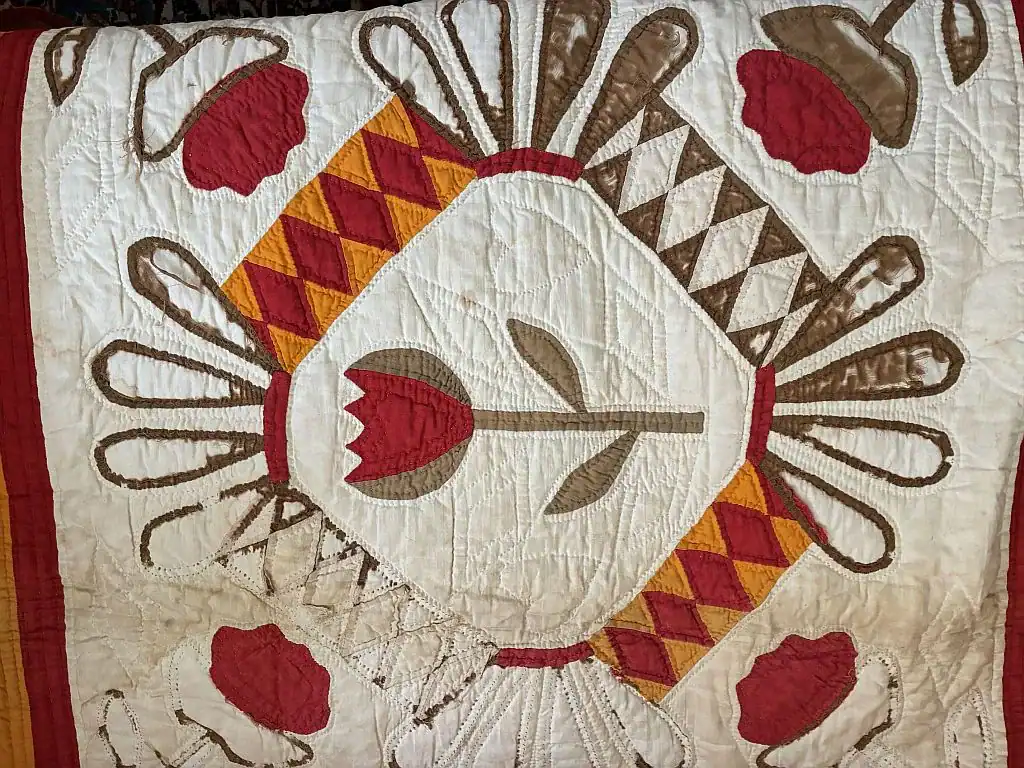
Hi all! I recently acquired a red and green quilt from the later 1800’s…it has what I thought was called trapunto on it. There are appliqu stems and leaves that are stuffed from the bottom of the quilt, giving it a3-dimensional appearance. I was mentioning it to a quilt friend-dealer who I know, and emailed her pictures, and she said that this was not trapunto. She has been a dealer for 25 years, and I thoroughly respect her opinions, but I guess I need to be educated…..what exactly is trapunto, and what are the criteria that have to be met before it can be called such??
Date: Tue, 10 Apr 2001 10:10:10 EDT | From: DDBSTUFF@
I thought I’d send along the web address for those who want to get a peek at the Amish Quilt Stamps: <A HREF”http://www.framed.usps.com/images/stamps/2001/19.htm”>2001 Stamp Program</A> or http://www.framed.usps.com/images/stamps/2001/19.htm At this address you can view all the new stamps coming out this year. As for the Amish Quilt Stamps, there is a block of four stamps each depicting a different Lancaster Co. Pa. Amish Quilt. Does anyone else think it odd that the Postal Service is releasing them in Indiana first? Darwin
Date: Tue, 10 Apr 2001 16:54:26 -0400 | From: Carol Bikofsky <bik@>
The Quilters’ Connection will be holding its 24th Annual Quilt Show and Sale on Friday, May 11, 10am to 9pm and Saturday, May 12, 10am to 4 pm at the First Parish Unitarian Universalist Church, 630 Massachusetts Ave. at Route 60, Arlington Cener, MA. You can find their website at www.quiltersconnection.org
Date: Tue, 10 Apr 2001 13:54:11 -0700 | From: quilter@
> Does anyone else think it odd >that the Postal Service is releasing them in Indiana first? http://www.framed.usps.com/images/stamps/2001/19.htm more odd than that (whaddaya expect?) is the fact that they’re showing 33 cents for postage! no excuse for that one.
Date: Tue, 10 Apr 2001 18:08:54 -0400 | From: “pepper cory” <pepcory@>
Just hazarding a guess–I think the Diamond in the Square and Trip Around the World are Lancaster PA style, but the Lone Star with the wide brown border could be PA, Ohio, or even Indiana. The lower right Nine Patch-y one looks like Holmes County. Maybe Julie Silber could tell us the factual origination of the designs and the Indiana reasoning, unless it was just Indiana’s “turn” to issue a new stamp. Must bring in a nice chunk of change for the issuing state!
Date: Tue, 10 Apr 2001 23:02:25 EDT | From: [from unknown]
Isn’t Indiana the home of our first author, Marie Webster, and also the home of the American Quilting Hall of Fame? Suzi in Chicago
Date: Wed, 11 Apr 2001 06:46:17 -0500 | From: “Ann G. Hubbard” <
If you go to the site that was given yesterday morning at http://www.amishacres.com, there is quite an explanation of how stamps are chosen. It is a very long process and I expect the reason you see 33 on some of the stamps is that was the cost of a first class stamp when the process of designing the stamp started. What we are seeing is an artist’s drawing, not the stamp itself. There is a 34 on the stamp at the amishacres site. Indiana has a very large Amish community as does Ohio. We have often driven through that area when we lived in Chicago and visited family in western PA. Missouri has very large pockets of Amish and mennonite communities, also. I expect this site was chosen for reasons Pepper named in that it was just “their” turn. I did not read all of the articles on the website. It is quite intensive, but very interesting, tho. It has been such a long time since we have had a quilt stamp that my only concern is to get some. Not all post offices get the same amount of stamps equally and I have found it hard at times to get the one I want. Ann from Lake of the Ozarks, MO
Date: Wed, 11 Apr 2001 08:36:30 -0400 | From: Pat & Jim <jimpat@>
Dear Linda Vergamini: It has always been my understanding that “trapunto”, or Italian quilting, encompasses both corded and padded designs. Originally, trapunto was done on whole cloth quilts, in lieu of piecing or applique, to form a 3-D effect on the surface. By extension today, it seems that we are calling just about an “stuffed” motif, whether it be an individual leaf that is appliqued or a piece of print fabric that is stuffed from behind, “trapunto”. If anyone has information contrary to this, I’d love to hear your thoughts. Patricia L. Cummings
Date: Wed, 11 Apr 2001 13:12:13 -0400 | From: “bonnie wilbur” <
I learned trapunto from a basic book on quilting published in about 1975 or so. I want to say it was a McCalls How-To book, but I looked for it recently and couldn’t find it. The book’s contention was that the only quilting which fit the classic definition of trapunto was parallel stitching lines through two whole pieces of fabric with yarn or cording inserted between them. The reason I was searching for the book is because the authors had another term entirely for parallel lines, or any other stitched shape, with with any other type of stuffing inserted, and unfortunately I’ve forgotten what that term was. I will look again. Bonnie
Date: Wed, 11 Apr 2001 14:01:13 -0400 | From: [from unknown]
Fons and Porter’s Quilter’s Complete Guide defines trapunto as a technique that uses stuffing to raise the quilting design in relief. And also in their guide, stuffed applique is called just that – stuffed applique. I can’t find anything different in any of my other books. In Kiracofe’s The American Quilt, trapunto is just referred to as stuffed work. Monica Mac
Date: Wed, 11 Apr 2001 14:11:20 -0400 | From: [from unknown]
Just found some more info in The Quilter’s Ultimate Visual Guide. Mary Stori’s section on trapunto says the terms are often used interchangeably. She defines trapunto as stuffing the quilting design, corded trapunto as stuffing between two parallel lines (for narrow areas such as stems) and uses the term stuffed work for stuffed applique. She has a good section about how these methods are done. This is a great book with lots of info. Monica Mac
Date: Wed, 11 Apr 2001 14:26:37 -0400 | From: Newbie Richardson <
Linda, The problem is as much semantics as technique. There are two common techniques for raised quilting: stuffing the area under the design with bits of batting inserted through the backing of the quilt. That is correctly called “stuffed work”. The second technique, dating back to the middle ages in Italy, is “trapunto”: where strands of thick cotton cording are inserted from the back of the quilt and pulled along between the sewing lines to create the raised effect. The term “trapunto” has become something of a generic for any kind of raised quilting. Like “Kleenex” or “Xerox”. It really gets fun when the piece has no actual “quilting”, but has both stuffed work and trapunto! There were some really breath taking ones like this made in the mid 19th c. A lot of these were done all in white. Newbie
Date: Wed, 11 Apr 2001 13:36:25 -0500 (Central Daylight Time) | From: Richard Pletcher <richardpletcher@>
Some of you had asked why the first day of issue for the new Amish quilt stamps was in Indiana. I asked Richard Pletcher from Amish Acres if he knew the reason. Following is his response. From: Richard Pletcher <richardpletcher@> The following quote is from the USPS announcement of the Amish Quilt stamps: “The Amish quilt is a uniquely American folk art form, and Amish quilting traditions vary from region to region. These quilts display the saturated colors, bold geometric patterns and central design motifs characteristic of those made in Lancaster County, Pa., in the first half of the 20th century. Four Amish quilts are reproduced in a repeating, rhythmic, quilt-like pattern to create this pane of 20 stamps, the first in the American Treasures series.” You notice that the first sentence acknowledges that “traditions” vary from region to region. The four quilts chosen were made in Lancaster, Pa. and are all from the Esprit Collection. I have listed them below. The USPS officials responsible for chosing the site for the dedication ceremony found Amish Acres through the miracle of the Internet search engine. I can’t speak for the USPS, but my conjecture is that the combination of Amish Acres facilities, attractions and events made the historic farm more appropriate to unveil the Amish Quilt stamps than any other location considered. Those features include the nation’s only Old Order Amish farmstead listed on the National Register of Historic Places; the fifteenth season of the 1955 Broadway musical about the Amish, “Plain and Fancy,” which has been performed over 2,500 times before over a quarter of a million patrons; the historical Round Barn Theatre, the opening day of the 39th Amish Acres Arts and Crafts Festival, an event attended by 70,000 people annually; The Inn at Amish Acres and The Nappanee Inn, host hotels for the historic attraction. Nappanee, the City of Issue, and Indiana simply happen to be the home of Amish Acres. I was told that a proposal for the location of the ceremony from USPS officials in Lancaster was also considered.
Diamond in the Square c. 1920 Pieced wools, 78″ 78″ Unknown Amish quilt maker Lancaster County, Pennsylvania Lone Star c. 1920 Pieced wools, 88″ x 89″ Unknown Amish quilt maker Lancaster Pennsylvania Sunshine and Shadow c. 1910 Pieced wools, 80″ x 80″ Unknown Amish quilt maker Lancaster County, Pennsylvania Double Ninepatch (variation), c. 1940 Pieced wools, 79″ x 79″ Unknown Amish quilt maker Lancaster County, Pennsylvania
— End Forwarded Message — Elkhart and LaGrange Counties in Indiana have, I believe, the third largest population of Amish in the U.S. Mary
Date: Wed, 11 Apr 2001 14:41:23 EDT | From: [from unknown]
Actually, the first known example of trapunto was what Newbie called “stuffed work” – the Guicciardini quilts are all stuffed from the back, and are commonly called trapunto. Italian corded work starts showing up during the Renaissance, about a century later. Karen Evans
Date: Thu, 12 Apr 2001 18:09:43 +0200 | From: Daniele Seyrig Baumgarten <
We here in France have another kind of stuffed work called boutis .It looks just like stuffed work but the way it is done makes it reversible . You take two pieces of cloth you quilt the design (generally a very intricate one with lots of symbols ) and then you stuff with cotton thread being very careful not to cut or break any threads (you delicately push the threads apart where you want to pull the cotton thread in ) Once finished you wash it and the threads just go back where they belong . It is probabbly a work that evolved from Italian trapunto . If you look at the 17th c boutis they are very finely worked and there is more cording than stuffing .I just saw one two weeks ago at an exhibtion and was astounded by the work . In the 19th c . ones the stuffing is predominant in a lot of boutis . At the same exhibition I saw a copy made this year of the 17th c one worked with more stuffing . There is a real boutis revival here right now and we have several books and magazines that show how to make boutis . Lots of classes too . I was told that there will be a class in Montreal but I do not know when or where . Sorry if I repeat what I already said in a message last year . I just thought the newbies might be interested ….VBG Daniele in Paris
Date: Sat, 14 Apr 2001 14:56:34 EDT | From: [from unknown]
Has anyone been collecting the newspaper itself as this new KCS series comes out? I waited too long to order back copies of the 2nd and 3rd newspaper issues and they are now out of the newspaper (though you can order the pattern packets themselves). If anyone has extra copies of the newspaper, I would l be willing to buy them from you. The next in the series (#4) should appear tomorrow, I believe. Is there anyone on QHL in the Kansas City Star reading area that would be willing to send me the whole page the pattern appears on? I will be happy to pay for the cost of the newspaper, if you have to buy an extra copy, plus postage. Karen Alexander Northern Virginia
Date: Sun, 15 Apr 2001 07:05:32 -0500 | From: “Jocelyn” <jsmartin@>
Karen, The Barbara Brackman patterns will be compiled in book form this fall, for sale by the KC Star. I started collecting them, but accidentally threw out some papers, so if you’d like to email me privately, perhaps we can work out a deal on future copies. 🙂
Date: Sun, 15 Apr 2001 20:40:25 EDT | From: Xroadclown@
I’m interested in learning about any web sites, or other sources of information about quilt history that would be suitable for 4th graders. thanks, melanie ( in sunny, finally, upstate NY!)
Date: Mon, 16 Apr 2001 09:21:09 -0400 | From: Judy White <jawhite@>
Did I dream this or at one time, didn’t someone post a list of places with archival supplies for paper? If anyone remembers or knows of such a list, please post it again. Thanks so much. Judy White in Ct where we had a glorious Easter day and it might snow Wednesday
Date: Tue, 17 Apr 2001 17:24:08 EDT | From: [from unknown]
In a message dated 4/14/01 2:58:31 PM Eastern Daylight Time, KareQuilt@ writes: << Has anyone been collecting the newspaper itself as this new KCS series comes out? I waited too long to order back copies of the 2nd and 3rd newspaper issues and they are now out of the newspaper (though you can order the pattern packets themselves). If anyone has extra copies of the newspaper, I would l be willing to buy them from you. The next in the series (#4) should appear tomorrow, I believe. Is there anyone on QHL in the Kansas City Star reading area that would be willing to send me the whole page the pattern appears on? I will be happy to pay for the cost of the newspaper, if you have to buy an extra copy, plus postage. Karen Alexander Northern Virginia >> I would also be interested in getting my hands on these patterns…but unfortunately, I’ve managed to find NONE so far. I know that the patterns can be purchased individually, and that there will eventually be a book or compilation of them, but I’d love to have the newspapers themselves. Anybody? Would appreciate the help!! Lori East Massachusetts
Date: Mon, 17 Dec 2001 21:43:19 -0500 | From: “fawn” <
Information about which quilts are depicted in the 2001 postal stamp featuring Amish quilts and about how the site of first-day issue site was selected is of interest to quilt historians. Much appreciation to all who have provided details. The only other US postal stamp depicting quilts was issued in 1978 as one of the American Folk Art series of first class (13 cent) stamps. The circa 1875 “Baskets” quilt, rendered by artist Christopher Pullman of Boston, was in the collection of American Hurrah Antiques of New York City. Although the quilt itself had absolutely no connection with West Virginia, the first-day issue was held in Charleston, West Virginia. The selection of Charleston as the site was largely engineering by WV Senator Jennings Randolph. The first-day celebration featured WV quiltmaking cooperatives and cottage industries, along with a quilt exhibit of contemporary Postage Stamp quilts (pieced from squares/rectangles about the size of a postage stamp) and Basket quilts ( with blocks resembling baskets). From the “Whatever it’s worth Department”: Some parallels may be drawn between 2001 and 1978. In both cases, a commercial collection furnished the quilt/s depicted on the postal stamp, the first-day issue site was not co-incident with the quilt/s provenance, and a public display of quilts accompanied the stamp’s first-day issue. Does anyone remember hearing that Paducah, Kentucky, was jockeying to become the site of the next US postal stamp to bear a quilt image?20 In any case, quilt aficionados will surely treasure the issue of the Amish Quilts postal stamps. Fawn Valentine snowy West Virginia
Date: Tue, 17 Apr 2001 22:09:51 -0400 | From: “John Cawley” <cawley@>
I’m going to have to start taking notes if I want to tell you about all the amazing things we see at meetings of Fran’s Vintage Friends. We made to pilgrimage to western Maryland yesterday; it was wonderful. I brought a scrapbook that one of the ladies in my quilt guild lent me because they all know that I am a history buff. she told me that her mother, aunt and grandmother (all lifelong residents of Middletown, Delaware) had been quilters and they saved articles and patterns from magazines and newspapers during the 1930s. The book is fairly bulging with loose clippings in addition to items glued to every page. The first thing I saw when I opened the cover was “Sears Century of Progress in Quilt Making.” Of course, I was hyperventilating. See Patchwork Souvenirs by Barbara Brackman and Merikay Waldvogel. Patterns are given for an unnamed pieced design, Bleeding Hearts, Tea Rose, Bowl of Flowers, Martha’s Vineyard, Colonial Rose, Iris, Autumn Leaves, Louisiana Rose, Delectable Mountains. The back cover is a picture of the Grand Prize Winner which they call Feathered Star. this quilt was presented to then First Lady Eleanor Roosevelt and has not been seen since. Sears offers “a complete outfit for making a similar quilt top, size about 72×90.” This included the proper assortment of plain and printed cotton patches in box with illustration and instruction for making. ” The complete outfit cost $3.25. For an additional $.25 you could get the perforated quilting pattern. The next big surprise was “Grandma Dexter New Applique and Patchwork Designs.” The book is stuffed with articles clipped from Needlecraft, the Detroit Free Press, the Kansas City Star, The Farm Journal, Modern Priscilla. I haven’t begun to do justice to this treasure trove. It really held up the proceedings at Fran’s because nobody wanted to pass it along to the next person at the table. I’m thrilled to think that I’ll have it at least until next month’s Guild meeting. The day I brought it home I called the owner to tell her what a thrill it was for me to see this collection; I want to impress upon her how important it is. She told me she only kept it for sentimental reasons. Of course, we saw quilts too and they were fabulous. Go to The Hands that made them, p. 71. That amazing strippy with the hand knotted fringe on p. 71 has setting strips of vibrant chrome orange printed with blue. We saw the Basket of Chips on p. 78 too. It was a great day for Pennsylvania quilts since we were informally previewing the antique quilt exhibit for next summer’s Quilt Odyssy show in Gettysburg which will feature quilts from Adams, York and Franklin County. Don’t miss it. Our eyes were trying to cope with more double pinks, poison green, chrome yellow and Lancaster blue than one would normally see in a year. I can’t think of a better way to spend a day: wonderful people, beautiful quilts, learning a lot and laughing even more. Thanks Fran. Cinda on the Eastern Shore