April 18 – May 8, 2001
These restored messages come from the Quilt History List, an online forum where quilt historians, collectors, researchers, appraisers, and enthusiasts discussed antique quilts and related textiles. The archive dates from 1996 through approximately 2016 and is being restored gradually. Sign up in the form at the bottom of the page if you want to know when a new page is added. Original spelling, opinions, formatting, and inactive links may remain unchanged.
Primary topics of this QHL Digest:
- Rescuing Desiccated Old Blocks — Members debate whether decades-old, brittle vintage blocks can safely be quilted at all, and trade rehydration and stabilization tips.
- Naming a Mystery Needlework Technique — A member’s memory of six-petaled tin templates and wrapped yarn sparks a hunt for the right historical term, landing on “stumpwork”-style Pennsylvania German handwork.
- Dating Quilts by Woven Name Tapes — A woven name tape on a family quilt top leads to research into when such labels came into commercial use, including an 1894 Ladies Home Journal reference to the J&J Cash Company. (see the article on dating quilts)
- Sourcing Reproduction KC Star Patterns — Members point each other toward eBay listings and newspaper archives for original Kansas City Star quilt pattern columns.
- Shows, Sales, and Exhibits on the Calendar — Announcements round up an Indiana Historical Society exhibit, the Kalona Quilt Show and Sale, and Paducah-area detours worth a stop.
Date: Thu, 26 Apr 2001 10:06:19 -0500 (Central Daylight Time) | From: Mary Persyn <Mary.Persyn@>
FYI – The Indiana Historical Society is mounting a new exhibit, starting May 12, entitled “A Working Life.” The exhibit will “explore the contributions of three Hoosiers to Indiana’s rich history of art and craft.” The three Hoosiers are Marie Webster, a leader in the early 1900s quilt revival, Harry E. Wood, a teacher and craftsman who led the “general shop movement” of the 1930s, and Portia Howe Sperry, the founder of the Brown County Folks Shop. For more information see http://www.indianahistory.org/workinglife.php The Indiana Historical Society is located in downtown Indianapolis. Mary
Date: Thu, 26 Apr 2001 19:31:46 -0700 | From: monikajcd@
Pat……..that looks like the Mittie Barrier Quilt. I remembered that quilt right away. It’s in “American Patchwork Quilting”, a Better Homes and Garden Book, page 298-300. It says she was a plain South Carolina farm wife and made the quilt in 1920 . It was handed down to her daughter. They have patterns included for 3 of the blocks. Monika Grants Pass, OR monikajcd@
Date: Fri, 27 Apr 2001 07:40:04 -0400 | From: “Zendelle Bouchard” <zendelleinr.net>
Hi all, I have some vintage 30s-40s-50s blocks that I am preparing to make into a quilt. I’m washing them to get rid of the dust of decades, and spreading them flat on a towel to dry. But they’re coming out really rough and stiff. Should I be putting a little fabric softener in the rinse water? Or would this be a bad idea? Or will they just soften up as I’m working on them? Z
Date: Sun, 29 Apr 2001 14:50:32 -0400 | From: Newbie Richardson <pastcrafts@>
Z, I would not waste my time trying quilt those old squares. The fabric has gotten too desicated to take the stress. Even if they survive the initial sewing, they will split along any seam lines with in a few years. FAbric Softener woun’t do you any good. Think of the fibers as hair that has been over permed, or skin that has been exposed to the sun for too long. Not much can be done. Sorry. On a brighter note, I am SURE that you have plenty of other projects waiting to get done! Best, Newbie Richardson Past Crafts Studios Appraisals and Conservation of Historic Textiles Alexandria, Va.
Date: Mon, 30 Apr 2001 10:08:11 -0400 | From: “anne” <datkoa@>
> Barbara Garrett and Joan Hamme will > present a slide lecture featuring the best of the quilts discovered by > the York County, Pennsylvania, Quilt Documentation Project at the May 16 general meeting of the Baltimore Applique Society. The meeting is at 7 p.m. at the Howard County Center for the Arts, 8510 High Ridge Road, Ellicott City MD and will cost $3 for nonmembers. The Quilt Documentation Project > registered more than 1,600 quilts. The lecture will show about 300 of > the most outstanding, including applique, pieced, signature, and other > types of quilts. > > York County is Baltimore’s closest Pennsylvania neighbor, and some > shared influences and styles will be apparent, especially in the album > quilts. Several Baltimore-style album quilts appeared in one community > near the Maryland border. In addition to the slides, our lecturers > will display several quilts found during their documentation days, > include a friendship quilt signed by Baltimore album quilt designer Mary > Simon and featuring one of her multi-layered basket blocks. The book > based on the project, “The Fabric of Friendship” will be available for > purchase. > > Barbara Garrett is a quilt historian, quilter, lecturer and author. > She was a consultant to the York County documentation project as well as > projects in several other Pennsylvania counties. She spoke to the BAS > at the March meeting on the historical development of quilt styles as > seen in doll quilts she has made with period and new materials. She > recently appeared on HGTV’s program, “Simply Quilts.” > > Joan Hamme, a quilt historian and quilter, was the chair of the York > County Quilt Documentation Project, which registered quilts and related > items from 1997 to 1999. The project plans to continue to record the > county’s quilt legacy in upcoming public and private documentations. > Joan was president of the York County Quilt Guild from 1996 to 1997. > >
Date: Mon, 30 Apr 2001 10:45:33 -0400 | From: Newbie Richardson <
Mary Waller wrote: > > Hi, Newbie, > > Just read your post to QHL about using old blocks. > > I’ve heard/read you describe rehydrating other materials, like leather. > Is that possible with fabric? > > Mary Waller > Vermillion SD Of course you can do it with fabric. But it does not return them to their original “youth”. Sometimes, after a fabric has been wet cleaned, it feels dry and crispy after it air dries. Depending on how much stress it can with stand, a gentle steaming works great. But that is very hot and can really be stressful on the fibers. One recent technique to remove fold lines from old, fragile fabrics that cannot be wet cleaned is to use Gortex fabric. Basically the trick is to use the gortex as a barrier that allows the moisture to penetrate – but not let that same moisture condense on the textile. You place a piece of gortex over a section to be rehydrated, then press a damp cloth over it using weights to hold it down. Check every five minutes (using a timer is best)to be sure that no droplets have formed from condensation on the other side of the gortex. I observed this at the Museum of Fine Arts Boston where they were putting on an exhibit of the paiseley shawl. One of the consevators got distracted, did not keep an eye on the project, the moisture condensed on the shawl, leaving a water mark. It is very time consuming – but a great technique for displaying old quilts that have a really bad foldline. Newbie
Date: Mon, 30 Apr 2001 10:54:27 -0400 | From: Newbie Richardson <pastcrafts@>
Marcia Kaylakie wrote: > > Dear Newbie, > I am designing a workshop called Old Blocks, New Quilts and your comment > was of interest to me. Do you have a particular method to determine whether > or not a block is “past it’s prime”? Or do you do it just by feel and > sight? I would be appreciative of insight in this area. Sincerely, Marcia > Kaylakie, Austin, TX Marcia, Please remember that I am not an experienced quilter (my thing is smocking classic children’s clothing!) but I can usually tell if the fabric isn’t going to respond well to any conservation with needle and thread by the “feel” of the fabric. I keep going back to the analogy of over permed hair or over sun exposed skin, they feel different! Another test is to tug gently on the fabric – does it “give” like a new piece does? Try this with both an old piece and a new (prewashed) piece. There is a definite difference in how the fabric reacts. This has NOTHING to do with the appropriateness of quilting with old blocks/tops. I still believe that the original maker is up in Heaven, pleased as punch that her unfinished project is FINALLY getting done! But I do notknow anyone who has so much free time that she can waste it on a lost cause! There are lots of options for using old blocks, ect. Making a new quilt is only one of them! Best, Newbie
Date: Mon, 30 Apr 2001 11:17:13 EDT | From: Trimble4@
Hi all, I am wondering if anyone here has some clue as to how long those woven name tapes (like you put on camp clothes, or kids’ gym suits) have been around. I purchased a lovely old quilt about a week ago, and was tickled to find a name tape sewn to one corner (hadn’t seen THAT until it was mine). I did a little on-line research and found the name belonged to a man, and got dates and towns for some of his relatives. Have gotten no further, though. Seems the gentlemen passed away 15 years ago and the quilt was not in the town where he died. That part of the investigation is for another day soon. I am just curious…having the name made it so much less anonymous! Thanks a million for any help. Lori East in windy Massachusetts
Date: Mon, 30 Apr 2001 14:22:23 -0400 | From: “pepper cory” <pepcorymail.clis.com>
Can anyone on QHL remember/name the craft that used those six-petaled tin templates? Yarn was wrapped around them and produced dimensional flower shapes in rugs and mats. Sometimes the templates turn up at antique shops as quilt templates and although a few might have been used to trace the occasional quilting design, these daisy-like templates had a use of their own. Now what WAS the name of the craft?! Thanks- Stumped in coastal Carolina, Pepper Cory
Date: Mon, 30 Apr 2001 16:11:59 EDT | From: QultFrFn@
Jean — Thanks for your remarks regarding hand and machine quilting in the same piece. Yes, I’ve been campaigning for allowing both <=> machine and hand quilting in pieces for years…usually to very deaf ears. It’s not only NQA, but also in Paducah…at least the last time I judged there. I keep doing it in my work and teach it…and warn my students about the resistance they will probably encounter should they enter their quilts in shows. I think it’s going to need to be a serious ‘grass-roots’ kind of movement to make the change. Sincerely, Nancy Brenan Daniel, AZ quilter
Date: Mon, 30 Apr 2001 16:26:56 -0500 | From: “Jocelyn” <jsmartinukans.edu>
Newbie, re: desiccated blocks What can those of us who have antique quilts/tops/blocks do to prevent them from drying out?
Date: Mon, 30 Apr 2001 18:18:06 -0400 | From: Barb Garrett <bgarrett@>
Hi Pepper – For those of us living in southeastern PA, it isn’t obscure needlework as it is found all over the place — comforters, pillows, pot holders. Our sources when I did documentation called it Tufted Yarn Work.
Date: Mon, 30 Apr 2001 19:12:28 -0700 | From: Denise Clausen <nadyneoregoncoast.com>
Hi Sue The Latimer Quilt and Textile Center has many of the Needlecraft/Home Arts magazines in its collections. Denise Clausen Director LQTC Susan Wildemuth wrote: > > Does anyone on the list know if there is a photo archive, photo morgue, or > museum despository for the photos featured in the NEEDLECRAFT/HOME ARTS > Magazines from the 1910’s-1940’s? > > Thanks, > Sue
Date: Mon, 30 Apr 2001 22:45:14 -0400 | From: Paul and Nancy Hahn <phahn@>
Barb, My Old Order Mennonite friends from New Holland referred to this as “stump work” when they showed me pincushions made of these blocks. Don’t know if that is a regional name or just their family name for this. Nancy Hahn
Date: Mon, 30 Apr 2001 22:53:06 -0400 | From: “J. G. Row” <Judygrowrcn.com>
>You place a piece of gortex over a section to be rehydrated, then >press a damp cloth over it using weights to hold it down. Check every >five minutes (using a timer is best)to be sure that no droplets have >formed from condensation on the other side of the gortex. Perhaps the museums should learn of our technique for flattening rolled posters before mounting and framing them. We have a cold vacuum press, actually 2 presses, one 40 x 60, the other 48 x 96. We sandwich the (cheap) poster between 2 sheets of kraft paper, lay the package on the bed of the press, spray the top kraft paper with a light misting of water so that is almost doesn’t change color — very little does the job — and then close the lid and turn on the press. The vacuum pulls the moisture out of the kraft paper and down through the poster paper, relaxing the fibers and getting the roll marks out. The vacuum also sucks all the extra moisture out of everything. If you leave the press on for 10 minutes or so there might not be a bit of moisture left. With fine fabrics the gortex would work the same way as the kraft paper does for us . Of course a large Paisley shawl wouldn’t work even in our largest press. We throw the kraft paper away when we are done with it, but perhaps the gortex would be reusable. I’ll have to look into that. Judy in Ringoes, NJ judygrowrcn.com
Date: Tue, 1 May 2001 06:12:23 EDT | From: JBQUILTOK@
I have a quilt top that’s been in the family. It has woven tape w/ the name of the maker & a date of 1906 written onto it. I doubt it was put on at the time the top was made – suspect my great aunt documented what it was sometime in the 1940’s or 50’s. Janet Bronston
Date: Tue, 01 May 2001 22:21:58 +1000 | From: Lorraine Olsson <svenpnc.com.au>
I just placed a search on google.com and came up with this information http://www.commercialproducts.com/ For ALL Your Woven Label Needs! Manufacturing Chemists of Starches and Finishing Auxiliaries for the Woven Label and Narrow Fabric Industry Since 1944! This was the first item , I have not researched any more, but it certainly places these labels in the 40s Lorraine in Oz
Date: Tue, 01 May 2001 09:38:28 -0400 | From: Newbie Richardson <pastcrafts@>
Barb, There is a more exact term for this technique. It is a German/Dutch term, starts w/ an “s”, I think. None of my books on Pa. German weaving has the term, as they are specialised in the weavings and door towels. This technique was considered a bit “declasse”, or “kitch” by many – which may be why I can’t find any reference in my books. I have talked to older ladies who did this work and were taught by their grandmothers, etc. I stupidly did not write down the term. But it is a specific vocabulary word which describes the technique of wrapping the yarn over those tin templates, cutting the yarn, and then felting it to get the tight tuffted effect. It was very popular in the last part of the 19th and 1st 3rd ofthe 20th centuries. Mostly done in Pennsylvannia, Ohio, Indiana. Don’t suppose you have any reference books that have the right term? Newbie in exquisitly beautiful Nortern Virginia. The dogwood are to die for!
Date: Tue, 01 May 2001 10:19:15 -0400 | From: Barb Garrett <bgarrett@>
Having some free time this morning I’m looking through some books and found the following — In the Goshenhoppen Documentation book by Nancy Roan, she says — Tufted yarn motifs turned up in the documentation with pillow tops and a knotted bed cover. Tufted yarn work is not unknown in eastern PA. We have seen rugs, bed covers. Pillow tops are by far the most common application. The tufted yarn motif is made by stitching varied colored yarn back and forth over the tin form. When the stitching is completed, the yarn is clipped and the form removed. These tin stars range in size from 3 inches to 12 inches. I have pin cushions made with this motif — vintage early 1900s. I agree with Nancy Hahn that I’ve heard it called stump work, just couldn’t find that name right away. I found the name in a book called Trapunto and Other Forms of Raised Quilting by Mary Morgan and Dee Mosteller, c1977. I’ll quote from page 13 — It was also during these two centuries (17th and early 18th) that another intriguing raised needle art became fashionable, both in England and on the Continent. Geven the rather graceless name “stump work,” the technique involved the use of layers of embroidery stitches, one on top of another, to build relief figures on fabric, normally white satin. To bring certain important design elements, such as human bodies and flowers, into even higher relief, sometimes tiny wooden molds were placed behind the stitching. Stump work was made even more elaborate than raised quilting by the addition of colorful “overlays” done in a variety of stitches. Stump work had many parallels with trapunto. It was done on fashionable garments and all manner of furnishings. Like trapunto, there is some question as to the derivation of its name and techniques. Also like trapunto, its popularity ended with the eighteenth century in Europe, followed by a brief vogue in American needlework. Could that “brief vogue” be the predominantly Pennsylvania German use of it on wool with the stars in the late 1800s and early 1900s? Barb in southeastern PA
Date: Tue, 01 May 2001 10:32:27 -0400 | From: “Judy Kelius (judysue)” <judysue@>
This past week I found matching redwork pillow shams (the kind you lay on the pillow) that have caricatures of a man and woman and a 1905 date, apparently when they were married. Their names are included – the man’s sham features some owls, and the woman’s has doves. There are also initials “AB” below the date, perhaps of the person who made these. Do any of you who are more familiar with redwork know anything about these? Were they standard caricatures that you could buy or did someone actually draw these? If anyone would like to see photos, let me know – I’ll be glad to email them to you. These are so neat! I’m going to do some research to find out who the people are . . . these shams came from within 10 miles of where I was born, so I have a special interest in them.
Date: Tue, 01 May 2001 08:27:30 -0700 | From: “Julia D. Zgliniec” <rzglini1@>
Dear Barb and QHL, I am not sure if I have the right mental image of what you are describing but I have several samples in my lace collection of doilies and mats made by wraping yarn or thread around a little tin template. It is called “Waffle Work” byKathleen Warnick and Shirley Nilsson in their book Legarcy of Lace, c. 1988. A Solstice Press Book, Crown Publishers, Inc., NY ISBN 0-517-56899-3 It gives pictures of both the technique and the little template. I recommend this book to anyone who likes/studies/collects lace of all kinds. Regrads, Julia Zgliniec- Poway, CA
Date: Tue, 1 May 2001 09:50:30 -0800 | From: mlelowell.edu (Mary Lou Evans)
I can date them at least back to the 40’s because we had them in our clothes as children…. TTYL, Mary Lou in N. Arizona
Date: Wed, 02 May 2001 04:49:44 -0500 | From: Shirley McElderry <tigersouplisco.com>
J&J Cash Company of Norwalk, Conn. made woven labels, trimmings, etc. In an 1894 Ladies Home Journal, the ad read: “Your name can be woven in warranted fast Turkey Red cotton on fine cambric tape; order through any dry-goods store–” I have some of these labels; they are one and a half inches by three-eighths. The letters were woven into the cloth in different colors and script styles. Shirley Mc from beautiful Iowa
Date: Wed, 2 May 2001 07:28:33 -0400 | From: “Zendelle Bouchard” <zendelleinr.net>
Hi Lori, the gentleman may have been a nursing home resident at some point. At the home where I work, they sew those tapes to all the resident’s clothing, etc. Although often times on the quilts, they just write the name on in black magic marker. Eek! Z >>I purchased a lovely old quilt about a week ago, and was tickled to find a name tape sewn to one corner
Date: Fri, 04 May 2001 10:46:34 -0400 | From: “Kris Driessen” <krisdriessen@>
>Press Release Immediate >Contact: Janet Finley (evenings) 303-422-3879 > >The Columbine Quilt Guild presents Louisa L. Smith for a lecture and >workshop on Strips ‘n Curves. Louisa Smith, Loveland, CO fiber artist, >teaches her very own Strips ‘n Curves method. Ms. Smith’s method will >soon be published by C&T Publications. You’ve seen these fabulous pieces >at Symposium and Fabrics of Legacies. This is the lecture and workshop >being held in Grand Junction by CQC. Excellent opportunity to attend if >you can’t make Grand Junction in August. Beginners and advanced are >welcome! > >The lecture and workshop will be held at the Wheat Ridge Community Center >(Pioneer Room), 6363 35th Avenue, Wheat Ridge, CO. >Lecture time: Monday, June 11, 2001 at 7 PM >Workshop time: Saturday, June 16, 2001 9 AM 4 PM > >Attend the Monday, June 11th lecture for a preview of the Strips ‘n >Curves method. Workshop sign-ups are being accepted immediately by >calling Janet Finley (evenings) 303-422-3879. Lecture guest fee: $6. >Workshop $30 members, $35 non-members. Supply list will be sent upon >registration. Make check payable to Columbine Quilt Guild.
Date: Sat, 5 May 2001 14:17:10 -0500 | From: “Susan Wildemuth” <ksandbcwgeneseo.net>
I am going to start on my son’s graduation/quilt this weekend, he graduates next year. I want to have some signatures on the quilt in various places-teachers, scouts leaders, 4-H leaders, etc. I do not plan to embroider the names. What I want is some ideas on what type of “pen” to use that is thin-lined, won’t run, eat fabric, is permanent, and with proper quilt care, will still be readable years down the road. I plan to do a brief history “Life of Brian” to go with his quilt and display both at his graduation party. I wish I could claim this idea as new, but I’m afraid I’ve seen it at three different graduations where mom or grandma was a quiltmaker. I have used Micron pens (black is always my color of choice) in the past. Is this a good choice or is there something better out there? Any help you can give me would be greatly appreciated. Thanks, Sue
Date: Tue, 08 May 2001 21:03:48 -0700 | From: Denise Clausen <nadyneoregoncoast.com>
Hi Sue Lettering on fabric is what I do. I am both a calligrapher and quilter and teach classes about lettering on fabric. I have used Pigma pens the most often. I have seen a comment in archival supply catalogues that they are both permanent and will not damage fabrics. I had used them for years not knowing about their long term effects on fabric. I did test them for durability and they did loose a bit of intesity when washed is a machine. I did have a couple quilts dry cleaned after the house was filled with smoke and ash after a run away slash burn came within feet of our house. The intensity of the ink reduced significantly, but it is still visible enough to trace over it again. Pigma pens come in several sizes of pointed pen, in a “brush” felt pen, and in a small “edged” pen (for calligrahy). They come in many colors. Best of luck Denise Clausen
Date: Wed, 18 Apr 2001 04:58:30 -0500 | From: “Ann G. Hubbard”
Don’t newspapers keep back copies of already published newspapers. If you wrote to the KC star maybe they would sell you those issues. Just a thought. Ann from lake of the ozarks, MO
Date: Wed, 18 Apr 2001 06:09:39 -0400 | From: “Zendelle Bouchard” <
I have seen original patterns from the KC Star for sale on eBay many times. Sometimes it is just one or two patterns; sometimes a scrapbook full; some people sell photocopies of the patterns. However, I have not seen full pages or full newspapers. It seems quilters just cut out the patterns and saved them. It would be fun to try and collect all the originals (not that I need another thing to collect!) Z
Date: Wed, 18 Apr 2001 07:16:07 -0500 | From: “Jocelyn” <jsmartin@>
> I would also be interested in getting my hands on these patterns…but > unfortunately, I’ve managed to find NONE so far. I know that the > patterns > can be purchased individually, and that there will eventually be > a book or > compilation of them, but I’d love to have the newspapers themselves. > Anybody? Would appreciate the help!! Lori, Too late to get it from the beginning. The individual patterns sell for $8, and the book will be out in the fall, so it will be much cheaper to wait for the book. You can contact the STAR and order individual issues of the papers, until they sell out (which they may have already, Barbara wasn’t sure). OTOH, if people want to email me and make it worth my time to go out and buy copies and mail them to them <G>……
Date: Wed, 18 Apr 2001 08:25:30 -0500 | From: Marilyn Woodin <
Over 300 quilts dating from 1860-2001 will be presented For Sale at the KALONA QUILT SHOW AND SALE in Kalona, Iowa on Thursday April 26th from 6pm-9pm (early bird show), Friday April 27th 9am-7pm and Saturday April 28th 9am-5pm. This show will celebrate a 30th Anniversary this year and,even though it is at the time of Paducah, many find their way to come to Kalona on their way to Paducah. You are invited to help us celebrate. For more information: email woodin@ or kac@ or call 3196562240 or 3196564489. Wonderful shows at the Quilt Show and Textile Museum—Wonderful food—Great atmosphere– Terrific Shops for shopping.. We are the largest Amish/Mennonite community West of the Mississippi.
Date: Wed, 18 Apr 2001 12:24:35 -0300 | From: family.chisholm@ (Sara Chisholm)
I know I’ve read many solutions to the problem of ink on a quilt since I’ve been lurking here, but now I need the info, and of course, have not stored it away. I vow, from this day forward, to create documents where I will paste “how to deal with” or “how to repair” snippets so I will have them when I need them. What I need now is a solution to this problem: a dear friend had her quilt quilted by a group that marked it (horror of horrors) with a ball point pen. It seems two women had been marking the top and in one corner, their marks didn’t meet. They tried using Javex 2 (a color safe bleach) to remove the marks in the offending corner – which it did from the top – only to come through as bright blue lines on the light colored back! My friend was good-natured about the marks, and refused an offer to buy the quilt from her, but would like to remove the marks safely, if possible. Any suggestions? You can email me privately, as this discussion has already been well covered here before. Thanks for you help! Sara in Nova Scotia, where the snow had plugged the screens and my crocuses can no longer be seen.
Date: Wed, 18 Apr 2001 14:18:25 -0500 (Central Daylight Time) | From: Mary Persyn <
I just received an archival supplies sale catalog in the mail from Gaylord. They have a number of textile storage items, boxes, tissue, tubes on sale for anywhere from $2 to $7 and more off depending on item and size. I checked their web site but did not see the sale listed there. The sale prices are good through June 30, 2001. If you are interested, you could try calling Gaylord at 1-800-448-6160 and ask for a copy of the Gaylord Archival Supplies Sale Catalog. Mary in sunny Valparaiso where yesterday’s snow melted pretty fast, thank heavens.
Date: Thu, 19 Apr 2001 18:32:05 EDT | From: DDBSTUFF@
A friend just sent this info to me. I thought I’d pass it along. Hope you all haven’t already discussed this. INTERNATIONAL QUILT CONTEST – NY Deadline: May 31. To celebrate new construction at the Museum of American Folk Art (MAFA). Theme is Quilted Constructions: The Spirit of Design. Contact: Museum of American Folk Art, 555 West 5th St., New York, NY 10019, Email: quiltcontest@. Good Luck, Darwin
Date: Thu, 19 Apr 2001 19:07:46 -0500 | From: Jan Wass <jwass@>
A reminder to all those quilters heading to Paducah on I-57. Stop at exit #77 in Southern Illinois and view a new exhibit of old Illinois Amish quilts. Some of the most striking and colorful Amish Quilts were created right here in Illinois… and this new exhibit presents 20 of these beauties. Some of these quilts are among the earliest discovered so far in any of the Amish communities in the country. I will be giving gallery talks on Tuesday, April 24, at 11 am and 2 pm and on Saturday at 11 am. There will be a special open house on Saturday and Caryl Fallert and Jane Sassaman are important parts of the festivities. Please stop and stretch your legs. Jan Wass, Exhibit Curator and Curator of Decorative Arts, Illinois State Museum Illinois Amish Quilts: Sharing Threads of Tradition is on display at the Southern Illinois Art Gallery through September 3. The gallery is located in the Southern Illinois Artisans Shop and Visitor Center, six miles north of Benton on I-57, just west of Exit #77. Hours: 9 am to 5 pm, 7 days a week.
Date: Thu, 19 Apr 2001 20:46:32 -0400 | From: [from unknown]
Can anyone help me? I’ve been asked about restoring a tapestry, and of course I don’t do this. The tapestry resides in mid-Florida. Anyone know of someone? Thanks. Alan
Date: Sun, 22 Apr 2001 21:15:31 -0400 | From: [from unknown]
I have received my confirmation for the Vermont Quilt Festival (June 29 – July 1 this year) and I am pleased that I will be in the Sunday morning class “Antique Quilt Commentary” with Bobbie Aug and Sharon Newman. There is so much I can learn from these ladies that the class should really be fun. The wonderful range of antiques to see at the show is always great and a highlight of the show for me. And of course I try not to drool too much over what the vendors have to sell. And the contest quilts are great too. Anyone else planning to be at VQF? Sandi in Vermont
Date: Tue, 24 Apr 2001 23:11:54 EDT | From: [from unknown]
Well, I won’t be going to Paducah, but next week I am going to Shipshewana, IN for a Dear Jane gathering…get to meet lots of “on-line” friends <in person> and really looking forward to it. I had a wonderful day on Saturday…we did a “quilt identification day” through the local historical museum. Had 72 quilts brought in, we take down any info the owner has on the quilt & maker, measure & “document” the pattern, quilting, fabrics, etc. and photograph the quilt. This is an extension of the Iowa Quilts Research Project, which we did back in 1988. The state project was for that one year, but locally, we still have requests for documenting quilts. Fortunately, one of my best friends is the exhibits curator at our local historical museum, so we have continued to do our “Quilt ID Days” about once a year. We have seen some real treasures (and a lot of “well-loved” quilts!!) This year, one lady & her daughter brought in 18 family quilts & tops that were fabulous!! 3 were circa 1870…had Civil War commerative fabrics in them!! One was a sampler, one the “Tumbler” charm type block, and one was a “Double Four Patch” (grid 4 x 4 of assorted fabrics making up the block) set with sashing, and then there were tiny strips appliqued on top with signatures!! Each of these was in mint condition, probably never washed or used!! Such a joy to see them!! (I asked if they were interested in adopting me 🙂 These were the work of one woman, and there may be a future exhibit in the making there!! One quilt design that we keep seeing over & over is a circa 1930 Butterfly block, about 7″ square, where the butterfly is cut from one piece of floral print fabric & usually stitched around with black embroidery floss in the buttonhole or blanket stitch. These blocks are set with six in the center, 3 rows with 2 butterflies set side by side. Then a border about 4″ wide, usually of a yellow or gold solid. Then there is a second row of butterflies, and another border of yellow/gold. One more row of butterflies, and another border of the solid. The yellow/gold borders give a strong vertical rectangle look to the quilt. This setting is so distinctive, and yet we see it so often, it must have been a published pattern or maybe even a kit. I have looked through the “30’s” era books I have, but don’t see this in any of them. We saw 3 of these quilts (all from different sources) on Saturday, and I know of several others. I wondered if any of you know of a source for this design?? Another neat quilt I documented was in sad shape (or maybe I should say, it had been well-loved!!). We use Barbara Brackman’s “Encyclopedia of Pieced Quilt Patterns” and also her Applique book for pattern identification. I told the ladies at the pattern ID table to check the Applique book for Lily of the Valley or Tulip designs. I was pretty sure the design was one that had been in a newspaper. The block was a horizontal rectangle, with a folded leaf and several bell-shaped flowers on the left and another leaf and more flowers to the right. Sure enough…it was “Lily of the Valley” by Nancy Cabot, which had appeared in the Chicago Tribune. This quilt had a lot of buttonhole stitch, but it was done in thread to match the applique pieces. The background fabric had been a butter yellow to begin with, faded almost white now. The green leaves have faded considerably, but the embroidery floss that originally matched it was still a bright kelly green. The quilting stitch done on this was unusual, too…it was done with a fairly coarse cotton thread and there were 3 running stitches, then a back stitch, 3 running stitches, then a back stitch. The different pull on the back stitches (which were shorter than the running stitches) really gave this a different look. I wonder if the maker was worried that the heavy thread would break & the back stitches would strengthen the quilt?? Or maybe, that is just the way she was taught to quilt. The young girl who brought the quilt in didn’t know much about it. That is the frustrating thing…wishing these quilts were signed & dated or that they could talk, to tell us their stories!! Well, have run on long enough!! Happy Stitching (or gardening 🙂 everyone!! Karan from breezy Iowa
Date: Wed, 25 Apr 2001 09:10:55 -0400 | From: [from unknown]
Since things are kind of quiet on the list, I thought I would ask a couple questions I have had. I am reading Old Patchwork Quilts and the Women Who Made Them by Ruth Finley. Very interesting and I love how free she was with her opinions. I am drawn to a few of the quilts pictured and was wondering where are they? Are any of the quilts in this book in museums now? I especially am curious about the Star of Bethlehem used as the frontispiece – it just says “Author’s Collection” and Plate 9, the Full Blown Tulip which says “Courtesy of Mrs. Abigail Stevenson”. I wish the Tulip quilt was shown in color since Mrs. Finley gave such a vivid description of her dislike for the colors chosen for the quilt. My second question is about the Tulip quilt. I would like to try to recreate this quilt for myself. Do I need to get some permission from someone to do this? Thanks, Monica Mac in spring-has-finally-arrived Maine!
Date: Wed, 25 Apr 2001 11:43:28 -0400 | From: “Pam Weeks Worthen” <pamworthen@>
DH took me along to Amsterdam on a business trip. Of course I managed to turn part of it into quilt business, and spent a wonderful morning at “Patchworks.” Check them out at dutchquilts.com, as this is what enticed me into the shop in the first place. Here’s the story: We schlepped across the city, back and forth for 3 days, trying to make all the connections Doug needed to make concerning a decision to sell or restore his c. 1750 Potter, Jr. ivory flute. We couldn’t find our friend who is the expert repair person for ivory, then we did, then he wouldn’t fix it and said it should be sold to a musuem, so back and forth between the repair person and the dealer until Thursday, when the tram finally took us past the Patchwork shop. We got there at 5:15 on what was supposed to be late closing night, but the door was locked and my insistant rattling of the knob got stern looks and negative head shakes from the staff. Dejected, Doug and I headed to the closest bar for hor’s d’etc (never can spell that) and a beer and who should walk in but the crew from the quilt shop, The owner apologized for closing early and we talked for a bit. when he learned that I liked old quilts, he promised to make up for the closing by bringing a few in if I could visit the next day. I agreed and turned up at 11:00 and spent the next 2 hours in heaven. Old quilt heaven. He brought in a Dutch quilt, c.1780, hexagon pieced in Grandmother’s Flower garden fashion–ie, 6 petalled flower surrounded by white hexagons. Pieces were larger than I would have guessed, about 2 inches from edge to edge. EVERY hexagon piece was different, with the exception of the white ones, all in block prints, chintzes and other wonderful stuff that I hope to learn about some day. Second oldie was an American quilt, c. 1850, ocean waves set in the brightest double pinks I have ever seen. closely quilted, and in excellent condition. BEst of all were the palampores. Yep, palampores. Okay, they were repro’s, but to DIE for!!!! His speciality is reproducing Dutch chintzes and he has panels reproduced of palampores. I saw the line he has for sale, and they are gorgeous. If I can make myself stop going to auctions, I plan to save up for one. He also had bought some that were printed in France before WW1. and there’s some story about visiting the place they had been printed and the blocks having been lost to bombs, but I was too close to passing out from ecstacy and heard about every third word. I brought a mess of fabrics home, but am as pleased with my 3 new books, one on Dutch patchwork from 1700 to 1900, and the other 2 are French titles. I wonder if our Paris connection (I’m so sorry, I have lost your name and e-mail address) can tell me the difference between “boutis” and “piquet”. My French is adequate for a rough translation of the texts of these 2 GORGEOUS books, but I haven’t taken the time to dig out a good dictionary to translate the intricacies of the titles. One is “Les Boutis de Provence’ and the other ‘Piquets de Provence”. One half of the fabric there were American imports–the repros we have now,like the Sturbridge lines and the Cocheco Prints, etc. The other half are his Dutch chintz repros. I did a little damage to my personal plan of paying off the credit card before the year 3000, but not too bad. There was a poster there for a show at the Netherlands TExtile Museum for American quilts, but it was somewhere 2 hours away not easily accessible by train/bus and our flute business had not been concluded, so I didn’t even try to go. Other textile wonders in this incredibly beautiful city included 2 yarn shops I poked into, but didn’t find much different from what we have at home, and a shop specializing in sari silks. Thank Goddess it was closed! Oh, the flute! We ended up schlepping it through Saturday, when Henk the repairer finally decided he could fix it with out damage if the repair failed, so we left it with him, and Doug will be able to play on it for another 10 years. I want him to make a recording, and I’ll let you know when it comes out. Back to work! Pam in NH w
Date: Wed, 25 Apr 2001 14:47:19 EDT | From: [from unknown]
What is the name of the shop, and do they have a web address? Sounds like a marvelous time! Also, what is the name of the book on early Dutch quilts? Even if it’s in Dutch, it sounds very interesting….:) Thanks! Karen Evans
Date: Wed, 25 Apr 2001 21:40:01 -0400 | From: “Gregg Sloan” <
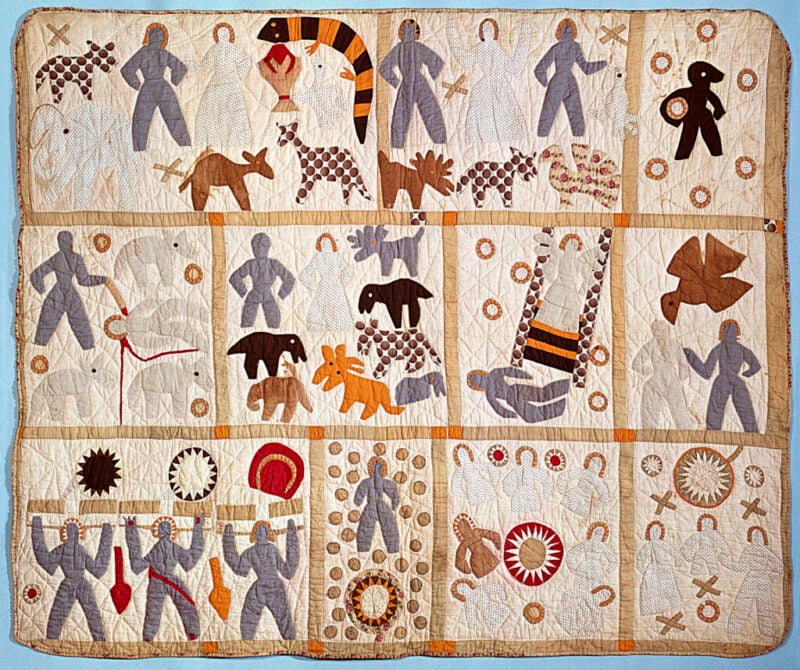
I really fell in love with a quilt at the Lancaster PA quilt show. It was a Crazy in the main antique exhibit area of the Tennis Court. It is the one with all the animals and the year 1920 at the top left. Does anyone know if it is documented in any quilt book? You can see a picture of it at my photo site, under the Lancaster PA folder. http://community.webshots.com/user/quilterpatsloan Thank you! Pat Sloan See my new patterns on the Website: http://www.quilters@