August 5 – 15, 2001
This page contains affiliate links. If you buy through them, I may earn a small commission at no extra cost to you. As an Amazon Associate I earn from qualifying purchases. Learn more
These restored messages come from the Quilt History List, an online forum where quilt historians, collectors, researchers, appraisers, and enthusiasts discussed antique quilts and related textiles. The archive dates from 1996 through approximately 2016 and is being restored gradually. Sign up in the form at the bottom of the page if you want to know when a new page is added. Original spelling, opinions, formatting, and inactive links may remain unchanged.
Primary topics of this QHL Digest:
- Quilt Odyssey Recap & Antique Book Finds — List members report back from the Quilt Odyssey show in Gettysburg, including a chance find of a rare book by dealer Stella Rubin.
- Baltimore Album Exhibit Extended — Follow-up notes confirm the Maryland Historical Society’s Baltimore Album exhibit has been extended, with members coordinating guild visits.
- Reproduction Fabrics & Revolutionary War Era — A newer member asks about fabrics and patterns from the Revolutionary War period, sparking a wider conversation about reproduction fabric lines.
- Yvonne Khin’s Quilt Block Dictionary — An extended thread compares editions and prices of Yvonne Khin’s block-identification book against Brackman’s Encyclopedia.
- Family Quilts & Log Cabin Dating — Members help date a garage-sale Log Cabin quilt and a deceased relative’s unfinished project using construction clues. (see the article on dating quilts)
Date: Sun, 5 Aug 2001 23:05:28 EDT | From: Edwaquilt@
Patchwork Patter was the early publication of the National Quilting
Association.
Tumbling Alley was edited by Evelyn Brown who lived in Gainsville
Florida.
I’m now sorting through various things and find that I have several
of these
early publications.
Holice
Date: Mon, 6 Aug 2001 22:36:29 -0400 | From: “J. G. Row” <Judygrow@>
DH and I returned tonight from the Quilt Odyssey in Gettysburg. It
was a wonderful show in a VERY comfortable venue! If only the Lancaster
show
could find a venue like the Eisenhower Center in Gettysburg! Or even
like
the Expo center where the Mancuso’s have their Fort Washington show.
I
always dread the inconveneince of all the rooms and stairs, and
especially
the dread trip to and from the tennis courts of Lancaster.
But, back to Quilt Odyssey. The special show of the quilts of York
and
Adams counties was terrific! Especially since the books just
recently were
published. It was so nice to see the quilts in the flesh. Many
thanks to
the owners and collectors who loaned their quilts for the exhibit.
I didn’t run into any list members, but since we stayed an extra
night
after
the show closed (to do some sightseeing and antiqueing) I did see and
was
tempted to swipe a sign still up at the Inn announcing that Phyllis
Twigg
would be doing quilt appraisals (follow the arrow). Sunday night I
counted
5 people besides DH and me who were having dinner at the Inn and I am
sure
no one would have caught me, or minded. But I chickened out.
We did do our antiqueing today and I came home with a collection of
106
quilt blocks, all different patterns, fabrics and sizes, Probably all
made
before 1910. Some were hand pieced, some machine pieced. These were
obviously not done for a sampler quilt but as a record of block
designs.
They had been stored in a cardboard box for some longish time, and
the
bottom couple of blocks, the largest, are stained. I think I can
freshen
them up a bit without further damage.
My question is, how should I store them for display and handling? The
smallest square is about 6″, the largest block, a feathered star in
red
solid and white is about 16″ square. My thought was to cut a rag
matboard
to a standard size, probably 16 x 20, and put a couple of basting
stitches
through the the top of the blocks to the board to hold them down, but
enable
them to be lifted up to see the reverse side. That will be
expensive, even
for me and I get the boards wholesale, and will take up a great deal
of
room.
Or, I could baste them to muslin, but that would continue to make
handling
them awkward.
Does anyone else have any suggestions? I know many of you either
have or
have seen large blocks collections. Like the Carrie Hall blocks.
I’d appreciate your help.
Judy in Ringoes, NJ
judygrowrcn.com
Date: Mon, 6 Aug 2001 23:16:20 -0400 | From: “J. G. Row” <Judygrow@>
At an antique shop on our way home from Gettysburg I found a
wonderful
new book by the quilt dealer Stella Rubin.
How to Compare and Value American Quilts
(Hardcover)
by Stella Rubin
Retail Price: $24.95 Hardcover – 176
pages
(August 2001)20
Mitchell Beazley;
ISBN: 184000381220
Both Booksamillion.com and Amazon.com have listed it for $17.95.
Unfortunately, I paid full price. Well, that doesn’t matter because
I
think it is a must-have for everyone even remotely interested in
collecting antique quilts. If you look through your old Dutton Quilt
Engagement Calendars you will find that Stella’s quilts have been
regular and spectacular items in virtually every year.
In this book over 60 styles or types of quilts are displayed 2 each
on
facing pages. One is a “best”, the other only a “good” or a “better”
in
the style. All of the text tells you why one is better (or more
collectible ergo more valuable) than the other. Some might argue
with
some of her reasoning, but there isn’t much I would wag my head to.
I
found that most of the time I was nodding in agreement. The photos
are
clear but there are very few close-ups. 20
Her valuations obviously reflect what HER market is willing to pay,
and
I suppose is self serving, and will tend to drive her own prices
higher.
Personally I think her valuations are high. The one quilt from
her
own collection that I hoped she would one day be willing to sell to
me
has just been priced incredibly out of my reach! — It is pictured
and
valued in the book as a “best.” Now the whole world will want it.
20
Not all the quilts pictured are from her own inventory. Her “best”
Baltimore Album she values at over $150,000, her “good” at $15,000 –
$25,000. The worst photo in the book is of the only quilt she values
as
“Incalculable.” This is the “Russellville Fair”quilt from Kentucky
circa 1856 in the Smithsonian collection for 50 years. Of course
this
is a whitework quilt and they often don’t photograph well. But I
know
I’ve seen photos of this quilt where you can actually see all the
intricate detail. In her photo you can just make out general
circular
shapes and some trees around the border.
There is much good history, and information on caring for and
displaying
your quilts, and a list of where to see and/or buy quilts.
One of the wonderful things about this book is that most of the
quilts
pictured have never been published before. They are fresh images,
important to those of us who devour every new book of antique quilt
history and often see the same quilts time after time.
Judy in Ringoes, NJ
judygrowrcn.com
Date: Tue, 07 Aug 2001 09:13:05 -0400 | From: John W Kaufman <incentive@>
Thank you to the QHL members who came to visit and shop at my booth
at
Quilt Odyssey. Some of you were my best customers.
The show was a great success for both the promoters and vendors. J. G. Row’s comments on QHL were typical of remarks I heard from other
visitors.
Thank you again for your support. Hope I will see you again soon.
In the “doing it the way they used to” department I still have a set
of
vintage curtain stretchers for sale. Please contact me privately if
you
are interested.
Nancy Kaufman
Just as I Am / Incentives
Arlington, Virginia
Vintage Fabrics, Sewing Notions, and Linens.
Date: Tue, 7 Aug 2001 10:58:01 -0500 | From: lessmann@ (Ellen Lessmann)
QHL-
I recently found an old print at an estate sale. The subject
is
quilting, so I could not pass it. The picture shows two women in
colonial
type dress. An older is seated in a wingback chair on the left side
of the
picture, by a fireplace, which is the center of the picture. She and
a
younger woman, who is on the right side of the picture, are holding
up a
large sampler type quilt to admire, across the center of the picture,
in
front of the fireplace. At the older woman’s side is a wonderful
sewing
table, with what appears to be a screw on type of pincushion and
spool
holder.
I cannot read the signature for sure, best quess would be
“William
Fezller” or something like that. The size is about 15 inches x 20
inches,
and the condition is not too great. It shows fading and water
damage, but
still has a lot of charm, at least to me.
Does anyone recognize the description? I would love to know
more
about it.
Thank you all — Ellen in Omaha
Date: Tue, 07 Aug 2001 20:41:02 -0400 | From: Barb Garrett <bgarrett@>
I was at the post office today and there was a poster about an
activity
that may be of interest to some people — I jotted the information
down
quickly but there is a phone number to call if you have questions —
Amish Quilt Stamp 2nd Day Event
August 10, 2001 10-4
Ceremony at 11:30
PA Dutch Convention and Visitor Center
Greenfield Road Exit of Route 30 east
Lancaster PA
Stamp Sales, Special Event Cancellation
Souvenir Cards, Pins, Bookmarks, Posters
Information – Bev at 717-390-7416
I asked my post lady and she said the stamps will be available for
sale
at your local post office on the morning of August 10, and they may
not
sell them on August 9, which is the first day of issue. The
Convention
Center is about 10 minutes from the site of the Lancaster Heritage
Quilt
Show held each April at the Host.
Barb in southeastern PA
Date: Tue, 7 Aug 2001 19:06:30 -0700 (PDT) | From: Kris Driessen <krisdriessen@>
I received this note from a Japanese quilter to pass on to my E-mail
club, but I am sending it to QHL too in case y’all are interested.
Kris
From: louisejburford@
Hi – I have just joined the quilting bus !
I am located in Tokyo, Japan.
If anyone has an interest in acquiring japanese textiles –
particularly antique textiles, or quilting accessories, traditional
dyed fabrics – particularly aizome (natural indigo dyed textiles),
thread etc, – I would be more than happy to arrange it for you.
I have studies Sashiko – traditional Japanese quilting for 8 years
here in Japan and would love to meet up with others over the internet
who are interested in this craft.
Looking forward to hearing from you,
Louise
_________________
Date: Tue, 7 Aug 2001 22:45:00 EDT | From: KareQuilt@
Did you see the blurb on page 12 of QNM July/August 2001 about the
international panel & forum (sponsored by QNM) that will take place
in
Greensboro, NC, as well as Lansing, MI, at the World Quilt & Textile
gathering? The blurb reads in part: <<This year’s topic will focus
on the
development of quilting communities, including discussion of the
structure
and originals of small quilt groups to the evolution of quilt guilds
and
organizations as they exist today. The international panelists will
include
Cynthia Morgan from Australia, Annie Viche of France, Kazuki Yoshiura
from
Japan, Grete Moe of Norway, and Christine Porter from the UK. U.S.
quilter
Sue Nickels will serve as moderator in Michigan, and Melody Johnson
will
direct the discussion in North Carolina.>>
I am very interested in this topic, but cannot go, unfortunately. I
would
love to hear a report on it. Anyone on QHL planning to attend the
panel at
either Greensboro or Lansing that would be willing to take notes and
give
me/us a report? Please email me privately if you are planning to
attend the
panel at one of these sites. Thanks.
Karen Alexander
Date: Wed, 8 Aug 2001 22:47:45 -0400 | From: “Cinda Cawley” <lrcawley@>
I spoke with the people at the Maryland Historical Society this
afternoon. They are thrilled with the response to the Baltimore
Album
exhibit. My guild, the Bayside Quilters, are doing a program on the
12th as part of the “Summer Quilt Sundays” the Museum has offered.
We’ll have story telling (quilt themes), applique demos, quilting
demos
and guided tours of the exhibit. I know some of you have been there.
How about some feedback. Kim? Denise?
If you can get to Baltimore before Sept. 9 you are in for a real
treat. They are not going to show these quilts again for years and
years. .20
Maryland Historical Society, 201 W. Monument St., Baltimore, MD
410-685-3750
Cinda on the Eastern Shore
Date: Thu, 9 Aug 2001 07:31:17 EDT | From: JQuilt@
the baltimore album exhibit at the maryland historical society
museum…has
been extended until sept 16th…
you can see a mini slide show of the quilts at
http://www.mdhs.org/online/quilt_exhibit.html
jean
Date: Thu, 9 Aug 2001 12:00:10 EDT | From: Hazelmacc@
Someone may have mentioned this but Nancy Rowley gave a paper for
AQSG with
the title “Red Cross Quilts for the Great War”. It can be found in
Uncoverings, Vol. 3, 1982.
Hazel Carter in hot No. Va. Relief for us tomorrow so they say.
Date: Thu, 09 Aug 2001 18:55:52 | From: “Kim Heger” <kheger@>
I just finished watching “America Quilts” on PBS; what a wonderful
program!
They are having a telethon, and mentioned that if you call in and
make a
donation of $75, you will receive a copy of the “America Quilts”
video. A
donation at the $120 level will get you the video and a copy of a
magazine
with the century’s best quilts. The number is 1-800-337-4788. Just
thought
some of you out there might want to know!
Kim
Date: Thu, 09 Aug 2001 22:47:18 -0400 | From: denise nordberg <quiltdiva@>
My guild ran a trip to the Maryland Historical Society last Saturday
to
see the Baltimore Album exhibit and some of us are still drooling.
I’ve
been an afficionado .for years so I knew there would be goodies but
the
exhibit is outstanding. In addition to the Baltimore Album quilts of
1847-1857 era, they have on exhibit “before and after” quilts ie.
quilts
that led up to the short burst of energy that we know as Baltimore
album
quilts and those that followed and were from outside the small
Baltimore
quilt area. It was a treat to the eyes and also a learning
experience
for those who can’t get enough of these outstanding examples of
quilting. The space itself and the way the quilts were hung was also
inviting with a different wall color for each of the three periods.
I
especially liked the exhibit of cartes de visite, kaleidescopes and
friendship albums (not unlike our autograph albums) which showed some
of
the influences on the quilts. The book of the exhibit, available at
the
gift shop is also stunning. The color is quite good and it will
serve
to remind me and continue to educate me about these beautiful quilts.
Denise in NE PA
Date: Thu, 09 Aug 2001 21:18:25 -0700 | From: quilter@
Hi,
The following message was passed through QHL to me from the Rocky
Mountain
Quilt Museum. My software detected the “Code Red” worm in the
attachment.
Thought you might like to know.
Quilter
Date: Fri, 10 Aug 2001 20:01:27 -0700 | From: Amy Wilson <awilson@>
I am new to the list and am interested in fabrics and patterns from
the
Rev. War period. Does anyone know of any resources? Thanks!
—
Amy
Date: Sat, 11 Aug 2001 20:12:13 -0500 | From: The Dougherty Family <dttes@>
One of my friends bought a quilt at a garage sale, and wondered how
old it
might be. It’s a Log Cabin design with 1/2″ finished strips, set
diagonally, in different colors and types of satin. Where it’s a
little
frayed, you can see that it was sewn to a base that looks like
cheesecloth,
but a little more tightly woven than what’s available now. The darks
include purple, green, black, brown, red, tan, grey, and orange. The
lights include pastel shades of pink, blue, mint, yellow, rose,
green, and
orchid. The centers are about 1-1/2″ and are dark yellow satin.
There is
a pleated ruffle sewn on the sides (but not the bottom) from the same
yellow. This yellow has an allover moire type weave, with scattered
circles of different sizes in a tighter satin weave. There are no
prints,
but all of the satins have different types of weaves, and neither of
us
have ever seen anything woven like the yellow ruffles and centers.
Any clues?
Thanks,
Teri Dougherty
Indianapolis, IN
te: Sun, 12 Aug 2001 13:31:29 +0200
From: Ady Hirsch <adamroni@>
To:
Hi All,
I really enjoyed reading Judie’s reports on her progress with the
Mariner’s
Compass quilt, and that got me curious. I know this is a high-brow
intellectual sort of list, where lofty historical matters are
discussed
<g>, but I’m really curious to know what quilts you’re working on.
Any
reproduction quilts being made? What are your favorite patterns?
Favorite
period? Call it late summer boredom, an excess of quality time with
my kids…
Hope I’m not breaching any netiquette rules here, but I’d really like
to
hear..
Happy quilting
Ady in Israel, hand quilting a repro log-cabin in mid-19th cent.
repro
fabrics, literally glued to the air-conditioner.
Date: Sun, 12 Aug 2001 10:06:46 -0300 | From: Terry and Sara Chisholm <family.chisholm@>
I’m currently finishing up some projects that my mother, who passed
away
earlier this year, had started. One is a reproduction of a Florence
Peto quilt – I think entitled “Playtime” – full of wonderful
conversational prints. Just a bit more quilting and a binding and
that
will be done.
Mom had also collected fabric to reproduce Ruth Baston Hull’s c.1830
“Pieced Quilt (Four Patch on Point)” – pg 92 & 93 in Calico and Chinz
–
which I’ve started. Not quite all the fabrics are there – so I’ll
continue the search, but I couldn’t paw through the ones she had
without
itching to start. I’ve got a nice pile of four patches in the box.
It’s been too hot to do any quilting for the last week or so, but the
weather has finally broken, and my machine is running again!
Sara Hart Chisholm, Middleton, Nova Scotia
Date: Sun, 12 Aug 2001 14:14:10 +0100 | From: “Audrey Cameron” <audreycameron@>
Here is an exhibition in Bristol, England that may interest anyone
lucky
enough to be there or near:
A Patchwork of Internment; the British Empire & Commonwealth Museum,
Clock
Tower Road, Temple Meads, Bristol, BS1 6QH, 18 September- 21 December
2001;
open 1-5, admission 3 pounds, concessions 1.50
The exhibition covers the experiences of British civilian men,
women &
children internees in Japanese prisoner of war camps in the Far East
during
WWII illustrated through sketches, hand made toys & games, camp
newspapers &
embroideries.
The centrepiece will be quilts made by the women of Changi which
were
sent to POW camp as a message to their husbands that these women were
still
alive.
This will be the 1st time the three quilts (albeit 2 as
reproductions) have
been brought together since the war.
More information can be obtained by e-mail:
collections@
Audrey Cameron in Lincolnshire, England
audreycameron@
audrey.cameron@
Date: Sun, 12 Aug 2001 10:04:58 -0700 | From: “Laurette Carroll” <rj.carroll@>
Hello,
I have been purchasing yards and yards of *reproduction* fabrics
since
the F&Z fabric line came out several years ago. (Hi Julia). So lately
I
have been making pieced quilts using fabrics from different eras, and
trying to make them look as authentic as possible for that specific
era.
I love the little antique doll and crib quilts, so I have made
several
of those. I have also done a few strippy quilts using nice border
fabrics for the strips.
I take my ideas from quilts in my collection or antique quilts in the
literature, but I don’t try to reproduce the quilt in detail. I
prefer
to work at getting the same look or feel of the quilt.
Laurette Carroll
Southern California
Look to the Future with Hope
Date: Mon, 13 Aug 2001 00:25:08 EDT | From: KATNUE@
If anyone read an e-mail last week about someone writing a new book
about the
value of antique quilts please let me know. I lost the e-mail with
the
information. Thanks Kathy
Date: Mon, 13 Aug 2001 08:51:18 -0400 | From: “Kris Driessen, QuiltBus.com” <krisdriessen@>
I added it to our “favorite books” page at
http://www.quilthistory.com/top_twenty.htm
It’s “How to Compare and Value American Quilts”,
http://www.amazon.com/exec/obidos/ASIN/1840003812/quiltweb/
Kris
At 12:25 AM 8/13/2001 -0400, you wrote:
>If anyone read an e-mail last week about someone writing a new book
about the
>value of antique quilts please let me know. I lost the e-mail with
the
>information. Thanks Kathy
Date: Mon, 13 Aug 2001 13:56:49 +0100 | From: “Audrey Cameron” <audreycameron@>
Hi
I would like to make a query about 2 books I would like to obtain:
Is there a Quilt Engagement Calendar (by Cyril Nelson) this coming
year? I
have a 2001 one. Where can I get one – Amazon & Barnes & Noble know
nothing.
The other is Ellen Kort’s Wisconsin Quilts,A Voice of Their Own
published
by Rutledge who I know are no longer publishing. I also realize that
Ellen
Kort’s Wisconsin Quilts, Stories in Stitches is coming in September.
Is this
a new one or the other with a new title?
TIA
Audrey Cameron in Lincolnshire, England
audreycameron@
audrey.cameron@
Date: Mon, 13 Aug 2001 08:58:33 EDT | From: Tubeywooby@
Ady and all-
I just got back from Sydney in the great land way down there,
visiting none
other than our illustrious member Hiranya.
We had a lovely 2 weeks browsing quilt and antique stores, and I
spent my
spare time piecing a quilt top for her out of her voluminous
reproduction
fabric collection. (Read: mountains of fabric, some excavation
required) It
was a strippy style, with the strips of blocks being a square in a
square.
The border fabric was a wide column fabric… not sure of the
manufacturer. I
finished it the day before I left, and took pictures of her standing
with her
top.
Now making sofa slip-covers in hot Houston, Texas- Melissa Young
Date: Mon, 13 Aug 2001 15:50:50 -0500 | From: “Steve and Jean Loken” <sandjloken@>
Ady and group,
My favorite period is late 19th century. I’ve been collecting many of
the
repro fabrics and hope to make a Lady of the Lake quilt much like
that in a
book in our library. It will be in many double pinks, madders,
shirtings,
and some blue and green repros. I made a careful diagram of color
placement,
but alas, forgot to write what book it was.
I did finally learn how to send plain text, so this is my first post
in a
while, but I’ve been enjoying the digest very much lately.
Jean in Minnesota, fair and sunny and just like anyone would want the
weather.
Date: Mon, 13 Aug 2001 22:57:25 -0400 | From: “J. G. Row” <Judygrow@>
This weekend, while on vacation on the North Fork of Long Island,
there
being no quilt or fabric stores handy, I stopped in my third favorite
type
of store, a used book store. (Second favorites are antique shops and
there
were plenty of them.) In the bookstore in Greenport I found a large
format
paperback book, 489 pages, published in 1980 and written and
illustrated by
Yvonne M. Khin, called “The Collector’s Dictionary of Quilt Names and
Patterns.” Both she and her husband were natives of Burma and began
quilting after coming to the United States. Mrs. Khin’s first quilt,
a
tumbler pattern was made in the late 1960’s.
This book contains 2400 patterns, each one with a hand drawn very
clear
design, alternate names and earliest references, much like Barbara
Brackman’s Encyclopedias of pieced and applique designs, which came
much
later.
I’ve not heard of this book before, nor have I ever heard Mrs. Khin’s
name
mentioned. Can anyone tell me about this lady? And why her book was
so
quickly eclipsed by Brackman’s?
Judy in Ringoes, NJ
judygrow@
Date: Mon, 13 Aug 2001 23:26:33 -0500 | From: Gail Ingram <GIngram@>
re: Addy in Israel: “I know this is a high-brow
intellectual sort of list, where lofty historical matters are
discussed, but
I’m really curious to know what quilts you’re working on. Any
reproduction quilts being made? What are your favorite patterns?
Favorite
period? “
Well, this hot summer of quiet thinking time, this list’s exchanges
about
the dangers of romanticizing our foremothers’ circumstances coupled
with the
purchase of a gorgeous red-and-white Pineapple pattern quilt top on
Ebay
have given me an epiphany—–I am a Depression Quilt gal. For years,
I’ve
fought off admitting that.
I love using and owning all those lovely geometric designs in the
colors of
the 19th century, but I don’t love making them. I’ve bought enough
green and
white and red fabrics to make all sorts of old standards from an
earlier
era, but when I sit down to sew block after block of an identical
pattern
with identical fabrics, I grow wan and feel the need of freshly
dripped
coffee and fresh air.
I never leave a quilt store without a bag of 20’s and 30’s repro
fabrics,
which I love washing and pressing and putting in their correct places
in my
plastic boxes. I yearn for old sateen the way some folks yearn for a
good
meal. Sometimes I literally cannot pass by the closet where my
fabrics live
without pulling back one of the pocket doors and admiring the little
prints
and pastels and art deco designs. I collected feedsacks long before
such
collections were in vogue. I have bits and pieces from my
grandmother’s and
mother’s scrapbags. My first quilt was a Double Wedding Ring. My
second was
a Dresden Plate—both made from scraps of small print fabrics passed
to me
from the 30’s and 40’s and 50″s.
The recent purchase of a beautifully done Red and White Pineapple
quilt top
finally freed me. Looking at that quilt on our high 1840’s tester
bed, I
rejoiced in its beauty. The red-blue-and-yellow Pine Tree quilt over
which I
laid it, the gift of another student’s granny, gives my life daily
grace.
The classic Peony on which I’ve been working for too long is almost
done and
will be pretty on a similar poster bed at Christmastime. Two 1850’s
quilts
from the family of an early teaching mentor look terrific on the
Renaissance
bed in a guest bedroom
It occurred to me: I’ve done my duty to my beds and my earlier
ambitions.
Now I can do what I’ve wanted to do from the first—-use all those
Depression and Depression repro fabrics. So today, I pulled out a
piece of
1930’s blue yardage and looked up a basket pattern Scioto Danner sent
me
from Emporia, KS, when I was 23 years old and desperate for guidance.
I
might even drive over to Arcadia, LA, 20 miles west on I-20 and see
where
Bonnie and Clyde met their end, check out some of those movies like
“Places
in the Heart” and oggle the cotton print dresses their heroines
wear—just
to get the feel of the era. A last fling before school starts. And a
headstart on a winter’s happy piecing and thinking.
Now, how’s that for “highbrow” and “intellectual,” Addy? Maybe it
helps
that I’ve pulled Alice Walker’s wonderful story “Everyday Use” from
my shelf
for bedtime reading–just to keep the mood going.
Gail Ingram
Date: Tue, 14 Aug 2001 08:25:08 -0400 | From: Judy White <jawhite@>
Hi Judy. You bring up a very interesting question. I have the Khin
book as well as the original Brackman Encyclopedia of Pieced
patterns.
Personally, I think this is a case of two people doing the same thing
only in a different way. In the Khin book, she classifies the
patterns
by the basic geometric design – square, recetangle, diamond, circle,
hexagon, applique, misc. She states in her introduction that she
rejected the patch identification method in favor of the geometric
design method.
On the other hand, Brackman identifies the patterns in her
encyclopedia
by “the basic unit of the design and its repeat. To use the key to
find
a pattern, the reader must decide what the repeat is.” Also, in the
Brackman encyclopedia, she uses a hard-to-use (in my opinion) decimal
system of numbering the patterns.
Volume 1 of the Brackman book was published in 1979 and Khin’s book
came
out in 1980. They both used some of the same sources for their
patterns
but apparently unaware of each other, or maybe not. Barbara Brackman
had access to the Spencer Museum of Art at the University of Kansas
and
its vast collection of quilt books, pamphlets and the Carrie Hall
Block
Collection there.
In Quilter’s Newsletter Magazine, issue 151 on page 28, there is an
article about Yvonne Khin and her quilt collection and how she began
quilting. She said it took her ten years to write the Dictionary of
Quilt names and Patterns.
I think the reason we are more familiar with Barbara Brackman is that
she kept writing articles and doing research about old quilt patterns
and women who quilted in the midwest and she published her findings.
To
my knowledge, the Dictionary of Quilt Names and Patterns is the only
thing Khin published. But I could be wrong about that.
Another interesting thing is that a review was published in Quilter’s
Newsletter about the Khin book when it first came out, and they sort
of
chastised her because the drawings could not be drafted as quilt
patterns ready to use. Apparently, they missed the whole concept of
“dictionary.”
Judy White – Ct
Date: Tue, 14 Aug 2001 07:25:14 -0500 | From: Laura Hobby Syler <texas_quilt.co@>
Hi Judy,
I met Ms. Kin when she lived in DC back in the ’80’s and have both
the
hardback and soft cover – autographed. My father got them for me when
he
lived in DC.
While the book is loaded with designs, it is very difficult to find a
pattern unless you know the name. I think the huge size, weight and
hand
drawn look of the blocks turned people off…at least some of my
customers thought it unprofessional for the price @ $12 if memory
serves
me correctly (way back when I had my quilt shop)
At the time I was selling it, I was also selling Jinny Beyer’s “The
Quilter’s Album of Blocks & Borders” (hardback only and sold for
$16.95)
and very professionally done graphics with fabric textures added, and
Judy Remhel’s “Key to 1000 Quilt Patterns” 3 additions. These are
small
3 ring binders, about the size of a paperback book. I know Jinny did
not
reprint her book, and I lost contact with Judy…though I believe
I’ve
seen one of the editions from time to time advertised in QNM….
They have all come in handy for me though the years…and I continue
to
use them all for pattern identification when I’m stumped!
Laura
Date: Tue, 14 Aug 2001 09:02:16 EDT | From: JQuilt@
a lot of tradtion is “unprofessional” ..
and while that may be the case with ruby’s quilt block
dictionary…there is
a large place in the quilting world for tradition…so let’s not
write off
ruby’s book so fast…instead let’s treasure and honor the lady and
the book
that was in the beginning of cataloging all the quilt block
patterns…
jean
Date: Tue, 14 Aug 2001 09:04:28 -0500 | From: “Carla Toczek” <CToczek@>
I’ve found that the hot Texas summer is just as confining as the
previous New York winter and consider that fact a great excuse for
sewing. <G> 20
I’m finishing a block of the month program from a Croton-on-Hudson,
NY
shop that uses Nancy Kirk’s Civil War line in a block within a star
design, each being different from the last. It’s an original design
from the shop, but has a great period feel to it.20
On my list of to-do’s, I plan to delve into my own stash of repro
fabric
and make the double pink and poison green streak of lightning quilt
from
the New Jersey Quilts book. The same quilt was patterned recently in
Traditional Quiltworks Magazine; although, I promise I already had
the
idea to do it myself!
And on a related note, have you all seen Pepper Cory’s new line of
cinnamon pinks and reds? They’re really nice. 20
Howdy from Central Texas,
Carla Toczek
–
Date: Tue, 14 Aug 2001 10:36:15 -0400 | From: Barb Garrett <bgarrett@>
I remember seeing Yvonne and her husband in old, early issues of
quilt
magazines — like Quilt World of the late 70s early 80s. They did
articles, patterns — can’t remember exactly what, but I was familiar
with her name as a magazine contributor before I heard of Barbara
Brackman. My aging brain remembers them appearing “older” in
pictures
— perhaps her encyclopedia was the culmination of her work in quilts
rather than the beginning that it was for Barbara. Is Yvonne still
around?
Since Quilter’s Newsletter did not understand the intent of the book
and
didn’t give it a positive review, it just may be a case of not
having
the right item at the right time — Yvonne was ahead of her time and
the
quilt world wasn’t ready for a book of pictures — people needed
patterns so they could re-learn how to make quilts. By the time AQS
published Barbara’s book, the market was a little more ready for that
type of book, plus the interest in quilt documentation started about
the
same time and her book was the readily, easily available book to
consistently use for reference, giving it a boost in popularity and
recognition. State (and county here in PA) projects weren’t as
likely
to use the Rehmel or Khin books as they weren’t easily found, so
volunteers became familiar with Brackman, not realizing there were
other
encyclopedias available.
Barb in southeastern PA
Date: Tue, 14 Aug 2001 12:23:34 EDT | From: QultFrFn@
Lucky you! I haven’t found Khin’s books yet. Used bookstores are
usually
first on my list. ( I found a mint condition QUILTS IN AMERICA,
Orlofsky,
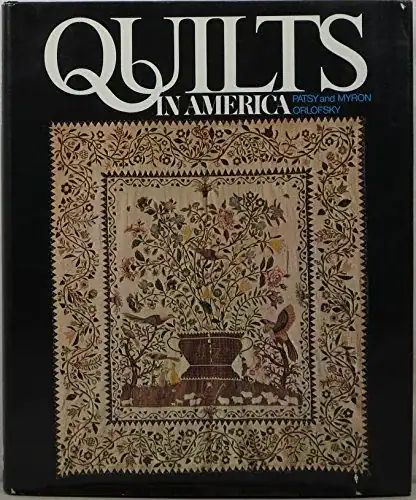
1974 edition, for twenty dollars last year.)
I’ve collected quilt ‘encyclopedias’ for some years and have found
the Hall
and Kretsinger book wonderful as a view into available patterns of
the first
third of the 20c. Rehmel and Beyer were the first, that I know of,
to
organize the block and patterns into consistent, mathematically
reasonable,
‘systems’. This is a great benefit for teachers, designers, and
students —
because the math isn’t arbitrary.
Although I do enjoy Brackman’s encyclopedia I find the lack of
reasonable
math systems an annoyance. I have only her self-published
encyclopedia —
maybe in the AQS version things are organized better.
I’ve enjoyed following the comments on this topic! Nancy in Tempe,
AZ
Date: Tue, 14 Aug 2001 18:01:21 -0400 | From: “J. G. Row” <Judygrow@>
Vivien,
My Khin is marked $16.95 original price, and I paid $20.00, so I got
a good
deal! Hooray!
Judy in Ringoes, NJ
judygrow@
From: “Vivien Lee Sayre” <vsayre@>
To:
> Judy,
>
> You found one of my favorite reference books. I bought mine for $10
from
someone
> down sizing, about eight years ago and use it constantly for
appraising
and
> ideas. It is wonderful! Recently, I saw this book sell on-line for
over
> $150, so someone else has learned how good it is too.
>
> Vivien
> > In the bookstore in Greenport I found a large format
> >paperback book, 489 pages, published in 1980 and written and
illustrated
by
> >Yvonne M. Khin, called “The Collector’s Dictionary of Quilt Names
and
> >Patterns.”
> >This book contains 2400 patterns, each one with a hand drawn very
clear
> >design, alternate names and earliest references, much like Barbara
> >Brackman’s Encyclopedias of pieced and applique designs, which
came
much
> >later.
Date: Tue, 14 Aug 2001 20:23:41 -0500 | From: “caveman” <caveman@>
Hi all,
Someone asked what we are all doing. I already deleted that e-mail
but
wanted to answer the question. I just finished two miniature quilts
that
are going to be auctioned at my quilt guild show (Arlington, Tx) in
September. One is a little Grandmother’s Fan quilt made of the 1930’s
repro fabrics and muslin. The other one is a strippy style quilt of
little 3 inch pink and brown scrappy cactus baskets, set on point.
The
border and sashing fabric is a pink and brown Harriet Hargrave
printed
stripe. I’m really pleased with this one and hope it brings a good
price. My guild has a miniature quilt auction every year with the
money
going to the Susan G. Komen Foundation for breast cancer research. I
try
to donate a quilt every year and this year the machine quilting is
done
by Karen Roxburgh who does wonderful work.20
If anyone has the booklet “The Quilts of Western New York” then you
can
see exactly the quilt I just finished, also to be hung at the
Arlington
show. This quilt is an extremely scrappy Blind Man’s Fancy pattern,
with
many pinks, browns, reds, blues, yellows, and absolutely no greens.
The
original quilt is an 1880’s quilt and mine looks just like it! I
spent 2
years making this quilt, carefully scrutinizing each fabric in the
original photo and matching it as exactly as possible. The result is
every bit as I had hoped it would be. The quilt is so exuberant and I
would love to know what the original maker was thinking as she made
it.
She definately had no inhibitions in her piecing or color
combinations.
She often turned her points the wrong way, demonstrating a carefree
attitude. At least, this is how I envision her. I did mine just like
hers.
I hope some of you will be able to make it to the Arlington quilt
show,
this Sept 21 to 23. Maybe you will even want to bid on some of our
mini
quilts. It is for a great cause. I’ll see you there!
Arlene Heintz in Arlington, Tx
Date: Tue, 14 Aug 2001 22:24:08 -0400 | From: “anne” <datkoa@>
Please post for interested persons in the Washington, DC area.
Thanks.
On Thursday Aug 16, Australian quilter/fiber artist Sharyn Hall will
speak
at PM Patchwork in Washington, DC. Sharyn works as a full time mixed
media
artist and contemporary quiltmaker, teaching patchwork and quilting
as well
as advanced design based workshops. She lives in Brookfield, an outer
suburb
of Brisbane, capitol of Queensland, Australia…lots of sun, not too
much
cold weather. She has been teaching about 12 years and working as an
artist
since 1985, exhibiting locally (3 solo exhibitions), nationally (1
solo) and
internationally in many group
exhibitions. She uses dyeing, painting and printing to colour fabric,
and
hand and machine stitching as embellishment, with the environment as
the
source of inspiration.
Sharyn was recently awarded a Churchill Fellowship which allows
overseas
study/research. Her Fellowship will take her to Japan, USA, Canada
and the
United
Kingdom to study/research the transfer processes of photographic
images from
computors to fabric and the digitising of similar images into stitch.
She
is visiting and studying
with a very exciting list of artists- Jean Ray Laury, Jane Dunnewold
and
many others.
PM Patchwork welcomes visitors for this lecture. The meeting is 7 PM
at the
Chevy Chase Community Center, two blocks south of Chevy Chase Circle
on
Connecticut Avenue. There will be a $2 fee. For additional
information,
you may call Anne Datko at 301-949-9458 or email at datkoa@.
Date: Tue, 14 Aug 2001 19:53:40 -0700 | From: “Rachel Greco” <grandmasattic@>
Can anyone really have enough of these quilt block
dictionaries? I guess I’m a little “nutty” but I love to look
through
all of them. I find that they are all valuable in their own ways:
Brackman, Khin, Rehmel (she has three volumes of pieced and one of
applique that I know of–wrote to her a couple of years ago and she
said
they were all “out of print” but I have managed to collect at least
one
of all of them), Beyer, Hall, Kretsinger, McKim, the collections of
Wilma Smith, Mildred Dickerson, Edna Van Das and the others who did
the
round robin thing, and the women who did Tumbling Alley and similar
publications, and the AQSG publications (and probably more that I’m
forgetting to mention)–they’re all wonderful. I find myself
collecting
not only one copy of these but searching for first editions, second
and
third editions of things I already own, alternate printings, etc.
It’s
fantastic to see the early beginnings of Brackman’s work when it was
basically mimeographed on pages and then compare to the AQS version.
It’s interesting to see how everything and everyone evolves and
humbling
when one considers the work involved in creating all these things and
making them available for the rest of us. We are very lucky to have
this
research in all its forms–professional, hand drawn, sketched,
annotated. I think the earlier editions of the quilt magazines did a
fabulous job of acquainting quilters with quilt history in general
and I
refer to them often. The state books are “must haves.” It’s amazing!
The house is over run with resource materials and yet I keep
collecting–proving yet again that a collector is a collector is a
collector and can’t seem to quit! I admire the Quilt Historians
among
us very much as they keep this unique art form’s past alive. Thank
you,
thank you, thank you, to everyone who has ever attempted to document
even a part of it!
Rachel Greco
Grandma’s Attic Sewing Emporium
Dallas, Oregon
Date: Wed, 15 Aug 2001 11:01:16 -0500 | From: Laura Hobby Syler <texas_quilt.co@>
Hi Rachel (and everyone else on the list who is an avid book
collector!)
I would like to make sure that these resources get on the list that
I’m
compiling for an article. I have Brackman, Khin and the 3 pieced
books
by Rehmel, could you supply complete titles copy write dates and
ISBN’s
if available for the others? I know its a lot of work, but I think
everyone would like to add them to theirs as well.
Many thanks,
Laura
IN hot…HOT north Texas!!!