January 8 – 15, 2002
These restored messages come from the Quilt History List, an online forum where quilt historians, collectors, researchers, appraisers, and enthusiasts discussed antique quilts and related textiles. The archive dates from 1996 through approximately 2016 and is being restored gradually. Sign up in the form at the bottom of the page if you want to know when a new page is added. Original spelling, opinions, formatting, and inactive links may remain unchanged.
Primary topics of this QHL Digest:
- Identifying a “Bed Spreader and Straightener” — Members puzzle over an unfamiliar antique tool listed on eBay, comparing it to bed-mounted “rolling pins” once used to smooth feather mattresses.
- Swastika-Block Quilt: Date or Design? — A quilt saved from being used as furniture padding shows a swastika-like block pattern with initials and numbers, which the list works out are most likely a 1920 date and maker’s initials rather than a wartime symbol.
- More PBS “Mill Times” Reactions — The documentary discussion from the prior digest continues, with more subscribers weighing in on its treatment of New England textile-mill history.
- Appliquéd Quilt Questions from a Historical Society Collection — The Schwenkfelder Library & Heritage Center asks the list for help with two quilts in its collection, including a striking appliquéd piece.
- Removing Water Stains at Home — A newspaper home-helps column on lifting stains from whole-cloth quilts leads members to compare hydrogen-peroxide bleach and Oxy-Clean-style products. (see the article on stain removal)
- Listening to Audiobooks and Radio While Sewing — Members swap tips on NPR replays, BBC Radio streaming, and audiobooks on tape or CD as company while hand-sewing or machine work.
- Southern California Antique Quilt Exhibits — Amanda Baker previews a series of upcoming antique quilt exhibitions in southern and central California.
Date: Tue, 8 Jan 2002 21:58:50 -0000 | From: “Sally Ward” <Sally.D.Ward@>
Somebody please explain? ‘Bed spreader and Straightener’? How big
would this
thing be, and how did it work?
http://cgi.ebay.com/aw-cgi/eBayISAPI.dll?ViewItem&item=1500062955
<img alt=”Mvc-906s.jpg (13844 bytes)” border=”2″ height=”48″ src=”./02007_files/Mvc-906s_small.jpg” width=”100″/><img alt=”Mvc-905s.jpg (8658 bytes)” border=”2″ height=”20″ src=”./02007_files/Mvc-905s_small.jpg” width=”100″/><img alt=”Mvc-907s.jpg (9575 bytes)” border=”2″ height=”27″ src=”./02007_files/Mvc-907s_small.jpg” width=”100″/>
Sally W in UK
Date: Wed, 9 Jan 2002 08:59:20 EST | From: Midnitelaptop@
if you want to give yourself a wonderful treat…
save some of your handsewing (binding, applique, embroidery,
mending)..knitting etc..and borrow a book on tape, from the
library…
put the tape on the player…don’t use the headphones…and sit and
sew and
enjoy being read to….for us old dinosaurs it’s like listening to
radio when
we were kids..
you can sew at the machine too, if you have one that operates
quietly….
i am now listening to chapter 34 of David Copperfield…i don’t want
the book
to ever, ever end….i have come to love and live in the world of the
Copperfields, Peggottys, Micawbers, and of course Barkus(who is
willing!)
try it…it’s as good as a trip to a spa…
jean
Date: Wed, 09 Jan 2002 08:17:28 -0600 | From: Laura Hobby Syler <texas_quilt.co@>
Well…they look a lot like the weaving shuttles that I’ve had “on
the
shelf” for 15 – 20 years….but who knows. Only 18″ long? They are
curious indeed!
Laura
In N. Texas where we are back to 70+ degrees today!
Date: Wed, 09 Jan 2002 08:23:58 -0600 | From: Laura Hobby Syler <texas_quilt.co@>
Val,
Most depression era tops can still be quilted. but to be sure, the
best
thing you can do is let someone who is qualified get their hands on
it
to tell if the “hand” of the fabric is still good. Any of the AQS
appraisers can do this for you, or most dealers like Xenia or Jean
Lyle
who deal in quilts, tops and vintage fabrics. But as a general rule,
most can still be quilted, and if the construction is a bit off
<G>…machine quilting may be the best answer for preserving it. Do
make
sure you use cotton or at least 80/20 batting!!!
Laura
Kevin Champ wrote:
>
> I have a question on the Machine Quilting…if a person bought a
top
> from the 30’s…would it be acceptable to machine quilt it…
> The top is pretty, but probably of no historical
significance. The
> fabrics are sturdy and I would really like to have it done. Would
“in
> the ditch” stitching have been an option for the early machine
> quilters??
> I would be using my regular machine and all cotton thread.
> Val
Date: Wed, 9 Jan 2002 18:33:00 EST | From: Chyral@
Hi all!
Recently I was looking though some research materials I’d stored away
in the
attic, and came across a number of photographs which I’d taken to
document a
quilt (and a set of bed curtains) I’d purchased at auction late in
1992.
I believe the quilt, which is pieced predominately from chintz
furnishing
fabrics, dates from the second quarter of the nineteenth century.
The
bed-hangings are a glazed pillar print from about the same date. A
partial
paper label of the textile manufacturer still intact on the back of
one
curtain.
They aren’t the best photographs in the world, but I thought they
might be of
some interest to some members of this list. I’ve put up a small
website with
a few of the photos at
http://popgirl7.tripod.com/quilt/page1.htm
Enjoy! 🙂
-Cheryl
(Just a few pictures are show below – click on the thumbnails)
Date: Wed, 9 Jan 2002 22:15:05 -0600 | From: “quilt97” <quilt97@>
A friend has saved a quilt that was given to her brother to protect
furniture being moved. The blocks look like either a swastika design
or 4
sections of Rail Fence. She wrote that the fabrics all seem to be
shirtings
and are all in blues some of the blocks look like chambrey shirts.
The
blocks are separated by sashing so do not make an actual rail fence
design.
The quilting looks to be about a 4-inch grid pattern. The following
numbers
and letters are embroidered on the front of the quilt
16
7 20
BP
I would appreciate any information about this quilt to pass along to
my
friend.
Thanks!
Elisabeth
Date: Thu, 10 Jan 2002 05:41:52 -0500 | From: “Judy Kelius (judysue)” <judysue@>
Could the numbers be the date it was made – July 16, 1920? (and the
BP
would be the quilter’s initials)
Date: Thu, 10 Jan 2002 07:08:57 -0500 | From: Sandi or Mike Hardy <shardy@>
I also saw the PBS show “Mill Times”. And I agree with Judy that the
cartoon story line was distracting. I wish there had been more
realistic
information about the mills and the workers. A Ken Burns documentary
does sound like a wonderful idea.
Last September we took a day and went to Lowell Massachusetts and
toured
the Lowell National Historic Park district. The working looms
in the PBS show were in the Boott Mill in Lowell. There were only a
few
which ran during the open hours and the noise was very loud. I can’t
imagine what it would have been like with a building full of them.
The
gift shop sells yardage of the fabric they make there now. It is a
coarse fabric made to be used as dish towels etc. My husband had a
very
nice talk with one of the weavers about the machines.
I really enjoyed the exhibits and other sites, including the New
England
Quilt museum which is a couple of blocks from the mill. There is also
the American Textile museum nearby but we ran out of time. We plan to
go
back again. If you are in Massachusetts it might be an area you would
really enjoy seeing. The National Park service did have a web site
with
information but it is not working right now.
Sandi in Vermont
Date: Thu, 10 Jan 2002 09:59:23 -0500 | From: “Dee Stark” <dee@>
Judy Sue said the same thing my initial reaction was – that it is a
date.
Not being able to see the fabrics, I’m assuming they look circa 1900?
My
thoughts, are, however that perhaps this was a presentation quilt –
for a
birth perhaps or that the date is significant in some other way? The
reason
I say that is that I haven’t often seen a date of completion featured
as a
design element…….
The swastika, an anciet symbol found in every culture (document back
to 2000
BC) had- up until Hilter’s appropriation of it as symbol of the Nazi
party
(first made its appearance in August, 1920, btw on a Nazi flag, but
not
commonly known until WWII in the 1940’s) – been a positive symbol,
generally
signifying the four cardinal directions.
I won’t get into the Buddist/eastern religion conotations – likely
this
quilt was made by someone with Western sensibilities 😉
Sometimes called a Babylonian cross, or Gammadion cross, it was often
used
by early Christians as a symbol depicting Christ.
By the late 1800’s it was a common symbol of good luck – fabric with
Babylonian crosses was easily found, as well as postcards, etc.
The swastika is the most powerful example I’ve found of how a
symbol’s
meaning can transform within its cultural context.
For someone in the United States, in 1920, this might be the
equivalent of a
quilt made with a giant horseshoe 🙂
Hope this is of use!
dee
www.deestark.com
Date: Thu, 10 Jan 2002 12:05:07 -0600 | From: “quilt97” <quilt97@>
While visiting the encylopedia seeking definitions of words in
current news,
I came across this paragraph which reminded me of how interwoven
(sorry!)
thread and fabrics are in our lives, throughout the centuries.
“Sabotage is an action aimed at weakening an enemy, usually by
destroying or
damaging a productive or vital facility, such as a factory?, dam? or
supplies storage. The name is derived from the early industrial age,
when
powered looms could be damaged by the wooden shoes (known as sabots)
of the
displaced weavers being thrown into the machinery. “
Elisabeth
Date: Thu, 10 Jan 2002 13:02:05 -0500 | From: “judygrow” <judygrow@>
Cheryl,
Thanks for putting those photos of your quilt up. I printed out all
the pages and it is like I own the quilt now. Great study stuff.
How do you know the date and place of the quilt? Was it signed anywhere?
I own a signature quilt dated in a few places 1843, and placed in 2 blocks in New Brunswick and Newark. It is a block I’ve never seen before and is a 3 fabric quilt. These folks were wealthy! It uses
the exact same binding as your quilt. That “Trenton” tape with the blue
and rusty brown!
Also, I must congratulate you on your photography. Getting the shots
in that raking light helped the quilting stitches to really stand out.
In much quilt photography the light is straight on and the quilting stitches drop out entirely! Kudos to you!
Judy in Ringoes, NJ
judygrow@
—– Original Message —–
From: Chyral@
Date: Thu, 10 Jan 2002 13:28:53 -0600 | From: “schwenkfelder library & heritage center”
Greetings:
I have two questions for the list regarding quilts in our collection:
1. We own a wonderful, incredibly striking appliqued quilt and
matching pillow shams that is made of solid-colored cotton in what I believe
is being referred to as “cheddar” (I’m rather new to quilt IDs!) and a
very deep wine color — it’s not burgundy, as we think of it today.
It is hand quilted and truly shocking as a combination. The pieces are
in near pristine condition (I’m wondering how often it was used, as it
is startling!) Can anybody shed some light on this combination, and whether anyone else has seen it? I’m afraid the documentation has
been separated from the quilt at some point, so I have to rely mostly on
the quilt. I recall someone discussing a peculiar deep red that he or
she seemed to think was used in the Bethlehem PA area — and we’re about
45 minutes from Bethlehem.
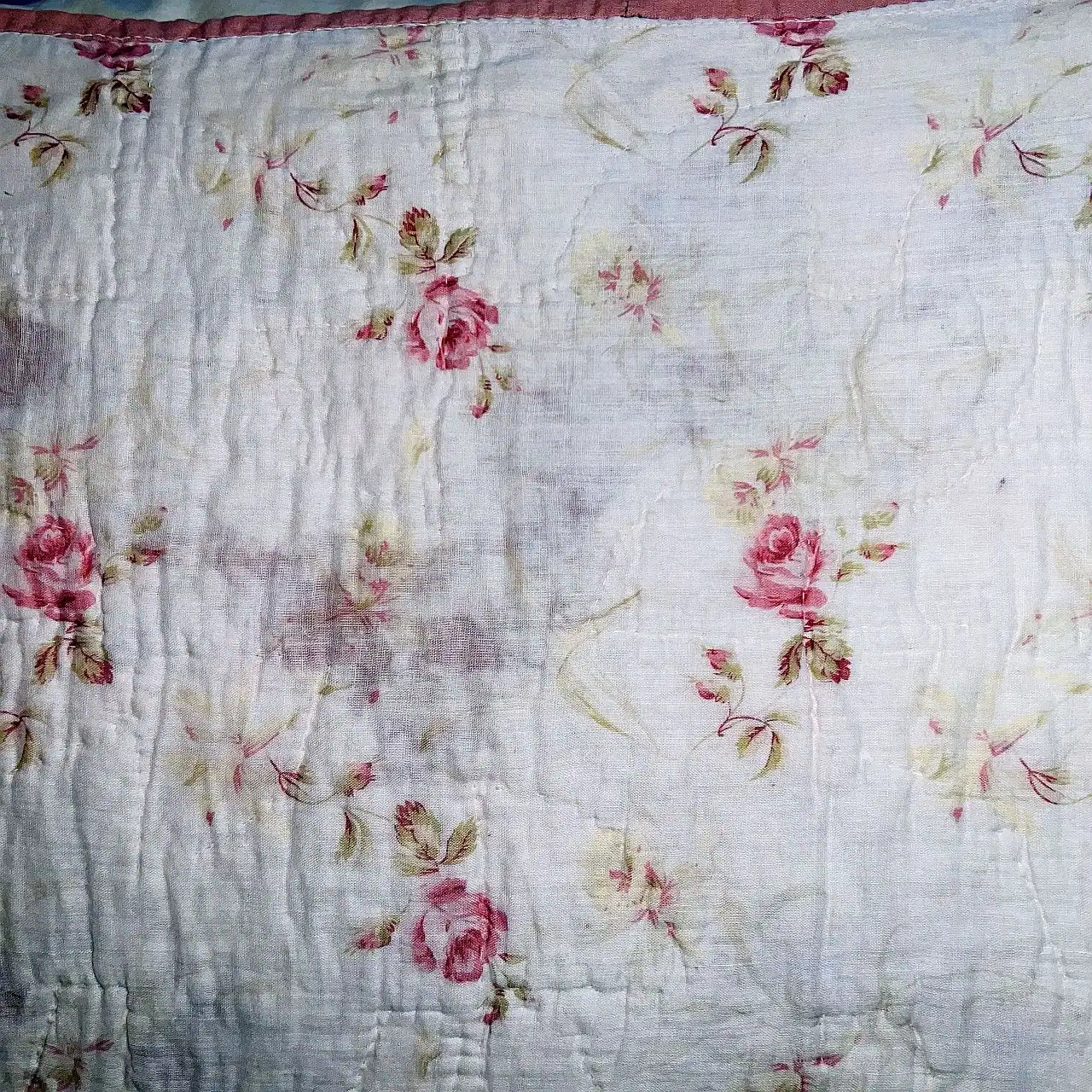
2. Though I rarely to do any conservation on my own, or even minor cleaning, I very much want to exhibit a whole cloth white on white quilt, dated 1838, that has a nasty water stain on one end — it must
have been in a chest or box that got wet on just one side. Is there
any way of trying to lessen the stain, that could be done in-house? Something that could be carefully applied with cotton swabs? I’m heartbroken over the stain, and I will exhibit it no matter what, but
it is a great piece and I want to try and do whatever I can for it.
The Heritage Center will be having an exhibit of quilts from its permanent collection titled Patterns of America opening on April 15
and running through the summer. Also, the Mennonite Heritage Center in Harleysville, PA about 20 minutes from us, is opening a show of
quilts made for special occasions, and curated by Nancy Roan, sometime in February. It’s a quilt year in Montgomery County, PA!
Thanks everybody,
Candace Perry
Schwenkfelder Library & Heritage Center
Pennsburg, PA
www.schwenkfelder.com
Date: Thu, 10 Jan 2002 15:38:24 -0500 | From: “bonnie wilbur” <bonnie.wilbur@>
In northern Virginia, and many places I’ve been in the US, you can
also
listen to National Public Radio on Sunday evenings as they replay
many early
radio shows on Old Time Radio. My DH has taped many of the shows for
years
so we now have a library of our own. I find that I get 3 times as
much work
done listening to a book on CD or tape or the radio as I do when I
turn the
TV on for background noise, because I’m never visually distracted.
Bonnie
Date: Thu, 10 Jan 2002 16:19:32 -0500 | From: Barb Garrett <bgarrett@>
I’m not sure how I signed up to receive this notice, and am sure
others
on the list received it also, but the quilt is so wonderful I wanted
to
share this site with those who didn’t get the notice. Barb in
southeastern PA
Happy New Year from the staff of the International Quilt Study Center
at
the University of Nebraska-Lincoln!
We are starting off the 2002 Quilt of the Month series with our
newest
International Quilt Study Center acquisition: a rare, pictorial
quilt.
Please view at:
http://quiltstudy.unl.edu/Exhibitions/quiltofthemonth/qm_0001.htm
Often called The Reconciliation Quilt, the post Civil War-era quilt
is
believed to hold the world-record price for a quilt sold at auction.
(It
sold for $264,000 in 1991 at Sotheby’s.) Robert and Ardis James,
avid
quilt collectors and benefactors of the International Quilt Study
Center,
subsequently acquired the quilt and recently donated it to the
Center.
The quilt was made in New York during the late 1860s by Lucinda Ward
Honstain. It features 40 unique pictorial quilt blocks depicting
scenes
of
domestic, commercial and political life in the United States during
the
years before and after the Civil War. Numerous ../images of
African-Americans
are illustrated, including one block portraying a black man on foot
towering over a white man on horseback with the inscription “Master I
am
Free.” Another block features the embroidered date Nov. 18, 1867,
the
year
blacks gained the right to vote.
The quilt is on view at the Sheldon Memorial Art Gallery on the
University
of Nebraska-Lincoln campus. Don’t miss the chance to see this
exceptional
quilt ? from January 10th until March 3rd. Sheldon hours are:
Tue.-Sat.
10
a.m.-5 p.m., Thurs.-Sat. 7-9 p.m., Sun. 2-9 p.m.
Date: Thu, 10 Jan 2002 21:05:07 -0500 | From: “Cinda Cawley” <lrcawley@>
Wonderful news that there will be quilts to be seen in S.E. PA this spring. Candace asked about the combination of cheddar and an odd
shade of red. Barb Garrett and I both think that this red (somewhere
between brick and ox blood) appears often in quilts from the Bethlehem, PA area.
Cinda on the Eastern Shore
Date: Thu, 10 Jan 2002 21:16:32 EST | From: Kathlash@
Dear Barb,
Thanks for sharing the information on the Reconciliation Quilt…what
an
awesome piece of American quilt history!
Kathleen Lashley
Date: Fri, 11 Jan 2002 09:38:21 -0500 | From: “Nancy Roberts” <aquilter@>
The question on removing a water stain from the whole-cloth quilt
reminded me of a Household Helps column I read in this morning’s newsaper. The author recommended using a bleach product called Brilliant Bleach which she said is a peroxide stain remover especially suitable for colors. You add the product, fill the washer, add the item and then let it soak. She gave
the 800 number which I can retrieve from the recycle bin if anyone wants
it. She also suggested checking your supermarket laundry section. I’m
unfamiliar with this product. Anyone heard of it or use it? Nancy Roberts
Date: Fri, 11 Jan 2002 10:00:58 -0500 | From: “Judy Kelius (judysue)” <judysue@>
This sounds interesting so I looked on the web for more info. Their
web
site is http://www.soapworks.com. There is a link to stores that
carry the
product. Trader Joe’s is one of the stores listed, and I will be near
one
next week, so I’m going to pick up some of this to try!
At 09:38 AM 1/11/02, Nancy Roberts wrote:
>The question on removing a water stain from the whole-cloth quilt
reminded
>me of a Household Helps column I read in this morning’s newsaper.
The author
>recommended using a bleach product called Brilliant Bleach which she
said is
>a peroxide stain remover especially suitable for colors. You add the
>product, fill the washer, add the item and then let it soak. She
gave the
>800 number which I can retrieve from the recycle bin if anyone wants
it. She
>also suggested checking your supermarket laundry section. I’m
unfamiliar
>with this product. Anyone heard of it or use it? Nancy Roberts
Date: Fri, 11 Jan 2002 10:11:02 EST | From: Midnitelaptop@
i thought it was great…gave me a personal sense on the development
of the
mills of new england…
the program was about mills and how they were built and how they
ran…
DavidMc writes books like that “how things work”.
the program was not really about the textiles or the
workers….although i
thought it was great how he included the feisty women who wanted
better
conditions…
i’e visited the textile museum(and the quilt museum) in lowell
mass…if you
get the chance to visit…they are both great.
jean
Date: Fri, 11 Jan 2002 07:45:34 -0800 | From: Laura Robins-Morris <lrobins@>
>Bonnie wrote:
>… I find that I get 3 times as much work done listening to a book
on CD or tape or >the radio as I do when I turn the
TV on for background noise, because I’m never >visually distracted.
It’s the fast-forwarding through the commercials that really takes up
the precious quilting time! I can’t believe how
much more I get done when I turn off the TV/VCR.
My other problem is that I have lots of tapes of PBS documentaries
and I feel compelled to watch them and learn all
those important things. But they frequently need to be seen, not
just heard, and that doesn’t work well with sewing.
(And then there’s also that old guilt thing about feeling the need to
multi-task and get more accomplished, and the need
to justify the time spent on something purely for pleasure. Too much
to do, so little time. But that’s another can of
worms!)
Audio tapes are the way to go.
Laura in Seattle.
Date: Sat, 12 Jan 2002 13:46:43 -0500 | From: “Jan Drechsler” <quiltdoc@>
Cheryl, Just checked out the photos of your beautiful chintz quilt.
Thank
you so much for getting them scanned, on a web page and annotated. A
very
generous gesture that makes this group so special and important to me
in my
daily quilt learning curve.
Oh, those blues, those chintz blues…
Jan
—
Jan Drechsler in Vermont
Quilt Restoration; Quilting teacher
www.@/~bobmills
Date: Sat, 12 Jan 2002 19:56:06 -0500 | From: “Cathy Hooley – Goose Tracks Quilts” <cathy@>
I happened to look at the ingredients list on the all fabric bleach bottle when I was doing laundry today and the main ingredient is hydrogen peroxide – could it be the same thing as Brilliant
Bleach?
“a bleach product called Brilliant Bleach which she said is
a peroxide stain remover especially suitable for colors”
Cathy Hooley
Goose Tracks Quilts
http://www.goosetracks.com
Date: Sat, 12 Jan 2002 20:46:25 -0600 | From: “leigh/hcquilts”
Dunno about this stuff. Sounds just like Oxy-Clean:
http://www.gazoontite.com/default.sph/Gaz.class/store/department/product.jsp ?id=15050003&action=pageID
I did a test of Oxy Clean (at 1/4 the strength recommended for laundry use) on some madders and double pinks which were in mint, unused condition.. The color in the madders smooshed togther into something muddy, and the double pinks turned blueish. No thanks. I’ll stick to Biz.
Date: Sun, 13 Jan 2002 12:22:49 -0000 | From: “Sally Ward”
If you would like to listen to BBC Radio programmes from the UK you can go to http://www.bbc.co.uk/radio/# to hear programmes live online while you surf or sew. This page shows you all the programming options, within which you can look for what interests you. For drama, discussion etc. I recommend Radio 4 http://www.bbc.co.uk/radio4/atoz/
The daily scheduling for Radio 4 is at http://www.bbc.co.uk/cgi-perl/whatson/search/daylist.cgi?tmp=whatson/sdk/rad io4/daylist_radio4.tmpl&day=Today&service_id=49700. (This is so long you may need to cut and paste the address)
Sally Ward
Date: Tue, 15 Jan 2002 16:52:02 -0800 | From: Audrey Waite
When friends know you are obsessed with quilts they send you articles about quilting and quilters printed in their local newspaper. Today I received one published in the Riverside, CA Press-Enterprise.
It is a very nice article about our own Nancy Kirk. She’s going to be in Ontario, CA to lead a session called “Tell Me About Grandma’s Quilt” at the Road to California Quilt Show. Way to go Nancy. I’m going to the show – hope I get to see you there.
Audrey Waite http://www.quiltcamp.com
Date: Tue, 15 Jan 2002 15:56:17 -0800 | From: “Amanda Baker”
I wanted to let those of you in southern and central California know about a series of wonderful antique quilt exhibits coming up soon, but first I’d better introduce myself. I am a quilt appraiser, working to be AQS certified in the near future, have a textile design background, and am a quilter in my spare time. I have two small children, so right now I have more plans for quilts than actual quilts. I’ve been subscribing to the list for many months now, so maybe this posting will get me more involved! I’ve been helping out on this project, and it’s been a great experience.
“Women’s Symbols of Endurance: Quilts” is the theme at The Stagecoach Inn Museum exhibit of antique quilts displayed in the 1876 Inn and Schoolhouse, from Feb.16 to Set. 15, 2002. 51 S. Ventu Park Rd. in Newbury Park, California, near Thousand Oaks off the 101 Frwy. Open Wed. – Sun.,1to 4 PM, (805) 498-9441 or e-mail: stagecoach@. Additional quilts and events on the 3rd weekends:
Feb. 16-17: Early American Quilts, 1840-1870 Certified appraisals by Julia Zgliniec 1-4 PM Sat. only at 4:15 PM: Award winning quilter Margarete Heinisch will lecture and show her patriotic quilts
Mar. 16-17: Turn of the Century Quilts, 1890-1910 Sunday only at 11:30 AM-1:00: The Hamish Amish Quilters and Don Beld, historian, will show and discuss their contemporary quilts and the famous women represented in them.
Apr. 20-21: Colonial Revival Period Quilts,1920s-1930s Sat. only at 4:30 PM: Rosalind Perry lectures on the Quilters’ Hall of Fame with Marie Webster’s quilts displayed, book signing 3:00-4:00
May 19-20: 20th Century War Years Quilts, 1915-1945
June 15-16: Early American Quilts, 1840-1870 (repeat of February) Sat only 9 AM to 3 PM: Old, Used & New Sewing & Needlework Flea Market (donations accepted till the June 10)
July 20-21: Geometric Patterns & Kit Florals, 1940-1960s
Aug. 17-18: Quilts made from Children’s Books, and Storytelling time, with new and old quilts on display