February 15 – 22, 2002
These restored messages come from the Quilt History List, an online forum where quilt historians, collectors, researchers, appraisers, and enthusiasts discussed antique quilts and related textiles. The archive dates from 1996 through approximately 2016 and is being restored gradually. Sign up in the form at the bottom of the page if you want to know when a new page is added. Original spelling, opinions, formatting, and inactive links may remain unchanged.
Primary topics of this QHL Digest:
- Amish Quilts and the Shift Away from Wool — Following a TV mention, members discuss when and why Amish quiltmakers moved away from wool battings and fabrics.
- “Panne” Velvet: Spelling, Pronunciation, and Definition — A crazy quilt fabric identification question turns into a deep dive on the term “panne” velvet, with members citing period and modern textile dictionaries to settle the spelling and meaning. (see the article on cotton and textile terms)
- Locating Boutis Reference Material — A member thanks the list for help tracking down a reference work on boutis (French corded whitework quilting), closing out an earlier research request.
- Identifying the “WRC” Initials on a Quilt — Members work out that the letters WRC on a quilt most likely stand for Women’s Relief Corps rather than another Victorian-era organization.
- Quilt Digest Annual: Tracking Down All Five Volumes — A member compiles publication details for the five volumes of The Quilt Digest for a fellow collector trying to complete the set.
Date: Fri, 15 Feb 2002 20:25:24 -0500 | From: “Cinda Cawley” <lrcawley@>
Joe Cunningham, on Simply Quilts this afternoon, said that the Amish stopped using wool in their quilts at the beginning of WWII when it became impossible to get on the civilian market since wool was being used for military uniforms. I’d not heard that explanation beore. I checked in The Amish Quilt by Eve Granick who says “…the war forces Amish women to use new types of materials–rayons and other synthetic substitutions.” Cinda on the Eastern Shore
Date: Fri, 15 Feb 2002 21:06:57 -0500 | From: Barb Garrett <bgarrett@>
Cinda and others –
Today I did something I do only at this time of the year — played tourist at a quilt shop in Lancaster County. The shop had several circa 1940s and 50s Amish quilts from Lancaster County made of crepe, and I asked the owner — a Mennonite lady — when the Amish switched from wool to crepe. She said during WWII because all the wool went to military uniforms and the Amish couldn’t buy it. They and the conservative Mennonites started using Romaine Crepe — I kept saying lettuce to myself so I’d remember the name. She described Romaine Crepe to me as being a type of rayon that shrunk up when it got wet. She was born in 1938 and said as a child she remembers getting a new dress that she wore to school, sometimes with an apron and sometimes without, for several weeks, and then her mother washed it and she saw it hanging on the line and it was so tiny. She said she cried and cried. They were able to stretch it back out when they ironed it, and she was again able to wear her dress, and was happy. This was the routine — after washing, the dresses were stretched back to size in the ironing process. She also talked about the Amish ladies having difficulty with the dresses when it rained. But they used it in their quilting, probably with no trouble as the quilts weren’t washed. .
So even though I’m not a modern person with cable, I heard the same story about changing over to crepe as Cinda did <grin>. Interesting coincidence. I asked if after the war they changed back to wool and she said no, for quilting they stayed with crepe. For clothing they changed to cotton during the 50s until polyester came in. They loved (and still do) polyester for clothes — both 100% poly and poly cotton blends as it didn’t need ironing and wore well. Poly double knits from the 70s are still the preferred fabrics for women (Amish, Mennonite, Brethren) to make knotted comforters — both for home use and for disaster donation — they wear like iron, need no batting, wash and dry easily.
Barb in southeastern PA
Date: Sat, 16 Feb 2002 21:05:58 -0600 | From: “Susan Hughes” <shughes04@>
Hi everyone,
I have been lurking for a couple of weeks and would like to introduce
myself. My name is sue and I’m from Northern Indiana. I’ve been quilting for about 15 years but I’ve always been a sewer ever since I was in 4-H at the age of 10.
I recently was able to purchase an old quilt top and a finished quilt. The quilt top needs to be finished and quilted. Are there any magazines that deal with antique quilts? The quilt top is polished blue cotton
with white appliqu circles in rows so that they remind me of how bowling pins are set up. I guess they are in a triangular shape. Then there are two crossing lines with leaves on them connecting the triangular sets. Only two little areas that need the appliqu finished—but I have no idea what design to quilt in it. There are
some big spaces that something nice could be quilted in. Also, I don’t know if they were quilted in white or in a colored (blue) thread. Where could I find some information? Guess the library would be my first choice. Does anyone know if there is anything online?
The second quilt I bought is my favorite colors–Turkey red and poison apple green. It is a thistle design (I think). It is a huge quilt.
Fits very well on my queen size bed. It has the smallest quilting and appliqus stitches I think I have ever seen. It must have 14 stitches to the inch! It is heavily quilted and has just a few rust spots on it. What have some of you used to take out the rust spots? I won’t attempt to wash it until spring when I can put it outside to dry.
Now I will brag–Got the top and the thistle quilt for $173.00. It was an estate state and the lady collected quilts. It was a bargain. I
have some other old quilts that cost lots more than that! I just know someone is looking down from heaven and thanking me for finally finishing the blue quilt; ).
Thanks for your help. QltSu
Date: Sun, 17 Feb 2002 04:12:10 -0500 | From: “Judy Kelius (judysue)” <judysue@>
Hi Susan – pick up a copy of “Time Span Quilts” by Becky Hurdle,
published
by AQS a few years ago. I think this is out of print but still
available
from most of the on-line book stores. Barnes & Noble has it. It is
all
about working with old tops and includes a tip on getting out rust
spots.
(I haven’t tried it.) Make sure they are rust spots – brown spots on
old
quilts and tops are caused by many problems, often oil from a wooden
piece
they were stored in. This is nearly impossible to get out. If it’s a
top,
you can often replace badly stained fabrics. If it’s a quilt, you can
applique pieces over the affected areas. In either case, use either
antique
fabrics consistent with those in the quilt or appropriate
reproductions.
By the way, real “Turkey” red is colorfast – I recently purchased a
red and
white applique top from the turn of the century with bad water stains
and a
few other spots. I soaked it for several hours in a solution of
bleach and
Biz, and it came out just perfect! I tested the fabrics before doing
this,
and could see that both fabrics in the top were strong enough to take
this.
This also applies to redwork pieces – stained ones can often be
bleached
without hurting the red. If any of the red seems to be fading, then
it
certainly won’t work! Always test first.
Date: Sun, 17 Feb 2002 07:13:27 -0500 | From: Pat & Jim <jimpat@>
Dear Susan:
Congratulations on finding some treasures to add to your collection.
There are several magazines that address issues regarding antique
quilts. My column “Pieces of the Past” in The Quilter, formerly
called
Traditional Quilter magazine, appears regularly. A newer column
called
“Quizzing the Quilt Historian” appears in Traditional Quiltworks and
is
written by one of QHL’s members, Kim Wulfert. Another very good
source
of information are the articles written by Xenia Cord for American
Patchwork and Quilting. We all add something different to the topic
of
antique quilts and are serious collectors, and students of quilt
history. There are many other great sources of information such as
commercial sites that are adding in some quilt history. Your library
will turn up lots of possibilities for further reading, as well.
Now, down to the nitty gritty. There are several divergent opinions
when it comes to finishing quilts. Some collectors prefer to make a
reproduction of the quilt and leave the original in the state in
which
it was found. This protects the integrity of the piece and does not
disturb it with newer, superimposed stitches, yet provides a way to
celebrate the intent of the originator and lets her creative vision
live
on. By using fabrics available today, the quilt will last all that
much
longer. That is usually my first choice.
Some folks feel that everything has to be finished. Certainly, if
one
has paid out good money, one might feel it necessary to use an item,
rather than have it take up closet space. That is a personal
judgement
call. This leads us to other considerations, though. If the quilt
top
is of the utilitarian type, and not at all unusual, perhaps finishing
it
and using it is okay. The trouble with using something on a bed is
that
it is subject to all the inherent risks of light damage, pet damage,
and
please pardon me for saying, organic stains. Visitors tend to want
to
change their babies on the bed, etc. and whoops!
Then, we come to the idea of washing. The term wet washing is every
conservators nightmare. You run the risk of unstable dyes running,
fabrics shrinking, brittle fabrics disintegrating or tearing. An old
quilt is most at risk when it is wet. On the other hand, to have a
conservator clean your quilt for you, will be expensive. However,
most
have a lab setting whereby the quilt remains in a flattened state in
a
full size tray through the entire process. In this way, unnecessary
strain is not put on the old quilt’s fibers.
You mention putting the quilt outside to dry. Again, lots of things
to
think about, everything from weight of the quilt on a line, damage
from
bird droppings, ultraviolet ray damage, etc. etc. I usually lay mine
out flat between white sheets on the grass and choose the hottest day
of
the summer to do this, if and when I have to wash an old quilt at
all.
I prefer not to do so.
As far as rust spots, these are best left alone. They authenticate
the
age of the quilt, like wrinkles or gray hair.
I’d write more, but I guess I will save my arthritic hands for now,
as I
plan to quilt all day.
Thanks for writing to the list. The professionals here are more than
willing to be helpful, especially to beginners.
Sincerely,
Patricia L. Cummings
certified master craftsman in quiltmaking
http://www.quiltersmuse.com
Date: Sun, 17 Feb 2002 13:17:51 EST | From: Midnitelaptop@
just thought you might like to read a little excerpt, from the book
i’m
presently reading…Mill on the Floss by George Eliot, written in
England in
1860..the reference to both patchwork and counterpane was so
interesting…i
thought i would pass it along….
jean L
beginning of quote….
O dear, O dear, Maggie, what are you thinkin’ of, to throw your
bonnet down
there? Take it upstairs, there’s a good gell, an’ let your hair be
brushed,
an’ put your other pinafore on, an’ change your shoes – do, for
shame;
an’come an’ go on with your patchwork, like a little lady.’
`O mother,’ said Maggie, in a vehemently cross tone, `I don’t want to
do my
patchwork.’
`What, not your pretty patchwork, to make a counterpane for your aunt
Glegg?’
`It’s foolish work,’ said Maggie, with a toss of her mane, – `tearing
things
to pieces to sew ’em together again. And I don’t want to do anything
for my
aunt Glegg – I don’t like her.’
Date: Sun, 17 Feb 2002 15:42:47 EST | From: Midnitelaptop@
the quote comes from the last few paragraphs of chapter 2….of Mill
on the
Flosse by George Eliot…
jean L
Date: Mon, 18 Feb 2002 16:04:55 +1100 | From: Lorraine Olsson <sven@>
I just saw this, and I am sure there are some members who love and
collect paisley shawls. It looks fascinating.
Lorraine in Oz
Item Link below
http://cgi.ebay.com/aw-cgi/eBayISAPI.dll?ViewItem&item1073531786
Date: Mon, 18 Feb 2002 09:15:03 -0600 | From: Barbara Hamel <bhamel@>
I am new to the list–just joined a couple weeks ago. I am a quilter
but
when it comes down to it I’m really more interested in the old stuff
associated with quilting including books, patterns, and old quilts
themselves.
I have many questions which revolve around items I have collected
in the
last few years but the recent posting about washing old quilts leads
me
tell this story and ask for your advice.
Last summer I purchased a large tied tumbling block comforter (tied
quilt–whatever you want to call it) at a garage sale for $5.00. The
reason I bought it was because for me it is a treasure trove of old
1880
-1900 (my guess) fabrics, some cottons, wools?, silks etc. The
reason the
person sold it for $5.00 was because she had made the mistake of
washing it
and many of the red patches and some green ones bled all over the
quilt. The small number of silks in the quilt have
deteriorated completely but were probably like that before she
washed
it. It has a very thick cotton batt so the weight when wet must have
been
considerable. I don’t know how she dried it. I think she was sick
over
the fact she had washed it and was selling it to get it out of her
sight.
Basically I bought her problem from her and now it is mine.
I have been trying to decide if I should try to live with the quilt
it the
way it is or try to do something to see if I can remove some of the
color
runs. I only have five dollars invested so I don’t have much to loose
and I
don’t think I could make it much worse. On the other hand perhaps
treating
it the correct way would improve the appearance. It has a very thick
cotton batt so the weight when wet must have been considerable. I
don’t
know how she dried it
I have read everything I can find related to washing old
quilts. Everything I read tells me to be sure to test for color
fastness
before trying anything but they don’t have much to say about how to
handle
cases where the colors have already run. I’ve seen references to
products
such as retaine and synthrapol and others have mentioned products
such as
Rit Color Remover and RLR Laundry Treatment. Some of the products I
have
seen in stores say to use hot water. I don’t think hot water would
be the
best idea for these old fabrics. Perhaps the best method is the one
which
would require the most work–determine which patches are bleeding,
remove
them, and then wash the rest of the quilt again (sew the patches back
in)
and hope for the best. Since it is not quilted removal of patches
would be
fairly easy to do but on the other hand there are many many of them
so it
would be quite a bit of work. Maybe I should do what I have been
doing
with it–nothing.
Can anyone offer any comments or advice?
Barb Hamel
Date: Mon, 18 Feb 2002 14:35:50 -0600 | From: Barbara Hamel <bhamel@>
Totally unrelated to my posting from earlier in the day …
Over the weekend I purchased two quilt kits at a thrift store linen
sale. I’m trying to figure out when these kits were produced. I’m
guessing 1930’s or 1940’s. Can anyone help? I have a couple other
quilt
kits but I know they are of much more recent origin that the ones I
purchased this weekend.
The two kits are for the same quilt (Bucilla no. 2550) but one of the
boxes
is in bad shape and the binding is missing from the contents of the
other. The kits are packaged in cardboard boxes slightly larger than
8
1/2″ by 11″ . The boxes are covered with pale yellow paper and show
a
black and white illustration of the quilt on the lid. The following
wording is also given at the top of the lid: “Bucilla Floral Basket
Applique Quilt, for simple quilting and applique” At the bottom of
the lid
it says “Stamped on fine weave white cambric for simple quilting and
applique…” The quilts in the kit are sized 80 x 100 Full (Double)
The
boxes and the kit contents are all numbered/stamped no. 2550.
The quilt design is as the title on the box states, a floral basket.
If
necessary I could probably come up with a photo of the kit (or at
least a
scan of the box lid) and post it for you to look at. I thought
perhaps
someone might recognized this kit/box design from the description.
I checked Barbara Brackman’s Encyclopedia of Applique and could not
find
this design. I also checked some old mail order catalogs and was
again
unsuccessful. Are there any other reference sources specific to
quilt
kits? I have a completed quilt that I suspect was made from a kit
and I am
trying to research it as well. I will save the specifics of that
quilt for
another posting.
Any help is greatly appreciated.
Thanks,
Barb
Date: Mon, 18 Feb 2002 16:47:00 EST | From: Kittencat3@
I know that Bucilla was doing quilt kits into the 1970s because I saw
them in embroidery catalogues. This doesn’t sound familiar, but my
memory isn’t what it used to be….
Lisa Evans
Date: Mon, 18 Feb 2002 18:17:19 -0500 | From: Barb Garrett <bgarrett@>
I stumbled on this listing on ebay right before the auction ended,
and
didn’t want to interfere with the bidding, so waited til now to send
the
link. I think it’s a fabulous piece of quilt history — not just
run
of the mill — and thought you would enjoy seeing it — I hope the
pictures stay up a day or two.
http://cgi.ebay.com/aw-cgi/eBayISAPI.dll?ViewItem&item1513570961
Barb in southeastern PA
Click on the thumbnails below
Date: Mon, 18 Feb 2002 20:53:41 -0500 | From: “Teddy Pruett” <Aprayzer@>
<<They and the conservative Mennonites started using Romaine Crepe
–being a type of rayon that shrunk up when it got wet.>> 20
SO, that’s what that stuff is called!! I can tell you that it has
another pretty remarkable property in addition to being shrinky-uppy.
(I know the scholars on this list are shuddering – lighten up, yall.)
My aunt’s original farmhouse was abandoned in the 1950’s when they
built a new home on a different section of the property. Over the
years, the old house was vandalized, windows knocked out, floors
rotted,
etc. Animals of all descriptions lived in the house – including
large
field rats and mice, who had pulled all the old textiles into piles
for
nesting places. The piles were sometimes as high as two feet –
enormous
mounds. I was kicking through them, looking for interesting items,
buttons, Prince Albert tins, tidbits – just whatever might be there –
and came across a wonderful late 1940’s dress in nearly perfect
condition. I was dumbfounded!!20
Every other textile had been shredded to bits, but none of the
animals had eaten this one particular dress, even tho it had been in
the
mound. I got a stick, picked up the dress, brought it home and
washed
it. Of course, it shrunk up to a bitty little thing. I’m glad to
know I can iron it back out!
DOn’t you think that’s pretty interesting??? Teddy Pruett, Lake
City, FL20
Date: Mon, 18 Feb 2002 18:16:06 -1000 | From: Laurie Woodard <lwoodard@>
Aloha kakou–Hi all.
I just learned that there is an exhibit of 12-15 Hawaiian quilts at the Honolulu Academy of Arts. Located in the new textile exhibit wing, the show should be up at least until March 2002. This would be a rare opportunity to see in person old Hawaiian quilts so often pictured in books and magazine articles. We’ve been having so much cold, rainy weather this last week, I haven’t gotten down to see it yet but I do know that the exhibit includes a red and white Hawaiian applique quilt dated 1892. It was made for Mormon missionaries Elder and Mrs. Farr, presented as a gift when his term as President of the Laie mission ended. The design, cut from red cotton twill fabric, is very unusual but not unlike the Hawaiian quilt made for another Mormon church elder and shown in Mary Bywater Cross’s Quilts of the Mormon Migration.
This year is the 75th anniversary of the founding of the Honolulu Academy of Arts and there is lots happening (see their web site at http://www.honoluluacademy.org/exh/upcoming.htm). The exhibit, FINDING PARADISE: ISLAND ART IN PRIVATE COLLECTIONS, April 11 through May 26, 2002 should also include Hawaiian quilts. The accompanying book, of the same name, includes a chapter on Hawaiian quilts written by yours truly.
In May, the Hawaii Quilt Guild hosts their annual quilt show, Reflections, May 2 through 12, 2002 at the Academy Art Center (First Floor). “The best new contemporary quilts by members of the Hawaii Quilt Guild. Many styles of quilting included.”.
In June, the Mission Houses Museum, also in Honolulu, presents their 24th annual quilt show. Called Kapa `Awaiaulu (The Fabric of Our Community), co-curated by musuem curator, Stuart Ching and myself, the exhibit runs June 29-Aug 10, 2002. This exhibit focuses on quilts associated with community groups and organizations, including school and hospital quilts; the Police and Fire department Hawaiian quilts by Elizabeth Akana and Auntie Debbie Kakalia, respectively; and quilts of Hawaiian service organizations like the (Queen) Kaahumanu Society and others. The exhibit will be dedicated to the memory of my closest friend and mentor Peggie Ehlke, who died in October 2001, just twelve days short of her 81st birthday. Peggie was the first curator of Mission Houses, retiring just shy of twenty-five years. Her Hawaiian quilt, a Cup of Gold design, also will be on display. — Laurie Woodard Hawaiian Quilt Research Project http://openstudio.hawaii.edu/hqrp/default.html
Date: Tue, 19 Feb 2002 09:04:08 EST | From: Cassquilt@
Does anyone know if there’s any way to find out more information on a quilt that was rendered in watercolor for the Index of American design during the 30’s? You can reply to me privately if you want.
TIA, Cassandra Thoreson
Date: Tue, 19 Feb 2002 11:53:18 -0500 | From: “laurafisher” <laurafisher@>
A while ago you posted info about a lawsuit concerning the unauthorized copying of someone’s designs. I thought I printed it out, but can’t find it. Can you locate that info and send it to me again; no need to post to the whole list. A client designer of mine is having trouble with someone who copied her designs, and wants to know who contact. Thanks Laura
Date: Tue, 19 Feb 2002 11:42:48 EST | From: JanetSATX@
At a quilt show in Salisbury. NC last weekend, a crazy quilt made with “pan velvet” was displayed. The pieces were rather large, with embroidery mostly on the seams, and to me appeared to be 1st quarter, 20th c. Can anyone tell me what “pan velvet” is? I’m a long time reader of the list with interests in quilt history, dating, judging and appraising. Janet Sutton
Date: Tue, 19 Feb 2002 11:19:56 -0600 | From: “leigh/hcquilts” <hcquilts@>
The actual term is panne.
The 1694 edition of the Dictionary of the Academie Francaise defined “panne” as “a kind of velvet… more commonly of silk.”
Webster’s definition:
Main Entry: panne Pronunciation: ‘pan Etymology: French, from Old French penne, panne fur used for lining, from Latin pinna feather, wing — more at PEN
1 : a silk or rayon velvet with lustrous pile flattened in one direction — called also panne velvet
IOW, crushed velvet.
Date: Tue, 19 Feb 2002 09:33:20 -0800 | From: chrisa@
The spelling is panne and is pronounced pannay velvet, as it’s the French word for a high-luster velvet with higher nap or pile than regular velvet. The fabric is put through a roller which flattens the pile somewhat and gives it luster.
Joan Kiplinger on Fabrics.net is a good resource and it’s an excellent website for questions like these, meaning to me, questions regarding fabrics we see less often in quilts than plain weave cottons.
Kimberly Wulfert www.antiquequiltdating.com
Date: Tue, 19 Feb 2002 09:37:58 -0800 | From: chrisa@
<<<The 1694 edition of the Dictionary of the Academie Francaise defined “panne” as “a kind of velvet… more commonly of silk.”>>>
Panne was originally made with an organzine silk ground, with silk or wool pile. It was developed in the middle ages. Organzine is a twisted silk thread that lends exceptional strength.
Kimberly Wulfert www.antiquequiltdating.com
Date: Tue, 19 Feb 2002 14:18:41 EST | From: Midnitelaptop@
if you go to …you may see the quilt you’re looking for http://www.nga.gov/collection/gallery/iadtxtl/iadtxtl-main3.html jean L
Date: Tue, 19 Feb 2002 16:19:20 -0500 | From: mreich@
I often use Fairchild’s Dictionary of Textiles for a resource. My copy is dated 1959. The original version was published in 1915. It has always been very helpful to me and seems to be concise. Does anyone know of its accuracy? Here are the Fairchild definitions for the above two textiles;
Panne: A French word meaning shag, plush. The term is applied to a pile fabric with a longer pile than velvet but shorter than plush, the pile is flattened or pressed down by means of heavy roller pressure in finishing, giving the fabric a high luster. The ground is usually organzine silk and the pile wool or silk. Also made of rayon. Panne velvet has been popular since the Middle Ages, the best grades coming from Italy and later from France. In the latter country, a law of 1667 regulated that the ground warp and the pile warp were to be of organzine and the filling of boiled silk: the width of the fabric was 22 inches. At that time Paris was the center of the silk panne industry, while at Amiens another variety was made with goat’s hair pile dyed in all shades. Originally spelled “penne.” Used in millinery, evening wear. Recently, it was a flattened rayon pile velvet on a silk ground.
Romaine: A trademark for a lightweight, plain weave, semi-sheer fabric with a dull luster and a crepe texture. Warp and filling are combination ply yarns made of one end of acetate and one end of viscose rayon crepe twist yarn; these yarns give body to the fabric, which is made in low counts. Some wool is also used. The fabric was originally made of silk. Also called heavy sheer, Romaine crepe.
Hope this info helps. sue reich
Date: Tue, 19 Feb 2002 15:23:24 -0600 | From: “leigh/hcquilts” <hcquilts@>
Sorry, but I have to differ with you on the pronunciation and spelling of this term. Both the Academie Francaise and all the English language dictionaries I’ve consulted write “panne” *without* any accent, and pronounce it “pan”, not “pan-NAY”.
Note here that accents appear in “veluë,” “lustrée” and “doublé” but not in “panne”, so it’s not a typo:
PANNE. s. f. Sorte d’estoffe veluë de soye ou de fil, mais plus ordinairement de soye. Panne de soye. panne de fil .Quand on dit simplement Panne, On entend celle de soye. Bonne panne. panne forte. panne bien lustrée. panne noire. panne grise. manteau doublé de panne. robe de panne .
http://tactweb2.chass.utoronto.ca/cgi-bin/tactxml/tactxml2.pl/academie/a1_m- p?P8A0F7300#here (Academie Francaise)
http://www.m-w.com/cgi-bin/dictionary?book=Dictionary&va=panne (Webster’s Collegiate; also the 1913 unabridged version)
http://www.bartleby.com/61/52/P0045200.html http://www.bartleby.com/61/wavs/55/P0035500.wav (American Heritage, including .wav file)
I can’t find panne’ (with the accent on the E) in any online French dictionary.
Date: Tue, 19 Feb 2002 16:39:52 -0800 | From: chrisa@
Looks to me like it is used both ways Leigh. My references are all American, and the one I used to address Janet’s question is Fairchild’s Fabric Almanac by Marvin Klapper, 2nd edition, 1966 &1971. It uses panne with the accent ague., goes from lower left to upper right, see page 91.
I also asked Fabrics.net to add from their larger library and got these:
panne used by itself refers to panne satin and is usually called shoe or slipper satin. No accent here. Mary Humphries, Fabric Glossary, 1999
Callaway Textile Dictionary, 1st edition, 1948, lists panne with an accent and describes it as mostly used for millinery. So that would describe its primary use at that time.
panne with accent is listed in Fairchild’s Dictionary of Textiles, 7th edition, 1996 and they say it can be pronounced pan or pannay
Then I checked another of my books, America’s Fabrics by Bendure and Pfeiffer, 1946, and they show it without the accent. yet, as you have found, they show other words with the accent, so it is no typo.
So it looks like it can go either way on this side of the ocean anyhow, and refer to different end uses perhaps. Montgomery’s Textile in America Dictionary doesn’t even list panne.
A last and funny tidbit on this comes from Larousse’s French -English dictionary in which it lists panne twice without the accent and never with. The first definition is “hogs fat” and it’s pronounced pan. The next is also pronounced pan and means “breakdown or mishap, out of order or on the blink in American.” I think the word has fallen into that category:)
Kimberly Wulfert www.antiquequiltdating.com
Date: Tue, 19 Feb 2002 19:01:03 -0800 | From: Gaye Ingram <GIngram@>
I don’t know about the rest of the list, but I personally am happy to learn all this about the pronunciation of panne/, panné velvet.
I had only encountered the word pronounced with the accent on the last syllable. Thus, when I noted the posting listed the one-syllable/short vowel pronunciation, I did a quick memory search to determine before whom I had proved myself ignorant. I prayed I had mumbled when I used the term.
Now, I’m feeling better, knowing either pronunciation is acceptable.
It would be interesting to check a mid-century Larousse/Merriam Webster to see if the dual pronunciations are recent or long standing.
Singing po-TOT-oh, po-TATE-oh in rainy North Louisiana, Gaye
Date: Tue, 19 Feb 2002 22:26:02 -0500 | From: “Suzanne Cawley” <ccawley@>
Hi Everyone!
I have a guild friend who recently had a serious fire in her basement located directly under her sewing room. Although her quilts survived; they suffered smoke damage. Even after airing, they still have an odor of smoke. Does anyone have any suggestions on how she might get rid of these odors (other than dry cleaning or wet washing) without damaging her quilts?
Thanks in advance for any help you can provide, Suzanne in Keyser, WV
Date: Wed, 20 Feb 2002 11:39:37 -0500 | From: “Cinda Cawley” <lrcawley@>
I was in D.C. on Saturday. I found the changes which resulted from Sept. 11 to be very sad. All of the beautiful buildings, which were always so welcoming, are surrounded by Jersey barricades; at every entrance to the museums my bag was searched; the terrace at the west front of the Capitol (vantage point for one of the best views in town) is not open to the public, At the information desk of the National Museum of American History you can get a list of quilts currently on display (a wonderful convenience for those of us who make periodic flying visits). In the showcase in the textile hall is the Christmas Tree Quilt (1861). You can see it on pp. 66-67 of the Smithsonian Treasury book. One of my many unscientific observations is that there is a certain “look” to NY album quilts which distinguishes them from album quilts made in PA and MD (not to mention Baltimore). I think they tend to be more idiosyncratic and have relatively simple applique. The Christmas Tree Quilt (1867) is a perfect example. The Christmas Tree in the center block is hung with baskets of fruit and flowers, parasols, a fish, a mitten, a cat, a bird in a cage. The base of the tree is fenced and Merry Christmas is embroidered underneath. Other blocks have Odd Fellows and Masonic symbols, flags, fruit trees, etc. Also on display is a Maryland album quilt (1860) made on the Eastern Shore (see Smithsonian Treasury p. 53). It is exactly what springs to mind when we say “Album Quilt.” Almost every flower on this quilt is ruched; those that aren’t are stuffed. It’s quite spectacular. My other adventure of the weekend was a visit to Ft. Ward in Alexandria, VA. At the beginning of the Civil War a ring of forts was built to protect Washington, D.C. Ft. Ward is one of the survivors. They have a small exhibit about the U.S. Sanitary Commission which was organized by civilians to provide care and comfort for the Union soldiers. Thousands of quilts were donated to the Sanitary Commission; as far as I know not a single one has survived. Almost everything distributed by the Commission was stamped with “U.S. Sanitary Commission,” as is a pillowcase in the exhibit. What I did see were some of the items donated for sale at the great Sanitary Fairs held to raise money for the Commission’s work. There was a wonderful “Stars and Stripes” apron decorated with patchwork. The bib top is in the shape of a shield and the skirt has flags for the patch pockets. The most spectacular beaded velvet pincushion, about 9″ in diameter, was donated to the New York Fair. This is a fascinating subject. Cinda back on the Eastern Shore and glad not to have to face the traffic of the big city everyday.
Date: Thu, 21 Feb 2002 06:20:25 -0500 | From: “Kathleen Holland” <KathieHolland@>
Cinda, Is the book you referred to yesterday, Smithsonian Treasury book, a book just about quilts in the Smithsonian Collection? Do you know if the book is still available? Thanks, Kathie in NJ
Date: Thu, 21 Feb 2002 08:02:20 -0800 | From: Chris Flynn <lovechris@>
Hello everyone. I can’t tell you how much I’ve learned and how much I enjoy the information here! Thank you all so much!
Now…. I have a redwork quilt with beautiful embroideries. Most of the blocks have “W.R.C.” stitched in them somewhere. Does anyone know what that stands for? My guess is Woman’s Rights Committee??? I’m guessing the quilt is 1910-20’s.
Thanks so much, Chris in Boulder Creek, CA
Date: Thu, 21 Feb 2002 10:42:36 -0500 | From: “pepper cory” <pepcory@>
Thanks to all the QHL members who responded to my plea for help locating “Boutis des Villes” by Francine Nicholle. I bought the book mail order from Lacis, a fantastic shop in San Francisco. Now I must buy a French-to-English dictionary to help translate the text as my schoolgirl French is failing me! The reason for my quest was that I signed up for a class with Ms. Nicholle at Quilt Expo in Barcelona the first week in April and hoped to get a better feel for the art of making boutis by then. The pictures are fantastic and have renewed my love affair with whole-cloth quilts! Cheers from the Carolina coast- Pepper Cory
Date: Thu, 21 Feb 2002 21:58:25 EST | From: Kathlash@
Kathie,
The Smithsonian book is entitled “The Smithsonian Treasury, American Quilts” by Doris M. Bowman, published by the Smithsonian Institution Press in 1991, it is out of print. I was able to acquire a copy recently on ebay for about 24.00. It is also offered at bn.com in their out of print section. A beautiful book!
Kathleen Lashley
Date: Fri, 22 Feb 2002 11:13:01 -0800 | From: “Susan Wildemuth” <ksandbcw@>
Just want to make sure I have all the volumes of:
Kile, Michael and Roderick Kiracofe, Ed. (The) QUILT DIGEST. San Francisco: Quilt Digest Press (Quilt Essays)
Volume 1 -1983 ISBN:0-913327-05-0 Volume 2 – 1984 ISBN:0-913327-01-8 Volume 3 – 1985 ISBN:0-913327-02-6 Volume 4 – 1986 ISBN:0-913327-06-9
Are there any more?
Thanks Sue
Date: Fri, 22 Feb 2002 12:41:11 -0600 | From: Xenia Cord <xenia@>
There are 5 volumes of The Quilt Digest. Volume 5 is 1987 (ISBN 0-913327-13-1).
Xenia
Date: Fri, 22 Feb 2002 11:45:15 -0500 | From: “Dee Stark” <dee@>
I asked a friend of mine who has a degree in Victorian studies if she could think of anything, and she said:
***************************************** Hmm, my expertise isn’t american Victorian. WRC may stand for a small local group, and not a large national organization. Maybe a church group? Women Roman Catholics? Western Reform Church?
One other thought – could it have been the name of a factory? If the quilt was made by workers in a factory for a fellow worker, they may have put the factory initials of where they worked as a commemoration.
*******************************************
My expertise *IS* in the American Victorian period, and I’m not coming up with anything. The phrase “women’s rights”, though, is a 1960’s phenomenon, in the early 1900’s it was called women’s suffrage.
dee www.deestark.com
Date: Fri, 22 Feb 2002 18:06:31 -0000 | From: “Sally Ward” <Sally.D.Ward@>
On this side of the pond I would think WRC could stand for Weslyan Reform Church, a movement started by John Wesley in the mid to late 1700s and which led to the establishment of the Methodist Church after his death in 1791. According to my Brewer’s Dictionary Methodism was introduced into the USA in the 1760s.
Sally W
Date: Fri, 22 Feb 2002 18:04:34 -0800 | From: donbeld@
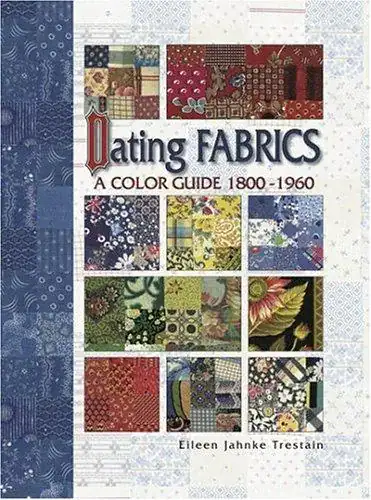
Okay, history buff!. A member of my guild “lent” me a piece of old fabric that I believe is from the 1830’s. It is 18 inches wide and approximately 40 inches long. The repeat print on it is 13 inches. It is a very large bouquet of flowers with leaves and vines and buds set on a background of small squares with stars in their center. The colors are medium tan (background), corral (pale orange) and brown flowers with medium (Prussian?) blue and brown leaves. It is in extremely good condition. It has been hemmed by hand to a solid piece of woven, rough cotton (sort of like cross stitch fabric, but very small and soft. This back piece is also medium tan. All the sewing is by hand. It is not quilted, but does have a sleeve that is hand sewn, probably from a later date (1900?). There is little fabric fading, although there are a few, small (1/4 inch) wear tears.) My questions are this (1) Anyone agree with me on date? It is very similar to fabrics shown in the book “Dating Fabrics, 1790-1960, for the 1830’s period; and 2) it has been folded (that is were the wear is) and needs to be iron? out? HOW DO I DO THAT WITHOUT RISKING DAMAGING THE FABRIC. Thanks, Don Beld
Date: Fri, 22 Feb 2002 22:29:28 -0500 | From: Diane Shink <dimacquilt@>
Hi to all from Montreal I contacted Chris last night but see everyone is guessing so I must tell you that WRC stands for the Womens Relief Corps which was basically the auxillary to the GAR formed after the CivilWar to help the old Soldiers etc. I have volumes of research on this group as I happened to unroll a quilt in Montreal a number of years ago which was made by the WRC to commemorate the Veterans of the Civil War 1861-1865. It is a story fitting for a Ken Burns film but a lot of American Women worked very had to promote patriotism in America in the Victorian Era and are forgotten today. I am looking foreard to seeing pictures of the quilt when I return from a ski holiday in Quebec City. Diane M Shink, AQS Certified Quilt Appraiser
Date: Fri, 22 Feb 2002 23:44:21 -0800 | From: “Maureen Flanagan” <flanagan@>
There are 8 copies of this book available through ABE Advanced Book Exchange at www.abe.com, beginning at $11.00. Using ABE, you can search the inventories of more than 9,000 booksellers. ABE forwards its listings to Barnes and Noble, half.com, and other services where the books are marked up, so you will get them at their list selling costs through ABE.
And while there are only 4 of the Quilt Digest books right now on ABE, you can set up a wants profile so that you will be alerted when one of these are added to the ABE database.
Best regards,
Maureen. ******************************************** Ashland, Oregon.