April 5 – 11, 2002
These restored messages come from the Quilt History List, an online forum where quilt historians, collectors, researchers, appraisers, and enthusiasts discussed antique quilts and related textiles. The archive dates from 1996 through approximately 2016 and is being restored gradually. Sign up in the form at the bottom of the page if you want to know when a new page is added. Original spelling, opinions, formatting, and inactive links may remain unchanged.
Primary topics of this QHL Digest:
- Contested eBay Portrait Quilt — Members scrutinize an eBay-listed painted-portrait quilt, debating whether its faces show undisclosed restoration.
- Ladies Art Company Catalog — Members discuss the historic Ladies Art Company pattern catalog as a key source for quilt block naming history.
- Rail Fence / Split Rails Block Origins — A new member’s question about the Rail Fence block’s origins leads to discussion of the related Split Rails pattern, traced back to a Signorelli painting.
- Restored Quilts at Quilt Shows — Members discuss whether quilt shows have a distinct judging category for restored quilts.
- Kit Quilts from the 1930s-40s — A member asks how to preserve and store kit quilts still in their original packaging.
- Building a University Quilt History Reading List — A member preparing a university quilt-history presentation gathers reading and resource recommendations from the list.
- Landis Valley Museum History — The founding of the Landis brothers’ Lancaster County, PA museum is recounted as background for regional textile collecting history. (see the article on quilt museums)
Date: Fri, 05 Apr 2002 07:58:10 -0800 | From: Chris Flynn <lovechris@>
Hello all…. I have to tell you how jealous I am of all the quilt
history
workshops, lectures, classes offered everywhere but here!! I’ll pick
up
some classes in Paducah…. but…. do any of you know of offerings
way out
West??
Thanks so much,
Chris in Boulder Creek, CA (near San Jose)
Date: Fri, 05 Apr 2002 12:20:37 CST | From: jocelynm@
On Mon, 1 Apr 2002 15:57:10 -0500 “Cinda Cawley” wrote:
> On p.
> 121 is a quote from Aunt Jane of Kentucky: “…when I’m dead and
gone
I always read that when I speak to quilt
> guilds.
I know Aunt Jane gets quoted a lot, but isn’t she really a character
in a
book, rather than being a real human being?
Jocelyn
Date: Fri, 05 Apr 2002 12:25:09 CST | From: jocelynm@
> the northern states, Free Black and white women wore long dresses
> with Sue Bonnets. In the Quilt Code, the Sue Bonne!
> t and Bandanna helped women recognize the clothes they would be
given
> to wear in the Northern States.”
Lynn,
The illogic of these legends always takes me aback. Slaves would not
be
able to recognize the clothes, having seen them on their white owners
and
on visitors to the plantation, but from seeing a Sunbonnet Sue quilt
block, they WOULD learn to recognize them? Most of the Sunbonnet
quilts
I’ve seen don’t exactly correspond to c 1850 clothing.
Jocelyn
Date: Fri, 05 Apr 2002 12:47:25 CST | From: jocelynm@
> THE UNDERGROUND RAILROAD IN NEW JERSEY ON NJN PUBLIC TELEVISION
>
There was an interesting story in the Lawrence (KS) Journal-World
this
morning, about the ‘mysterious’ tunnels that connect stores downtown.
The
two commonest explanations are UGRR and speakeasies’ escape tunnels.
Both
are wrong. As the historian said, ‘Some people get a little too
literal
about the UNDERGROUND Railroad.’ <G> While Lawrence was a stop, there
was
no need to have underground facilities, as it was easy enough to hide
people above ground in those days. Nor is there any history of
speakeasies functioning in downtown Lawrence during the Federal
Prohibition or the local prohibition that started 30 years earlier.
The explanation? They were for conveyor belts that connected from the
river to the stores, where they powered generators for electric
lights.
In 1905, the city built a hydroelectric dam, and they became
obsolete.
The UGRR is very popular now, and is giving rise to having all sorts
of
artifacts attributed to it…but we have to be careful in making the
leap
from the existance of a mysterious object, and the creation of a myth
of
its use.
Jocelyn
Date: Fri, 5 Apr 2002 20:15:33 -0500 | From: mreich@
Karen in Rochester, you asked about wool quilts. There was a book
published
in 1978 by Jean Dubois called “The Wool Quilt: Patterns and
Possibilities.
Durango Press was the publisher. It is only 180 pages long and in
black and
white. It starts off with wholecloth quilts and ends with crazy
quilts. I
have always found it helpful for reference. sue reich
Date: Sat, 6 Apr 2002 02:27:53 -0500 | From: seater@
Dear Louise, Thank you very much for your info on washing, or I should say, not washing kimonos. The first thing I said to my husband when our daughter’s email request came in was, “I have a feeling one is never supposed to wash a kimono. I think you unsew them or something…” So I’m glad I asked and you responded so quickly! I love this group.
But to avoid embarrassing my daughter I should have made clear that these kimonos are not part of the wonderful Far Eastern collections at the museum founded by the first sea captains to trade with Japan. These in question are costume/props for interpretation classes and re-enactments for visitors.
Susan in Raleigh NC where the pine and oak pollen make all the outside world yellow.
Date: Sun, 07 Apr 2002 13:13:03 -0700 | From: Judy Knorr <jknorr@>
I just returned from the Quilter’s Heritage Show in Lancaster, PA yesterday. We made a special side trip on our way home to visit the quilt display at the Schwenkfelder Museum in Pennsburg, PA. A special thanks for posting information about this show on this list. It was well worth the trip. A lovely display of 25 quilts in a beautiful museum. I loved the little doll quilt and the crib quilts, but was amazed at the variety of bed size quilts owned by this small museum. The quilts are displayed so that you can examine them (with your eyes, of course) very closely. Pictures are allowed to be taken. What a treat to see these quilts “up close”! This display is open until the end of August and a variety of activities are scheduled around it. It would be a great destination for anyone who loves exploring the backroads and seeing the beautiful countryside in southeastern PA. Thanks again for an hour well spent! Judy Knorr (who drove there through a late spring snow shower!!)
Date: Sun, 07 Apr 2002 14:43:10 -0700 | From: Pat Crook <dc.paga@>
Hi Everyone! I’m new to the group and also a novice quilter. I am curious about the origin (if any) for basic blocks like the Rail Fence? I’m writing a column about the historical roots of traditional blocks. Can anyone help me with more info — or — suggest other blocks for beginners that have historical origins or other names? (That is the theme of this article.) Many thanks in advance! Hugs, Pat
Date: Sun, 07 Apr 2002 16:51:26 CST | From: jocelynm@
On Sun, 07 Apr 2002 14:43:10 -0700 Pat Crook wrote:
> Hi Everyone! > I’m new to the group and also a novice quilter. I am curious about the > origin (if any) for basic blocks like the Rail Fence?
Pat, Apparently, a lot of the basic blocks were ‘discovered’ by quilters all over the place, and named by the quilter(s) in that area. When my mother was a girl, there was an elderly lady in the neighborhood who was known as being the expert on gardening. One day, someone asked her the name of a particular bush, and she had a lapse of memory. Instead of saying so, she playfully said, ‘That’s a Johnny Bush.’ Well, her listener took her seriously, and started calling it a Johnny Bush, because after all, Miss Whomever had said it was, and she knew everything about gardening! <G> So locally, lantana bushes are called Johnny Bushes. Quilt blocks were probably named after the were made (that is, rather than saying, ‘I want to make a quilt called Rail Fence. Now, what should it look like?’) so it depended upon the maker and her friends- What do you call it, Susan?; Well, I don’t know, I was thinking Zigzag, maybe.’ ‘Looks more like a rail fence to me.’
Brackman’s Encyclopedia of quilt patterns (don’t remember the precise name) lists several blocks that had different names in different parts of the country. Political names especially had regional differences; a Southern woman would NEVER have made a Lincoln’s Platform block. 🙂 But she might have made that design and called it something else, possibly unaware that in the North, it honored Mr. Lincoln. The late 19th century, with women’s magazines, did a lot for making standardized names, as of course did the Mountain Mist quilt batting with a pattern attached and a catalog you could send for.
Jocelyn
Date: Sun, 7 Apr 2002 21:52:31 EDT | From: Palampore@
I am still researching the paper lined quilt. I lost the emails from the 2 people who sent me info. on the family tree of these folks. I need you to email me again and identify yourself. I apologize for any inconvenience. I need to know where this info. came from to help the person in TX who has been tracing this family. I found her on the Genforum. She is very excited to find something from this family. Still no idea why they lined the quilt with batting and newspapers from Rochester, NY. One paper is from 1869 and another 1868. Haven’t the heart to take it all apart to see if there are more.
good night, Lynn in New Bern, NC
Date: Sun, 7 Apr 2002 22:44:04 EDT | From: Kittencat3@
I’m not sure when the pattern came to be called Split Rails, but you can see it on the doublet worn by one of the soldiers in Luca Signorelli’s “Calvary” from the late 15th century. The painting can be viewed on line through the National Gallery’s web site, www.nga.org.
Lisa Evans
Date: Sun, 07 Apr 2002 19:00:34 -0800 | From: Greg & Dawn Church
Hello all,
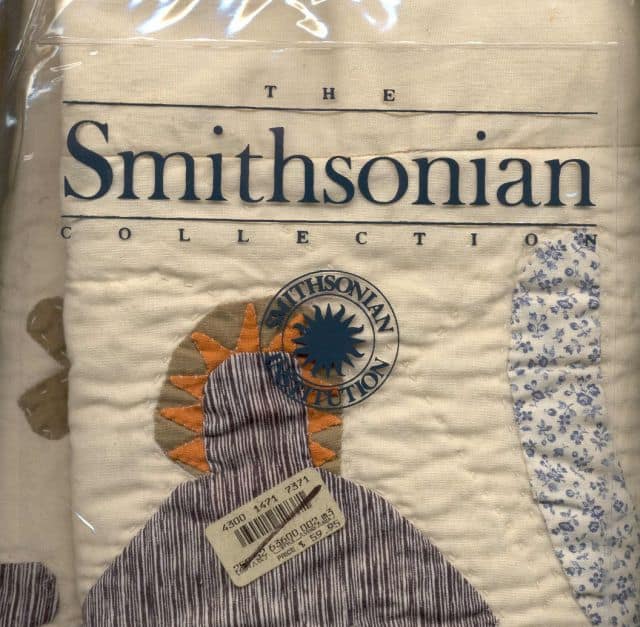
Quick question… I own several kit quilts still in the packages from the 30s and 40s. Because they are in very good condition with all of the paperwork intact (brand, number, etc.), I would like to know if anyone is aware of anyone or any organization which “catalogs” this type of information? I searched through Brackman’s Applique book and none of the one’s I own are there… would hate to have this stuff “lost” with me and my limited reach.
Thanks in advance. Dawn
Date: Mon, 8 Apr 2002 09:35:10 +0100 | From: “Sally Ward”
I’ve just had this pointed out on another list. I’d love to hear what QHL makes of it…
http://cgi.ebay.com/ws/eBayISAPI.dll?ViewItem&item=855890432
Sally W in UK (Click on the thumbnails below.)
Date: Mon, 8 Apr 2002 08:35:29 -0500 | From: “Karan Flanscha” <sadierose@>
The new issue of VICTORIA magazine (May 2002)has an articled titled “Could you be a pioneer?” by Elizabeth Clair Flood, which tells about a PBS show THE FRONTIER HOUSE which is to air April 29 to May 1. This series took three families and set them up to live from May to October as Montana pioneers circa 1883 would have. Quoting Adrienne Clune, the mother of one of the families “My expectations were so far from the reality, I dreamed about having all this time to do quilting and enjoy the countryside.” “For Adrienne, work was unceasing. Just doing the laundry took 2 days a week. An accomplished seamstress and a fine gourmet cook, she struggled to prepare two full meals a day.” “I love to cook, but when you have to make three hundred meals without a break, that is tough.” I am sure that our romanticized version of what it was like to live in the 1800s is very different from the realities of the times. Isn’t it amazing that these women (and men) found time/ made time to create functional beauty in the form of quilts, to keep their families warm, to keep their hopes alive, and to leave for us to know a little bit about them. Hope this is on Iowa’s public station!! Karan
Date: Mon, 08 Apr 2002 08:16:56 -0700 | From: Gaye Ingram <GIngram@>
I must do a presentation on quilts for a university history class (undergrad/grad level) and am preparing a list of resources/reading list. I would appreciate any recommendations for books/articles/monographs/dissertations on general uses of material culture for historical studies.
The course is on the frontier movement, esp 1850-early 1900s and my presentation will be part of “women’s” historical importance/contributions/lives. I find students are always surprised one can do historical research about quilts and always hope to open students’ minds to that possibility.
I shall appreciate any suggestions re material culture in general, quilt history in particular.
Thanks, Gaye
Date: Mon, 8 Apr 2002 12:08:41 EDT | From: KareQuilt@
http://cgi.ebay.com/ws/eBayISAPI.dll?ViewItem&item=855890432
Sally,
Glad you pointed this quilt out to everyone because I was stunned when I came across it this weekend. Anyone know anything about it?
Karen Alexander
Date: Mon, 8 Apr 2002 13:11:26 -0400 | From: “laurafisher” <laurafisher@>
Hi – this quilt was purchased at a Stella Triple Pier Show a year or two ago. Everything was there except most of the faces. For my money it was too far gone to re sell because the most important part, the faces, would have had to be remade.
It looks like that has been done. There are faces there now. Did not read all the caption yet, but it would be interesting to see if the seller discloses the restoration.
Laura
—– Original Message —– From: <KareQuilt@> To: <QHL@> Sent: Monday, April 08, 2002 12:08 PM Subject: QHL: Stunning late 1800s Portrait Quilt on eBay
> http://cgi.ebay.com/ws/eBayISAPI.dll?ViewItem&item=855890432 > > Sally, > > Glad you pointed this quilt out to everyone because I was stunned when I came > across it this weekend. Anyone know anything about it? > > Karen Alexander >
Click on the thumbnails below
Date: Mon, 08 Apr 2002 13:42:41 -0400 | From: Kittencat3@
I had my doubts…those faces didn’t *quite* look Victorian. Neither did the hair. It doesn’t look like the seller is disclosing the restoration work in the description.
Interesting. Very interesting. Caveat emptor?
Lisa Evans
Date: Mon, 8 Apr 2002 18:44:39 EDT | From: JBQUILTOK@
One of the largest catalogs w/ quilt names that I’ve found from early years is the Ladies Art Company catalog. I have a copy (as in someone put it thru a Xerox – copy) of an 1898 catalog. It offered patchwork patterns for sale and has a name for each. I find it very interesting that a good many of the traditional patterns are in this booklet & wonder if this company shouldn’t get more recognition for naming patterns.
Janet Bronston
Date: Mon, 8 Apr 2002 19:03:53 EDT | From: KareQuilt@
There is an excellent overview of Ladies Art Company Catalogue in Quilter’s Journal (edited by Joyce Gross), Vol. 1 No. 4, Summer 1978, pg. 13 by Cuesta Benberry. Both Joyce Gross and Cuesta Benberry are Honorees in The Quilters Hall of Fame.
Speaking of QHF, here is our Press Release from a couple of months ago.
THE QUILTERS HALL OF FAME NEWS RELEASE FOR IMMEDIATE RELEASE
Quilters Hall of Fame Announces Honoree for 2002
Ruby Short McKim (1891 – 1976) has been selected as The Quilters Hall of Fame inductee for 2002. As the Dayton (Ohio) Daily News declared October 2, 1932, “Wherever quilts and quilt patterns are known, the name “McKim Studios” is as famous as the name Tiffany is famous in the diamond world.” Trained as an artist at the New York School of Fine and Professional Art and influenced by the philosophy and teachings of its director, Frank Alvah Parsons, McKim went on to become a shining entrepreneur at a time when women entrepreneurs were quite rare by today’s standards. Her earliest pattern series were published in the Kansas City Star May 7, 1916, The Bedtime Quilt (or Quaddie Quiltie). This graphic straight-edged design series of 20 angular interpretations of Thornton Burgess’ Bedtime Quilt became her signature trademark for years to come. Marriage and the birth of three children put her design career on hold for a short time. In 1924 she introduced another of her distinctive signature series, her Roly Poly Quilt of curvilinear animal embroidery designs, and continued to add to these unique designs throughout her career. Her angular pieced flower designs began in 1928, and as a result of their popularity, she discovered the even wider market of traditional quilt patterns. Her famous Kansas City Star syndicated series lasted from 1928-1961. Over the years her work also appeared in Child Life and Better Homes and Gardens. Quilt historian Jill Sutton Filo writes, “Impervious to social standings, McKim’s patterns filtered into millions of homes weaving a national network that blanketed America.” McKim is perhaps best known for her 1931 classic 101 Patchwork Patterns, one of the earliest published quilt pattern anthologies in Quilting history and still considered a classic today, establishing her for all times as one of the giants of 20th century quilt history. She was included in the first edition of Who’s Who Among American women over 50 years ago, and her continuing influence on American quilting goes unabated as her classic patterns enjoy still another rival.
“Honoring Ruby Short McKim’s many and varied accomplishments in creating, preserving and so widely disseminating our quilt heritage via her syndicated patterns is recognition long due,” stated Hazel Carter, President of The Quilters Hall of Fame, upon announcing the selection. The induction will take place during The Quilters Hall of Fame Celebration in July 18-21, 2002, in Marion. Indiana. For details about the judged quilt contest with cash prizes plus Celebration 2002, send a self-addressed stamped envelope to The Quilters Hall of Fame, P.O. Box 681, Marion, IN 46952.
Contact – Karen B. Alexander, Press Secretary Ann Calland, Museum Manager QHF OFFICE PHONE: (765) 664-9333 quilters@ WEBSITE: http://www.quiltershalloffame.org
Thanks!
Karen Alexander
Date: Tue, 09 Apr 2002 06:22:35 -0700 | From: Nancy Manning
Hi Everyone– Has anyone noticed if there is a category developing for restored quilts yet in quilt shows? I have not seen this locally. I’ve worked on two 30s quilts intensively now, and a 60s kit, and am now working on a duplication, and have others in the wings. I realize these quilts cannot be compared to “new” quilts in judging, yet they aren’t exactly strictly “antique” when restored. I think they might deserve a special category. Any thoughts? We seem to have a few more people developing interest in restorations each quilt show season. Nancy (in rainy Michigan)
Date: Tue, 09 Apr 2002 09:47:24 -0500 | From: Laura Hobby Syler
Nancy, I’ve “judged” a couple of shows over the years that have these quilts in a multi-generational or multi person category and not eligible for judging. Only for show. From a judges perspective it would be pretty tough, but not impossible, to apply the guild’s judging criteria to these quilts. Of like and kind applies here as well as appraising. Not a lot of fun to judge, but still judgable. OTOH…I have curated several exhibits for the Dallas show titled: “Can This Quilt be Saved” showing quilts that have been restored with photos of the before damage, quilts that are partially restored and those that are beyond restoration…mounted on backing or merely draped over a stand to show the public what has potential and what doesn’t. I did the exhibit 3 years in a row and then the last one we brought in the Quilt Rescue Squad from the now defunct Quilt Restoration Society. What fun that was. Nancy Kirk has formed the Quilt Heritage Foundation from the roots of QRS and I believe,is still doing an annual seminar in Omaha each fall. From a show chairman’s point of view, there are so many categories in most quilt shows now that to add one for these quilts would be a show chairs nightmare! We have tried to create so many new categories to accommodate all the styles and techniques that you end up with 25 or 30 categories! I doubt that we will see a special category for these quilts to be judged…maybe just a special exhibit. Laura Hobby Syler Certified Appraiser of Quilted Textiles Quilt Judge, Teacher, Lecturer, Writer
Date: Tue, 09 Apr 2002 09:47:19 -0600 | From: Xenia Cord
Replying very late to last week’s discussion on western Pennsylvania quilts in the colonial period (I’ve actually been in Pennsylvania doing a show). In 2000 I presented a paper for AQSG on William McCormick, a frontiersman, teamster, soldier, and professional weaver from Winchester, VA, who removed to Connellsville (just south of Ft. Pitt) in the 1760s. His wife Effie was the daughter of Col. William Crawford, the man who (among other things) looked after George Washington’s land interests in western Pennsylvania. I suspect Crawford Co. was named for him.
Crawford was tortured to death over 3 days by Indians in the Ohio territory, in retaliation for an earlier act of brutality by western militia from the Ft. Pitt area. Accounts of his death inflamed the Pennsylvania frontier during the Revolution, and have passed into American literature. (citations available)
In all of the research I did into McCormick’s life and times, I found no reference to quilts – only to woven textiles in linen and wool (and combinations). McCormick wove extensively for Crawford, providing fabric for uniforms when Crawford formed a company of the local citizenry to fight with Washington. Since McCormick was also a teamster, his accounts extend to the goods he brought in and out of the Connellsville-Ft. Pitt area, but cotton yard goods are not among them. Instead, he carried salt, iron, and seed west, and carried out such items as skins, brains, and scalps (yes!).
If you are interested in the article, you may find it in vol. 21 of Uncoverings (2000), pp. 27-55. It’s called “Textiles and Cooperative Commerce in Colonial America: The Example of William McCormick,”
Xenia
Date: Tue, 9 Apr 2002 13:08:07 EDT | From: KareQuilt@
In today’s comic section of the Washington Post the cartoon “Pickles” by Brian Crane is about cats and quilts. Thought you all would enjoy it, especially if you are a lover of both. <g>
Karen B. Alexander
Date: Tue, 9 Apr 2002 14:23:48 -0400 | From: “judygrow” <judygrow@>
Gaye wrote: > I must do a presentation on quilts for a university history class > (undergrad/grad level) and am preparing a list of resources/reading list. I > would appreciate any recommendations for > books/articles/monographs/dissertations on general uses of material culture > for historical studies.
> The course is on the frontier movement, esp 1850-early 1900s and my > presentation will be part of “women’s” historical > importance/contributions/lives. I find students are always surprised one can > do historical research about quilts and always hope to open students’ minds > to that possibility.
I’ve gone throught the books that I am reading lately and have made a list which I am sure others can add to. Perhaps list-Mom Kris, or someone else can keep the list up on a web site?
1. “The Light of The Home — An Intimate View of the Lives of Women in Victorian America.” with illustrations from the Margaret Woodbury Strong Museum. Harvey Green, Pantheon Books, NY.1983. ISBN 0-394-71329-x …….”Green culls from letters and diaries, quotes from magazines, and looks at the clothes, samplers, books, appliances, toys, and dolls of the era to provide a rare portrait of daily life in turn-of-the-century America.”
2. “Pioneer Women: Voices From the Kansas Frontier.” Joanna L. Stratton Simon and Schuster PB – Touchstone . 1981. ISBN 0-671-44748-3
3. from the EveryDay Life In America Series………. Victorian America: 1876 – 1915; Transformations In Everyday Life. Thomas Schlereth. Harper Perrennial. 1991. ISBN 0-06-092160-9
Others in that series but not on the time period requested…..
4. The Expansion of Everyday Life: 1860 – 1876. Daniel Sutherland. University of Arkansas Press. 1989. Harper Collins. ISBN 1-55728-596-9
5. MY FAVORITE The Reshaping of Everyday Life: 1790 – 1840. Jack Larkin. Harper Perennial. 1988. ISBN 0-06-091606-0
6. Everyday Life in Early America. David Freeman Hawke. Harper Row. 1988. ISBN 0-06-091251-0.
7. The Ssocial Fabric: America Life from 1607 – 1877. Editors John Cary and Julius Weinberg. Little/Brown. 1984. ISBN 0-316-13072-9 An anthology of American social history for college history courses — “touches on marrying and making love, fighting and getting drunk, owing the grocer and going without heat……etc.” Fourth edition.
8. Mid Century America: Life in the 1850’s. Com[piled and edited by Carl Bode. Southern Illinois University Press. 1972. ISBN 0-8093-0562-3.
Other books by Carl Bode (I haven’t read them — JKG) 9. The American Lyceum: Town Meeting of the MInd.”
10. Antebellum Culture (first published as “The Anatomy of American Popular Culture, 1840 – 1860”)
11. The Half-World of American Culture (could be the same book as……….) 12. American Life in the 1840’s (compiled and edited) (short writings from the period with modern introductions to each piece.
others on earlier times:
13. The Writers Guide to Everyday Life in Colonial America from 1607 – 1783. By Dale Taylor. Writers Digest Books. 1997. ISBN 0-89879-942-2 (If you think that modern historical novels all use the same descriptive devices, this book and another in the series of a later time period are probably the reason why.)
14. “The Refinement of America. Persons, Houses, Cities. ” by Richard L. Bushman. Alfred Knopf. NY. 1992. ISBN 0-394-55010-2. Centered on the mid-Atlantic States, specifically Delaware, in the 18th century.
I’d love to add more titles to my list, too. Everything I read only increases my understanding and appreciation of early quilts and quilt makers.
Date: Tue, 09 Apr 2002 15:13:29 -0400 | From: Kittencat3@
I don’t remember the author, but “The Feminization of American
Culture” was a pioneering look at the women’s magazines and their
contribution to 19th century domestic culture.
Lisa Evans
Date: Tue, 09 Apr 2002 18:44:43 -0500 | From: Marcia Kaylakie <marciark@>
Hello,
This question came to me over Quiltnet and I asked permission of the
sender
to send it on in hopes you might give her some good guidance.
Thanks!
>A question has come up regarding our guild’s challenge this year
which I
>thought I would present to my Quiltnet “authorities” for some
“unbiased
>opinions”.
>
>For our challenge this year, we are able to purchase a printed
fabric flag
>(one of the Daisy Kingdom fabrics with 6 flags/yard, being sold to
us
>individually) with instructions to create an item for display at our
>September meeting with 3 winners chosen and all quilts shown at the
annual
>quilt show. Although these flags are printed to resemble Old Glory,
they
>are not to scale, the stars being out of proportion and the stripes
to the
>right of the flag not as long as the official flag.
>
>The question is whether or not it is o.k. to cut this flag to use in
your
>item for entry into the challenge (for example, one person would
like to
>make a shield shape for placement on an eagle, etc.). The debate is
>whether or not a “flag like” piece of fabric is o.k. to cut or
because it
>resembles the flag it should not be.
>
>I seem to remember a similar debate when Willie Nelson wore a “flag”
shirt
>which was quieted when pictures appeared of Roy Rogers and Dale
Evans
>wearing similar ones! Presumably, all entries will be respectful
of
>the flag, but before we proceed further I’d be interested to know
the
>proper etiquette.
>
>Thanks for your input!
>
>Donna, in Sonora, CA
Marcia Kaylakie, AQS Certified Appraiser
www.TexasQuiltAppraiser.com
Date: Tue, 9 Apr 2002 22:51:10 -0400 | From: Mary Beth Goodman <mgoodman@>
>Has anyone noticed if there is a category developing for restored
>quilts yet in quilt shows? I have not seen this locally. I’ve
worked
>on two 30s quilts intensively now, and a 60s kit, and am now working
on
>a duplication, and have others in the wings. I realize these quilts
>cannot be compared to “new” quilts in judging, yet they aren’t
exactly
>strictly “antique” when restored. I think they might deserve a
special
>category. Any thoughts? We seem to have a few more people
developing
>interest in restorations each quilt show season.
>Nancy (in rainy Michigan)
Hi Nancy
I don’t think we’d have a problem judging this sort of quilt at our
show. You would enter it as a group quilt since you and someone else
worked on it.
You’ve given me an opportunity to say that the entry deadline for
NYQuilts! quilt show is fast upon us – April 15th. We welcome all
kinds of quilts and use a point system which rewards each quilt on an
individual basis. You can get complete information and the forms you
need to enter quilts and take classes at our web site. (questions or
problems, please contact me off list)
Also as an aside, we’ll be hosting the “AMERICA: From the Heart”
touring quilts. These 125 quilts debuted at Houston last November,
being made in the period between September 11th and the end of
October. I’m quite honored to be displaying them at NYQuilts! and
feel they represent the best of what quilts have always been – a way
to express our emotions and thoughts. I hope you’ll be able to take
this opportunity to see them.
—
Mary Beth Goodman, Coordinator
NYQuilts!
Quilts, vendors, lectures, classes!
June 8-9, 2002
Russell Sage College, Troy NY
http://www.nyquilts.org/
Date: Wed, 10 Apr 2002 00:44:00 EDT | From: KareQuilt@
Dear QHLers,
Someone on our list shared our discussion concerning the painted
portrait
quilt currently on eBay with the owner/seller of the quilt. The owner
has
contacted me, I suppose because I had shown some interest in the
quilt on
this List. He asked if I would share this additional information
about the
quilt with the whole List. In the interest of clarification on the
condition
of the quilt, I pass his note on to the rest of you. I have not bid
on this
quilt nor do I plan to. It is already well out of my price range.
However, I
am definitely very interested in its provenance. The seller’s email
follows.
Karen Alexander
Subj: Re: NEW YORK PORTRAIT QUILT ON eBay
Date: 4/9/02 8:07:23 PM Eastern Daylight Time
From: Anthers
To: KareQuilt
Hello. My name is Steve McKinney. I have been a dealer in quilts
and
antique textiles for over twenty years. A member of your quilt
history
discussion List emailed me yesterday to tell me that the New York
portrait
quilt that I have up for auction on Ebay has been “challenged” by a
member of
your List and I would like to this opportunity to tell the real
story.
This quilt has never been repaired or restored by anyone. It is just
as I
found it when I purchased it during the set up of an antiques show in
New
York. The “picker” that I purchased it from had just found it in the
estate
of a prominent New York family.
Another dealer saw the quilt just before I did, and in an attempt to
get a
better price from the seller, temporarily walked away from it. When
she
walked away I rushed in and purchased the quilt immediately. I
folded it up
and put it under my table. Needless to say, when the dealer returned
to buy
the quilt, it had already been sold. I have not exhibited this
quilt at
any antiques or quilt show, and I have not offered it for sale
privately to
any individual collector or dealer.
I do not know why this person would claim that the faces in the quilt
were
“gone”. They are in very good condition considering the medium
(silk) used
for their applique. A few of the faces have some splits and two have
very
minor flakes, but I feel that the quilt is in remarkable condition
for its
age.
The only thing that I have done to the quilt is to have it
professionally
mounted on acid free cotton which has been stretched over a wooden
artist’s
frame. Nothing more.
I wish I knew more about the history of the quilt. The “picker”
would not
tell me the name of the family from which it descended. I imagine
there were
more things in the estate and he did not want to reveal a valuable
source!
But, perhaps, two years later, I could persuade him to provide more
information. I will see.
If any of you have questions or comments on the quilt I would be more
than
happy to hear from you. My email address is: antikers@.
Regards,
Steve
<<end of Steve’s email to me>>
Karen Alexander
Date: Tue, 9 Apr 2002 23:50:01 -0500 | From: “Carol Butzke” <butzke@>
For many years the National Quilting Association Show has sponsored a
category called Capitol Hill at their yearly national show. It is
for “tops
or blocks begun prior to 1950 by someone other than the entrant and
completed by the entrant within the last five years; shortest side
must be
at least 60″. This is an exhibit category only and not judged in the
competition.
If you are interested in entering this year’s show in Charlotte, NC
show
entries will be taken until May 1st. Information can be found at the
NQA
website at: www.NQAQuilts.org/charlotte
Carol Butzke
NQA Show Judging Coordinator
Date: Wed, 10 Apr 2002 09:42:08 -0400 | From: Angela Kryhul <angelakryhul@>
Hello to all of you.
I’m new to this list, so please let me introduce myself.
My name is Angela Kryhul and I am so pleased to have found this forum
and so many resources associated with quilt history.
My interest in quilts goes back almost 20 years. While I enjoy making
projects (my average is one quilt every 2 or 3 years), I’m more of a
“quilt groupie” meaning I like to hang around with quilters, read
quilting books, attend shows and spend hours on the Internet at quilt
sites.
I live in Toronto and my background is as a business journalist. I’m
at
a point in my life where I want to transition my skills into the
areas I
love-quilt history, textiles and women’s domestic history.
My goal is to make a career out of studying quilts and domestic
textiles
and I’d like your help. How have you managed to make a career in this
area? Did you take any special courses? If so, which ones and where?
(Are any available by correspondence, including the Internet?) Did
you
cobble together a career for yourself or is there a college or
university that can offer me some guidance in this area? Are you
associated with a corporation that makes quilting supplies? Which
quilt
or historical associations did you join? Which shows are a “must” to
attend?
Thanks so much for any help you can provide.
Angela (in sunny Toronto)
Date: Wed, 10 Apr 2002 10:04:50 EDT | From: KareQuilt@
This question would be an excellent way for many on this List to give
us a
thumb nail history of their own endeavors! These thumb nail sketches
would
then become important snippets of history themselves for future
historians as
they research and write the history of quilting of the later part of
the 20th
century! Come on guys and gals. Add to history and share your
stories! I
don’t make a living at it. It’s simply my avocation and passion,
though I am
now (as of 2002) paid for speaking, ….but it will never support
even my
book habit!….let alone by quilt collecting habit!
<<is there a college or university that can offer me some guidance in
this
area? >>
Angela, you need to get in touch with the International Quilt Study
Center.
They offer an excellent graduate program. Patricia Crews is the
Director.
Patricia Cox Crews, Ph.D.
Professor and Director
International Quilt Study Center
Dept. of Textiles, Clothing & Design
P. O. Box 830838
University of Nebraska-Lincoln
Lincoln, NE 68583-0802
Phone: 402-472-6342
Fax: 402-472-0640
pcrews@
http://quiltstudy.unl.edu
Good luck!
Karen Alexander
Date: Wed, 10 Apr 2002 11:42:42 -0500 | From: “Jennifer Van Haaften” <jasvanhaaften@>
>The new issue of VICTORIA magazine (May 2002)has an
>articled titled “Could you be a pioneer?” by
>Elizabeth Clair Flood, which tells about a PBS show
>THE FRONTIER HOUSE which is to air April 29 to May 1.
>This series took three families and set them up to
>live from May to October as Montana pioneers
>circa 1883 would have. Quoting Adrienne Clune,
>the mother of one of the families “My expectations
>were so far from the reality, I dreamed about having
>all this time to do quilting and enjoy the
>countryside.”
> “For Adrienne, work was unceasing. Just doing
>the laundry took 2 days a week. An accomplished
>seamstress and a fine gourmet cook, she struggled
>to prepare two full meals a day.”
> “I love to cook, but when you have to make
>three hundred meals without a break, that is tough.”
> I am sure that our romanticized version of what it
>was like to live in the 1800s is very different from
>the realities of the times. Isn’t it amazing that
>these women (and men) found time/ made time to create
>functional beauty in the form of quilts, to keep
>their families warm, to keep their hopes alive, and
>to leave for us to know a little bit about them.
>Hope this is on Iowa’s public station!!
>Karan
Yes, all that work should give a us a renewed respect for women
living in
the past. However, we need to also remember that they didn’t know
what we
know now. They didn’t know any different and didn’t grow up any
different.
Imagine if you’d been helping your mother with various chores around
the
household since you were four, five or six in the 19th century. You’d
get
increasing responsibility as you got older and would be expected to
know how
to cook from scratch, though you could probably use recipes. You
would have
learned how to butcher and dress poultry, along with other young
women in
your family. You’d learn from your mother, grandmother and aunts how
to
manage your house using what you had. If Adrienne and her family had
already
grown up in that environment, they would have probably had a better
grasp on
things and the ability to find more time to make things work and not
be so
exhausted. Being more familiar with that way of life could have made
it
easier for them to find time to quilt, read, or sew clothes.
Cooking on gas or electric ranges is not like hearth or woodstove
cooking.
Using cast iron reguarly for pots and pans is a physical strain. I
would say
our female ancestors were much more fit than we are. So for Adrienne,
though
considered a good cook, she would need to relearn the whole process,
and
have to keep it up for the months they were out there. I am sure it
is not
easy. I have worked at a few different living history sites and have
learned
the “knack” to cooking in these different methods as well as using
historic
recipes. But I would say I didn’t feel confident until a few months
after
working at those places. It was kind of like being the daughter,
learning
from the experienced interpreters how to manage the kitchen.
I think getting right in there and doing is an interesting way to
learn
about history. I would suggest any of you “would be pioneers” try
volunteering at a living history site. It gives you the “experience”
and an
idea of what our ancestors dealt with and you can have a lot of fun
and
share your historical knowledge with others. It also could give you
an
opportunity to share quilting lore, facts, and techniques form the
past.
Though it is never really a true picture of life in the past in my
mind.
Because at the end of the day, you get to go home to cold showers,
air
conditioning and can microwave your supper if you feel like it.
I would have loved to try the Frontier House to get a more complete
day in,
day out idea of living the 19th century way, but I know, at the end
of the
day, I am glad to have the technology I have to use to make my own
life the
way I want it to be. I have a greater access to information and new
ideas
that I may never have had in the past. Like the toughness of life in
the
19th century, there are some good and some bad things about life now.
And
someday our granddaughters and great-granddaughters will exclaim
about how
hard our life was and wasn’t it too bad that we didn’t have all the
conveniences they have.
🙂 I have the Frontier House air time on my calendar. The most
disappointing
thing to me is, those families spent 6 months out there in Montana
and they
condensed it down into 6 hours of television. Life in a nutshell–the
soundbyte.
Jennifer Van Haaften
In Chicago Suburbia
Date: Wed, 10 Apr 2002 15:17:32 -0700 | From: donbeld <donbeld@>
Hi Gaye, One the most interesting and delightful series I have read
that
relates to quilts and frontier women is a a collections of diary
entries of
women who settle the prairie states in the 1830-60’s written by Linda
K.
Hubalek. They ae titled: Thimble of Soil, A women’s quest for land;
Traid
of Thread, a women’s westward journey; and Stitch of Courage, a
woman’s
fight for freedom. These diary entries tell of the times and
problems of
frontier life and the quilting that goes with them. Many of the
blocks are
named with “early” names which means that they are often called
things like
“Grandmother’s Favorite, Sister’s Choice”, etc.
An example of the writing: “I shivered when Deborah told me how Ann
died of
consumption on a cold winter day. They buried her in a quilt she had
just
finished. My first thought was that it was a waste of needed
bedding, since
a dead person doesn’t need a blanket. Deborah explained that it was
Ann’s
wedding quilt that she labored on before she died, and she could bear
the
two to be apart. I understood because I tucked special items in my
children’s caskets. Even when the person is dead, we still want to
comfort
them.” Thimble of Soil, page 56.
A quilt store in Littleton, Colorado (is it okay to give their name?
Fabric
Expressions! puts out a block of the month every year that I have
participated in since 1996, and these books were the bases for the
1999
quilt. For those of you who have seen it, they are the originators
of
“Women’s Voices” quilt.
Either way, the books are great reading. Don Beld
Date: Wed, 10 Apr 2002 17:31:19 -0700 | From: donbeld <donbeld@>
Hi, I just had to share that I have seen the five pre-Civil War
quilts that
we are going to be able to show in our quilt show next month. These
are the
quilts that were allegedly set on fire by Sherman in his March to the
Sea
during the Civil War in South Carolina.
The family story (they have owned this plantation since it was given
to them
by George III in 1755) is that there were 27 other quilts that
Sherman took
with him for “horse blankets”. What a loss!
As best I can tell–remember I am not certified or an expert, just a
fascinated amateur-three of the quilts are 1830-40 and two are
1850’s.
There two that are identical that the family says are called Fig
Leaf–I
haven’t found the pattern in a book yet. One of them is the quilt
that is
burnt from the Sherman incident. They are appliqued with green and
red
fabrics (large prints). There is one nine patch 1850’s, one that
they call
Drunkard’s Path, but isn’t–it looks like a different version of
Robbing
Peter to Pay Paul, and one they call Sun Burst that is a pieced
Dresden
Plate kind of design with a round center and eight pedals. I think t
is
Sunflower. Anyway three are in excellent condition and are wonderful
to
see. Don Beld
Date: Thu, 11 Apr 2002 09:55:25 -0400 | From: “Cinda Cawley” <lrcawley@>
George and Henry Landis were brothers who collected the artifacts
of
Lancaster Co., PA. In 1925 they opened a museum on their home farm
which
exhibited the thousands of items they collected. This was the
beginning of
the Landis Valley Museum now administered by the PA Historical and
Museum
Commission. For the first time the museum’s quilts are being
exhibited, but
you have to be quick. The exhibition ends on April 21.
I went to Landis Valley last Friday expecting to see typical PA
German
quilts. I did and much more. In addition to 30 quilts there is a
wonderful
array of sewing notions, but the quilts… It was like a ticket to
Ali
Baba’s cave!
Lots of PA German of the highest quality: a Sawtooth Diamond in
chrome
yellow set against Lancaster blue, a red and green Double Irish Chain
on a
cheddar background, dark green Fleur de Lis on red, lots of the
wonderful
backs I always hope to find on PA German quilts (some constructed of
long
strips, others whole cloth of fabulous prints), a four block Coxcomb
in
turkey red and poison green with reverse applique and a vine border
with
stuffed grapes.
The surprises were even more exciting: Rob Peter to Pay Paul in
bottle
green and chrome yellow with a wide border of a sophisticated indigo
and
white large-scale floral print, repeat block quilts with wide chintz
borders, a Friendship Album from New Jersey dated 1842-45 with
pieced,
applique and chintz applique blocks.
For once I can do more than just tantalize you. There is a 40
page
catalogue of the exhibit with full page photos of all the quilts and
captions by Patricia Herr. It is available for $13.95 from the
museum
store, www.landisvalleymuseum.org. . The store manager is Shelby
Chunko and
the assistant manager is Linda Siems. Phone (717) 569-9312. Email:
weathervane@. If you’re interested don’t wait. This is
sure
to sell out.
The Quilters Heritage Show was at its usual standard of
excellence. For
the first time in ages I stayed until it closed on Sunday and decided
that
is the day to see the show. The crowds were gone!
Cinda on the Eastern Shore
Date: Thu, 11 Apr 2002 14:27:03 -0500 | From: “Steve and Jean Loken” <sandjloken@>
Marcia and group,
I have read that the only item that must be respected according to
the flag
etiquette rules are actual flags that fly on poles. Representations
of
flags, ie. fabrics, shirts, and even the tiny flags held at parades,
may be
treated in any way you wish, and may be discarded in the trash. The
rules
are made or kept by veteran’s organizations, mainly American Legion,
and
their web sites often have the rules written out. But, of course,
they don’t
think about sewing when they print the rules.
Jean in rainy Minnesota