January 22 – 26, 2004
These restored messages come from the Quilt History List, an online forum where quilt historians, collectors, researchers, appraisers, and enthusiasts discussed antique quilts and related textiles. The archive dates from 1996 through approximately 2016 and is being restored gradually. Sign up in the form at the bottom of the page if you want to know when a new page is added. Original spelling, opinions, formatting, and inactive links may remain unchanged.
Primary topics of this QHL Digest:
- Dating Club and Fabric Verification Fun (FVF) Recap — A member’s long, detailed report from an in-person Dating Club and FVF meeting describes a wide range of quilts examined that day. (see the article on dating quilts)
- eBay Quilt Finds and Questions — Several members flag interesting quilts spotted on eBay, prompting dating and identification discussion.
- Log Cabin / Hexagon Pattern Name Origins — A thread on the Log Cabin pattern’s name and its relationship to hexagon-based variants begins. (see the article on Grandmother's Flower Garden quilts)
- Feathers in Quilting Designs — A discussion opens on feather motifs used in quilting patterns.
Date: Sat, 24 Jan 2004 18:14:16 -0500 | From: “crossland_n_j Crossland” <crossland_n_j@>
> Kris Wrote: > This one caught my attention > http://cgi.ebay.com/ws/eBayISAPI.dll?ViewItem&item=2588908969&category=2221 > > but is it silk? Is it mid 19th century? I think not, but I would be > happy to be wrong. What do y’all think? > > Kris, practising her y’alls. > > Kris, you are soooo right! Shattered silks gave the date away. If it was > mid 19th century, there wouldn’t be any shattering. Julie in not so cold, > it is “Artic” NH.
Date: Sat, 24 Jan 2004 23:55:44 -0500 | From: “J. G. Row” <JudyGrow@>
“Telltale Textiles: Quilts from the Historic Deerfield Collection”
Lynne Bassett gave a personally guided tour of the show of quilts and other textiles that she curated at Deerfield this summer, and I had the great pleasure of being one of the touristas. Finally, the catalog of the show has been published, and thanks to Barb Garrett mine was personally delivered on Tuesday.
All of 40 pages long, it could be the most concise and informative written and illustrated history of early quilts and textiles in America. Most of the text is in the captions to the glorious photos. And thank goodness Lynne has been making a special study of whole cloth calamanco quilts and putting their designs into line drawings. Photographs of those quilts are never good enough to allow us to savor the sumptious design of their quilting. The catalog includes 3 of Lynne’s line drawings, and from them we can see how the undulating reciprocating vine, packed with fantasy flowers are the same motifs used in bed rugs, painted furniture decoration, and stitched samplers.
I have always wondered where the ubiquitous feather quilting motif came from, when it was first used. From studying Lynne’s drawings I think the design element that we call “feathers” today started as leaves on vines, with veins delineated. I wonder when the name “feather” was given to the motif. (See especially figure 9 on page 10.) I hope Lynne can get a publisher for her entire collection of drawings! That would be really special.
Too often the study of quilts takes place in a sort of locked room, and the focus stays only on the quilts. In her catalog, Lynne has reminded us that quilts were only one part of a world full of expensive textiles. I especially appreciate that Lynne has included articles of clothing using textiles like the ones used in the quilts. We have often wondered what “that” print looked like in a dress, and Lynne shows us. I also appreciate that design sources and other household uses of the same motifs used by quilters are included.
A wonderful catalog, it belongs in every quilt lover’s library, and should be given to every beginning quilt historian as required reading.
It is unfortunate the the museum is charging so much for shipping this small catalog. Priority mail is less than $4.00 with the mailers free from the post office. Yet Deerfield is charging $6.95 for mailing. I hope that policy changes.
Historic Deerfield Museum Store: 413-775-7170 or museumstore@
Judy in Ringoes, NJ judygrow@
Date: Sun, 25 Jan 2004 06:34:06 -0600 | From: Pat Kyser <patkyser@>
> I was in Mexico for a week and came home to find this list so silent I > wrote Marsha to ask if I’d been dropped. With the meeting in Louisiana > coming up soon, I would expect more traffic. Who is going? Pat Kyser in Alabama
Date: Sun, 25 Jan 2004 07:41:51 -0600 | From: Gail Ingram <gingram@>
The Louisiana hostesses are bizy preparing for the onslaught <g> of guests, also a www to which we may refer in p.r. and guild notices.
And besides, with you in Mexico, nobody felt like writing!
On the way to confession and communion, Gail
> From: Pat Kyser <patkyser@> > Reply-To: “Quilt History List” <qhl@> > Date: Sun, 25 Jan 2004 06:34:06 -0600 > To: “Quilt History List” <qhl@> > Subject: [qhl] Re: qhl digest: January 24, 2004 > > >> I was in Mexico for a week and came home to find this list so silent I >> wrote Marsha to ask if I’d been dropped. With the meeting in Louisiana >> coming up soon, I would expect more traffic. Who is going? > Pat Kyser in Alabama > > > > — >
Date: Sun, 25 Jan 2004 12:09:27 -0500 | From: “Lynne Z. Bassett” <lzbassett@>
Wow! Judy, thank you so much for your generous comments about my catalogue! I deeply appreciate your taking the time to write the review. I hope you don’t mind if I pass it along to folks at Historic Deerfield (some of whom really didn’t want to publish the catalogue because they thought it would never sell). I have to thank curator of textiles Edward Maeder, not only for asking me to do this project, but for believing in it so strongly that he cajoled and browbeat his colleagues at the museum as necessary until they submitted and published the catalogue.
As for finding a publisher for my larger project on the whole cloth wool quilts, from your lips to God’s ears! I have written a couple of grant and fellowship proposals recently that will keep the project going if I get them–and eventually (I hope by 2007) it will actually be done and published! In the meantime, I am grateful to the Dallas Quilters Guild and the Meredith Scholarship of the American Quilt Study Group for giving me money this year for my research. So far, I have added about 30 new quilts to my database and I’m working on doing more drawings.
Thank you again, Judy!
Best wishes, Lynne
Date: Sun, 25 Jan 2004 08:04:30 -0800 | From: Anne Copeland <anneappraiser1@>
Hi Kris, I have seen a lot of very old silk quilts in my years of appraising, and have been puzzled to see that some that had dates sewn on them had absolutely no shattering or shredding. I began to realize that it is possible that 1) not ALL silk merchants were unscrupulous; and 2) silk could have been brought in directly from the Orient or other locations. Therefore, not every single piece of silk may be shatteredor shredded. And I have seen in some quilts where some pieces were shattered and others not a bit, even colors that normally shatter or shred.
This piece, however, leaves me with another question in my own mind. The pattern and the way it is put together and the silk itself, esp. note the piece in the lower right hand corner, and there is something that looks almost like gold lame on the left side, and the light blue in the upper right does not look right for that period either. Even the red is somehow very odd. But the pattern and the way it is put together and quilted does not look at all right for a silk quilt. I would expect more to see wholecloth or a strippy quilt, or something somewhat irregular (not talking crazy pieces). This is too precision pieced, and also the quilting style for silk seems very questionable to me.
Very suspicious. I would think more like something made in the orient. All the silk looks way too new. Just my take on it, but it doesn’t look right for a quilt of that time. Peace and blessings, Annie
Date: Sun, 25 Jan 2004 16:10:40 -0600 | From: Gail Ingram <gingram@>
I’ve been trying to access the link to the Study Group reports on www.quilthistory.com and cannot.
Help?
Gail
Date: Mon, 26 Jan 2004 11:56:01 +1000 | From: “Quiltstuff” <quiltstuff@>
I don’t think that is the case. When you look at British crests and decorations , there are definitely pictorial representations of feathers that look like ours. In particular the Prince of Wales feather. These feathers ( I think Ostrich feathers) look more like quilting feathers than other feathers do. I think they then took on a life of their own and quilters and artists started using the form to do borders and turn circles..
Though interestingly when trying to search for a picture for you, I did find out that there is a New Zealand fern called after the feather that must look like it.
Suzy
> I have always wondered where the ubiquitous feather quilting motif came > from, when it was first used. From studying Lynne’s drawings I think the > design element that we call “feathers” today started as leaves on vines, > with veins delineated. I wonder when the name “feather” was given to the > motif. (See especially figure 9 on page 10.) I hope Lynne can get a > publisher for her entire collection of drawings! That would be really > special. >
Date: Sun, 25 Jan 2004 22:57:28 -0500 | From: “J. G. Row” <JudyGrow@>
Suzy,
I am not talking about crests and regal decorations. I am speaking about flowering vines sprouting flowers and leaves of all sorts, including shapes that we now call “feathers.” These are seen on whole cloth calamanco quilts from 1790 through 1840. And they are also seen by themselves as large space fillers, separate from attached flower shapes.
They are quite different in shape and intent than the three-feathers-on-a-crown insignia of the Prince of Wales as seen here in a fake diamond brooch copied from one owned by the Duchess of Windsor.
http://pages.tias.com/6203/PictPage/1449408.html
To retain the recognition as a symbol belonging to the Prince of Wales I would think that any representation would have to retain that same shape.
I’ve often wondered what inspired the the circular Prince(ss) Feather design. Certainly it bears no resemblance to the actual insignia of the P.O.W.
My intuition tells me that if it was inspired by any one, it was from the 1848 Hungarian freedom fighter Louis Kossuth (1802-1894) , who visited the US in 1851 and was reknown for wearing a hat decorated with a single feather plume. Here’s an image of him praying on his knees in 1849 and the plumed hat is at his feet. http://hungary.ciw.edu/kossuth/images/ima.jpg Here’s another print, in color. http://hungary.ciw.edu/kossuth/images/1848%20allegoria.jpg
Just last weekend at an antique show I photographed a print dated 1848 showing him giving a speech to a crowd in front of a church with his plumed hat in his hand. The year 1848 was a year of revolutions which began in Sicily and soon included almost all of Europe except England and Russia. A new sense and spirit of Freedom was felt all over the world, and American especially were eager for news from around the world. When Kossuth visited the US in 1851 he became a celebrity and his plumed hat became an immediately recognizable symbol.
I’d like to know if there are any documented Princ(ess)’s feather circular applique patterns earlier than 1851.
Anybody?
Judy “Ringo” in Ringoes, NJ judygrow@
Original Message —– From: “Quiltstuff” <quiltstuff@> To: “Quilt History List” <qhl@> Sent: Sunday, January 25, 2004 8:56 PM Subject: [qhl] feathers
> I don’t think that is the case. When you look at British crests and > decorations , there are definitely pictorial representations of feathers > that look like ours. In particular the Prince of Wales feather. These > feathers ( I think Ostrich feathers) look more like quilting feathers than > other feathers do. I think they then took on a life of their own and > quilters and artists started using the form to do borders and turn circles.. > > Though interestingly when trying to search for a picture for you, I did > find out that there is a New Zealand fern called after the feather that must > look like it. > > Suzy >
Date: Sun, 25 Jan 2004 23:34:20 -0500 | From: “Lynne Z. Bassett” <lzbassett@>
The origins of the feathered vines and bizarre flowers are complicated. The designs that we see in the whole cloth quilts are rooted in the Renaissance, which based much of its design on ancient Roman “grotesques,” which were curving, stylized floral and foliate forms found during excavations of classical period Roman grottoes. The designs were popularized in the Renaissance because of the development of the moveable type printing press; the new printing industry published design manuals, particularly for lace. Many of the designs that we see not only in the wool quilts, but in furniture, ceramics, silver, etc. of the period are related to early lace designs. I talked about just this subject at Historic Deerfield’s quilt symposium last fall and I certainly hope to publish it someday, somewhere!
Best, Lynne
Date: Sun, 25 Jan 2004 23:57:28 EST | From: @aol.com
Content-Type: text/plain; charset=”US-ASCII” Content-Transfer-Encoding: 7bit
That’s what I always thought…the same design elements show up over and over on domestic furnishings, artwork, stucco, bookbinding, embroidery, lace, and so on and so on. Also, there were a couple of very influential design books, most notably the one by Cesare Ripa.
An excellent book on Renaissance design is Jocelyn Godwin’s =The Pagan Dream of the Renaissance,= published by Phanes Press. There’s a terrific chapter on the origins of the grotesque style, plus a lovely description of the gardens at the Villa D’Este. Highly recommended.
Karen Evans Easthampton, MA
Date: Mon, 26 Jan 2004 07:37:21 -0600 | From: Xenia Cord <xenia@>
The 18 members of the Midwest Fabric Study Group who were able to make it to Louisville Saturday enjoyed a great day of wandering at our leisure among the chintz quilts on display, reading the descriptions, attempting to see at an angle behind the quilts (the scheduled docent did not appear, and despite our offer of gloves, the attendants refused to even twitch an edge for us <g>!)
The quilts were beautifully displayed, hanging full out with lots of space around each. There were also two glass cases that allowed us to get very close to the examples without exhaling on them (or worse). One case held samples of vintage chintz fabric, and the other an incredible paper pieced hexagon top with units about the size of a quarter – and thousands of them! (I don’t think this was the quilt on C&C page 56, but the work was similar). The piece was arrange in the case so both the finished side and the basting, papers, and whipstitched joining could be seen. A similar composition can also be seen on page 72-3. If you have a copy of Calico & Chintz you can follow along; we saw a great many of the quilts illustrated in the book.
Another hexagon set, this one described as a child’s quilt, featured coordinated ‘flowers’ set in fields of white hexagons, with a red ‘Indiennes’ in hanging diamonds defining each flower. The quilt had a wide chintz border of roses on drab brown, ca. 1830 (see C&C, p. 84-5).
The first piece that confronted us was a wonderful appliquéd top with chintz cutouts on a white linen ground (backed, no quilting). The center focus was a basket created of segmented chintz feather prints, and the arborescent filling included leaves cut from other chintzes and neatly appliquéd. Startling among the fabrics was a dark indigo with large white dots, about the size of an aspirin. The dots were cunningly used as design elements in flowers around the outside of the center design. A swag with trefoil lobes at the intersections bordered the piece. This one is not in the book.
The wholecloth on page 62 is incredibly more vivid than it looks on the page, in part because it is huge and dominated the wall; it is only casually quilted, and we were not treated to the French toile backing fabric, which can be seen on page 63. We saw a sedate, planned Unequal Nine Patch (BB #2020) on point, in brown tones with a single 2-step green arborescent between, showing blue frond palm trees with coconuts. There were several pillar prints, including one in the fabrics case, using the pillars to advantage by setting the top strippie style. The alternate stripes were rather simple block formats on point (see p. 80-81) There was also a Flying Geese strippie from mid-century, set with brown chintz (p. 128-9)
A lovely southern (SC) quilt with a delicate broderie perse clutch of flowers in the center and floral motifs surrounding was set in a series of chintz frames, each successively wider and all floral, and was intensely quilted, supposedly by slaves on the plantation (p.96-70. Another block format, a Nine patch from New England, presented in brown tones and showed tantalizing scraps of a monochrome chintz with an exotic plumed bird on a nest of bizarre fruit; the eye kept jumping, trying to reconnect the images (p.98-9).
Other quilts included a pieced ‘Sunflower variation in bold yellow and blue ombre cotton, with an interesting approach to the problem of not enough striped fabric to completely frame the piece (see the corners on p.111). Eight year old Carolyn Miller pieced a small quilt of more than a thousand pieces, using chintzes and other cottons; friends inked, stenciled, or embroidered their names on precise ‘Reel and Oak Leaf’ blocks in a variety of 2-step greens and turkey red ‘Indiennes,’ with an incredible moire-print blue border that shimmered just because of the print design (p.119). another border that was equally dramatic blue ombre print in segments, almost like Attic Windows.
For sheer drama, the most vibrant piece in the exhibit was a quilt made of HUGE Nine Patch blocks on point (p.124-5); we estimated that they were between 12-15″ square. The blocks were random, incorporating a vivid assortment of red, gold, yellow, brown, pink, and blue calicoes, and the setting fabric was a dramatic vermicular print in brown, shadowed in white, on a brown and blue ombre striped ground overlaid with delicate black fronds like feathers. The pieced frame and floral striped border were subdued enough to keep this piece from jumping right off the wall!
The exhibit continues at the Speed Museum (www.speedmuseum.org) until March 14, and will also have the following schedule:
April 7-June 7, 2004 – Portland Museum of Art (Portland, Maine) Sep. 19-Nov. 21, 2004 – Butler Institute of American Art (Youngstown, Ohio) It’s not to be missed!
Xenia
Date: Sun, 25 Jan 2004 22:38:41 -0800 | From: “Laurette Carroll” <rl.carroll@>
Judy, Brackman in her “Clues in the Calico” shows an early Prince’s Feather quilt, dated 1818. A wonderful chintz applique quilt, in a medallion setting. Is this what you were looking for? Laurette Carroll Southern California
> I’d like to know if there are any documented Princ(ess)’s feather circular > applique patterns earlier than 1851. > Anybody? > Judy “Ringo” in Ringoes, NJ
Date: Mon, 26 Jan 2004 07:13:06 -0800 (PST) | From: Donald Beld <donbeld@>
–0-1125824333-1075129986=:29989 Content-Type: text/plain; charset=us-ascii
Okay, let’s get those creative juices flowing. I love speculating about how quilt patterns get their names and how one pattern evolves into another. 19th Century pieces patterns frequently are based upon what’s familiar to the maker and also have a cubistic or linear image, i.e., Bear Paw, Churn Dash, Dutch Rose, and on and on.
My favorite speculation is SHOOFLY. I couldn’t figure that one out; so I looked up Shoofly in the dictionary and guess what–Shoofly is defined as a child’s rocker with an animal head!! If you look at the Shoofly pattern and cover up one of the upper triangles, you can see the rockers in the bottom two triangles, the body of the rocker in the center square, and the head in the other upper triangle. At least that is my speculation.
Anyway, I am putting together a special exhibit of Log Cabin quilts for my guild this May (we have a tour of Victorian Homes, hang quilts in our park, and always do something in the Lincoln Shrine that relates to the Lincoln era). Plus I am also going to display the 1820’s Hexagon that I have discussed earlier. So far I have 10 Log Cabins, ranging from an 1873 Courthouse Steps that is signed and dated, to a stunning Log Cabin Komono that was at Road to California last week. (IF ANY OF YOU HAVE ANTIQUE OR VINTAGE–ESPECIALLY EARLY 20TH CENTURY, LOG CABINS THAT YOU WOULD BE WILLING TO SHOW, PLEASE CONTACT ME PRIVATELY.)
I know that Hexagon, Honeycomb, etc., dates from 18th Century England, and that Log Cabin came over from England in the 1820’s–but was called Barn Raising. (Wonder when the name was consolidated into Log Cabin–1860’s?)
But in looking at them, it dawned on me that it was not an outrageous speculation that Hexagon evolved into Log Cabin!!!! Does anyone else see that possibility? Hexagon is very time consuming and a seamstress tour de force. Log Cabin is much easier; and if you look at a Barn Raising, you can see Hexagon squared off. I know we probably will never know for sure, but inquiring minds want to know. What do you think, Don Beld
Date: Mon, 26 Jan 2004 10:57:59 -0500 | From: “Cinda Cawley” <lrcawley@>
J. G. Row comments re. the Deerfield catalogue, “In her catalog, Lynne has reminded us that quilts were only one part of a world full of expensive textiles. I especially appreciate that Lynne has included articles of clothing using textiles like the ones used in the quilts. We have often wondered what “that” print looked like in a dress, and Lynne shows us.” I haven’t picked up my copy of Lynne’s opus yet; it’s waiting for me in PA. Since I’m still hyperventillating from seeing the exhibit last summer I know it will be wonderful! I suggest you check out “What Clothes Reveal” by Linda Baumgarten. It’s the catalogue of the recent clothing exhibit at Williamsburg which I saw just before Christmas. It was stunning. I read every word of every label and learned a LOT! Believe me, I had a lot to learn (don’t know much about costume). The book, which is available on amazon.com for a lot less than the $65.00 I paid at the Dewitt Wallace Museum, has a color picture of every item in the exhibit and chapters such as: The Myths and Meaning of Clothing, Homespun and Silk, Common Dress, Cradle to Coffin, Tailoring Meaning. It discusses men’s, women’s and children’s clothing in the Colonial Williamsburg collections from the most luxurious formal dress to hunting shirts worn on the frontiers (even Colonial Revival garb worn for fancy dress and reenactments). I was fascinated by the information on underwear. They had stays and shifts and caps and banyans (men’s casual robes). This book is a treasure! Cinda on the Eastern Shore startled to discover I had to put on boots to walk to the mailbox. Four inches of snow! Climate change big time!
Date: Tue, 21 Oct 2003 11:17:04 -0500 | From: “Maurice Northen” <3forks@>
Oh, how interesting. I was told it was “fly swatters ready for aim! Joan of the South —– Original Message —– From: “Donald Beld” <donbeld@> To: “Quilt History List” <qhl@> Sent: Monday, January 26, 2004 10:13 AM Subject: [qhl] Log Cabin/ Hexagon
> Okay, let’s get those creative juices flowing. I love speculating about how quilt patterns get their names and how one pattern evolves into another. 19th Century pieces patterns frequently are based upon what’s familiar to the maker and also have a cubistic or linear image, i.e., Bear Paw, Churn Dash, Dutch Rose, and on and on. > > My favorite speculation is SHOOFLY. I couldn’t figure that one out; so I looked up Shoofly in the dictionary and guess what– > > > — >
Date: Mon, 26 Jan 2004 17:54:07 -0000 | From: “Sally Ward” <sallytatters@>
> Log Cabin came over from England in the 1820’s–but was called Barn Raising.
Do you mean called Barn Raising in the US? We didn’t ‘raise’ our barns, we built them out of stone or wood to a very different specification and method to yours, so that’s not a familiar term and I think the pattern name came back to us from you. In ‘Patchwork Quilts‘, Averil Colby illustrates a Log Cabin and calls it ‘Barn Raising’ but notes ‘In England, the name Log Cabin has been the name given to all arrangements.’
Of course, we don’t really have ‘Log Cabins’ either, but huts or cottages (and I believe that in the Isle of Man it was called ‘Roof Tile’)…so who knows where that name came from, and when…
Sally W
Date: Mon, 26 Jan 2004 17:58:55 -0000 | From: “Sally Ward” <sallytatters@>
You just reminded me, Don, of the day the penny dropped for me on ‘Puss in the Corner’ -f ourpatch with a large centre square and smaller squares in each corner. I was leafing through a copy of Kate Greenaway’s ‘Childrens Games’ and found a game of that name where four children stand as if at the corner of a square, and one in the centre throws a ball to them in turn.
Sally W
Date: Mon, 26 Jan 2004 13:05:26 -0500 | From: “Cinda Cawley” <lrcawley@>
I was at the Schwenkfelder Library and Heritage Center on Sat. and Candace Perry has done it again: a wonderful small exhibit with a patriotic theme. There are two quilts: one a red, white and blue strippy, the white strip is the Civil War era fabric with the soldier, canon and canon balls; the other is an amazing Irish Chain variation made about 1930 in Lehigh County, PA from scraps from the Zionsville Flag Factory. This is literally a quilt made from pieces of flags and beautifully organized. There are delightful water colors of eagles with brilliantly colored feathers by members of the Kriebel family (a large tribe among the Schwenkfelders) and buttermolds in eagle designs (wouldn’t that be fun to have on the table). There are many watercolor portraits by Abrrham Heebner of historical figures: Washington, Franklin, Jefferson, Zebulon Pike. I’m interested in anything to do with the Centennial Exhibition so it was fun to see a complete set of exhibition medals in their original box. Not only really famous people are commemmorated. There a snuff box (1815-1830) with a portrait on enamel of Gen. Samuel Smith who commanded the American forces at the Battle of Baltimore (think Star Spangled Banner). My favorite item in the exhibit (because next to quilts I love fraktur) was a Vorschrift from 1822. Vorschrit are writing samples given by a teacher to a pupil sometimes as a reward for good work, sometimes as an example to imitate. They usually include some motto or religious exhortation. In this one the initial “J” in Jesus is decorated with an eagle and the word “liberty” even though the rest of the text is in German. Thanks Candace. Cinda on the Eatern Shore
Date: Mon, 26 Jan 2004 13:55:15 -0500 | From: “Brenda & Roger Applegate” <rbappleg1@>
Could you please site the source that the Log Cabin came from England in the 1820’s. For some reason I recall that the Log Cabin block did not exist during the Underground Railroad period when I was reading about the infamous “code”. Brenda Applegate ——=_NextPart_000_0025_01C3E414.068F2870–
Date: Mon, 26 Jan 2004 11:24:07 -0800 | From: “Laurette Carroll” <rl.carroll@>
Hello, I have the 1882 English publication, Dictionary of Needlework, Caulfeild and Saward (not the facsimile), with an illustration of the Log Cabin design, calling it “American Patchwork”, and stating in part…. “a work well known in Canada under the name of ‘Loghouse Quilting’ but only lately introduced into England.”
Under the section on “Patchwork” the Log Cabin illustration is named “Canadian Patchwork”.
The author notes that this patchwork design is made of different colored ribbons, instead of the usual silks and cretonnes. The author then goes on with directions to make the block using a foundation of plain fabric on which to sew the ribbons in the usual balanced design of even width sized “logs” rotating around a light colored center square, balancing the colors so that the square is divided with the lights and darks arranged on two adjoining sides of the square.
Laurette Carroll Southern California
Look to the Future With Hope
> I know that Hexagon, Honeycomb, etc., dates from 18th Century England, and that Log Cabin came over from England in the 1820’s–but was called Barn Raising. (Wonder when the name was consolidated into Log Cabin–1860’s?) >
Date: Mon, 26 Jan 2004 19:39:45 -0000 | From: “Sally Ward” <sallytatters@>
<Could you please site the source that the Log Cabin came from England in the 1820’s.
According to Janet Rae in ‘Quilts of the British Isles‘ (1987) the earliest extant British quilts featuring the pattern date to the first half of the 19th Century. She in turn quotes Averil Colby in her book ‘Patchwork’ (written in 1958) in which she mentions an unspecified Stirlingshire woman whose family had handed down this pattern from those used in quilts during the ‘Forty-Five’ – meaning the Jacobite Rebellion of 1745. However, Colby gave no reference or annotation.
Rae mentions that Log Cabin was also called ‘straight patchwork’ and described as an ‘old pattern of the West Country’ in Gifford’s ‘Needlework’, believed to have been published at the turn of the century (the last one<G>) in London. Also that it was described as the ‘true Manx pattern’ of the Isle of Man (Garrad ‘Quilting and Patchwork in the Isle of Man’ in Folk Life Vol 17 1979). But no dates.
Rae also found a reference to the pattern appearing on a square English perfume bag worked in silk and dated 1650, (Seligman and Hughes, ‘Domestic Needlework’, London: Country Life 1926 plate 58).
Sally W
Date: Mon, 26 Jan 2004 15:30:10 EST | From: ZegrtQuilt@
1075149010 Content-Type: text/plain; charset=”UTF-8″ Content-Transfer-Encoding: quoted-printable Content-Language: en
FOR IMMEDIATE RELEASE: CONTACT: Shelly Zegart President The Alliance For American Quilts (502) 897-3819 Zegrtquilt@ http://www.centerforthequilt.org ALLIANCE FOR AMERICAN QUILTS NAMES NEW DIRECTOR Robert Shaw, one of the country99s leading authorities on the history , cultural importance and artistry of the quilt, has been named Executive Dire ctor of The Alliance for American Quilts. In announcing Robert Shaw99s appointment, Alliance for American Quilt s President Shelly Zegart said, Bob brings a unique combination of ta lents and experience to this new position. He has been an important advocate for quilt s for many years, and the ideas he has presented through his writings, exhibitions , and lectures are broad, deep, and inclusive. We are confident that the vision an d focus he brings to The Alliance for American Quilts will make him a superb Executive Director, and we look forward to working with him on The Alliance= 99s many exciting projects.9D Robert Shaw is a curator and art historian who has written and lectured extensively on quilts and other American folk arts. His 1997 book The Art Qu ilt was the first comprehensive treatment of the subject. His other critically acclaimed books include Quilts: A Living Tradition; America’s Traditional Cr afts; Hawaiian Quilt Masterpieces; Call to the Sky: The Decoy Collection of James M. McCleery, MD; Great Guitars; and American Baskets. He has curated exhibitions at major museums and expositions in the United States, Europe, and Japan, contributed to many books and exhibition catalogs, served as a consultant to= museums, private collectors, and Sotheby99s, and written articles for The Magazine Antiques, Quilter99s Newsletter Magazine, Fiber Arts, and other perio dicals. He has also been a juror of both Quilt National and Quilt Visions and is on the= board of Studio Art Quilt Associates. A graduate of Middlebury College, he w as curator at the Shelburne Museum from 1981-94 and served as curator of specia l exhibits for Quilts, Inc. in Houston from 1998 until his appointment by The Alliance. The Alliance for American Quilts is a national non-profit 501(c)(3) organization that brings together quilt makers and designers, the quilt industry, quilt scholars and teachers, and quilt collectors in the cause of documenting, preserving, and sharing America’s great quilt heritage. The Alliance is comm itted to collecting the rich stories that historic and contemporary quilts tell about our nation’s diverse people and communities. Since its founding in 1993, The Alliance for American Quilts has developed a= series of projects to gather and coordinate the great body of information about quilts, make it accessible to a variety of users, and facilitate its interpretation through programs that tap the full potential of quilts to inf orm the study and understanding of American history, arts, and culture. Members of The Alliance’s Board include nationally-recognized scholars, quil t industry business leaders, prominent quiltmakers, and educators. They join with partnering cultural institutions, universities, and a dedicated volunte er corps to develop innovative projects to enhance recognition of quilts and quiltmakers in American culture94past, present, and future. The Alliance implements its projects in partnership with institutions and organizations nationally, including three regional centers94 the Cent er for American Material Culture Studies at the University of Delaware, the Great Lakes Quilt Center at the Michigan State University Museum, and the Center for American History at the University of Texas. Other Alliance partners include the Library of Congress American Folklife Center and MATRIX, the Center for Huma ne Arts, Letters and Social Sciences Online.
The Alliance99s current projects include Quilters’ S.O.S.-Save Our St ories, a grassroots oral history project; Boxes Under the Bed=84=A2, an effort to identify and preserve quilt documentation; The Quilt Index, a comprehensive, web-base d database of quilts and related information in public and private collections ; and Quilt Treasures, a special oral history project to document the lives, work, and influence of the leaders of the American quilt revival of the 1960= s and 70s and to develop multimedia presentations about them for The Center For Th e Quilt Online (www.centerforthequilt.org). Commenting on his appointment, Robert Shaw said, The Alliance for A merican Quilts serves a critically important role as a catalyst to the advance of qu ilt appreciation, scholarship and documentation. Quilts have always brought people together. The Alliance for American Quilts has built on that traditio n, uniting people interested in quilts from inside and outside the quilt world around a shared vision and bringing their talents together in collaborative ventures. The Alliance has made enormous strides in its first decade. I look forward to working with the Board as we continue to further recognition of quilts an d preserve the history of American quilts and quiltmakers.9D For more information, contact: Shelly Zegart President The Alliance For American Quilts (502) 897-3819 Zegrtquilt@ http://www.centerforthequilt.org
-30-
Date: Mon, 26 Jan 2004 | From: danabalsamo@
Hello all, Copake Auctions in Copake, NY is having their annual Textile Auction February 14th. Their preview is online and there are 20 pages of superb quilts, paisley shawls, linens, samplers, coverlets, rugs, and more…mostly quilts, though.
Their site is http://www.copakeauction.com/index.html
I purchased from them last year by phone bidding. They are very professional and if you call them ahead of time, will go through the items you are interested in and describe any damage or history they have on the item. Very customer oriented and a pleasure to do business with. I dealt with Seth last year in case you have a choice.
I had wanted to get there in person this year, but don’t think we will make it. Although I can’t think of a better Valentine’s getaway than a bed and breakfast surrounded by snow capped mountains and a quilt auction!
Not affiliated, just a very satisfied customer.
We’ve been talking about log cabins and Prince(ess) Feathers, and there are a few listed as well as crazy quilts, appliqued quilts, embroidered quilts, a stencilled quilt and this rare beauty expected to hit $14k
http://www.copakeauction.com/2004-02-14/pics/051.jpg
Grab a cup of coffee and put a movie on for the kids…you’re going to be awhile.
My best, Dana, NJ
It seems that by 1865, Miss Flora McFlimsey grew-up! This change was precipitated by the purchase of a Willcox and Gibbs sewing machine. Here is the poem. Enjoy!
Harper’s Weekly March 4, 1865 pg. 144
What it was that changed Miss Flora McFlimsey from a frivolous girl into a sensible woman.
“Oh, May!” said Miss Flora McFlimsey one day, “We must buy no more goods of importers, they say; “We must study economy __ saving must try; “So a sewing machine I’m determined to buy. “Now which is the best? Pray tell, for you know “You have tried every kind: you do nothing but sew. “Which is your favorite? Mind, don’t tell fibs.” May answered, instanter, “Why — Willcox & Gibbs.
“Tis a dear little beauty, a bright busy bee; “The shape is exactly a capital G. “You can learn all its ways in a single half hour, “And feel that you’ve gained an all-conquering power. “Tis so noiseless and neat! ’tis a sweet little elf: “To the rich it brings ease; for the poor it makes pelf. “I never have now that sharp pain in the ribs, “And I owe this great comfort to Willcox & Gibbs.”
Miss Flora, entranced, not a moment would wait, But drove down Broadway to five hundred and eight. In she flounced, in she flourished, but through all her prinking, A look in her face showed that she had been thinking. She bought a machine, then homeward she hied; A little child’s apron for practice she tried; And would you believe it? two nice little bibs She made in two hours on Willcox & Gibbs.
Absorbed and delighted, no note did she take Of time, or the lover who came in its wake; For lover he was, that great muff, Master Willie, With mustache all wax and expression all silly. In vain did he scold her, and swear like a Turk ‘Gainst the dignity, beauty, and goodness of work. She’s all changed! What has done it? I never tell fibs? ‘Tis that magical letter of Willcox & Gibbs.
Date: Mon, 26 | From: Judy White <jawhite@>
Help!! All of a sudden I’m getting my messages in a mish-mash of html/plain text. What happened and how do I stop it. I must have done something to cause it but I don’t know what. The reason I say that is because it’s happening with all my messages and not just those I receive on QHL. Any ideas how I can end this? My browser is Netscape 7.1 and I’m just getting used to it. I don’t like it as well as the old version.
Judy White waiting for the snow in Connecticut
Date: January 26, 2004 | From: “Quiltstuff” <quiltstuff@>
There must also be a variation. In Laura Ingalls Wilder book , one of the Little House on the prairie series, there is a blizzard, so Ma gets them to play a game with something that sounds like musical chairs where she says ‘ Pussy wants a corner” and the children go to a corner of the cabin. I remember reading it recently and thinking ‘ ah-hah!”
Speaking of her books, although she mentions piecing quilt blocks , she never mentions quilting them either at a bee or on a frame but they did get quilted. Pity really as she gives such other detail of the domestic how tos of that time. Suzy
> You just reminded me, Don, of the day the penny dropped for me on ‘Puss in > the Corner’ -f ourpatch with a large centre square and smaller squares in > each corner. I was leafing through a copy of Kate Greenaway’s ‘Childrens > Games’ and found a game of that name where four children stand as if at the > corner of a square, and one in the centre throws a ball to them in turn. > > Sally W
Date: January 26, 2004 | From: “Quiltstuff”
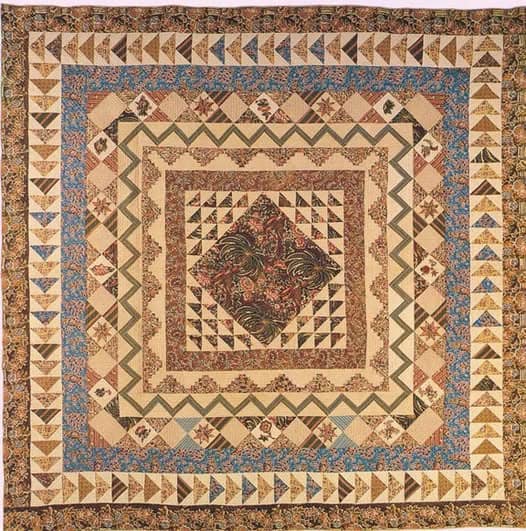
Thanks for posting that link. I was very interested on the second page ( No 28) to see the Little Woman” quilt. The detail shows the picnic scene form the book and I can just make out enough detail to see Beth at her piano, the trunk in the attic and what is obviously a wedding. How wonderful. I do adore that book Viewing the quilts raised another question with me. There were at least three quilts described as English medallion quilts. Is there are history of these being imported into America recently. Or would these more likely to have arrived in the 19th century. I know you may not be able to answer that very broad question. VBG But I was struck the other day when looking at a New Zealand quilt history book that many of their early quilts also came from Britain as did ours.
I am concerned that with the number of American quilts now being imported into Australia ( including by me) that eventually no one will know where they originated and our quilt history will be globalised. Just a thread of thought.
Suzy Atkins Brisbane
Date: January 26, 2004 | From: Dana Balsamo
Hi Suzy, Email Seth Fallon at Copake (his email addy should be on the website) and ask him your questions about the specific Medallion Quilts. If he know he will tell you, or he might be able to find out from the person who has put them up for auction. He may take a few days to get back to you, but he is very generous with info if he knows the answer. If he doesn’t, he’ll be honest about that, too. This auction does bring international attention. Correct me if I am wrong, but English Medallion may not necessarily come from England…it is a style of quilt that uses a Medallion center, and then several borders surrounding them of a specific pattern, that were common from the pieces from England. Maybe I am not phrasing this right…is Bettina on this list? I can drag out my notes if anyone is interested. My best, Dana
Beth at her piano, the trunk in the attic and what is obviously a wedding. How wonderful. I do adore that book Viewing the quilts raised another question with me. There were at least three quilts described as English medallion quilts. Is there are history of these being imported into America recently. Or would these more likely to have arrived in the 19th century. I know you may not be able to answer that very broad question. VBG But I was struck the other day when looking at a New Zealand quilt history book that many of their early quilts also came from Britain as did ours.
I am concerned that with the number of American quilts now being imported into Australia ( including by me) that eventually no one will know where they originated and our quilt history will be globalised. Just a thread of thought.
Suzy Atkins Brisbane
> Hello all, > Copake Auctions in Copake, NY is having their annual Textile Auction > February 14th. Their preview is online and there are 20 pages of superb > quilts, paisley shawls, linens, samplers, coverlets, rugs, and > more…mostly quilts, though. > > Their site is http://www.copakeauction.com/index.html >
Date: January 26, 2004 | From: Xenia Cord
The “Little Women” quilt design was designed by Marion Cheever Whiteside Newton; see Nada Treadway Patterson, “Marion Cheever Whiteside Newton: Designer of Story Book Quilts, 1940-1965,” Uncoverings 1995, volume 16 of the Research Papers of the American Quilt Study Group. 67-94. “Little Women” (pattern 2652) was sold through Ladies Home Journal in October 1950, pp.140-141. There were 15 blocks in the set, illustrating the story.
Xenia
Date: January 26, 2004 | From: patkyser@
If someone posted info on motels, etc. re:the upcoming DSQSG meeting, I am unable to find it. Would appreciate mYBE HAVING it just posted on this list as an email. Many thanks, Pat in AlaBAMMY