May 6 – 11, 2004
These restored messages come from the Quilt History List, an online forum where quilt historians, collectors, researchers, appraisers, and enthusiasts discussed antique quilts and related textiles. The archive dates from 1996 through approximately 2016 and is being restored gradually. Sign up in the form at the bottom of the page if you want to know when a new page is added. Original spelling, opinions, formatting, and inactive links may remain unchanged.
Primary topics of this QHL Digest:
- Finding AQS Certified Quilt Appraisers — Members help each other locate certified quilt appraisers by region. (see the article on quilt appraisers)
- Writing Quilt History: Content vs. Patterns — Authors and publishers continue debating whether quilt history books should include patterns to boost sales.
- State and Local Quilt Documentation Projects — Members share tools and forms for cataloguing local and regional quilts. (see the article on state quilt documentation books)
- A Mysterious Silkscreened Image on a Crazy Quilt — Members try to identify a possible portrait of actress Lillie Langtry appliqued onto a crazy quilt block. (see the article on Victorian crazy quilts)
From: Babette Moorleghen
Carla, there are 2 AQS certified appraisers in St. Charles, MO which is across the State from you but I’m sending the information anyway.
Ann Hazelwood PATCHES, INC. 337 South Main St. St. Charles, MO 63301 (636) 946-6004
My brain is so tired tonight I can’t recall the name of the other appraiser, but she is also associated with Patches. I’ve had quilts appraised by Ann in the past and she is very knowledgable so I know you would be happy with her. Perhaps you could meet half-way which I believe would be Columbia, MO? Hope this helps you out. Hugs, Babette
Hello,
I am in immediate need of an AQS certified appraiser in the Kansas City area, MO or KS side. The closer to Ft. Leavenworth, the better, but I am willing to meet at a location convenient to both myself and the available appraiser. Any information would be appreciated.
A private email response would be fine.
Thank you,
Carla Toczek Fort Leavenworth, KS
Cinda
From: “Judy Anne”
Annie, Once you do get your quilt kit information out there somehow be sure to let us know here. I like the women’s history idea. There is a lot of interest there.
I once did a poll on my quilt history site to see who visited it. I had assumed almost all my visitors were quilters but it turned out only about half were. Others were drawn to the site through interest in women’s history, antique quilts, etc.
I think quilt history is a great aspect of women’s history. It is more the history of everyday women. So much of the women’s history that we see is about various famous women.
Judy Anne
From: “Jean Carlton”
Can someone tell me the current number of states that have conducted quilt searches and produced a book? The QHL list includes many titles that are not strictly state projects….I count 38 states (some with numerous titles) but I thought I had heard it was over 40. By the way, here in Minnesota, the process is well underway. Our first drafts have been turned in and the date of publication will be spring of 2005; in time for our annual state show in Duluth ( June)
Jean Carlton
Georgia had a series of documentations a number of years ago, around the time of the Olympics that was held in Atlanta. Anita Weintraub was in the process of writing a book with the quilts, and then her husband died. I haven’t heard anything about it since then.
Paula
Date: Sat, 8 May 2004 | From: KareQuilt@
Annie wrote <<Really, the kit quilt industry is mostly women’s history, and it has always fascinated me that so many women ran successful businesses as early as the turn of the century when women didn’t have the vote. The indu stry in general was incredibly innovative during hard times.>>
All this talk about writing and editing makes me chuckle — and tremble. “Chuckle” because I have had a little experience on both ends and know how difficult both jobs can be. In addition, I am married to a man who is both a writer and editor so I hear stories from both sides of the fence all the time. I “tremble” because The Quilters Hall of Fame’s first book on our current 34 Honorees just went to press and will be available July 15. (Yours truly did the chapter on Brackman.) Each chapter is written by a different author. Since production costs limited us to 4 pages per Honoree (including photos 93 I think), our submitted drafts had to be tightly edited. Fortunately, we have had an excellent editor in Rosalind Webster Perry. We were asked for a Timeline too . I submitted a 3-4 page timeline on Brackman that didn99t make the cut. <g> (But that leaves me plenty of material for another article.) In fact, we have deliberately produced this book in a three-ring binder format so that we can continue to publish supplements and updates and so that interested quilt buf fs and quilt historians can add stuff from their own files to each section of the binder. Watch our website for ordering information: www.quiltershalloffame .org
Karen Alexander Press Secretary The Quilters Hall of Fame
From: Neva Hart <nevahart@>
Hello to Carla Toczek and all – when in need of an AQS appraiser, please see www.quiltappraiser.org and www.AQSquilt.com click on “Quilt Appraisers” then on “Appraiser List” — which is fairly up to date. We’re a very helpful bunch, and would gladly refer you to the nearest friendly appraiser!!
NEVA HART AQS Certified Quilt Appraiser in Virginia Ph 540-721-3216 www.quiltappraisers.org www.AQSquilt.com charsetUS-ASCII
Hello to Carla Toczek and all –
when in need of an AQS appraiser, please see
www.quiltappraiser.org
and
<underline>www.AQSquilt.com</underline>
click on “Quilt Appraisers” then on “Appraiser List” — which is fairly up to date.
We’re a very helpful bunch, and would gladly refer you to the nearest friendly appraiser!!
NEVA HART
AQS Certified Quilt Appraiser in Virginia
Ph 540-721-3216
www.quiltappraisers.org
www.AQSquilt.com –Apple-Mail-67-493337205–
Date: Sat, 8 May 2004 09:13:12 -0600 | From: “BOBBIE A AUG” <qwltpro@>
FYI AQS maintains a listing of all Certified Appraisers, along with their con tact information, on their website. They are listed by state.
Bobbie A. Aug Author, lecturer, teacher, AQS Certified Quilt Appraiser qwltpro@ www.BobbieAug.com P.O. Box 9654 Colorado Springs, CO 80932-0654
Deadline of Contest Extended
QHF has decided to extend its Grand Opening Block Contest “My Dream House Real or Imagined” from June 1 to June 15. That gives everyone two more weeks to make a block. We are also waiving the requirement to send a photograph of yo ur entry block. QHF Board Member Karen Alexander writes, “You still have three choices of sizes for your block, but we would be thrilled just to receive numerous versions of the 8 1/2 inch square blocks (including seam allowance) of house designs from which we could create quilts for future Opportunity Quilt s to raise funds for QHF/Marie Webster House! At a meeting a few nights ago discussing the lack of entries, some quilters told me they really don’t like to enter contests but want to help. If you really don’t like to enter contests — but want to help us — just make an 8 1/2 inch square house block (any house pattern, traditional or multimedia welcomed) — pieced or appliqued, etc., P LUS signed, dated and your state (or country) noted in indelible ink, we would b e thrilled to receive your block(s)!! Each block you submit puts us that muc h closer to creating a whole quilt! If you simply want to “gift” us with a block but not enter the contest, mail your quilt blocks to Sue Munn, c/o QHF, Box 681, Marion, IN 46952-0681 and add a note saying “This is a gift block to he lp raise funds for The Quilters Hall of Fame. If you want to actually enter your block in the contest, go to our website (www.quiltershalloffame.org) and download the PDF file Contest Entry form and send it along with your quilt b lock. Can’t read a PDF file? Please send your snailmail address and email address to Karen at KareQuilt@ and she will send an entry form in the body of an email. Thank you! Every quilt block counts! Karen Alexander, QHF Press Secretary
From: “Karen”
Another thing…check with a university press or a small women’s history publisher. You may well find some interest there. Or try working up some of the information into an article and submit it to the academic press. A publisher might well be more interested if you can say that part of the manuscript has already appeared in print.
Karen Evans
From: “Jean Carlton” <jeancarlton@>
Hi Jean:
Congratulations on make progress with the Minnesota documentation project! What a lot of work for so many people, but such a contribution to scholarship and history.
I don’t know if you looked at the State Quilt Documentation Projects and Regional Quilt History: A Selective Bibliography
The list was collaboratively compiled around 2001 and continuing and was formerly housed at the University of South Dakota until I left there in January 2004. The first part of the bibliography is a section of books published as products of state documentation projects. There are numerous other regional or state quilt history books, but these are listed in a separate section. I recently completed a bibliographical analysis of the publishing history for Shelly Zegart and a table from this work is now linked from the document.
Pennsylvania’s state documentation project has been published as county books and Feazel’s work is a dissertation, but uses the records derived from the Nevada state quilt documentation effort. These are the only two that are a little dissimilar from the traditional books.20
If you feel the list needs some updating, please do let me know.
Best regards (and happy mother’s day if it applies!)
Maureen Battistella Ashland, Oregon.
*******************************************
Subject: State Documentation Books From: “Jean Carlton” <jeancarlton@>
Can someone tell me the current number of states that have conducted quilt searches and produced a book? The QHL list includes many titles that are not strictly state projects….I count 38 states (some with numerous titles) but I thought I had heard it was over 40. By the way, here in Minnesota, the process is well underway. Our first drafts have been turned in and the date of publication will be spring of 2005; in time for our annual state show in Duluth ( June)
Jean Carlton
From: “sue reich” <mreich@>
It is with great pleasure that I have been given permission to announce a new web site for a dear friend of mine, An Moonen. You can find it at www.antiquetextile.info. An shows some of the wonderful pieces from her collection; included are Dutch quilts, samplers and linens. Enjoy! sue reich
From: “Patchwork Secrets”
I want to catalogue local quilts. I am sure I can find the quilts with simple inquiries through local churches, newspapers and other public forums. But I am not sure what I need to include on the documentation. Does anyone have a check list or form that has been used in the past for something similar? Eventually the data will be published in a book which part of the proceeds will be used for our library new building fund raising project. Any suggestions or help is appreciated. Sharon
From: “Judy Anne”
Maureen,
What a great resource? I just added a link to it from my website.
Judy Anne
America’s Quilting History http://womenfolk.com/historyofquilts
From: Anne Copeland
Thanks for all the kind suggestions everyone has given and all the kind words too. I have no doubt the book will eventually be published. It has just been frustrating that all the publishers wanted us to add patterns to the book to make it more saleable. It feels like prostitution to have to add patterns to a book on quilt history! I don’t mean that in an offensive way to anyone who has suggested it, but there is a place for patterns and there is a place for pure history, and the book will sell with just the history aspect. I think the women’s history arena may be a better choice for us. They aren’t interested in patterns. They are interested in history.
Peace and blessings, Annie
From: “Sally Ward”
It feels like > prostitution to have to add patterns to a book on quilt history!
Annie, why not think of it more as a ‘loss leader’? Were it not for in the first instance searching for patterns I could make, I wonder whether I would have found my way into the fascinating world of quilt history. And I know I have lured others by lending them a book with a pattern, only for them to wander into the text side and discover they are interested………
It is publishers’ business to know ‘why’ people buy books, after all <G>
Sally W
Date: Mon, 10 May 2004 08:56:02 -0500 | From: “Jean Carlton” <jeancarlton@>
Maureen, Thank you so much for that link. The bibliography is just what I was looking for….Broken down in categories – and it’s so current. But I think I’ll have to move to PA now – it’s just not fair! To Sharon – many of the books that have resulted from statewide searches discuss the process used to gather information in detail. Over time, better, more complete and user friendly forms have been used to gather data. Minnesota has revised their paperwork more than once – the current form makes it easier to enter info into a database – something not important nearly 20 years ago when the project began. The New Jersey book, for one, includes a complete example of their form. I am sure there are sites with suggestions – and I would be happy to share with you what Minnesota used if you email me privately. It’s good to look a few over – then you can decide what will be best for your project. Glad you are doing this! Jean Carlton
From: Kris Driessen
The National Geographic is jumping into the fray:
http://news.nationalgeographic.com/news/2004/
Kris
Date: Mon, 10 May 2004 10:01:27 -0500 | From: Marilyn Woodin <woodin@>
I’m all for a book without patterns–good for you. Marilyn Woodin
From: “Karen Quilts Texas”
Anne and all about the subject of writing and publishing.
While there is indeed a place for a quilt history book without patterns, there is undoubtedly a much smaller market for such a book than for a book with patterns! Book publishers are after all, not charitable organizations, and are in business to make a profit for owners and/or investors. And, for an author, the expectation of profit, is also worthy of respect. In addition to making new information available to readers, there is also the hope by most authors that the book will provide at least some payment for time well spent, and to many authors, a necessary income!
A good book publisher is one who knows what will sell, and, what will not. Their ability to understand the market for their products is as important as their ability to recognize a good book/author (product) when they see one.
If the book has been submitted to various publishers and all are suggesting that patterns be added to improve the saleability of the book then they are probably giving the author an honest appraisal, not necessarily of the book, but of it’s marketability. Offense should not be taken, as this is not a critical comment on the content, but on the market for such content.
While I enjoy a history book like any quilter, I do enjoy a book that also gives me patterns for some of the historical quilts featured. I don’t think it detracts in any way from the historical information, and, if anything adds to the learning experience. What is the old saying about the value of “walking in someone’s shoes?” To produce a historical quilt, is to understand another era’s art and craft. If anything, adding patterns to a book might serve to offer the information up to an audience that might not normally buy “just a history” book on quilting!
I speak not from any particular experience in publishing, but I did spend over 20 years in business in marketing management. So my perspective is from that of the capitalist!
At any rate, I thought that this opinion might provide a view from a different direction for this discussion.
Karen Spring, TX
From: “Christine Thresh”
Annie said, “…all the publishers wanted us to add patterns to the book to make it more saleable.”
If you don’t want patterns to “sully” your history book, then put up the $10,000 to $20,000 and publish it yourself. Then, be prepared for the marking costs after the production costs.
If ALL the pubishers wanted patterns added to your manuscript they may know more about selling books than you do.
I can’t see how it would hurt a good book on quilt history to have a pattern(s) included.
I used to be a publisher of fiber art books in the 1970s.
Christine Thresh http://www.winnowing.com
Date: Mon, 10 May 2004 | From: “Sandra Millett” <smillett@>
Dear Anne:I’m jumping into the writing content vs. patterns fray, as a quilt bo ok author and quilter. I do enjoy history books on quilting, but can become frustrated if there is one that catches my fancy and there is no pattern provided. This frustration also holds true seeing real-live quilts. One show I was involved in exhibited a quilt made in the 1880s and had a specific block with an unusual pattern and color setting. I photographed it and spent more than many hours getting the drafting proportions just right. How much easier if there had been a pattern. I’ ve had the same inclination when studying quilt history books. Frequently t he photos are so small that it is impossible to draft a multi-patch block because this block is not delineated enough. Aha, for a pattern, so that I can be historically accurate. Froncie Quinn, the museum licensed pattern writer does a terrific jo b of incorporating history with her patterns. As an active quilter, I woul d enjoy a dash of patterns along with the history. But the bottom line is that if you hear the same reasons for rejection, and want to get your manuscript published, then perhaps pattern inclusion should be considered. I learned this the hard way.
Years ago, I sumitte d my first manuscript and got a call from Simon & Schuster: the editor want ed a book with a different topic for each chapter. Focused, I turned them d own planning to contact when I sold and wrote my book (Quilt As You Go was i n print for ten years and became a classic). When it was done about 18-mon ths later, I called the editor at S&S. Only problem was she had moved to another house and the replacement editor wasn’t interested. As probably the only person to reject Simon & Schuster in recorded history, I certainly learned my lesson–now I say “Yes”–fast. My moto i s give ’em what they want and get another book on the shelves. It adds to my credibility and pocketbook. Guess my bottom line is to determine whether the the historical information is important enough to (1) get it to the public with patterns added or (2) consider the possibillity of not having it published or (3) paying out major bucks to self-publish and market. Good luck with your decision,Sandra Millett Freelance writer Quilting the Savory Garden Trophy Club, TX-
From: Xenia Cord <xenia@>
Because I have also written articles on kits and know something about their history and design, may I say that including kit designs in a book about the history of kits could violate copyright. I cite an instance where a Canadian magazine (Canadian Living) wanted to provide its readership with fabric kits for an antique kit quilt (1930s) featured in an article. The quilt belonged to someone on the editorial staff, as I remember.
Through much calling back and forth, and consultation with some of the brightest and best on QHL, we determined that the kit had been offered by Progress Quilts, a brand name of Tobin, Sporn & Glaser of NYC. The company still exists under a slightly different name, has no knowledge (or archives) of its kit quilt history, but still maintains copyright on items once marketed by them. So the magazine was allowed to offer a printed paper pattern, not anything in fabric kit form.
The only person I know who can properly market kits from 1930s designs is Gail Bomers, who is still using the patterns and equipment used by her father, who marketed through Needlearts Guild in Michigan.
It’s a minefield out there…
Xenia
From: “Karen”
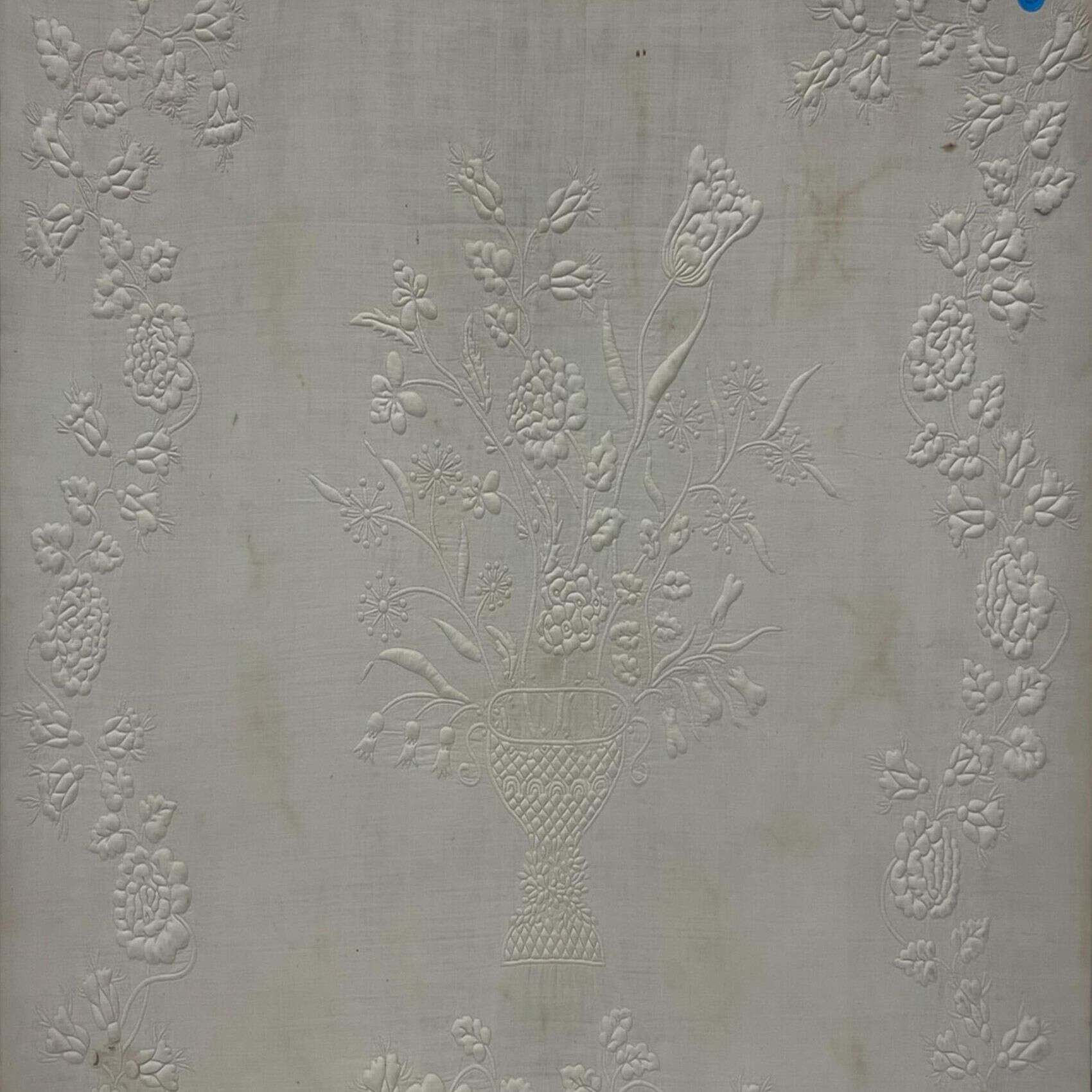
I just bought a delightful little confection on Ebay and wondered if anyone on the list had ever seen such a thing. It was described as a trapunto book cover, about six inches square, of silk stuffed with cotton and lined with silk tissue. The cover itself is a silk tabby weave in beige, with the designs outlined in pale red silk thread (lovely stitching, very fine) and pre-stuffed over a scrim. The lining is cream silk in what today would be called silk habotai. The edges were once finished with pale red silk piping, but the silk has deteriorated and there’s only cotton cording left. The overall condition is decent, with a couple of small holes and no obvious shattering. There’s a label inside the cover: “Wilson’s Handmade, Brandenburg, Kentucky.”
Has anyone ever heard of this company, or seen such a book cover? It looks to me more like a small jewelry case. The seller was from Mount Orab, Ohio, and knew nothing beyond what was on the label.
If anyone knows anything about this, please let me know. Thanks!
Karen Evans
Date: Tue, 11 May 2004 09:22:26 -0400 | From: Beth Donaldson <quilts@>
To print a copy of the current form Michigan uses to document quilts click on: http://www.museum.@/glqc/MQPform.PDF For information on our documentation project, which is now in its 20th active year click on: http://www.museum.@/glqc/mqp.html. I would also suggest this site, http://www.quiltindex.org/faq.php. It is in the Quilt Index. It lists all the fields that the index uses and how to collect your data if you eventually want it included in the index.
Beth Donaldson Quilt Collections Assistant Great Lakes Quilt Center at the Michigan State University Museum 201 Central Services, MSU Museum East Lansing, MI 48912 517-432-3800
Date: Tue, 11 May 2004 13:59:18 -0400 | From: “Lucinda Cawley” <lrcawley@>
I heard this via the grapevine, but since no one from BAS, who really should be crowing, has posted the news I will tell you that the replica of the Samuel Williams quilt made by the Baltimore Applique Society to be raffled to benefit the Baltimore Museum of Art was won on Sunday, May 2 by someone other than me. The good news is that they raised more than $24,000. I believe that quilters are born with either an applique gene or a piecing gene. I didn’t get the applique gene, but I admire the efforts of these talented women all the more because of that. I was at the museum on May 1 and had another close look at the fabulous exhibit now in its last week. The good work of the BAS makes the point to museum professionals that quilt lovers work to support the institutions that give us what we want to see. Thank you BAS. Cinda on the Eastern Shore
Date: Tue, 11 May 2004 14:01:24 -0400 | From: “Lucinda Cawley” <lrcawley@>
Does anybody have idea of how many quilts were entered in the Great American Quilt Festival Statue of Liberty Contest in 1986? Question # 2: What’s the earliest Ocean Waves quilt you know of? Cinda on the Eastern Shore
Date: Tue, 11 May 2004 14:05:19 -0400 | From: “Lucinda Cawley” <lrcawley@>
Last Wednesday I went to the Corcoran in D.C. to see the Gees Bend exhibit. The audio-guide makes it clear that much of the hype comes from people who know nothing about quilts or textiles. For instance, it is remarked with wonder that strips of corduroy appear as slightly different shades when positioned in different directions on a quilt or that tearing a fabric on the diagonal causes it to stretch and ravel. The many quilts pieced of narrow wedge shapes clearly were made from fabrics narrower at one end than the other (sleeves or pants legs perhaps). The voices of the women who made the quilts spoke eloquently about doing the best they could with the limited resources available. These quiltmakers are without pretension; that is supplied by the “art critics” who have run away with their work. The film that accompanies the exhibit and the incredibly beautiful still pictures from the Farm Security Administration project of the 1930s show examples of mainstream quilt patterns. It would seem that the rough utility quilts composed of worn and torn recycled clothing or scraps of “Sears corduroy” from the Freedon Quilting Bee were deliberately chosen for the exhibit. One wonders what percentage of the entire body of work done by the quiltmakers this style represents. .The museum gift shop is selling new quilts made by the Gees Bend quilters for $3,500 to $10,500! Cinda on the Eastern Shore
Date: Tue, 11 May 2004 15:51:46 -0500 | From: “Karen Quilts Texas” <karenquiltstexas@>
Lucinda –
I think I have some QNM from that time, I’ll see if that info might be in the ’86 issues. Actually, there was a small book published about the contest. I came across a copy and sold it not too long ago on Ebay, but I can’t seem to locate my record on it. It contained pictures of the winning entries from each state, and contained some patterns for a few blocks. It also showed the quilt as it was displayed – I believe on the Mall in Wash. D.C… I’ll keep looking, and see if I can come up with either for you.
Karen A. Spring, TX
—–Original Message—– From: Lucinda Cawley [lrcawley@] Sent: Tuesday, May 11, 2004 1:01 PM To: Quilt History List Subject: [qhl] two questions
Does anybody have idea of how many quilts were entered in the Great American Quilt Festival Statue of Liberty Contest in 1986? Question # 2: What’s the earliest Ocean Waves quilt you know of? Cinda on the Eastern Shore
Date: Tue, 11 May 2004 20:49:02 -0400 | From: “Anita G. Solomon” <solo57@>
Fortunately I was able to persuade my C&T editor to include an essay by Laurel Horton, “Paper, Patchwork, and the Role of Innovation”, as the preface to my book of paper foundation patterns. It was limited to five pages and included a few illustrations of patchwork that were pieced on paper. The five pages of preface ‘took up space’ where patterns ought to appear. Apparently, buyers expect a certain number of patterns for their dollars.
In the end I had the book of my dreams. But it wasn’t easy for Laurel or me to bridge quilt history and quilt patterns in a “how-to” book.
Anita/NYC
Date: Tue, 11 May 2004 19:15:27 -0700 | From: “Julie Silber” <quiltcomplex@>
We have a crazy quilt with one piece which is a silkscreened (?) image of a woman. It looks like a cabinet card type of photograph which has been transferred somehow to silk, and then included in a crazy quilt otherwise devoid of human images. I have wondered if it could be the maker of the quilt… It was suggested to me that it might be a “cigarette silk” with a portrait of an actress, but I am not familiar with this kind of cigarette silk. The one we have is one-color only printed somehow on a light color silk — more like perhaps a cyanotype? (or are those always blue?) The cigarette silks I know are smaller in size and in full color, often printed on an ecru or cream ground… ? I’d like your help. I feel like I should know this, after all these years of studying quilts. But I do not. Do you? You can e-mail me and I will send photos, or you can see the image in our eBay listing: 3723636253. I’d appreciate any info. Thanks! Julie Silber quiltcomplex@
Date: Tue, 11 May 2004 22:30:16 -0500 | From: “Laura Syler” <texas_quilt.co@>
Hi Julie, Just took a look at the quilt…pretty neat! I too am curious!! I’d like to know what responses you get. I recently did some restoration work on a crazy quilt with a similar photo/silk. We really pondered over how that photograph got on the fabric, and was in better shape than some of the other silks. “Mine” is more of a head shot rather than full length view, and was about 4″ in length.. The owner told me that she was told by her grandmother that it was a “premium ribbon” of some actress – sounds familiar doesn’t it? I have not seen any individual cigarette silks of this type myself, other than in the quilt. Maybe Nancy Kirk can give you a clue…. Laura Hobby Syler Richardson, Texas Certified Appraiser of Quilted Textiles Quilt Restoration Specialist
—– Original Message —– From: “Julie Silber” <quiltcomplex@> To: “Quilt History List” <qhl@> Sent: Tuesday, May 11, 2004 9:15 PM Subject: [qhl] Image on Crazy Quilt
We have a crazy quilt with one piece which is a silkscreened (?) image of a woman. It looks like a cabinet card type of photograph which has been transferred somehow to silk, and then included in a crazy quilt otherwise devoid of human images. I have wondered if it could be the maker of the quilt… It was suggested to me that it might be a “cigarette silk” with a portrait of an actress, but I am not familiar with this kind of cigarette silk. The one we have is one-color only printed somehow on a light color silk — more like perhaps a cyanotype? (or are those always blue?) The cigarette silks I know are smaller in size and in full color, often printed on an ecru or cream ground… ?
I’d like your help. I feel like I should know this, after all these years of studying quilts. But I do not. Do you? You can e-mail me and I will send photos, or you can see the image in our eBay listing: 3723636253. I’d appreciate any info. Thanks!
Julie Silber quiltcomplex@
Date: Wed, 12 May 2004 09:46:15 +0100 | From: “Sally Ward” <sallytatters@>
My first thought was the actress and royal courtesan Lily Langtree. I have flipped back and forth from these google pictures to the ebay pic and think I see the likeness. Trouble is, anyone with that hairdo and a bustle could pass for Lily on an old photo <G>.
http://www.@/uttamkumar44/lilylangtry_bierstadt.jpg
http://www.tace.com/items/7174.html
http://www.spartacus.schoolnet.co.uk/AClangtree.htm
Sally W
Date: Wed, 12 May 2004 06:48:42 -0400 | From: “Judy Kelius (judysue)” <judysue@>
Although I don’t think it is out of the question that it is an image of the maker, my hunch is that she is a vaudeville actress . . . images of many of these were put on cigarette silks at the beginning of the 20th century. Many of these vaudeville stars made the transition to silent movies. Somewhere I have a crazy quilt with several images in it, one of them quite large (you had to send away for the larger silks – the smaller ones were included in the cigarette packages). Such silks were often put in crazy quilts.
By the way Julie, that quilt is STUNNING! Thanks for sharing.
A couple of references: http://www.womenfolk.com/historyofquilts/tobacco.htm http://maureengreeson.com/ (maybe she would be able to identify the image?)
At 10:15 PM 5/11/2004, you wrote: >We have a crazy quilt with one piece which is a silkscreened (?) >image of a woman. It looks like a cabinet card type of photograph >which has been transferred somehow to silk, and then included in >a crazy quilt otherwise devoid of human images. I have wondered >if it could be the maker of the quilt… It was suggested to me >that it might be a “cigarette silk” with a portrait of an >actress, but I am not familiar with this kind of cigarette silk. >The one we have is one-color only printed somehow on a light >color silk — more like perhaps a cyanotype? (or are those >always blue?) The cigarette silks I know are smaller in size and >in full color, often printed on an ecru or cream ground… ? > >I’d like your help. I feel like I should know this, after all >these years of studying quilts. But I do not. Do you? You can >e-mail me and I will send photos, or you can see the image in our >eBay listing: 3723636253. I’d appreciate any info. Thanks! > >Julie Silber >quiltcomplex@
Date: Wed, 12 May 2004 07:21:11 -0400 | From: “Karen” <@charter.net>
That sure does look like Lily Langtry. She was extremely popular and I wouldn’t be at all shocked to find out she was pictured on cigar silks.
The quilt is absolutely gorgeous. Wherever did you find it?
Karen Evans
Date: Wed, 12 May 2004 08:03:55 -0700 | From: “Julia D. Zgliniec” <rzglini1@>
Dear QHL, Good Morning to all!
In addition to cigarette silks, hat linings also contained various images of current events and activities. Sometimes they were just the manufacturer’s crest or “logo”. They were usually of fine quality silk and the image quality was quite good. Printed silk handkerchiefs are another source of these images.
The oval shape of the woman and the larger size in addition to the fine quality of the silk makes me think hat lining silk.
I have seen a whole quilt made of these larger silk images, sashed block style, embellished with feather stitching along the seams.
Regards,
Julia Zgliniec, Poway, CA
Date: Wed, 12 May 2004 12:17:00 -0400 | From: munsey@
This message is in MIME format. Since your mail reader does not understand this format, some or all of this message may not be legible.
Cinda: I quickly scanned my copies of Bishop and Houck, “American Patriotic Quilts As Expressions of Liberty”, E. P. Dutton, 1986, and The Great American Quilt Festival Special Souvenir Issue of “The Clarion”, The Museum of American Folk Art, Spring-Summer, 1986, and found no reference to the total number of quilts submitted to the contest. However, in QNM Issue #181, April 1986, Bonnie Leman’s editorial states “Over 1200 quilt entries were submitted as slides. . . .” and Issue #182, May 1986, in a page 8 article about the festival indicates there were “More than 1,000” entries. I didn’t check out the other QNM issues. Plus, there were all the other quilts like the “So Proudly We Hail” state quilts and others made for special exhibits. Where are they all now???
Check the QNM Cumulative Index for quite a number of references to both the contest and the festival. I used my print copy covering issues 1-269, but I believe that the entire index is available (and download-able) on line at the QNM web site. Sandra on Cape Cod —-__JNP_000_6fe0.08e2.1f67–
Date: Wed, 12 May 2004 11:14:52 -0500 | From: “Carol H. Elmore” <celmore@>
I’m glad Julia brought up the hat silk connection. I have a small collection of them with dogs (and one cat figure)in them. Also hat silk linings were used for political campaign items. Probably other famous people were also depicted including actors and film stars. I have seen crazy quilts with various types of the hat silks. Carol Elmore Manhattan Kansas
Date: Wed, 12 May 2004 10:41:09 -0700 (PDT) | From: Kris Driessen <krisdriessen@>
Karen is in the process of moving, so she asked me to post this:
QUILTERS HALL OF FAME LIVE AUCTION: “QHF is actually starting to move its offices into the Marie Webster House this week! What a RED LETTER DAY!! Quilters across the country (and the world!) have made donations to QHF over the past many years and we are extremely grateful,” Grand Opening Co-chair Karen Alexander writes. “Though we are opening in July, there is still a great deal of detailed finish work to be done on the Marie Webster House, not to mention the additional upkeep expenses that we will incur once we are open. It is so exciting to see the house of the first author of a book on quilting history take shape! The large upstairs bedroom out of which Marie ran her business (Practical Patchwork) is going to be set-up as close to “as it was” as we can get it. Everything quilters and Guilds do for QHF is so very much appreciated!! We would like to let quilters know that if you don’t have the desire to enter our Grand Opening Block Contest (deadline June 15 – see our website for Entry Form), QHF is also in need of items such as miscellaneous UFO blocks, quilt tops or completed small wall hangings, baby quilts, handmade dolls, doll quilts or other small quilted items for our Grand Opening Live Auction! Items for the QHF Grand Opening Live Auction should be mailed to chairperson Jean Chambers, 406 Gardner St., Marion, IN, 46952-1916. Thank you, quilters, for the many ways you support QHF! If you have any questions, contact Karen at KareQuilt@ or call our offices at 765-664-9333. Contest Entry Form can be found at www.quiltershalloffame.org
Date: Wed, 12 May 2004 13:47:21 -0400 | From: “sue reich” <mreich@>
Go to pages 98-99 and 114-115 in “Quilts and Quiltmakers Covering Connecticut.” There you will find the stories of hat trimmers from the hat manufactories of late nineteenth century Danbury, Connecticut, and the way they used the silks that fell to the floor as they cut the linings to fit hats. The first quilt is embroidered with “We Are All Crazy” and it has embroidered on it the only existing image of the first Danbury Hospital. These industrious hat trimmers/women actually made two quilts to raffle to raise for the town’s first hospital. In 1885, the town’s population was nineteen thousand and it did not have a hospital. It is the women of the town who are credited historically for managing its existence. The fair held on April 15 & 16 (also embroidered on the quilt) and its purpose was well documented in a local newspaper. The news accounts mention the quilts, the embroidery, where they were displayed, the amount of money both raffles raised and who the winners were. The second quilt was made by Flora and Dora Morgan, sisters from Bethel who also worked as hat trimmers. Their crazy quilt is exquisitely worked with multiple images of women in addition to the more common images of found on crazy quilts. sue reich
Date: Wed, 12 May 2004 12:45:59 -0500 | From: “Kathy Moore” <KathyMoore@>
Call for Papers
=93Collectors, Collecting, and Collections”
A symposium organized by the
INTERNATIONAL QUILT STUDY CENTER
University of Nebraska-Lincoln
February 24-26, 2005
We invite scholars and artists to submit proposals for papers and panel presentations that explore the phenomenon of collecting, and especially collecting quilts and related arts, from a variety of perspectives. These may include but are not limited to psychological, aesthetic, historical, economic, anthropological, museological, and sociological. We encourage papers and presentations that address the urge to collect, the meaning of collections, and the ways collecting influences artists’ and source communities. We also encourage participants to explore the business of collecting from the perspective of all involved from private collectors to curators, from artists to gallery owners, and from dealers to appraisers.
Categories of Presentation:
=95 Individual papers are expected to be based on original research, are generally illustrated and 20 minutes in length followed by 5 minutes for questions.
=95 Thematic sessions should include 3 to 4 presenters, and a moderator with a theme based on a particular aspect of the collecting phenomenon or some other theme related to worldwide quiltmaking traditions. Speakers’ times are flexible; in general, a total of one and a half hours is recommended. Panel participants must send a copy of their working paper to their session moderator by December 1, 2004.
=95 Panel discussions should involve 3 to 4 individuals and a moderator who poses questions to which panelists respond. A total time of one hour is recommended for panel discussions.
Symposium Submission Guidelines:
Interested individuals should submit abstracts of 150-200 words with a cover letter and brief resume (maximum 3 pages). Moderators of thematic sessions or panel discussions should submit a proposal of 150-200 words, a cover letter and a resume, plus a brief resume (maximum 3 pages) for each participant. Abstracts/proposals should be sent electronically, faxed, or postmarked no later than August 16, 2004. Submit your abstract/proposal and resume by August 16, 2004, to:
Kathy Moore, Symposium Coordinator
2005 IQSC Symposium =93Collectors, Collecting, and Collections”
International Quilt Study Center
University of Nebraska-Lincoln
P.O. Box 830838
Lincoln, NE 68583-0838
Fax: 402/472-0640
Email: iqsc-symposium2@
Symposium Overview:
The International Quilt Study Center’s second biennial symposium features invited speakers, juried papers, thematic sessions, and panel discussions. The two days of symposium presentations are supplemented by pre-conference tours, including a behind-the-scenes tour of the International Quilt Study Center’s state-of-the-art storage facility, curator-led tours of campus exhibitions, and special exhibitions at other venues in the Lincoln area. Special exhibitions will be organized at the Sheldon Memorial Art Gallery, the Robert Hillestad Gallery, the Museum of Nebraska History and other venues in the Lincoln area.
The =93Collectors, Collecting, and Collections” symposium will bring together cultural anthropologists, curators, artists and art historians, popular culture scholars, and consumer behavior experts, as well as textile artists, textile historians, and collectors. It will provide a unique forum for dialogue among a broad spectrum of individuals interested in the phenomenon of collectors and collecting, especially the collecting of quilts and related textiles.
Featured Speakers:
Russell W. Belk, Eldon Tanner Professor of Business at the University of Utah for the past 20 years. His areas of expertise are consumer behavior, popular culture, collecting, and marketing. He has published more than 250 books, articles, and videotapes including Collecting in a Consumer Society. He is president of the Society of Marketing and Development and past president of the Association for Consumer Research.
Guerrilla Girls came together in 1985 out of frustration that the most influential galleries and museums exhibited and collected almost no women artists. Assuming the names of dead women artists wearing gorilla masks, they take the audience through their 18-year history confronting discrimination in the world of art and culture.
Other invited speakers will include Nancy Druckman, Sotheby’s, Senior Vice President and Director, American Folk Art; Jonathan Holstein, collector, guest curator, lecturer, and author; Shelly Zegart, collector, dealer, and author of American Quilt Collections: Antique Quilt Masterpieces; Ursula Ilse-Neuman, Curator, Museum of Arts and Design (formerly American Craft Museum); Mary Catherine Lamb, independent studio quilt artist and collector; Jack Walsh, collector of studio art quilts.
Questions or more information contact:
Peter Bleed, Symposium Chair or
Kathy Moore, Symposium Coordinator
International Quilt Study Center
iqsc-symposium2@
http://quiiltstudy.unl.edu ——=_NextPart_000_0014_01C4381F.13A2E240–