February 25 – March 1, 2005
These restored messages come from the Quilt History List, an online forum where quilt historians, collectors, researchers, appraisers, and enthusiasts discussed antique quilts and related textiles. The archive dates from 1996 through approximately 2016 and is being restored gradually. Sign up in the form at the bottom of the page if you want to know when a new page is added. Original spelling, opinions, formatting, and inactive links may remain unchanged.
Primary topics of this QHL Digest:
- Ancient Roman Mosaics and the Origins of Patchwork — A debate over whether ancient Roman floor mosaics have any real connection to the origins of American patchwork quiltmaking.
- Averil Colby’s Patchwork Books — Members identify and compare the several historical patchwork and quilting reference books written by Averil Colby.
- Ordering “Through the Needle’s Eye” from the York Quilt Exhibition — A UK member works to help US QHL members order a companion book to a York, England quilt exhibition.
- What Is a “Wilson Quilt”? Tracing an 1818 Newspaper Term — An 1818 robbery notice mentioning a “wilson quilt not put together” and “humkums” fabric sends members searching historical textile dictionaries.
- Origins of the Word “Catywampus”/”Catty-Cornered” — A lighthearted regional-dialect thread launches over what “catywampus” and “catty-cornered” mean and where they come from.
Date: Fri, 25 Feb 2005 23:39:31 -0600 | From: louise-b
Ami Simms book of Roman tiles/mosaics from 100+AD in Italy showed ‘patterns’ used in traditional quilts today. Christine Porter’s recent book showed tile patterns in churches, homes and businesses that are recognizably ‘traditional quilt patterns’ we use today. (Goodness knows, I have made some of them too.)
Considering the age of the places in the Porter book, it makes me think that memories of these floors were bought by the women and men of that time to American when they were reinterpreted as ‘blocks’ for usage.
What I would like to know is what the patterns were called in the early times by the ones who installed them! If I could find the right books or persons!
Louise Bequette — in mid-Missouri
Date: Sat, 26 Feb 2005 18:24:16 +1000 | From: quiltstuff <quiltstuff@>
Kris wrote >> > I agree that the idea of stitching two pieces of fabric together with > something in in the middle and calling it quilting may have > originated in Asia, but aren’t quilts as we think of them (pieced, > applique) an American invention?
I am guessing that with your knowledge Kris, that this comment was very much tongue in cheek but certainly there are lots of early English examples of quilts and they would have a greater claim to the first pieced and applique quilts.. as would several other European countries…. The early aussie quilts including ones done by convicts on the ships over seem to follow the English quilts more than the American ones.. Aussies seemed to make frame ( medallion) quilts much later that the Americans. Hexagons were very big here as well. Later ,you can see the influence of the US. especially when it comes to crazy quilting
For those who haven’t seen the aussie quilt register it is at http://amol.org.au/nqr/ Check out the quilt ‘tree’ which allows you to find quilts by their roots and methods of making. and you can also search by date.. so you can look at the pre 1850 ones. http://amol.org.au/search97cgi/s97is.dll
There is 46 there.. of course, many of those may have come with settlers…. Quilt number 5 is our most famous convict made one known as the Rajah quilt…
Suzy Australia
Date: Sat, 26 Feb 2005 07:25:11 -0500 | From: Karen Evans
I’m familiar with those patterns, and yes, they’re very, very similar to quilt blocks. Alas, there isn’t one scrap of evidence that there’s a connection, and believe me, I’ve been looking for over ten years. What piecing there in the Middles Ages and Renaissance seems to have been applied to clothing, not bedding. And since most of the patterned floors appeared in Italy anytime from the Late Antique to Renaissance periods, and patchwork quilts began showing up sometime in the late 17th/early 18th centuries, the connection simply isn’t there.
Also, the early American colonists were Spanish, British and French, and the patterns Ami found were Italian. Italians didn’t start coming to America in any quantities until the 19th century, by which time patchwork quilting was well established. Sorry….:(
Karen Evans [feeling rather like the meanie who popped the child’s balloon]
From: Sally Ward <sallytatters@>
<Italians didn’t start coming to America in any quantities until the 19th century,
Ah, but they went other places a lot earlier… The Roman Empire spread right across Europe when we were still counting BC in three figures, and they left their mark everywhere.
I found these UK examples of Roman tiling very quickly on a google search:
http://www.thejoyofshards.co.uk/visits/southtrip/verulamium.shtml http://www.realvnc.com/~jnw/photos/html/img/jnw22/grp7/photo_1238.html www.eagle.co.uk/vale-of-york/isirium.html
So the Roman/Italian geometric style could well have been part of the cultural background of many of your European immigrants. Its a tangled web….
Sally W
Date: Sat, 26 Feb 2005 09:23:04 -0500 | From: sue reich <suereich@>
In 1983, my husband and I went to Rome for a business trip. We visited Santa Maria Maggiore a few doors first thing. This magnificent church was built over many centuries mostly twelfth through the sixteenth but its marble flooring by the Cosmati school was laid in the twelfth century. When we walked into the church, I was overcome by the quilt patterns everywhere. I exclaimed something to that effect. My husband who eyes immediately had gone up to the spires and peaks of the ceiling thought that I was suffering from jet lag! I immediately began photographing the floors,so much so, that a guard questioned me about my obsession. He told me that he had never seen anyone photographing the floors of the church! The Cosmati floors of S. Maria Maggiore laid around 1145 are described in “The Churches of Rome” by Roloff Beny and Peter Gunn as “The floor is a shining Cosmati carpet of porphyry and marble, patterned in circles and swirls of mid/twelfth/century opus alexandrinum.” The patterns are Building blocks, Flying Geese, Medallions galore, Square in a Square, Variable Stars, Eight Point Stars, Six Point Stars, and intertwining medallions all laid with Italian marbles of the most incredible colors! S. Giovanni in Laterno, the Cathedral of Rome, and nearby this church is as spectacular. The Cosmati floors are actually all over Rome and Italy, and they are glorious.
This is what my book says about the school. “In Rome during the twelfth and thirteenth centuries there was a renaissance of ecclesiastical art, which some have rather unjustly dismissed as a ‘false dawn’. It came to an end at the beginning of the fourteenth century…. Alongside the magnificent mosaics of such artists as Cavallini, Torriti, and da Camerino, whose work was largely figurative and pictorial, there developed another mosaic style which was essentially decorative. The technical skill of these Roman craftsmen in marble, with their workshops and guilds, often ran in families, generation after generation carrying on the profession of architecture, building, sculpture or mosaic…. Owing to the frequent name of Cosmas, these families have been collectively known as the Cosmati, although there was no family with that surname. The outstanding beauty of their work, particularly in their mosaic which has taken its name from them, reserves a special place for the Cosmati in any account of Rome’s churches. Shortly after returning home, Judy B. Dales displayed on of her quilts in Quilter’s Newsletter Magazine that was a copy of one of the floors. We shared correspondence about these designs and I sent her copies of my photos. The book “Patchwork from Mosaics” was published in 1985 B. T. Batsford of London written by Helen Fairfield. It features floors from Florence and Venice of similar designs, interpreting them into quilt patterns. Hope this is of interest. sue reich
Date: Sat, 26 Feb 2005 15:33:33 EST | From: Hazelmacc@
Well, here are some facts that I have regarding early quilts”
A Scytho-Siberian funerary carpet in the style of a quilt, lst century BC – See Quilting by Averil Colby.
Mosiac patchwork of silk (a fragment) found in Caves of the Thousand Buddhas, Berinda region in India, 500-800. See Colby’s Patchwork book.
Sicilian quilts – one of a pair, scenes of the Legend of Tristam, c. 1395. Colby’s book Quilting. One is in the V& A in England.
Indo-Portuguese and Portugal embroidereed quilts, 1500-1700. See Janet Ray book. I saw an exhibit of these quilts while in Hawaii years ago and they were beautiful!
German quilt of heavy linen corded and padded, c 1500 (Quilting – Colby)
Silk embroidered on crimson quilt, Karl V, the Hapsburg emperior gave to his court physician, 1544. See de Koning-Stepel book).
Hazel Carter In No. Va.
Date: Sat, 26 | From: Vivien Sayre <vsayre@>
Hazel, Do you mean “Patchwork” by Averil Colby or did she write another book called “Quilting“? Thank You, Vivien
Date: Sat, | From: Karen Evans
She wrote two, actually. The patchwork one was published in the early 1960s and the quilting one was published in the early 1970s.
From: Laurette Carroll <rl.carroll@>
Vivien, I know of 3 quilt books among those that Averil Colby has written. Patchwork, 1958 Patchwork Quilts, 1965 Quilting, 1971
Laurette Carroll Southern California
Look to the Future With Hope
From: Nancy Roberts
Thank you, Candace, for the link to this quilt auction site. I found that clicking on “upcoming auctions”, clicking on “view by category”, and then typing the word “quilt” into the search feature turned up a couple of pages of quilts. The lot numbers ranged wider than those noted in your post, so possibly you missed some offerings that would be worth seeing. I viewed a Vermont friendship quilt in a star pattern.The description referred to a “red half penny border”. I couldn’t tell from the photo what this referred to. Any ideas? It looks like simple red binding. Here’s the link in case you’d like to take a look. Thanks if you can clarify. http://www.pookandpook.com/cat/2005-03-12/27 Nancy Roberts
—
We don’t have much in the way of quilting history books in the UK, and there is a kind of family tree which goes:
‘English Quilting Old and New’ by Elizabeth Hake, 1937.
On the first page she references a 1932 V&A booklet as saying ‘..the word (quilt) can be traced as far bak as the 13th century at least, and so the making of quilts is undoubtedly an old traditional craft in the British Isles…In medieval and later inventories quilts are very often mentioned.’ LAter she says ‘Simultaneously the craft was carried on in most European countries, more especially in Sicily; and in Oriental countries, particulaly India, Persia, and in North, East and West Africa’ (yes, Africa <G> I wish she had put in a reference for that remark <G>). The book is primarily about quilting, the earliest patchwork quilt she illustrates is from ‘the early 19th century’)
Hake is referenced on the very the first page of
‘Traditional Quilting‘ – Mavis Fitzrandolph, 1954,
which was heavily drawn on by Averil Colby for
‘Patchwork” ‘Quilting’ and ‘Patchwork Quilts’
all of which are referred to, and information updated in
‘Traditional British Quilts‘ by Dorothy Osler 1987
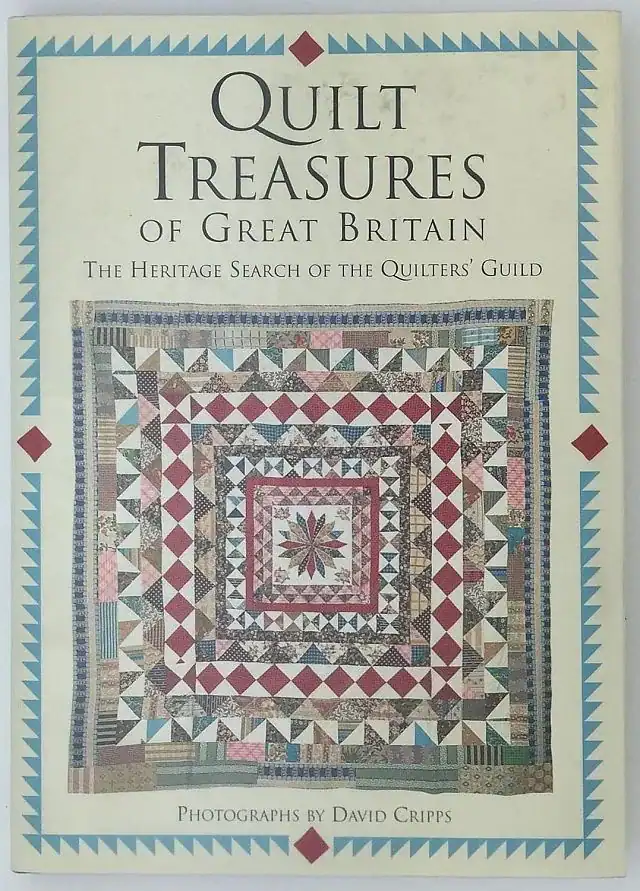
All out of print, but they do turn up from time to time. Dorothy’s is the most recent publication we have of its type. (no offence to Quilt Treasures and Quilts of the British Isles, both excellent references and lots more pictures.)
Some time ago I mentioned a forthcoming exhibition of quilts (‘Through the Needle’s Eye – 250 years of quilt making’) from the collection of the Castle Museum in York. It is being held in the City Art Gallery as part of the celebration of the refurbishment of the gallery. Unfortunately the refurbishment suffered delays, and the exhibition didn’t open as planned in January. However, it will now definitely open on 19th March, running until 5th June. The quilt exhibition is accompanied by a book of the same name, currently at the printers and promised for the opening.
The exhibition shows 20 quilts from the collection, but the book is in effect a catalogue of almost the entire collection. So far I have seen a black and white proof only, and was I admit a little dismayed at the smallish format they have chosen. (Presumably a financial decision taken by the ‘suits’). I know the original photos to be of exceptional quality, so I am hoping the printing will do them justice. Even small format it will still be a fantastic resource for an overview of British quilts (most of them local to Yorkshire) on a 250 year timeline, and the first new broad range catalogue we have had in years.
The Art Gallery website has a brief mention of the exhibition at
Home Page
and by chance pictures a turkey Red and white signature quilt which I am just starting to research. A detail of this quilt appears in ‘Quilts of the British Isles’. It is what we know as a ‘Bazaar’ quilt, made as a fund raiser by selling signature space. Happily for us it records that it was made in October 1892, for St John’s School in Dewsbury West Yorkshire. So far I have recorded the 400-plus signatures, located the school in question, found contemporary newspaper reports, and set off on the trail of the contributors. I’ll let you know how I’m getting on in a year or so <G>.
Sally W Happily, near York!
From: Sally Ward <sallytatters@>
Ah…just found a much better page…
http://www.yorkartgallery.org.uk/ — Sally (‘Tatters’) Ward
From: Sally Ward <sallytatters@>
Oh that worked well, didn’t it. All roads lead to Rome, and all links come up as the main page. Oh well, you’ll just have to find it yourselves <GG> Sally W
Sally Ward wrote: > Ah…just found a much better page… > > http://www.yorkartgallery.org.uk/
— Sally (‘Tatters’) Ward
From: Sally Ward <sallytatters@>
Ok. I’ve just tried the link on the information page that says ‘buy the book’ and it doesn’t go anywhere. I’ve emailed the marketing department to find out details, and will pass them on as soon as.
Sally W
I can’t see either what they mean but weather permitting I might go to this auction since I’m not that far (or at least to the preview) and I can let you know. If I stay, I’m not sure my checkbook could match my temptation. Thanks!
Date: Sun, 27 Feb 2005 09:55:14 -0500 | From: munsey@
In addition to the three books mentioned previously – “Quilting”, “Patchwork”, and “Patchwork Quilts“, Averil Colby wrote two other books – “Samplers” and “Pincushions”. QHL members in Great Britain may know of additional works. I believe that “Quilting” is still the most complete discussion of quilting (not patchwork or applique) patterns and various stitching techniques ever published.
“Samplers” is a definitive book about British needlework samplers from very early years and has separate chapters on the 16th through 20th centuries. It was first published in 1964, reprinted in 1984 by Batsford.
“Pincushions”, published in 1975 by Batsford, contains photos of delightful Victorian pincushion, proving that pins can be kept in something other than red tomatoes! This book has detailed instructions for making pincushions for reproducing these delights using techniques ranging from embroidery, to knitting, to patchwork with lots of beading and other craft design.
Sandra on Cape Cod
From: Cinda
Please, Sally let us now how we can get the York book in the States. Thanks. Cinda
I’ve emailed the marketing department about the missing link (how poor is that, to open the website without the link!), and will be over there myself on Tuesday anyway, so if they are setting up a way to do it I’ll let you know. It might press the point a bit if anyone who would like it just dropped an email to
Marketing Manager– Charlotte Dootson Tel: +44 (01904) 687664 Email: charlotte.dootson@
The Curator and I both emphasised that there would be demand for this book, and from overseas, but I’m afraid it fell on deaf ears.
Worst case scenario would be that I activate my Paypal account and buy on your behalf, which I’ll do if necessary, just to prove a point to them <G>
Sally W
Date: Mon, 28 Feb 2005 08:25:22 +1100 | From: Janet O’Dell
Many thanks for the info Sally, I have already emailed the Gallery from Melbourne Australia wrt the book. I will be in UK in May so I hope to visit the exhibition.
Cheers Janet O
Date: Sun, 27 Feb 2005 16:55:23 -0500 | From: Candace Perry <candace@>
Cinda, go figure. Here’s another instance where you just want to say,”whatever.” On a lighter note, however, I was very interested in the flying geese quilt that’s the last image in the “virtual collection.” We have a flying geese with similar patriotic fabric on the reverse; seems interestingly coincidental! (the maker also may have been from eastern Berks County, PA, given her name, Kieffer, a good Dutchy name that we see in this vicinity).
Date: Sun, 27 Feb 2005 16:20:24 -0800 | From: Margaret Geiss-Mooney <mgmooney@>
Good afternoon, QHLers – It is difficult to make out the borders in the image posted at the link but it appears to be scalloped (sp?). Regards, Margaret (Meg) Geiss-Mooney Textile/Costume Conservator Professional Associate, AIC mgmooney@
>>Thank you, Candace, for the link to this quilt auction site. I found that clicking on “upcoming auctions”, clicking on “view by category”, and then typing the word “quilt” into the search feature turned up a couple of pages of quilts. The lot numbers ranged wider than those noted in your post, so possibly you missed some offerings that would be worth seeing. I viewed a Vermont friendship quilt in a star pattern.The description referred to a “red half penny border”. I couldn’t tell from the photo what this referred to. Any ideas? It looks like simple red binding. Here’s the link in case you’d like to take a look. Thanks if you can clarify. http://www.pookandpook.com/cat/2005-03-12/27 >>
From: Joan Kiplinger <jkip@>
Does anyone have an email address or website for Ellie Sienkewitz??
Date: Sun, 27 Feb 2005 19:37:48 -0500 | From: Kathie Holland <kathieholland@>
http://www.ellysienkiewicz.com/
From: Karen Portwood
Hello all,
I’m catching up on some previous posts and reading Cinda’s most recent recap prompted me to recall that I hadn’t posted ours yet. So for you reading pleasure…here ’tis. Enjoy!
***********
The Midwest Fabric Study Group met on Sunday, February 6th at the Daisy Barrel in Fairborn, Ohio. The previously scheduled meeting was canceled due to our unpredictable Midwestern weather. We had a smaller contingent of twelve due in part we suspect to Super Bowl Sunday. Those who were unable to be with us sure missed some wonderful quilts!
Our topic for the day was “Finds and Favorites.” It was great to see what everyone brought to share. We started the day with a Hmong quilt that was purchased in the late 1990s. It featured wonderfully graphic green, gray and white reverse appliqué four square center separated by sashing with small square in a square patchwork. The overall design of the quilt was similar to that of the early medallion style quilts with its many “rounds” of boarders.
Another member brought an interesting bedspread believed to be from India. She posed the question to the group as to whether there might be a connection between palampores and vine appliqués?
She also brought a quilt from Missouri with the embroidered date of 1959-60 in the center. Above the date was a crown with the letters “F” “P” “L” “E” surrounding it. Think one quarter of an hourglass block, with the “F” to the left on a royal blue background, “P” on top on white, “L” to the left on red and “E” underneath on another white background all with the crown positioned in the middle. The letters and the details of the crown were worked using a small metallic gold ric rack braid. The names on the quilt were embroidered in black floss on a blue and white album style block. The titles next to some names were interesting such as “grand guard” and “O.P.” We believe this quilt might be from a ladies branch of a fraternal order. Any thoughts as to which one it might be?
Along that same line, we saw a signature quilt made from men’s ties. The names on the ties were all freehand machine embroidered in a white chain stitch. The quilt was purchased at a yard sale in Bloomington, Indiana. At one end of the quilt was an orange moiré fabric rectangle with royal blue horizontal soutache braid stripes with “Members International Typographical Union” and below it a black rectangle was the name “Frank Morrison 16” on it. After some research, it was discovered that the ITU was headquartered in Indianapolis and had many chapters across the states. All the ties had men’s names and a number after the name representing their chapter number. We learned the number 16 represented the Chicago chapter. Mr. Morrison, as well as several members who were listed on the quilt as ITU chapter presidents, was known to be instrumental in establishing the American Civil Liberties Union!
Just when you think things couldn’t get any more exciting, this same member showed us a wonderful gift she received from a coworker. It was a beautiful red, green, and chrome orange appliquéd quilt! Each of the eight blocks had an urn with a green base and red handles with a red scalloped top. The urns had four red and four chrome orange carnations blooming out of them. The quilting on it was the fabulous dense quilting you see mid-19th century featuring feather wreaths with cross hatched centers and chevron background quilting. We noticed that some of the flowers had a closely spaced white buttonhole stitch around just the petal part and some of the flowers did not. Also, the quilting lines ran right across the appliqués. The quilt was said to have come from near Union City, Indiana (which is above I-70 and right on the Indiana/Ohio line) and was made by a member of the Fitzmaurice family who emigrated from Ireland.
The “gasper” quilt of the day was a circa 1850 appliqué quilt from Boardman near Youngstown, Ohio. The family names associated with the quilt are Agnew on the paternal side and Cowden on the maternal side, both are of English decent. The quilt’s current owner isn’t sure it was a family quilt as it could have belonged to a local gentleman her grandmother cared for. The quilt featured nine delicious floral appliqués in the center surrounded by the most wonderful red and green “watermelon” style swag border with double pink bows between the swags. We found this quilt to have quite a profusion of green across its surface compared to most red, green, and gold quilts you see. Another fun feature was the tiny green piping along the white binding.
This same member also brought a sweet 1930s-40s pinwheel star. There were many of the usual 30s and 40s fabrics in the star points with the pinwheels meeting at the intersections done in a bubblegum pink. We surmised you could easily reproduce this quilt assembling the pieces into strips. The back was an unusual pink fabric that felt kind of slick almost like percale.
We then saw two different basket quilts owned by two different people. One was a turkey red and white (Brackman #650.3) with the name “Hattie E. Hostettler” quilted in block letters inside a flowing ribbon. The curious part about this was that the name was quilted in upside down from the orientation of the baskets. Almost like the maker wanted to admire her name as she slept underneath the quilt. The initials “H.E.H” and the date “1878” in the same style block letters were quilted in an arch inside one of the setting triangles. The quilt’s owner has done some preliminary research using online census records and discovered this quilt may have been made within 50 miles of where it was purchased in Illinois!
The second basket quilt we saw was a delightful scrappy (Brackman #650.2). It was tied with red yarn and had fabrics in it that spanned the decades from the turn of the century to the 1930s! It was a real treat to see how many different ones we could find.
This person also brought a couple scrap quilt tops that featured some great fabrics for study. One of my favorites was a rust colored background with a bluish grey squiggle with what appeared to be cones (think dunce caps) floating across the surface. Another fun discovery was leaf and bud piece of fabric that has been reproduced by In the Beginning Fabrics. Luck would have it that the Daisy Barrel had the repro so we could place it beside the original for comparison! The repro was exact in scale and some color placement but the original beat the repro hands down on detail and crispness of design! What fun to be able to see them side by side. Only meeting in a quilt shop could afford such an opportunity!
We also saw a really fun eye popping orange quilt with royal blue and white polka dot flower pot blocks (Brackman #732). The quilt was purchased in Lawrenceburg, Indiana. This quilt just read happy to me. What a bold lady she must have been. I can only imagine her friends saying “You are going to use what color in that quilt?”
This same person also brought a 1936 Bucilla kit quilt numbered 8644. It has a center of appliquéd light and dark peach flowers with light and dark 30s green leaves all with black, white and brown embroidery stitches. It was purchased as an unfinished kit it in Lawrenceburg, Indiana. It came with the original instructions, embroidery floss and blue binding. All the appliqué and embroidery were completed all it needed was the quilting and binding. The quilt’s new owner exquisitely completed the quilting and expertly attached the binding. It is truly a beautiful quilt. It looks like it was just made yesterday.
The final quilt we saw was a sweet crib sized blue and white single Irish chain. This quilt had gorgeous double quilting around feathered wreaths in the white spaces. We all marveled at how such a simple design could be set off by such time consuming quilting!
We rounded out our day with some shopping in the store and set off to enjoy the rest of the mild sunny weather! Our next meeting will be on March 12th in Indiana at Jonathan Bird’s Cafeteria in Greenwood. Cindy Claycamp is making the reservation, and will email directions. The topic for the day will be “Tools & Toys.” We should bring sewing/quilting tools, toys (includes toy sewing machines), and related, be prepared to talk about what you bring.
Respectfully submitted,
Karen Portwood
From: Suzanne Cawley <wvquilter@>
Hi All!
I am currently reading “Quilts, Coverlets, & Counterpanes” by Paula Locklair which is a catalog book of bedcoverings from the Museum of Early Southern Decorative Arts and Old Salem Collections. On page 8, there is a quote from an 1818 reward notice of a robbery in Savannah, Georgia. It says in part “stolen out of the house, a black leather trunk, containing….a part of a wilson quilt not put together…”.
What is a “wilson quilt”? I have not heard that term before. I am also wondering what “humkums” is, as mentioned on page 7. It is identified as a fabric used for quilts.
Curiosity has gotten the best of me. Thanks for any info you can offer.
Suzanne Cawley In wild, wonderful Keyser, WV, where we are patiently awaiting another 10 inches of snow
From: sue reich
April 9, 2005
Wenham Museum
132 Main St.
Wenham, MA
10:00 a.m. – 3:30 p.m.
Fee – $35 members
$40 nonmembers
Reserve your place. NOW!
You are invited to join us for the first AQSG/New England Quilt Day to take place at the Wenham Museum. The Museum is eager to share their vast collection of quilts with our group.
Bring a friend, and spend the day with antique quilts, learning about AQSG and sharing in the fellowship of other quilt history lovers.
If you have any questions or would like to attend, contact
Regional coordinators; Lorie Chase – New Hampshire, Stephanie Hatch – Massachusetts, Bonnie Dwyer – Maine, Anita Loscalzo – Massachusetts, Kathy Metelica – Vermont, Sue Reich – Connecticut.
Pam Worthen, New Hampshire, Registrar
14 Newmarket Rd., Durham, NH 03824-2818
603.942.9211/pamworthen@
Address _________________________________________________________
Town ___________________________________________________________
Telephone _______________________________________________________
Email _________________________________________________________
Choice of lunch Regular ______________ Vegetarian __________________
Date: Mon, 28 Feb 2005 08:48:16 -0500 | From: Lynne Z. Bassett <lzbassett@>
> What is a “wilson quilt”? I have not heard that term before. I am also > wondering what “humkums” is, as mentioned on page 7. It is identified as > a > fabric used for quilts. > > Suzanne Cawley
Dear Suzanne,
I have no idea what a “wilson” quilt is–although it’s probably a misspelling by the transcriber, or by the original writer. As for “humkums,” that’s “humhum,” a “plain cotton cloth of thick, stout texture woven in Bengal,” according to Florence Montgomery, _Textiles in America_.
Best, Lynne
From: Joan Kiplinger <jkip@>
Suzanne — Linton and Fairchild describe this as humhum or hummons, a coarse, plain weave East Indian fabric popular in the 18thC and used chiefly as a wrapper or a bath towel.
Date: Mon, 28 Feb 2005 09:37:06 -0500 | From: Joan Kiplinger <jkip@>
Suzanne — here is another mention of humhum/humkums from a chapter on apparel in The Annals of Philadelphia by John F. Watson, 1830. This describes some of the cloths advertised in an ad:
“…..tandems, isinshams, nuns, bag and gulix, (these all mean shirting) huckabacks, (a figured worsted for women’s gowns) quilted humhums, turkettees, grassetts, single allopeens, children’s stays, jumps and bodice, whalebone and iron busks…….”
Date: Mon, 28 Feb 2005 10:01:03 -0500 | From: sue reich <suereich@>
I sent a Word Document previously but it did not translate in a very appealing way. Let me expand upon the previous email. New England Regional Coordinators of AQSG have arranged to spend a Quilt Day at the Wenham Museum in Wenham, MA on April 9, 2005 from 10:00 a.m to 3:30 p.m. We hope to appeal to quilt enthusiasts of New England with the incredible quilt collection of this Museum, an introduction to AQSG, and the good fellowship of quilt historians. Lunch will be provided with both regular and vegetarian choices. The cost is $35/members and $40/non-members of AQSG. If you have any questions or would like to attend, contact regional coordinators; Lorie Chase – New Hampshire, Stephanie Hatch – Massachusetts, Bonnie Dwyer – Maine, Anita Loscalzo – Massachusetts, Kathy Metelica – Vermont, Sue Reich – Connecticut. Make your check payable to Pam Worthen/AQSG Pam Worthen, New Hampshire, Registrar, 14 Newmarket Rd., Durham, NH 03824-2818 603.942.9211/pamworthen@ Name ___________________________________________________________ Address _________________________________________________________ Town ___________________________________________________________ Telephone _______________________________________________________ Email _________________________________________________________ Choice of lunch Regular ______________ Vegetarian __________________
Date: Mon, 28 Feb 2005 09:00:25 -0800 (PST) | From: Sandra Millett <smillett@>
Dear Sarah:
Thanks for your efforts. The bolts here in Texas say Made in US. Interesting.
Sandra Millett
sewsewsarah@ wrote: I am a Jo-Ann’s employee. I called my manager and she checked the bolt. There is no manufacturer listed on the bolt or the selvage. However, it does say that it is made in Taiwan, if that helps any.
Sarah in WV
http://groups.yahoo.com/group/ChristianWomenWhoQuilt
Date: Mon, 28 Feb 2005 13:40:34 -0500 | From: Pepper Cory <pepcory@>
Might this be a reference to the sort of wholecloth quilts designed and made by Ona and Rosalie Wilkinson? Their cottage industry was active in Indiana from just before WWI until the late 1940’s (I believe). They designed comorters in ‘modern’ colors and the simplicity of their designs seems to have been a reaction to fussy late-Victorian styles. Just guessing… Pepper
Date: Mon, 28 Feb 2005 13:42:00 -0500 | From: Pepper Cory <pepcory@>
It pays to read the WHOLE message! The ‘wilson’ quilt, if dated 1818, is clearly not related to the early 20th century quiltw of the Wilkinson sisters. My guess now-the name of the mill or manufacturer that made the fabric. Pepper (red-faced)
Date: Mon, 28 Feb 2005 14:07:55 -0500 | From: Paul and Nancy Hahn <phahn@>
For people in the US who may be interested, I will be going to the York Museum quilt exhibit in early April. I had intentions of bringing back a supply of the soon-to-be published Quilt Book for my shop. I have been talking to Sally Ward, who so graciously offered to set up a way for US members of QHL and BQHL to acquire the book, and she felt it may be less hassle for me to ship the books back then for her to deal with it. At this time we are not sure of the price/exchange rate/shipping, etc, but if you may be somewhat interested in having me include you in the number of books I order, please contact me off line and I would be happy to let you know of the particulars.
Nancy Hahn, Maryland….let it snow, let it snow, let it snow!
From: Sandra Millett <smillett@>
Thanks for your efforts. The bolts here in Texas say Made in US. Interesting.
Sandra Millett
Date: Tue, 1 Mar 2005 08:18:14 -0500 | From: Karen Evans
Does anyone have the name of a contact person in the textile department at the Victoria & Albert Museum? I wrote to them asking about one quilt and received a very nice reply with information about a completely different quilt. Please e-mail me privately, and thanks a million in advance!
Karen Evans ——_NextPart_000_000B_01C51E37.36BA70F0–
From: Andi Reynolds <andi0613@>
The Museum of Easly Southern Decorative Arts is committed to making life easy for researchers. To that end, I suggest looking at what they have to offer at www.oldsalem.org. Click on MESDA and follow links to their online research database of Southern artisans. This is especially great for those interested in trades and skills in addition to quiltmaking who are researching individual artisans. I have no commercial interest in, etc., etc., except that MESDA is located in my hometown, Paula Locklair is a family friend and she and MESDA have been a wonderful help to me in past endeavors. I can strongly vouch for the excellent resource MESDA is for quilt history types.
Date: Tue, 1 Mar 2005 10:29:08 -0600 | From: Charlotte Bull <charlou@>
Is it at all possible that the “wilson quilt ” referred to was a Family Quilt with album or signature blocks not yet put together? Wilson is a last name! Just a wild guess! cb
Date: Tue, 1 Mar 2005 11:31:25 -0800 (PST) | From: Lori Hudlow <lahudlow@>
Just wondering when we first saw the appearance of The Feathered Star or Sawtooth blocks.
Thanks, Lori
From: Dannie Mann
Hi,
I would like more information on the quilt block in the attached photos. Does it look familiar to anyone? Was it a kit or a was it a pattern from the newspaper? Approximately when would this have been first available?
Thanks for any help, Dannie Mann Madison, Alabama
From: Judy Kelius
What is different about this quilt top? http://cgi.ebay.com/ws/eBayISAPI.dll?ViewItem&item7303237228
When I wrote the seller and told her it was no wonder it was “catywampus,” she asked what a catywampus is. Is this a regional expression? I assumed everyone knew what it meant!
From: ElizaBeth L. Haubold
catywampus is a normal expression where i come from and I’m in Texas.
Judy Kelius <quilts@> wrote:What is different about this quilt top? http://cgi.ebay.com/ws/eBayISAPI.dll?ViewItem&item7303237228
When I wrote the seller and told her it was no wonder it was “catywampus,” she asked what a catywampus is. Is this a regional expression? I assumed everyone knew what it meant!