October 11 – 17, 2003
These restored messages come from the Quilt History List, an online forum where quilt historians, collectors, researchers, appraisers, and enthusiasts discussed antique quilts and related textiles. The archive dates from 1996 through approximately 2016 and is being restored gradually. Sign up in the form at the bottom of the page if you want to know when a new page is added. Original spelling, opinions, formatting, and inactive links may remain unchanged.
Primary topics of this QHL Digest:
- Antique brown fabric sought for quilt repair — A member restoring a great-great-grandmother’s 1880s Garfield’s Monument quilt asks for genuine period brown fabric, and gets several offers. (see the article on quilt restoration)
- Baltimore Album exhibit announcement — A member shares details of a Baltimore Museum of Art exhibit on Baltimore Album appliqué quilts.
- Marseilles spreads and coverlets — Members trace the origin of the term ‘Marseilles Spread,’ discuss coverlet dating, and compare notes on a nursery-rhyme-motif coverlet.
- UNL study on quilting adhesives — A University of Nebraska study on the effects of light and aging on basting sprays, fusible webs, and fusible battings sparks debate about heirloom-safe practices.
- Origins of trapunto and appliqué technique — Members discuss early Italian trapunto quilting and possible Egyptian appliqué antecedents raised at a recent AQSG session.
- German and Germanic-American featherbeds — A long thread on ‘comfortables’ and featherbed traditions among German and German-American communities, and how they differ from quilts.
Date: Sat, 11 Oct 2003 | From: Donald Beld <donbeld@>
Hi, I am in the process of donating a Garfield’s Monument quilt my great-great-grandmother, Perthina Bailey, (don’t you love her first name) made in the mid to late 1880 to the Lincoln Shrine in Redlands, California.
However, it has several pieces of deteriorated brown fabric where it would have been folded and exposed to the sun.
I want to repair those few pieces (by covering over) with genuine 1860-90 brown fabric–not reproduction, but genuine antique period fabric.
Does anyone have a source? Please let me know privately if you feel it isn’t something for the chat line. Thanks, Don Beld
Date: Sat, 11 Oct 2003 | From: “Maurice Northen” <3forks@>
Don, I have 2 quilts which have browns, of good size. Tell me the size you need and I will scan you what I have that I can donate.
Joan of the South Quilt conservator in Texas
Date: Sat, 11 Oct 2003 | From: “Phyllis Twigg”
THE BALTIMORE MUSEUM OF ART PRESENTS, “BALTIMORE ALBUM QUILTS: APPLIQU=C9D ARTISTRY” BALTIMORE, MD (September 30, 2003)-Discover Baltimore’s unique contribution to the art of quiltmaking in a rare exhibition of album quilts from The Baltimore Museum of Art’s collection, one of the largest in the country. Baltimore Album Quilts: Appliquéd Artistry, on display from November 5, 2003, through May 9, 2004, features more than 20 exceptional album quilts and individual squares created in Baltimore between 1845 and 1865, masterpieces of needlework in which each elaborate square is treated like the personalized page of an autograph album. In conjunction with the exhibition, the BMA will offer series of workshops led by well-known quilters, including a lecture and workshop by nationally known quilting expert Elly Sienkiewicz.
GALLERY TALKS : With Anita Jones, BMA Associate Curator of Decorative Arts for Textiles: Thursday, November 13, 1 p.m. .With a Museum Docent : Thursday, November 20, 2 p.m. and Thursday, December 4, 2 p.m.
REPRODUCTION QUILT RAFFLE TO BENEFIT BMA
In conjunction with the exhibition, a reproduction of the Samuel Williams quilt featured in Baltimore Album Quilts: Appliquéd Artistry has been made by The Baltimore Appliqu=E9 Society. This four-year project-the product of thousands of hours of effort by more than 100 volunteers working in the United States, Great Britain, and Canada-has resulted in the most ambitious historical quilt ever recreated by the Society for the benefit of a museum or historical society. The reproduction will be on display at the BMA and at quilt shows around the country before it is raffled on May 2, 2004. Proceeds will benefit the BMA’s Textile Department. Call 410/396-6338 for ticket information.
Visitor Information: The Baltimore Museum of Art is open Wednesday through Friday, 11 a.m. until 5 p.m.; Saturday and Sunday, 11 a.m. until 6 p.m.; and during the first Thursday of every month (except major holidays), 11 a.m. until 8 p.m. The Museum is closed Monday, Tuesday, New Year’s Day, July 4, Thanksgiving, and Christmas. Admission is $7 for adults; $5 for seniors ages 65 and over and college students; and free for children 18 and under. Admission is free on the first Thursday of every month and for related Free First Thursday activities. The BMA is located on Art Museum Drive at North Charles and 31st Streets, three miles north of Baltimore’s Inner Harbor. For general Museum information, call 410/396-7100 or visit the BMA’s
web site at www.artbma.org.
Date: Sat, 11 Oct 2003 | From: “Maurice Northen”
Here are what I have, 2 quilts. Both of the “dot” fabrics are plenty. The plaid brown will only be the 2″ squares., but there are plenty, I will just have to lift them for you. I know neither of these are strips, if that is a must?
Joan in Texas
Date: Sun, 12 Oct 2003 | From: Debby Kratovil <kratovil@>
Does anyone have a full set of the Nancy Page “Laurel Wreath Quilt” series with the four birds. It is so sweet. I have the flowers and the leafy vine and four birds. But I don’t have a picture (newsprint) of the black drawing of the full quilt. What is the size of that? Does anyone have a quilt made from the patterns. You can answer off the list if you prefer. Many thanks ahead of time. Debby (the quilter who is not a very good historian) — Debby (with a “y” and not “ie”) Kratovil http://www.quilterbydesign.com http://www.ipriority.com
Date: Sun, 12 Oct 2003 | From: “Carol H. Elmore”
I received my catalogue–Mosaic Textiles: In search of the Hexagon this past week from France. It is an exquisite book and I would recommend it to all of you on the list. My French is rather rusty since the last French class that I had was over 30 years ago but despite that I can read much of the book. The pictures are well done. It was a real challenge to get the check in euros but was definitely worth the effort. If anyone on the list gets to go to France and see the actual quilts, I hope you’ll report back to us. Janine Janniere has done a great job with the catalogue.
Carol Elmore Manhattan, Kansas
Date: Mon, 13 Oct 2003 01:38:56 -0500 | From: Jennifer Perkins <qltrstore@>
This was sent to the Omaha Quilt Guild. Thought you all would be interested, too! Jennifer in Iowa
[Forwarded from “quilten95” <mlrichling@>, Fri, 10 Oct 2003:]
Dr. Patricia Crews and Janet Evenson have participated in a study, and written a report on the effect of light and ageing on selected quilting products containing adhesives.
The study covered the use of quilt basting sprays, fusible webs and fusible battings.
Basically, the study recommended quilters interested in making heirloom products should avoid quilt basting sprays and fusible webs. Fusible battings appeared acceptable, but could cause yellowing.
Here is the address of the finding: http://www.quilts.org/QIQAFall03SpecialRep.pdf
I’m sure this report will cause quite a few “fireworks”. Read and enjoy…
Have a great weekend, Mary R. 🙂
Date: Mon, 13 Oct 2003 | From: “Sherry” <smassey@>
Don,
Are you donating this to a museum? I would not recommend changing the original quilt, damaged or not. You may consider sending the period fabric WITH the quilt and informing the curatorial staff that this is fabric SIMILAR to what was in the quilt, but don’t restore the quilt. A good museum will want to retain the history of the quilt as it is and CONSERVE it in its current condition. Be sure and include all the information you have about your ancestor, also.
Sherry Massey, Registrar Oklahoma Museum of History
Date: Mon, 13 Oct 2003 | From: “Liz Lois” <loislane@>
Hi Sally, That quilt is also pictured in the book Quilt Masterpieces by Susanna Pfeffer page 71. I believe it is still owned by the Kentucky Historical Society. I believe I saw it at the museum there about 10 years ago. Liz in Wisconsin
Date: Mon, 13 Oct 2003 | From: “Candace Perry”
I recently received for the collection a white “Marseilles” coverlet or bedspread with a nursery rhyme motif. It apparently dates to the 1920s. Can anyone shed some light on these and why they are called “Marseilles?” I apologize if this was brought up before — I have a feeling I read something about it but don’t know where! Thanks tons! Candace Perry Schwenkfelder Library & Heritage Center
Date: Mon, 13 Oct 2003 | From: “Sherry”
I am so happy to see this study!! I have been trying to convince my quilting friends that the use of fusibles (and polyester batting) in their quilts will only bring disappointment in years to come. Unfortunately, some of them express today’s “microwave society” attitude toward quilting: “In 20 years I won’t care what it looks like”. So many modern quilters are in a hurry to see a finished product and don’t want to take the time to use quality products and construction methods. Unfortunately, I’m afraid today’s quilts won’t stand the test of time as so many of our historic quilts have. I, for one, continue to quilt by hand, using only natural threads and battings in the hope that a love for QUALITY quilting will regain a foothold among quilters. Only time will tell. Thanks for the infor, Jennifer.
Sherry Massey
Date: Mon, 13 Oct 2003 | From: “deb” <deb@>
Most quilters – or I should say most of my customers (I own a quilt shop) – do two kinds of quilts just like quilters of yesteryear – those that are “utility quilts” and those that are “company quilts”. They produce three or four times as many utility quilts as they do “company”. Today’s utility quilts are quick pieced, quick quilted, may have fusibles and are to be used to hang on the wall for holiday decorations, snuggling on the couch, thrown on the floor for a fort, dragged around by babies and toddlers, etc – they aren’t expected to last so the quilter doesn’t put more effort into them than necessary for them to serve their purpose. Company quilts may not be hand pieced or hand quilted but are done for beds and are used by and given to those who will appreciate them – they are expected to last and be handed down & the quilter puts more effort into how she makes them.
I won’t get into the argument of hand quilting vs. machine quilting other than to say I have seen machine quilting that is much better than some hand quilting & vice versa.
My customers do quite a bit of utility quilts, but they do enough “good” quilts so that I think quite a few will last for future generations to treasure.
In 1936 Carrie Hall was worried enough about the sale of kit quilts to state ” In the ready-cut quilts offered for sale are seen the effects of this hurrying age in which we live.” (Boy would she be in for a shock today!) Others also likened the kit quilts to boxed cake mixes and instant foods. Today those kits, finished & still in the packages are highly collectable.
Just my two cents. Debbie Quilting Possibilities Bayville, NJ
Date: Mon, 13 Oct 2003 | From: “MJ Kinman, The Alliance for American Quilts” <mjkinman@>
Hello, All –
On behalf of The Alliance for American Quilts and our colleagues at Michigan State University, I’m pleased to announce the launch of the Quilt Index, an online database that will eventually include tens of thousands of images of historical and contemporary quilts. You can explore the Quilt Index at www.quiltindex.org. It launches today with nearly 1,000 images from four separate archives.
The Quilt Index is a project conceived and developed by The Alliance for American Quilts (www.centerforthequilt.org) in partnership with Michigan State University Museum/Great Lakes Quilt Center (http://www.museum.@) and MATRIX: The Center for Humane Arts and Letters Online, at Michigan State University (http://www.matrix.@).
I have included more information about the Quilt Index below. Our hope is that this will become an important resource to all who are interested in studying quilts and quilt heritage.
MJ Kinman Executive Director The Alliance for American Quilts
October 13, 2003 — The Alliance for American Quilts and Michigan State University announced today the launch of The Quilt Index (http://www.quiltindex.org), a new website placing historical and contemporary American quilts at the fingertips of anyone with a computer and Internet access. This landmark online resource offers a central, searchable database to provide first-of-its-kind access to information and images of this original American art form. The Quilt Index launches with information for over 1,000 quilts from four separate archives. Yet this is just the beginning. The Alliance for American Quilts and MSU will begin working with other groups around the country to add records for the tens of thousands of quilts that have been documented by state quilt projects and collecting institutions.
The Quilt Index was conceived and developed by The Alliance for American Quilts in partnership with Michigan State University Museum/Great Lakes Quilt Center and MATRIX: The Center for Humane Arts and Letters Online, at Michigan State University. Four quilt archives contributed quilt images and surveys from the state and regional quilt documentation projects to create this initial phase of the Quilt Index: the Illinois State Museum, the Michigan State University Museum, the Tennessee State Library and Archives, and University of Louisville Archives and Records Center.
“The Quilt Index has long been a dream of many who study quilts and work to preserve their history,” adds Shelly Zegart who co-founded the first of the quilt documentation project, the Kentucky Quilt Project, in 1981. Zegart, now board president of the Alliance for American Quilts, says the Quilt Index is the culmination of more than 20 years of effort to document and preserve our quilt heritage.
The advantage of a single comprehensive Quilt Index is enormous, the project architects say. Quilts can be viewed by contributing collection or documentation project as well as searched across collections for patterns, individual quiltmakers, themes, techniques, and many other characteristics. As a result,” The Index provides a rich, deep resource for students, teachers, scholars, quiltmakers, and the general public,” notes Marsha MacDowell, curator of folk arts at the MSU Museum and MSU professor of art and art history.
Major advances in digital library technology combined with years of quilt documentation and research made the development of this comprehensive on-line Index possible. The complex Quilt Index architecture and web site interface design were constructed by MATRIX, a center devoted to the application of new technologies in humanities and social science teaching and research.
Planning and implementation of the Quilt Index was made possible by grants from the National Endowment for the Humanities (NEH) division of preservation and access. For more information, contact MJ Kinman, Executive Director of The Alliance for American Quilts (Email: mjkinman@ ) or Marsha MacDowell, Professor and Curator, Michigan State University Museum (Email: macdowel@).
Date: Mon, 13 Oct 2003 11:56:29 -0400 | From: “Candace Perry” <candace@>
On a website that excerpted an 1830 book about Philadelphia. These are materials that were for sale on the wharf in Philly sometime in the late 18th century. Any ideas on some of these wild names (quilted humhums?)? Candace Perry Schwenkfelder Library & Heritage Center Tandems, isinshams, nuns, bag and gulix, (these all mean shirting) huckabacks, (a figured worsted for women’s gowns) quilted humhums, turkettees, grassetts, single allopeens, children’s stays, jumps and bodice, whalebone and iron busks, men’s new market caps, silk and worsted wove patterns for breeches, allibanies, dickmansoy, cushloes, chuckloes, cuttanees, crimson dannador, chain’d soosees, lemonees, byrampauts, moree, naffermamy, saxlingham, prunelloe, barragons, druggets, florettas!
Date: Mon, 13 Oct 2003 | From: “Major Ma’am”
Candace, I recognized Saxlingham, it is a village in Norfolk, England. (East Anglia area about 60 miles north of London.) It might be a particular weave or type of material that came from there. I will see what else I can find out about it, if possible and get back to you.
Becky In the High Desert Of California (dans le haut désert de la Californie)
Date: Mon, 13 Oct 2003 | From: Gail Ingram <gingram@>
Candace,
Can you give dimensions and details of design?
I own such a coverlet, one that has the alphabet and figures from nursery rhymes woven into it. I believe it to be early 20th century.
Gail
Date: Mon, 13 Oct 2003 | From: “BOBBIE A AUG” <qwltpro@>
Candace, These were called Marseilles Spreads because that is the port in France w here they were shipped from – not where they originally made. They were made in Italy but died out in popularity about 1400’s. They were made in Provence, France and exported out of Marseilles because that was the biggest shipping port. These were the woven or loomed ones made on a Jacqua rd loom. They were not the earlier quilted ones. This is brief, I know.= Just finished doing research for a book.
Bobbie Aug
Date: Tue, 14 Oct 2003 | From: @aol.com
One slight correction…weren’t the Marseilles spreads popular into the 19th century? The jacquard loom wasn’t invented until the 18th century. The medieval spreads were all hand sewn.
Karen Evans Easthampton, MA
Date: Tue, 14 Oct 2003 | From: “Candace Perry”
Gail, I’ll be getting the spread out by tomorrow and I’ll report on it! I know that Humpty Dumpty is featured. Candace
Date: Tue, 14 Oct 2003 | From: “Martha”
Hi all, Just read this report and am pleased that info. is finally out on these types of products. I, too, have many quilt friends that give the same response of, “I don’t care if it doesn’t outlast me” when referring to their quilted creations having used fusibles and adhesives. I wonder if they are really being truthful??
Question to the group: Some quilt restorers that I know purport the use of a product called “Fine Fuse” to stabilise weakened areas of fragile fabrics in quilts. Did the UNL researchers test this product, and if so, was there any conclusive data? Is this product similar (in chemical makeup) to any of the products listed in the special report?
Thanks for any info. Enlightening quilt enthusiasts in Northern Colorado:-)
Martha Spark Antique Textile Consultant Fort Collins, CO
Date: Tue, 14 Oct 2003 | From: “Sherry”
Martha,
Good question. I think it is interesting that you referred to “quilt restorers” and not quilt conservators. I would bet that the chemical makeup is very similar to those products studied by UNL.
Date: Tue, 14 Oct 2003 | From: @aol.com
I wouldn’t touch any of those products with a ten foot pole. If it was good enough for Aunt Jane, it’s good enough for me. 🙂
Karen Evans [a proud quilting Luddite]
Date: Tue, 14 Oct 2003 | From: “Sherry” <smassey@>
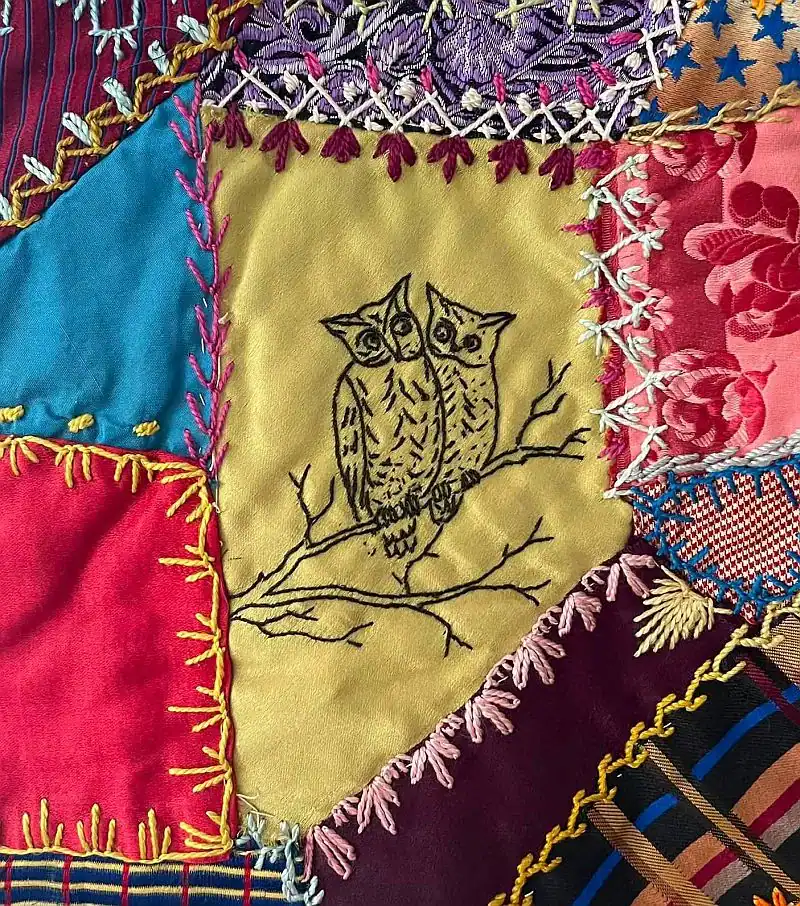
I would like to express my sincere appreciation to Schultz Metcalfe for the absolutely magnificent crazy quilt block she made for our quilt exhibit. The fabrics and embellishments are exactly what we wanted and so much more than either of us working on the exhibit would have been able to produce. It is so gratifying to be reminded of the kindness of strangers and quilters are among the kindest people I know. Thank you again, Schultz. Your name will be listed on the Acknowledgements in the exhibit gallery guide which will go to the IQSC along with the rest of the exhibit documentation, for their archives.
Date: Tue, 14 Oct 2003 | From: “JG Kane” <jgkane84@>
Hello Candace, You asked about Marseilles quilts – the area around Marseilles, in France,was famous for fine quilting.The quilts were usually all white, made of silk or linen, and were corded and stuffed in elaborate patterns.This type of quilt became known as Marseilles, Marcella,or Marsala. The quilted fabric, sometimes wool and cotton as well as the silk and linen, was imported into England throughout (18th and in turn exported to the colonies as petticoats as well as bed covers. A process was developed in England to loom weave fabric that ressembled the Marseilles quilting and this was patented in the 1760’s, opening the way for cheaper quilt-like fabric, which was also exported (in yardage as well as bedcovers.)As time went on the quality deteriorated – the early bedcovers are heavy, and quite thick. I have one that is the typical frame design, with lovely ‘quilted’ motifs, but it is heavy! Hope this is what you wanted! Jill, in Leeds. U.K.
Date: Tue, 14 Oct 2003 | From: “JG Kane” <jgkane84@>
What wonderful names in your list candace! They sound like early English poetry I only know Huckaback ( rough, woven patterned cotton used for hand towels in C19th ,C20th – we call them huckabacks), and Drugget, which I associate with a woven cover used like a rug to cover floors and carpets. I’d love to know what the others are! Jill, in Leeds
Date: Tue, 14 Oct 2003 | From: Xenia Cord <xenia@>
Looked through Montgomery, and was able to find the following definitions. Variant spellings may account for the absence of the others, marked “not found.”
tandem -linen cloth from Germany isinsham – not found gulix – also garlix, bleachable linen cloth from Goerlitz, Silesia huckaback – linen, self-patterned weave, tabby ground, small figures quilted humhums – plain, thick woven cotton, toweling, from Bengal turkettees – not found grassetts- also grazet, silk and worsted dress goods, warp & weft different colors single allopeens -alapeen, mixed wool & silk, men’s furnishing & upholstery fabric allibanies -allibanee, mixed silk & cotton, striped, from India dickmansoy – not found cushloes – not found chuckloes – not found cuttanee – silk & cotton satin weave, striped, often floral, Gujarati export cloth for quilts; also imported for printing in England crimson dannador – not found chain’d soosees – sousae; silk or cotton/silk, India, 36″ wide x 10-20 yd. long, black/ white striped lemonees – related to sousae, solid pastel (?) goods, India byrampauts – not found moree – morea; staple cotton goods, Coromandel coast, India, used for chintz naffermamy – not found saxlingham – not found prunelloe – prunella; worsted for women’s gowns, petticoats, shoes; academic gowns barragons – coarse fustian (cotton), strong & twilled, for men’s cheap clothing druggets – wool or wool/silk, sheer or thin, narrow weave goods, England and US florettas – 18th C. glazed worsted dress fabrics, Norwich, small lozenge & zigzag patterns; from fleuret or waste silk (French).
THERE WILL BE A TEST IN THE MORNING!
Xenia
Date: Tue, 14 Oct 2003 | From: “Kathy Moore” <KathyMoore@>
Regarding Candace Perry’s request for information on the Marseilles coverlet, I researched these for a term paper for Dr. Pat Crews in her History of Quilts class last spring semester at Univ. of Nebraska. What I learned is that the term Marseilles was originally used for beautifully and professionally quilted pieces done by professional seamstresses in Marseilles, France in the 1700s and 1800s. They were expensive and highly prized by royalty and the landed gentry in Europe; frequently done on commission for weddings and birth events. Some of them made their way to the colonies even though there were legal restrictions on trade of these textiles. In the early 1800s when industrial weaving machines began to be used they were quickly employed to weave facsimile “Marseilles” coverlets which were much more affordable and became very popular. I believe these were a form of double cloth woven goods; not quilted, whole-cloth goods. They were also referred to a “Marsels”. Sally Garoutte wrote an article about both of these goods for Uncoverings (sorry I don’t have the date handy) and Kathryn Berenson wrote an article about the quilts for Uncoverings in 1995. She also has published a fabulous book with many beautiful color plates illustrating the quilted pieces, Quilts of Provence. I think the book is now out of print, but I recently obtained a used copy through Amazon.
Hope this helps.
Kathy Moore
Date: Tue, 14 Oct 2003 | From: “Margaret E. Geiss-Mooney”
Good evening, all – After I googled “Fine Fuse”, one of the websites (all retailers of the product) stated that it is “made of strong nylon”. Another name for nylon is polyamide polymer. So, yes, the chemical makeup is the same as those investigated in the UNL Special Report on quilting adhesives. But as the two authors said in the report: “It is also clear that knowing the general chemical classification of an adhesive provided on a product label is not enough information to make an informed decision, since the two polyamide products (Stitch Witchery and Wonder-Under) behaved very differently from each other.” But Stitch Witchery exhibited significantly greater amounts of colour change and Wonder-Under exhibited significant product bleed-through. “The fusible webs evaluated, while acceptable for 10 to 20 years, could not be recommended for quilts intended to be handed down from generation to generation or for studio art quilts intended for sale to serious collectors or museums.” Regards, Margaret (Meg) Geiss-Mooney Textile Conservator Professional Associate, AIC in beautiful Northern California mgmooney@
Date: Wed, 15 Oct 2003 09:55:59 -0400 | From: “Newbie Richardson” <pastcrafts@>
Dear List, Newbie Richardson here. I have been both conserving and restoring quilts for 20 years. Shattered silk syndrome is a death sentence – cancer of the fabric! I only use Fine Fuse when rescuing a silk crazy quilt from oblivion. Due to the shattering of the silk, the quilt is doomed. Therefor the judicious application of this particular fusable is , in my opinion, warrented. It is nylon, which over time, and especially when exposed to UV light, does turn brittle and yellow. However, the quilts in question – or areas of shattered silk on dresses – which I have treated in this manner will be housed in proper storage or displayed in low light conditions. For the momment this is the best solution to an impossible dilema. I only use it on costumes or quilts which need to be saved because of their provenance or association with an historic site and where even a 25 year extension of their lives is a good thing. I think of it in the same terms as some of the treatments for cancer – not a cure, but will prolong life. Newbie
Here’s the website from which I extracted the list of items for sale on the Philadelphia wharf.
http://members.@/liv18thc/apparel.html
Enjoy! Candace Perry
Date: Wed, 15 Oct 2003 12:37:48 -0600 | From: “BOBBIE A AUG” <qwltpro@>
The ones made in Italy in the 1400’s were, of course, three layers. The ones I referred to shipped from Marseilles and made on the Jacquard loom were “loomed” spreads, made, of course, after the invention of the Jacqua rd loom. Sorry, I thought I was being clear in my earlier post.
And, again, these were not known to have been made in Marseilles – only shipped out of that particular large port. They were known to have been m ade in France in Provence – hence, the book titled, “Quilts of Provence.”
Bobbie Aug
Date: Wed, 15 Oct 2003 | From: Laurie Woodard
For those who attended AQSG and heard the reference to Egyptian appliqued tent panels on view in Hawaii, they can be seen at Shangri La, the (former) home of Doris Duke (deceased), on the slopes of Diamond Head in Honolulu. Tours are arranged through the Honolulu Academy of Arts (see their web site at http://www.honoluluacademy.org/shangri/housegrounds02.htm). The Egyptian panels are hanging in the dining room (just follow the link).
For those who missed the AQSG seminar, you can read the paper on “Egyptian Appliques” presented by Blaire O. Gagnon, Kingston, RI in the current issue of the AQSG journal, Uncoverings 2003, available via the AQSG web site at http://www.h-net.org/~aqsg/Publications.htm#Uncoverings.
Hope you’ll be able to join us next year as we head to the Portland, Oregon/Vancouver, Washington area. — Laurie Woodard Hawaiian Quilt Research Project http://openstudio.hawaii.edu/hqrp/index.htm
Date: Wed, 15 Oct 2003 | From: “Edith L. Taylor” <etaylorku.edu>
Dear Laurie:
Thank you for the pointer to this lovely web site! The panels (which are in the Dining Room) are gorgeous! Also, the Academy shop has some beautiful textile-related items, including gold-plated bookmarks of a number of Hawaiian quilt designs (no affiliation, of course).
Thanks!
Date: Thu, 16 Oct 2003 | From: “Cinda Cawley” <lrcawley@>
I apologize in advance for anything or anybody I omit from this account, but I can’t remember everything from a weekend like this. Suffice it to say Seminar 2003 exceeded all of my expectations.
As might have been expected, the AQSG Seminar in Dallas was a Texas-sized event–an incredible number of quilts to see thanks to Quilt Mania, a multi-site extravaganza of quilt exhibits organized by various cultural venues in the area. On a marathon bus tour Friday, Oct. 10 we whirled from Japanese quilts at the Crow Collection of Asian Art (one of the most exquisite small museums I’ve ever visited) to a community center showing a combination of antique and contemporary quilts including a legitimate “Underground RR” quilt paying tribute to William Still, the man who recorded thousands of first hand accounts of escaped slaves for the abolitionists in Philadelphia (no myth here!).
We visited a late 19th century farmhouse filled with quilts of a single family; at Old City Park all of the historic buildings featured quilts in domestic settings. We stopped at the Texas State Fair around lunch time (let me tell you, that corn dog tasted great) and saw great quilts at the African American Museum and The Science Place. My #1 favorite quilt was at The Science Place; it’s a red and green 1840 Bear’s Paw friendship quilt from Bucks County, PA (with a diagonal set giving it a very New Jersey look, not surprising since NJ is just across the Delaware River) with the most incredible inking. The center block shows a confrontation between a goose and a swan above the name of the owner; other blocks include dogs, cats, birds, grapes as well as the more traditional calligraphic swirls forming cartouches. We wished that Susan McKelvey were with us to enjoy this masterpiece of inking.
We saw a dozen outstanding Amish quilts in a facility called Thanks-Giving Square where the architecture rivaled the quilts for our attention. There were two exhibits at the Irving Arts Center: selections from the International Quilt Festival Collection (antiques including a mid-nineteenth century Lone Star which prompted a vigorous discussion about how it had been constructed–the quiltmaker had obviously been confronted with a “volcano” in the center and found an ingenious solution); the second exhibit is of quilts by five contemporary quiltmakers and is absolutely stunning. It takes a lot to pull me away from antique quilts, but these beauties are simply heart-stopping!
My only disappointment is that the Dallas Museum of Art’s part in Quilt Mania doesn’t open until January so we didn’t get to see “Prosperity Is Just Around the Corner.” Some of us did get to the museum’s celebration of their 100 birthday which features the 100 gems of the collection including two Baltimore-style albums and a splendid Connecticut bedrugg. There is a very nice publication with a good sample of the quilts in color which is available from the various museum gift shops. Go online to the Dallas Museum of Art. The Texas organizers have set the bar for future seminars very high.
The accommodations at the Adam’s Mark were really nice (we had a suite!) and the food was great! There were different study centers to choose from and all received positive reviews from the participants. Lynne Bassett led the one that I took about regional identification of quilts. She talked about her ongoing study of New England wholecloth wool quilts and showed some amazing slides of her drawings of the quilting patterns. The handouts were great! Xenia Cord, Pat Nichols and Sue Reich also led study centers; hard choices had to be made.
I hope I haven’t forgotten anyone and that people who participated will tell us what they learned. Barbara Brackman’s keynote address was fascinating. I do hope that AQSG prints it in the next Uncoverings. I know that we’ll all be talking about it, but her points about interpreting quilt patterns deserve the widest possible circulation. Barbara took on the UGRR controversy directly. She stressed the need for advocates of the “code” theory to present evidence. All high school debaters learn that “The burden of proof rests with the affirmative,” a principle which is ignored by the advocates of HIPV and associated stories. Using the approach she employs in her Encyclopedia of Pieced Patterns and the applique volume, Barbara has searched for the earliest printed references to “quilts as codes,” the “black centered Log Cabin,” etc. All such references date from long after the period of slavery and the UGRR.
The code idea seems to have originated in the early 1990s with the publication of the children’s story “Sweet Clara and the Freedom Quilt.” Brackman compares the code idea to the kind of literary and art criticism that imputes more weight to the ideas of the viewer/reader than to the intent of the artist/author. I’m not doing justice to the cogency and impact of Barbara’s presentation. Suffice it to say that it was a breath of fresh air that lifted our spirits. There was fabulous show and tell and good stuff at both the silent and live auctions. The lucky twenty who went to McKinney on Sunday p.m. saw two wonderful quilt collections, had a taste of Texas hospitality and a picnic in a truly unique setting.
J. G. Row bought the best quilt in Texas, but she will have to tell you about that coup herself. I met Gail Ingram who is just as much fun as you suspect from her posts on QHL. Anybody who doesn’t belong to AQSG is missing the best quilt connection there is. If (heaven forbid) I could only do one quilt-related thing each year it would be AQSG. Join now! Cinda back on the Eastern Shore
Date: Thu, 16 Oct 2003 11:06:22 -0700 | From: ikwlt@
i am not often able to give much input as i am not as informed as a great many on this list. i do however gleen a great bit of information that has served me well when helping even more novice quilters about textiles, history, quilt care, etc. recently there was a question about references to coffin quilts and i ran across one in the book “america’s glorious quilts.” it is #43 and the description follows: “elizabeth roseberry mitchell. graveyard, pieced, appliqued, and embroidered quilt. 1839. lewis county, kentucky. cotton, 85X81″. collection the kentucky historical society, frankfort, kentucky.” it is mainly lemoyne stars with alternate plain blocks and bordered with a picket fence. there are coffins meant to be moved from the outer part of the quilt into the “cemetary” upon death (four in the center). if anyone is interested in the text that follows, e-mail me and i will gladly furnish it. patti
Date: Thu, 16 Oct 2003 | From: Sandra Moran <fiftiesqueen@>
hello, I am looking for some information regarding age. When were comforters, or tyed quilts first popular? Where tied comforters used as baby quilts? I am looking for nineteenth century information. Thanks, Sandi
===== Red Hat Society http://www.redhatsociety.com TheFiftiesQueen http://www.sandimoran.com
Date: Thu, 16 Oct 2003 | From: Gail Ingram <gingram@>
For several years I have read with a combination of gratitude and envy the reports Cinda Cawley has posted to our lists about the doings of The Dating Club. One of my favorite stories from that group came soon after 9/11/01, when several members had determinedly maneuvered their way around a highway blocked by missiles that had fallen from a government truck. Yet it was not until last weekend and the AQSG conference in Dallas that I could even begin to understand what kept those women from turning around and going home in those dark times.
I’ve been to lots of professional conferences in my lifetime, most of them of the literary sort, but I don’t think I’ve ever been to a conference where there was such genuine pleasure in learning and so little territorialness and turf battling as I saw last weekend. I’m sure some of that exists, for it is part of human nature, but the overwhelming sense was of mutual advancement of learning and sincere pleasure in shared information. A joy i n learning and a desire to share knowledge pervaded every element of the four-day experience.
The Dallas conference was my first AQSG conference. This week Xenia Cord, t o whose not-so-subtle query, “Why aren’t you a member of AQSG?,” I owe my own AQSG membership and thus the pleasure of the weekend past, almost as subtly suggested I post to our list my impressions as a first-time conference goer . Personally, I don’t know how to say no to Xenia.
Yet, I don’t know how to describe the experience either. It was that comple x and that good. If I had to sum it up, I would use Sue Reich’s parting remarks in her superbly organized and articulated study session on cross-cultural influences: Sue said, “I hope I have raised questions that will lead you to further inquiry.” I cannot think of a private conversation , a study session, a roundtable discussion, or a paper that did not do just that—foster inquiry. Everything I learned merely made me want to know more. laid the ground for further inquiry. My Amazon.com and abebooks.com accounts have been active this week! And so has my mind.
As a teacher, I strive to build among my students a community of learners, a group that in all its interactions, encourages and supports the spirit of inquiry and learning. If in my lifetime I manage to achieve in my classroom the tenor of the Dallas gathering, I will feel successful.
How to particularize, since any enumeration must necessarily be limited and thus incomplete?
Something I think aptly illustrates the pervasiveness of learning and teaching comes to mind. This week I wrote Karen Alexander thanking her for being such a terrific teacher, and she wrote back reminding me that she had not conducted a session. Yet so vital had her contributions been in a study session and in many private conversations that they constituted, in reality, a sustained and coherent piece of instruction. The same is true of many others.
Talking with Cuesta Benberry on a park bench about the work of Roland Freeman and the interplay of cultures, discovering in Bets Ramsey a generous source of information about southern quiltmaking (and literary gossip), watching Cinda Cawley’s sharp eyes “read” a quilt in an after-hours informa l gathering, and in consequence of Xenia’s disciplined and enthusiastic instruction, finally mastering things about chintz production which had remained sketchy despite my reading in the subject—in and out of formal study sessions, I was learning every minute, Such generous teachers I do not believe I’ve encountered in recent years.
How exciting it was to visit with a young scholar like Ronda McAllen, whose sharp and inquiring scholarship is about to revise some long-standing notions about the body of Baltimore Album Quilts, and, moreover, to see her work being encouraged, fostered. And Teddy Pruett, aPrayzer indeed—-how could I have understood the depth of her scholarship and her creativity without actually laying eyes on her, talking with her? What a pleasure to put a face on Nancy Hornbeck, whose disciplined scholarship had first calle d my attention to the high quality of quilt study going forward in American. Julia Zgliniec’s patiently explaining how to pronounce her name (‘When you are zick, you go to zee clinic’) and witnessing the aura that surrounded J. G. Row after her find-of-the-weekend early chintz quilt—- There are simply too many memorable people and experiences to recount them all. And isn’t that a wonderful thing to be able to say?
Cinda, in her usual clarity and precision, has spoken of the extraordinary exhibits Dallas made available (Can anyone forget walking into Thanksgiving Square exhibit and seeing that black and blue Amish quilt that glowed so much it seemed to be backlighted?), about the call-to-sound-scholarship of the keynote address, and about the study sessions and roundtables. Perhaps the rest of you take those things for granted, but this newcomer found them nothing short of marvelous.
Marvelous too was the sense of humanity that marked the scholarship and the attitude toward quilts and quiltmaking among AQSG conference goers. No one forgot that these remarkable objects were more than artifacts: everywhere was the awareness that they were products of human beings and spoke of a distinctively human spirit. Indeed, I was moved by the prevailing concern to identify the makers of these textiles, to give voice to anonymity. In an era when scholarship more often seeks to divorce the object of study from its creator and to treat it as a sterile object whole in itself, it was refreshing to know that this group, centered in Nebraska but scattered across the nation, had consciously chosen to recall that the humanities dea l with human beings and ultimately speak of human aspirations and character. In that regard, it affords a healthful example to all current scholarship i n the humanities.
I believe I speak for all of us who attended the conference for the first-time when I acknowledge the generous spirit with which we were taken into the fold. For me, it was like coming home to family=AD=AD=AD=ADwithin minutes of my arrival, I felt like I even knew the house’s floorplan. I think if I had been, say, a potter who had just drifted into the wrong convention hall , I might have tried to act like a quilter, just so I could enjoy the comraderie and good cheer that abounded throughout the conference rooms.
It was fitting, I thought, that my own weekend ended at sundown in a reverently reconstructed barn in Melissa, TX, where Carolyn Miller and Ted Cantrell shared some of their very different collections of quilts. Each collection revealed the character and personality of its creator, spoke as eloquently about the enthusiasms and humility of Carolyn and Ted as they did about textile or quilt history. Listening to their flat East Texas accents and witnessing the joy these two took in the quilts they had gathered (I can still hear Carolyn saying, “I like big, bold designs”) was a benediction. It simply could have gotten no better.
And hearing Carolyn, who lives among stunning quilts, say, “Now, Barb tells me that….” or ask, “Now what do you think about this piece?” reminded me that humility is one of the basic requirements for learning and reaffirmed my own determination to join with others in the south to create a quilt study group that will continue the work of the national conference. We may never attain to the knowledge base of The Dating Club members, but we can have fun learning.
So, Xenia, while I might not be able to articulate perfectly the tenor of the AQSG conference and the gifts of membership therein, including “Blanket Statements” and “Uncoverings,” I assure you I will try to pass along the gift you gave to me: through our emerging study group and through personal contacts, I will personally encourage others to participate actively in AQSG. After the past two years and last weekend, how could I do otherwise?
Echoing Cinda, I would suggest to all on our list who are not members of this group that membership in AQSG supports a level of scholarship and creates a community of learning that is distinctive for its discipline and its generosity. Its continued work depends not merely on the donations of corporate donors, but on the active membership of all whose interests it serves.
And note that I haven’t even mentioned the laughter part—and I’m talking mascara-running laughter, not your mere twittering. That alone is worth the cost of membership.
To all in AQSG and the organizing Dallas group that made last weekend so stimulating and happy, I am sincerely grateful.
From the hills of North Louisiana, where fall has come—for a second time, Gail
Date: Thu, 16 Oct 2003 | From: Pat Kyser <patkyser@>
Will someone out there kindly send a web site where the report on the fusibles, spray adhesives etc. is displayed? I’d like to read further on this.
Also, CInda, your report on AQSG was fabulous. I truly felt I’d been there. Too, as a native Texan, it warmed the cockles of my heart to know they’d done so well. Is the Quilt Mania exhibit something that will be open to the public for a certain period, or was this something arranged just for your group? Thanks, Pat
Date: Thu, 16 Oct 2003 | From: Ark Quilts <quiltarkmv@>
Dear Sandra– You will find some interesting information about bedding styles brought with the German/Swiss immigrants from Ohio in the book, Quilts & Communities by Ricky Clark and Elise Ronsheim. Down filled comforters was a typical Germanic European style of bedding and common to immigrants. They eventually adopted quilting…..can’t remember all the details, but it was interesting information. Good Luck, Connie Ark
Date: Thu, 16 Oct 2003 | From: “Candace Perry”
The use of “feather beds” in Germanic areas, both in Europe and America, was the custom. Germans and German Americans actually slept under these things, which were essentially large bags filled with feathers. We have some examples, in hand spun linen, in our collection. They were infrequently cleaned, contributing to the disgust factor of many early non-German travelers. Candace Perry Schwenkfelder Library & Heritage Center (here’s hoping the Schwenkfelders cleaned their feather beds…)
Date: Fri, 17 Oct 2003 | From: Trimble4@
Well, gee! I won’t even try to tell y’all how much fun I had this weekend in Dallas. Those who have written before me are supremely eloquent. Wow. Just let me say that, “Wow.”
For those of you who have not met Cinda, or Gail, or Sue, or Teddy, or Xenia, or Julia, or…well, shall I list the whole AQSG membership roster? You are truly missing out on a great pleasure
Most everyone at AQSG heard my pleas (please), and now I need to share (beg)with the rest. I am seeking information on the Sunflower block. NOT the 1930s version, but the 1830s sort. This is shown in the Brackman bible as pattern 3480 and 81: Sunflower, Sunburst, Noonday, Rising Sun, etc., etc., etc. Seems we have more names for it than existing quilts! I am seeking examples of those specific patterns: center circle, row of small dogtooth triangles, row of diamonds connected to the triangles, outer row of curved triangles. So much for my descriptive skills.
I am especially interested in finding English or Amish examples, but ANY and ALL information you can provide will help. Early examples, late examples (Cindy Hamilton’s come to mind here, they are drop-dead gorgeous), any you come across will help.
Thanks in advance. And yes, you really SHOULD join AQSG. Lori
Date: Fri, 17 Oct 2003 | From: Xenia Cord <xenia@>
I’m a Norwegian by birth, and grew up sleeping under a “feather bed.” In fact I gave it up with some dismay when I left for college, because I was sure a blanket would never be as comfortable. (I was right; but quilts are a good substitute.) These feather compositions were goose or eider down, the containers sewed in long channels to keep the feathers evenly distributed. Over the fabric that actually housed the feathers we had cotton removable covers, which were washed with the sheets. They doubled as bedspreads, being decorative.
Once a year, along with all our feather bed pillows, Mother took the featherbeds to the cleaners, where the feathers were cleaned and put into a new fabric housing (I don’t know what this was, but it was a very tightly woven fabric so the feather spines could not work through).
I can tell you from long memory that these featherbeds were warm, lightweight, cozy, and they made bed-making a snap!
Xenia
Date: Fri, 17 Oct 2003 | From: “Mary Persyn” <Mary.Persyn@>
Follow up.
As soon as I changed my setting to receive all messages as sent, I started receiving messages. Curious.
Mary
Date: Fri, 17 Oct 2003 12:20:09 -0400 | From: Vivien Sayre <vsayrenesa.com>
Gay,
I think you articulated the tenor of the AQSG conference beautifully.
Vivien
Date: Fri, 17 Oct 2003 | From: “Sally Ward” <sallytatters@>
Germans and German Americans actually slept under these things, > which were essentially large bags filled with feathers.
This made me smile…<G> ‘continental quilts’ or duvets hit the UK in the late 60s and were embraced with enthusiasm because the removable covers looked good, the quilts were warm and light, they virtually eliminate bedmaking and – I heard Sir Terence Conran of Habitat explain just recently on a TV retrospective – they were very sexy when compared to the heavy layers of blankets needed in unheated houses which could interfere with spontaneity <G>. Early ones were either very expensive feather and/or down or cheap polyester. You could actually buy a conversion kit to re-use the down from your eiderdown, my MIL had hers re-made and they are still around, just too hot to sleep under. Nowadays there are many options between the cheap and the expensive. You can get poly mixed with wool, or with silk, or with cotton, or all poly or many qualities, or many varieties of feather and down, or all organic ecological wool……
These days, you would be hard pressed to find a house in the UK where people don’t sleep under a duvet (ubiquitously known as a ‘quilt’), although I moved back to woollen blankets and my own handmade quilts some years ago and recommend it to friends going through that ‘is it me or is it hot in here’ phase. I don’t mind making a bed, love the flexibility of throwing off a cover or two, like the look of a flat bed, and…well, am not to bothered about spontaneity any more <G>.
The downside is that whenever I mention to people outside a select circle that I make quilts they look blank and wonder why I spend my time stuffing wadding into calico channels ……..
Sally W In Yorkshire, where this weekend there will be more quilts going on the bed. We are promised a truly wuthering arctic wind.
Date: Fri, 17 Oct 2003 | From: <mreich@>
Germans still sleep under down comforters. On the beds in small guest houses and inns, you will find a sheet covering the mattress, a pillow and at the foot of the will be a folded down comforter. This is the same for my relatives in Germany. When I traveled with my brother a few years ago, he looked at the bed and asked why we were given two pillows! I told him that he was about to have the best night’s sleep of his life, and he did. sue reich
Date: Fri, 17 Oct 2003 | From: Laurie Woodard
I’m forwarding this report from Cathy Litwinow (Litwinow@), which, somehow, didn’t make it onto the list yesterday.
“I’m a Quilt Maniac!” exclaims the T-shirt I purchased at the Crow Museum i n Dallas. There aren’t enough words to say thank you to the AQSG board and the conference committee (the food was as fantastic as the table conversations. We saw, ate, talked, showed, bought, and celebrated quilts Oct 10-12. We come for the papers, which can be read in Uncoverings 2003. (Order your copy by calling the offices in Lincoln, NE 402-472-5361 or orde r online at http://www.h-net.org/~aqsg/Publications.htm) and renewing old friendships and making connections with new quilting buddies.
It started for me with an ice cream and all the toppings. “Smiley face” Teddy Pruett and Xenia Cord leading us in an unusual game of Ph.D. (either Patchwork Historians in Detectives in Dallas or Patchwork History in Dallas-they spen t hours preparing). Next morning 110 quilters experienced Quilt Mania in Dallas. Dr. Marian An n Montgomery made sure that we would see quilts in Dallas, by organizing the “largest collaboration of quilt exhibits ever!” Fall 2003-2004, during this time 11 institutions will hang quilts. We visited 8 of the 11. I saw a dozen Japanese quilts at the Crow Museum, fabulous Amish quilts at the Thanks-Giving Square, many quilts at the Old City Park, and The Historical Village of Dallas (where I didn’t climb all the stairs but enjoyed the enthusiasm as grade school children filled out their playbooks filled with activities-I love the lavender Victorian House, (which matched my outfit).
At Historic Mesquite, the 16 quilts that were the works of the Lawrence and Walker Women were displayed there. On to the State fair where, at the Science Center, 10 State Fair winners were hung and the science of technology, chemistry and mathematics of quilts will be explored. The Africa American Museum showed post-Civil War quilts (where I gave in and used the wheel chair). At the Women’s Bldg. a huge screen held the virtual electronic quilt. Those fortunate enough to return to Dallas next year will get to see even more! Friday evening Barbara Brackman challenged us with her “Rocky Road to Analysis: Interpreting Quilt Patterns.” What researchers can say for certai n is the published date, sometimes the name the maker gave the quilt, and where it was made. Beyond that we each look and study each quilt with our own prejudice.
Quilts are now being looked at with multi-disciplinary eyes , often using literary and art criticism methods. An example, if a Mariner’s Compass is used in a quilt while the maker was going West, does it equal wheels? (The above was my ears hearing and eyes seeing her talk and slides)= . There was no slide show and share so many retired early. I was put into an elegant executive suite and Cinda’s friends were put in a presidential suite (bumped up due to the OK/TX football game, i.e. Quilters being less likely to tear up the place!) In that suite, we had a private show-and-tell. I saw a fabulous chintz and squares from 1840’s, a reproduction Lone Star w/red outlining the star-blue setting corners and triangles filled with Prince’s Feather appliqu=E9, a teal and brown silk Quaker quilt, a Pomegranate, a cheddar foundation with red & green flowers in pots folk appliqu=E9, a reproduction Broderie Perse, Pat Nicol’s 1000 Pyramids and, Cinda’s “What the name of this unusual red and green musical instrument?”
Saturday morning the first papers were presented. In fear of missing anyone (my boxes of stuff are in the mail), they surpassed the usual excellent standard AQSG members can be so proud of. When was the last time you had artichoke hearts and Greek olives for mid morning break? Dr. Kim Wulfert did a stupendous job of getting all of at the round table excited about research! Then I shopped, dropping $$$ at the wonderful vendors, finding quilts from newspaper patterns, red work, redwork Sun Bonnet Sue and of course double pink that are in the boxes in the mail. Some great buys were also found the silent auction! Pres. Bettina Havig outdid herself. Framed reproduction quilt blocks from an old magazine (Why didn’t I get my secretary sister’s talents) were given to the corporate sponsors of the papers. The live auction-What more can I day in that many rare and valuable objects went for much less then e-bay prices.
Potty break had me missing the bidding for the Gross’s Stuff quilt. Then more show and share. Florence Petro’s daughter sent fabric to a quilter in TN who then showed her reproductions, Beth McCasland-her g-grandma’s folk art piece, Molly Butler –the BAS raffle quilt, and her fabulous Lone Star, a Trapunto spread with ruffle, a drab chintz with no red or green, a chintz mosaic, Susan Day’s Baltimore Medallion, Rhonda McAllen’s Baltimore, Kay Triplett and 1820 Mariner’s Compass, Mary Koval a 1710 crewel work on border with borders and medallion.
Teddy Pruett showed some of us “Cook is a Four Letter Word” stove knobs for eyes and the drool humor that only Teddy uses in her masterpieces. Sunday, again, more excellent papers. Business meeting, then waving good bye until next year in Vancouver, WA to many friends. Twenty-one of the luckiest quilters in the world got on a bus to McKinney and it’s antique malls and shops. And to think I was in the same mall that J. G. Row of NJ found the find of all finds! A nearly mint condition 1820 variable star with chintz ruffled border, and then, talking to the owner wh o said it was a part of her mother’s collection, thinking it might have come from NJ! Mary Ghormley was most kind in saying that the quilt was in the second best home, (the rest of us turning absolutely green with envy and tickled oink for Judy–I’ll let her share the low-I mean really low price).
Then on to Ted’s, artist and collector extraordinaire! Would really love to have one of his “Yellow Rose of TX” made with barbed wire. Ten at a time climbed to the quilt loft, every surface draped w/quilts from his collection. Carolyn Miller had filled the lecture hall at the Hotel with 1= 2 fabulous quilts ranging from double pink and green feathered star, Pots of Tulips, Red Work, Russian Sunflowers to a Sampler, to name a few. And now she had piled a table with even more quilts. A few favorites were the Davy Crockett quilt from a pattern published in the Ft Wayne paper and quilted with horse heads and horseshoes, a sampler, a yellow and green applique, Whig Rose on cheddar with the blocks being rectangular, Scissors border quilt and a North Carolina Lily.
For Ted (looks of Harrison Ford and a drawl of Ashley -GWTW) and son, Cody, to share their home will always be a special memory. Riding the bus with Mary Ghormley and Cuesta Benberry and hearing them talk about the 1977 symposium in Lincoln, NE, and the round robin letters that kept quilting alive will never be a menopausal brain bubble! To end, I met Doris Fickau and Xenia Cord for breakfast. Dee Dadik came to the table saying she would rather have an Ohio featherweight permitted me t o whip out my remaining traveler’s checks and purchase the PURPLE AQSG Featherweight!!!!!! It’s wonderful that it only weighs 11-1/2 # so it is under my 15 # lift limit. Plus it fits under an airline seat. Home, happy, and hardly waiting for next year. If any of you can add names to the quilts and make corrections please let m e know. Catherine Litwinow
Date: Fri, 17 Oct 2003 | From: “judygrow”
> And to think I was in the same mall that >J. G. Row of NJ found the find of all finds! A nearly mint condition 1820 >variable star with chintz ruffled border, and then, talking to the owner who >said it was a part of her mother’s collection, thinking it might have come >from NJ! Mary Ghormley was most kind in saying that the quilt was in the >second best home, (the rest of us turning absolutely green with envy and >tickled oink for Judy–I’ll let her share the low-I mean really low price).
I was in that mall because Mary Ghormley pointed it out to me, and because it wasn’t on the main drag. I don’t think the quilt is quite 1820 — more like 2nd quarter of the 19th century. It is a t-quilt, definitely New England, a variable star on point set with alternate flowered chintz blocks with the same chintz used as the flounce on three sides. I was happy that Cinda saw me at the register, and I could ask her to have them hold the bus, because this transaction took much longer than expected. I envisioned the bus leaving without me!
I have the quilt on our period short post curly maple (what we call) double-size bed and with the cut-outs set correctly at the foot of the bed, the flounce comes within a inch of the floor on the three sides. However the quilt stops short of the pillows, or right where the pillows would be. That includes the flounce. How much shorter must the bed it was made for have been? This bed is roughly the same period, but at least 10 inches longer than the quilt. I knew that people slept propped up on bolsters, but didn’t know that they made the beds shorter. All the early 19th century beds I have seen have been just as long as the two we have. Could there have been something else in the same fabrics just to cover the pillow area and drop to the floor? Is that a New Endlnad thing?
I got to talk on the phone to the dealer who sold it to me, and have her name and her mother’s name. It came from her mother, Natalie’s collection. Natalie lived most of her life in New Phoenix, Kansas before moving to the Dallas area, and did much of her buying in the east (but no mention of NJ). The dealer said that she knew her mother owned that quilt as long as she could remember, but had it put away with all her best treasures. Natalie lived everyday with the second tier things and saved the best. She died in August, and the dealer and her sister were sending her collection out into the world. As they clean out their mother’s things they may come upon some more information about the quilt, and if they do she will send it on to me.
I know the ladies on the bus know how much, rather how little I paid for the quilt, but I’d rather not make it world-wide knowledge.
One correction; at the late night show and tell, the red and green “maybe a musical instrument” 9-block applique was my show and tell, not Cinda’s. I bought it because I thought it didn’t look like any botanical specimen I’d ever seen. It most resembled a tintinnabula to me, a device with lots of little bells carried on a long staff and sounded in religious services. I know I’ve seen it somewhere, I just don’t know where. If any of you know what I am talking about and can find me a picture I will be most grateful.
I am still on a real high from the AQSG experience. I put on 3 pounds with all the good food and have to go back on the Atkins diet again! The visual experience was mind boggling, but the emotional experience was heart warming. So many friends. So little time together.
Judy in Ringoes, NJ judygrow@