October 18 – 25, 2003
These restored messages come from the Quilt History List, an online forum where quilt historians, collectors, researchers, appraisers, and enthusiasts discussed antique quilts and related textiles. The archive dates from 1996 through approximately 2016 and is being restored gradually. Sign up in the form at the bottom of the page if you want to know when a new page is added. Original spelling, opinions, formatting, and inactive links may remain unchanged.
Primary topics of this QHL Digest:
- Blue-dyed quilt battings debated — An extended, multi-day discussion on whether historical quilt battings were sometimes dyed blue, and why (hygiene theories, water scarcity, indigo dyeing practices). (see the article on natural dyes)
- Spray adhesives and basting products — Conservators and quilters weigh in on the safety and reversibility of spray adhesives and basting sprays, including a picture framer’s conservation perspective.
- 19th-century tied quilts — Members discuss how common tied (rather than hand-quilted) construction was in 19th-century quilts, based on personal documentation experience.
- “Scotch Blocks” and Irish Chain pattern names — A query about a possible regional or alternate name for the Irish Chain pattern leads to a discussion of Mountain Mist pattern naming.
- Houston International Quilt Market preview — A vendor shares an early report from Quilt Market in Houston, including booth locations and early impressions.
- Stenciled quilt research request — A textile historian preparing a museum exhibit seeks a copy of the 1985 Quilt Engagement Calendar to identify a stenciled quilt image, and the thread continues into a second, related stenciled-quilt sighting.
Date: Sat, 18 Oct 2003 | From: “Sally Ward” <sallytatters@>
As a footnote to this past thread, I’ve asked someone who has spent the last 25 years looking at, UK quilts (a member of the Quilt Treasures documentation team) if she has come across dyed wool wadding. I also gave her the reference to the Shelburne Museum’s ‘possibly British’ quilt with dyed yellow wool wadding.
The answer was that – of those quilts where wool wadding has been visible through damage – she has no recollection of ever seeing a dyed wadding. She was also bemused by the suggestion of yellow-dyed wool, suggesting that this might simply have been the natural wool colour of that particular sheep, as wools can vary a great deal.
As regards the waddings seen in the US I have found myself wondering about the process. Is there documentation about wadding being dyed separately, or is it an assumption? Could the wadding and quilt tops have been dyed together either before or after assembly? Could the wadding have acquired colouration during wear and washing?
Enquiring minds…….
Sally W
Date: Sat, 18 Oct 2003 | From: Jennifer Perkins <qltrstore@>
I will send this again as someone wanted the address of the study. I have signed onto the Quilt Art list, and they are having an interesting conversation about whether collectors and museums will pay big $$$ for art quilts which are heavily fused based on the information in this study about deterioration in a relatively short amount of time. Jennifer
Date: Sat, 18 Oct 2003 07:50:15 | From: @aol.com
One of the quilts discussed at the Deerfield symposium last month had an indigo dyed cotton batting, but very little concrete is known about the whys and wherefores. Yet another quilting mystery….
Karen Evans Easthampton, MA
Date: Sat, 18 Oct 2003 | From: “Pam Weeks Worthen” <pamworthen@>
Well, I just have to chime in here. I was all registered for Dallas when my husband announced that our friends from Switzerland were arriving on the 10th of October, and bringing a Swiss quilter with them. And, could I please stay at home? <sob> I did, and we did have a lovely time. Thanks to those of you who e-mailed condolences to me privately, and especially to Gail and Cinda for the description of the event. Rockford was my first Seminar, and I had vowed never to miss it again. “What she said!”, as the teenagers would say! Last year was wonderful, and I already have the dates for Portland engraved in my 2004 calendar.
The Swiss quilter, Cathrine Marchand is a quilter/welder/woodworker/knitter/potter–you name it, she does it, and teaches in their version of a high school, where handcrafts are highly valued as part of a “normal education.” We shopped at Keepsake, poured over my collection of books and pawed through my stash. She helped me learn the French equivalent of US quilting terminology, and I taught her the same words in English. Some of the direct translations of our quilt block names are hilarious! We joked all week about where in New England she could find Amish quilters, as Amish quilts are her personal favorite.
Anyway, in this American household we keep duvets for our European friends, and our son actually prefers his duvet to quilts/blankets. (I’m not sure if this is really because I have never finished a bed-sized quilt for him!) I spent this morning doing laundry and hanging the duvets to air. We have often seen them hanging out windows of houses in small villages to air on weekday mornings in Switzerland and Germany.
AS to dating comforts or tied quilts, I have purchased many tied quilts in NH antiques shops, as they are often scrap tops tied to scrappy backs, and I adore scrap quilts. These range in date from 1880’s to 1950’s (in the shops). The earliest tied one I have is NOT scrap, but a cheater cloth chintz (polished cotton surface) and based on the colors, I would date it c. 1850. The back is very coarsely woven muslin. The ties are cotton, more like string than heavy thread, and each tie holds what was probably once a small pom pom of cotton thread, now flattened into a disc a little less than an inch across. It is clean as a whistle, with the chintz shattering on the top, the thread rotting in the knife edge finish, and the dry cleaner’s tag still attached to the corner.
I need to add my encouragement for all who are not AQSG members to join. All ASQG members are welcome to use my new guest room at any time. 😉 (unless the Swiss are here)
Pam Weeks Worthen
Date: Sat, 18 Oct 2003 | From: “batwoman522 aka arlene marin”
I am surprised about all the discussion of how Germans sleep. In my house, in New Jersey, we all sleep under down comforters and some of us on feather beds as well. I really didn’t think that it was so unusual. By the way, I use them all year long, even in the summer. They are very light and keep just the right amount of body warmth. I highly recommend. My quilts go on top for decoration.
I have been reading the QHL for several months and this is the first time I have felt qualified to post a response. Thanks for all the wonderful information.
arlene marin, An amateur in New Jersey
Date: Sat, 18 Oct 2003 | From: “Steve and Jean Loken” <sandjloken@>
Sandi, I happen to have the database of 3000 or so quilts we documented in Minnesota in my computer. I checked for tied quilts that we documented as 19th century and there were 15. About half were crazies, 2 were log cabins (both often not quilted because they were on foundations) and the rest other pieced designs. Most were end of the century, ie. 1890s and none were earlier than 1860. None were children’s quilts. One was African-American, and it was discovered by the owner inside another tied quilt. So I would say that makes tied quilts somewhate rare in the 19th century. Jean in MN
Date: Sat, 18 Oct 2003 | From: Vivien Sayre <vsayre@>
Good Grief Pam, You have more “last minute” things happen to you then anyone I know. Hope your weekend was equally enjoyable and successful. Vivien
Date: Sat, 18 Oct 2003 | From: “Cinda Cawley” <lrcawley@>
Pat asked about Quilt Mania. All the exhibits are public and open for differing periods of time, most from now until spring. There is a website; search for Quilt Mania. Cinda on the Eastern Shore
Date: Sun, 19 Oct 2003 | From: “Judy Kelius (judysue)” <judysue@>
My hunch is that tied quilts were more common in the 19th century than it may appear today but they were more likely to be used than quilts with quilting . . . and we all know what happens to a tied quilt with cotton batting when it is washed! Of course, batting shift isn’t a concern if there isn’t any, which was often the case with log cabins and crazy quilts. The few 19th century tied quilts with batting that I have come across have never been washed, and they usually had heavy batting, obviously made for warmth, not “for show.” Also, they have always had simple pieced designs, not something with a lot of hours of work invested in it.
At 09:19 PM 10/18/03, you wrote: >Sandi, >I happen to have the database of 3000 or so quilts we documented in >Minnesota in my computer. I checked for tied quilts that we documented as >19th century and there were 15. About half were crazies, 2 were log cabins >(both often not quilted because they were on foundations) and the rest other >pieced designs. Most were end of the century, ie. 1890s and none were >earlier than 1860. None were children’s quilts. One was African-American, >and it was discovered by the owner inside another tied quilt. So I would say >that makes tied quilts somewhate rare in the 19th century. >Jean in MN > > >— >You are currently subscribed to qhl as: judysue@. >To unsubscribe send a blank email to leave-qhl-1444947Y@
Date: Sun, 19 Oct 2003 | From: <KareQuilt@> To: “Quilt History List” <qhl@> Sent: Sunday, October 19, 2003 10:04 AM
<qhl@> Sent: Sunday, October 19, 2003 10:04 AM Subject: [qhl] AQSG-second attempt at posting
> What fun to find “Blanket Statements” (#74) waiting for me when I returned home from Dallas. Another great issue thanks to the excellent talents of its editor, Marilyn Luecke! Seeing it in my mailbox helped ease the letdown that often comes following such a stimulating AQSG weekend. “Blanket Statements” is a huge perk to being a member of AQSG It comes out 4 times a year and runs 20 pages long. The lead article (4 pages) in this issue was “Signature Quilts” by Xenia Cord, accompanied by 6 photos. There were also one page articles about Documenting the 20th Century Quilt Revival; the “Freedom Quilt” made by Japanese students to honor the victims of September 11; French Art Textiles; the Quilt Index; Indigo dyes; an overview of the Dallas Quilt Mania participating museums and historical places; as well as half page articles about “Improvisation in African-American Star Quilts;” a report on a lecture by Sara Miller on Amish quilts and quiltmaking; a brief look at the 25 year retrospective of AQSG member Laurene Sinema and her contributions to Arizona quilting; a list of the exciting exhibitions scheduled for The Rocky Mountain Quilt Museum in the coming year; and the guide lines for the two-color quilt study project for 2004 (i.e. the reproduction by AQSG members of a two-color quilt from the period of 1800-1940, maximum size of the reproduction piece to be no more than 200″ measured around all four sides). In addition to the just named articles, there are always bits and pieces of other important news of the quilt world as well. You owe it to yourself to be a member of AQSG so that you can receive this jam packed newsletter four times a year! You can’t buy it anywhere and I still haven’t found one on eBay yet! Check out their website: > www2.h-net.@/~aqsg/ > > Sorry. I can’t end with the line “no affiliation” for I am passionately “affiliated” with this group. <g> > > Karen Alexander > b.?\&v
Date: Sun, 19 Oct 2003 16:00:46 -0400 | From: “Lynne Z. Bassett” <lzbassett@>
Dear Sally,
Sorry it has taken me a couple of days to catch up with the quilt list. I found your questions and am happy to address them.
I have looked at probably 150 or more whole cloth wool quilts, very thoroughly documenting them with a worksheet that those who participated in my workshop at AQSG received. I have no doubt whatsoever that when I have found colored battings in these quilts that they were dyed on purpose. It is not possible that a quilt which is one color on the top and a completely different color on the back will end up with a consistent blue batting in the middle just from being washed! Nor is it likely that the batting was dyed at the same time as the quilt fabric. In fact, in going back through my files to look quickly for examples, I realize that I have several times found a blue batting in a quilt which has a green top and a yellow back. And I still firmly believe that the batting in the Shelburne quilt was dyed–it is a vivid yellow, not the soft yellow of sheep’s wool. I also have seen brown sheep’s wool (undyed–natural color) used on the inside of the dark whole cloth quilts.
I have found references in diaries to dyeing quilt backs yellow, but I have not yet found mention of a batting being dyed. I would love to find one! I was as surprised as anyone the first time I looked in a hole and found a blue batting. However, I have found now after years of looking at these things that this is not terribly rare.
Hope I have convinced you!
Best, Lynne
Date: Sun, 19 Oct 2003 17:14:20 EDT | From: Trishherr@
I recall examining the 18th c. silk petticoats in the collection of the Chester County Pennsylvania Historical Society when I was working on a Quaker quilt project more than 15 years ago. I remember one of the petticoats had what appeared to be blue-dyed wool batting. Since it is well documented that ready-made silk petticoats and quilts were being imported into Philadelphia from England, I thought that perhaps this blue one might be an English import. I do not recall seeing others with dyed filling or batting. This blue did not appear to have run from the silk during washing. I think it was original to the piece. It is a long time ago, but if my memory serves me right the quilting was quite sophisticated and possibly professionally done, as one might expect in an imported piece.
Just a thought hope others can add to that.
Trish Herr
Date: Sun, 19 Oct 2003 | From: “Sally Ward” <sallytatters@>
Thank you Trish and Lynne. Yes, I’m convinced <G> but very intrigued. I’ll pass your information back to my contact and see what she thinks.
I notice you both refer to blue-dyed batting. Do other colours appear? I don’t suppose the ‘blue’ wool could just in fact be from ‘black’ sheep? Some of our Yorkshire sheep come in many hues of black. (only speculating….)
Sally W
Date: Sun, 19 Oct 2003 | From: “Lynne Z. Bassett” <lzbassett@>
> I notice you both refer to blue-dyed batting. Do other colours appear? I > don’t suppose the ‘blue’ wool could just in fact be from ‘black’ sheep? Some > of our Yorkshire sheep come in many hues of black. (only speculating….)
Nope, can’t be anything but a dyed blue. Your suggestion that it might be a “black” sheep made me smile–I’d love to see a sheep the color of the battings! 🙂
Except for that one case of the yellow, I can’t remember seeing a color other than blue in a dyed batting.
Lynne
Date: Sun, 19 Oct 2003 | From: @aol.com
Also, blue dye stains on a batting would be quite noticeable. I’ve done a bit of indigo dyeing, and unless the fabric wasn’t rinsed at all when first dyed, any color loss into the batting would be weak and uneven. The colored battings sound like they’re evenly colored, which strongly indicates they were pre-dyed. Finally, wouldn’t wash water hot enough to make the fabric run leave water spots or stains, especially on silk? Or make the wool batting shrink or felt? This *would* be noticeable, especially with a silk top.
This is really intriguing. I wish there was more information – 🙁
Karen Evans
Date: Sun, 19 Oct 2003 | From: “Sally Ward” <sallytatters@>
> Nope, can’t be anything but a dyed blue. Your suggestion that it might be a > “black” sheep made me smile–I’d love to see a sheep the color of the > battings! 🙂
OK. I concede defeat <G>.
What would be nice would be to have someone pull a bit of one of these battings and do some tests, see what the dyes were…….. What sort of dyes were in use at the time ?
Sally W
Date: Sun, 19 Oct 2003 | From: @aol.com
Blue, it would almost unquestionably have been indigo or woad. Yellow, probably weld, chance of it being osage orange but more likely weld.
Hope this helps –
Karen Evans
Date: Sun, 19 Oct 2003 | From: “Candace Perry”
What makes the traditional 18th/19th century German bedding a tad different from comforters is that they were literally a bag full of feathers — it was described accurately by Xenia (and I meant no offense when I described the reaction early non-German travelers had to this custom — apparently not all PA Germans were “crazy clean”, a trait I always thought was innate!) If anyone is ever hanging around my neck of the woods and wishes to see some of this bedding — including a lovely indigo checked feather bed, minus the feathers, give me a call. Candace Perry Schwenkfelder Library & Heritage Center.
Date: Mon, 20 Oct 2003 | From: ARabara15@
In my collecting/reselling, I have come across more 19th Century tied quilts than 20th Century. They were mostly 4th qtr 19th C, some were unused, others had wool batting which doesn’t shift when washed. I agree with Judy Sue that these were made more for utility purposes and haven’t survived.
Donald Brokate The Crazy Quilt Collector Trenton, NJ
Date: Mon, 20 Oct 2003 | From: Kris Driessen <krisdriessen@>
For everyone having problems with the digest…
I have been trying to figure out the problem – why do some people get digests and others don’t? Why some days and not others? I have signed up for the digest at several different E-mail addresses and I do notice that if one address doesn’t get the digest, often others don’t as well. I am going to guess there was no digest on those dates.
I did E-mail Quiltropolis about one particular problem and they told me on those dates they had server problems and lost all the E-mails:-(( However, I do get the messages directly at this address, so I was able to make up a digest of sorts and post in on the archives. Archives going back to 1996 are available to all paid members. (see http://www.quilthistory.com/subscribe.htm)
One of my addresses has a spam filter at the ISP level. I think it is possible that sometimes the digest gets caught in that filter – for example, when people try to send an attachment to the list, it creates an awful mess of HTML and that will cause the digest to be blocked.
My only suggestion is that you consider a second E-mail address. I rarely have trouble with this yahoo address – and it *is* rather convenient to have all your QHL mail in one place.
Kris
Date: Tue, 21 Oct 2003 | From: <mreich@>
Late October is the time of year for spirits. I have the perfect nineteenth-century quilt poem to share with you. It reads a little on the side of melancholy, however, life and death went hand-in-hand until well into the twentieth-century. People died and were waked in the home. Losing children, infants, mothers in childbirth and young husbands to farm accidents affected every family. As an ER nurse, I often think of today’s common-place medical issues that would have been automatic death sentences before the twentieth century. So, perhaps, this poem did not read as sad in 1862, as it does today. It is a very beautiful poem. Hopefully, it will make us all look twice when we see a mid nineteenth-century quilt. sue reich, from Connecticut at its autumnal peak of color.
Weekly Oregonian Portland, Oregon May 17, 1862
Sunlight on the Quilt
It covered a wretched pallet, In attic room forlorn; A sunbeam crept through the broken pane, And brightened its colors worn.
The light of the fair, fresh morning– How the widow’s eyes grow wet, As she watched the spot on her faded quilt Where its rosy foot was set.. And like the touch of a fairy, To the widow of threescore, That sunbeam wakened her coffined dead, Her dreams of the days of yore!
This patch was sowed in the garden, On a sunny noon in May; And that, in a field, where a hand, long dead, Was gathering in the hay; This delicate star was fashioned By a group now stiff and white, And that was the scrap of the muslin dress She wore on her wedding night.
Ah! the old familiar muslin! Ah! the timid, blushing bride! The surpliced priest and the silent group, And the dear one at her side; How swelled the heart of the widow, With quiet, thoughtful tears, To look on the picture the sunbeam brought From the halls of buried years.
And the attic was filled with shadows, With the tender, dim-eyed guests, Who flitted around the time-worn quilt, And spoke from their hollow breast, In a noiseless, joyous whisper, Of the past and its pleasant store, Till the widow lifted her voice and wailed For the things that come no more!
Oh, friend! ’tis a mournful picture, Believe me, if thou wilt– But joy and sorrow alike are hid in the folds of a patchwork quilt!
Date: Tue, 21 Oct 2003 12:25:48 -0600 | From: Jennifer Hill <jennifer.hill@>
I guess Pellon didn’t like the conclusions of the recent study on the longevity of fusilbles.
http://www.pellonideas.com/linkpages/secondary/PR.html
Jennifer Hill Caglary, AB
Date: Tue, 21 Oct 2003 11:48:38 | From: <chrisa@>
Thank you Jennifer for exposing us to these comments from Pellon. I found their objections to be reasonable as explained from a logical standpoint and yet I could not hang a hat on the amount of information I know to be true in the conservation field. I look forward to the response from the study participants and hope that further information on the aging effects of new products continues to be shared on QHL. Although such information of harm may not effect the use of it for some, at least it offers the opportunity for informed decision making. And it may also urge manufacturers to be more conscious of these considerations when formulating new products.
Recently there was a post about the use of spray adhesives for basting. I have used various spray products for basting quilts since Katie Pasquini Masopust taught us about it in 1990, and I have never had a problem with fabric turning yellow. It is somewhat more difficult to hand needle, but far from impossible and machine quilting hasn’t been a problem. I think it makes machine quilting so much easier then pinning. I hope the claims of yellowing don’t prove to be universal among the spray products. I had called the maker of one before using it, and was told the chemicals were not dangerous in any way when on the body and that aging tests did not show a change in their behavior. Washing would cause the adhesive to slowly leave the fabric was the impression I was left with. I have not used the pre-gummed or adhesive battings yet. I would like to know if there have been claims of yellowing or harm from these.
Kim Wulfert www.antiquequiltdating.com
Sorry to be late in answering this question but — have been on vacation. While in Ireland l learned that the Irish made the chain pattern but, indeed, called it “American Chain”. In “Irish Patchwork” catalogue assembled by Alex Meldrum in 1979 at the Kilkenny Design Workshop they had two of these chains and called them “Mosaic”. On the first one they wrote “Americans call this pattern ‘Irish Chain’; it is occasionally referred to in Ireland as ‘American Chain’.” The quilt with this description was done with red square and white background. The second was done in a light green squares and red background — this one also had a backing done in a brick pattern.
Hazel Carter in NO. VA.
Even more amusing…what we call Log Cabin is known in certain areas of England as Canadian Log Work. And God only knows where and when it came to be called *that*.
As for “Irish Chain” – it’s probably as much Irish as it is anything else….:)
Karen Evans
Date: Tue, 21 Oct 2003 | From: “judygrow”
Many of you know that I am a picture framer. I try to use conservation practices in all I do, but often my customers opt out of conservation framing because the materials cost more. They want it done in a hurry, they don’t care what it looks like in 10 years or so — it is just a decorative item and their tastes or decorating scheme might change.
It is true that prints on the wall really do look better if they are permanently mounted to a board like matboard or foamcore. They don’t wrinkle or ripple even in the most humid weather. But permanently mounting is something we never even mention to a customer who is considering conservation framing. Mounting with an adhesive of any kind is not a reversible process and is therefore not considered part of conservation framing.
My thinking about using fusibles in quilt making runs along the same lines. If I am making something that I hope will become an heirloom I won’t use any chemicals whatsoever. I try not to press often, and hard, and I use the best quality materials I can afford. I wash my hands before working and I don’t even put a piece of sucking candy in my mouth, or have a coffee cup near where I am working. As I’ve often heard, you can’t unpress, you can’t unwash, and I know, you can’t unfuse.
However, I’ve used fusibles on things I need to get done in a hurry, things that I know will get hard use, and lots of washing, and may get used up.
Once a chemical of any kind is added to the mix, the original is changed forever, no matter how “benign” the chemical. It turns the original into something else. That may be just what is wanted for the intended use,and the artist’s intentions.
I wouldn’t stop using all fusibles just because of these tests. I’d just keep thei results in the back of my mind and use the products appropriately. What I don’t want to happen is for “quilt artists” to start sueing the Pellon corporation 10 years from now for a change in the appearance of their “art-quilt.”
For goodness sakes, look at all the glorious crazy quilts which are self destructing because of a chemical process in the manufacture of the textiles they are made with. Look at all the white, red, and dun colored quilts that started out white, red, and green, because the chemical formulation for a stable green was elusive.
I am just thinking about James MacNeill Whistler, the painter, who experimented with using asphalt as a medium. Whistler saw his work as being completed at inception. Working quickly to get on to the next idea was paramount. He sometimes expedited the actual process by using thinned oil paint, thinned with asphalt or a Japan drier I believe. Using his specially prepared “sauce”, he was able to finish a canvas in only one or two days without having to wait for paint to dry for extended periods before adding on another layer. Some of his paintings are now turning black from his use of this untried, untested material.
We must continue to be educated consumers. If the tests at U NE were faulty as Pellon says they were, still, that should raise a red flag for quilters who want to know positively that their quilts will remain unchanged in appearance for their heirs to inherit.
Judy in Ringoes, NJ judygrow@
Date: Tue, 21 Oct 2003 | From: “judygrow” <judygrow@>
Let me also weigh in on using spray adhesives. I use spray adhesives all the time in picture framing. I know from 25 years experience that 1. They don’t yellow the art. 2. They do a good job in mounting the artwork. 3. Using another chemical, a solvent, the art can be removed from the mounting board. 4. The adhesive is impossible to remove from the back of the art.
For 25 years I’ve used spray adhesives in a spray booth, an enclosed space, with a 24″ exhaust fan and paper filters. Even with taking those precautions there is overspray which remains in the air.
Most of you who use spray basting do not take these kind of precautions. I don’t care what the manufacturer says about the safety of his product (and I noted that Kim quoted the mfr as saying it wasn’t harmful in any way when ON the body) if you inhale any of it you get sticky lungs!!!! And sticky lungs can kill you. If you spray indoors without taking precautions you get a sticky house as well as sticky lungs.
If you spray baste…….. 1. do it outside. 2. make sure the wind is blowing from behind you 3. wear a mask.
Better yet ——- do it the old fashioned way, with needle and thread. Or as I’ve been doing >> send it out to a long arm quilter for basting only.
Judy in Ringoes, NJ judygrow@ .
Date: Tue, 21 Oct 2003 14:28:33 | From: <chrisa@>
I actually was asking the mfr. about the adhesive seeping through the fabric over time and getting onto my body. That’s how concerned I was with using it! “Spray outside only” is all over the can and of course he mentioned it yet again on the phone. Fortunately this is not a problem for me in CA, bit it could present an obstacle in other climates. A little spray goes a long way and I spray in sections, not the whole thing at one time.
Thanks for the info on the non-yellowing properties you have come across in the framing business.
Kim Wulfert www.antiquequiltdating.com
Date: Tue, 21 Oct 2003 20:43:01 | From: Trishherr@
Dear Sally,
As a veterinarian and farm kid showing sheep and having had a flock of dual purpose meat and wool breeeds of sheep on our farm, I feel confident in saying that I know of no breed that would produce a blue fleece. I too am sure this was purposely dyed. But that is all I can really say about it.
Enjoy your interest and questions in the matter.
Trish
Date: Tue, 21 Oct 2003 | From: “Sally Ward” <sallytatters@>
Thanks Trish. I never argue with a vet <G>
I’m just looking for explanations, really, because I’m amazed that anyone bothered to dye a batting, and amazed that we’ve not seen it over here, and amazed that we didn’t know it happened in America when it seems to be common knowledge over there that it did.
The problem of course is that someone says blue and we all picture a different colour. The wool I’ve seen spun and knitted up on ‘natural wool’ trade stands is a lovely dark slatey grey-blue-black. Since the original message was that they were for dark tops I think I assumed we were talking something like that sort of colouration. Maybe someone who has seen these blue waddings could find something we could all look at which demonstrates the colour.
This morning I found a phone number for a UK association called the Coloured Sheep Breeders. The lady I spoke to cited Shetland sheep as having a slatey-grey fleece, but pointed out that another candidate – the Bighorn – produced a carpet wool which might be the right colour, but would be highly unsuitable for quilt batting. (She described having felted some and ended up with a very creditable pan-scourer <G>). She also talked about how how random cross-breeds could produce anomalies (apparently there’s someone in Australia who has claimed to produce ‘true blue’ wool naturally quite recently, but she’s being accused of secret night-time dye-dipping <GG>) What did make me prick up my ears was that she talked about how fleeces could change colour over the years, and as an example described a fawn fleece which she had kept for three years before it was washed and spun, and she was quite taken aback that it turned a very (quite startling, she emphasised) bright yellow. Her theory was that the lanolin left in the wool while it waited had had an effect, but she also mentioned a form of dermatitis in sheep which could have the same effect – you’d know more about that than I.
I’m now quite happy to accept that your early quiltmakers dyed their battings. I’m just amazed that they bothered…………
Sally W
Date: Wed, 22 Oct 2003 | From: The Lesters <jeanlester@>
I have read the research on the effects of light and aging but I have not seen any recent reports on the human toxicity from the basting sprays. I know that when Sullivan’s came out it supposedly had Toluene in it. I have worked in medical research and know that toluene can be absorbed through the skin as well as being absorbed by the lungs. Not good stuff for the human body!!!
Does anyone know if the present sprays still contain this substance.
Jean
Date: Wed, 22 Oct 2003 | From: “Ann-Louise Beaumont”
At a nearby fall festival, I heard someone call an Irish Chain quilt “Scotch Blocks”. Since this was a new name to me, I asked her about it. She was an antique dealer who was just starting to learn about quilts, and she couldn’t tell me where she had found that name. I suspect she either was in error, or made it up to appear more knowledgeable than she really was. Needless to say, I was quite disappointed because I thought I might have found something new. Has anyone else come across “Scotch Blocks”? Best Wishes, Ann-Louise Beaumont in Greeley, CO
Date: Wed, 22 Oct 2003 | From: Vivien Sayre
Ann-Louise, I have not heard this before but I can understand how you could come up with this name. Thanks for the ‘heads-up’. I’ll keep and ear and eye out during documentations or appraisals.
Vivien
Date: Wed, 22 Oct 2003 | From: “Lynne Z. Bassett” <lzbassett@>
> The problem of course is that someone says blue and we all picture a > different colour. The wool I’ve seen spun and knitted up on ‘natural wool’ > trade stands is a lovely dark slatey grey-blue-black. Since the original > message was that they were for dark tops I think I assumed we were talking > something like that sort of colouration. Maybe someone who has seen these > blue waddings could find something we could all look at which demonstrates > the colour.
I don’t have a picture for you, but I can tell you that the waddings tend to be something like a “sky blue.” (Think Crayola.)
> I’m now quite happy to accept that your early quiltmakers dyed their > battings. I’m just amazed that they bothered…………
It has been my theory that these frugal quiltmakers were using up excess wool from another project, or that they were using wool that didn’t turn out quite the color they wanted, but I really don’t know.
Best, Lynne
Date: Wed, 22 Oct 2003 | From: “Vera Brown” <ilene3@>
Hi, I just wanted to add my experience with spray basting. I like a fool spray basted a small wall hang in my tiny living room because it was raining outside. I have a cat with for want of a better way to describe her, brain abnormalities. I did not think of her or myself for that matter. She had at least three Grand Mal type seizures in one day. At first, I did not think of the spray. The vet put her on Phenobarditol. The seizures did stop, but she was so loopy that I took her off it after a couple of weeks. But now it has been months since I sprayed and took her off the medication and she is fine. I did begin to suspect the spray by the second day and read the can back. It said it could attack the nervious system and I think my cat is extra sensitive. I will not do that again. And I will limit my breathing of the fumes, OUT SIDE, from now on. Ilene Brown of Raleigh
Date: Wed, 22 Oct 2003 | From: <chrisa@>
What occurred to when searching for why had to do with conserving and recycling water. As I understand it, dying takes a lot of water to both dye and to rinse and re rinse. If you had some wool for batting there, it would need to be washed, so maybe she just used the rinse water to be frugal and save her weary arms from carrying more in from the well.
Indigo was being imported into America early on and came up to the Northeast from the south in the second half of the 18th century, so it was available enough. It wouldn’t run so it was a safe dye to use for the inside. Lynne’s description of it being sky blue lends more credence to this theory of reusing water with intention.
I have been throwing in a piece of muslin when I was something mew in the sink because I expect color to run off. Even when the water is a dark red or black, I have yet to see the muslin take on more than a dingy color. Darn, why doesn’t it work when you want it to!
Kimberly Wulfert www.antiquequiltdating.com
Date: Wed, 22 Oct 2003 | From: “Charlotte Bull” <charlou@>
Hi…a recent mention of Red, Green & White quilts which became Red & Tan reminded me that I’d not told you about a top that a friend bought at a thrift shop for $4. A classic Big Block applique. 6 blocks. Each 29″ finished and the fabric was from selvage to selvage. A very good quality white at one time, however it was badly aged, stained, spotted & chewed and now is an off-white color. No borders. Just the blocks. Each a very unique version of a Prince’s Feather with a huge Brown flower of 16 arcs in the center and a smaller Orange flower of 8 arcs in its center. This was in Reverse Applique. Perfect stitching too.
What made it very different was that there were only 4 feathers. Each was 14″ in length. Each had a reverse applique center portion of 1 1/4″ that was also gently curved. These were on the diagonal lines of the block. 2 were Brown with a center portion of Orange. 2 were Bluegreen or Teal with a Brown center portion. The Orange is what I’d call Cheddar! Every block had the same placing with the colors alternating & opposing. In the torn/chewed areas you could turn it under and see that the Brown was a very Rusty Redbrown. However the Browns were of two shades so some were more of a Tan with no hint of red. These Tans were the Center Flower and the spines of the Feathers. But one spine was pieced of the Brown and the Tan.
The Bluegreen was a very deep dark Bluegreen and even darker underneath the seams. The Cheddar seemed to have no fading or changes except where one area seemed spotted as if by sprinkled drops of a liquid or mildew that had been washed out. There were Tan stains underneath the seam stitching of the Brown pieces, but only along the stitched edges, not into the rest of the fabric background. (This is unlike another quilt I just found that has obvious bleeding of Reds in one block only as well as pure Turkey Reds in others.)
Now for the unique addition. Each block had 4 pairs (total of 8) of long thick curved pieces in Orange Cheddar coming from the underneath of the center flower. They look like the Antennae of a Butterfly that you see embroidered on some quilts. There was no intention that they be anything else than thick (1 1/2″) curved pieces. Nothing torn or removed. One pair per side. 12″ long. Each one curves towards a Feather. Really, I can only say that they look like antennae!!! Not a bud or a vine or a leaf! I cannot find any example similar to this! And believe me, please, I did search. Do any of you recognize it? Does it ring your bell? I hate to say this, but the shapes are rather lacking in grace or beauty!
My friend has complained for almost a year that I still had it, so she finally came to get it yesterday, which was what I wanted as I needed to show her my research results! She is totally untutored but I’ve got her HOOKED!!! Okay, those curved sticks look a bit like fish hooks! (LOL) My pay for my efforts were 2 old “Honey Bee” blocks from the 1890s that she just found in a bag of 1930s oddly curved Dresden Plates which I was also asked to research. Brackman’s Circular Saw – #3544 I knew it already!
The Honey Bee blocks were the fabric I cannot resist…Eli & Walker Green with Black & Yellow! But totally appliqued. Even the center square. Not pieced at all. Background a routine shirting fabric of White with Black widely spaced mini polka dots. Super Pieces that I’ll set with acceptable fabric for a small hanging. I think I can match the green. The total applique version is in Brackman’s Applique book as Unnamed #5.32 c. 1840. It is not curved so not Turkey Tracks.
I may have to start volunteering at the Thrift Store like she does! But she is forced to buy old clothing for her quilting. This week she got a much cut up and faded string pieced quilt from the 1930’s. Already cut in 8″ strips! Also a real puzzler of oddly cut up long triangles made of yellow & green squares that reminded us both of John Deere tractors. Sorry, but we do live in Tractor Mania Land. I have guys begging to buy my Bill’s 1941 Ford 8N. Which still is used to brush hog my pastures. And if you don’t understand this you can write to me privately! A VBG! Charlie of the Ozarks
Date: Wed, 22 Oct 2003 | From: “crossland_n_j Crossland” <crossland_n_j@>
I am mainly a lurker but now I have three comments at once. Maybe it’s the moon or the cold rainy, almost snowy weather in NH.
First, the subject of tied quilts. I agree that many of them were used up. Here in New England, I’ve seen many tied quilts that were in very poor condition. I love to have a tied quilt to document. Not often, but sometimes, there is another quilt inside. At one historical society there was at least three quilts inside the one we were inspecting. The date span between the quilts inside a quilt are usually not more than about 10 years. This supports your theory that they were the quilts they used a lot and then used up. Just last week, I had the privilege of documenting a tied quilt that was dated ca 1820. The quilt’s fabric is red and white made of a home-furnishing, drapery fabric. The same toile but of a different color is pictured on page 280 of Textile Designs by Susan Meller and Joost Elffers. I could post a scanned image if it isn’t against copyright. I think it probably is, so I’ll wait to hear if I should post a scan.
For Kris and questions about problems receiving emails. I was one of those who couldn’t receive emails. After I was upgraded to MSN8, the application had been set to filter span. Once I annotated the application that emails from this address was not junk, I was then able to receive the digest again.
Finally, an Amish Quilt Question. I haven’t had the opportunity to see any Amish Quilt backs. Have only seen them in shows or books. Are wool Amish quilts backed and binded with wool or is cotton, other fabrics used? Do they normally have batting and if so, wool or cotton?
Julie Crossland Hudson, NH
Date: Wed, 22 Oct 2003 | From: “Carolyn K Ducey”
FOR MORE INFORMATION, CONTACT: Marin Hanson, Curator of Collections International Quilt Study Center 402-472-6301; mhanson4@
International Quilt Study Center Launches Online Image Database & New Website
The International Quilt Study Center is pleased to announce the launch of its new online image database that allows anyone, anytime, anywhere to search its extensive quilt collections.
Online audiences are now able to go to the IQSC website and link direct ly to the database of more than 1200 quilts, viewing detailed information about each quilt as well as full-color images. Searching capabilities include searching by pattern name, quiltmaker, location of origin, date , and predominant technique, among others. For those who are unable to at tend one of the IQSC’s many local and traveling quilt exhibitions, users are
also able to search the database by exhibition name, creating a virtual
quilt gallery on their computer screen. Another highlight is the abilit y to search by collection name; for instance, viewing all of the quilts in t he 930-piece Ardis and Robert James Collection, the 156-piece Robert and H elen Cargo African-American Quilt Collection, or the 90-piece Sara Miller Am ish Crib Quilt Collection. The IQSC also looks forward to adding the newly-acquired 400-piece Jonathan Holstein Quilt Collection to the data base in the coming year.
In conjunction with the online database, the IQSC has also introduced a
newly redesigned website. It features an updated look and new informati on, as well as old favorites such as the Quilt of the Month program, an e-m ail subscription service for keeping in touch with the IQSC’s collections, exhibitions and public events. The new website retains the IQSC’s curre nt web address: http://quiltstudy.unl.edu
Carolyn Ducey Acting Director & Curator International Quilt Study Center HE 234, Univ. of Nebraska Lincoln, NE 68583-0838 402/472-6301
Date: Wed, 22 Oct 2003 18:52:57 | From: Slnquilts@
Julie,
The Amish quilts I have have cotton backs and cotton batting. I saw all that Catherine Anthony had and they had wool challis or cotton backs. Some of them were printed or woven. I think all she had were cotton batts also. Sharon
Date: Wed, 22 Oct 2003 20:06:43 | From: QuiltEvals@
Dear QHL,
I’m just finishing 2 years of work on a fabric dating program that includes a CD which allows access to a searchable vintage fabric database as well as DVD video about dating quilts and fabrics.
I’d would like to take an opportunity to thank QHL members for being my inspiration for this project, and my therapy during work on it as well as an other DVD program I consulted on about the quilt appraisal process.
If you go to my website, http://quiltappraiser.com/houston.htm you can print a $$$-off coupon for purchase of these programs in Houston. They will be available at both Xenia Cord’s Legacy Quilts booth, and at Mary Koval’s Antique Quilts. The booth numbers are available on the coupon.
Sorry, I can’t offer the couponA0mail order.
Deb Roberts
Date: Wed, 22 Oct 2003 | From: QuiltEvals@
Hi all,
I have a reservation at the Hyatt that I will not be using that covers both Market and Festival. I have had an offer to stay somewhere else that works out better for me. I am sure the reservation can be amended – so if anyone is interested in taking it over let me know. I will be canceling by tomorrow night if I do not hear from anyone.
Debbie Roberts <A HREF”http://quiltappraiser.com”>http://quiltappraiser.com</A>
Date: Wed, 22 Oct 2003 | From: “Jocelyn” <jocelynm@>
> Germans still sleep under down comforters. On the beds in small guest > houses and inns, you will find a sheet covering the mattress, a pillow and > at the foot of the will be a folded down comforter.
Sue, Is it also customary to have a HUGE washcloth? The first two-three days I didn’t use it, as I couldn’t figure out what this giant square of terrycloth was doing on my bed. 🙂 The down comforter was pretty obvious, as it was snowing in the higher altitudes when we got there on Pentecost!
The kitten keeps tryung TO HELB O me tyep0…….7:e.,mmmmmmmmmmmmmm
Date: Wed, 22 Oct 2003 22:56:04 -0600 | From: “Cindy Brick” <brickworks@>
To those of you going to Houston next week: stop by the
Brickworks booth and say hi! We’ll be at #203, along with Denise Clausen
Calligraphy. (She has some especially nice redwork patterns.) Cindy Brick
BRICKWORKS http://www.cindybrick.com
>
Date: Thu, 23 Oct 2003 07:21:02 -0400 | From: “Patricia Magyar” <magyars@>
Hi friends-last posting before flying to Houston-maybe the Scotch Blocks name
came from a mis-stating of the Mountain Mist pattern that was a plaid? Just a
thought- Pepper Cory
Date: Thu, 23 Oct 2003 | From: tracy jamar
I have been throwing in a piece of muslin when I was something mew in the sink because I expect color to run off. Even when the water is a dark red or black, I have yet to see the muslin take on more than a dingy color. Darn, why doesn’t it work when you want it to!
Years ago I took a class at FIT (Fashion Institute of Technology) in Textiles, we did an exercise with muslin to demonstrate it’s ability to absorb. After 3 days of having weighted my muslin in water I gave up as it had absorbed nothing.
Kim, maybe if you used something other than muslin, such as a washcloth (I remember the excercise was to show that it was the weave and not just the inherent qualities of a fiber that dictated absorbtion abilities) or even wool or silk. I realize that different fibers require different types of dyes but who knows what has been used in something and maybe another fiber type might pick up the excess.
Mind you I don’t do any dyeing, these are a few bits of information that settled in my “muslin” brain.
Tracy Jamar
I’m glad I’m not the only one that has had these results, or thought of doing it in the first place. I have tried to overdue a cotton fabric I didn’t like and in one case it did take some dye, but it turned out to be even uglier!
Kimberly Wulfert www.antiquequiltdating.com
Kim, maybe if you used something other than muslin, such as a washcloth (I remember the excercise was to show that it was the weave and not just the inherent qualities of a fiber that dictated absorbtion abilities) or even wool or silk. I realize that different fibers require different types of dyes but who knows what has been used in something and maybe another fiber type might pick up the excess.
Mind you I don’t do any dyeing, these are a few bits of information that settled in my “muslin” brain.
Tracy Jamar
<lzbassett@> Date: Thu, 23 Oct 2003 18:08:48 -0400 X-Message-Number: 6
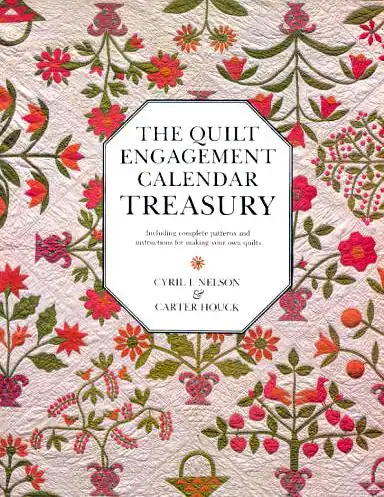
Does anybody have a copy of the Quilt Engagement Calendar from 1985 that I could borrow? I promise to send it right back, as soon as I have scanned the stenciled quilt that I have heard is the image on plate 28. I am working on an exhibit of stenciled textiles for a museum here in Massachusetts, and I’d love to add this information to my research notebook. Please contact me off-list and I will give you my address.
Many thanks!
Lynne Bassett
<kkiefer@> Date: Thu, 23 Oct 2003 18:42:53 -0400 X-Message-Number: 7
Hi Jean,
You can request a Materials Safety Data Sheet (MSDS) from Sullivan’s which should help in determining if Toluene is still a component of their basting spray.
Just e-mail or call the company. I believe manufacturers and distributors are required to provide an MSDS upon request.
Kathleen Kiefer Textile conservator Winterthur Museum, Garden & Library Winterthur, DE
Subject: Basting spray From: The Lesters <jeanlester@> Date: Wed, 22 Oct 2003 07:24:29 -0400 X-Message-Number: 2
I have read the research on the effects of light and aging but I have not seen any recent reports on the human toxicity from the basting sprays. I know that when Sullivan’s came out it supposedly had Toluene in it. I have worked in medical research and know that toluene can be absorbed through the skin as well as being absorbed by the lungs. Not good stuff for the human body!!!
Does anyone know if the present sprays still contain this substance.
Jean
Date: Thu, 23 Oct 2003 | From: “Julie Silber”
Hello All, Julie Silber here. Three things:
1. It was great to be at AQSG in Dallas and meet many of you. I love putting faces to names, don’t you? (We’ve got to keep meeting like this!)
2. In answer to ANOTHER Julie who wrote: “Finally, an Amish Quilt Question. I haven’t had the opportunity to see any Amish Quilt backs. Have only seen them in shows or books. Are wool Amish quilts backed and binded with wool or is cotton, other fabrics used? Do they normally have batting and if so, wool or cotton?”
Amish quilts made between 1880 and 1950 (or so) almost all have cotton backs. In Lancaster, PA (where the fronts of Amish quilts are typically wool), the back is usually cotton — almost always darkish in color, and sometimes even a subtle print! Bindings are usually wool.
In the Midwest (broadly speaking) Amish quilts tend to have cotton backs in solid colors, sometimes white. But also navy, grey, and several blues, etc. Rarely, if ever, printed. (Never say never — I have not seen a printed back.) Bindings of Midwest Amish quilts are typically cottons.
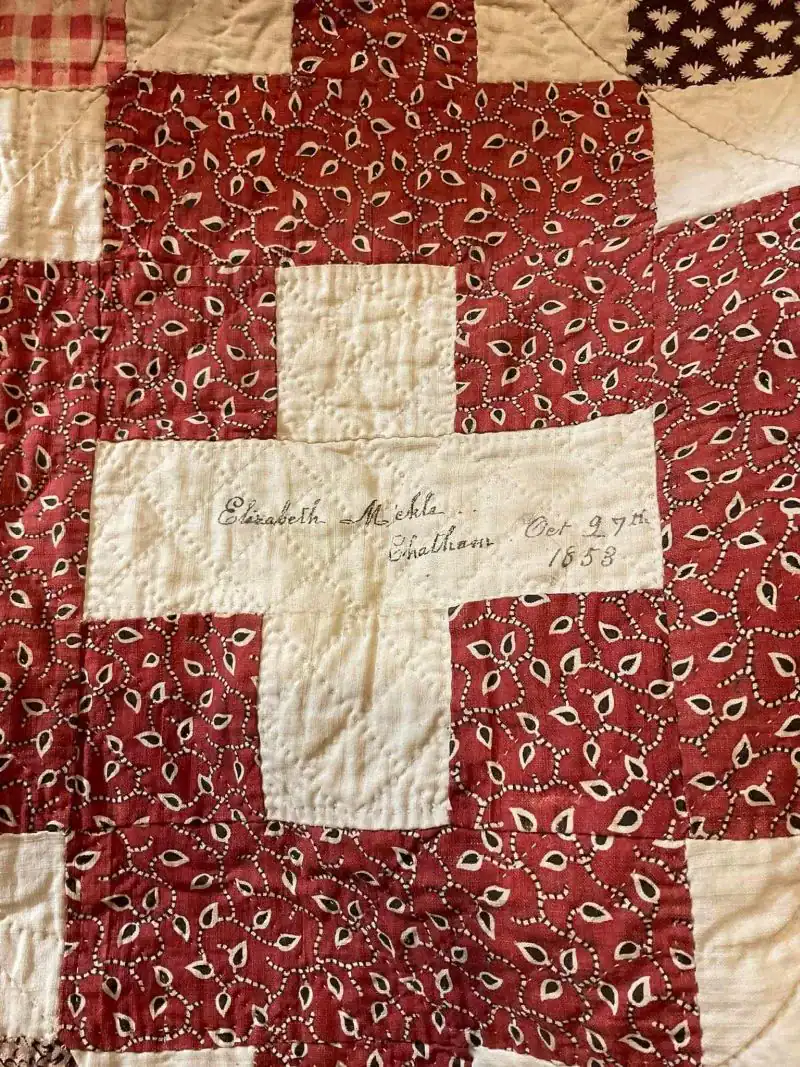
3. We have a quilt with what I first thought was a rare addition. Now I’m not so sure. A scrappy Irish Chain (signed and dated) 1856 has appliquéd folky four-lobed figures in the alternate (white) blocks. Not sure of origin of this quilt. (See it at eBay #2566659217) …
However, very recently I was looking through our small Pennsylvania Pieced Pillowcase collection, and I found a scrappy Four Patch pair with an almost identical added embellishment — this time a four-lobed figure in indigo print.
What gives? Is this common? Is it perhaps a Pennsylvania feature? A PA German embellishment? Or…????
If you can not get to the images, e-mail me and I can send them to you directly. quiltcomplex@ THANKS!
—
My white cotton panties ALWAYS pick up the dye from DH’s stray dark (new) socks that somehow find their way into the wrong load. I never thought to use them as a dye detector when pre-washing fabrics. Now if I can only find some that are still white… Laura in Seattle
Dear list, I appologise for a non- quilt related question but many of you have the right “demographics” to have an answer to my question. I need the name/make/ model of a lightweight, folding wheel chair for my mother to use when she arrives at her destination. She needs it for going down the hall to the doctors, or in the drug store, etc. She would always have a companion ( my 87 year old father or me, mostly) to take it out of the car and push her. I did a search, but there are so many choices! My local health services store is run by (very nice) Middle Eastern folk who do not speak adequate English and are in the business of selling what they carry, not giviing advice on the various choices. Please email me off list if anyone has any advice. Thanks Newbie Richardson pastcrafts@
Date: Fri, 24 Oct 2003 10:07:02 -0400 | From: “crossland_n_j Crossland” <crossland_n_j@>
Sharon Newman, Thanks for your quick, friendly reply. I’m sure you will have
no trouble getting a job. You are a bundle of energy and are so talented. I
so enjoy listening to you speak and you have probably forgotten more than I
ever knew. Although, whenever I’ve asked you something you don’t seem to
forget a thing. The wool Amish Quilts: I know from a Joe Cunningham (one of
the authors) book on Amish patterns that the bindings were wide, an inch or
more. On a wool quilt, were the bindings done in cotton also like the backs?
Thanks, Julie Crossland in NH where it finally gave up and snowed yesterday.
Date: Fri, 24 Oct 2003 09:28:56 -0500 | From: “Maurice Northen” <3forks@>
Julie, Yes, yes, don’t you love that Southern hospitality, with such
knowledge!! Sharon is the best!!! Please talk to me about some vintage quilts
from NH that I just saw. They are dated 1887, Crazy coverlets with 6″
cotton/flax lace? Joan of the South e-mail: 3forks@ —-
Date: Fri, 24 Oct 2003 | From: “Ann-Louise Beaumont” <albeaumont@>
Lynne, I’m sure you know better than I about the stenciled quilt that the
Amherst Historical Society has in its collection, so I’m mentioning it now
for the list. This was the first stenciled quilt I had ever seen and as far
as I’m concerned, no other one even comes close to it. Instead of a somewhat
sterile symmetry seen in most stenciled quilts, this is vibrant and exuberant
and life is just busting out all over it. It has fruit trees (pears and
cherries and apples?) in pots, and rose bushes in pots, and baskets of fruit,
and rose wreaths, and tulips (?) and stars and grapevines with leaves and
grapes. It’s wonderful and I wish pictures of it were in the literature along
side with all the other ones. In the realm of pure speculation, I have
wondered if this is a precursor of the Baltimore Album style quilt, since the
rose wreath and basket of fruit images appear there too. Best Wishes,
Ann-Louise Beaumont in Greeley, CO
Date: Fri, 24 Oct 2003 11:52:15 | From: “Lynne Z. Bassett” <lzbassett@>
Does anybody have a copy of the Quilt Engagement Calendar from 1985 that I
could borrow? I promise to send it right back, as soon as I have scanned the
stenciled quilt that I have heard is the image on plate 28. I am working on
an exhibit of stenciled textiles for a museum here in Massachusetts, and I’d
love to add this information to my research notebook. Please contact me
off-list and I will give you my address.
Many thanks!
Lynne Bassett
Date: Fri, 24 Oct 2003 16:18:27 -0400 | From: Vivien Sayre <vsayre@>
Lynne, I have a picture of a Stenciled Album spread c1854, New York State, in
the Quilt Engagement Calender 1986. It is done in blocks and a center
medallion formation and contains floral vines, birds, stars, stylized floral
wreaths, etc. Is this the one you are looking for? Viv
Date: Fri, 24 Oct 2003 17:46:16 -0500 | From: Gail Ingram <gingram@>
At the Dallas AQSG meeting, Karen Alexander mentioned the forthcoming book
about the history of the founding of the Quilters’ Hall of Fame. As I recall,
it had a stellar cast of contributors. Karen described the photography and
artwork as particularly beautiful.
Can anyone provide publication facts and date/place it will be available?
Thanks,
Gail
Date: Fri, 24 Oct 2003 | From: “Phyllis Twigg”
Just to let you know, we have only 3 openings left for the 2004 FVF Seminar. If you have been planning to attend, please send your check ASAP to Peggy and John Armstrong. We will maintain a waiting list should additional folks be interested. The Amish dinner event is filled. Looking forward to a fun March weekend in Amish country, Phyllis Twigg
Information about the seminar can be found below:
The FVF Quilt Study Group of Maryland has finalized plans for the 2004 Textile Seminar in Bird-In-Hand, Pennsylvania. The dates are March 5-7, 2004 at the Bird-In-Hand Family Inn in Bird-In-Hand, Pennsylvania. The speakers and topics will be as follows:
1. Judi Gunter – “Antique Doll Quilts: A Mirror of Their Times” 2. Barb Garrett – “The Fabulous World of Feedsacks” 3. Fran Fitz – “Conservation, A Practical Approach” 4. John and Peggy Armstrong – “Antiquing With John & Peggy” 5. Suzanne Cawley – “Granny’s Scrap Bag” 6. Cinda Cawley – “Finding Aveline: The Women Who Made the Quilts” 7. Mary Perini – Plenary Session 8. Phyllis Twigg – “To Tell the Truth: Playing Quilt Detective”
The event will open on Friday evening with the FVF Banquet at 6:00 PM at the Bird-In-Hand Family Restaurant. The weekend will include an optional Saturday night dinner ($17) at the home of a young Amish couple in Lancaster County. The Sunday morning breakfast buffet is included in the basic fee. The Seminar concludes on Sunday afternoon at 12:30 PM.
Those of you who attended in 2002 will remember the excellent Show & Tell sessions around the big table in the meeting room. We will do that again. This year we are requesting participants bring along a pair of white gloves. Time will be allowed for antiquing and/or fabric shopping in the area. March is a great time to do see Lancaster County without the presence of a multitude of tourists.
More information about the Bird-In-Hand Family Inn can be found at www.bird-in-hand.com
Reservations are now being accepted. The cost of the seminar is $200. That amount includes two nights lodging at the Bird-In-Hand Family Inn (double occupancy), the Friday night banquet, Sunday breakfast, and admittance to all 8 sessions. Persons wishing to attend the Amish Family Dinner should include $17 additional for a total of $217. Checks can be made payable to FVF Seminar treasurer Peggy Armstrong and mailed to: John & Peggy Armstrong, 110 Lincoln Road, Chambersburg, PA 17201
The seminar is limited to 30 persons and the Amish dinner limit is 22. Meals include tax and gratuity. CANCELLATION POLICY: All cancellations must be made prior to February 2, 2004. There will be a 20% administrative fee deducted. No refunds can be made after the February 2nd deadline. You may, however, arrange for another person to take your place. For single occupancy, add $55.
For additional information or questions contact Phyllis Twigg at ptwigg@
—
Date: Fri, 24 Oct 2003 21:18:58 EDT | From: KareQuilt@
Hi Gail,
Well, there are actually two books. The Quilters Hall of Fame will be
publishing its own book about our 34 Honorees in time for the Grand Opening=
in July. However, the book I think you are refering to is the book containing
my truncated story about the “history of the founding” of The
Quilters Hall of= Fame — “Once Upon A Quilt: A Scrapbook of Quilting
Past and Present” (published by Voyageur Press and edited by Margret
Aldrich) which was released October 10.= There are 12 contributors in order
of appearance: Merikay Waldvogel, Ami Sim= ms, Sydney Dayre, Mary Eleanor
Wilkins Freeman, Carolyn OBagy Davis, Sa= ndra Dallas, A. B. Silver, myself,
Karen Boyer, Shelly Zegart, Helen Kelly, Elsie Singmaster, Marjorie Hill Allee,
plus two anonymous articles. It is hardback= , full of beautiful photographs
of quilts (many from Stella Rubins collection= ); antique ads related to
sewing; antique and vintage photographs of women quilting and= people
standing before the backdrop of an old quilts; as well as artwork of=
quilting scenes by Adele Earnshaw, Judy Wickersham, Rebecca Barker, Carolyn
Watson, Warren Kimble, Pauline Eble Campanelli, Doug Knutson, Dennis McGrego=
r, Pauline Jackson, Diane Phalen, Dan Campanelli, and Judith W. Huey. It is
sim= ply gorgeous to look at and contains 15 different stories — some
humorous. I am= planning to do buy in balk (if I get enough orders) then sell
at full price= and donate the difference to QHF. Thats what I did with the
other book= that published one of my stories in March 2001 — only it was
softcover and didn= t have any photos. Just another little way to try to help
get QHF and the restored Marie Webster House up and running so everyone can
enjoy it and come do research, if they so choose. Yes, we do eventually hope
to have a research l= ibrary and file room open for the serious researcher.
If you would like to order th= e book from me, Gail, (or anyone else) just
email privately.
Karen B. Alexander Independent Quilt Historian KareQuilt@
Date: Sat, 25 Oct 2003 11:42:22 -0400 | From: “judygrow” <judygrow@>
My friend, QHL list member, and AQS certified appraiser, Debbie Roberts has just put out 2 DVD’s with included CD’s on “Determining Value” The ABC’s of Quilt Appraisal” and “It’s Not a Mystery Anymore: The ABC’s of Quilt and Fabric Dating.”
She is offering a $15.00 coupon for those lucky folks going to Houston. See the ads and print the coupon at http://www.quiltappraiser.com. Xenia Cord’s and Mary Koval’s booths will both stock the disks.
The two packages are advertised at http://www.quiltmedia.com
I’ve gotten the “Quilt Appraisal” one and it is chock full of wonderful information and images. Even professionals will find this informational and extremely useful. I’m waiting for my Quilt and Fabric Dating one to arrive in the mail.
If you forget, you can go to http://www.quilthistory.com/. Kris has the coupon on a pop up.
Judy in Ringoes, NJ judygrow@
Date: Sat, 25 Oct 2003 16:47:44 -0400 | From: <mreich@>
I have two articles that are very similar from 1891 and 1895 regarding tied comforts or as they are referred to at that time “comfortables.” I know that there was some discussion earlier about tied quilts and the earliest ones. As usual, the articles are chockful of information about prices, the socio-economic status of tied comforts at that time and the materials to use. I thought that you all might find them of interest. sue reich
Bismarck Daily Tribune Bismarck, North Dakota September 13, 1891
How to Make a Bed “Comfortable.”
It is a simple matter to make a bed “comfortable” which will cost three or four dollars in the shops already made up may be purchased for one dollar. The patent cotton batting which comes in even layers stitched in place by machine saves all annoyance in arranging the cotton, and may be as easily laid on as cotton cloth. The prettiest material for covering a “comfortable” of cotton is common cheesecloth. It requires five yards for each side of a “comfortable,” and from three to four rolls of patent cotton – batting. This amount of material makes a “comfortable” two and a half yards long by tow wide, a size larger than is usually found for sale. A pretty one may be made of pale blue cheesecloth on one side and pale blue worsted and buttonholed with blue worsted around the edge. Cream white and lavender make another dainty combination. These light, inexpensive bed coverings are especially useful in cottage homes, where they give in summer all the warmth needed on hot nights. One of the prettiest “comfortables” of this kind made be made of pale yellow cheesecloth tacked with yellow worsted. It looks particularly well at the foot of a white counterpane in a white and yellow room. The process of making is simple. If you do not have a quilting frame the materials can be spread over a bed. It is not so convenient, however, and if you have a number of “comfortables” to make it pays to get a quilting frame. In any case, however, put down one side of the cheesecloth. It should measure two yards by two and a half. Roll out the cotton and lay it evenly on this, tacking the breadths of cotton together, where they lap, with long basting threads. Put the upper side of the cheesecloth over all evenly. Begin nine inches from he edge to put in a row of tacking, making each tack firm with a little knot. Continue the tacking nine inches apart. Make a second row, beginning the tacking nine inches from the first row, but alternating so that they fall between and not opposite the other tackings. Continue till the “comfortable” is finished, rolling it up as it is tacked. When it is all done turn in the edges, stitch them together evenly and cover the edge with coarse buttonhole stitch in worsted. — New York Tribune.
Edwardsville Intelligencer Edwardsville, Illinois November 8, 1895
Bed Comfortables.
Suggestions Concerning the Making of These Convenient Bed Coverings.
There are many people of abundant means who maintain that the day of the comfortable has gone by and that blankets are the only bed covering that should be used. This is on the ground that that which is the best is the only thing to use. This is a desirable enough theory, providing every one has means to secure the best. But a large majority of persons must be content with something that will suffice, though it is not the best, and a great many families will continue to use comfortables in winter because they are a warm, economical bed covering. For the benefit of this latter class is here appended some helpful remarks on the subject from the New York Tribune: It requires for one comfortable about ten yards of cheesecloth, or some such sheer cotton goods, which may be purchased at 6 cents a yard, and three of four bolts of patent cotton batting and half a skein of Germantown yarn. These materials will cost about $1.25 or $1.50 and will make a comfortable 2 yards by 2 ½ yards in size. Smaller duvets, or comfortables, for the foot of the bed are made a yard wide and 2 ½ yards long. When a more luxurious comfortable is desired, old summer silk skirts may be dyed in gay colors and used for the purpose. Wool, which costs a little more than the best cotton, but is much lighter, may be used to fill these silk comfortables, and the result is a bed covering as light and also warm as the best California blanket. Where there is a quilting frame in the house, and the comfortable is filled with patent cotton, it is an easy matter to make one. The peculiarity of patent cotton is that it laid and stitched about every nine inches in its width, so that the labor of laying and smoothing down the cotton, the hardest part of the work in making an old fashioned comfortable, is practically done away with. Begin by stretching the under part of the comfortable on the frames and rolling out the cotton on it, laying it in place and basting the breadths together where they lap. After this put on the top cover and baste the edges of the comfortable together and secure it in the frame. Nine inches from the edge tack the comfortable with the Germantown yarn, tying the tackings sown with No. 8 cotton. Nine strands of wool are sufficient for a tacking. Separate the tackings by nine inches, and when one row is done on the quilting frame roll it up that distance and begin nine inches from the first, but between, not opposite, the others. Continue until the entire bed is tacked. After this is done remove the comfortable from the quilting frames, turn it in around the edges stitching them closely together with the machine, and buttonhole the edges with Germantown yarn.