April 20 – 21, 2004
These restored messages come from the Quilt History List, an online forum where quilt historians, collectors, researchers, appraisers, and enthusiasts discussed antique quilts and related textiles. The archive dates from 1996 through approximately 2016 and is being restored gradually. Sign up in the form at the bottom of the page if you want to know when a new page is added. Original spelling, opinions, formatting, and inactive links may remain unchanged.
Primary topics of this QHL Digest:
- Simply Quilts UGRR Episode Debate — Members react to a Simply Quilts episode on Underground Railroad quilt codes, weighing in on the historical accuracy of the claims.
- Piecing on the Journey West — A discussion of whether pioneer women actually pieced quilts while traveling the wagon trails, with poems and family stories offered as evidence.
- Caring for Treadle Machines and Storage Furniture — Members trade tips on sealants, pine cabinets, and armoire storage for antique sewing machines and quilts. (see the article on caring for antique quilts)
- American Fancy Exhibit at the Milwaukee Art Museum — A member recommends a decorative-arts exhibit tracing “fancy” aesthetics in early American textiles and quilt patterns. (see the article on quilt museums)
Date: Tue, 20 Apr 2004 16:44:31 -0400 | From: Vyvyan L Emery <vyquilter@>
Hello list folks,
I just saw a small article in a local paper, excerpted as follows:
“First Public Display of 38 Antique Quilts at 1st Annual Gold Festival Thirty-eight intact antique quilts will be on display Saturday, April 24, at the 1st Annual NC Gold Festival in McDowell County, NC on the grounds of the historic Carson House in Pleasant Garden. Arthur and Zee Campbell will be displaying there private quilt collection for the first time ever. The rare collection of quilts date 50 to 200 years old. The Campbells will also be showing historic quilting frames, blanket chests and an antique sewing cabinet. The couple discovered the historic quilts and sewing items five years ago while restoring their c. 1826 home… The quilts have been dated and examined by a curator form the Biltmore Estate in Asheville… For more information on this collection please call 828-738-9798 or e-mail the Campbells at thecottages@.”
The Carson House is located on Hwy. 70 outside of Marion, NC which is about 30 miles east of Asheville on I-40. Admission is free. I have no affiliation, just thought it sounds interesting if anyone is in the area. I do plan on attending.
Vyvyan E. in WNC
Date: Tue, 20 Apr 2004 18:04:05 -0400 | From: @aol.com
Um, that’s interesting. It sounds rather like backpedaling to me, and is yet another reason why I wish to God Ms. Tobin would release transcripts of her interviews with Ozella Williams. *argh*
Karen Evans
Date: Tue, 20 Apr 2004 15:06:39 -0700 (PDT) | From: Kris Driessen <krisdriessen@>
Remember, the 500 series of Simply Quilts was filmed in 1999…
Kris
Date: Tue, 20 Apr 2004 21:13:35 -0700 | From: “Margaret Geiss-Mooney” <mgmooney@>
Meg the nag here this evening – Remember to let the polyacrylic paint/sealant dry out/air out for at least a week before putting anything as absorbent as quilts in the same space. Preferably with a fan blowing out the space, to increase the off-gassing of the applied finish.
Regards, Margaret (Meg) Geiss-Mooney Textile/Costume Conservator mgmooney@
—–Original Message—– From: Patricia L Cummings [quiltersmuse@] Sent: Monday, April 19, 2004 2:39 PM To: Quilt History List Subject: [qhl] storage of quilts
Forgot to mention that polyacrylic can be applied over wood, either bare or painted, and makes a good sealant.
Avoid using polyurethane as it will emit fumes that are damaging to quilts.
Pat
Date: Tue, 20 Apr 2004 21:18:44 -0700 | From: “Margaret Geiss-Mooney” <mgmooney@>
And while I’m on the subject 🙂 If the heavy plastic you mean is acrylic (i.e. Plexiglas, Acrylite) and not polyethylene sheeting, then that is OK. The polyethylene sheeting you get from the hardware store has slip agents added to it to the melt and so can’t be considered archival for that “close intimate contact” that a quilt setting directly on top would have. Or put down a folded sheet so the thickness is at least 3/8″ (and then rinse the sheet in good-to-excellent quality water periodically, with no detergent and air dry, no dryer sheets). Enough? Enough! 🙂 Margaret (Meg) Geiss-Mooney Textile/Costume Conservator mgmooney@
—–Original Message—– From: Judy Kelius (judysue) [judysue@] Sent: Monday, April 19, 2004 10:57 AM To: Quilt History List Subject: [qhl] Re: storage – pine
Hi Margareta – I would certainly suggest that you put something between the wood and the fabric to be safe. How about a heavy piece of plastic? That
way you could still see the wood but would protect the fabrics from the acid in the wood. This sounds lovely! – Judy
At 11:00 AM 4/19/2004, you wrote:
>Hello everyone, >I’m sure one of you experts out there can tell me if it’s safe to store >quilts in a (newly made) pine cabinet. The wood is waxed but not sealed. >Should I perhaps cover the shelves with something before putting my quilts >on them? >I’m quite excited about this piece so I’ll describe it- bought from a >company specializing in replicating traditional European furniture (sorry, >no website). It’s a copy of a French “meuble =E0 farines” – maybe staple goods >such as flour were stored on the shelves, but then, on one side, there are >drawers for storing jam pots – and when mother turned the key and locked the >door to the shelf part, the drawers were partly inside the door too, so >noone could steal the jam! >Anyway – happy to hear advice about storing quilts there. >Margareta > > >— >
Date: Wed, 21 Apr 2004 08:54:52 +0100 | From: “Sally Ward” <sallytatters@>
Wouldn’t walking for mile on mile every day be boring, and would it be possible to walk and piece?
Sally W
Date: Wed, 21 Apr 2004 06:55:11 -0500 | From: patkyser <patkyser@>
Karen, your report on the Kentucky quilt exhibit is thorough and very inspiring. Thank you so much. If I have to drive up there alone, I am going to see this one. I did not go to the Calico exhibit in Louisville because I never found anyone else interested. However, thanks to your report, I am not going to let that happen this time. Re: Simply quilts and UGRR – my sister in Texas, a non-quilter, called, VERY impressed with the show and feeling sad that “there are no slave quilts left.” I set her straight but ended up feeling she maybe did not think I knew as much about it as Anderson’s guests did. Pat Kyser in Alabama
Date: Wed, 21 Apr 2004 10:29:34 EDT | From: Jccullencrew@
In a message dated 4/21/2004 3:55:58 AM Eastern Standard Time, sallytatters@ writes: Wouldn’t walking for mile on mile every day be boring, and would it be possible to walk and piece? Wonder if walking and working on rick rack would work…it would position the needle for you almost automatically as you walked…
lol…but always trying to find a way…
Carol Grace
Date: Wed, 21 Apr 2004 10:38:36 -0400 | From: “Pepper Cory” <pepcory@>
Hello-I tried that email regarding the western NC quilt exhibit and the mail bounces back. Can you check if that’s the right email address? Many thanks- Pepper Cory
Date: Wed, 21 Apr 2004 10:51:53 -0400 | From: “Anne Datko” <datkoa@>
Had seen the Simply Quilts UGGR show before.. but what struck me yesterday was that Tobin never referred to Dobard by name. Once she said, “….my co-author…” AnneD ——=_NextPart_000_0045_01C4278E.A87E3820–
Date: Wed, 21 Apr 2004 17:31:11 +0000 | From: “jocelynm@” <jocelynm@>
On April 21, 2004, Sally Ward wrote:
> Wouldn’t walking for mile on mile every day be boring, and would it be > possible to walk and piece? > Sally, I’m sure it WAS boring. I looked in my TREASURES IN THE TRUNK book very qui ckly, and it lists in each time bracket one quilt that was pieced on the ro ute. Considering the hundreds/thousands of women who came west, that’s not a lot, even when you consider there are quilts that didn’t survive to be re corded.
Personally, I can walk and knit at the same time, but I cannot do either atfull speed. Knitting is MUCH more conducive to low-light conditions, and families would be wearing out socks right and left (so knitting to replace t hem would be necessary). I figure that at the speed at which I knit socks, it would be a full-time task to keep socks on myself, a husband and 4 kids.= 🙂
Probably there were women who could walk fast enough to keep up AND piece at the same time. I’m guessing they weren’t piecing Mariner’s Compasses or doing applique, though. <G> And I’ll bet that for every one of them, there w ere a hundred women who succumbed to the monotony and unending physical andemotional demands of the journey, and just didn’t have the energy to piece.
Date: Wed, 21 Apr 2004 14:29:21 EDT | From: Midnitelaptop@
i spent the morning replacing a block in a quilt i made a few years ago… first i thought i would just replace a few of the pieces of the block… well, i soon found out the time used unsewing parts of the block was far better spent making a new block..(i had saved original fabrics for this very occasion) let me say there’s a rhythm established in making an original quilt… that doesn’t seem to exist when a block is taken out of context(of course these are personal feelings and may not be true for everyone) anyway…it seems to me i spent more time making and replacing this one block than it would have taken to make a whole row of blocks for a new quilt. of course i admit i did spend a sizable amount of time kicking the ironing board legs..and making necessary trips to the little bowl of M&Ms(to soothe my bubbling soon to erupt frustration)
once again Bravo!!! quilt repairers and restorers…you are definitely worth more than any money you receive for your labors… jeanL
Date: Wed, 21 Apr 2004 13:34:27 -0700 (PDT) | From: Judy Schwender <sister3603@>
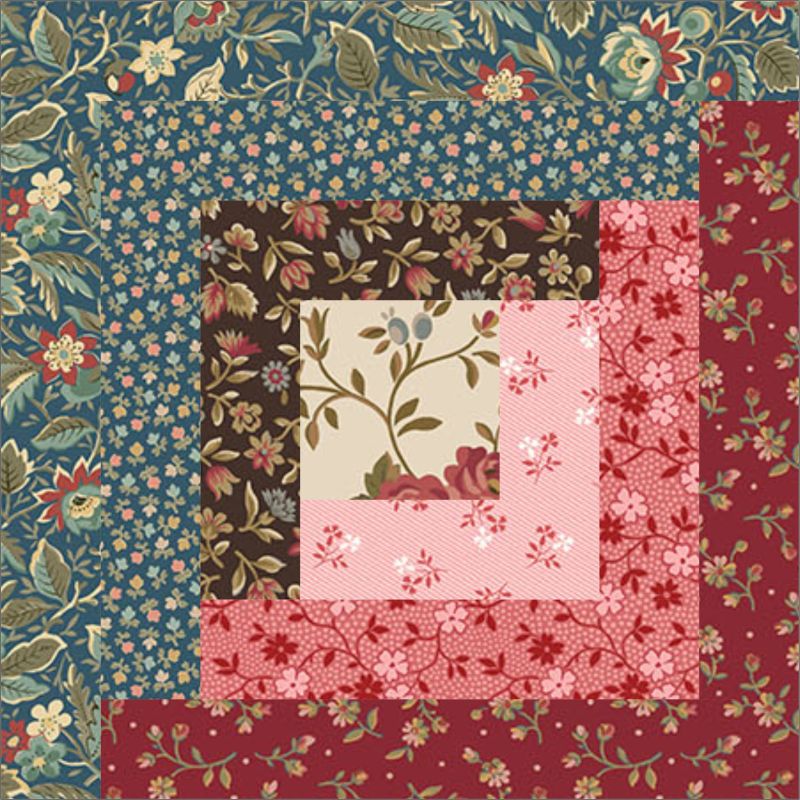
Hello- I have received several replies to my inquiry with regard to date and name inscribed Log Cabin quilts. Barbara Brackman’s 1869 listing was mentioned. The Minnesota Historical Society has a Pineapple quilt made by Lucy Lee Lamson dated 1865. You can see it and a detail at: http://www.mnhs.org/collections/museum/8297.html Thank you to Linda McShannock, curator, for this information. If you know of friends, family, fellow guild members, or local museums that have signed and/or dated Log Cabin quilts I would very much appreciate any information about them. I realize this is my second shot at this so thanks very much! Judy Schwender International Quilt Study Center Lincoln, Nebraska
Date: Wed, 21 Apr 2004 19:03:48 -0500 | From: “Jocelyn Martin” <jocelynm@>
>> Fact is, quilting, at least portable piecing, was done anytime. Maybe not on a jouncing wagon but how about in a moment of private time after dinner? Never under-estimate our grandmamas’ fortitude
Pepper, OTOH, we shouldn’t underestimate the toll riding in a covered wagon would put on a body. 🙂 Follow a day’s jolting, with a vigorous walk to collect buffalo chips for fuel and tote water from the creek, preparing a dinner over a campfire, and the occasional boiling of laundry or mending of their clothes, rest might have been more of a priority than creativity. Not to mention, the lack of light. If you didn’t know where you’d get more, you wouldn’t want to use candles unnecessarily. Don’t know about you, but there are plenty of days I come home and sit like a lump after dinner, ‘too tired’ to get out my needlework- and I didn’t have to milk a cow, dress out whatever game my husband shot for dinner, boil water to wash the children, dishes and clothing, or ride ten hours in a vehicle without springs. Although I suspect our campus buses don’t have much more shock absorption than a Conestoga. <g>
From: “nomad1@”
On April 21, 2004, Sally Ward wrote:
> Wouldn’t walking for mile on mile every day be boring, and would it be > possible to walk and piece? > Hi Sally, I can actually get 6 stitches at a traffic light! Those days in pre quilt days I used to get aggro when stuck in traffic jams Now they don’t faze me at all, as I just paper piece my beloved hexagons! Once I was stuck behind=
this mega truck and was reading at that time, when a beaming guy tapped on=
my window I wound down the window and was most embarassed when he told me gently that the truck was now parked!! Aaaargh! yes, i felt a twit indeed!=
I adore finding opportunities to use time in a fun way, even at boring moments! I have not had any luck at the dentists!! SoI can well imagine our quilt sisters using every possible opportunity to piece etc Smiles to all, Hiranya from Sydney, Australia : >
ps Teddy and Debbie, did you get the mug shots from Houston?
From: Babette Moorleghen
Hello, my name is Babette and I am so excited about finding this list! I have been collecting antique quilts and quilt tops/blocks, patterns, etc. for many years now and just found your list while doing a search on quilts at the 1904 World’s Fair in St. Louis. I’m looking forward to asking questions and learning more about this obsession I have! Now, my to my first question: Can someone point me to where I can find info on the quilts that might have been displayed in the 1904 World’s Fair in St. Louis? I have been asked to do presentation on this and would like to get more information. Thanks. Hugs, Babette in Illinois
Date: Thu, 22 Apr 2004 | From: cberry@
At guild meeting Monday night, our speaker was Donna Kohler, a woman who does all her piecing, embroidering and quilting on a treadle machine. In fact, she has about 16 treadle and hand-crank machines. One quilt that she displayed had very close stippling; I’m still thinking about that one. It was amazing.
Donna’s husband was at the meeting to run the slide projector. He commented that Donna’s machines filled their house and there was no room for him to collect anything but “thoughts.”
Anyone on QHL who uses a treadle? I was especially fascinated by the hand-crank machines. I think it would be difficult to turn the crank with one hand while guiding fabric under the needle with the other.
Carol Berry Merced, CA
Date: Thu, 22 Apr 2004 | From: Midnitelaptop@
everything aches today…and i would love to sit in bed and have someone tell me stories…. would love to hear some “most memorable moments” in….quilt collecting, restoring, repairing … anybody want to help me forget that on this soggy day in new england.. my contrary knees just don’t want to bend…
thanks jeanL
Date: Thu, 22 Apr | From: sadierose@
Jean, Here are a couple of poems to keep you company….
The Land of Counterpane
From Child’s Garden of Verses By Robert Louis Stevenson
When I was sick and lay a-bed, I had two pillows at my head, And all my toys beside me lay, To keep me happy all the day.
And sometimes for an hour or so I watched my leaden soldiers go, With different uniforms and drills, Among the bed-clothes, through the hills;
And sometimes sent my ships in fleets All up and down among the sheets; Or brought my trees and houses out, And planted cities all about.
I was the giant great and still That sits upon the pillow-hill, And sees before him, dale and plain, The pleasant land of counterpane.
***************
As from the house your mother sees You playing round the garden trees, So you may see, if you will look Through the windows of this book, Another child, far, far away, And in another garden, play. But do not think you can at all, By knocking on the window, call That child to hear you. He intent Is all on his play-business bent. He does not hear, he will not look, Nor yet be lured out of this book. For, long ago, the truth to say, He has grown up and gone away, And it is but a child of air That lingers in the garden there.
Robert Louis Stevenson
Date: Thu, 22 Apr 2004 | From: Joan Kiplinger <jkip@>
Okay, Jean, here’s a story. This is in regard to women quilting during wagon train travels. My grandmother, born in 1869, traveled as a young child in a covered wagon contingent from Kansas City area to Northeast Ohio and were chased by Indians during part of that trip. This would be about mid-1870s. I don’t know how many wagons as they would pick up other convoys heading in their direction. She always joked about the fact that her grandmother was Cherokee and didn’t understand why her parents didn’t let those “bad” men know they were related. Often when she stayed with us and when I balked at having to do dishes, she would remind me about what children her age did, and one involved this trip. Everyone was assigned duties and rotated these assignments. Thus some weeks there would be a group of men dividing patrol alerts and various male chores, then they would change off. Women’s groups were washing, cooking and mending/ sewing with older children minding the youngins and running errands and everyone would pitch in during emergencies or for sick care. They would exchange duties each week or so. I would imagine there might be some quilting time available with this division of labor. Hope you feel better and aches disappear.
From: Vyvyan L Emery
Pepper, The e-mail is thecottages@. That is what was printed in the paper where I saw the article. Maybe try the phone #. Sorry, but that’s all I know. I wonder if picture taking is allowed. I plan on bringing a camera just in case and will also take notes. Hope you can contact them and that you’ll be able to attend.
Vyvyan
From: Kris Driessen
If you are an appraiser in that area, please respond to her directly at dc@
“I have a quilt that a 94 year old friend gave me and said his grandmother made it. How do I find an appraiser to find out its age and worth? I’m in the Seattle, Wasington area. Thank you for your time and consideration! Deonna Clarkson dc@
Kris
From: “LR Cawley”
Not quilt related, but as a devotee of RLS here is my contribution. Cinda on the Eastern Shore
Give us grace and strength to forbear and persevere. Give us courage and gaiety and the quiet mind. Spare to us our friends; soften to us our enemies. Bless us if it may be in all our innocent endeavors; if it may not, give us the strength to encounter that which is to come that we may be brave in peril, constant in tribulation, temperate in wrath and in all changes of fortune and down to the gates of death, loyal and loving to one another. Robert Louis Stevenson
From: “Ilene Brown” <ilene3@>
Hi, I own 3 treadles,but have not learned to use them yet. I plan on learning when I get more time, after I finish most of my remodeling of my townhouse. I, also, have a 1928 Singer hand crank in bentwood case. I have sewed with it. After a few minutes of awkwardness, it actually was not that bad. Also, I found that I was able to wind the best, most even bobbin on it than I ever have been able to on an electric. I now own 17 machines. I’m addicted. Ilene of Raleigh, NC
Date: Fri, 23 Apr 2004 | From: Kim1964hay@
For anyone who might be interested, there is a wonderful series of books titled “Covered Wagon Women: Diaries and Letters from the Western Trails”. They are diaries of women who traveled west, the years covered are 1840s up to around the turn of the century. Kenneth L. Holmes is the editor, my first book was the one with an introduction by Lillian Schlissel.
Kim Haynes
From: Jennifer Hill <jennifer.hill@>
> >Anyone on QHL who uses a treadle? I was especially fascinated by the >hand-crank machines. I think it would be difficult to turn the crank with >one hand while guiding fabric under the needle with the other.
Hands waving, jumping up and down, I do, I do! And I “know” Donna Kohler from some of my other lists. She does awsome work.
The “newest” of my 30+ machines is an almost BOL, about 20 yrs old, and the only machine I ever bought new. But now I do practically all of my sewing on machines that are much older than I am. At home, I only use treadles or handcranks, but I find lightweight electrics much more portable for when I have to go out to classes etc.
My fav machine is a 100yr old Singer treadle. I piece on several machines, but I like to quilt with this one, especially free motion. A well adjusted treadle affords unbelievable stitch-by-stitch control. How else can you get that auto needle up/down feature on a $20 machine?
I’ve sewn quilts and clothing on my handcrank machines. I’m currently embellishing a Baltimore-type applique block with chain stitch embroidery using my 1900 Singer model 24. You quickly get used to manipulating the fabric with only one hand. Of course, FM work is difficult to imagine, but straight line or gently curving quilting lines are quite easy.
In the pre-plastic era, sewing machines were built to last several lifetimes. They are very simple to operate and maintain, and the main working parts just never wear out.
Jennifer Hill Calgary, AB