April 21 – 27, 2005
These restored messages come from the Quilt History List, an online forum where quilt historians, collectors, researchers, appraisers, and enthusiasts discussed antique quilts and related textiles. The archive dates from 1996 through approximately 2016 and is being restored gradually. Sign up in the form at the bottom of the page if you want to know when a new page is added. Original spelling, opinions, formatting, and inactive links may remain unchanged.
Primary topics of this QHL Digest:
- English Paper Piecing Through the Ages — A rich thread on the history of English paper piecing, including what papers were used before printed templates and its modern resurgence in Australia. (see the article on Grandmother's Flower Garden quilts)
- Caring for a Vintage Singer 301A — Tips for cleaning and removing musty odor from a newly acquired vintage Singer sewing machine.
- A Scherenschnitte-Style Mystery Quilt — Members work out that a puzzling reverse-appliqued quilt uses the Pennsylvania German scissor-cutting (scherenschnitte) technique.
- Museum Photography and Copyright — Continued discussion of the etiquette and legality around photographing museum-collection quilts for publication. (see the article on quilt museums)
- Batik and Textile Exhibits Worth a Visit — Recommendations for a batik exhibit at the American Textile History Museum and other collections worth seeing in person.
Date: Thu, 21 Apr 2005 10:56:16 -0400 | From: “Candace Perry” <candace@>
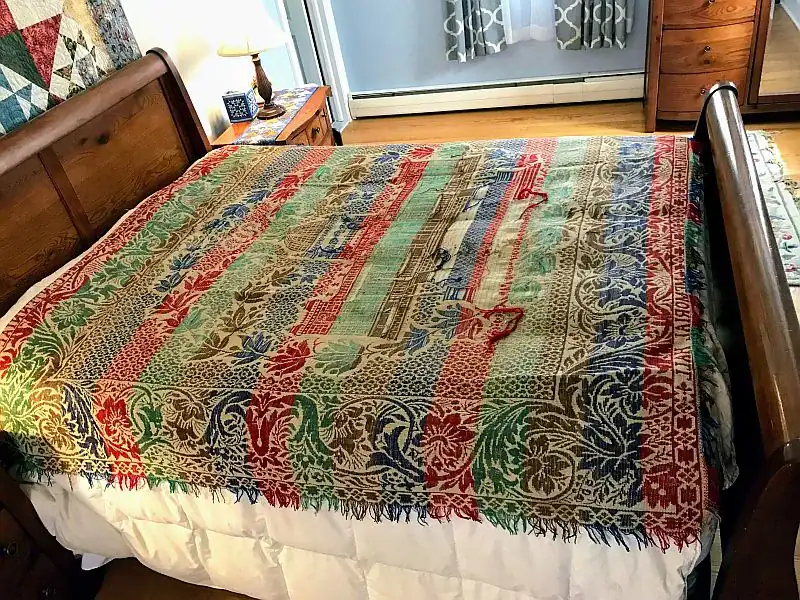
From all of your excellent descriptions (what would a generalist curator do without you fine people?) I am pretty certain this is NOT candlewicking, and is a Bolton-type coverlet. I’m going to proceed with that assumption… Thanks so much, Candace
—–Original Message—– From: Lynne Z. Bassett Sent: Thursday, April 21, 2005 7:51 AM To: Quilt History List Subject: [qhl] Re: candlewicking versus Bolton style coverlets
For those who might be interested, there is also a wonderful essay about Hannah Wilson written by Donna-Belle Garvin published in _Textiles in Early New England: Design, Production, and Consumption, The Dubin Seminar for New England Folklife Annual Proceedings 1997_ (Boston University, 1999), pp. 29-47. The title of the essay is “The Warp and Weft of a Lifetime: The Discovery of a New Hampshire Weaver and Her Work.”
Best, Lynne
> This past weekend, I posted a new file on my website in which I discuss > what candlewicking (candlewick embroidery) is. The article is about Hannah > Wilson, a New Hampshire woven coverlet maker whose signature trademark was > to make Bolton style coverlets (like those made in Bolton, England). These > are mistakenly attributed to a candlewicking technique because they have > raised bumps due to their double weft loop construction. When coverlets of > this kind were loomed, there were two weft threads, one of which was > pulled up to the surface to create a 3-D effect. > > There is a link to the full article on the front page of my website. The > fascinating details of Wilson’s life, were provided to me by Donna-Belle > Garvin, the former NH Historical Society curator whoat present is in > charge of the museum’s publications. Her research over the last fifteen > years uncovered the mysteries surrounding this early to mid nineteenth > century coverlet maker.
Date: Thu, 21 Apr 2005 10:49:12 -0400 | From: “Lynne Z. Bassett” <lzbassett@>
Ooh, I hope my mother clips it for me! I didn’t find it on MassLive.
Best, Lynne
> And speaking of Lynne…she was featured, along with Jane Crutchfield, in > an article in today’s Springfield Republican about the Mass Quilt > Documentation project. I read mine in the actual paper, but the > Republican’s on-line presence is www.masslive.com. > > It was a decent article from what I could see, with a great color picture > of Lynne, Jane, and a Baltimore-style album quilt (was it the one with the > armadillo?). Nice quotes from both ladies. > > Karen Evans > > > > — > You are currently subscribed to qhl as: lzbassett@. > To unsubscribe send a blank email to > leave-qhl-1598487G@ >
Date: Thu, 21 Apr 2005 14:50:25 -0400 | From: “J. G. Row” <JudyGrow@>
http://www.masslive.com/search/index.ssf?/base/living-2/1114106877140730.xml?lnfe
I searched last 7 days for the word quilt. Here’s our Lynne.
By the way, if you have a newspaper article you want to frame, don’t! Have a COLOR copy made instead and frame that. Tuck the actual newspaper away somewhere and pull it out every now and then to see how much it has turned brown and brittle. Your framed piece will stay bright and new looking and you won’t be able to tell that it isn’t the real article.
Judy, aka the Ringoes Kid judygrow@
>> And speaking of Lynne…she was featured, along with Jane Crutchfield, in >> an article in today’s Springfield Republican about the Mass Quilt >> Documentation project. I read mine in the actual paper, but the >> Republican’s on-line presence is www.masslive.com.
Date: Thu, 21 Apr 2005 15:33:53 -0400 | From: “Lynne Z. Bassett” <lzbassett@>
Thanks for finding the article, Judy! As usual, the reporter (though she tried to get it right) mixed some things up, with rather funny results. (I always look forward to newspaper articles with trepidation–I have learned from first-hand experience that you definitely cannot believe everything that you read! At least this reporter didn’t claim that I was burying a quilt in a time capsule, as one reporter once wrote in an article for that same newspaper–an idea that he made up out of “whole cloth”–ha! sorry, couldn’t resist–but he was extremely careless and not the brightest bulb in the pack, if I may say.) The debate over the date of the quilt that’s featured in the article is not focused on any “beard protector” as reported, but on the fact that the military gentleman that is appliqued in the design has a beard–which was fashionable in the Civil War period, but not in the Mexican War period (late 1840s). That, plus the shape of the dress worn by the woman also appliqued on the quilt, points distinctly to a date in the 1860s. And the reporter completely mixed up what I was trying to say about the quilt designer in Conway. But you can read about that in an article for _The Magazine Antiques_, which I am writing now–should be out in the December issue or thereabouts.
Best, Lynne
Date: Thu, 21 Apr 2005 16:48:09 -0400 | From: Kathie Holland <kathieholland@>
Sharon I had the same problem today and Sally Ward was nice enough to send me this info. I hope it helps you too
The direct link for his quilt is
http://tinyurl.com/97gjd and http://tinyurl.com/az8tv
kathie in NJ
From: “Leah Zieber”
Hi all, Recently purchased my daughter a Singer 301A from a lady in Iowa. The machine is tops! I am very pleased with it. The only problem is there is a distinct odor in the suit case that the machine is stored in – it smells like a basement – actually, a wet basement. Am thinking maybe mold, but nothing is black or dirty. Other than “Oust” and “Lysol Spray” do you have any suggestions for removing the smell (or maybe just changing it to something nicer 🙂 Appreciate your help – Leah Temecula California where the balloons are flying again.
Date: Thu, 21 Apr 2005 21:15:47 -0700 | From: “Christine Thresh” <christine@>
Visit the ISMACS site at: http://www.ismacs.net This is the International Sewing Machine Collectors Society.
They have information about all sorts of sewing machine things. They also have an e-mail list that welcomes questions. There are solutions for smelly cases.
Christine Thresh on an island in the California Delta http://www.@
Date: Thu, 21 Apr 2005 21:41:38 -0700 (PDT) | From: Donald Beld <donbeld@>
Some other comments about the quilt I posted on vintagepictures.eboard.com–I love the turquoise fabric with what appears to be a scotty dog in it–note that one of the pieces the black stick figure is off the mark–so the fabric was probably either blocked or rollered.
If you look at the Dargate fabric book–or go to www.reproductionfabri@ and look at the 1825-85 period and the Dargate repros that Margo has done, you will see some similar repro fabrics.
The quilt, unfortunately, doesn’t belong to me and I didn’t photo graph all of the combs–there was one that was not only fussy cut, but the way the maker put it together created a “bird” sitting in the comb–on another she created a face–quite an artist.
Her whip stitches were so small that when I first saw the quilt after being told about it, I thought it was machine work and was about to tell the owner that it wasn’t pre-Civil War, but then realized that they were just tiny stitches–I would estimate 10 to 15 whip stitches to a side x 8 would be about a 80-100 stitches a cell!! all on a 3/4 inch piece!
I suspect that is why whip stitching was soon replaced by the clever American ingenuity of using a running stitch!
Sally, your questions were interesting–don’t know when whip stitching and paper piecing died out–like I said, I suspect just before the Civil War, when people started making simpler quilts for more utilitarian reasons. But, of course, paper piecing is back in today as a machine piecing technique. I don’t know how to do it, as I hand piece and hand quilt all of my work.
Best, Don
Date: Fri, 22 Apr 2005 04:59:23 -0400 | From: “Linda Heminway” <ibquiltn@>
Hi! I have been on a web e-mail list for years, called Featherweight Fanatics and have learned the precise method to deodorize an old sewing machine case. Wash the inside and outside of the case thoroughly with a mild solution of Murphy’s Oil soap and water. Air dry in the sun with the top open. Then place a bar of safeguard soap (has a nice fragrance that is strong) in it’s opened box (not directly on the interior of the case) inside the case. Shut the case and encase it in a plastic trash bag and just leave it for about two or three weeks. When you open the case after that, it should smell nice and fresh inside! Worked for me on more than one case and I keep an opened bar of Safeguard inside each of my cases to keep it deodorized. This would work on old trunks and suitcases as well, I presume. Linda Heminway Plaistow NH
Date: Fri, 22 Apr 2005 07:45:51 -0500 | From: “Laura Syler” <texas_quilt.co@>
Don, Several years ago I worked on a similar paperpieced hex quilt (top) that a client had started to hand quilt at least 20 years earlier…lost interest on the last row and stuffed it in a cedar chest. It was a family piece so she wanted to have it finished and give to her daughter as a wedding present. Didn’t really want to quilt on such wonderful fabrics, but it couldn’t be left as it was.It was paper pieced, tiny TINY whip stitches like you mention. There were still papers in the outer rows and I saved some of them. Many appear to have been letters. “Dear Mother”, “July 1843”, and “Connecticut” are visible. There was one piece of newsprint mentioning Louisiana. My humble opinion as to the demise of paper piecing is that during the time of the civil war paper was very precious, as were the messages that letters carried. Articles (such as the letters apparently used in the piece I worked on) were saved. Plus, I agree with you about the wonders of Yankee ingenuity <G>. Laura Hobby Syler
Date: Fri, 22 Apr 2005 08:43:04 -0400 | From: Patricia L Cummings <quiltersmuse@>
Dear list members,
For those of you who have taken the time to read my article about Donna-Belle Garvin’s research, you already will have seen that I mentioned the article about Hannah Wilson and her Bolton-style coverlets that Lynne Z. Bassett has mentioned in a separate e-mail to the list..
Donna-Belle is a fine researcher who has delved into genealogical records and probate records and combined the tidbits of information that she found in a book, as well as knowledge gained from museum networking, and other oral history accounts. From these sources, she was able to provide us with a comprehensive look at not only the works of the nineteenth century woven coverlet maker, but details of her life.
I feel honored to have been asked to further dessiminate this research to the public by writing an article for the antiques market, which I have now shared on our website.
I am certainly pleased and happy for any attention and honor that this story brings to Donna-Belle, someone whom I have known and admired for years. So, if folks have not availed themselves of the information shared on my website about her research, they can order the Dublin Seminar journal alluded to by Lynne..
In that particular journal, an article written by Lynne Zacek Bassett also appears: “The Great Leap: Youth’s Clothing in the Early Nineteenth Century”.
My particular interest in the Hannah Wilson story is that she lived and worked, all of her life, in my home state of New Hampshire.
Best,
Pat Cummings www.quiltersmuse.com
Subject: Re: candlewicking versus Bolton style coverlets From: “Lynne Z. Bassett” <lzbassett@> Date: Thu, 21 Apr 2005 07:50:36 -0400 X-Message-Number: 8
For those who might be interested, there is also a wonderful essay about Hannah Wilson written by Donna-Belle Garvin published in _Textiles in Early New England: Design, Production, and Consumption, The Dubin Seminar for New England Folklife Annual Proceedings 1997_ (Boston University, 1999), pp. 29-47. The title of the essay is “The Warp and Weft of a Lifetime: The Discovery of a New Hampshire Weaver and Her Work.”
Best, Lynne
Date: Fri, 22 Apr 2005 09:30:51 -0400 | From: “Lynne Z. Bassett” <lzbassett@>
Dear Pat,
I apologize if you think that I was inferring that you had not given D-B Garvin enough credit! You very clearly stated that she was your source in your initial email. It’s just that as a member of the steering committee of the Dublin Seminar for New England Folklife, I like to take every opportunity to promote the Seminar, its publications, and its authors. (Thanks for mentioning my essay in the same volume, though it was one of my first, and certainly not one of my best publications. The lecture was better.)
In hopes that this clears up any misunderstanding, Lynne
—– Original Message —– From: “Patricia L Cummings” <quiltersmuse@> To: “Quilt History List” <qhl@> Sent: Friday, April 22, 2005 8:43 AM Subject: [qhl] Dublin Seminar reference
> Dear list members, > > For those of you who have taken the time to read my article about > Donna-Belle Garvin’s research, you already will have seen that I mentioned > the article about Hannah Wilson and her Bolton-style coverlets that Lynne > Z. Bassett has mentioned in a separate e-mail to the list.. > > > Best, > > Pat Cummings > www.quiltersmuse.com >
Date: Fri, 22 Apr 2005 09:08:23 -0500 | From: Mary Persyn <Mary.Persyn@>
> Sally Ward asked: > > I must admit I didn’t think there was much paperpiecing done in the US > at all. If English immigrants were bringing in predominantly that > technique, who was bringing in ordinary piecing? and how quickly were > the papers abandoned? And why, do you suppose? Does anyone do it now at > all, or only as reproduction work? Are there any other traditions that > use papers like we did?
I have assumed that the best of the New York Beauties, etc were paper-pieced. Is that correct?
I have wondered how the older versions of the Whig’s Defeat, the ones not made into blocks, could be done accurately without paper piecing. My own research so far suggests the latter pattern came to U.S. from England, which further argues for such a technique.
What evidence is there about construction of such quilts?
As for the currency of paper-piecing, I know that in the 1950’s, I saw this technique used, not for the hexagon patterns, but for centers of Double Wedding Ring, a complex Sunflower, and similar quilts that had considerable bias edges or triangles that created arcs. In all cases, the quiltmaker sewed through the paper, rather than whip-stitching elements together.
This issue is interesting. I hope those who have evidence of use of paper technique in 19th-century quilts will speak
Date: Fri, 22 Apr 2005 07:22:59 -0700 (PDT) | From: Dana Balsamo <danabalsamo@>
Hi Mary,
There are many US quilters who paper piece today. I have been paper piecing a GFG quilt for the past 5 years…I made my own pieces, though. I bring my work everywhere I go and it often is a conversation starter…I have had many quilters approach me while I work to comment and share their own stories about making one just like mine, and the different techniques involved, most paper piece though. Of all the GFG quilts I have come into contact with from the 1930s, all but one were paper pieced, the odd one was machine pieced. What a trip with all thos Y seams!
My best, Dana
Mary Persyn <Mary.Persyn@> wrote: Sally Ward asked:
I must admit I didn’t think there was much paperpiecing done in the US at all. If English immigrants were bringing in predominantly that technique, who was bringing in ordinary piecing? and how quickly were the papers abandoned? And why, do you suppose? Does anyone do it now at all, or only as reproduction work? Are there any other traditions that use papers like we did?
There are companies in the US which sell the little hexagons today and I know people who still use them. I figure if the hexagons are for sale there must be enough of a market for them.
Mary in rainy Valparaiso
From: “Kathy Moore” <kathymooreneb.@>
Lynne, please let us know when your article comes out and how we can get a copy. Keep in mind that in some parts of the country The Magazine Antiques is not available on the news stands. I’ve been frustrated more times than I can tell that I couldn’t find the magazine and couldn’t get copies of articles. The UNL library doesn’t carry the magazine nor does it have back issues.
I hope I get to see it. It sounds interesting.
Thanks, Kathy Moore Lincoln, NE ——=_
From: Joan Kiplinger <jkip@>
Linda — I can vouch for your bar of soap as a lifesaver. When I bought leather luggage in the late 1950s it was lined with gorgeous moire taffeta. Manufacturer recommended storing several small bars of soap [like those from hotels] in each of the pockets and in case itself to prevent damage. I still have one of the cases and it is as new and aromatic as the day I bought it. I’ve followed this storage method for other containers and never have had any problems with mildew or odor.
Do you also recommend Murphys for the fibreglass cases for the 401 Singers?? I’ve found Ivory suds to be effective per Singer manual but never thought about Murphy.
From: “Laurette Carroll” <rl.carroll@>
Hello Sally, you wrote …. I must admit I didn’t think there was much paperpiecing done in the US > at all. If English immigrants were bringing in predominantly that > technique, who was bringing in ordinary piecing? and how quickly were > the papers abandoned? > Sally W
In my collection of 19th. Century quilts there are many that are paperpieced. While not used as often as the running stitch, it was used fairly often. The pattern we most often find it used on is, not surprisingly, the hexagon quilt. But I have found it used on triangle quilts and nine patches also. Judging from the quilts I have examined, I would say it was used throughout the 19th. C, especially on hexagon quilts, but as the century progressed it was used less often. Although, on hexagon quilts it was used up until at least the 1930’s.
Interestingly I have seen both sewing techniques in the same quilt. The blocks may be made using the paperpiecing method, but then they are put together with a running stitch, perhaps because it is a faster method.
I will not give statistics, because hexagon quilts are some of my favorites, and are a large part of my collection. BTW I also have a number of quilt tops and that makes it easier to see the construction methods used.
The papers I have seen often have pencil marks, indicating that the paper was cut using the usual method of drawing around a template, and then cutting out the paper template.
In my collection is a wonderful set of hexagon star “blocks” made mid 19th. C. that still have the papers attached. In some stars the maker used several layers of paper on which to baste the fabric. One hexagon has 5 layers of paper, which look to be about the weight of newsprint.
Papers on the back of these blocks have various dates, showing that it is not wise to date from the papers which may have been saved for many years. I have not taken any basting out but I have found papers in these stars dated from 1778, and also 1829, 1843-48, 1853-55.
I have posted photos of the blocks to the eboard. See below, look under – quilts – hexagon stars.
www.vintagepictures.eboard.com/
Laurette Carroll Southern California
Look to the Future With Hope
Date: Fri, 22 Apr 2005 12:08:36 -0700 (PDT) | From: Laura Fisher <laurafisherquilts@>
HI — if there is an eight point star with raised loops or bumps in the center of that woven coverlet, I think what you have is a Canadian woven bedspread. Sometimes there are pine tree forms among the raised motifs, sometimes stickfigure people, sometimes smaller stars and other geometric patterns.
I have a couple in stock now –one is a full width seamless and one is a center seam version woven in two panels (I even have one now that was sewn together incorrectly so the half-stars are at the two sides, rather than forming a central medallion). Traditionally these are woven in white cotton. I have heard these called “boutis” (though that term in France refers to quilted coverlets I think). I have seen woolen ones with commercial labels sewn on the back indicating they were made in Quebec, usually the motifs are in white wool and the background colors seen include pink (I have one now), blue, grey, green. Those are c. 1920s; I understand the white ones are late 19th century.
I had heavy weight coverlets in cotton like this in which a name and sometimes the town and the date, are woven into the bottom border. Are those Bolton coverlets? I know some came from England, I even have one signed Philadelphia, so I presume the weaving technique was done there, Canada, and here (or woven there for export to U.S..
I have a striking coverlet that I assume if an early Bolton one, with deer in landscape squares woven all along the border and a field of diamond lattice woven in caramel wool on cream. It is 96″ x 100″ and hea-vy! but incredible. here’s a photo.
In that Knopf guidebook of 20 years ago about quilts, coverlets, etc. there is an indigo-on-white one that was thought to be American and early, but I wonder if they were all woven in Canada and migrated here.
Laura Fisher
Date: Fri, 22 Apr 2005 15:56:41 -0400 | From: “Candace Perry” <candace@>
Laura, there are pine tree type objects around the star… I do believe ours is seamless. We couldn’t find a name, date, or palce name on it. Do you think they were imported into the U.S.? Thanks for this GREAT input! Candace Perry
—–Original Message—– From: Laura Fisher Sent: Friday, April 22, 2005 3:09 PM To: Quilt History List Subject: [qhl] “Bolton type coverlets
HI — if there is an eight point star with raised loops or bumps in the center of that woven coverlet, I think what you have is a Canadian woven bedspread. Sometimes there are pine tree forms among the raised motifs, sometimes stickfigure people, sometimes smaller stars and other geometric patterns.
I have a couple in stock now –one is a full width seamless and one is a center seam version woven in two panels (I even have one now that was sewn together incorrectly so the half-stars are at the two sides, rather than forming a central medallion). Traditionally these are woven in white cotton. I have heard these called “boutis” (though that term in France refers to quilted coverlets I think). I have seen woolen ones with commercial labels sewn on the back indicating they were made in Quebec, usually the motifs are in white wool and the background colors seen include pink (I have one now), blue, grey, green. Those are c. 1920s; I understand the white ones are late 19th century.
I had heavy weight coverlets in cotton like this in which a name and sometimes the town and the date, are woven into the bottom border. Are those Bolton coverlets? I know some came from England, I even have one signed Philadelphia, so I presume the weaving technique was done there, Canada, and here (or woven there for export to U.S..
I have a striking coverlet that I assume if an early Bolton one, with deer in landscape squares woven all along the border and a field of diamond lattice woven in caramel wool on cream. It is 96″ x 100″ and hea-vy! but incredible. here’s a photo.
In that Knopf guidebook of 20 years ago about quilts, coverlets, etc. there is an indigo-on-white one that was thought to be American and early, but I wonder if they were all woven in Canada and migrated here.
Laura Fisher
Date: Fri, 22 Apr 2005 21:10:40 -0400 | From: “patch_madam” <patch_madam@>
I was thinking about the topic of papers used for English piecing. My Grandmother had told me about these- they would often come strung together in the piecing order. So if a block had 12 diff pieces- they would be strung in order that you would piece em together X how many blocks there were. Very neat idea! An old fashioned one at a time dispenser! lol No worries of losing all those little pieces in the wind or by knocking em over accidently. I like this idea and I may try it next time i English piece. On assymetrical pieces Grandma said there would be a mark on the side to be facing up too. As a little girl she would use flour sacks and bits of left overs from sewing- usually the bits too small to be used in clothing.
Kathryn
Date: Fri, 22 Apr 2005 20:14:01 -0800 | From: Gloria Hanrahan <gloria@>
I was wondering about the timing of paper changing from linen and fabric scraps to being made from wood. The lack of stability of the paper itself could certainly not make a quilter want to spend much time with method.
Gloria
Date: Sat, 23 Apr 2005 17:07:33 +1000 | From: “quiltstuff” <quiltstuff@>
Paper piecing is having a huge resurgence here in Australia.. It never really went away. many quilts were still being made with hexagons all through the ‘quiet’ years of quilting before this current revival.
But in the last two years, there are books, classes, paper templates and plastic templates for rotary cutting the patches prior to basting.
people like them because they can do intricate designs that fit well.. and they can take them to quilting group and sew while listening to speakers.. or do it in front of the TV.
A more social way to piece rather than on the machine. A lot of ladies are also incorporating paper piecing with their medallion quilts… which is having a big resurgence as well.
Suzy Atkins Brisbane
Date: Sat, 23 Apr 2005 07:16:15 -0400 | From: “Linda Heminway” <ibquiltn@>
Firstly, as this is a digest pertaining to old quilts, I wonder if we were to find a bunch of old quilts stored in a musty old trunk if we used soap as a deodorizer (again, Safeguard seems to be the absolute best here, not sure why) and did not lay the bars of soap ON the quilts, but use an open box of soap and fold it into the underside of a quilt and perhaps encase it in a large pillowcase or something, if we would have success in deodorizing them? I have smelled some quilts that are just downright musty and as several of our dear digest members have said it it not best to wash some of the delicate old quilts, perhaps some of this method would be helpful? Just a thought. At any rate, Joan K. asked if I would recommend Murphy’s oil soap on fiberglass cases for 401 Singers. I can’t recall any 401 case begin made out of fiberglass, but I can recall them being wood and covered in what is called grasscloth and I have used a mild solution of Murphy’s (usually one part Murphy’s to 4 parts luke-warm water) to clean those cases. Airing dry in the sun is an essential part of the cleaning and deodorizing process. Also, for those of you who are interested, inside the underpart of many sewing machines, like old Featherweights, is a gasket made of almost a felt-like material that totally absorbs the odor from a musty/moldy smelling case. When you uncrew and remove the metal underplate you will find this gasket, it’s really an oil drip pad of sorts. Over the years, this pad will absorb moisture combine with rancid old sewing machine oil drips and if left sitting in an attic or a basement, you can well imagine why the machine and case have that odor. In order to truly complete the process of deoderizing both the machine and the case, this bad needs replacing. So, you have just GOT to change that gasket and leave the machine out of it’s case for a week or two to get the smell out. Thoroughly clean the machine and oil/lube it as well. For more detailed instructions on this process, you may check my web site: http://home.comcast.net/~hemy/restoring%20antique%20sewing%20machines.htm You can trace the old gasket onto heavy cardboard, like a pizza box, and then use that as your replacement. If any of you would like more information on this subject, feel free to e-mail me privately. Linda Heminway Plaistow NH
Date: Sat, 23 Apr 2005 08:55:30 -0400 | From: Joan Kiplinger <jkip@>
Linda — All the 401s I have seen have plastic cases; I remember the old Singer man telling me they were part Fibreglas construction, part plastic resin. Don’t think I have ever seen a wood case for those models; however, mine was made in 1960 so possibly by that time wood had been replaced by more modern substances. But next time I have case out, think I will try your method. The Murphy spray version is a less concentrated solution for light household cleaning. You raise an interesting point about soap placed in quilt folds. I’m wondering if some of the acids or other ingredients used in soapmaking might not be harmful to old fabrics. On the other hand the wrapped bars in my suitcase preserved the fabric, although that cloth may have been treated with a protective solution for durability. At any rate, thanks for the Murphy tip.
Linda Heminway wrote:
> > At any rate, Joan K. asked if I would recommend Murphy’s oil soap on > fiberglass cases for 401 Singers. I can’t recall any 401 case begin > made out of fiberglass, but I can recall them being wood and covered > in what is called grasscloth and I have used a mild solution of > Murphy’s (usually one part Murphy’s to 4 parts luke-warm water) to > clean those cases. Airing dry in the sun is an essential part of the > cleaning and deodorizing process. > >
Date: Sat, 23 Apr 2005 08:21:54 -0400 | From: laurel@
One resource for paper piecing, though certainly not the last word, is a 2002 exhibition catalog published by the Charleston (South Carolina) Museum, Mosaic Quilts: Paper Template Piecing in the South Carolina Lowcountry. I wrote the introductory essay based on what little information was available on the topic. Most of the pieces illustrated are from the Museum’s own collection, and some date to the early nineteenth century, before the influence of the magazine articles cescribed by Virginia Gunn in her 1983 article in Uncoverings. If we had similar information from other east-coast regions, we might begin to understand the extent and distribution of the technique.
The catalog is available from www.charlestonmuseum.com.
Laurel Horton
Date: Sat, 23 Apr 2005 23:28:03 -0500 | From: louise-b
Lots of comments on paper piecing in the past and since I read Australian P&Q knew that there seems to be a lot of emphasis on paper piecing there. From my personal experience I cut out a lot of 8 pt. diamonds from paper inserts in magazines and made a Christmas star 10-12 years ago. Believe there were 3 diamonds to a point; by the time I finished that, it was enough for me and have no intention of ever doing it again.
This winter I worked from Kaffe Fasset’s new book, Caravan of Quilts, and made the cover quilt using 1″ diamonds and squares (instead of his 3″ diamonds/;squares) sewing by hand and did not find it that much of a problem. I could see no need for the papers that he indicated should be used.
Louise — in mid-Missouri
Date: Sat, 23 Apr 2005 22:39:42 -0700 | From: “Becky, SewingCity.com” <becky@>
—–Original Message—–
Lynn, If you take a picture of one of the museum’s quilts and use it in the book, you need their permission, since they own the quilt. If you use a photo that someone else took of a quilt – you need the photographer’s permission. Your drawings / renderings should be fine to use, however you might want to cite the inspiration for the design. These are just my 2 cents from reading copyright information – I am not a lwyer. Good luck, Louise
This was a hot topic in historical paintings and the museums that owned them claimed copyright. On this website (http://tudorhistory.org/files/copyright.html) and the referring page they list (http://englishhistory.net/tudor/art.html) make very good arguments that a museum has no right to copyright a painting (or in the case of this discussion, a quilt). Sure, they may own the quilt, but if you sketch it, or take a photo of it, that picture is yours.
Becky —————– http://www.sewingcity.com
Date: Sun, 24 Apr 2005 14:09:32 -0400 | From: “Lynne Z. Bassett” <lzbassett@>
Thanks, Becky. I wouldn’t dream of taking a photo of a quilt in a museum collection (or belonging to a private collector) and then publishing it without permission. It’s just the question of my drawings, brought about by the various responses I’ve gotten from museums as to whether or not I need permission to publish them. The consensus from all of the responses I’ve gotten on this question is that I can publish the drawings in any scholarly work without specific permission. However, I’ve decided it’s best at least to inform the museums I’ve used quilts from, just as a professional courtesy. And I need a licensing agreement to publish commercial patterns from my drawings.
Thank you to everybody who responded to my query!
Best, Lynne
> —–Original Message—– > > Lynn, If you take a picture of one of the museum’s quilts and use it in > the book, you need their permission, since they own the quilt. If you use > a photo that someone else took of a quilt – you need the photographer’s > permission. Your drawings / renderings should be fine to use, however you > might want to cite the inspiration for the design. These are just my 2 > cents from reading copyright information – I am not a lwyer. Good luck, > Louise >
Date: Sun, 24 Apr 2005 17:56:06 -0700 | From: “Marilyn Withrow” <marilynquilts@>
Just a thought — put the machine in a plastic bag with two or three dryer sheets, close it and leave it for 24 hours or so. LABEL THE BAG SO NO ONE TOSSES IT IN THE GARBAGE IN ERROR!!! Dryer sheets absorb odor, as do activitated charcoal and kitty litter. This eliminates odors in some quilts; might work with sewing machines, too. Marilyn Maddalena Withrow aka The Quilt Psychic Professional Quilt Appraiser, Judge, Historian, Designer and Speaker
Date: Sun, 24 Apr 2005 10:49:20 -0400 | From: “pines” <pines@>
Having visited the exhibit this week, all I can say is that it is wonderful and well worth the trip. The Museum is also having a sidewalk sale in the library. Great bargains! I was able to pick up a 1976 issue of QNM.
No affiliation to the Museum–just had a great time.
pines
Date: Mon, 25 Apr 2005 08:02:12 -0400 | From: “Lynne Z. Bassett” <lzbassett@>
If you really want to immerse yourself in batik, the American Textile History Museum–just a couple of blocks from the New England Quilt Museum–has two batik exhibitions opening on May 7th.
Best, Lynne
Rocky Mountain Quilt Museum 1111 Washington Ave. Golden, Colorado 80401 www.rmqm.org Further information: Call Judith Trager, Curator, 303-554-5976 or the museum at 303-277-0377
The Rocky Mountain Quilt Museum debuts its dynamic new collection of 64 art quilts May 14, 2005 with the opening of their blockbuster exhibition, ?Rooted in Tradition: Art Quilts from the Rocky Mountain Quilt Museum? at Foothills Art Center in Golden, Colorado. The collection, donated to the Museum by the artists represented, marks a dramatic divergence for the Colorado museum, which formerly based its collection on historical quilts relating to American quilt styles and Colorado history and culture.
This dazzling new collection bridges the gap between traditional bed coverings and wall art, specializing in textiles that were made solely for display. The collection covers the years 1980 ? 2004 documenting the history of the art quilt movement and features some of the most notable American textile artists including Michael James, Yvonne Porcella, Patty Hawkins, Joan Schulze, M. Joan Lintault, Gayle Fraas and Duncan Slade, and Nancy Erickson. Quilts in the collection reflect the growth of the quilt form as art and the recognition that what was once a homely craft is now considered highly collectible fine art. All of the artists in the collection are still actively producing art.
?My grandmother would not have recognized these artworks as quilts,? says Judith Trager, curator of the collection and director of the Museum?s Art Quilt Project. ?Many of the images on the works are arresting?transfer printed nudes, over-sized buoys, purple capybaras. Literally every artistic technique has been used: collage, painting, screen printing, discharged fabrics, digital imaging, over-dyed fabrics?anything that gets the idea down on the canvas of the quilt.? Non-traditional materials are evident throughout the collection. Quilts can be cloth, paper, beads, or even screening.
In addition, the exhibition will travel to Museums throughout America for three years after the show closes July 31, beginning with the Utah Museum of Fine Arts in Salt Lake City in early 2006. The Rocky Mountain Quilt Museum has also published a full-color book, Rooted in Tradition: Art Quilts, to accompany the collection and will sponsor a three-day symposium on the art quilt June 3, 4, 5, 2005 at the Colorado School of Mines in Golden. Symposium speakers will be artists from the collection and topics will focus on the history and future of the art quilt as well as information about new materials and techniques.
For more information on the Museum?s Art Quilt Collection, please go to: http://www.rmqm.org/html/symposium.html
To Download a symposium brochure, please go to: http://www.rmqm.org/graphics/RIT_regform.pdf
To visit the Museum?s web page, please go to: http://www.rmqm.org/html/info.html
Some facts about the museum: –The Rocky Mountain Quilt Museum was incorporated as a nonprofit 501(c)(3) organization in 1982; RMQM opened in 1990 in downtown Golden, Colorado, with a gift of 100 quilts from the personal collection of Eugenia Mitchell, the museum?s founder. –RMQM was the third quilt museum in the United States in 1990 and now is one of eleven quilt museums in the country. –More than 156,000 people from all over the world have visited the museum since 1990. –Two galleries showcase 10 exhibits year?over 250 quilts, by regional and national quilt artists. The shows range from traditional to contemporary, each with a unique style and theme.
Date: Tue, 26 Apr 2005 00:49:04 -0400 | From: “J. G. Row” <JudyGrow@>
This is the strangest quilt. It is as though the maker was doing a reverse applique quilt but the red pieces are on top. They are little scraps which could have been cut away from another applique quilt. The maker made some attempts at symmetry.
It is so delightfully quirky.
http://cgi.liveauctions.ebay.com/ws/eBayISAPI, aka the Ringoes Kidjudygrow@
Date: Tue, 26 Apr 2005 00:57:06 -0400 | From: “J. G. Row” <JudyGrow@>
I hope this is in a better format than the previous.
http://cgi.liveauctions.ebay.com/ws/eBa aka the Ringoes Kidjudygrow@
Date: Tue, 26 Apr 2005 05:45:05 -0500 | From: “Susan Wildemuth” <ksandbcw@>
Interesting quilt. It looks similar to Anita Shackleford’s Applique with Folded Cutwork technique, doesn’t it?
http://www.hgtv.com/hgtv/cr_quilting_other/article/0,1789,HGTV_3305_1376581,00.html
Date: Tue, 26 Apr 2005 06:55:37 -0400 | From: Judy Kelius <quilts@>
It is an interesting one . . . I like your theory of the leftover scraps!
Here is another interesting quilt on eBay: http://cgi.ebay.com/ws/eBayISAPI.dll?ViewItem&rd=1&item=7316846227
In poor condition, but an unusual combination of cutwork and regular applique. Hey Ringoes Kid . . . it’s also from New Jersey!
I often save these quilts I find on eBay in a folder on my computer for future reference – it is easy to do by clicking “File,” then “Save As” – you can give it whatever name you like. Internet Explorer will create a htm file along with a folder with all the photos. You can open it later by double-clicking on the file or within Internet Explorer by clicking “File,” “Open” and then “Browse.” –=====================_2945468==.ALT–
Date: Tue, 26 Apr 2005 06:53:59 -0500 | From: “Susan Wildemuth” <ksandbcw@>
Her name is Anita Shackelford not Shackleford — Sorry about that.
Date: Tue, 26 Apr 2005 09:29:39 -0400 | From: “Candace Perry” <candace@>
It’s quilt scherenschnitte!!! (the form of scissor cutting of the PA Germans…)Very cool, I think. Wish it were from Montgomery Co., PA. Candace Perry
It is an interesting one . . . I like your theory of the leftover scraps!
Here is another interesting quilt on eBay: http://cgi.ebay.com/ws/eBayISAPI.dll?ViewItem&rd=1&item=7316846227
In poor condition, but an unusual combination of cutwork and regular applique. Hey Ringoes Kid . . . it’s also from New Jersey!
I often save these quilts I find on eBay in a folder on my computer for future reference – it is easy to do by clicking “File,” then “Save As” – you can give it whatever name you like. Internet Explorer will create a htm file along with a folder with all the photos. You can open it later by double-clicking on the file or within Internet Explorer by clicking “File,” “Open” and then “Browse.”
From: “sue reich”
The next time you are standing in line at the supermarket, pick up the Spring 2005, Martha Stewart Weddings! One of the main features is an article devoted to wedding cakes inspired by textiles. Eyelet, calico, matelasse, damask, and crewel design have been used to exquisitely decorate wedding cakes. Just an fun fyi. sue reich
Date: Wed, 27 Apr 2005 10:55:53 EDT | From: Crm793@
Quick question, anybody know of places to see antique quilts in Kansas City? Sort of a spur of the moment trip to quilt market.
Carolyn Miller