February 1 – 4, 2006
These restored messages come from the Quilt History List, an online forum where quilt historians, collectors, researchers, appraisers, and enthusiasts discussed antique quilts and related textiles. The archive dates from 1996 through approximately 2016 and is being restored gradually. Sign up in the form at the bottom of the page if you want to know when a new page is added. Original spelling, opinions, formatting, and inactive links may remain unchanged.
Primary topics of this QHL Digest:
- Selling Antique Textiles on eBay — Members trade practical tips and ethical concerns about selling antique quilts and textiles on eBay.
- Identifying a Blue/Indigo Resist Quilt — A member’s quilt is identified as an indigo resist print, with references to published research on the style.
- Imported English Cotton and Bolt Winding — Members discuss how printed cotton fabric shipped from England was historically wound and measured on bolts.
- “Clues in the Calico” Reprint Inquiry — Members discuss the out-of-print fabric-dating reference book Clues in the Calico and whether it will be reprinted.
From: Andi
I didnt see this portion of todays New Morning show on the Hallmark Channel, but I believe they faithfully reproduce the spoken content on their website: newslettersfaithstreams.com.
Andi in Keota, Iowa
Turning stories into cloth
When you think in terms of the African-American community and art, there is no other art form so closely identified with the culture as quilt making. Quilt making and jazzthey’re synonymous as art forms in the African-American community.
African-Americans have been quilting since coming here. There’s a long history of needle arts, [including] quilt making in Africa.
When African people were brought to this country, they did not come without needlework skills. They could do patchwork, they could do appliquE9.
The quilts were not used as bed quilts in Africa.
But there’s a very rich patchwork traditionpatchwork clothing, patchwork armor, horse blankets in Mali, and tents and clothing in Nigeria.
Pieces of patchworkcotton patchwork clothhave been found in ancient tombs in Egypt, so there’s a long history of African people involved in needlework.
It was very easy bringing those skills here to apply them to the traditional American bed quilt.
Slaves made quilts on the plantation for the plantation owners and their wives, who would direct them in the traditional American patchwork pattern.
But once they would do that work on the plantation, they were free, if they had materials, to make their own quilts, which were quite different from the quilts that were made for slave owners. They pretty much did their own thing.
… There’s a long tradition of narrative quilts used in Africaas quilted banners, appliquE9 banners.
West African history is told by the griot. It’s an oral historythe griot handing down the stories of a village from one generation to another.
When African people were brought to this country as slaves, they were not allowed to read; they were not allowed to write.
I would like to think that it was an easy assimilation from that oral history into a pictorial history.
We are people with a lot of stories to tell, so what better way to tell [them] than in a story quilt?
Carolyn Mazloomi Threads <http://www.pbs.org/wnet/religionandethics/week725/interview1.html> of Faith
Date: Wed, 1 Feb 2006 13:30:28 EST | From: BEVPEV@
In a message dated 1/29/2006 9:07:32 PM Pacific Standard Time, qhl@ writes: My understanding from my local postmaster is you can also file federal mail fraud charges against the person.
I am a eBay seller and have had more than enough wonderful experiences there but in one instance a buyer sent me a bad check. I was able to file online with the USPS for mail fraud. I have to tell you, that got the buyer’s attention! I was immediately sent a replacement check even though the buyer is longer a registered user–he was obviously more afraid of the USPS than eBay.
With our global interest, it seems like we need a “grading service’ for quilts. Unlike my baseball cards, they cannot be encapsulated, but there must be some way quilts could be appraised, registered and graded to ensure authenticity to some extent. Of course, that would eliminate some of the “finds” people are hoping to get, even on eBay.
Date: Wed, 01 Feb 2006 11:54:31 -0800 | From: “Leah Zieber” <leah.zieber@>
Hi all, just wondered weather or not printed cotton that came over from England was referred to as a “bolt” or “bolts” like we call them now, or did they have a different name? Haven’t been able to find any reference. Thinking late 18th early 19th century.
Appreciate any help with this.
Date: Wed, 1 Feb 2006 15:32:44 -0500 | From: “Bill Volckening” <williamvolckening@>
Eureka! I think you nailed it.
In a message dated 1/29/2006 9:07:32 PM Pacific Standard Time, BEVPEV@ writes:
>it seems like we need a “grading service’ for quilts.
The problem is eBay doesn?t have a system for classifying quilts in the listing process.
eBay has classification fields for certain items, such as clothing. These fields are provided to sellers in menu form, and when sellers are creating listings they can select from the multiple choice menu to better answer commonly asked questions about the item.
Take a look at the following listing for a hideous, terribly overpriced Roberto Cavalli men?s shirt (or should we call it a blouse?):
http://cgi.ebay.com/675-ROBERTO-CAVALLI-mens-fabulous-Ornament-shirt-EU50_
Check out the ?Description? box just below the top listing. In this description there are item specifics, such as neck size, sleeve length, collar and condition. All those specifics are provided by eBay, but the sellers must select them from lists while creating their listings.
They do it with art objects, too. Take the photo of the 1923 Producer?s Ball in Hollywood, California ? an item currently listed with a modest starting bid of $1,500,000:
http://cgi.ebay.com/photograph-of-the-1923-producers-ball-in-hollywood-cal_
In that listing, the description profile has item classification specifics such as dimensions, date of creation, photo type, original/reprint, subject, color, framing, country / region.
Since eBay has classification systems for clothing, art objects and antiques, I think we need to ask them to have a classification system for quilts. Beyond that, I think we should help eBay understand why they need a system for quilts, how the system should be structured, and what fields of information we would recommend.
If anyone else thinks this idea could help, I’m willing to assist in its development.
Bill
Date: Wed, 1 Feb 2006 12:43:54 -0800 | From: <chrisa@>
You might check with Bootte Cotton Mill in Lowell, Mass. They have a small wooden machine, that turns the wooden bolt on it to wrap the fabric on it. I didn’t see it operating, it’s on display in their museum. If memory serves me right, they called it a bolt turner. It is from the 19th century, and Bootte began after the first mills did around 1830, but can’t be more precise than that- sorry.They would have bolted the fabric they made, not imports probably, but they may know the answer to your question.
In regards to how England referred to the fabric they exported here in early 19th century, I read the term pieces or yards quite often, but haven’t read bolts. I have late19th century photographs of bolts of fabrics on mercantile shelves and the Shelburne museum displayed 1880s fabrics on bolts in their dry goods store on the museum grounds. They have replaced those bolts with reproduction fabric, but it was the real thing in the late 1997s. I saw doll and puppy dog cheater panels, and calico prints on display.
Kim Wulfert www.antiquequiltdating.com
—– Original Message —– From: Leah Zieber
Hi all, just wondered weather or not printed cotton that came over from England was referred to as a “bolt” or “bolts” like we call them now, or did they have a different name? Haven’t been able to find any reference. Thinking late 18th early 19th century.
Appreciate any help with this.
Date: Wed, 01 Feb 2006 17:14:33 -0500 | From: “Newbie Richardson” <pastcrafts@>
Please excuse the interuption – but Nancy, I do not have your new contact info – could you please send me an email? Thanks, Newbie Richardson
Date: Wed, 1 Feb 2006 17:53:55 -0500 | From: “Bill Volckening” <williamvolckening@>
Hi All,
I have posted a picture to illustrate what I was trying to explain about selling items on eBay. This picture shows what the screen looks like when you’re listing a clothing item, but the “Item Specifics” field offered for clothing, art and antiques is not offered for quilts.
The picture is posted at:
http://www1.eboard.com/eboard/servlet/BoardServlet?ID33453&S
or go to: www.quilthistory.com, click on “gallery” and look for the message under the “General” category. Message is called “eBay Needs Listing Tool for Quilts”
I’m looking at the “Item Specifics” field, which is not offered by eBay with all types of items.
When you’re selling an item, you need to go through several pages of data input. The “Item Specifics” category provides drop-down menus from which sellers may select the option that most closely describes their item.
The “Item Specifics” feature is not included in the listing process when listing antique quilts.
Bill
From: TEXTIQUE@
Hi Listers; (spell check shows you as Blisters)
I lived in a town in OH founded by Quakers that were documented to be active in the UGRR movement. I grabbed Hidden In Plain View the minute it hit my local bookstore. I didn’t even get past the first chapter when I began to think ‘whaaat’! An African-American quilt-making friend explained to me “that black lady sure fooled that gullible white girl” I agree.
I did check the aforementioned New York UGRR conference info and the book is on their list of reading material. _http://www.ugrworkshop.com/_ (http://www.ugrworkshop.com/) I did write to the contact e-address with my objections and an explanation. I suggested that they at least provide links to alternative views. The following e-mail message was returned so I share it with you all.
Dear J, When ever people raise the issue of HIDDEN IN PLAIN VIEW I explain that the book is filled with errors and not regarded as good history or good quilt information. I am interested in this alternate view you speak of. There is one passage in Siebert’s book on the UGRR that refer to Quilts but explain nothing. I welcome hearing about any reasonable explanation. I look forward to hearing from you. -Paul Stewart Quoting webmaster@ : My first thought is “if is filled with errors and not regarded as good history or good quilt information” then why is it on the list. You will notice that there is no explanation of the contents that is written for the other books. The unfortunate problem is that all people do not ask Mr, Stewart’s opinion. The book is accepted as truth simply because it is such an exciting thought. Who will step up and respond to Mr. Stewart with me. Several opinions are better than one (and I get so steamed when I try to explain my position, I sound like an idiot). Just go to the link above and click on Contact. Thanks for your help. Jan Thomas
From: “Leah Zieber”
Ok, I think I may have answered my own question, but let me know what you think – In F. Montgomery’s Printed Textiles I find a reference on page 24. It mentions a report from John Holker to the French Director of Commerce (about 1750) and Holker used the term in the following reference, “The sample adjoined is taken from a bolt one yard in width and thirty yards long…” So, I think I can be safe to call printed cottons imported from England in late 18th early 19th century by the term “bolts” of printed cottons.
Best, Leah Z
From: BEVPEV@
In a message dated 2/1/2006 9:08:06 PM Pacific Standard Time, qhl@ writes: Since eBay has classification systems for clothing, art objects and antiques, I think we need to ask them to have a classification system for quilts. Beyond that, I think we should help eBay understand why they need a system for quilts, how the system should be structured, and what fields of information we would recommend. I think you are onto something there, Bill. However, it is the industry, at least in the case of clothing and my cards, that have set the specifics. The clothing industry standards are obvious, as least according to size. But even there, I don’t think you will find categories such as “genuine” or “fake.” It seems like these disreputable dealers would list their quilts as Antique, Pre-1940, and so on. The cards, like coins, have grading services. I would think it would require the quilt industry to have specific standards. Appraisals, by appraisers certified by various organizations would be the logical standard, even then there would be room for fraud. Still, you can purchase cards or coins on eBay that are not graded and some people would still chose to sell, or purchase, their quilts that way. All in all, I don’t think there is an easy answer.
My experience with eBay is that they do listen. The more of us who write, the more chance we have of making a change.
Beverly
From: Judy Kelius <quilts@>
As an eBay seller, I think that would be a disaster! Reputable sellers already provide the information needed and are happy to provide additional information or photos to anyone who asks. Much of the problem is that many sellers know nothing about the items they are selling – they are selling things they inherited or picked up at a garage sale or auction. I ask them if applique is hand or machine sewn, and some don’t even know how to tell the difference. So even if you had them fill in a form, there is no guarantee that it would be correct. Many sellers incorrectly describe the age or condition of a piece not because they are trying to deceive but because they are uneducated. Then, of course, there are those who are trying to deceive buyers, but having a grading system isn’t going to change them. I too buy on eBay and I have made some bad buys but have made just as many good buys. I ask questions and almost always pay with Paypal and report problems to them if a seller is not willing to take back an incorrectly described piece, and I buy cautiously. (Usually an email from Paypal to a seller who refuses to negotiate with you will make them accept a return or give a partial refund, even if their description specifies no returns.) Sometimes I take chances . . . sometimes I win, sometimes I lose. I have actually thrown some items I purchased in the trash. The sellers’ mistakes aren’t always in their favor . . . two of my favorite eBay finds were both described as “1940s” (which seems to be a favorite date for the sellers who don’t know anything). One, a top, was much closer to 1840! The second was a crib quilt loaded with Centennial fabrics, clearly dated 1876 . . . it was obvious the seller didn’t even look at it very closely.
In a message dated 1/29/2006 9:07:32 PM Pacific Standard Time, >BEVPEV@ writes: > > >it seems like we need a “grading service’ for quilts.
Date: Thu, 2 Feb 2006 14:03:41 -0500 | From: “Bill Volckening” <williamvolckening@>
I’ve been trading on eBay since 2001, and have bought and sold just about every type of object you can imagine, including quilts. The function works very smoothly with other types of objects, and I don’t see a lot of reason to believe it wouldn’t help with quilt listings.
As a seller, I appreciate the opportunity to provide a quick fact box with what I know – and what I don’t know – about an object. I’ve used it in many listings, and it’s definitely a useful function (more information is goooooood, not bad). As a buyer, I appreciate the the quick fact box because it helps me make decisions about items quickly – without having to wade through the entire description.
Sure, people could easily misuse the added description. But my experience suggests that most eBay traders are decent people. Many have no idea when their listing is misleading, most are really grateful when someone points it out, and these folks will often revise listings when new information is brought to their attention. With a little education and experience, it’s not too difficult to identify those who don’t play by the rules. At that point, eBay would have done everything it could to prevent fraud, and it would ultimately be up to the buyer to decide whether or not they feel they want ot buy something.
Bill
Date: Thu, 2 Feb 2006 16:59:19 -0500 | From: “Candace Perry” <candace@>
I frequently use ebay for work and pleasure, and I believe I have commented before about sort of policing the fraktur listings on ebay. Fraktur — Pennsylvania German decorated manuscripts — are rare and precious things coveted by folk art collectors and also misunderstood by many. I see “fraktur” that is not authentic sold as 18th and 19th century more often than I care to admit. For me — because I have the great pleasure of gazing upon the best collection in the known universe, every day if I so choose — it is frequently easy to spot. But it is a folk art form that is rather esoteric, and anything in watercolor with a colorful bird and a heart becomes fraktur. On top of that, other sorts of decorated manuscripts from New England and more “English” areas are now lumped under the fraktur umbrella, even thogh the word “fraktur” relates specifically to the writing itself — it is the shortened form for “frakturschriften.” This is when I run screaming from the room… Anyway, my point is that I think there are so many collecting areas wherein these problems exist that it’s kinda gotta be every (wo)man for himself. If it looks too good to be true, it probably is. Or you might get the find of the century. I feel awful that people get taken and there’s no recourse; I often fret about over the buyers of some stinky pieces of pseudo-fraktur and wish they could be warned. I do tell the sellers I think it’s not authentic (rather than fake, which implies, IMO, some sort of deception afoot) and to be prepared if they get called on it… or perhaps to keep their little black souls awake at night, if they’ve taken some unwitting person for a ride. Judy Kelius has the right idea…it is what it is, you know?
Date: Thu, 02 Feb 2006 16:53:41 -0500 | From: “Lorraine Forster” <circusvue@>
This is in response to Leah Zieber’s question, “The sample adjoined is take n from a bolt one yard in width 3D and thirty yards long…” So, I think I can be safe to call printed 3D cottons imported from England in late 18th early 19th century by the 3D term “bolts” of printed cottons.
The etymology or history of the word, bolt, is ME (Middle English 1100-1500 ) and OE (Old English before 1100) and related in origin to G (German). So…….
LO CIRCUSVUE
Date: Thu, 02 Feb 2006 23:36:33 +0000 | From: Sally Ward <sallytatters@>
Most of the sites I’ve checked on Anglo Saxon measurements quote our bolt of cotton as being 40 yards, or 32 ells (an ell being 3ft 9inches, or a double forearm. Apparently.). Although some also quote a bolt of linen or wool as being 70 yds.
There’s a good list of our archaic measurements at http://www.hemyockcastle.co.uk/measure.htm. My favourite unit from the tables on the back of my schoolbooks was the Rod, pole or perch. I never remembered how long it was but thought how lovely for it to have three names <G>
Sally Ward
Date: Thu, 2 Feb 2006 19:28:44 -0500 | From: “Sharon Stark” <sstark@>
Just brought home an old quilt I bought at the auction this week – it appears to me to be an early bedcover, but I don’t know much about it and really haven’t seen anything else quite like it. It appears to be cotton, coarsely woven, indigo? dyed, quilted in clamshell pattern around the perimeter and in a diagonal grid in the center. I’ve posted a page of pics at http://www.rickrack.com/bp.html Maybe one or more of you will be able to tell me more about my find.
On another note, I’ve posted to the eboard a picture of my Bowmansville quilt, which is the other type we discussed, the kind I like to call “Bowmansville Pavement”.
Date: Thu, 02 Feb 2006 17:11:00 -0800 | From: Julia Zgliniec <rzglini1@>
OOOOh my gosh…….At a quick first glance it looks to me like a “blue resist” ….Anyone else have another idea? Newbie????Karen???? regards to all. Julia Zgliniec …excited by your purchase.
> > > >
Date: Thu, 02 Feb 2006 17:17:31 -0800 | From: Julia Zgliniec <rzglini1@>
I hit send before I mentioned that you can read about Blue Resist in the 2004 Uncoverings published by the American Quilt Study Group. Julia
>
Date: Thu, 2 Feb 2006 20:24:15 -0500 | From: “Bill Volckening” <williamvolckening@>
> Judy Kelius has the right idea…it is what it is, you know?
I’m not so sure…but maybe I just missed the point of this discussion…was the point just to allow ourselves an opportunity to vent about the situation? or was the point to do something about it?
(never mind, I think I know the answer)
Venting will hold my interest for about as long as it takes to complete this sentence. If there are others out there who wants to do something more than vent, I’m there. Otherwise, on to the next discussion…
Bill
Date: Thu, 2 Feb 2006 13:49:08 EST | From: Mendofleur@
List Members,
I know many of you are experienced sellers on ebay. I have purchased, but not sold and now would like to participate on the other side. Would anyone be willing to share some of their experiences, pros and cons? I am eager to learn. I have a large collection of older textiles that I would like to start selling. Of course I could always buy the book “ebay for dummies”, but I think list members might have good, solid advice for a beginner.
Thank you all.
Phyllis de Vries
Date: Thu, 2 Feb 2006 19:23:02 -0800 | From: “Eileen Trestain” <ejtrestain@>
I am also interested in knowing if fabric sent here from England came WOUND on wooden bolts. You have piqued my interest, as this is something I have to know anyway, and have just been putting off for the time being. ( I work as the Clothing and Textile coordinator for Fort Vancouver National Historic Site, a former HBC factory). It seems very wasteful to have the fabrics wound on wood, and very heavy for sending here overseas, when every square inch is needed on board ship to provide the year’s supply of goods.
We also have to change our trade shop display soon, from the 1970 calicoes someone felt would do the trick of looking accurate at the time, and has not been changed since. I have not had time to research any yet to clarify what was existing here.
Eileen Trestain author “Dating Fabrics” and “Dating Fabrics 2”
Date: Thu, 2 Feb 2006 23:32:46 -0500 | From: “J. G. Row” <JudyGrow@>
The quilt that Sharon posted to the gallery is spectacular. If there are any misspellings in this post it is because my keyboard is slippery with drool!
I’ve never seen a border on any Bowmansville-type quilt like the one on Sharon’s example. I am so excited to add this one to my database.
I hope all of the others on this list will keep a lookout for me — If you know the where-abouts of a Bowmansville-style quilt in either the star or pavement patterns please let me or Judy Kelius know about it. We are trying to gather images of all we can find and hope to be able to write a paper about them. Only one in my database comes with any provenance, but perhaps we can do something sylistically.
Judy, now in Flemington NJ aka The Ringoes Kid judygrow@
Date: Thu, 2 Feb 2006 22:26:09 -0800 (PST) | From: karenquilt@
http://www.laconnerquilts.com/ This is a heads up to let you know that LaConner Quilt Museum in LaConner, WA, has an exhibit up until March 12 of a selection of quilts and patchwork clothing made by my late mother-in-law, Winifred Waters Alexander (born in Yakima, raised in Seattle). Wini was a prolific seamstress and needle worker all her life, worked for the Prudence Penny column briefly in the 1940s; made her first quilt in 1948; and began quilting in earnest about 1975 as she was teaching junior high level Home Economics in Seattle. After she retired from teaching, she taught clothing construction and embellishment, as well as quilting and other forms of needlework through guilds and quilt shops in the greater Seattle and San Dego areas and then Lopez Island the last 18 years of her life. She was also instrumental in the founding of the Enchanted Quilters of Lopez Island and the Northwest Quilting Connection. And not least of all, she was instrumental in getting me turned onto quilting when she presented a quilt to our eldest daughter in 1976 that she had made using Sarah’s elementary school art work, using many different forms of needlework and applique to render the art work in detail. I was not familiar with quilt-making and never dreamed what magic a talented needlewoman could do — especially with a child’s artwork. The magic snared me for I fell in love with the quilt as a carrier of a family’s history as well as women’s history. The rest is history and I owe much of it to Wini. I am grateful to be the caretaker of her legacy. There is also an exhibit curated by Ann Copeland of this List hanging at the same museum — “Myths and Legends: Past, Present and Future” that is absolutely wonderful. LaConner is about 90 minutes north and slightly west of Seattle.
Karen Alexander in the “not too sunny” Northwest (got to think positive) — but at least the sun is coming up earlier and earlier!
Date: Fri, 03 Feb 2006 09:04:56 +0000 | From: Sally Ward <sallytatters@>
Eileen Trestain wrote: > I am also interested in knowing if fabric sent here from England came WOUND on wooden bolts.
Your best place for research would probably be the National Maritime Museum at Greenwich. They have a section devoted to the history of the Merchant Navy which also gives links to other sources of mercantile history.
http://www.nmm.ac.uk/server/show/nav.005002006000003
Good luck!
Sally Ward
Date: Fri, 03 Feb 2006 07:16:27 -0500 | From: Judy Kelius <quilts@>
At 01:49 PM 2/2/2006, you wrote: >I know many of you are experienced sellers on ebay. Would anyone be >willing to share some of their experiences, pros and cons?
I’ve been selling on eBay for about 7 years, and things have changed tremendously and continue to change. If you are selling antique textiles, here are some general tips and observations:
– Make your description as detailed as possible. Don’t assume that bidders will recognize that rare fabric or unusual border – describe them! This also helps those bidders who search on specific terms. And if you are selling a quilt, use the word “quilt” in your title even though you have it listed in a “quilts” category – many bidders do not search by category but by words.
– Photos! The more, the better, It gets expensive to use eBay’s photo services. You probably have free web space through your internet service provider. Learn how to use it. Make sure you show details. Some bidders don’t read, they just look at the photos! And almost everyone, including me, looks at the photos first – if the photos aren’t appealing, they won’t look any further.
– Use paragraph breaks. Nothing worse than reading one long run-on paragraph. Well, maybe even worse is reading a description in capital letters – we call that “shouting.” Check your spelling and grammar.
– Somehow let people know that you are knowledgeable about what you are selling. This can be done in a “ME” page, in the description, and in the way you describe something. If you don’t know much about what you are selling, say so and indicate you are willing to answer questions. It’s amazing how helpful some bidders will be – they will tell you what you have, and then you can include their responses at the end of the listing, a nice touch that eBay added. You can’t change a description unless the item has no bids . . . then you can revise your description, change price, etc. Once there are bids, if there is a major mistake, you have little recourse other than to end the listing early and relist it. To end it early, you will need to cancel any bids. Be careful since the first option eBay provides is to end a listing early AND sell to the highest bidder.
– Build up a reputation – some buyers don’t browse listings very often but they will check out their favorite sellers. Even when I list nonquilt items, I often find my regular buyers bidding on them! If you aren’t going to sell many things, consider paying an established seller to sell them for you. Almost everyone will work on consignment.
– Take a chance and don’t use a reserve on some items. Some people will not bid on an item with a reserve since they assume it is more than they want to pay. That said, do be cautious and protect your major investments with reserves. But be realistic. Check completed auctions to see what similar items have sold for.
– Much of the bidding action takes place in the last five minutes of an auction. This is a major change since I started selling on eBay, when people would bid early and high. Now many use a “sniping” service to place last-minute bids for them. This has also made the ending day and time less important – but I still try to end my best items when most bidders can be home in front of their computers. (This used to be Sunday evenings, but I no longer find Sundays that different from other days of the week.) I find when I list something, I will usually get bids the first day or two, then almost nothing until the very last day. This can be very nerve-wracking for the seller! Checking your “My eBay” page will show you how many people are watching your auctions . . . that will give you an idea of interest. If there are no watchers and low bids and you are nervous about the final results, you can cancel an auction up to the last 12 hours (?) of an auction (but that will turn off some bidders – think about it very carefully before doing it). Bidding on your own items is a definite NO – doing so, even under a different ID or through someone else, will result in suspension if eBay finds out.
– There are many programs on the market that help you create listings and work with buyers after you have sold something. So if you are going to sell a number of items, check these out first. I use eBay Seller’s Assistant Pro, but that is being phased out and replaced by Blackthorne software. There is also an online program eBay sells called “Selling Manager” or “Selling Manager Pro” – I prefer to use one where the data is stored on my computer, not on eBay’s web site. You will pay extra to use one of these services, but I couldn’t function without one! Check your favorite sellers’ listings – you can often see a credit at the bottom to tell you which software program they use.
– Accept Paypal! I personally think twice about bidding on an item if the seller doesn’t accept Paypal. And Paypal helps protect both you and the buyer from fraud. (Plus it’s nice to get paid immediately!)
– Have fun! – Judy
Date: Fri, 3 Feb 2006 07:18:21 -0800 (PST) | From: Ark Quilts <quiltarkmv@>
Greetings! Just wanted to check in with those on the QHL who expressed an interest in the situation about The Smithsonian Collection Quilts being sold as “antiques” and “rare” on Ebay.
I am in the process of obtaining permission to reprint copies of ads that originally appeared in 1992-93 for the quilts. I have been contacted by Macy’s-Lazurus and Bon-Ton/Elder Beerman who now own the companies that ran those ads. I have not heard from Spiegel Catalog (only accepts written requests) or from The Smithsonian Institution’s Museum of American History (responsible for the quilt reproduction project).
I checked the Smithsonian’s web pages first & determined there is no information about the reproduction quilts on their web site. However, the original Harriet Powers quilt & the Bride’s Quilt have tiny color photos of the originals.
As indicated in my emails & on the documents of the ads that were forwarded to a few members of this list, those cannot be published anywhere (web or print) until permission from the current copyright holder is obtained. That information was sent just for your personal reference & information.
Kris Driessen has offered to help me post this information on the web (thanks to Kris) and I am compiling information for a magazine article. If you have any suggestions for the most appropriate place for it to be published in print, please let me know. Posting to the QHL is okay, too. I am familiar with most of the quilting trade magazines, but do not know about the antiques trade publications. I think this information should go in both.
Unfortunately, this project turned out to require more time to put together than originally thought.. what started out as a casual research query has really turned into a full blown “project”. So please be patient. I will keep you posted. And, thanks for your help.
C. Ark in NW Ohio
P.S. I have sources for 2 of the Smithsonian imports: The Bride’s Quilt & the Bible Quilt. Do any of the QHL members own copies of the Great Seal quilt or the Sunburst quilt? Or, do you know of an owner who might let us use photos of the quilts? You can contact me privately in email.
Date: Fri, 3 Feb 2006 07:35:21 -0800 (PST) | From: Judy Schwender <sister3603@>
Good morning- Please, can someone tell me who is currently publishing Clues in the Calico? Judy Schwender Curator of Collections / Registrar Museum of the American Quilter’s Society Paducah, KY
Relax. Yahoo! Mail virus scanning helps detect nasty viruses!
Date: Fri, 03 Feb 2006 11:32:15 -0500 | From: Judy Kelius <quilts@>
At 10:35 AM 2/3/2006, you wrote: >Good morning- > Please, can someone tell me who is currently publishing Clues in > the Calico?
It is out of print and probably will not be reprinted. The publisher kept saying they were going to reprint it but they went out of business late last year.
From: TEXTIQUE@
My working copy of Clues In The Calico has fallen apart from all the use over the years. I would love to get another just to have a nice copy in my library.
Is it possible that another publisher could be contacted to reprint it?
Jan T.
Date: Fri, 3 Feb 2006 13:48:55 EST | From: QuiltEvals@
Hi Sharon – I get the digest version of QHL so do not know if more has been mentioned and will apologize for any redundancy. However, I concur with Julia Z, definitely indigo resist. I have a very similar indigo resist fabric and I have been told that this particular style (with a lot of white in the ground) is known as “American style indigo resist”. Would anyone have further informa tion on this particular style? The 2004 Uncoverings as Julia mentioned is an excellent reference, the paper was co-authored by Mary E. Gale & Margaret T . Ordoñez from the University of Rhode Island. Margaret may be able to ide ntify the particular style further for you. There were at least 3 indigo resist quilts on display at the Souleiado Museum in Tarascon, France, when the textile tour visited there last Septem ber. However, there’s were all were more typical (having more indigo, less white ground). BTW, if anyone is ever in France and has the opportunity, even th ough this is a “printed textile museum”, the quilt collection there is outstanding, and when time is taken to study them, for the most part they a re all from the 1st half of the 19th century, and hanging freely over racks for all to see and examine closely.
Just for fun, take a look at this Smithsonian Quilt: _http://americanhistory.si.edu/collections/quilts/06.htm_ (http://americanhistory.si.edu/collections/quilts/06.htm) Similar to what you have. A wonderful purchase-congratulations!
Deb Roberts _www.quiltappraiser.com_ (http://www.quiltappraiser.com) _www.textiletour.com_ (http://www.textiletour.com/) Join us for the “tour de France” September 2006, a fascinating journey through French quilt and printed fabric history.
Date: Fri, 3 Feb 2006 15:04:37 -0500 | From: “Kathleen Kiefer” <kkiefer@>
Regarding the wonderful blue resist quilt, this from Linda Eaton Curator of Textiles, Winterthur Museum & Country Estate:
Tell her to see Figure 203 on pag 207 of Florence Montgomery’s book Printed Textiles: English and American Cottons and Linens 1700-1850. For a more up to date discussion of these see Mary E Gale and Margaret Ordonez, “Eighteenth-Century Indigo-Resis Fbrics: Their Use in Quilts and Bed Hangings in Uncoverings 2004, Volume 25 of the Research Papers of the American Quilt Study Group, edited by Kathlyn Sullivan, pp157-179. Great Quilt! Linda
Kathleen Kiefer, textile conservator, Winterthur
*********************************************
Subject: Unusual old quilt From: “Sharon Stark” <sstark@> Date: Thu, 2 Feb 2006 19:28:44 -0500 X-Message-Number: 7
Just brought home an old quilt I bought at the auction this week – it appears to me to be an early bedcover, but I don’t know much about it and really haven’t seen anything else quite like it. It appears to be cotton, coarsely woven, indigo? dyed, quilted in clamshell pattern around the perimeter and in a diagonal grid in the center. I’ve posted a page of pics at http://www.rickrack.com/bp.html Maybe one or more of you will be able to tell me more about my find.
Subject: Re: Unusual old quilt From: Julia Zgliniec <rzglini1@> Date: Thu, 02 Feb 2006 17:11:00 -0800 X-Message-Number: 8
OOOOh my gosh…….At a quick first glance it looks to me like a “blue resist” ….Anyone else have another idea? Newbie????Karen???? regards to all. Julia Zgliniec …excited by your purchase.
Date: Fri, 3 Feb 2006 13:15:20 -0500 | From: “Holli Gribbons” <hgribbons@>
To my knowledge this book is out of print and very hard to come by. I want a copy and have seen a few for sale at over $100. If I find another one I will let you know.
Date: Fri, 3 Feb 2006 15:41:42 -0500 | From: “J. G. Row” <JudyGrow@>
Jan and all whose books have become, “infractus libri,”
When I saw how much use my “Clues” was going to get, I took it to my local Mail Boxes (which is also a copier place) and had them cut it and rebind it with a spiral binding. They also encased the covers in hard plastic so it still looks as good as new. It only cost a few dollars for this service and has prolonged the life of the book while keeping it looking presentable .
You can probably have this same thing done with your split copy even now at Staples or Office Depot, although I don’t know if they have the same plastic for encasing the covers.
Judy, now in Flemington NJ aka The Ringoes Kid judygrow@
Date: Fri, 3 Feb 2006 16:50:09 -0500 | From: “Sharon Stark” <sstark@>
Thanks everyone for the information received. I have my reading and research cut out for me. Hopefully I can find the references mentioned; the weblinks (and others I found by googling “indigo resist”) have been very helpful as well.
So much fun learning something new. About something old.
Sharon
Date: Fri, 3 Feb 2006 17:17:32 -0600 | From: Carolyn K Ducey <cducey@>
Hello! The International Quilt Study Center has one of each of the Smithsonian quilts. You can find them at the following link to our searchable database. To find the quilts, search under primary pattern, on the Advanced Search. For example, the Bible Quilt comes up on the drop-down menu, as “Bible Quilt, Reproduction”. The Baltimore Album quilt is listed as “Album Quilt, Reproduction.”
http://www.quiltstudy.org/search/index.html
We don’t have professional quality photos, but we could provide a reference photo.
Carolyn Ducey Curator of Collections International Quilt Study Center HE 234, University of Nebraska Lincoln, NE 68583-0838 402/472-6301
From: Elpaninaro@
Hi Phyllis,
I have been selling on eBay since 1998 and I am proud to have sold items in just about every category except autos and real estate.
Quilts have been hard for me- even with very good photos and what I think to be very accurate descriptions of condition. The few times I have sold “cutter” pieces, I have done well- but with fully intact good quality pieces I have had a rough time.
I would attribute that in part to the fact I seldom sell them and am not “known” as a quilt seller on eBay. I think, based on my experience in several categories, quilts are an area where being a known and trusted seller by a core community can make a significant difference in your selling prices- just as is the case in the Rock and Mineral category.
My best advice is to do a search for quilts- whatever search you do as a buyer- and look at 40-50 listings. Keep a notepad handy and make notes on what you see in the listings that you find particularly helpful as a buyer- and also what turns you off as a potential buyer.
If I can offer any advice on the mechanics of listings, best timing for listings or other details- please feel free to email me back for more thoughts. I travel during the week, but can access email over the weekends and am happy to offer any help I can.
This Sunday evening is a good time to list items for sale. Many people will not be listing because of the SuperBowl which means there will tend to be fewer good items closing next Sunday evening (which is a heavy traffic time for eBay), and eager bidders will have fewer choices.
Conversely, this Sunday evening is also a good time to be a buyer… 🙂
Take care,
Tom.
Date: Fri, 03 Feb 2006 16:43:40 -0900 | From: Gloria hanrahan <gloria@>
A few things to add to what Judy has said. I haven’t sold much on eBay, but am a very active buyer. I live 3,000 miles from the nearest flea market, so it’s my favorite haunt.
Don’t forget measurements. For textiles, give me inches x inches for size, don’t just say 3 yards. A real close photo of the weave is appreciated as well as putting something like a quarter next to the print to help me see the scale.
Some good search words to include somewhere are old, vintage, aged, used, depression era, jadeite color, nile green, etc. I do not search by category, so the search words are important. If the fabric has little dogs, put that, not just novelty prints.
Double check your photos and see if the colors are really, really close. If one photos is the best representation, then point that out. I just purchased a rug described as burgundy. The seller noted that the rug seemed burgundy to her, but her daughter thought it was more purple in color. I thought the colors looked purple in her photos and I was looking for a purple rug, so just that little tidbit made me go ahead and decide to purchase the rug.
Tell me a short bit of what else you are selling at the same time such as “I have several different antique fabrics listed” so that I will be sure and click on your View seller’s other items link. If you are going to list items over a period of time, suggest people add you to their favorite sellers list in order to be notified when you list new items.
I love sellers who use the box for estimating shipping. Since I’m in Alaska, shipping is a real issue for me. I have to really, really want something to write a check and I won’t go to the effort of getting a money order, so paypal is one of the first things I look for on a page.
Tell me if you have time constraints for answering emails. I don’t expect a seller to sit at the computer, but if they work full-time and can only get to the computer once a day, I appreciate a note telling me they try to answer emails within 48 hours. That gives me a heads up not to wait if I have a question.
Offer to combine shipping for several auctions. That will make me look further and sellers have often waited for other auctions to end before demanding the payment for the first item in order to give me a chance to purchase more than one item or auction.
Don’t get fancy and put music on your pages. I’m out of there. Don’t have the cursor turn into butterflies floating on the page. I’m out of there.
I can honestly say I have not had a really bad eBay experience. We purchased a home last year which underwent a complete remodel. All of the vintage light fixtures are from eBay. Bent glass towel bars courtesy of eBay. Braided, crocheted and hooked rugs. I even bought a 1950’s O’Keefe & Merritt stove and had it shipped from California to Alaska from an eBay seller who was great to work with the freight company.
My postman tells me I give him job security for his route. Have fun.
Gloria Hanrahan
Date: Sat, 4 Feb 2006 08:59:53 -0500 | From: Marsha MacDowell <macdowel@>
Michigan State University Museum owns the Harriet Powers SI reproduction quilt. We’ve displayed it once with an interpretive label about the controversy.
Date: Fri, 3 Feb 2006 18:10:25 -0500 | From: “Peg Bingham” <pegbingham@>
Dear All –
I am new to the list and have loved following all the threads. This is my first post. I am hoping someone has some good tips for me.
Our son is in his second year at college in CT, outside of NYC. Except for drop-offs and pick-ups, we haven’t had any chance to visit there. My husband & I are traveling from OH in two weeks to spend a few days. I am so excited.
Does anyone have any suggestions for quilt-related activities – shows, shops, museums, etc.? We plan to spend Sat. 2/18 in the city and Sun. 2/19 around his town. Please send any suggestions as my DS has no idea how to entertain two old folks for multiple days!
Thanks in advance,
Peg
Date: Sat, 4 Feb 2006 08:02:52 -0500 | From: “Holli Gribbons” <hgribbons@>
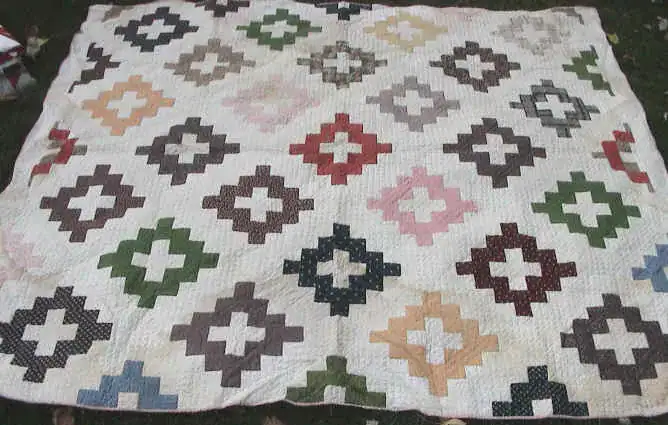
Hi, I have been asked to take on the task of finding out the name of a quilt block.(If possible) I found this quilt on ebay that was advertised as a “Christmas” quilt, no other description. I saved the picture because I thought it was so beautiful and wanted to make one. I joined another message board and posted the pictures and asked for the name. No one knew, but all fell in love as I did. Soon it was drafted and a pattern posted and we all have one going. We call it the “Starlite Mint” block. But now the woman who drafted the pattern wants to know if there is another name or if we can just go on calling it Starlite Mint. Here is a link to where we have posted the pattern it is at the very bottom of the “Free PDF Patterns” page. http://www.quiltpox.davisfamilycreations.com/free_pdf_patterns.htm
Does anyone here know of another name for this block? Thanks, Holli
Date: Sat, 4 Feb 2006 09:55:55 EST | From: Kaytriplet@
On the subject of how cotton was stored and carried to be sold, there is a wonderful riverboat museum in Kansas City. The contents of the museum are the steamboat paddlewheel Arabia and her contents. She was completely laden with cargo from Saint Louis (on the Mississippi) and passengers wanting to head west from Kansas City when the boat hit a big log and quickly sunk into the mud. Nothing was removed from the boat when she went down in 1856, and the items are amazingly well preserved from having been under fresh water and not exposed to air or light. In my mind, I know that some cottons are there, but remember that the cotton thread holding boots together, etc. rotted. The mud was such that she immediately sunk in up to the chimneys, and it offers a perfect picture of many of the goods of the day. Huge numbers of buttons for the shops in Kansas City, big kegs of alcohol, dolls, shoes, etc.
The museum folks did the excavation and recovery specifically with a museum in mind (all privately funded) and could probably tell you exactly how the calico was stored (bolts or not) for transport to the shops in KC. I haven’t been here in years, but checked online, and based on the web site, it appears to be thriving. I know in the beginning there was some doubt. It was basically a family who decided to dig up the corn field one winter after the crops. It was very difficult to do, as the water table is so high. They had to drill 20 wells to siphon off the water, and it cost them far more than they had expected.
http://www.1856.com/story8.html
Let us know what you find, or the next time I am in KC, I will see if I can go by again and chat with them.
Kay Triplett