February 20 – 23, 2006
These restored messages come from the Quilt History List, an online forum where quilt historians, collectors, researchers, appraisers, and enthusiasts discussed antique quilts and related textiles. The archive dates from 1996 through approximately 2016 and is being restored gradually. Sign up in the form at the bottom of the page if you want to know when a new page is added. Original spelling, opinions, formatting, and inactive links may remain unchanged.
Primary topics of this QHL Digest:
- Textile History Forum 2006 Conference Announcement — Details are shared about the biennial Textile History Forum conference to be held at Winterthur Museum in October 2006.
- Quilts Featured in Film — Members note quilts appearing as props in the movie Nanny McPhee.
- Politically-Named Quilt Patterns of the 1840s — A member researches quilt block names tied to political movements and figures of the 1840s.
- Origins of Early Silk Quilts — Members debate whether certain 16th- and 17th-century silk quilts are of American or European origin.
Date: Mon, 20 Feb 2006 05:16:51 -0500 | From: “Linda Heminway” <ibquiltn@>
Thanks for sharing, Teddy, I would have loved to have been there! By the way, I love making and wearing period costumes. My daughter is in theater and has the lead (Christine) in Phantom of the Opera and I am busy making a late-Victorian era ball gown for her. It’s really awfully fun to research a time period and make something. Linda Heminway New Hampshire
Date: Mon, 20 Feb 2006 03:32:52 -0700 | From: “gingham@” <gingham@>
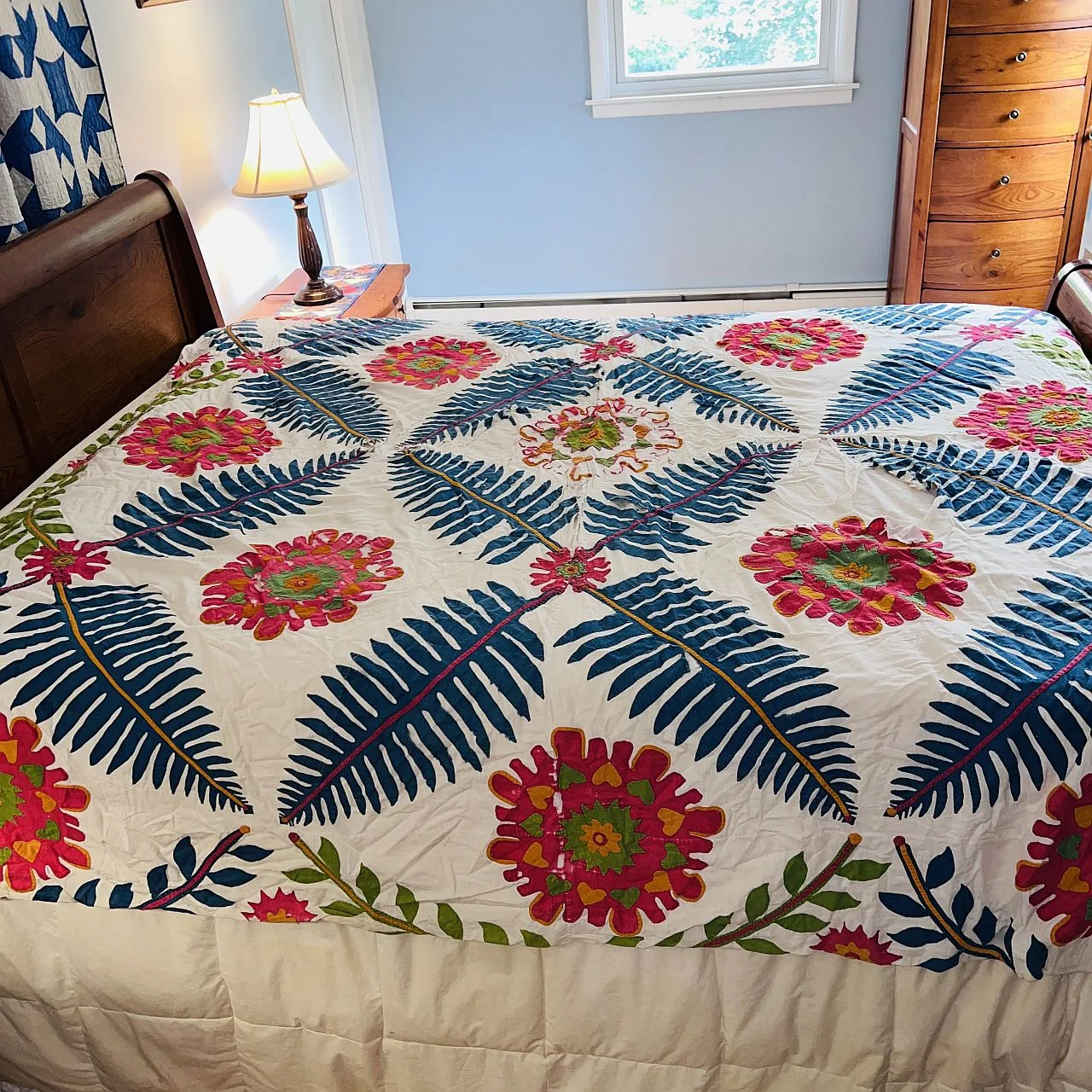
Helene, From your picture on the eboard, I’d agree that the white mark is that telltale leftover piece of manufacturer tag. (I’ve removed several of these myself from made in China quilts-my cats have no respect for quilts, so I only use inexpensive quilts.)
I haven’t seen this quilt myself before but I’d say your instincts are good. As to date, it looks fairly recent to me.
Information on this topic (vintage or repro) can be found at http://hartcottagequilts.com/vintage Knife edge and end of label are 2 of the clues. She also shows the Smithsonian bride quilt and has a link to the repro. that we were discussing recently. There is also tons of other quilt history information at that site.
Sandra in Utah
Ps I got this digest late Sunday/early Monday but didn’t get one on Sunday-did I miss it or was everyone quiet for a day?
Date: Mon, 20 Feb 2006 05:31:25 -0800 (PST) | From: Kris Driessen <krisdriessen@>
Helene, et al,
Glad you figured out how to post a picture. Just for everyone’s general edification, if you can’t figure out how to change your subscription or post a picture, all that information is on the subscribe page at http://www.quilthistory.com.
I agree that quilt looks foreign. The colors and fabrics are “wrong”, the finish is knife-edge and the pattern – the block groupings – repeats itself. This quilt was probably made 30″ wide (or whatever) then cut and sewn to itself again to double the width.
Kris
Date: Mon, 20 Feb 2006 05:34:46 -0800 (PST) | From: Kris Driessen <krisdriessen@>
Sorry, I meant to post this a week agon:-((
I updated the quilt study group page http://www.quilthistory.com/study/CRQSG0206.htm
Some interesting stuff there!
Kris
Date: Mon, 20 Feb 2006 08:02:39 -0600 | From: “Karen Musgrave” <KarenMusgrave@>
The Alliance for American Quilts (www.centerforthequilt.org ) eBay auction this week has lots of vintage fabric, many OOP books including a hardcover, boxed, signed and dated copy of “Abstract Design in America,” “Always There: The African-AMerican Presence in American Quilts,” and a great c1900 reversible wool abstract quilt, an Iroquios Sewing basket, vintage quilt blooks including 19 diamond blocks and much more! You can check it out by going to http://search.ebay.com/_W0QQfgtpZ1QQfrppZ25QQsassZalliancequilts or search by our seller’s name- alliancequilts.Your purchases also benefit a great organization which is doing incredible things for quilts. New auctions are posted every Sunday. Happy bidding and thanks for the support.
All the best, Karen Musgrave Join us! Become a member and get advance news on our auctions AND help preserve our great quilt heritage. www.centerforthequilt.org
Date: Mon, 20 Feb 2006 7:28:24 -0800 | From: <suereich@>
I have always loved history and admired the re-enactors of historic moments for their consummate attempts to make the past meaningful. Their concentration on detail and authenticity does not attempt to romanticize and glorify the realities of war as was pointed out by Teddy’s descriptive’s of casualties, death and grieving. Until this year, I never saw the ironies in those re-enactments. Acting at war while we have those same events happening in real-time now seems ironic to families who have men and women being injured and killed in the War on Terror. Many of those same scenes that Teddy so colorfully described have happened in my town and two surrounding towns within this past year in very real-time. Each of these towns has a population of about 3,000. They are all small communities in close proximity, and all touched the horror of War. In October, 2004 in Bethlehem, CT next door, a 36 year old Black Hawk pilot was shot down in Iraq. Eight months later, here in Washington, our own town spent two weeks mourning my son’s crash in Afghanistan. We opted to have my son’s ashes brought home instead of being placed in a mortuary. Never did I imagine that my home would become a funeral parlor in the nineteenth-century tradition, and yet it was somehow so right that he be here to be in the midst of our family, friends and comrades, and not off in some lonely place. Many of the scenes that Teddy so eloquently reported played out in my own living room. Just three weeks ago, a young man from another itty-bitty town next to ours, Kent, CT was shot in the chest and legs and is now at Walter Reed. His mother is a nurse at the small hospital I work at. With every crash and casualty report since June 28th, my heart breaks for the families and communities that will have to face our events of last summer. Acting them out from Wars of our past is necessary to keep those memories accurate and alive, but just know that in real-time they are still happening. My apologies in advance, this was not quilt-related. sue reich
Date: Mon, 20 Feb 2006 08:16:56 -0800 (PST) | From: Kris Driessen <krisdriessen@>
Textile History Forum Announces 2006 Conference
October 6-8 – Columbus Day Weekend— at Winterthur and Call for Papers
Cherry Valley, NY: The fifth biennial Textile History Forum will be held Columbus Day Weekend (October 6-8, 2006) at Winterthur Museum in Winterthur, Delaware. At this lively gathering, textile enthusiasts from all over the country will hear juried papers, share works in progress, take behind-the-scenes tours of Winterthur, participate in small group workshops, and enjoy a banquet and auction of antique textiles, textile tools, and textile-related items.
Call for Papers: The Forum seeks papers on all aspects of textile history from the pre-Columbian period through the twenty-first century, including textile technology, costume, quilts, weaving, dyeing, spinning, technological innovations, textile availability, and so on. Current and unpublished research is especially encouraged.
Those interested in presenting a paper at the Forum should submit a one-page proposal by March 30, 2006. Proposals chosen for presentation will be announced by April 15, 2006. Final papers should be no more than 16 pages long, including citations, bibliography, and illustrations. Final papers are due by August 15, and will be published in the Proceedings of the Textile History Forum. Authors will retain copyright. Copies of the proceedings will be available to all registrants who attend the Forum.
In addition to formal paper presentations, the Textile History Forum will include a Works-in-Progress session to allow those currently involved in research but not yet ready to present a formal paper to share information on their work. Those interested in participating in the Works-in-Progress session should submit a brief description of their project for consideration.
The Textile History Forum brings together textile historians, students, researchers, museum curators, independent scholars, and textile enthusiasts from around the country for two days of intense exchange. Participants will have the opportunity to take small behind-the-scenes tours at Winterthur, take hands-on workshops, bid on textile-related items at our Forum auction, and enjoy the wonderful resources of the Winterthur museum complex.
The Textile History Forum has been meeting and publishing important research on textiles since 1999. Highlights of previous meetings include discussion and reproduction of pre-Columbian woven shoes; a tour through handwear of the 18th century; identifying Ohio coverlet weavers; researching fabrics used in African American Quilts; examinations of tailors’ account books; investigation of design house fabrics; and studies of silk woven for cartridge bags in WWI.
Send proposals and inquiries to Rabbit Goody, The Textile History Forum, 101 Chestnut Ridge Road, Cherry Valley, NY 13320. 518-284-2729 phone/fax. Email: rgoody@
On the web at www.textilehistoryforum.com or www.thistlehillweavers.com.
Date: Mon, 20 Feb 2006 11:52:37 -0500 | From: “Bonnie Dwyer” <bonniedwyer@>
Ouch! This is the same date as the AQSG Seminar in Connecticut!
Bonnie Dwyer Maine Quilt Appraiser and textile enthusiast who wishes she could be in both places at the same time! <much wringing of hands>
—–Original Message—– From: Kris Driessen Sent: Monday, February 20, 2006 11:17 AM To: Quilt History List Subject: [qhl] forward of interest
Textile History Forum Announces 2006 Conference
October 6-8 – Columbus Day Weekend- at Winterthur and Call for Papers
Cherry Valley, NY: The fifth biennial Textile History Forum will be held Columbus Day Weekend (October 6-8, 2006) at Winterthur Museum in Winterthur, Delaware. At this lively gathering, textile enthusiasts from all over the country will hear juried papers, share works in progress, take behind-the-scenes tours of Winterthur, participate in small group workshops, and enjoy a banquet and auction of antique textiles, textile tools, and textile-related items.
Call for Papers: The Forum seeks papers on all aspects of textile history from the pre-Columbian period through the twenty-first century, including textile technology, costume, quilts, weaving, dyeing, spinning, technological innovations, textile availability, and so on. Current and unpublished research is especially encouraged.
Those interested in presenting a paper at the Forum should submit a one-page proposal by March 30, 2006. Proposals chosen for presentation will be announced by April 15, 2006. Final papers should be no more than 16 pages long, including citations, bibliography, and illustrations. Final papers are due by August 15, and will be published in the Proceedings of the Textile History Forum. Authors will retain copyright. Copies of the proceedings will be available to all registrants who attend the Forum.
In addition to formal paper presentations, the Textile History Forum will include a Works-in-Progress session to allow those currently involved in research but not yet ready to present a formal paper to share information on their work. Those interested in participating in the Works-in-Progress session should submit a brief description of their project for consideration.
The Textile History Forum brings together textile historians, students, researchers, museum curators, independent scholars, and textile enthusiasts from around the country for two days of intense exchange. Participants will have the opportunity to take small behind-the-scenes tours at Winterthur, take hands-on workshops, bid on textile-related items at our Forum auction, and enjoy the wonderful resources of the Winterthur museum complex.
The Textile History Forum has been meeting and publishing important research on textiles since 1999. Highlights of previous meetings include discussion and reproduction of pre-Columbian woven shoes; a tour through handwear of the 18th century; identifying Ohio coverlet weavers; researching fabrics used in African American Quilts; examinations of tailors’ account books; investigation of design house fabrics; and studies of silk woven for cartridge bags in WWI.
Send proposals and inquiries to Rabbit Goody, The Textile History Forum, 101 Chestnut Ridge Road, Cherry Valley, NY 13320. 518-284-2729 phone/fax. Email: rgoody@
On the web at www.textilehistoryforum.com or www.thistlehillweavers.com.
Date: Mon, 20 Feb 2006 12:10:05 -0500 | From: “Bill Volckening” <williamvolckening@>
I have to admit, I was a little confused until I looked up the word “snood” in the dictionary. To me, “Snood” is a computer game available at:
http://www.womgames.com/index.php
For the benefit of others like me, in addition to being a computer game a “snood” is a small netlike cap worn by women to keep the hair in place.
Bill
Date: Mon, 20 Feb 2006 12:50:28 -0500 | From: joan kiplinger <jkip@>
Bill — our mothers wore snoods for WWII factory work. They were required to keep hair from being snagged by machinery. They were great to wear when we played dress up with our mothers heels and castoffs. And all in all, snoods did complement slack suits most women wore to work and dressier styles for street wear..
Bill Volckening wrote:
I have to admit, I was a little confused until I looked up the word “snood” in the dictionary. To me, “Snood” is a computer game available at:
http://www.womgames.com/index.php
For the benefit of others like me, in addition to being a computer game a “snood” is a small netlike cap worn by women to keep the hair in place.
> > >
Date: Mon, 20 Feb 2006 13:04:39 -0500 | From: “Pepper Cory” <pepcory@>
Hello all, Loved Teddy’s description of the FL ‘after the battle’ event and thank you, Sue, for sharing–I always appreciate your comments. Teddy’s account brought to mind why we love history and still think it’s important: somewhere along the way in our lives, we “connected” with a place or a person and realized they were folks just like us. I can date my fascination with history from being able to live, for two golden years, in a Civil War-era farmhouse. My Dad was base commander at Warner Robbins AFB (Georgia) and our family with 5 kids, 2 dogs, and umpty cats, overflowed any base housing available. So, the AF gave us an old farmhouse still left on base property. Mom immediately set about improving the place and bailed out many a non-violent offender from the base brig to come refinish floors or paint walls. She fed them well, worked them hard, and it didn’t hurt Dad’s status one whit when soldiers got to meet the Colonel and his missus under those circumstances. Refinishing the wide plank pine floors was a huge job. Somehow, some civilians from the town found out about the farmhouse’s re-do and a committee of ladies in hats and gloves came to take a look-see. Mom served them tea and then took them on a tour of the place. She pointed out some black stains on the pine floors that hadn’t sanded out. “Oh-” said the ladies in a rush, “-but that’s blood! This farmhouse served as a hospital when Atlanta was lost and the troops evacuated. They dropped off their wounded here!” After the delegation left, we all went back and solemnly gazed at the bloodstains. Guess that explains the bullet we dug up in the garden too. Pepper from NC
Date: Mon, 20 Feb 2006 21:47:02 -0700 | From: “JESSICA VAUGHN” <vaughn8047@>
I’m trying to get to some archived messages, but can’t. Can someone help me?
TIA, Jessica M. Vaughn Aurora, CO vaughn8047@
Date: Tue, 21 Feb 2006 04:24:25 -0800 (PST) | From: Pat Cummings <pat@>
One never knows what news feature will show up on TV. Last night, on the Boston news, there was a story about a fat cat, believed to be the heaviest feline in the world at 33 pounds. The poor thing could barely walk, but is attended to with loving care by its owner in China.
In the final clip, after having been fed and brushed, the cat is shown being lifted onto a bed (for people), its head gently laid on a pillow, and then…you guessed it, a kitty-size little quilt with plaid squares being laid over him. The cat did not seem to mind this lavish attention. I would have liked a more lingering glimpse of the quilt.
I am amused.
Pat Cummings
Date: Tue, 21 Feb 2006 07:42:30 -0500 | From: danabalsamo@
If anyone is keeping a list… several quilts were in the new movie Nanny McPhee. There were 7 children and each had a bedcover on their bed: I remember a log cabin quilt, a tumbling blocks (that looked like silk), a quilt from a large piece of toile with borders added. Others had afghans. They also used a red and white quilt top as a table cover when they sat to have dinner, Puss in the Corner pattern. There were many other stunning textiles in the movies, I was in awe of the window coverings. A bit odd, because the rest of the home was in disrepair, paint coming off the walls, and they were very poor, but those brocades and velvets looked luxurious. It was a fantastic movie, one of the better kiddie flicks I have gone to see.
My best, Dana
Material Pleasures http://www.materialpleasures.com
Date: Tue, 21 Feb 2006 05:20:44 -0800 (PST) | From: Anita Loscalzo <aloscalz@>
Dear All,
We’re trying eBay as an adjunct to our live auction at the Lowell Quilt Festival of items donated that we decided not to accession into the permanent collection. All proceeds will go to the conservation of items in the permanent collection.
A crazy quilt is our first offering:
Item number: 7391543723
Thanks for bidding!
Anita
Anita B. Loscalzo, Curator New England Quilt Museum 18 Shattuck Street Lowell, MA 01852 ——– email: Curator@ telephone: 978-452-4207 Ext. 11
Date: Tue, 21 Feb 2006 09:29:43 -0500 | From: “Lorraine Forster” <circusvue@>
While searching the genealogy of my great grandparents in Louisiana, I came across an interesting fact I thought I would pass along. Type in the address bar: http://www.rootsweb.com/~usgenweb/la/opelousas/census/1810/0333.gif then expand to regular size so you can see it better and to reach the next page just substitute 0334.gif
This will show you the Report of Manufacturers and Manufactured articles as of December 20, 1810 signed by George King. It shows cotton cloth 22,500 ells value $2250 and other items including indigo – none. A check of my dictionary revealed: ell – a measure of length, now little used, varying in different countries: in England and her colonies equal to 45 inches (from the German elle: original meaning arm, forearm). Trying it out with a tape measure and my own arm, I find, if I measure it twice, I do get approximately 43″ (but I am short).
Speaking of dictionaries, I too looked up “snood” but thanks anyway, Bill.
LO CIRCUSVUE
In Pittsburgh, Pa, far removed from Melville, La where
my parents met during World War II.
Date: Tue, 21 Feb 2006 08:43:22 -0600 | From: Charles Woodford <haq@>
Not about quilts, I don’t think, but the subject of snoods brought up a question recently discussed here in our household of two. What is the religious significance of covering hair, such as the Muslim women are required to do and now I know that Israeli women do (required?). The practice seems to permeate throughout religions and history: e.g. Catholic women covering their heads at Mass, Jewish men wearing hats, etc. What is wrong with hair anyway?
Of course I know the practical reasons for covering the hair, such as working in the aviation factories and in food preparation kitchens, but what about the religious significance of an uncovered head of hair?
I also know that sometimes covering just feels better such as when I gave my 6-year old son a haircut so horribly short that he put a paper bag over his head. Also, I have had some of the same temptation when having had a bad hair day. At those times, throwing a quilt over my head might have seemed the thing to do.
Barbara Woodford
Date: Tue, 21 Feb 2006 19:20:14 +0000 | From: “jocelynm@” <jocelynm@>
On February 15, 2006, Kris Driessen wrote:
> Judy Anne (et al) > > The minute you put something in writing, it becomes copywritten.
The moment you put a thought into words, it’s protected by copyright. 🙂
Copyright also covers the spoken words of a lecturer. It would not be legal to attend a workshop, take diligent notes about the lecturer’s wonderful n ew design/method, and then disseminate the notes to all and sundry. The key is ‘intellectual property rights’- the person who thinks something up has the right to say how it’s used.
Date: Tue, 21 Feb 2006 11:23:10 -0800 | From: “Major Maam” <majormaam@>
Hi,
I think the history of religious symbols and symbolic items is really interesting. I tried to make this as generic as possible in hopes that it wouldn’t offend anyone. You can also google “symbolism religious head covering” and find many more sites about this subject. There are a lot of news articles written about this subject as well, especially on the Middle Eastern aspects.
Basically, women covering their hair, is to show their submission, humility, and/or respect to their deity or their husband; it is also part of some religions’ morality code. The reasons are different in various religions. It is a long historical custom; which has changed or is now changing in many religious factions.
Some of the fabric/lace used in religious head coverings is gorgeous, see the last site on the list. On the Island of Burano, near Venice Italy; almost every little shop has a family “museum” of lace veils and other lace items. They were so proud of their lace making heritage.
http://www.bible.org/page.asp?page_id1202
http://www.jewfaq.org/signs.htm
http://www.montanasat.net/rickv/Headcovering_Veiling.html
http://www.pbs.org/wnet/religionandethics/week521/feature.html http://www.kingshouse.org/headcovering.htm
http://www.glamdoily.com/
Becky
> What is the religious significance of covering hair, such as the Muslim > women are required to do and now I know that Israeli women do (required?). > The practice seems to permeate throughout religions and history: > > Barbara Woodford
Date: Tue, 21 Feb 2006 16:13:29 -0600 | From: Gail Ingram <gingram@>
I am studying politically-oriented quilt names in the 1840’s. So far I have discovered no first-hand identification of quilts by their political names—nothing, for instance, in diaries or journals. I’ve discovered multiples lines of solid circumstantial evidence, but I yearn for something more.
If any of you on the list has discovered such evidence for a political quilt pre-1860, I would really appreciate your contacting me personally.
Sue, have you found such evidence for this genre in your search of newspapers? I’ve yet to complete that line of research.
From gray Louisiana where the oriental magnolias bloom despite recent ice, Gail Ingram
Date: Tue, 21 Feb 2006 17:51:10 EST | From: Blackeyesandysue@
They’re not American, but Maggie Lidz speculated in 1997 that a lot of the 16th and 17th century silk quilts were made in response to the Battle of Lepanto in the 1570s. It was a great Catholic victory over the Moslems, and many of these quilts show ships, “Mohammedans” in what is supposedly their native costume, and Catholic dignitaries like the Archduchess Isabella and Don John of Austria.
Her article on this is in the December 1997 issue of Antiques: the Magazine, and I believe she’s on staff at Winterthur in Delaware….
Karen Evans
Date: Tue, 21 Feb 2006 19:27:40 -0800 (PST) | From: Joni Branscome <dechintabooks@>
I’ll have to keep a lookout for that movie.
I still cringe every time I think of HOW TO MAKE AN AMERICAN QUILT where Winona Ryder walks through that field in that awesome handmade quilt with it dragging in the dirt.
danabalsamo@ wrote: If anyone is keeping a list… several quilts were in the new movie Nanny McPhee. There were 7 children and each had a bedcover on their bed: I remember a log cabin quilt, a tumbling blocks (that looked like silk), a quilt from a large piece of toile with borders added. Others had afghans. They also used a red and white quilt top as a table cover when they sat to have dinner, Puss in the Corner pattern. There were many other stunning textiles in the movies, I was in awe of the window coverings. A bit odd, because the rest of the home was in disrepair, paint coming off the walls, and they were very poor, but those brocades and velvets looked luxurious. It was a fantastic movie, one of the better kiddie flicks I have gone to see.
My best, Dana
Material Pleasures
Date: Wed, 22 Feb 2006 10:21:02 +0100 | From: Margareta Faust <margareta.faust@>
Good morning,
I remember hearing that when the Vatican Council in 1962 abolished the obligation for women to cover their heads at Mass, the lace industry in Northern France (Valenciennes and region) collapsed overnight….!
Here’s a thought: why should women cover their heads in church but men take off their headgear? Margareta in Europe (intrigued)
Date: Wed, 22 Feb 2006 06:51:17 -0500 | From: “Karen Evans”
Ah, but in Judaism men *do* cover their heads when they pray, and they do in Islam as well. And men wore coifs or hats to church for hundreds of years in Christianity.
I’m not sure why modern Christian men uncover in church, but I think it has something to do with armor and helmets; tipping one’s hat, for instance, has its origins in raising the visor of one’s helmet. But I’m not sure….
Karen Evans
Date: Wed, 22 Feb 2006 07:19:58 -0600 | From: Gail Ingram <gingram@>
> > Here’s a thought: why should women cover their heads in church but men take > off their headgear? > Margareta in Europe (intrigued)
M., have you any documentation on the collapse of lace industry’s correlation with 1962 Vatican Council’s relaxing rules re women’s headdress in church? As someone who “fiddles” with laces, I find this interesting. After the nice lace headgear on the site to which you directed us, I know I’d vote to reinstate the convention.
Maybe the different headgear conventions/rules go to the deeply rooted patriarchal tradition in the church? Throughout the Old Testament, from Adam onward, one sees men seeking to hide sins from God by covering their bodies. And the New Testament is filled with images reminding mankind they will ultimately appear naked before God. Maybe there is some deep connection with that for men. Women, of course, were to be protected, sheltered from the prying and lustful eyes of men. Women’s hair was traditionally considered their “crowning glory” and also a major temptation to men.
Or maybe it’s just a reversal of everyday life that reminds one he or she is in the presence of the sacred and holy?
An interesting question. Me, I’d go for those “doilies” with the Svworski (sp?) crystals.
Gail
Date: Wed, 22 Feb 2006 07:21:15 -0600 | From: Gail Ingram <gingram@>
A friend asked me about the “National Underground Railroad Network to Freedom.”
Anyone have any information about this?
Gail Ingram
Date: Wed, 22 Feb 2006 14:35:21 +0100 | From: Margareta.Faust@
Gail, the statement was from a French TV programme about the French lace industry. If I find anything more on the subject in my personal library, I’ll gladly let you know. Another idea would be to look at publications on the textile industry in the north of France. Will do – when I get the time! Margareta
Date: Wed, 22 Feb 2006 07:54:57 -0500 | From: “Pat” <parsnips1@>
Good morning,
Remember though, that some Christian priests do cover their heads – the priests wear miters over a scullcap. The miter might be removed during a service, but the scullcap isn’t. Sorry, I have long forgotten the significance. Pat
—– Original Message —– From: “Karen Evans” <charter.net> > > I’m not sure why modern Christian men uncover in church, but I think it has > something to do with armor and helmets; tipping one’s hat, for instance, has > its origins in raising the visor of one’s helmet.
Date: Wed, 22 Feb 2006 13:15:05 -0500 | From: “Teddy Pruett” <aprayzer@>
First of all, thank you to the many kind folks who wrote that they enjoyed the description of the hospital drama. I was a bit concerned about it being off-topic, or I would really have been descriptive!
As for snoods – well, all I can say is that I put on this floozy blond wig and looked as if i were going to take my place under the red light, but when I put the snood on over it, I was suddenly simply angelic. Well – VIctorian, anyway! I love those things.
I don’t have my Bibles or references handy, but it does state very plainly in the Bible that a woman’s hair should be covered. Nuff of that.
Lastly, tomorrow, two of my friends – one of whom is on the list (hi MA!) and I will be attending the opening of an exhibit of African American quilts made in FLorida. We will get to attend the opening lecture as well. If anything bears mentioning here on the list, I’ll let you know.
Oh, that reminds me – a friend and reenactor told me that she had read an article in a quilt magazine about quilts being used on the you-know-what. I can’t even write it. She was going to bring a copy for the museum’s records, and I told her as gently as I could that the legend was not based on solid historical fact. She was incensed!! I was told huffily that “Maybe the Eleanor Burns UGRR Quilt wasn’t complete fact, but the rest of the story is.” Oh, lawd, lawd. Teddy
_________________________________________________________________ Is your PC infected? Get a FREE online computer virus scan from McAfee® Security. http://clinic.mcafee.com/clinic/ibuy/campaign.asp?cid=3963
Date: Wed, 22 Feb 2006 15:25:13 -0500 | From: “Newbie Richardson” <pastcrafts@>
Teddy and List The calm you experienced in your re-enactment of piecing a quilt – and putting on correct period clothes – is called “experiential anthropolgy”. That is the process of learning about a practice by doing it as it would have been done at the time. When done correctly you can get an “ah ha” momment. Mine came when I laboriously hand sewd a c 1800 outfit: stays, shift, underdress, dress, and spencer jacket. The amount of plain sewing was so boring and tedious – so when I put it asside for the day and picked up my elaborate picture smocking project (while watching the evening news on TV) – working with the colors and complicated design was like being on holiday. Ah ha! I thought – so that is why we have all those fabulous, complicated, needlework and quilted pieces from the 18th and 19th c. They were FUN to do! Just think how boring hemming diapers and other household linens was! Newbie
Date: Wed, 22 Feb 2006 15:34:58 -0500 | From: “Karen Evans”
Oh man…what Newbie’s describing sounds *so* familiar…only I do it with Italian Renaissance gowns, which fortunately don’t include stays or corsets. But I swear it’s the only means to find out why certain things were done a certain way….
Karen Evans
Date: Thu, 23 Feb 2006 07:03:10 -0600 | From: “Andi” <andi0613@>
Thank you, Newbie, for reminding me about the quilt history of my own family. I have several typical 1930s quilts made by great-great grandmothers, but no one after them quilted until I fell into it in 1990. Reason: my great-grandmother had three daughters and absolutely hated all the sewing she had to do for them (they were born in 1911, 1913 and 1915, to give you an idea of what she must have needed to make). As a result, none of those girls sewed or liked to sew, either and although my mom saved a bunch of money for our family by making most of my dance costumes (and once, memorably, a camping tent that slept four without leaking), doing anything else with needle and thread was out of the question. She had spent her childhood picking up her Granny’s pins and thread snips and listening to her complain about sewing.
On to experiential anthropology. The TV programs that have aired in the last decade that put modern folks in old or ancient living situations (I am not talking “Survivor” here, although what these people had to do was more authentic, I think) have generated many “aha” moments. My favorite comes from the BBC’s portrayal of an Iron Age village. Archaeologists had wondered for years what the shallow depressions just inside the entry openings to huts from that period signified. Thought was given to sacrifice, protection from evil, etc. Turns out, that’s where the chickens pecked when it rained! Ha! I mean Aha!
Andi in Keota, Iowa
Date: Thu, 23 Feb 2006 08:37:17 EST | From: Mitzioakes@
Boy did you hit a memory – my mother hated to sew also as she was the pin-picker-upper from my Grandmother’s daily dressmaking. All my mother would do was embroider and crochet, but sew -no, no., no. So I had to learn early on (on a treadle) to fix my own tears and rips – eventually my clothes and the rest is history. Thanks for making me smile this dreary day in snowless Vermont. Mitzi
Date: Thu, 23 Feb 2006 09:14:26 -0600 | From: “Debby Rake” <dsrake@>
I wholehaeartedly agree that one can learn much about any historical artifact by replicating it. I have often gained insight into a quilt I was studying by making a copy, either of the entire quilt or an element of it.
Elizabeth Barber’s book, Woman’s Work, The First 20,000 Years, has a great illustration of this. Barber was studying a fragment of an ancient wool kilt that came out of a peatbog in northern Europe. She wove a copy of the piece, and in so doing was able to determine which was the warp and which the weft by the pattern of the threads.
This book is a fascinating read, by the way, and has one of the alltime great titles.
Date: Thu, 23 Feb 2006 10:05:35 EST | From: DDBSTUFF@
I just posted a picture of an unusual butterfly quilt on the Eboards.
Has anyone seen one like this? Is it a kit or known pattern? I’ve not seen one before.
Any thoughts?
Darwin
Date: Thu, 23 Feb 2006 16:18:29 -0500 (GMT-05:00) | From: Matt Arnett <marnett@>
I’ve been away from the list for a while and trying to catch up. Did the Clementine Hunter quilt issue ever get resolved to everyone’s satisfaction? Or at least to the satisfaction of those that are interested? If not, I’d be happy to throw in my two cents worth, as someone who is fairly familiar with her body of work and the interest in it (though I am not one who has much interest in it) Matt
Matt Arnett Tinwood Media 512 Means St. NW Suite 305 Atlanta, GA 30318 ph. 404.607.7172 cell. 404.234.8050
Matt Arnett Tinwood Media 512 Means Street Suite 305 Atlanta, GA 30318 tel.404.607.7172 cell.404.234.8050
Date: Thu, 23 Feb 2006 15:20:41 -0600 | From: “Kim Baird” <kbaird@>
Yes, Matt, please add your opinion.
Kim
Date: Thu, 23 Feb 2006 12:58:10 EST | From: Feedsackfanatic@
I have two antique quilts that I had appraised several years ago and have decided to sell them. They were both made in Lancaster County, PA. If anybody has any suggestions on how I could sell them, would you please email me privately?
Thanks. Paula feedsackfanatic@
Date: Thu, 23 Feb 2006 14:41:03 -0800 | From: Julie Silber <quiltcomplex@>
Does anyone have information about the value of quilts made by Eleanor Beard in Hardinsburg, KY? I’m hoping to give an owner of a wholecloth, stuffed central medallion quilt made circa 1950 – 60, an idea of the value. The quilt has the original label attached. Thanks, Julie Silber
Date: Thu, 23 Feb 2006 15:50:28 -0800 (PST) | From: Kris Driessen <krisdriessen@>
Paula, et al
If you are in a hurry to sell them, I would suggest Ebay. But (at the risk of angering every appraiser on the list), don’t expect them to bring anywhere near their appraisal value. However, having said that, I will backpedal real quick and tell you that a quilt is worth exactly what someone is willing to pay for it. On Ebay, you may get someone who is determined to have it, and will bid up to the full appraised value or more.
If you are not in a hurry, I do have a free consignment page on Hickory Hill Quilts. Just send me a picture, price and description and let me know when it sells. I am not being generous – it’s a gimmick for me to get people to wander around the website. Works pretty well, too:-))
This offer is open to everybody, by the way, which is why I sent this note to the list rather than privately.
Kris http://www.hickoryhillquilts.com/quilts.htm
Date: Thu, 23 Feb 2006 20:20:55 -0500 | From: “Linda Heminway” <ibquiltn@>
Amazing news for me, my cousin found out how years ago my parents sold my grandmothers quilts at a yard sale and, realizing that I am a quilter and that it was important to me, gave me a quilt that was made by my grandmother. I had thought that none of my grandmother’s quilts had survived, but two of them have! I am now the proud owner of a quilt made by Helen Clifton Jacobs Derry and I think it dates around 1920 or so. I was also given another quilt made by her that needs repair that I will fix and return to my cousin, it’s a typical 1930s Dresden Plate with lots of pink. The older quilt that will be mine is a kind of a rail fence pattern in green and blue. It’s in reasonably good shape, but needs a few simple repairs. I want to label both quilts and would like your suggestions as far as what I ought to put on the labels and what materials and type of label ought to be one these quilts. Obviously I should say that my grandmother was the maker of the quilts and the approximate time period in which the quilt was made. I guess it would be nice to give her dates of birth/death and that I, her granddaughter (and my cousin on the other quilt) are presently the quilt’s owners. I should indicate what restoration I do and how, I guess and the date of that too. But, how would YOU do this? I want to enhance the quilts vs. take away from them. I am very excited! Linda Heminway, maiden name Linda Helen Derry (middle name after my grandmother who made these quilts!) Plaistow NH