February 3 – 6, 2004
These restored messages come from the Quilt History List, an online forum where quilt historians, collectors, researchers, appraisers, and enthusiasts discussed antique quilts and related textiles. The archive dates from 1996 through approximately 2016 and is being restored gradually. Sign up in the form at the bottom of the page if you want to know when a new page is added. Original spelling, opinions, formatting, and inactive links may remain unchanged.
Primary topics of this QHL Digest:
- The History of Duplex (Reversible) Fabric Printing — An 1894 illustration sparks a technical discussion of duplex printing.
- Pushing Back on the Underground Railroad Quilt-Code Story — Members continue questioning the popular “quilt code” narrative and how to correct it. (see the article on Underground Railroad quilts)
- 2005 International Quilt Study Center Symposium Announced — Save-the-date details for the Nebraska-Lincoln event are shared.
- Lincoln’s Deathbed and the Chicago Historical Society — A historical aside on an artifact connection.
Date: February 4, 2004 | From: “Laurette Carroll” <rl.carroll@>
Hello, I have a few of these 2 sided fabrics in my collection of fabrics and quilt tops. They are usually definite prints on each side of the fabric. My most interesting and puzzling two sided fabric is a white with red print on one side, and a solid black polished cotton on the other. The fabric is found in a quilt top c1890. The triangular piece of fabric is admittedly small, about 4 inches on a side, so the black piece could be part of a larger print I would imagine, but we’ll never know for sure, I guess. I have posted the photos to the eboard. Look under the fabric tab.
www.vintagepictures.eboard.com/
Laurette
Date: February 5, 2004 | From: Joan Kiplinger <jkip@>
I know many of you see red as the perpetuation of quilt coding continues as fact. Ran across this newspaper article Quilt Mimics Signals in the Topeka Capitol Journa. Perhaps you may want to drop a line to the reporter after reading it.. http://www.cjonline.com/stories/020304/loc_quilt.shtml
Joan new column now live Springs Mills story; & kettlecloth resolved http://www.fabrics.net/joan.asp
Date: February 5, 2004 | From: aol.com
I just don’t have the heart to do it. And at this point I’m beginning to believe that HIPV is becoming a genuine piece of quilting folklore. That it seems to be as historically accurate as the early dates on “colonial” patchwork is irrelevant to this; it’s folklore now, and I have this awful feeling we have as much chance of correcting/countering it as we would of stories about a friend of a friend going to Mexico and adopting a cute little dog that turns out to be a rabid sewer rate….
Karen Evan Easthampton, Massachusetts
Date: February 5, 2004 | From: <gingram@>
The UGRR is everywhere this month because of Black History Month. In our region, there are three separate exhibits, and the newspapers are full of it. I suspect that is true everywhere.
If we believe this to be based on false information, then it is our responsibility to do whatever we can to replace it with accurate information.
To do that, one must first read HIPV, not what someone has written about HIPV, and also read related materials. And I think we must read them with an open mind if we are coming to them for the first time.
If we believe the reasoning in that and related texts to be faulty, we must articulate the error plainly and dispassionately. Then we need to read the work of others who have taken issue with the argument put forward in HIPV and similar works. Finally, we must use the simple tests of evidence any beginning scholar has at hand. Only then will we be able to write an informed, cogently reasoned, and enlightening response.
We need to get that response down in good clear writing, writing that is adapted to letters to editors and museum keepers. And we need to send it out whenever, wherever we find the false version of history given note or voice.
Finally, it would seem we need to organize ourselves to address local quilt guilds and social studies teachers, apprising the public that a controversy exists and correcting that error. What about panel discussions planned for NEXT Black History Month? debates offered to organizations for programs? If organizations elsewhere are like those here, program planners would welcome a little different format and a promise of a little liveliness.
And what about organizing a presentation for students and making oneself available to local schools? The buzz in education is “critical thinking skills,” and just imagine how this issue could be adapted to a presentation addressing those skills.
It will do little good to “preach to the choir”: we need to present this information to those who either are uninformed or ill informed. Schools, museums (esp those focusing on African-American culture), and African-American quilt groups seem the most effective and logical places to begin.
Given an equal opportunity, fact and truth usually will prevail. And if we’re not willing to act firmly and publicly on behalf of truth, we have no right to complain.
I personally believe that the UGGR “myth” is inaccurate, but I also believe we need to address some issues we often treat too lightly–e.g., the role of oral history (for there is one) in establishing truth. I’ve encountered a number of quilters who are altogether too willing to accept their relatives’ versions of a family quilt’s history and who, in those cases, express no aversion to the kind of reasoning on which HIPV rests and to which they express deep aversion there.
What concerns me is that this issue appears to be turning into an ethnic or racial issue. Or perhaps it really is about other ethnic issues which are subjects of national debate.
I hope the community of quilters will think carefully about the basis for objections to UGRR, articulate them plainly and publish them broadly.
This issue presents an opportunity to emphasize the importance of quilts in the making of history—if, as most on this list appear to believe, the UGRR claims are unsupported but are acquiring widespread public credence, quilts are the medium by which the argument is being perpetuated and with which some of claims about the nature of community or the cleverness of slaves or something else are being objectified or made concrete. That very fact suggests the cultural relevance of quilts, and we should appreciate that and make sure that relevance is understood.
Perhaps we could link the UGRR with the myth that the first quilts were patchwork, symbols of a pioneering ingenuity and strength. That, at least, would diminish the racial or ethnic dimensions which seem to be seeping into the general dialogue about HIPV.
That quilts are so readily accepted as important symbols suggests that the public is onto something, anyway, for as those of who make and collect them know, they are symbols, and as such, they acquire meaning from the tradition and culture of which they are parts. We just need to define what they represent. And what they don’t represent.
IMHO, Gail
“I knew Wilkes Booth very well, and he sometimes slept at our house. Hew was a tall, well made young fellow, and he had large black eyes and luxuriant hair. He was a nervous, erratic, strange man; and it is a curious thing that he slept in our house a week before this deed was done, and under this same coverlid upon which Lincoln died. “The assassination, you know, occurred on the night of the 14th of April, and I saw Booth that morning riding a little sorrel mare down Pennsylvania avenue. It was not far off from Willard’s hotel that I saw him, and I was then on my way to play ball on the grounds just below the White House. When the game was over I went home and had supper. After supper I went the theatre, but I did not go to Ford’s, as I had often seen the “American Cousin,” but I went to another theatre, where “Aladdin and the Wonderful Lamp” was being played. As I started out to go to the theatre I saw the president’s carriage drive up to Ford’s, and President Lincoln and some other gentlemen and ladies got out. After I had been at the theatre but a short time the manager came to the front of the stage and said that the president had been shot at Ford’s. The crowd made a rush for the doors, and I tried to go home. As I reached the corner of Tenth and E streets, a block away from the theatre, I heard some men gathered around a fellow whom they caught hold of, and yelling: “Hang him! hang him!” They were standing under a sycamore tree, and one of them suggested that it was a good place to string him up. The wretch was a poor fellow who had nothing to do with the assassination, but whom they suspected. I pushed my way past these men, and finally got to the door of my father’s house. Two soldiers were in front of it. I tried to pass them, but they said: “You can’t go in. The president is lying in there.” “But I live here, I replied. “That makes no difference, you can’t go in,” returned the soldiers. “I will see if I can’t get in!” I muttered to myself as I slipped around to a shutter which I knew could be opened, and climbed into the window. The first man I met was my father, and he told me the president was lying in the room the actor Matthews had formerly occupied, and that he wanted me to help him. My sister was at school at Bethlehem, Pa., and my mother was there with her. So I was practically alone with my father. “Did Lincoln die in the room into which he was first carried?! “Yes, but this room has not been well represented in the pictures of the scene. It was a small narrow room in the rear of the house and just at the end of the entrance hall. It was about ten feet wide and fifteen feet long. It was very plainly furnished, and the walls were covered with brown and white stripes of paper running up and down from the floor to the ceiling. Some engravings and photographs were hanging on the wall” (here Mr Peterson pointed to some cheap pictures upon the walls of his room where we were sitting), “and these pictures were among them. The furniture of the room was very simple. There was a bureau, a little black walnut bedstead and a few chairs. To be continued… sue reich
Date: February 5, 2004 | From: aol.com
I just remember e-mailing a list of extremely specific questions on methodology and sources to Jacqueline Tobin, and getting a form letter in return that addressed *none* of my questions or concerns. The response alone bothered me greatly, and everything I’ve seen and heard since has just made me more skeptical about the HIPV hypothesis. Dobard and Tobin have shown a lamentable tendency to duck specific questions, and playing the race card (or allowing it to be played in their names) has no place in the discussion.
*sigh*
Karen Evans
Date: February 5, 2004 | From: “Judy Anne”
I’ve been reading all the frustration with trying to get through to people about the UGRR. Yesterday I got a letter from a school principal who gives UGRR lectures including quilts. I explained my point of view and sent links to sites with information. She responded that she included information on what oral history is in her lectures. She also said she has an elderly man once tell her that he had family quilts that had been used in the UGRR. I encouraged her to document it and gave her a link to the Saving our Stories information. If I could see enough well documented oral history I might be willing to say there is a possibility that there were occasions that such quilts were occasionally used. But even with oral history it is so far back I wonder if the myth could have developed back when our grandmothers were living. I can understand using the idea in classes much like Paul Bunyan tale is taught. But I know for the most part the message is that the UGRR quilts are absolute fact.
I’ve been trying to provide alternatives for Black History Month. I just posted an article on Mrs. Keckly and have one on Harriet Powers. I’m just hoping some teachers will see those.
Judy Anne
Date: February 5, 2004 | From: Patricia L Cummings <quiltersmuse@>
Kim Wulfert, Ph.D. wrote:
/Unfortunately this simple article I wrote a couple years ago now has stirred up claims of racism and anger coming from the authors toward Giles Wright and I. This is so far from ours minds. Accurate history was and is our only interest in the matter. Interviewers call me regularly, but I am realizing that I am never given serious time or quotes or consideration in these news articles. it’s making me very very weary of agreeing to do them at all. /
Dear friends:
The whole issue at hand is not one of racism, in my opinion. Kim is right about the need for accurate history and Gail is 100% “right on” about the need to help educate the public. Karen is correct in intimating that the quilts, their “secret code” and the Underground Railroad are becoming legendary.
Let me tell you a story.
On January 16, 2004, I was contacted by the owner/senior editor of a New England newspaper that circulates in the antiques market and is free for customers at participating antiques shops. The editor had been contacted, by a Public Relations firm, about a lecture to be held at the NH Historical Society. She asked me to attend the meeting and to write about it, since the topic was related to quilting. I agreed.
After hearing the lecture on January 18, I came home and started writing. From Sunday until the following Friday, I wrote, hardly without a break. The result is a lengthy article called, “Symbolism in Quilts as Part of the Underground Railroad System: African Textile Traditions”. During that time, I also made three additional quilt blocks to illustrate the article. In addition, we photographed other blocks that I’d previously made, and then searched my collection for some antique ones to add.
I was given permission to post the article before it was printed in the newspaper, (Feb. 5, 2004 edition of UnRavel the Gavel). The response to this article which we posted to our website on January 27, 2004, has been overwhelming!
Within two days, I was contacted by NeedleArts magazine and at this moment, they are planning to run my donated article, in its entirety, in the next available issue (perhaps as early as June). This magazine is circulated to members of the Embroiderers’ Guild of America, the sponsoring agency through which I earned the title of certified “master craftsman in quiltmaking”. The group has members in other countries, particularly England and Australia.
To give you an example of the kind of feedback I’m getting, readers have called the article: “riveting”, “unbiased”, “well-written”, “scholarly”, “excellent”, “well-researched”, “worth reading every word”, etc. I have been completely blown away by the lack of negativity in regard to my detailed account of the situation. Moreover, people are not just reading. They are sending me bits of information, such as the Topeka-Capital story, that I told Joan about. In fact, several close friends have written to the paper to invite the writer of the article to read what I’ve had to say.
I don’t need a pat on the back and I am not being self-congratulatory when I state that what I have achieved in that one piece of writing has helped to clearly state what those of us who care about historical accuracy have been saying since Hidden in Plain View was published.
Somehow, in this society, whatever is in print is consumed as the Gospel Truth. We are becoming a nation of non-thinkers and anti-intellectuals, in my opinion. Unfortunately, we are foisting this ignorance on our school children, who in learning these stories/myths in the interest of our need to paint a pretty picture about slaves, will pass this same information to their offspring. If everybody believes “it”, then “it” must be true! Right? I don’t agree.
In the case of the Topeka story, the woman in question relates that she tried piecing her blocks by candlelight but had to rip them apart because of their inaccuracy. Duh. Not to be insulting here because I suppose it was a good, scientific test on her part. We can’t fault the woman. She has bought into the myth and in her heart, probably truly believes that it is accurate and that she is doing a great thing by passing on the story. She is just one of many whose bubble would be burst if they had more information.
I have received many letters from the academic community, from graduate students and professional alike. In the interest of confidentiality, I will not “kiss and tell” or “name names”. However, having written this article, I feel that I have been able to reach beyond our little group of quilt historians to a greater consumer market. Hopefully, that will make a difference.
If you have not taken the time to read my article, please do yourself a favor. I hope that it inspires you. In addition, I have since posted an additional article about African textiles. Both articles are easily accessible from the front page of my website.
This is not a time to be cocky, and flap feathers. We can all do our part in spreading the word, and as I said in my article, my intention in writing the article was not to have the last word, but to reopen the dialogue for purposes of clarification. I think that I have done what I set out to do. That said, I invite you to read what I wrote on those cold winter days when I sat here struggling to coherently address the UGRR/HIPV issue. If I have not done an adequate job, God forgive me. As stated, there IS more to be said. There is more that I personally could have said about the various quilt blocks as named in HIPV, but remember, I was writing a newspaper article.
I have not yet seen a copy of the paper as it is currently being distributed to shops. However, my editor thought so much of the article, she sprung for all color photos of my blocks, at added expense to the paper.
So there you have it: one call from an editor in need of a front page story; one person (me) turning up at a meeting; one ensuing article; and many happy, more informed readers. Read HIPV, if you have not yet done so, then read my articles and all those of other quilt historians that I mention. Enjoy the extensive Bibliography of suggested reading materials, and then read some more….
As a little note: My mother is from Georgia. The story in my family is that there is not only Jewish blood running in our veins, but also black blood. I have no details on the latter but it is an interesting thought to consider having always thought of myself as a white,Irish/Austrian “Catholic”. My point is that I hardly feel prejudiced toward any other race or person. One can readily imagine that to be the case, if one reads the articles on my website. So, any accusation of rascism on my part, I just soundly dismiss in advance. “Big” people will not even think in those terms because it only sidetracks the issue. Let’s stay on track and think clearly about what we are discussing here. I hope I’ve done my part in helping to clear the air.
My article is free for all to read, and no, I do not plan to give lectures. Money was not a motivator here. Now, back to quilting….
Patricia Lynne Grace Cummings owner, Quilter’s Muse Publications www.quiltersmuse.com
Date: February 5, 2004 | From: “J. G. Row” <JudyGrow@>
Pat,
No wonder you are receiving such kudo’s on your article and web site. Your information is correct, well presented, and well written, as are all your posts to QHL. It is obvious that you are to be taken seriously as a scholar. We are all doing what we can to dispell the myths and educate the public. It is good to have you out in the front leading the way.
My hearty congratulations.
Judy “Ringo” in Ringoes, NJ
Thank you, Judy Kaman Grow. I know you to be a serious scholar, as well. I’ve very much enjoyed the fact that you seem to love books and historically correct information as much as I do. The graduate level class, “History of Quilts” that we took together at the University of Nebraska, Lincoln, in 2001, was just wonderful and was our first point of connection. Learning is a lifelong venture for both of us, isn’t it?
The man or woman who thinks they know it all becomes their own fool, easily held up to ridicule. There is always more to learn, and there are always ways to grow.
I appreciate your very kind words. Often, people may admire someone but it is rare that they share that sentiment, particularly in such an open way. While I do not do the things that I do to seek recognition, it is always a good feeling to think that one has gained the respect of one’s peers.
So, I offer my thanks to you for being such a kind-hearted soul.
Pat Cummings
Date: February 6, 2004 | From: <chrisa@>
If your experience is anything like mine has been Pat, you will receive requests for reprints of your article and many invitations to speak and to be interviewed. I have received these regularly since early 2002. I always prefer the reprint because the article says what I think and that hasn’t changed.
I want to thank the people who wrote me such nice and supportive emails after my post yesterday. What a surprise they were to receive. And I had hesitated even bringing it up, till Karen started the topic again. I am so happy that Pat has stepped onto the plate, since I never expected nor asked nor wanted to become the mouthpiece for this other view. The more the better- up front and personal. I don’t mean to diminish those of you fighting for the cause behind the scenes with letters, and teaching etc.
One active QHL member was quick to tell me that my emails “full of blatant mistakes in common English usage.” would get in the way of me “being taken seriously as a researcher” and she also said scholar, but I haven’t used that term to describe myself in this field. The interviews are on the phone, and this came in an email from her with my last name spelled wrong. A good laugh! However, this got me to think about whether or not I have ever seen or read any interview by a reporter where they give equal time and attention to the alternate point of view, the fact based point of view is how I would distinguish it.
I can’t think of a single such interview or article. Can any of you? The interviewers who call me do so because of the website article, but they only want to quote from my conversation with them currently. Karen brings up that Tobin doesn’t respond to answers, and we certainly have not seen or heard much from her at all. She did have one response article on another website, but it is fairly unknown and I can’t recall what it is, sorry. Dobard is the main rep. for that point of view.
When the book first came out, I can see how this would happen. The theory they were putting forward needed to be explained. Let’s face it, the children’s books that first brought up the idea weren’t taken seriously. So those first interviews were telling the Ozella story. But it’s been a long time now, nothing at all more has surfaced to help their story with support and yet, this story still takes most of the space in the interview. Pat, mine and Leigh Fellner’s articles help fill the gap, I realize, but the interviews get into the popular and national newspapers and magazine, not our article.
If Black history month were their only motivation, I could see why they would chose to discuss the story at length, but I get calls all year long. Get ready Pat! Maybe it just comes down to the race issue some have raised, and to be politically correct (instead of accurate recording of American History in the early 19th century) popular press has decided to stay clear since it really isn’t that important in the big scheme of things. it’s important to us. but it’s not IMHO when in the context of slavery and going north and fighting the war.
Kim Wulfert www.antiquequiltdating.com/tours.html
Date: February 6, 2004 | From: “Kathy Moore” <KathyMooreneb.@>
SAVE THIS DATE! February 24-26, 2005
INTERNATIONAL QUILT STUDY CENTER University of Nebraska-Lincoln 2005 Symposium, “Collectors, Collecting, and Collections”
Planning has begun for the second biennial symposium, sponsored by the International Quilt Study Center at the University of Nebraska. This symposium will focus on the phenomenon of collecting, and especially collecting quilts and related arts, from a variety of perspectives—psychological, aesthetic, historical, economic, anthropological, museological, and sociological. Participants will also have the opportunity to engage in dialogue addressing the urge to collect, the meaning of collections, the ways collecting influences artists and source communities. The two days of symposium presentation will be supplemented by pre-conference tours, including a behind-the-scenes tour of the International Quilt Study Center’s state-of-the-art storage facility, curator-led tours of campus exhibitions, and special exhibitions at other venues in the Lincoln area.
For a complete description of programs and speakers for this special event, please visit our website at http://quiltstudy.unl.edu where you will find a full range of conference-related information.
Kathy Moore, IQSC Symposium Coordinator International Quilt Study Center University of Nebraska-Lincoln iqsc-symposium2unl.edu http://quiltstudy.unl.edu 402/472-7232
Date: February 6, 2004 | From: macdowel@
Because I knew that the Chicago Historical Society owns the bed that Lincoln was in, I checked with my friend Dr. Russell Lewis, Curator of Research and Collections at CHS to see if CHS owned the quilt mentioned in the article. Here is his reply I received this morning and thought it would be of interest to QHL list members:
“Marsha: Good to hear from you, and I hope all is well. We do not have the quilt described in the article, and I am dubious that it existed; I have never heard reference to it. We have the bed, the blood-stained sheets, and a pillow. Her description does not square with what actually happened. The attending doctors had to probe Lincoln’s wound to keep it from coagulating, which caused a buildup of pressure and Lincoln’s breathing became belabored; they did this numerous time throughout the night. So, there was not splattered blood and certainly no brain matter. The bed was bought from the Peterson family.
You might want to visit or Wet with Blood web site: http://www.chicagohs.org/wetwithblood/index.htm
and http://www.chicagohs.org/wetwithblood/BLOODY/bloody4.htm
Russell”
****
Sincerely, Marsha MacDowell
Thanks for the feedback about the bed, sheets, and pillow Lincoln died upon. Just for the record, I am going to finish the article. This is supposed to be an eyewitness account and seems to be accurate about some things. We can all speculate, but who really knows. I think the word “spattered” was used as a descriptive by the author of the article. As an ER nurse, I can tell you for a fact the when you have bleeding from a head wound, there are lots of bodily fluids are everywhere. From the layman’s perspective it is always more gruesome. sue reich
“When I came in the president was lying on the bed. His face looked ghastly, and the blood was still flowing from his wound upon the pillows. The blood flowed fast and the pillows were saturated. A number of the cabinet, including Edward Stanton, Salmon P. Chase, Secretary Wells and others, stood beside the bed, and several doctors were present. Charles Sumner sat on the bed holding the president’s hand, and sobbed like a child. There were tears in the eyes of nearly every man present, and now and then they tried to speak to the president. He lay with his head on this pillow, and his eyes. all blood shot, almost protruded from their sockets. His face twitched, and it looked as though he was trying to speak, but I suppose the action of his features was involuntary.” “Was Mrs. Lincoln present?” I asked. “No, at this time she was in an adjoining room, and Robert was there trying to comfort her. She was sobbing and crying, and during that night she came now and then to the bed and burst into a flood of tears, and then went away, sobbing, into the other room. The doctors wanted some hot water and bottles and asked me to get them for them. We had a hot fire in the kitchen, and I had the cook put the hot water in the bottles and bring them in. The doctors then placed them about the body of the president, rubbing his limbs all the time to keep the blood in circulation. I helped them, and stood at the foot of the bed, rubbing his right leg.
At this time all hope had not been given up, but as the night wore on the prospects became very gloomy, and the scene comes before me to-night. “Between 3 and 4 o’clock I got very sleepy, and was sitting on a trunk at the foot of the bed and nodding. Secretary Wells touched me and said: “My boy, you are tired out, and you had better go out and get some sleep, and we will call you if we need you.’ At this I went into the next room and sat down upon a rocking chair. I was soon sound asleep, but in a moment a rough hand caught my shoulder, and Secretary Stanton’s voice said: “My boy, this is no time to sleep, and you had better go in and watch.” I then returned to my place, but I could not keep my eyes open, and I finally went into the back room and slept till dawn. It was just light when I returned to the death chamber. President Lincoln was breathing so heavily that you could have heard him in any part of the house. His face was death like, and his jaw had fallen down upon his breast, showing his teeth. So he remained until 7:22, when he died. “I have never seen a correct painting of the death bed. A lot of cheap things were thrown upon the country at the time, but they were not in accordance with the facts. Mrs. Lincoln is painted in these pictures as kneeling at the bedside and holding her husband’s hand as the life went out of his body. She was, in fact, not in the room. The cabinet were, however, all present, and all were weeping. Charles Sumner and Robert Lincoln stood together, and Sumner’s arm was thrown around young Robert’s shoulders. Sumner was crying, and young Lincoln was sobbing.
Date: February 6, 2004 | From: Joan Kiplinger <jkip@>
Here is an email I just received from the reporter at the Topeka Capitol Journal re the article which appeared several days ago, Quilts Mimic Signals. I am in no way an expert on this subject but wrote to the author suggesting she read Pat Cumming’s fine summation to gain insight surrounding the controversary of quilt codes. It appears there were others who took the opportunity to voice their sentiments. Possibly they have received the same email as I.
Ms. Kiplinger Thanks for writing me about the quilt article. I have received quite a few e-mails in regards to the acuracy of the research in “Hidden in Plain Sight” and regret perpetuating misinformation, if that is the case. We are considering a way to cover this topic again in the newspaper.
Sincerely, Erin Adamson
Date: February 6, 2004 | From: <chrisa@>
<<Thanks for writing me about the quilt article. I have received quite a few e-mails in regards to the acuracy of the research in “Hidden in Plain Sight” and regret perpetuating misinformation, if that is the case. We are considering a way to cover this topic again in the newspaper>> Ms. Kiplinger
This is very good news if in fact they follow-up on it. Pat- this may be an opportunity since your article has already come to their attention.
Kim Wulfert www.antiquequiltdating.com/tours.html
Date: February 6, 2004 | From: “Laura Fisher” <laurafishernetlink1.net>
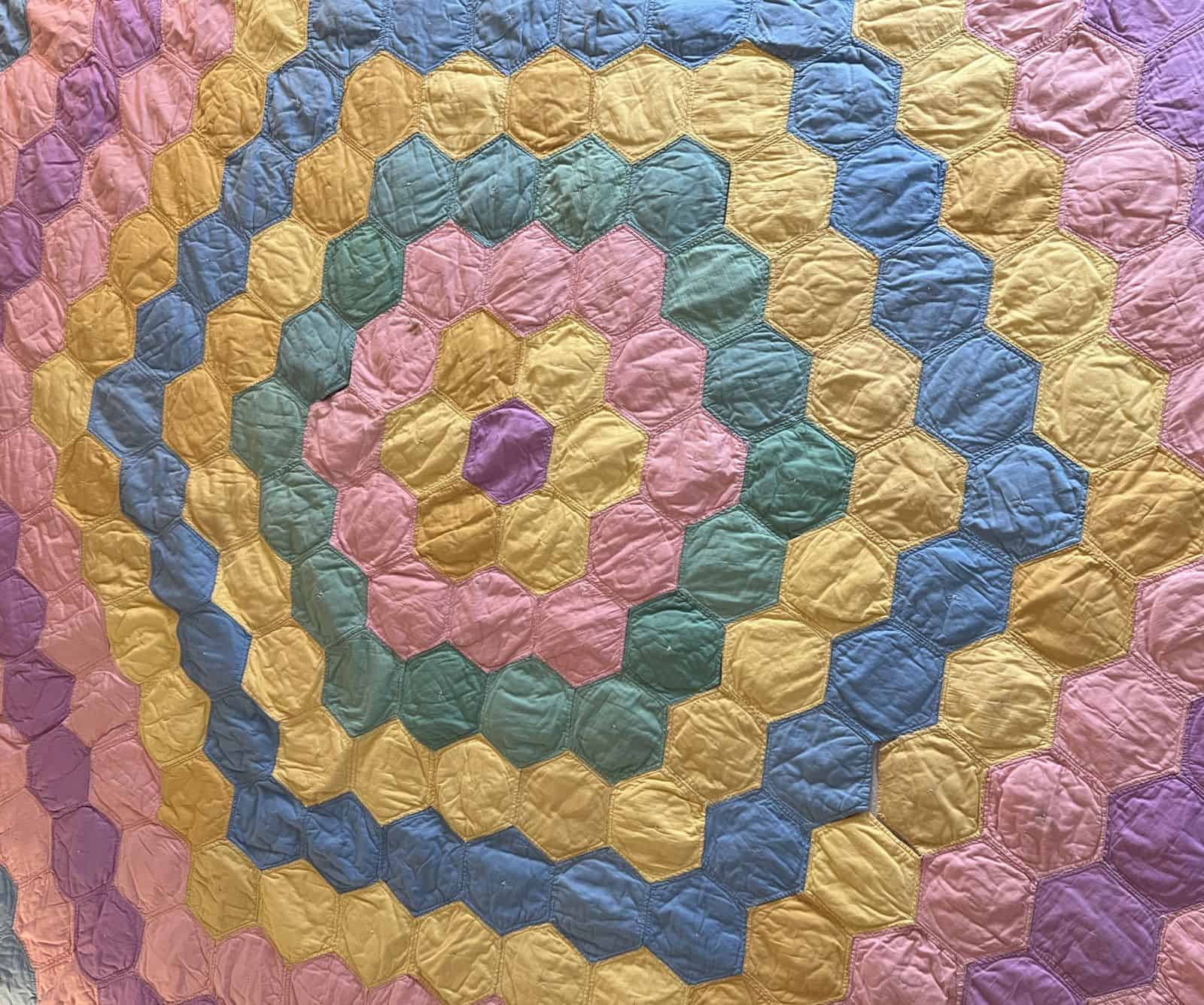
I have on hand now, and have seen only one or two other log cabin quilts pieced as a hexagon, not a square.
I think this variation is called Church Windows; the basic block is three sided, not four. This wool challis quilt top is almost three dimensional, looks as if it is a basketweave, but actually pieced of narrow strips around a hexagonal center.
It will be on view as part of a guest exhibition I am curating for the American Quilters Society in Paducah Kentucky in April, called “In A Thousand Pieces…. featuring quilts made of — guess what — thousands of tiny pieces of fabric! Hope y’all come now….
Laura Fisher ——=_NextPart_000_010E_01C3ECC0.57459600–
Date: February 6, 2004 | From: “Quiltstuff” <quiltstuffoptusnet.com.au>
Below is an email I received after writing to the journalist of that article on UGRR quilts. Sounds like she has had quite a few emails. VBG Suzy
From: “Adamson, Erin” <erin.adamsoncjonline.com> To: “Quiltstuff” <quiltstuffoptusnet.com.au> Sent: Saturday, 7 February 2004 7:38 AM Subject: RE: Underground railway.
> Ms. Atkins, > Thanks for writing me about the quilt article. I have received quite a few e-mails in regards to the acuracy of the research in “Hidden in Plain Sight” and regret perpetuating misinformation, if that is the case. We are considering a way to cover this topic again in the newspaper. > > Sincerely, > Erin Adamson
Date: February 6, 2004 | From: “J. G. Row” <JudyGrow@>
Some time ago someone posted a message about Dr Dobard’s impending speech at the International Spy Museum in Washington DC. I immediately went to the web site, and wrote a “thoughtful” message about our widely held concerns about the veracity of HIPV, etc. etc.
I just returned to the web site to see that the talk is SOLD OUT. Only today I received an answer from the executive director of the museum. In it he says that if I come he will make sure my concerns are voiced. Unfortunately, on Tuesday the 17th I will be in the third day of a 3-day move of my retail picture frame business and am 3-4 hours away from Washington.
(We are moving no more than 400 feet, and hope to be open in the new space on Wednesday the 18th. I gotta tell you — it is the same as moving across the country with 25 years of accumulated “stuff” including 80,000 feet of frame moulding.)
Is there anyone out there who will take my place at Mr. Earnest’s party? Even if it is sold out, I can respond to him and give him the name of my replacement if you’d like. I am sure that if you make yourself known to him you will be heard. Someone from our list SHOULD be there!
Letter and information below.
Judy “Ringo” in Ringoes, NJ judygrow@
Dear Ms. Kaman Grow,
Thank you for your thoughtful e-mail regarding our upcoming Quilts as Codes Program in February. When researching the possibility of having a program on codes and slave quilts, a subject in which we find considerable interest, we consulted many people and organizations in the Washington DC area including the National Museum of American History, the National Cryptologic Museum, and the Anacostia Museum of African American History and Culture, which is our partner in this program.
In presenting this and other programs, our purpose is simply to offer the public views and information on various Museum-related topics we consider of interest. In so doing, we are not endorsing those views or any specific program content. Indeed, a number of our programs have reflected sharply differing points of view (often by presenters on the same panel!) which we welcome in the spirit of enlightened inquiry and debate.
You are, of course, welcome to attend the program and raise the issues that you describe in your letter; and, as program moderator, I will certainly make sure that your question is aired.
Thank you again for your letter and your interest in our programs.
Sincerely,
Peter Earnest
Executive Director
P] 202.654.0925
International Spy Museum
800 F Street NW
Washington, DC 20004
spymuseum.org
pearnestspymuseum.org
F] 202.393.7797
Quilts as Codes: Secrets of The Underground Railroad Tuesday, 17 February 2004; 6:30 pm Sold Out!
Unravel the cleverly-sewn secrets that helped lead slaves to freedom!
Hear how intelligence was woven and yarns told tales: literally! Dr. Raymond Dobard, Professor of Art History at Howard University, co-author of Hidden in Plain View: A Secret Story of Quilts and the Underground Railroad, will reveal the fascinating evidence behind this unique intelligence method. Investigate real quilts and find out how they were intended to communicate with slaves navigating their escape to freedom, learn how to interpret pictures and pattern codes, and try your hand at creating and deciphering your own messages. A book signing will follow the program. Quilts as Codes is presented in partnership with the Smithsonian Anacostia Museum in honor of Black History Month.
Tickets: $20 Members of The Spy Ring (Join Today!) & Anacostia Museum Members: $16 Space is limited – advance registration required!
Date: February 6, 2004 | From: “J. G. Row” <JudyGrow@>
On second thought, perhaps if you inundate Mr. Peter Earnest with e-mails, he may bring up our opposing viewpoint himself. From his letter to me it seemed as though I was the only one who took the trouble to write to him.
Those of you with bona fide credentials, do include them as part of your signature. If you don’t have initals earned at an institution, I.S. is just as good — Independent Scholar! That’s me! Dr. Dobard gains credibility with the gullible from the “Dr” in front of his name, even though it has no bearing on the quality of his research.
pearnestspymuseum.org
I hope he lives up to his name. And don’t you just love his e-mail address? I visualize a very sly partridge in a ……………….you get the picture.
Judy “Ringo” in Ringoes, NJ judygrow@