July 16 – 25, 1998
These restored messages come from the Quilt History List, an online forum where quilt historians, collectors, researchers, appraisers, and enthusiasts discussed antique quilts and related textiles. The archive dates from 1996 through approximately 2016 and is being restored gradually. Sign up in the form at the bottom of the page if you want to know when a new page is added. Original spelling, opinions, formatting, and inactive links may remain unchanged.
Primary topics of this QHL Digest:
- eBay and Online Quilt Sales — Early experiences buying and selling quilts on eBay, concerns about fraud and misrepresentation, and the challenge of evaluating quilts sight unseen.
- Marking and Labeling Antiques — Advice on reversible methods for marking inherited antiques, including quilts, furniture, and metalwork.
- Appraiser Ethics Continued — Continued debate on whether appraisers should also be dealers, with strong opinions on both sides. (see the article on quilt appraisers)
- String Star and Fons & Porter Class — A member reports on taking a string star quilting class with Fons and Porter.
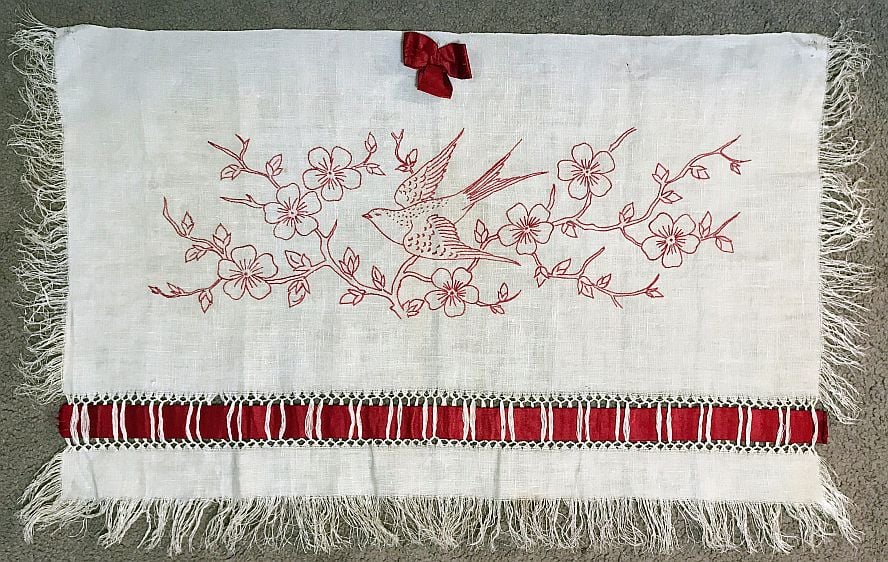
- Redwork and Hawaiian Quilting — Members share finds of vintage redwork on display in Hawaii and discuss red-and-white embroidered quilt history. (see the article on redwork and outline embroidery)
- French Textiles Book — A new book on French textiles is spotted in a catalog and generates interest.
- Bates Heirloom Bedspreads — A question about the collectible value of a Bates Heirloom ‘George Washington’s Choice’ bedspread.
Date: Thu, 16 Jul 1998 14:00:23 -0400 | From: “litfinr” I received one answer
on this from Karan in Iowa to use Isopropyll Rubbing alcohol, diluted 1/2 and 1/2 water. I thank you Karan. I would really like more imput before I try anything so if anyone else has any comments I would appreciate it. Connie In Indiana ———- > >
Date: Sunday, July 12, 1998 12:00 PM > > I recently purchased a redwork quilt that had been tied with red yarn. It > is dated 1914 and has beautiful blocks, very well done. It has a very thick > cotton batting. When it was washed the red yarn left marks all over the > quilt. The red fabric border and the red floss did not bleed. > > I plan to remove the red yarn (it is rotting and falling out) and retie > with cream pearl cotton. Then wash to hopefully remove the red. Because of > the age of the piece, I’m concerned about what to use. > Has anyone used Synthrapol on an older quilt or a product like Biz or > Vivid? Also the batting probably has red in it. Would it be better to > remove the batting before washing? > > Any help would be appreciated. The blocks are too special to ruin. > > Connie in Indiana >
Date: Thu, 16 Jul 1998 22:10:31 -0700 | From: arlenegg [at] icanect [dot] net Judy wrote a great
description of how to mark a fan pattern for quilting. If you didn’t have a 1/8″ hole punch or were in a hurry for a “ruler”, you could use plastic needlepoint canvas. Cut a strip, about an inch wide. The holes are already there! Arlene
Date: Fri, 17 Jul 1998 06:44:14 -0500 | From: Laura Hobby Syler
ruler that we were so fond of using in the ’80’s before we got all these wonderful rulers introduced into the quilting world. There are several different flavors…one with a metal edge, one without and one with holes every 1″ or so down the middle. My GM & GA’s used the string and pin & pencil method to mark the fans…tie a string to a safety pin . Then tie a knot in the string at 1/2 to 1″ intervals. Pin the safety pin to the quilt ….this is the pivot point for your arcs…then tie the string to the pencil at the knot desired and keeping the string tight draw your arch. I ‘ve done this simple method with great success using everything from soapstone markers to the “wonder markers” to chalk markers and mechanical pencils…simple but effective. Laura At 10:10 PM 7/16/98 -0700, arlenegg [at] icanect [dot] net wrote: >Judy wrote a great description of how to mark a fan pattern for >quilting. > >If you didn’t have a 1/8″ hole punch or were in a hurry for a “ruler”, >you could use plastic needlepoint canvas. Cut a strip, about an inch >wide. The holes are already there! > >Arlene > > >
Date: Fri, 17 Jul 1998 07:55:09 -0400 | From: Bonnie Lynn Campbell
found a great solution to getting blood stains out of fabric. = While working on my future daughterinlaw’s satin headband I stuck my = finger and bled on the top of the band! Tried the old saliva trick but = it did not remove it totally. A friend told me about using Peroxide. = It WORKS. Blotted it on with a cotton ball and before my eyes the stain = disappeared. Seems the peroxide breaks down the protein. The satin is = perfect, no shadows from the dampened area. Bonnie in DE
Date: Fri, 17 Jul 1998 16:26:11 -0700 | From: Kathleen Ballard
you reccommend it? SHARED THREADS: Quilting Together–Past and Present . By Jacqueline Marx Atkins A patchwork history of group quilting in America, emphasizes its social = role both yesterday and today, discusses the origins of quilting bees, = the types of quilts most often made communally, quilts with a social = conscience, like the AIDS Memorial quilt, Wedding Quilts, Mourning = Quilts, and more. TIA. Kathleen
Date: Fri, 17 Jul 1998 16:40:22 -0400 | From: “Kelchner, Alan”
comment regarding Q-snap frames. I bought one early last year and started using it. I really liked the square format of the frame, but the fastening method really scares me. I’m concerned that, especially with vintage/antique tops, it places too much stress on fragile/possibly fragile fabrics. So I gave it away as a door-prize for the quilt show last year. Someone else is happy, and I don’t worry about ripping my quilts (no – I actually didn’t rip anything, but the worry ….. ugh.) For those of you who work part/full time as restorers, I have a question. Someone I know, a business person, knows of some people who would use my services. I was asked if I would be willing to pay a finder’s fee for work sent my way (I have a feeling this would be more actual business than tentative questioning). 10% fee. I have no problems with this myself. I had planned on doing something like this when I’m set up to supply quilting services (although I had planned on a set fee for myself). We’ve tentatively made an agreement to do this, but I have asked that we wait a couple or three months – I have three very major jobs due out (two chintz, one nearly-dead feedsack – hundreds of man-hours involved) and do not want any further jobs waiting on me until their done. Has anyone else done something like this? How did you work it? Did it work out relatively well? Did you base the percentage on the total bill? Inquiring minds want to know! Alan
Date: Sat, 18 Jul 1998 00:45:06 -0400 | From: “Judy Grow”
History List” <qhl [at] cuenet [dot] com>, <arlenegg [at] icanect [dot] net> charset=”iso-8859-1″ 1/8″ hole punch or were in a hurry for a “ruler”, >you could use plastic needlepoint canvas. Cut a strip, about an inch >wide. The holes are already there! >Arlene How I love being on this list! There are so many creative people! What a great idea, Arlene! Just mark the holes with a dab of magic marker and off you go! Judy in Ringoes, NJ judygrow [at] blast [dot] net
Date: Fri, 17 Jul 1998 17:10:22 +0100 | From: “Audrey Cameron”
History” <qhl [at] cuenet [dot] com> not yet had an obituary of Amy Emms. This was sent to me by Marie, a QNL member so I hope it’s ok with her that I am sending it to the group. David [at] nodanw [dot] demon [dot] co [dot] uk Here is an article about Amy Emms, the British quilter, who died this week, aged 94. Some of you may have her book on Durham quilting (wholecloth). Stitches in time AMY Emms, who has died aged 94, was one of the last true folk artists of England. She quilted in the style called Durham because that county was still stitching tradition ally when Edwardian folklorists rediscovered the art around the time of her birth in the village of Fullwell, near Sunderland. It’s now, more fairly, called north-country quilting, She learned from her mother, a widow who came home, from skivvying and sat by gaslight at the quilting frame in a tiny bare house.
Aged seven, Amy threaded the needles. Durham quilters stab their stitches through two layers of cloth and the wadding between a technique descended through medieval masterpieces and a craft industry in 18th-century Marseille – so that the plain fabric is shallowly, and subtly sculpted. Amy’s mother drew her designs in chalk, or with the point of her needle; a folk-baroque iconography of feathers, flowers, shells and ropes scrolling over the fabric. As Amy grew, she joined her mother making quilts for sale; after the first world war, it was fashionable to commission quilts and puffier eiderdowns, not of the turkey red or white-cotton of poverty, but of softly shiny sateen. To Amy, the labour was pleasure and entertainment, as well as job satisfaction. At 20, she married Albert Emms, a stained-glass maker.
They lived with Amy’s mum and the women went on needle-working. Amy had a son, George, and a daughter, Olive, and handed down the craft to her. Olive’s wedding dress, a sculpture of dinted snow, remains Amy’s masterpiece. Amy was gifted, a prize and cup winner; the finest of her work is both rigorous and exuberant, like a Jacobean plasterwork ceiling. During the second world war, when her mother and brother died, Albert took sick, the children, were billeted away and the secure little house of her birth was destroyed by a landmine, she found comfort and refuge in her handicraft. Lady Havlock-Allan bought her work, became her patron, and Amy was a local celebrity. In 1951, she began to teach at local evening classes, and for almost 50 years shared her expertise with ever-widening circles. Women’s institutes and colleges called her in; she gave lessons at her own dayschool at the Shipley Art Gallery in Gateshead, made television films and videotapes for craft courses.
Design students made pilgrimages to her home. Her work looked discreetly handsome in church settings, and she completed commissions for copes and altar cloths. Amy had a rhythm in stitching, hypnotic to watch, and idiot questions from onlookers were always answered tolerantly, whether they were from daft ha’porth kids at Beamish Open Air Museum or rich nit-wits at Liberty, the London store. She was usually asked how long a quilt took, a sum she never bothered to tot up until she was getting old, when she discovered each had absorbed at least 350 hours of her life to embellish, plus a week of assembly. Needle-workers all over the world know her name: they read her unpretentious instruction book in the American National Museum of Quilting in Paducah, Kentucky, and in Australia and Japan. She was awarded the MBE In 1984, and was overwhelmed with pride at her visit to Buckingham Palace. She did not take the award as a compliment to herself; but as an honour to the craft she had passed safely on to the future. Ethol King Amy Emms, Quilter, born 1904; died June, 17,1998 — Marie
Date: Sat, 18 Jul 1998 16:04:38 EDT From: ZegrtQuilt [at] aol [dot] com To: QHL [at] cuenet [dot] com I am curating an exhibit and writing an essay titled”Kentucky Quilts Roots and Wings in Oct 98 at Morehead State University’s Kentucky Folk Art Gallery. I am looking at creativity in quiltmaking in Ky past and present .I am also looking at the outside influences on quiltmakers in the state that could have affected their creativity I am looking for something quite difficult to find – quotes from 19th century quiltmakers-talking about making “art” and or “creativity” , even vaguely going beyond normal descriptions of quiltmaking during the 19th or early 20th century . These quotes do not have to be from Kentuckians. In addition, I am searching for an early example ,1930’s or 40’s of a quilt from the workshop of Eleanor Beard from Hardinsburg,Ky. to include. I would be most appreciative of any assistance any of you might be able to offer.Thanks so much, Shelly Zegart
Date: Sun, 19 Jul 1998 08:56:17 EDT From: ZegrtQuilt [at] aol [dot] com Perhaps this can help you. Cuesta Benberry wrote an excellent article in Uncoverings:Dispelling the Myths. (not sure of the title early this a.m. and no time to look it up)..but…the hardback ..titled Quilt Cottage Industries..A Chronicle …beginning p.142 She discusses Eleanor Beard’s business and others that thrived in Ky and elsewhere during the same period. Shelly Z.
Date: Sun, 19 Jul 1998 22:34:41 EDT | From: BrickWks1 [at] aol [dot] com
>
Date: Sun, 19 Jul 1998 22:34:41 EDT From: BrickWks1 [at] aol [dot] com To: QHL [at] cuenet [dot] com Subject: QHL: Re: My 2 cents on Alan’s stuff Message-ID: <b235e138.35b2acc5 [at] aol [dot] com> Content-type: text/plain; charset=US-ASCII Content-transfer-encoding: 7bit Maybe it’s my suspicious little mind, but I have a little trouble with the finder’s fee idea, Alan. In my years as a restorer, I’ve had plenty of instances where another professional passed my name on to the client, but they never have asked for compensation for doing so. I, of course, return the courtesy by recommending them and their work when I get a chance. (If, of course, they do good work — and fortunately, I haven’t had a “bad” professional I’ve dealt with yet.)
If you really really think you’ll get some business from it, and you can make sure your fee for said business will make this worth it, then why not, I guess. But I still have trouble understanding why said clients couldn’t just find you via the normal channels. For me, it’s word of mouth, word of mouth, word of mouth…and the Internet. I also am a little afraid of the pressure that Q-Snap Frames deal, as well as hoops…don’t use these unless I am pretty sure that the quilt top can stand the stress. (And the last top I did via hoop, a feedsack, did have a few seams loosen up.) If at all possible, I prefer to use John Flynn’s frame. You don’t have to baste the layers together, and the tension is quite even. The Flynns sell the kit; you can make it up to any size, using the proper poles. Mine’s queen- sized, and the ends fit comfortably on either side of the couch. That way, I can move up and down as needed to finish a “reach” before I roll to a fresh spot. When not in size, the frame, with quilt still on, just rests standing up in a corner. Works for me… Cindy
Date: Sun, 19 Jul 1998 12:03:38 -0700 | From: “susanlk”
I like the idea of the fur storage, except what was requested was a FREEZER to kill the microbes and insects. So at least that’s a start, and maybe the fur storage places have some idea where to find the freezer required!! I was thinking of places which sell big blocks of ice at marinas… there must be other ice houses, mustn’t there??? We have to think “outside the box” to solve this one!!!! Best regards…this is a GREAT listserve!!! SusanLK
Date: Mon, 20 Jul 1998 08:48:21 -0600 | From: Bonnie Hunter
First off….granny hated it. She wouldnt care if you took it apart! Second off….YOU like it and want to use it and would really like to requilt it so it suits your needs. Which puts your work and grannies work together! Thirdly (thirdly? Is that a word?? LOL) It probably isnt a museum quality type piece so I wouldnt worry that I was ruining the value of it or anything. Lone stars have been so popular all throughout quiltdom that it is doubtful you have anything remarkable in the quilt integrity department if you know what I mean. I would take it apart….and quilt it in a way that you would enjoy using….maybe granny would have even liked it better when you get done with it! smiles Just my $0.02! Bonnie Jon & Chrystine Martin wrote: > discovered a King Sized lone star quilt done in whatwas once primary > colours..Opened this puppy up…and found a note from > my mom..seems she left this for me several years ago…and it just got > “shoved” under the bed frame..Here is where I need some help.. > The quilting is and was so sparse..and apparently the batting was/is > cotton..that when it was washed..some time ago by my mom ..that there > are little and very big.balls of batting all over the place. only two > areas where the diamonds need re=stitching. According to the letter > left by my mom..the quilt belonged to my granny..and was “stitched by > some church ladies in Texas before your grandmother got married.”
This > dating would make it early 1900’s..but I sincerely doubt that as the > pieceing is all very tightly done by machine and I seem to remember my > granny talking about “an ugly lone star ” given to her by one of her > family members on a trip.. > Ok..now for the question part… > Do I have this taken apart..and re-quilted so I can use it…there is > very large stitching done with no real pattern work..the diamonds are > all stitched in a line…no definition around each..just paralled lines > crossing all over the place. > As for looks…in one of the seams I an see that the fabric has faded > substantially..this may at one time have been very bright and > “unsightly” as I recall granny saying..but I love it..nice and bright > pastelly looking.. > > Ther is only a front turn over to the back binding… > so not too hard to take apart… > Any ideas?? > — ~::~::~::~::~::~::~::~::~::~::~::~::~::~::~::~::~::~::~::~::~ Bonnie Hunter
Date: Mon, 20 Jul 1998 17:40:57 -0400 From: “Judy Grow” <judygrow [at] blast [dot] net> On or around July 6th I got this message from MB: >Last week I saw a fabric sample book (with most of the samples intact) for JC PENNEYs >from 1937. It was the size of a large wallpaper book and had fabrics like you described…fine lawn >plus many many more. Also had the prices, if I remember right they started at about 19 cents a yard. I >didn’t buy it…but can’t get it out of my mind. I wrote back and asked where this treasure was, and MB was able to tell me that it was in an antique mall outside of Lansing Michigan on Route 12, and that the book was at a booth right behind the cash register. I called the operator for Lansing information. I called Lansing information, but since I didn’t have a name of a store, I couldn'[t get any help. I called 00 and gave the operator there everything I knew. She gave me the name and number of a flea market. I called the flea market. They didn’t know what I was talking about, but gave me the name of an antique mall. I called the antique mall. They didn’t know what I was talking about, but gave me the number of another antique mall. I called the 2nd antique mall, and spoke to Roxanne, who knew exactly what I was talking about, went and got the book, called me right back, took my credit card info and address, and said it would be sent right out. I got it today. It is actually dated November 30, 1938. It is 8″ tall by 14″ x 14″. It is heavy as lead, but in great condition, and crammed full of all sorts of “Novelty Wash Goods for the Spring of 1939.” The introductory pages with instructions for the store’s buyer are priceless. I learned there that “voiles are completely out of the picture,” with the exception of flock dots. Turning to those pages I saw dark blue colored semi-sheer fabrics with white flocking designs, imitating earlier and heavier weight indigo fabrics.
I was instructed that one-color patterns in the soft ice-cream tones such as aqua, teal, dusty rose, and cherry were “in” , and that bold large designs in vivid colors were contiuing from the last season. The smaller stores were instructed to carry nothing over 29 cents a yard, (fabrics started at 10 cents and, in this catalog, ended at 49 cents). Each page of samples also tells the name of the mill where JC Penny bought the items on that page, and from where they had been shipped. Besides the actual fabric samples, there is a wealth of information for the quilt/fabric historian contained in this book. I’ve looked to see if any of the fabrics from Margaret Adair’s March 1941 stash are contained in this sample book. They are not, that I can tell so far, and indeed, most of the prints look quite different. For the most part, the colors in this earlier book are far more saturated than those in the 1941 stash. Odd. Thanks, MB, for putting me on to it. Now I just have to find a place to keep it. It’s HUGE! Judy in Ringoes, NJ judygrow [at] blast [dot] net
Date: Mon, 20 Jul 1998 15:32:53 -0600 | From: Kathy Gaul
a mailing from one of the book clubs and saw a book I = had not seen thus far entitled, “French Textiles From 1760 to the = Present” by M. Schoeser & K. Dejardin. I am curious if any of you have = seen it, read it, reviewed it, etc. Did you think it was a good book = for reference of early textiles? I know it is on Barb Brackman’s “Quilt = Detective” listing – but it isn’t one that is starred as a “must have”. = Anyone have comments? Secondly, who’s gearing up to go to Restoration Conference this year? I = am looking forward to another great conference where I hope to see many = of you again! -Kat
Date: Mon, 20 Jul 1998 18:12:00 -0400 (EDT) | From: dcl924 [at] mindspring [dot] com (Diane Lockwood)
There are so many of you who collect antique quilts that you collect other antiques. Here’s the problem. We have inherited a houseful of antiques from DH’s parents. We thot we’d attach small brass (?) plates to the big furniture pieces but we are stumped on how to permanently mark the smaller items (like brass candlesitcks, dutch tobacco boxes, etc). Keep in mind that these antiques date from the early 1700s. It looks like we must use an engraving tool on the metal items tho we hate to depreciate the pieces. We sure can’t think of any other way to mark them. By the time our g’kids inherit the stuff, maybe the marks won’t have deprciated the items that much. Any ideas? Thanks, Diane Usually in Pollock Pines, Calif temporarily in North Georgia
Date: Mon, 20 Jul 1998 21:31:48 EDT | From: Tom1Glo2 [at] aol [dot] com
People seemed interested in the recipes in my old White House Cookbook for dying fabrics. These are instructions for cottons: Black – for five pounds of goods, boil them in a decoction of three pounds of sumach one-half hour and steep them for twelve hours; dip in lime-water one- half hour; take out and let them drip one hour, run them through the lime- water again fifteen minutes. Make a new dye with two and one-half pounds log- wood (boiled one hour) and dip again three hours; add bichromate potash two ounces, to the logwood dyeand dip one hour. Wash in clear, cold water and dry in the shade Sky blue: for three pounds of good blue vitriol four ounces; boil a few minutes, then dip the goods three hours; then pass them through a strong lime- water. A beautiful brown can be obtained by next putting the goods through a solution of prussiate of potash. Green: dip the goods in home-made blue; dye until blue enough is obtained to make the green as dark as required; take out, dry and rinse a little.
Make a dye with fustic three pounds, of logwood three ounces, to each pound of goods, by boilinb dye one hour; when cooled so as to bear the hand put int he goods, move briskly a few minutes, and let lie ond hour; take out and thoroughly drain; disolve and add to he dye for each pound of cotton, blue vitriol one- half ounce,a nd dip another hour. Wring out and let dry in t he shade. By adding or diminishing the logwood and fustic any shade may be had. Yellow- for five pounds of goods, seven ounces of sugar of lead; dip the goods two hours; make a new dye with bichromate of potash four ounces; dip until the color suits; wring out and dry. If not yellow enough repeat. Orange – for five pounds of goods, sugar of lead four ounces; boil a few minutes; when a little cool, put in the goods; dip for two hours; wring out; make a new dye with bichromate potash eight ounces, madder two ounces; dip until it suits; if color is too red, take a small sample and dip into lime- water and choose between them. Red – Muriate of tin two-thirds of a teacupful; add water to cover the goods; raise to boil; put in the goods one hour, stir often; take out empty the kettle, put in clean water with nic-wood one pound; steep one-half hour at hand heat; then put in the goods and increase the heat one hour- not boiling. Air the goods and dip them one hour as before. Wash without soap. I hope people find these useful. I will put the ones for wool in later. Gloria in Coastal NC
–
Date: Mon, 20 Jul 1998 23:15:46 EDT From: Kittencat3 [at] aol [dot] com Diane – do NOT, under any circumstances, put brass plaques on the furniture. You will ruin the value. Ditto for engraving the brass pieces. ANY changes of the sort to colonial antiques will make future generations, either of the family or of collectors/curators, gnash their teeth in despair. Furniture and decorative items that old should be left strictly alone – and if you doubt your ability to care for them, they should be put on loan to a museum with the facilities to do so. The chief treasure of my family is a 120 year old Eastlake-style Renaissance revival dresser. It was owned by my great-grandmother, grandmother and mother in turn, and everything, from the mirror to the drawer pulls, is original. It has never been refinished, stripped, or altered in any way, except for new screws attaching the mirror and the removable drawer lining paper installed by my mother. It’s in use right now for my clothes. Bob and I are planning a family in the near future, and I fully intend to pass the dresser along to the next generation.
Instead of attaching a plaque, I typed up a sheet of paper listing the four owners of the dresser and as much as I knew about them. I laminated the sheet and tucked it under the drawer liner in the top drawer. This way the dresser’s history is easily accessible without altering the piece in the slightest. If I have a daughter (or a daughter-in-law), she’ll know who bought the dresser, who owned it, and why it started out in western Pennsylvania and ended up in Massachusetts. This is only one way of preserving an item while attaching its history. A museum, particularly one with a good decorative arts collection, should have many more. I wouldn’t do a thing until I’d consulted a professional. If all else fails, see if you can get in touch with someone at the Metropolitan Museum in New York. Their decorative arts collection is superb, and their curators should know exactly what to do. Good luck! Lisa Evans Easthampton, MA
Date: Mon, 20 Jul 1998 23:54:15 -0400 | From: “Judy Grow”
about marking the antiques they had inherited: Diane, Allan and I have been collecting American antiques since we first married 33 years ago. Our home is furnished with nothing but, except for 3 upholstered pieces. Please, please, don’t attach brass plates to your case pieces. Instead, take out a drawer and either write on the drawer bottom or inside the backing of the case, IN PENCIL, all the information you want to include about provenance. This is an acceptable way to record history. And please, don’t touch the old finishes! Any repairs that have to be made can be recorded inside as well. We have one curly maple chest of drawers circa 1830, with the legend “Repaired by 100 years after” written in grease pencil on the rail under the top drawer. We think the makers name and date is written under a small drawer on the top, but since we can’t take the top off, we can’t read it .The repairer obviously did, but neglected to record the makers date. It just makes the mystery that much more intriguing. Any dealer or collector worth his salt will know just where to check the piece out (with a flashlight) looking for signatures, labels, history, and constructrion details. Why do you feel you must mark the brass and glass? If you feel the need you can put a paper label on the underside. I suggest, that you photograph everything (with a ruler or yardstick to indicate scale) and have two sets of prints made. Keep one in your safety deposit box, along with written descriptions of the items (and appraisals if warranted) and give the other to your insurance company if you will put them on a fine arts rider. If they are that valuable they should be appraised. We use our pre- Civil War stemware (flint glass) and 19th century porcelain. I couldn’t if I had labels to deal with. Our kids are in their mid 20’s and know about everything they will inherit. Start your kids’ education now. Judy in Ringoes, NJ
Date: Mon, 20 Jul 1998 21:58:55 -0500 | From: June Schumacher
(by way of “Kris Driessen, Hickory Hill I am looking for some instructions on “twilling”. I am looking for some instructions on “twilling”. I believe it is an old needlecraft for quilting. I understand it is done with a tapestry needle and two strands of crochet thread plus ???. The top (usually muslin), batting and backing is done all at once then the blocks are put together. Absolutely beautiful. Can you help? Thank you. June e-mail address is bsrjsch [at] wans [dot] net
Date: Mon, 20 Jul 1998 22:29:19 -0700 | From: “August, Rachel” Judy
wrote…”Now I just have to find a place to keep it. It’s HUGE!” I would like to offer the use of my home as a storage place for that wonderful sample book you found. LOL A friend of mine has an Alden catalog from the mid-40s. In addition to the usual catalog offerings, the catalog includes fabrics. Don’t I wish I could now buy those fabrics at those prices. ~^~^~^~^~^~^~^~^~^~^~^~^~^~^~^~^~^~^~^~^~^~^~^~^ Please remember to smile whenever you think of me. ~^~^~^~^~^~^~^~^~^~^~^~^~^~^~^~^~^~^~^~^~^~^~^~^
Date: Tue, 21 Jul 1998 06:40:22 +0000 | From: Carole Spencer
Diane, Any markings (or repairs) to antique pieces should be reversible. For brass and other metal pieces, you can use a layer of clear nail polish, write the information with an indelible ink pen (or use India ink) and another layer of clear nail polish (after the ink is thouroughly dry). This technique doesn’t work as well on wood or other more porous surfaces. You can also check with a local museum to see how they mark their pieces. Carole Spencer You wrote: There are so many of you who collect antique quilts that I’m hoping that some of you collect other antiques. Here’s the problem. We have inherited a houseful of antiques from DH’s parents. We thot we’d attach small brass (?) plates to the big furniture pieces but we are stumped on how to permanently mark the smaller items (like brass candlesitcks, dutch tobacco boxes, etc). Keep in mind that these antiques date from the early 1700s. It looks like we must use an engraving tool on the metal items tho we hate to depreciate the pieces. We sure can’t think of any other way to mark them. By the time our g’kids inherit the stuff, maybe the marks won’t have deprciated the items that much. Any ideas? Thanks, Diane Usually in Pollock Pines, Calif temporarily in North Georgia –
Date: Tue, 21 Jul 1998 08:48:58 EDT | From: CToczek [at] aol [dot] com
the net, finally, after a month of cross country adventure from Lubbock, TX to West Point, N.Y. We made it with two cars and two little boys despite an ear-ache, a virs, a hailstorm, in-law visits and mucho road work in Ohio and Pennsylvania. The high temps in the 80’s here sure beat the plains, but I’ve been warned to watch out for August and get ready for winter! My quilts made it just fine and my sewing room is now hollerin’ at me to get back in here! (I was delighted to find an oversized pantry in these particular Army quarters, which I immediately seized as my own! vbg) Anyway, glad to be back with you all. Judy, your fabric book story was exciting. I love to hear of finds like that. When passing through Little Rock for a family visit, I attended another auction with my parents. I took the time to look over the dishware (no linens this time, rats) but was surprised when the auctioneer got to a Sears/Roebuck 1900 catalog.
I bid and got it for only $2.00 and should have been suspicious then. Well, just award me the Dunce cap, because it was actually a 1971 REPRINT of the catalog, done back when the folk revivals were underway. LOL Still interesting to look through, even if it was a reprint, not an original…..and I at least paid less than the original cover price! The good news from that event is that I did get the dish I wanted, a medium- sized bowl from the Grace Snyder quilt pattern dish set. Too bad there was only one bowl or I would have tried for the whole set. A friend in Lubbock found the whole set of dishes in Iowa on a quilt tour last summer. I think I was the only one at the auction who knew the significance of the pattern. Anyone else know the dishes I’m talking about? And an approximate date the pattern circulated? This is the Grace Snyder of Nebraska/one-inch square designs/No Time on My Hands book that Kris at Hickory Hill carries. Best wishes, Carla who used to be in Lubbock, now at West Point on the Hudson
Date: Tue, 21 Jul 1998 20:59:58 EDT | From: [from unknown, signed “Cathy”]
Someone called me for advice today about the value of her grandmother’s Bates Heirloom bedspread called “George Washington’s Choice”. It is a handwoven, limited edition in its original box with a ” Certificate of Registration for Original Owner.” Date 1958. Was this a clever gimmick by Bates or does the bedspread have a collectible value? Any info appreciated. Cathy
Date: Tue, 21 Jul 1998 21:16:02 -0400 | From: [from unknown]
Friday morning I am taking a class with Fons and Porter on doing a string star quilt – something I have always wanted to do. So tonight I am cutting strips in preparation. I gathered quite an assortment of fabrics because I wanted to make this quilt from the point of view of a woman who is using up what she has – no preplanning of hues or textures, and using fabrics from all eras except the very modern. I have collected quite a few reproduction fabrics, so my choices spanned anything from what was manufactured last week to repros of 1825. I am doing this purposely. While I was cutting away it occured to me that most people, children especially, have absolutely no idea of the brilliance and variety of colors and prints people in other eras and centuries in this country used in their clothing. Might it make it interesting for children, particularly in elementary grades, as they study U. S. history, to have some samples to look at? They could be titled….”When I got dressed in 1920 my clothes might have looked like…..” (Can you tell I’m an ex teacher?) I have some teacher friends and I was thinking it might be nice to put together a display, but then I bogged down. Being the selfish quilter that I am I wouldn’t want to use/give away more than a 2″ square of each fabric. What would be the best way to mount them so that they would last the longest? Use a glue stick to paste them in a fancy notebook? Any ideas appreciated. Nancy Schott
Date: Tue, 21 Jul 1998 23:47:17 -0400 From: “Judy Grow” <judygrow [at] blast [dot] net> To: “Quilt History List” <qhl [at] cuenet [dot] com>, <fschott [at] ix [dot] netcom [dot] com> Subject: QHL: fabric samples Message-ID: <003201bdb523$6ce3e780$3ce8c6cf@judy-grow> Content-Type: text/plain; charset=”iso-8859-1″ Content-Transfer-Encoding: 7bit Nancy, I put all the samples I cut from Margaret Adair’s 1941 stash in a single photo album for 4 x 6 prints that had 208 openings. I actually had 212 pieces, but doubled some of them up. You could use an album for smaller prints, or single pages, or even slide sheets for binders. Those would really be small samples, but would give an idea of color and pattern. And all the above would keep them away from grimy little hands! Judy in Ringoes, NJ judygrow [at] blast [dot] net >While I was cutting away it occured to me that most people, children >especially, have absolutely no idea of the brilliance and variety of >colors and prints people in other eras and centuries in this country >used in their clothing. Might it make it interesting for children, >particularly in elementary grades, as they study U. S. history, to have >some samples to look at? They could be titled….”When I got dressed in >1920 my clothes might have looked like…..” (Can you tell I’m an ex >teacher?) I have some teacher friends and I was thinking it might be >nice to put together a display, but then I bogged down. Being the >selfish quilter that I am I wouldn’t want to use/give away more than a >2″ square of each fabric. What would be the best way to mount them so >that they would last the longest? Use a glue stick to paste them in a >fancy notebook? Any ideas appreciated. >Nancy Schott
Date: Wed, 22 Jul 1998 00:00:07 -0400 | From: “Judy Grow”
History List” <qhl [at] cuenet [dot] com> charset=”iso-8859-1″ e-mail newsletter and was intrigued by an offering in their latest. Go to http://www.cranstonvillage.com/herald and follow the directions to the Quilt Shop. Then go to the section on Cotton Fabric of the 1960’s. They have a couple illustrated, but most interesting is what happened to all their swatch books from as early as 1820! A fire marshall came into the plant at the turn of the last century and when he saw the room that had the books, he declared it a fire hazard and instructed them to get rid of them — and they did! The earliest they have left is from 1899. Remember all those wonderful books we saw in Lowell at the Museum of American Textile History? Imagine them all gone too! I’ve always hated fire marshalls. I’ve always seen them as little men in big uniforms. I have to deal with them once a year in the store, and everything has to pass their approval before you can open a store. And they are constantly changing the rules. When I opened my second store, in Short Hills NJ (which I sold almost 3 years ago, after 11 years) the fire marshall came in, smoking a cigarette, which he ground out on my carpeted floor, after telling me I had to redo this and that and the other thing to comply to code. And there is absolutely nothing you can do but comply! And burn inside! And so it was at Cranston almost 100 years ago. So much history lost because of one little man! AARRRGH! Judy in Ringoes, NJ
Date: Tue, 21 Jul 1998 21:41:35 -0700 | From: Jon & Chrystine Martin
see some of the red work that has been on display at the Mission Houses Museum in Oahu Hawaii…I had no idea there was such diversity in the technique..nor that the patterns made it via the missionaries to the islands… One typically only hears about the wondrous applique…but these were inspiring… — Chrystine Martin…. The Crafty RN
Date: Tue, 21 Jul 1998 21:44:53 -0700 | From: Jon & Chrystine Martin While moving
furniture in the Bedroom with DH…we ran across a ..don’t strangle me folks..plastic blanket bag stuffed with what I thought was white muslin.. After opening it…discovered a King Sized lone star quilt done in what was once primary colours..Opened this puppy up…and found a note from my mom..seems she left this for me several years ago…and it just got “shoved” under the bed frame.. Here is where I need some help.. The quilting is and was so sparse..and apparently the batting was/is cotton..that when it was washed..some time ago by my mom ..that there are little and very big.balls of batting all over the place. only two areas where the diamonds need re=stitching. According to the letter left by my mom..the quilt belonged to my granny..and was “stitched by some church ladies in Texas before your grandmother got married.” This dating would make it early 1900’s..but I sincerely doubt that as the pieceing is all very tightly done by machine and I seem to remember my granny talking about “an ugly lone star ” given to her by one of her family members on a trip.. Ok..now for the question part… Do I have this taken apart..and re-quilted so I can use it…there is very large stitching done with no real pattern work..the diamonds are all stitched in a line…no definition around each..just paralled lines crossing all over the place. As for looks…in one of the seams I an see that the fabric has faded substantially..this may at one time have been very bright and “unsightly” as I recall granny saying..but I love it..nice and bright pastelly looking.. Ther is only a front turn over to the back binding… so not too hard to take apart… Any ideas??
Date: Wed, 22 Jul 1998 17:11:19 EDT From: Carlyz76 [at] aol [dot] com To: QHL [at] cuenet [dot] com, fschott [at] ix [dot] netcom [dot] com Subject: QHL: Re: QHL-Digest Digest V98 #207 Message-ID: <d6c7bc46.35b6557f [at] aol [dot] com> Content-type: text/plain; charset=US-ASCII Content-transfer-encoding: 7bit In a message dated 7/21/98 10:04:39 PM Eastern Daylight Time, Nancy Schott writes << I have some teacher friends and I was thinking it might be nice to put together a display, but then I bogged down. Being the selfish quilter that I am I wouldn’t want to use/give away more than a 2″ square of each fabric. What would be the best way to mount them so that they would last the longest? Use a glue stick to paste them in a fancy notebook? Any ideas appreciated.>> How about line drawings of the people wearing the fabrics as the clothing. This would have to be on tag board or some other type of heavy paper. Examples – years past when little boys wore dresses until they were old enough to wear pants, a girl in a dress. A young woman in a wedding gown and the groom in his only dress clothes (which sometimes were not all that fancy depending on the status of the family). A Farmer in his work clothes, mom in her day dress, don’t forget the bank officer or military men. Even the fact that our nurses wore hats and whites until a few years ago. Then there is the nuns habit, too. Nancy you really got me thinking about this and it would be an excellent resource for a teacher. Carla Jolman, Muskegon, Michigan
Date: Wed, 22 Jul 1998 18:37:41 -0500 | From: Laura Hobby Syler cii” This
gave me chills!!! Short and sweet…. NEVER should you offer to purchase anything that you appraise! At least not within a reasonable time period…say at least a year!!! Anyone else want to comment! Laura At 11:59 AM 7/22/98 -0500, Liz Swartz wrote: >I just read a really disturbing story in the paper >yesterday. One of General Picketts’s (of Gettysburg fame) >descendents had an entire group of really important family >memorabilia appraised by one of the Civil War experts who is >a regular on Antiques Roadshow. The appraiser valued the >lot at $88,000, bought it from the descendent, then turned >around and sold it to a museum for $800,000! Isn’t that an >incredible conflict of interest? Well, needless to say the >descendent is sueing the appraiser. Any thoughts from all >you appraisers out there? What are the rules, writen or >unwriten? > > > >
Date: Wed, 22 Jul 1998 23:34:34 EDT | From: QuiltEvals [at] aol [dot] com
It is not uncommon for an unethical appraiser or dealer to under-evaluate an article, purchase it and resell it for a profit. The consumer needs to be aware of what to look for when seeking a qualified appraiser. Bottom line….if someone who appraises your article makes an offer afterwards purchase it….pick up the article(s) and look for a new appraiser. By the way…There is a web page for Quilt appraiser’s FAQ, that discusses things one should know to find a reputable appraiser, and also links to another page that describes the code of ethics that AQS certified appraisers must sign and agree to before certification testing can begin. These pages can be found at:http://quilt.com/debbieroberts/appraiserfaq.html andhttp://quilt.com/debbieroberts/ethics.html
Date: Wed, 22 Jul 1998 21:37:57 -0600 | From: Sharon Harleman Tandy
appraisers’ ethics Hi all, been gone awhile again. My addition is what I’ve heard from others: Never appraise what you want to buy and never buy what you have appraised. And, even though I am not certified, maybe BECAUSE I am not certified, this is a rule I follow completely and always will, since I want to protect my reputation and those of fellow quilt historians and quilt appraisers. Sharon.
Date: Thu, 23 Jul 1998 01:11:06 -0500 | From: Swede
This is a really interesting story. One I printed out and shared with my computer phobic dh who does appraisals for individuals and museums, libraries, etc. on movie memorabilia, vintage film equipment, and authenticates and appraises historic autographs. We are, by the way, also dealers. No one in this field could make a living simply from appraising these things and even a collegue who formerly appraised for Christie’s had to deal to stay alive. I would be interested in finding out more of the details of this situation. Anyone know where I can get more info? For instance, how much time elapsed between the time the items were appraised, bought and sold? Was it just the seller’s items that were sold to the museum or was it combined with some things the appraiser already had on hand that were related? How did the information get out as to how much the museum paid for this collection? Have any other appraisers been consulted as to what the value should have been set at? Did the seller first try to sell the collection him/herself with no luck and then turn to the dealer/appraiser? How much did the dealer/appraiser pay for the items?
Did the appraiser actually give a written appraisal or did the seller ask him “what’s it worth?” We always tell people who approach us in this manner, “What it’s worth and what we or any other dealer will pay for it are two different things.” We charge for appraisals and then give the customers a high/low, wholesale/retail and sometimes regional influence on the opinion. It’s easy to jump to conclusions as the public is generally suspicious of dealers in the antique field. And indeed, there is a lot of riffraff out there. But oftentimes, when the facts are known, it turns out to be a partially ficticious story propagated by the public who gobbles up “rip off” stories. I love people who complain about the amount of profit dealers make. Yes, sometimes it is 1000%.
But they never take into account how much time goes into finding, restoring, and advertising the goods in order to bring a good selection to the collectors. Everyone wants something for nothing. That 1000% quickly shrinks when you have 2,000 items on inventory that took just as much time to find and restore, but no one’s buying them! If the facts are as simple as stated in the original post re: this situation, and the appraiser knowingly misled the seller in order to buy the collection cheap and had the museum waiting in the wings to buy it, then I would think this is appalling and this is the sort of person who gives all people in the antique business a bad name and he should be dealt with harshly. But first, let’s have the facts, m’am. Just the facts… Annastina
Date: Thu, 23 Jul 1998 11:57:28 | From: PATRICIA KELLER
Hi, Folks – Although it is readily available, nail polish is not an appropriate base coat/ top coat for marking artifacts with identification numbers, etc. Neither is White Out, another perennial favorite… This is a topic that has received much attention among museum conservators, registrars and curators, particularly of late. If you intend to “write” information on an artifact, consider using an acrylic base coat (I like B-72 acryloid, white pigmented for dark objects, colorless for light objects, a PERMANENT marker or India ink for the lettering/ numbering (Sharpies fade out in light- better markers are available, like the Sakura Identi-Pen), and colorless topcoat (colorless B-72 acryloid, or Soluvar)to protect the information you have written on the basecoat from chipping etc. A mail-order archival supply company: Light Impressions, sells the B-72 acryloid already mixed and packaged in small nail-polish type bottles with little brushes built in.
The IdentiPens are available through Gaylord, another mail-order archival supply house. Light Impressions: 1-800-828-5539 Gaylord: 1-800-828-6216 Just one system among several that museum folks use. Patricia Keller 1998 08:04:16 EDT regulations may seem petty, and the guy who smoked a cigarette and stubbed it out on the rug should have been reported to the town (especially in a place like Short Hills!), but fabric is a fire hazard. Especially dusty fabric – large quantities of dust can spontaneously combust, like in the grain elevator out in the Midwest recently. We don’t know the condition of those early fabric books, we don’t know where they were kept or stored, and we have no idea if they were capturing enough dust to be a fire hazard. I agree that it’s a shame that Cranston got rid of the early sample books…but their choice to ¨C65C the books is hardly the fault of the fire marshal! He simply said to “get rid of them.” Cranston could have donated them to a museum, sold them to employees, or cleaned them and kept them in a proper archive. There were plenty of options besides destroying them. Finally, it is entirely possible that some of the books might have survived. When I worked at Steelcase, the furniture company, no one cared if I took fabric or laminate samples, and in fact I was allowed to “liberate” an entire sample case of mahogany laminates when the product line was phased out! It would not shock me to learn that some of the employees decided to liberate sample books if they liked the fabrics. After all, if no one ¨C66C the samples, why not take them? Lisa Evans
Date: Thu, 23 Jul 1998 08:31:04 -0500 | From: “Jeff & Sheri Lesh”
Also I just bought 11 Sawtooth Star blocks (from Brackman book, #2138) from a local antique shop. The fabrics are turn of the century or a little before, some homespun, mourning cloth, double pink, one chrome yellow, and one paisley block. The sizes were all over the place so I trimmed them to a more uniform size. I framed each block with a black repro sashing, then did the final trimming so they were exactly the same size. Then cut alternating blocks out of a double pink fabric and set them every other one with the double pink fabric. Setting them 2-1-2-1-2-1-2. It made a long, narrow piece, but I did not want to add anymore blocks to the set, so that limited my lay out. I got the top all sewed and really was not that thrilled with the way it looked, then I remembered the soldier quilts in the Civil War book, so I looked at them and they had some borders around them, so went digging in the abyss of the stash and came up with the Jenny Beyer Discovery Border, remember that from a few years ago. Well I still have a bunch of that, so put that around the edge. It really helped tie it together, with the pink, blue and black. I also tried that trick of using the binoculars backwards to look at it. The quilt really does look better from a distance than right close. But those lonely little blocks now have a new home and just imagine with me some civil war soldier sleeping under this quilt made by his loving mother for her dear boy! That’s my story and I am sticking to it! Sheri from Iowa Jeff & Sheri Lesh jefflesh [at] netins [dot] net
Date: Thu, 23 Jul 1998 13:11:03 EDT | From: EGinebaugh [at] aol [dot] com
has a quilt top with fabrics that I have never seen before. I thought someone out here may have some ideas or thoughts on it. The quilt top is just a brick pattern, in white, pink & blue solids, but the fabric is semi-sheer. It’s different feeling than any cotton or man-made fabric that I have seen. I’ts also a little stiff or crispy feeling, but not to the point of breakage, yet. The top is estimated at being made in the latter 1800’s. Family top, handed down through the ages. I told my friend who owns the top not to quilt it till someone looks at it first to determine if it will be shredded with the quilting process. Our question is: what type of fabric could this be? TIA, Liz in sunny Michigan P.S. Thanks, Maury
Date: Thu, 23 Jul 1998 14:43:11 -0400 | From: Nancy Roberts
quilts were popular from the late 19th century-Victorian era until the 1940s. Various motifs are related to different time periods and the patterns for redwork blocks were popular series in newspapers of the ’20s-’40s. An article with more in-depth background information about redwork quilts appeared in Traditional Quiltworks magazine, Issue 32 (summer, 1994). It features quilts from the collection of Sandra Munsey along with a block pattern for Sunbonnet Babies from Sally Goodspeed. Perhaps you or a quilting friend have this back issue. If not, one can be ordered from Chitra Publications by calling 800-628-8244. Also, a reader wrote in to Traditional Quiltworks with a question about salvaging vintage redwork blocks. Replies from Alan (quiltfix [at] bellsouth [dot] net-of this list) and me will appear in Issue 58, coming in the fall. Nancy
Date: Thu, 23 Jul 1998 15:28:27 EDT | From: QuiltFixer [at] aol [dot] com Since
inquires about the Restoration Cleaner I used, with her permission, I am providing this information: Doris Easley 916 782-3028 Fabricare Consultant/Heirloom Restoration Cleaning, Conservation, Restoration of all types of fabric and textiles Doris has her office in her home and consultations are by appointment or telephone. She get many things from individuals, museum, etc., by mail, ups, etc., but you must consult with her first. She travels a lot lecturing so may not be available immediately to answer your call. I found her to be very reliable and capable. She has many, many references. Toni Baumgard QuiltFixer [at] aol [dot] com — Sue Bender
Date: Wed, 22 Jul 1998 19:57:28 -0400 | From: Mary Beth Goodman
Just returned from Vermont Quilt Festival, and on my way, unexpectedly (!) to Quilting by the Lake, but I wanted to throw out a question: I love Princess Feather quilts – one of those quilts I’m likely never to make myself! They had one on display at VQF, an antique beauty. I was admiring it at some length when I realized that the more or less standard swag border was “upside down” – that is, the convex side of the swag pointed to the center of the quilt. I thought – how odd! Then I chuckled to myself thinking about the quilt maker, who, discovering that she’d sewn on the first side of border backwards, said “what the heck” and sewed the other four sides on to match! OK – next day, I’m seated at our raffle quilt table, across the way from a PA antique quilt dealer. They had not one, but TWO princess feathers on display. The first was taken down and perhaps sold. I wander over to look at what I find to be the second feather quilt and realize it too has swag borders – simple parenthesis shape things – ALSO sewn on convex side pointing in. This border was not fabric swag like, but geometric and with small dots along with it. The dealer wasn’t helpful, wanting to talk about the NY State governor instead of quilts, so I wandered off to consider all of this. To sooth my brain I ended up buying 5 1/2 yards of silk from the next vendor, Delectable Mountain Cloth from Brattleboro VT. So – how often do swags get turned around? Mary Beth
Date: Thu, 23 Jul 1998 17:21:58 -1000 From: Laurie Woodard <lwoodard [at] hawaii [dot] edu> To: “QHL Digest” <qhl [at] cuenet [dot] com> Subject: QHL: Hawaiian redwork Message-Id: <98jul23.172118hwt.148929(5)@relay1.hawaii.edu> Content-Type: text/plain; charset=”US-ASCII” >I was amazed to see some of the red work that has been on display at the >Mission Houses Museum in Oahu Hawaii…I had no idea there was such >diversity in the technique.. these were inspiring… >Chrystine Martin…. The Crafty RN Dear Chrystine (and everyone) I am glad to hear that you found the Hawaiian redwork as exciting as I do! These quilts were made in the same time frame, roughly 1880-1925, when cotton embroidery was popular in the mainland U.S. For those that have never seen it, Hawaiian quilters generally worked with only one or two motifs–the same floral designs sold by Briggs Transfer Co. and the Ladies Art Co. and others that were purchased by mainland quilters for their penny squares. They laid them out on a whole-cloth surface to create an overall design rather like their applique quilt designs. They also developed designs using local flowers like the Ohia lehua (metrosideros collina) and the Night blooming Cereus (a Mexican catus). Also, they might combine the Hawaiian coat of arms you are familiar with from Hawaiian flag quilts, with the floral designs. Victorian bows, ostrich feathers, butterflies, and birds also can be found. They embroidered in all weights of red cotton embroidery thread. Occassionally blue thread was used. When other shades of colorfast cotton embroidery thread appeared in the mid-twenties, other pastel colors were used. They quilted in a variety of straight-line quilting patterns, in the contour or echo quilting you expect to see on Hawaiian applique quilts, and in a few quilting patterns that seem to be unique to Hawaiian quilts (associated with the island of Kauai). You can see a representative sample of these quilts in “Uncoverings 1997,” the journal publication of the American Quilt Study Group (http://catsis.weber.edu/aqsg/). One quilt from the Mission Houses Exhibit, Honolulu, HI is featured (small image) on the “Hawaiian Quilts” web page of the Hawaiian Quilt Research Project(http://alaike.lcc.hawaii.edu/openstudio/hqrp/). Mahalo Laurie
Date: Thu, 23 Jul 1998 19:36:38 -0800 | From: ayjones [at] tacoma [dot] nwrain [dot] net (Yvonne Jones)
Mary Beth said: I love Princess Feather quilts – one of those quilts I’m likely never to make myself! They had one on display at VQF, an antique beauty. I was admiring it at some length when I realized that the more or less standard swag border was “upside down” – that is, the convex side of the swag pointed to the center of the quilt. Mary Beth, I have a wonderful Princess Feather with tulips, a red and green applique quilt. I never considered the border to be a swag border, just an original design. It could be similar to what you are talking about, it is like scalloped “U’s” all around the border and the ends of the U come out to the edge.As a quilter that does mostly applique I look at this quilt with great admiration to the quilter because it is the most difficult level of applique when you have so many “ins and outs” on not just the Princess Feathers but the border pieces as well. I hope this helps you in your comparisons. Yvonne QUILT-R Washington State ayjones [at] tacoma [dot] nwrain [dot] net The QUILT-R 🙂
Date: Thu, 23 Jul 1998 20:46:14 +0000 | From: Lou Ann Schlichter
Emily I noticed a response to your Redwork question and after just finishing a reproduction of same, a friend passed on an article to me. Quilter’s Newsletter, Sept.1997, pg.43 “Penny Squares & Other Redwork” It’s a good article that will give you a brief history. I’m now doing Sunbonnet Babies, embroidered, and 30-40’s reproduction fabrics to display in my shop. I see you are from Huntington Beach…come to Ojai and see them in person! Lou Ann Schlichter, Proprietress Heartwarmers Mercantile http://www.west.net/~hartwrmr
Date: Fri, 24 Jul 1998 04:40:48 -0400 | From: [from unknown, signed “SusanLK”]
Just a comment about appraisers and dealers, neither of which I am. I think the person who said an appraiser couldn’t pay the rent by appraising alone, and so becomes a dealer. That is another way to make a living from that specialized knowledge. Now how to make the two ETHICALLY compatible? I would suggest that if someone appraises for you, that person is immediately disqualified as a buyer. At least for an amount of time which allows you to get “a second opinion” from a source distant from the first. Then you can return to the first appraiser with the second appraiser’s value as your asking price! Problem is, when someone wants to liquidate a collection, quilts or stamps or whatever, they usually go to the local (or remote) DEALER and ask for an offer. So there’s a built in self interested appraisal going on. If your objective is to sell, once again, the only protection is several offers, just like bids on a remodelling job. Repeated “measurements” are the substitute for one’s own becoming an expert in the field. SusanLK
Date: Fri, 24 Jul 1998 08:23:39 EDT | From: BPack55294 [at] aol [dot] com
<< brick pattern, in white, pink & blue solids, but the fabric is semi-sheer. It’s different feeling than any cotton or man-made fabric that neither of which I am. I think > the person who said an appraiser couldn’t pay the rent by appraising alone, > and so becomes a dealer. an amount of time which allows you to > get “a second opinion” from a source distant from the first. Then you can > return to the first appraiser with the second appraiser’s value as your > asking price! All the folks I know who appraise were dealers first and then move into appraising as they are able to draw on years of experience. At least you’d better hope that’s the case. IMHO consulting an appraiser with no practical experience in the marketplace is about as effective as checking a price guide. An appraiser with no experience is (at least in the collectible field) like consulting a medical student vs. a bona fide doctor. Getting second opinions is a good idea if what you have is worth A LOT. Definately not worth it on a low ticket item. This is because in order to get a really rock-steady opinion, you’re probably going to have to pay for it. Please don’t call around and ask dealers if they “have X item for sale”, trying to get a bead on what your stuff is worth. First, you’re wasting the merchant’s time in your quest for free information. Secondly, a smart dealer knows what kind of questions a collector vs. a “brain picker” will ask and you will probably get either the brush off or faulty information. Also, if you’re paying for the opinion, the appraiser/dealer has much more of an obligation to provide you with accurate, thorough information. Ask for it in writing. Most people don’t want to sign their name to an appraisal in their profession if they’re not sure for fear of looking ridiculous if they’re “off”. > the only protection is several offers. Aren’t you operating under false pretenses to ask a professional to put thought and reseearch into what they should offer you for your item when you have no intention of selling to them? You’re wasting their time for your own personal gain. How is that ethical? The business person has other things to do—like make a living to feed her family Next, understand that when you ask a dealer for an offer THIS IS NOT an appraisal. An appraisal is when you bring in an item, and she either is absolutely certain what the value is because she sells tons of these items or it’s something that she will research (this involves phone calls to others in a network of specialist dealers around the country with whom she has a reciprocal arrangement to assess the national demand; consulting a variety of data amassed in the area; searching back issues of journals to see what other similar items sold for; searching her own data base of sales to see what the items sold for. And in some cases, such as an autograph or art, researching samples of the signer’s handwriting and verifying that it is authentic. When you ask for an offer, this is a subjective thing…the offer you receive MAY be reliant on how much money is in the dealer’s bank account, how sales were last week, how many of the same items are in the back room, or what kind of mood she’s is in that day not it’s “worth”. A dealer who is approached to buy is not ethically bound to tell you what your item is worth on a retail level and then make you an offer close to that. When a consumer goes to a garage sale and sees a gleaming Featherweight with a “make offer” sign, and the seller says she’ll accept $50, does the buyer say, “Oh, no, no, it’s worth MUCH more than that!. Here..let me pay you $400 for it.” I doubt it. And even if that happened once, if you did this all the time, you would fast run out of work capital. Choosing an appraiser is like choosing a doctor or lawyer or babysitter. Does that person have experience? Do you get a positive impression when you speak with her? How long has she been in business? Does she sell locally or nationally? Certification can at least provide a minimum set of standards, tho is not available in many fields and doesn’t mean a thing in some. The problem with certification is while it is a badge of at least meeting some kind of standard, you have no idea as to whether the person certified passed by the skin of their teeth or with flying colors. Certification does not guarantee a whole lot [tho it makes people feel good about dealing with you sometimes]. When you choose a doctor, he is certified by the state – but do you have a clue as to whether he graduated at the top or bottom of his class? Did he fail the exam twice before passing? Does he have 3 malpractice suits pending? It is important to remember that the doctor who almost flunked out of a 3rd rate med school, failed the state exam twice and is being pelted with malpractice suits receives the same certification as a Jonas Salk. Ask around, check the dealer’s reputation. KNOW the difference between asking for an offer and paying for an appraisal. If you feel uncomfortable with a bona-fide appraiser who then offers to buy [but you really want to sell], do a little homework. Comb the libraries, travel to other cities to visit other stores and learn something about what you’re selling. I think the maxim “buyer beware” should be modified to “buyer AND seller beware”. If it’s important to you to get top dollar out of your item, you’re going to have to do a little homework. Unfortunately, life is not fair and it pays to try to find out a little about what you’re trying to do, whether it’s replacing the roof or selling a collection. Sorry to have run on here. I just felt compelled to explain some of these issues from a merchant’s perspective. Annastina
Date: Fri, 24 Jul 1998 19:14:15 -0400 From: The Garretts <bgarrett [at] fast [dot] net> The sightings and reports continue. Thank you to all who have sent me information. 1. I just spoke to a man who made one in about 1953. He doesn’t remember any details except it was done in public school in Morgantown, PA, in 6th or 7th grade shop. He doesn’t remember if everyone made one, or it was an extra project. I got the feeling he hadn’t thought about it in a long time. The story of how I found out about him is more interesting. I do volunteer work at a shop in Morgantown and one day was talking to another woman there about the sewing chickens. She said — “my sister got my mother’s sewing chicken.” My friend is about 54, and said this in the same way one would say “my older sister got my mother’s good silver.” This intrigued me, as she seemed bothered that she hadn’t gotten it. She later told me her cousin had made the rooster for her sister to give their mother as a gift, thus the reason the sister inherited the rooster. Sister and cousin are about 57 years of age. But there the story ends for now. This same friend told me her pastor made one for his mother as a child, but the pastor is in Africa visiting his grandchildren, so I can’t talk to him until the fall.
2. Alice in Los Angeles has 3 — all different patterns — 2 are varnished, 1 is painted flat lime green. Two have pincushion wings, 1 does not. She got them at yard sales about 6 years ago in an area settled by families from the midwest in the period 1900 to 1930s. A local woman who sells sewing stuff usually has them — cost $50.
3. Liz in Michigan saw one on a trip to Toronto, Ontario, recently. It was painted thickly, with the last coat being yellow, scissors for the beak, handles the comb, pincushion on back, 4 spool holders, 1 thimble holder, 1 drawer. Cost $32 Cdn.
4. Sue in NW Ohio tells of her son making a plywood rocking chair with spool dowel arms and fabric covered back and seat in IA in Junior High in the early 80s. No animals, though.
5. Nancy in Arlington, VA, has seen them in antique malls in VA, PA, MD, and N Car. Usually $30 to $50. She has one “chick” from a yard sale — octagonal base 4 1/2″ across, chicken 5″ tall, light brown stain, wings feet and eyes are painted dark brown.
6. Jean’s father made her a rooster in 1934 while living in Bellefonte, PA. She remembers it sitting on the dresser beside her bed.
7. Mary saw one at the Historical Museum in Ft. Wayne, Ind. It had plaid cloth wings and a drawer in the base.
8. Beth has 2 ducks and 1 chicken. The chicken has a scalloped bottom 4″ x 7″, with a red cockscomb and cloth eyes with nails through the cloth. It was purchased in Rochester, NY. The ducks where purchased in Bloomington, Ind. One is on a square base about 5″, the other a rectangular base.
9. Peggy in Chambersburg, PA, and I found the same book on the same day — different antique shops. It is titled “Craft Patterns Home Ideas Book”, c 1955. It is a catalog of patterns available through the newspaper — the patterns can be ordered for either 15 cents or 20 cents depending on whose catalog you are using. Illustrated are 3 sewing ducks, 1 spool dog and 1 spool cat. No pattern for a sewing chicken. The company was from Elmhurst, Ill. The one duck is exactly like the sewing peep I had in Lowell — the one with a small drawer — so now I know it is a duck. Thanks for all the information. I still hope to find that pattern someday, so will keep looking. I delayed posting this in the hopes my friend’s cousin would have more information, but he was 12 when he made the rooster, so I’m not surprised he doesn’t remember. Barb in southeastern PA <bgarrett [at] fast [dot] net>
Date: Sat, 25 Jul 1998 20:42:32 +1000 From: nomad1 <nomad1 [at] ibm [dot] net> To: QHL [at] cuenet [dot] com Subject: QHL: RE:Sampler and Double Pink Quilt–Long post Message-ID: <35b9b698.57a [at] ibm [dot] net> Content-Type: text/plain; charset=us-ascii Content-Transfer-Encoding: 7bit Dear Nancy ( Kaufman) and QHL’ers, I am still catching up with my past QHL’s. and Nancy I just loved that sweet poem you wrote about, i.e ” The Sampler Speaks ” and it really spoke to me as when I recently visited your beautiful country I stayed awhile with my Auntie. I had a wonderful time sharing my love of antique quilts and have hopefully passed on that love to her. Imagine my delight when she disappeared into her room and reappeared carrying a parcel covered in tissue. Inside was this beautiful Sampler that my grandmother had worked on as a little girl. My Gran had passed it onto my Auntie Yvonne at age 16 when her needlework skills showed great promise. This treasure is even more precious to me, as my Grandmother was this formidable matriarch who dabbled in property, shares etc and I could never imagine her as a little girl who practised her sewing! The work is just beautiful, the English alphabet stitched in various scripts, some with flowers entwined, numerals as well etc. It is interesting that she did not do the same of the Sinhalese alphabet! I practically did a little jig of sheer delight as this wealth has now been entrusted into my care! :>
I plan to frame it and put acid free mountings etc and write the details on it to preserve it for future generations. The other treasure I found in the States, besides wonderful people, wonderful bison, antelope, prairie dogs, glorious scenery etc was this wonderful cheater cloth whole quilt. To me, it reads late 1800’s as the background is this wonderful double pink with blocks set on point, alternating pink and white. Feather stitching that is printed in black separates the blocks. Within some white blocks, baskets with black and white segments are set on point with a thin black handle. A flower sits on top with black leaves that have patterns of green leaves within them. The green is that chrome green. Some white blocks have a rose of Sharon with little buds and the same leaves. The double pink alternating block that has a small pink and white dot print has a black wheel with small pink flowers and the same leaves in minature surrounding a pink solid centre.
The quilting is done in a wave pattern by a treadle machine, with the stitches quite large. This probably all sounds ghastly, but it is actually a lovely quilt and everyone who sees it, just adore it. Has anyone seen something like this? Would love to get some feedback. Alan you are nuts over double pink right, have you any ideas about this? Sorry for nattering on so long, just had to share. Hiranya from Parramatta, Sydney, Australia :> where we are freezing!
Date: Sat, 25 Jul 1998 08:09:00 EDT | From: ZegrtQuilt [at] aol [dot] com
Annastina’s well written response to some issues re appraising. I agree with her. Again let me refer you to my website www.shellyquilts.com for the article I wrote on appraising,for what I intended to be an unbiased look at what is available to you and the questions you should ask when looking at the various organizations known to the quilt world. In the article I did not touch on Annastina’s points as ,as normally happens, I was limited to a particular number of words .In the antiques and fine art world, some of the most respected names in the business, and I mean business, are the very people to whom you go for either an appraisal ,the sale of an object, and the purchase of an object of the highest quality.ex; Israel Sack, America Hurrah, Leigh Keno to name but a few. They know the difference and carefully advise you of a potential conflict. ,should there be one.
They and others are professionals of the highest level with many years of experience and education in their fields. You all should study the Uniform Standards of Professional Appraisal Practice appraisal standards book which is” authorized by Congress as the source of appraisal standards and appraiser qualifications” which is followed by the member organizations of the not for profit Appraisal Foundation .,For information call or fax 202-347-7727. Most of you ,based on what I have been reading here ,will be amazed to find that membes of these organizations use this manual as their bible.where the rules,ethics and regulations are clearly spelled out. There are always folks out there who are less than honorable. It is, after all, your responsibilty to search for the right person for the right reason to answer your questions and provide you with the services you need. Shelly Zegart
Date: Sat, 25 Jul 1998 11:32:23 -0700 (PDT) | From: Pamela Robersson
new to this list, but read eagerly each day as the digest comes in. I feel there is such a body of knowledge here, and enjoy the various threads. I am interested in this appraisal thread. As a corporate collection owner, private collector, and buyer for other corporate collections, I find it very interesting. I have all of my corporate and personal quilts appraised, and encourage my clients to do likewise. In doing so, I have found that most insurance agents will rely on the opinion of a certified and knowledgable appraiser. The difference being that paying for and taking appraisal classes does not necessarily make one more knowledgable. Anyone with the money can take the classes. Certification in a field indicates some standard of reliability, as well as adherence to ethical standards. Since this thread was generated because of a seemingly unethical appraiser – ethics does become a concern here as it should in all of our dealings, whether it be selecting an appraiser or a real estate agent.
Integrity is important, yet, I have found that many well known dealer/appraisers, even some who are well versed on quilts, have not signed or agreed to any sort of a code of ethics…yes, I have asked. So, why not? My thoughts exactly. If someone refuses to agree to a code of ethics, then I don’t think I would want them appraising my quilts. For the most part I agree with Anastina’s summation of the dealer/appraiser situation. But in all situations, it is your responsibility as the consumer to know your product…..except in this case your appraiser. Because I only buy, and don’t sell, this opinion only comes from that vantage point. However, there are pleanty of appraisers with proven quilt related expertise who are not also dealers…..so to me there is no delima. If I were to want to sell a quilt, I feel that is the route I would go. Why take the risk with a dealer?
I would certainly never sell to a dealer who had just given me a fair market value on my quilt, without seeking a 2nd opinion, and my feeling is, why pay for something twice. Again, going back to consumer be informed. Earlier a web page was mentioned regarding appraisals. I looked at it and the information was very well written and concise. I also did a browser check and found some other sources for appraiser information. I also must say, that appraisals are important, not only from the point of getting a market value, but for insurance reasons as well. I learned the hard way several years ago. It is well worth the investment to have an appraisal on your property. My humble opinion. You all have a lovely weekend. Pamela
—
Date: Sun, 26 Jul 1998 00:43:57 EDT From: BrickWks1 [at] aol [dot] com To: QHL [at] cuenet [dot] com Annastina has made many good points about her post about appraisers — I do want to point out, though, that a good appraiser does not have to have dealer experience to be good at what she/he does. Some of the best I know started out as historians, restorers and collectors. Although I personally have sold a few pieces, I am by no means a dealer. Yet I think I’m no slouch as an appraiser, and my background (a lot of writing and research, as well as teaching and restoring) had a lot to do with it. (She says modestly, shuffling her feet) Cindy P.S. Has anyone ever seen a Civil War commemorative or Centennial commemorative fabric Crazy quilt? One sold recently on EBay, and I had never heard of one before that.