July 22 – 25, 2005
These restored messages come from the Quilt History List, an online forum where quilt historians, collectors, researchers, appraisers, and enthusiasts discussed antique quilts and related textiles. The archive dates from 1996 through approximately 2016 and is being restored gradually. Sign up in the form at the bottom of the page if you want to know when a new page is added. Original spelling, opinions, formatting, and inactive links may remain unchanged.
Primary topics of this QHL Digest:
- Confirming the Lafayette Commemorative Fabric — Members confirm the printed portrait on the mystery quilt as the Marquis de Lafayette, printed in 1824 to mark his American tour.
- History of Cheater Cloth — A discussion of “cheater cloth” — fabric printed to imitate pieced patchwork — tracing its origins back to the 1840s-50s. (see the article on cheater cloth)
- A Presidential Portrait Quilt Puzzle — Members work through a round of detective work trying to identify a historical figure, initially mistaken for John Tyler, printed on a quilt block.
- Museum Shows and Regional Events — Notes on the Herbert Hoover National Historic Site quilt show and AQSG auction donations. (see the article on quilt museums)
From: Barb Garrett
I recommend using the indigo fabrics that are imported from Africa — I get them from Sandy McCay — her selection is great — and her website to see the selection is —
http://www.cottoninthecabin.com/catalogue.htm
Once they are washed, they are soft and wonderful to work with, and the excess dye has been removed — one word of warning, do not try to hand rinse to remove the excess dye — unless you like the look of blue tinted hands — guess how I know that happens <grin>? Follow Sandy’s directions for good results.
Barb in southeastern PA
From: “J. G. Row”
> > http://www.cottoninthecabin.com/catalogue.htm > > Once they are washed, they are soft and wonderful to work with, and the > excess dye has been removed . Follow Sandy’s directions for good results. > > Barb in southeastern PA >
And follow those directions again, and then again. I’ve washed mine perhaps 4 times before the water stopped having a blue tint.
Judy, aka the Ringoes Kid, soon to be the Raritan Kid (somehow it just doesn’t have the same ring) judygrow@
From: “J. G. Row”
I’ve just posted a photo to www.vintagepictures.com . Look under the quilt tab for Mystery Man.
I’ve posted the block with the fabric from the 1840’s 9-patch variation quilt we saw at the Gloucester County Historical Society that contains a portrait of an unknown man with foliage and eagles.
Barb Garrett researched the fabric and told me that B. Brackman published in QNM back in 1995 (my copies are packed in anticipation of our move) that this fabric is a portrait of Lafayette from the Centennial year of 1876. The time periods don’t match up. This quilt and this fabric is 30 years earlier.
I’ve also put up two portraits of Zachary Taylor, my national hero of choice. Others have said Andrew Jackson, William Henry Harrison, and John Paul Jones.
Also, do you think that plant with the pendant fruit/flowers would be any kind of clue?
Does anyone have Julie Powell’s book handy? Mine is also packed.
Judy, aka the Ringoes Kid, soon to be the Raritan Kid (somehow it just doesn’t have the same ring) judygrow@
From: Carol Elmore
I looked at some photocopied pictures from Threads of History by Collins. I was trying once to verify pictures of him and Tyler for a piece of fabric that I have. The portrait on the Gloucester County Historical Society 9-patch is William Henry Harrison in my opinion. If you look on pp. 97-99 of the Collins book (especially the one at the top of pg. 98) you’ll see several bandanas with pictures of him that look just like this photo. He was commander in chief of the Northwestern Army during the War of 1812 and thus would have worn a military uniform as in the picture. He used this image in his 1840 campaign.
Carol Elmore AQS Certified Appraiser Manhattan, KS
From: “Julia D. Zgliniec”
Dear QHL, The figure in the picture is indeed General Lafayette. The yardage was printed in the 1840s I believe and then printed again for the Centennial. It is pictured on page 191 of Collins, Threads of History. I purchased a fragment of this fabric at the AQSG silent auction in Williamsburg. Regards, Julia
From: Carol Elmore
Julia is right about the picture. I have a copy of p. 191 in Collins but the date for the fabric there is 1876. Maybe there was an earlier version of it printed in 1840 or maybe Collins wasn’t correct on the date this fabric was printed. Does anyone have a good portrait of Lafayette? I still think it resembles W.H. Harrison. Maybe Collins didn’t identify the person in the fabric correctly. Incidentally the caption for the bottom two pictures on p. 191 are turned around but both two fabrics were supposedly printed in 1876. This is a real mystery.
Carol Elmore AQS Certified Appraiser Manhattan, KS
From: Laura Fisher
Hi all – thanks for all the replies to my indigo fabric request. I will share it with the client, and see if she wants to proceed.
As to colorfastness, what a good point Pepper made. I remember being in someone’s glass- enclosed Hamptons summer house admiring here cushy huge down sofas covered in turquoise–turns out a few months earlier they had been bought as dark indigo-denim-covered Ralph Lauren sofas, and in such a short time the color was completely transformed by the sun.
Re quilt references in newspapers, I should have added that I am thrilled to see that quilts are part of everyone’s consciousness now, and what once was a rare analogy is now a commonplace reference.
Have you noticed also the use of quilt patterns in new architecture? We all know about the Italian tile mosaic floors and their resemblance to quilt patterns, but now it seems that rather than add on ornament that could fall off buildings, architects design building surfaces with geometric patterns in light and dark tones that sure resemble quilts! I will try to develop a photo inventory of these in NYC and post them from time to time.
Re flooring, years ago I sold some Amish quilts to Armstrong Tile and they created floor tiles with an accompanying guidebook to show how to make quilt patterns for your floor. Don’t know if they still offer this service.
There is a carpet tile company called FLOR that sells packages with instructions on how to create patterns using several colors, and one could fashion a floor quilt if one wanted.
And, probably 25 years ago, in House Beasutiful or some other magazine Gloria Vanderbilt actually put quilts on floor, covered with plexi or polyurethane or something. Talk about surrounding oneself with quilts.
OK, now, back to my paperwork!
Laura
From: “Karan Flanscha”
Judy, Could you become “Judy, formerly known as the Ringoes Kid” ?? Maybe this heat is getting to me 🙂 Time for some ice cream!! Karan
From: Xenia Cord
The man in the printed fabric image is the Marquis de Lafayette. Fabric was printed in 1824 when he made his farewell tour of the US, his first return here since his Revolutionary War service when he was a mere lad. The fabric was reprinted (see, we are not the only ones to do it) in 1876, as shown on the quilt in Collins, when the nation celebrated everything it could about the Revolution and its heroes.
I have several copies of the 1876 image, and have seen the earlier one in a quilt from IQSC.
Xenia
From: “Susan Wildemuth”
I have recently inherited some treasures from a senior friend who passed last February. One of the items “appears” to be a top dated 1938 and it looks like it was made with cheater cloth. The panels are muslin and the pictures printed on them are things like cowboys, indians, baseball players, and so on.
When did cheater cloth first come on the market?
Thanks– Sue in Illinois
From: “Julia D. Zgliniec”
Dear Carol and QHL, I should know that it is always better to check my sources before posting!
In looking through my files on Lafayette, I find at least 4 different images for various ribbons and an image of the yardage under discussion – which according to the source ( Early American Auctions) was printed in 1824, the same time as many of the Lafayette commemortive ribbons were printed. The portrait on one of the ribbons looks very similar to the one on the yardage.
Julia Zgliniec
Date: Sat, 23 Jul 2005 10:37:16 EDT | From: Palampore@
I found this picture of John Tyler. I think that the face is definitely his.
_http://www.whitehouse.gov/history/presidents/jt10.html_ (http://www.whitehouse.gov/history/presidents/jt10.html)
Off to the beach. Lynn Lancaster Gorges New Bern, NC
Date: Sat, 23 Jul 2005 10:44:36 EDT | From: Palampore@
_http://datadave.com/virtualelection/09.htm_ (http://datadave.com/virtualelection/09.htm)
Here is more stuff about the Harrison/Tyler campaign. It might be Harrison. He, too, has a face like a scarecrow! This is it. I am out of here. Very interesting quest! Lynn Lancaster Gorges
Date: Sat, 23 Jul 2005 09:49:39 -0600 | From: Xenia Cord <xenia@>
Can we see a picture of this gentleman in uniform?
Xenia
Date: Sat, 23 Jul 2005 21:08:48 -0400 | From: “Teddy Pruett” <aprayzer@>
Laura Syler wrote:
<<My experience has been that the majority of the quilting thread changed colors. Not always, but most times. And particularly in the green areas. Flipping the quilt over reveals the color change, and not always to red or green….I’ve seen a lot of brown colors. Some of those may have been home dyed and fugitive.>>
That’s exactly what I would have said – but I’ve been amazed at how many mid-century quilts I see that have no quilting at all in the applique areas.
While I have your attention, I want to report that the little cardboard boxes of Sunset Soap Dyes, pat. 1915, are still very potent! I had a display of antique dyes on a shelf over my washer, and my son threw in a large load of clothes, inadvertently flicking one of the dye boxes into the wash. All I can say is I am glad it was light green, and not some darker color. I took his favorite tee-shirts and tossed them into a batch of Rit Dye Remover that’s been in the cupboard for countless years, and after that into a light bleach wash. He ain’t happy.
Also, a question for the Baltimore Album experts – or fans – on the list. I’ve been going through all my references, looking at various border treatments. I am doing some research on a BA with a fantastic border of running vines, leaves, and MARY SIMON ROSES!!!!! I’ve seen some very nice borders, but I’ve not yet found another one like this. I’d like to know if any of yall have seen another one. Or ideas for online viewing of BA’s. I’ve looked at the ones at the IQSC. EVEN THOUGH I am buried alive in reference books, there are some of the BA books I don’t have here in the woods. Teddy Pruett, in a near catatonic state from the heat – and who helped with a yard sale the past two days in over 100 degree, humid, wet, gooey heat. Those of you who know me know —–don’t make me sweat, honey, and don’t hurt my makeup. I get meaner than a bear with a sandpapered butt.
Date: Sun, 24 Jul 2005 08:12:02 -0500 | From: “Karan Flanscha” <SadieRose@>
The Herbert Hoover National Historic Site in West Branch, Iowa, is having a quilt show this summer. Hoover Quilts: A Display of Iowa Quilts is an exhibit of fourteen quilts, up until October 30th. Here is information from their website:
Hoover Quilts http://www.nps.gov/heho/pphtml/eventdetail18513.html
Date June 9, 2005 – October 30, 2005
Times 9:00am to 5:00pm daily
Location Herbert Hoover National Historic Site Visitor Center
Contact Daniel Peterson, 319-643-2541
The foundations that built Herbert Hoover’s success as a Great Humanitarian and U.S. President can be revealed through a new exhibit on display at the Herbert Hoover National Historic Site Visitor Center until October 30, 2005. Reflecting the years from 1874 to 1885, home, religion, work, and school played major roles in shaping the person we now know. Although quilts are pieces of fabric stitched together to provide warmth and comfort, they are often times communicative in their patterns. Like a painting, each of the fourteen quilts in this exhibition has something to tell us today about the historical, social, and cultural context of its time.
As with many art forms and creative hobbies, quilting has remained a common thread in our local history. The exhibit features two Friendship quilts that contain the threads of many local people of Cedar County Iowa. On loan from the West Branch Heritage Museum is a Friendship quilt, presumably made in 1853, that contains fifty-four signatures of early West Branch citizens, many of whom are Quaker. Another Friendship quilt, on loan from the Cedar County Historical Society, includes over 700 embroidered names. Made in 1907, the quilt contains the members of the Methodist Episcopal Church of Tipton. Other quilts in the exhibit include a Pinwheel quilt traditionally thought to be from the Jesse Hoover family (Herbert Hoover’s father), a nine-patch design from a cousin of Herbert Hoover, and a quilt top that was found in a trunk within the 1840’s Hall-Rate-Larkin house in Cedar County.
The exhibit, located at the National Park Service Visitor Center, is on display from June 10, through October 30, 2005. For additional information please call 319-643-2541.
On display at the Herbert Hoover Presidential Library-Museum is Under the Big Top: The Circus in America. This is an original and spectacular exhibit on the history of the circus in America. Visitors will be dazzled by the color, the light, and the activity of “The Greatest Show on Earth” just as they were when they attended their first circus. Under the Big Top is on display until October 30, 2005.
Herbert Hoover National Historic Site and the Hoover Presidential Library-Museum are open daily 9-5, and located off of I-80 at exit 254 in West Branch, Iowa.
Date: Sun, 24 Jul 2005 09:06:17 -0500 | From: Mary Waller <mswaller@>
Last week, I participated in a weeklong “summer institute” workshop for history teachers, at my local university. I am not a classroom history teacher, but I got some great info and opportunities doing this. There were several non-teachers in the workshop. Among other things, we visited a Hutterite colony (one of the Anabaptist groups who live and farm communally), an amazing Catholic church and a sundance grounds on the Yankton Dakota (Sioux) reservation, the remains of Fort Randall along the Missouri River, and a bison kill area about three miles from my house I had known about but was never sure of the details. I learned a lot about local stuff I’d heard about and a lot of local stuff I had hadn’t a clue about.
The most fun thing I got to do was use an atlatl, a spear-throwing device that predates the bow and arrow. I have never been an athlete or interested in sports, but this could be my sport! I was lousy at it, but I got better and I loved it!
This workshop was heavily supported by my state’s Humanities Council, administered by the university and various sessions were taught by a variety of faculty members. I recommend you check out workshops like this.
Mary Waller Vermillion, South Dakota, USA
Date: Sun, 24 Jul 2005 08:20:46 -0700 | From: Karen Alexander <karenquilt@>
<<…one of the chemicals approved to treat this disease has the brand name QUILT! I’m not sure why or if this is an acronym…>>
I stumbled across this company and their chemical QUILT name a couple of years ago and wrote them but do you think I can find the file now to share with you!!
Karen Alexander
Date: Sun, 24 Jul 2005 21:40:00 EDT | From: Palampore@
Oops, I had the wrong man. Thanks to Julia and Xenia for the final ID. If Will had been here to help he would have known immediately. He was off hanging out at the beach. How dare him! Another topic—-When we were at the Anchorage Art & History Museum last week I saw a great quilt of sorts. It was a letter rendition of an applique quilt. Said that it was a typical souvenior of the late 1800’s. There was no batting. There were leather appliques cut out and then stitched on top of leather squares that were stitched together. The leathers were light and dark. Great piece! Anyone else seen this type of thing? I will try to get the shot of it that Will took, and get it put on the site for you. We had a wonderful trip. Good night, Lynn Lancaster Gorges, New Bern, NC
Date: Sat, 23 Jul 2005 10:52:44 -0400 (EDT) | From: Linda Hunter <hunterlj@>
Dear Laura and all, I enjoyed your reference to Jesse Jackson’s quote about quilting. I use his quote all the time in my lectures. I even printed it up on bookmarks for my quilting students. It’s a wonderful statement that says America is not like a blanket, all one type of person etc., but like a quilt, many colors, races etc. I am so glad to hear when it was first used. On another note, I was just in NYC over the July 4th holiday and very much enjoyed visiting your shop. You were not there that day. I would have enjoyed talking with you. I very much enjoyed the variety of quilts. Thank you. Linda Hunter AQS Certified Appraiser
Date: Mon, 25 Jul 2005 08:10:46 -0500 | From: “Laura Syler” <texas_quilt.co@>
Susan, I have a piece in my fabric dating workbook circa 1870…those wonderful madder browns, reds & rust colors.
Laura Hobby Syler AQS Certified Appraiser —-
Date: Mon, 25 Jul 2005 08:15:11 -0500 | From: “Marcia Kaylakie” <marciark@>
I have a cheater cloth quilt from the 1870s, and I know cheater cloth was made much earlier than that! Marcia
From: Becky Gockel
I found this web site that has a little history about cheater cloth:
http://www.quilt.com/History/CheaterClothHistory.html
It must have been popular in the 1970-72 as well as I bought some while in high school to make a long full skirt. I just found it last year while moving and made a table cloth out of it.
Becky In the high desert of California
Marcia Kaylakie <marciark@> wrote:
I have a cheater cloth quilt from the 1870s, and I know cheater cloth was made much earlier than that! Marcia
Date: Mon, 25 Jul 2005 10:51:32 -0400 | From: “Lynne Z. Bassett” <lzbassett@>
This website states that cheater cloth goes back to the 1850s. It actually dates even earlier than that, and depending upon what you mean by “cheater cloth,” it could go back to the the late 1700s. I found a newspaper reference to printed marseilles quilt vesting fabric for men in a newspaper advertisement (Hartford, CT) in the 1790s–plus I found an actual swatch of printed marseilles vesting in an issue of Ackermann’s Repository from about 1810 or so. At Old Sturbridge Village, there is a man’s jacket made of cheater cloth from the 1840s, plus I have seen a portrait of a little boy wearing a dress made of cheater cloth which is also from the 1840s. The person who has done a lot of research on this topic is Deborah Kraak, former curator of textiles at Winterthur, who lives in Wilmington, DE. I believe she’s planning a publication on this, so we will have that to look forward to!
Best, Lynne
>I found this web site that has a little history about cheater cloth: > > http://www.quilt.com/History/CheaterClothHistory.html
From: Judy Schwender <
Good morning all,
The subject has come up before, so please let me share my thoughts on indigo “bleeding” onto other fabric. You should be able to wash or agitate it out because once the original dyed cloth is exposed to air, the indigo turns blue and will not dissolve in water. To make fabric darker blue it must be immersed and exposed to the air many times. It sounds like this bleeding is excess oxidized indigo that has washed off the original cloth, but in that form it is not a dye. See below.
Judy Schwender
Found at http://en.wikipedia.org/wiki/Indigo_dye:
“Indigo is a challenging dye to use because it is not soluble in water; to be dissolved, it must undergo a chemical change. When a submerged fabric is removed from the dyebath, the indigo quickly combines with oxygen in the air and reverts to its insoluble form.
“Indigo is a dark blue crystalline powder that melts at 390°–392°C. It is insoluble in water, alcohol, or ether but soluble in chloroform, nitrobenzene, or concentrated sulfuric acid. The chemical structure of indigo corresponds to the formula C16H10N2O2.
“The naturally occurring substance is indican, which is colorless and soluble in water. Indican can easily be hydrolyzed to glucose and indoxyl. Mild oxidation, such as by exposure to air, converts indoxyl to indigo.
“The manufacturing process developed in the late 1800s is still in use throughout the world. In this process, indoxyl is synthesized by the fusion of sodium phenylglycinate in a mixture of sodium hydroxide and sodamide.
“Several simpler compounds can be produced by decomposing indigo; these compounds include aniline and picric acid. The only chemical reaction of practical importance is its reduction by urea to indigo white. The indigo white is reoxidized to indigo after it has been applied to the fabric.”
Start your day with Yahoo! – make it your home page –0-854409900-1122304547=:33979–
Date: Mon, 25 Jul 2005 09:14:33 -0700 | From: “Julia D. Zgliniec” <rzglini1@>
Good Morning! Cloth, printed to look like patchwork, was being printed in the second quarter of the 19th century, and probably earlier. Most of the samples I have in my files date from the 4th quarter 19th when it must have been very popular. Some are established quilt patterns like Log Cabin and others are intricate compositions designed for the fabric printers.
I was appraising at a show in Reno, NV last year and a client brought me a photo of a relative posed in front of a fan quilted quilt. The client wanted me to ID the pattern because she said she had been trying to draft it without success. I recognized it as a printed patchwork Mariner’s Compass design. She was skeptical until I send her a scan of the fabric. She is very fortunate to have that picture and she was kind enough to send me a scan. I don’t know what colorway was used in the photo because it is a black and white. I have 2 colorways in my swatch book, one of which I have posted to the board with the title Simulated Patchwork in the Fabric section
Regards, Julia
VintagePictures – eBoard
Date: Mon, 25 Jul 2005 11:55:58 -0500 | From: Mary Persyn <Mary.Persyn@>
One of my donations to the AQSG auction in Golden is a brand-new Quilt! gimmie cap that I got from one of my farmer cousins in Oregon.
Quilt is a combination of Tilt and Quadris fungicides.
Mary
In Valparaiso where it is FINALLY raining!
From: <gingram@>
Lynn dolin’, I did tell you we decided to postpone by exactly one year the Southern conference. those who can are meeting at place d’ingram in Ruston on date of this year’s proposed conference. So would love for you to come. we’ll have fun. AND we will get this planned so it will be as good as AQSG in Dallas. And we’ll have a book from it. There simply was no way to raise money being under full auspices of library.
Am at Judy Roche’s this week and next. Oh glory. I have a headache from visual overload. And such a wonderful guest house. And books. I suggest to beg an invitation. We are making this woman come south.
what is pepper up to?
Date: Mon, 25 Jul 2005 12:44:36 -0600 | From: Xenia Cord <xenia@>
I love that in the simulated patchwork, the pink segments do not meet at their points!
Xenia
From: “Susan Wildemuth”
Thanks to everyone on the list who answered my question about cheater cloth. I appreciate it.
Sue in Illinois
From: Blackeyesandysue@
Sue, I have several pieces of antique cheater cloth from 1840-1850. One is a beautiful brown peacock, many of you have probably seen samples of the early cat cheater, and I have one that is glazed blue patchwork. I have a small piece of the 1880-90 crazy quilt cheater. It was reproduced recently. Cheater cloth very early and very interesting. Polly Mello
From: <chrisa@>
Do you remember at your dating class at Quilt Emporium years ago, my 1940s reproduction cheater of your 1880s? same cheater reproduction, of an earlier 19th century print? That was amazing. Mine was grays, mellow yellows and blacks and yours was a different colorway. It wasn’t a recognizable quilt block pattern, but an overall patchwork design that featured a floral in a larger area surrounded by smaller squares as I recall. Mine is packed away somewhere. Do you recall the date of the original fabric? It was fairly early as I recall and I have seen a picture in a book.
I have a cheater piece that I have not seen in a book or a quilt. I would date it ca. 1880. It is a faded piece and looks pink, blue and brown today. The main patterns are quite large and the main feature is a horseshoe that has “good luck” written above it in a typical Victorian font and added decor. The other main feature picture looks like a piece of corner architecture in a Victorian house’s doorway at the top. it is lattice or scrolling. These large blocks are divided by printed squares and half-sq. triangle blocks, which are the pink the blue ones. The rest is mostly shades of browns and whites and a little pink or maybe it was red. If anyone knows anything abut this particular cheater fabric, please let me know.
Thanks,
Kim Wulfert www.antiquequiltdating.com
Good Morning! Cloth, printed to look like patchwork, was being printed in the second quarter of the 19th century, and probably earlier. Most of the samples I have in my files date from the 4th quarter 19th when it must have been
very popular. Some are established quilt patterns like Log Cabin and others are intricate compositions designed for the fabric printers.
From: “Julia D. Zgliniec” <
Hi Kim, Yes, in fact I still have my book out and I have a picture of yours filed with mine. The print is pictured in : Schoeser, Mary, and Rufey, (1989) English and American Textiles 1790 to the Present. Thames and Hudson. New York, NY. The date given is 1882 and was printed by Cocheco.
Julia
From: <chrisa@>
That’s it! I was thinking there was an earlier one that both were copied from, but now looking at it, it smacks of 1880s with the paisley flowers.
Hi Kim, Yes, in fact I still have my book out and I have a picture of yours filed with mine. The print is pictured in : Schoeser, Mary, and Rufey, (1989) English and American Textiles 1790 to the Present. Thames and Hudson. New York, NY. The date given is 1882 and was printed by Cocheco.
Julia
From: “Lorraine Forster” <circusvue@>
I have Portraits of the Presidents series (up to Nixon) done by Sam Patrick. I looked at William H. Harrison, John Tyler, Andrew Jackson and Zachary Taylor (without knowing whose name was on the reverse) and my guess for the “9-patch fabric with portrait” is Andrew Jackson. It looks very much like him out of these four since he is the only one with hair parted on the right (although he is gray in my series portrait). The nose is the same, the pointy chin and the long thin face. I don’t have any portrait of Lafayette to compare. Is his hair parted on the right?
Andrew Jackson served two terms as president: (1829 – 1833) (1833 – 1837). His military service: Judge advocate of Davidson County Militia (c.1791); Major General of Tennessee Militia (1802 – 1812); Major General of U.S.Army (1814 – 1821).
The Mystery Man at the Gloucester County Historical Society appears to me to be William H. Harrison (although younger than the portrait I have which is gray). They both have hair combed forward with slight curls, same nose, bushy eyebrows and thin lips. If it is not Harrison, then perhaps a very close relative – father or son.
As to Harrison’s military service: U.S.Army (1791 – 1798), rose from Ensign to Captain; as Governor of Indiana Territory fought Indians at Tippecanoe (1811); commissioned Major General of Kentucky Militia (1812); U. S.Army (1812 – 1814), rose from Brigadier General to Major General in command of the Northwest .
The flowers in the “9-patch fabric with portrait” appear to be in the form of bleeding heart however, it looks more like a bleeding strawberry!
LO CIRCUSVUE
From: Julie Silber <quiltcomplex@>
Hi, Julie Silber here.
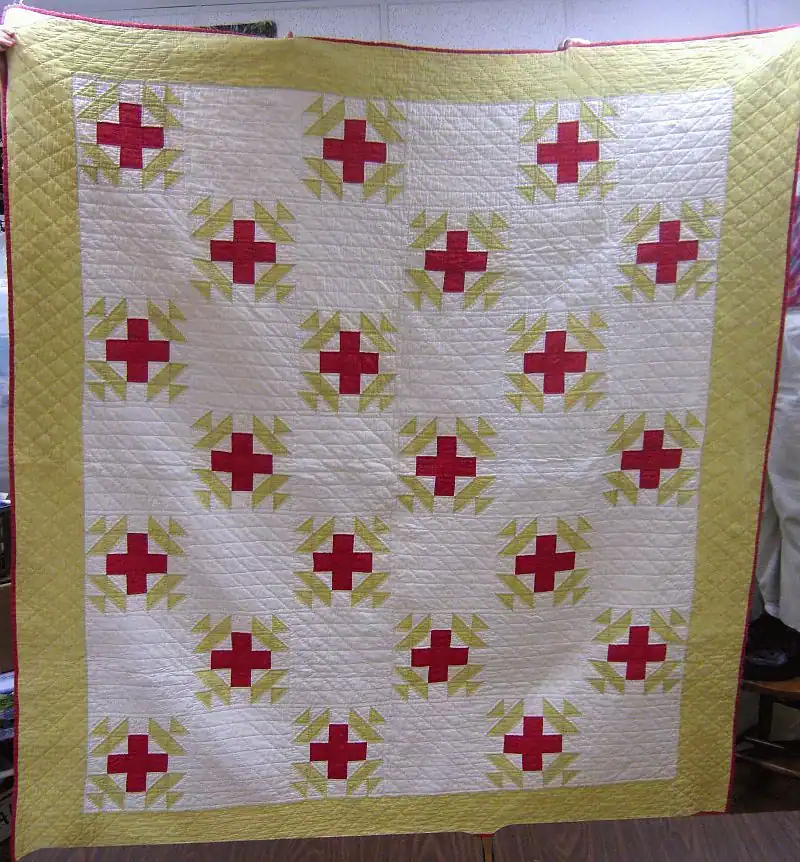
I have a quilt with a design I’ve not seen before. I can not locate it in Brackman either. Maybe you guys know … ?
You can see the mystery block and full quilt photos at <img src=”http:// jdemeter.mystarband.net/pinwheelvari.jpg”> and <img src=”http://jdemeter.mystarband.net/pinwheelvaridet.jpg”>
I can send more photos — please contact me directly for them. Thanks for any help.
From: Karen Alexander
[Emailed this two days ago but it never appeared in the Digest. Did some of you get it?]
Like Laura Fisher (and others I am sure), I too have collected references to quilt related words in the =8Chard news=B9=8Afor about 10 years. I believe an AQSG paper was even done on this subject several years ago. The metaphors t o fabric and needlework seem endless and timeless in our culture. About five years I wrote a draft for an article about my response but never followed through. Don=B9t remember why, but Laura=B9s post triggered the memory and I found the draft and shortened and updated it. This rewrite is a mixture of the use of metaphors and marketing: Besides my passion for the history of quilts and quilters, I do have other interests. <g> One of them is the psychology behind buying and selling. A producer has to find a way to entice the buyer to =8Cwant=B9 his/her product as well as =8Cto buy=B9 his/her product. I actually worked in the direct mail marketing world for about 7 years in the late 1980s and found tracking the results of which =8Cpackages=B9 pulled the greatest response absolutely fascinating. It is both an art and a science to make it work. The very vocabulary of our much loved medium=8Aterms such as =8Cquilted-together=B9 and =8Cpatchwork=B9 and =8Ccrazy-quilt=B9=8Ahave been metaphors fo r the daily human events of our culture for sometime. The front pages of our news media, in articles having nothing to do with quilting itself, have employed such terms with growing frequency in the past 2 to 3 decades. In August 2000, shortly after I agreed to take on the task of Press Secretary for The Quilters Hall of Fame, I read what I thought at the time a most extraordinary story in the New York Times Magazine section entitled =8CThe En d of the Mass Market.=B9 The story suggested that a shift in a cultural metapho r and myth that had been an icon throughout the 20th century had occurred. In fact, the subtle impact of the quilt metaphor upon popular culture to describe major cultural shifts was used in two different hard business news venues in 2000 that I stumbled across. The example that was especially interesting to me was an August 13, 2000, New York Times article addressing the =8Crevolution=B9 (their word) that is taking place in the way television is going to be =8Cmarketed=B9 to the vast American buying audience in the not too distant future future, and this =8Crevolution,=B9 according to the article, is based on a =8Cparadigm shift=B9 in American culture. In the second to last paragraph its author wrote: ‘One of the reasons people used to watch TV in the 1950’s and 60’s was for the shared experience. The metaphor for the country was the MELTING POT: people wanted to be the same. People read Time and Newsweek mainly because other people read Time and Newsweek. Now the metaphor is the QUILT. This is another way of saying that a technology [television] that was shaped by one kind of society is being forced to adap t to a new kind of society=8A” (Use of capitals for emphasis are mine.) Is the =8Clowly=B9 quilt, I asked myself as I read the article, and those who make them, really the =8Cnew=B9 metaphor for a =8Cnew=B9 kind of society? Is the quilt indeed taking on a new status on a national cultural scale by enterin g the lexicon of metaphors for stating what our culture is all about? In spite of the fact that I had seen quilting terms used more and more frequently in the =8Cgeneral media=B9 these past 10 years, this was the first time I personally had seen the quilt used as a metaphor for the WHOLE culture, deliberately displacing that preciously lionized metaphor, the =8Cmelting pot.=B9 And this was an article directed at the business world. It was not directed at the traditional =8Cwomen=B9s world.=B9 Absolutely fascinating , I thought!
Karen Alexander