March 25 – 29, 1999
These restored messages come from the Quilt History List, an online forum where quilt historians, collectors, researchers, appraisers, and enthusiasts discussed antique quilts and related textiles. The archive dates from 1996 through approximately 2016 and is being restored gradually. Sign up in the form at the bottom of the page if you want to know when a new page is added. Original spelling, opinions, formatting, and inactive links may remain unchanged.
Primary topics of this QHL Digest:
- Airing and Storing Quilts Safely — Members share practical advice on airing quilts each spring and avoiding damp plastic storage that invites mildew. (see the article on caring for antique quilts)
- The Second Annual QHL Dinner in Paducah — Joanna Evans firms up plans for the group’s in-person dinner at the AQS Paducah show.
- Shopping for a New Sewing Machine — A member researching an Elna machine sparks a wider comparison of sewing machines on the market in 1999.
- Feedsack Fabric Origins — A new member’s question about where feedsack fabric got its name reopens one of the list’s favorite recurring topics. (see the article on the feedsack story)
- What Is Paper Money Made Of — The earlier paper-and-money thread wraps up with a full answer on the cotton-linen composition of U.S. currency.
Date: Thu, 25 Mar 1999 20:43:02 -0800 | From: Audrey Waite <awquiltr@>
Maybe we should start a letter writing campaign to protest Orvis using the name of Cabin Creek Quilts in advertising its foreign-made quilts. If anyone has the address, I’d be happy to fire off an angry consumer letter. I don’t buy the “honest mistake” excuse.
Audrey Waite in sunny Sedona, AZ
Date: Thu, 25 Mar 1999 22:45:01 -0800 | From: “Anne Copeland” <anneappraiser@>
I have several issues I need help with.
I live in Lomita, CA, and I have a number of antique quilts. Recently it has been around 80% humidity, and I am quite concerned about my quilts as I have realized that some feel damp to me. I am almost tempted to take them to the laundermat and put them in a dryer as they just don’t seem to be drying out no matter what I do. Then I know it is a bad thing, but I have thought about putting the dried quilts in plastic boxes or something to protect them from further moisture. Does anyone out there have any suggestions? And also, I am doing some experiments with homemade dyeing. I found some large seed pods from a tree that have the texture and color of dark nut pods, but these seeds are not edible. They come in 3s or more on a stem, and fall off in the street. I have put some in cold water to see what degree of color comes off from just soaking. Next I will try boiling. I want to dye a little piece of muslin as an experiment. Who knows what mordant I should use, and how much of it to treat a piece 1 yard or less?
Thank you so much for your help, Anne Copeland
Date: Fri, 26 Mar 1999 07:28:20 +0000 | From: “Debora C. Wykes” <wykesfcn@>
I am an avid reader of QHL–I’ve learned so much by reading the posts every morning. I thought that I could get some feedback on a project I am planning with children.
After Easter vacation I will be taking over as a fourth grade teacher of a class that has lost their teacher to a job change. This is a much loved teacher who has taught at this small elementary school for over 25 years.
The kids cried when they heard she was leaving. She is staying in the school district, however.
I would like to do a memory quilt project with these 10 yr. old 4th graders to present to her sometime before school ends June 18th. I want them to plan most of it, do the artwork (a square a piece done in fabric crayons, fabric paint, or ?) plan (measure and plot) the border and backing and put it all together. AND -because as much learning has to take place here- do a scrapbook/journal of the experience and -if I can talk the technology teacher into it -do a website of the experience. I also thought I could have them research memory quilts, at least on the internet or see a picture of the AIDS quilt project or something like that. Has anyone else done a project like this? Am I crazy? What works and what doesn’t? I have alot of faith in kids and this seems like a good class of cooperative kids-I’d like them to be able to honor their teacher, yet know they are part of the vast history of doing so by a quilt. Math (planning the quilt), art, technology, history, social studies, english and writing are all involved here that I can see. My questions what media can you suggest that the kids could use to make their own squares? Any websites on the subject (outside of the regular quilting websites)? Any encouraging words? This is still an unapproved project, I haven’t talked to the art teacher or tech. teacher or anyone else, it’s just an idea in my brain right now.
Thanks in advance. Feel free to email me privately if your post is long.
Debbie in Monroe, MI
Date: Fri, 26 Mar 1999 08:41:29 EST | From: AlineMcK@
NO! Don’t put a damp quilt in a plastic box. Instead, look into de- humidifiers for your storage spot. There are chemicals in buckets that you can just put in a closet, and they’ll absorb the moisture. You then bake the goop to dry it back out, and re-use. I’ve also seen, but haven’t tried, little low-voltage electrical thingies. They look kinda like an aquarium heater. I think they’re in the “Home Improvements” catalog (which also sells the absorbent goop). Or try your local hardware store.
Another thought is, if you’ve got an entire roomful, get a window air- conditioner. Even if you run it at not-very-cold, it dehumidifies.
Date: Fri, 26 Mar 1999 09:02:16 EST | From: AlineMcK@
I’ve done group quilts with young kids. It’s a wonderful group project.
A few thoughts There are slack spots where some kids are done with a particular step, or waiting their turn, so have stuff on hand to fill their time. I take plenty of quilt books along, so the kids can look thru them. The larger, quilt-history books are best for this, more of a catalog of pictures than a heavy-duty how-to book. The most popular ones, however, are the books of story quilts or pictoral modern ones. I forgot that one of my modern quilt books included a few nudes. The boys LOVED that! And man, they studied the rest of that book like hawks. hee hee. I took advantage of an accident with my dog. Brought along a lap quilt that the dog had chewed, so they could see how the batting, top and backing all fit together. Thanks to BJ, one edge was a perfect cross-section. (Only reason the dog’s alive is 1, he’s cute, and 2, it was just a scrap lap quilt I threw together in a weekend.)
I cut the fabric into squares about 2″ larger than the actual cut size, and pre-drew both the inside square lines and the outside cutting lines. I learned the hard way you can’t just ask them to imagine the inside line…they’ll color right up to the edge of whatever you draw. Then they taped the squares to pieces of shirt cardboard, and used fabric markers to draw. (the markers are expensive…I still have a full set not in use. I can loan them by mail…postage, even both ways, is much cheaper than buying a full set). Then they can cut out the squares on the cutting line. Use large seam allowances, of course, for margin of error. I did 4″ finished size with 1/2″ seams. So they worked with 6″ squares that they then cut down to 5″. If these are elementary kids, they’re not going to have too much patience for designing the mechanics of it all. You might pre-cut several different colors of border, and let them choose which they want, give them choices of colors for the dark squares, let them choose if the finished quilt’ll be square or rectangular, etc.
For design, tape an old flannel sheet (thrift store!) to the wall, and have them stick up the squares. I alternated 4″ squares, plain dark with decorated light. Perhaps bring a selection of precut darks in various colors that would coordinate, and have them play with arranging those as the color scheme.
(Precut them large, and let the kids cut them down into sewing size, as with the decorated ones.)
I brought my machine to class, and sewed the squares into horizontal strips, which they then pinned back up on the flannel to see it take shape. If there’s time, you can then join the strips, or do that overnight. While I was sewing, they really enjoyed being in charge of bringing me the squares, one by one, in correct order.
Good luck!
Aline
Date: Fri, 26 Mar 1999 10:13:00 EST | From: QuiltFixer@
As soon as I have a nice warm day in spring, I start airing my quilts. I have two wooden old fashioned clothes dryers and I put clean sheets on them and I put a quilt over to air. I put them outside, but not in the sun. This seems to work well and then I put them in clean pillowcases. I try to rotate my quilts throughout the house in the winter so that they get good air exposure. Some on beds, some hanging, and some on my quilt rack. I would not advise putting quilts in plastic boxes or bags. You may want to store in acid free boxes, but I would still take them out from time to time. Toni Baumgard
QuiltFixer@
Date: Fri, 26 Mar 1999 10:22:04 EST | From: Palampore@
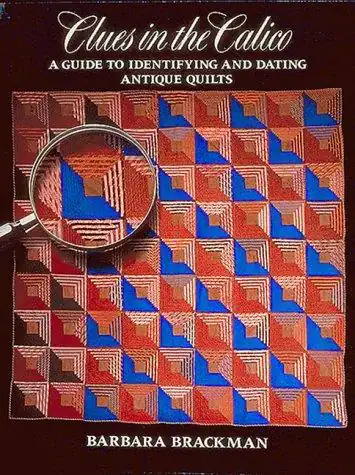
Three or four years ago I went to Fabric Camp done by Barbara Brackman and Terry Thompson in Lawrence, KS . For a week our group of 7 students were immersed in the study of antique textiles and quilts. We had a wonderful time and left there great buddies. That was also when Barbara was working on the CW quilt book and several of our group members made quilts for the book. Upon leaving we decided that we wanted to keep in touch, so we began a round-robin letter/package. Now about every 9 or 10 months I get a wonderful big envelope stuffed with 7 plastic gallon baggies and in each is a letter, pictures of wonderful quilts seen & or made over the year, and maybe a few pieces of a neat piece of cloth to share from each member. Last year one of the envelopes contained a picture of a memory quilt in memory of John Denver made by the 4th or 5th (?) grade class of Jeananne Wright of Colo. They had made a wonderful quilt and then had an evening to celebrate his life and music. It has since traveled to many locations and the Denver Family apparently feels very special about this quilt. Now this year this creative and talented teacher has come up with another great idea. They are making a Homerun Quilt as a tribute to baseball and are getting lots of the blocks signed by famous ball players known for their homerun history.
Jeananne will be retiring soon and I know she will be missed greatly for she is a great testimony to what teaching should be all about!!! If any of you want to get in touch with her please email me privately.
Now on to another subject—– This week I saw a quilt at the local historical society and I am very curious about it. It was a quilt made up of applique blocks about 16-18 inches in size. All of the blocks were the same.
The background was an off-white cotton. Appliqued to each was an eight pointed star in the center made of turkey red fabric. It was a radiating star not a block style star. Above and below was a heart made of orange cotton, but each one had the bottom tip of the heart squared off. In the four corners was a cross on the diagonal made of green calico. Was this symbolic of some group? I haven’t had time to sit and look thru all of my books, but I hope to over the weekend. The blocks were framed/sashed with a bright pink and white tiny check fabric. The borders were in turkey red. It was outlined quilted and had a loftier batting than that age fabric quilt would normally have.
Thanks in advance for any input on this…….
Lynn Lancaster Gorges in rainy yucky cold New Bern, NC (Spring keeps coming and teasing us and then leaves!)
Date: Fri, 26 Mar 1999 10:26:54 -0500 | From: Margaret Wolff <hrtworks@>
to all old sewing machine aficionados, There is a book available, “Sewing Machine Blue Book” which can be used to date machines. I have one, and it lists most machines by model number, gives a <underline>very</underline> brief description of the features and lists value. The values are very low, since few machines have much monetary value, other than the collectors models.I mean really low, $6,$10,$20.If you have the book for your old White, look up the model number and I’ll try to give you a value from this book.
Margaret
Date: Fri, 26 Mar 1999 07:51:32 -0800 | From: “Julia D. Zgliniec” <rzglini1@>
Dear Anne and All, Where I live, near San Diego and about 10 miles inland, moisture is not much of a problem. But this is what I do.
Sprinkled about the drawers and cupboards where I keep my collections of lace, fabric etc., are the desiccant packets that come in medication containers, luggage, and purses. Whenever I purchase something that has one of those, I save it and use it in the drawers and closets. the hanging quilts don’t seem to need them. It is simple, cheap and no stress on the textile.
I believe one could make their own with silica gel that is sold for drying flowers.
Dyes, there are many books on “natural dying” and there is a “dyers list” I just read about in my newest issue of “Spin Off “. They could answer your questions. I can’t find it at the moment but you could probably locate it through Susan Druding’s page at the Mining Co.
Regards, Julia
Date: Fri, 26 Mar 1999 11:08:21 -0500 (EST) | From: “Joanna E. Evans” <jevans@>
Please join us for the Second Annual QHL Dinner in Paducah.
*6pm on Thursday, April 22* We have a reservation at the Pines Restaurant at 900 N 32nd Street in Paducah. Their phone number for directions is 502-442-9304, or look them up on smartpages.com and you can print out a map that shows their location. We have a big long table reserved. That’s not ideal, but their round tables only seat six. Let me know if you would prefer to have a couple of those, and I’ll request them. If you won’t have a car, let me know and I’ll try to hook you up with someone who is willing to help out. Similarly, if you don’t mind giving someone a lift, please let me know in your email.
Please RSVP to me by emailing me privately so I can give them a final headcount.
Thanks to Barbara Woodford for her thoughts and assistance.
Hope to see lots of you in Paducah.
Joanna Evans (jevans@)
Bloomington, IN
Date: Sat, 27 Mar 1999 07:50:56 -0400 | From: Lorraine Olsson <sven@>
Thank you Judith for your research and thank you to every one else who had good ideas about dating the sewing machines. One more triumph for the group o}} Lorraine in Oz Judith Brainerd wrote
> Lorraine, your machine is a Family Vibrater and the date is 1917. I called the White Company at 1-800-446-2333 (or 216-252-3300). *�*
> Judith B
> Olympia WA
Date: Fri, 26 Mar 1999 20:03:08 -0500 | From: “John Cawley” <cawley@>
I’m back online, now in Easton, MD. I’ve really missed QHL. It’s = lovely here. I’ve joined the Bayside Quilters. I’ll be back and forth = between here and Scranton until I get my life sorted out. Can anybody = fill me in on the quilt world of the Eastern Shore and surroundings. = Thanks.
Cinda
Date: Sat, 27 Mar 1999 12:21:14 EST | From: Pennstudd@
Have been reading the daily posts for about a month now, and have learned more from the posts than any book could ever teach me. A great book that I got at Barnes and Nobles about fabric and their dyes is called “The Art Of Dyeing”
and is amazing. I though about dyeing a bunch of fabric for my next quilt so, I got some of the cakes from K Mart and used the washing machine version well, I sleep on the couch for the next week. I seemed to have forgotten to rinse the dye from my last batch of reds and my wife threw in my daughters school uniforms and turned them all wonderful shades of red and pink. Oh Well, I told her it could have been worse. Bill
Date: Sat, 27 Mar 1999 11:17:43 -0800 (PST) | From: Elaine Baglo <elainb@>
Did anyone pick up the newest Mary Englebreit Home Companion magazine yet?
In the most recent issue, there is an informative article about feedsacks and our own Jane of the Feedsack Club. If you haven’t seen this magazine yet, it’s a really nice one and well worth a look at especially if you’re interested in quilts, artists and antiques.
Elaine elainb@ Victoria, B.C., Canada
Date: Sat, 27 Mar 1999 18:52:45 EST | From: JBQUILTOK@
In a message dated 3/23/99 51135 PM Central Standard Time, SaraLMcN@ writes << Another thing that I have noticed and after talking to other vendors is the smaller number of historical / reference books being published with not many in the works. I think as we continue to see the changes in spending occur in the quilting market that there will be a focus on books, etc., that appeal to the largest group. >>
One problem I have with quilt books is the way the price has gone up & up.
The history books seem to be more expensive than the pattern books. While I fully realize they are well worth the extra money, I often have a hard time justifying spending it. I’m fortunate to have a guild that stocks 2 libraries – one for history & one for techniques & patterns. So, while I may drool when I read about the newest history book coming out, when faced with it on a shelf at $30+ I usually tell myself I’ll get it another day when there’s more left from the paycheck. Maybe we should push to get quilt history books stocked in our local libraries. Those I do own give a much better insight into daily lives over the last 100+ years than the who-bombed-who books that are ‘history’ in a lot of libraries.
Janet
>If you have the book for your old White, look up the model
number and I’ll try to give you a value from this book.
Margaret, my White is a 1935 “Crinkle” Rotary treadle. It’s the 33X series. Does your blue book have it? When I called the White Company to find out the year, they had trouble finding this particular machine in their book.
Thanks!
Judith B Olympia WA
Date: Sat, 27 Mar 1999 21:21:24 EST | From: AlineMcK@
Oh my, it feels good to be sitting down after two days at the Dallas quilt show. I don’t want to talk about my knees or my wallet.
But I did find a gorgeous set of late 1800s blocksan unusual setting of pieced stars with all my favorites of doublepinks, mourning prints, an only half-faded purple, and a large intact madder print. They’re in the sink in Textile Soak, with me biting my nails and agitating them about one-half stir per hour. I noticed on back of one square, “GM” in inch-high letters on the plain white muslin. It appears to be stamped or printed, not written. Letters are blocky, sans-serif, like this GM Anyone got any ideas? Please, no car jokes. And that includes Gremlins.
Aline
Date: Sat, 27 Mar 1999 22:45:30 -0500 | From: Alan Kelchner <quiltfix@>
If I was reading properly, there’s another guy on the list !! I’ll be damned. <G> Welcome, Bill, welcome !
Alan
Date: Sat, 27 Mar 1999 22:27:49 -0600 | From: “Peggy McBride” <jlmpam@>
I suggested to our local library that some quilt history would be of interest and was told, rather shortly I might add, they they weren’t interested in adding quilt history books, even when I offered to contribute a couple of books one being Quilts in America. So I went on my way, and just add the books to my personal library. The funny part is, several months later the library called and asked if I would be interested in loaning my personal books to someone. I said I would have to think about it. I am still thinking.
(actually the answer is no – DH says he doesn’t care what I spend on books, but I am not lending books)
Peggy in Iowa
Date: Sat, 27 Mar 1999 23:59:31 -0500 | From: “rainbo” <joandana@>
I am a new quilter and i have a basic question…i have not had any lessons, but just started putting together scraps then sandwiching some batting between that and the backing (whatever turns up) . when I started trying to quilt on the machine the backing puckers. what should i do to correct this?
joan
Date: Sun, 28 Mar 1999 12:07:55 +0100 | From: “Sally Ward” <sward@>
Thanks to everyone who offered an opinion on whether or not to remove papers for examination. The quilt in question is a real puzzler with no provenance and no parallels, but alas is not my own to do with as I wish. The present custodians will not touch anything, so the papers stay frustratingly out of reach. What I wanted was an ‘expert’ opinion on the right thing to do, and it seems most of you would go for taking a look. Maybe one day I can use those opinions to get my way!
Sally in UK Sally
Date: Sun, 28 Mar 1999 06:45:19 EST | From: Baglady111@
I would like to thank ELAINE of VICTORIA..a city where I will be heading in Sept..for mentioning the article in ME’s HOME COMPANION..It has been a HUGH success for snail mail, email, and phone calls..UNBELIEVABLE the amount of home makers who want to decorate with feedsacks. Those with country homes are hot for them..so my past few weeks have been spent decorating and supplying feedsacks for curtains and kitchen accessories.it’s really funny because it is a room that I have little associaton with today..I wondered A KITCHEN????
WHICH ROOM WOULD THAT BE??
I think the overwhelming response has been the fact that many, many magazines, newspapers, periodicals have written about THE FEEDSACK CLUB.but this is the first magazine that is NOT dedicated to quilt or quilters..it covers soooo many other interests and talents..We owe them a big THANK YOU for the opportunity to have done their interiew..hope you enjoy it when you read your copy..Thanx, Elaine..
Date: Sun, 28 Mar 1999 09:34:56 -0500 (EST) | From: quiltsnbears@ (Roberta Geanangel)
One way to get your library interested in the books is to volunteer to do an exhibit. It’s simple, just put a few quilts in a glass case (locked) which most libraries own, and put some books on the quilts. You can open the books or leave them closed. Arrange everything in an eye-catching manner.Be sure to check out insurance first.You’ll be surprised how many people will ask if those books are available from the library. It shows the librarians that people really are interested.
Libraries operate on tight budgets most of the time, they have to purchase books that will circulate. You can do this in a local historical society building also. Just remember to “stack the deck” and send all your friends in to ask for the books!
I’ve never known a library to turn down a free exhibit,except for a few big city ones.
Roberta
Date: Sun, 28 Mar 99 17:53:25 PST | From: “dhaynes5” <dhaynes5@>
Being a person who has lost several books, I agree with you husband about no lending with a qualifier. I only lend my books to my quilting friends I have known for years and see on a regular basis. They are just too expensive to replace.
DeAnna in beautiful Colorado dhaynes5@ ———-
> I suggested to our local library that some quilt history would be of interest and was told, rather shortly I might add, they they weren’t interested in adding quilt history books, even when I offered to contribute a couple of books one being Quilts in America. So I went on my way, and just add the books to my personal library. The funny part is, several months later the library called and asked if I would be interested in loaning my personal books to someone. I said I would have to think about it. I am still thinking.
> (actually the answer is no – DH says he doesn’t care what I spend on books, but I am not lending books)
> Peggy in Iowa
Date: Sun, 28 Mar 1999 17:10:12 -0800 | From: “Norma I. Herbold” <normah@>
I am in the market for a new sewing machine. I have looked at the following Elna, Quilter’s Dream Bernina, 140, 150 and 160 Pfaff, 2020, 7530, 6270 I would appreciate any comments, positive or negative, regarding these machines. Please respond to my email, normah@ Thank you. (I really do need a new machine and it is a lot of $$$…I’d like to make my decision based on knowledge, not because the bobbin beeps…or I like the knee lift. all comments would really help)
Norma Herbold Greenhaven Enterprises Quilt Retreats on the Olympic Peninsula http://www.olypen.com/normah
Date: Sun, 28 Mar 1999 19:13:50 -0500 | From: “John Cawley” <cawley@>
I’m really excited about the proximity of our new home to D.C.
Today we went to see the John Singer Sargent exhibit at the National Gallery. All I can say is God bless Andrew Mellon! I love that place.
The exhibit is wonderful; it goes to Boston next and that’s it.
One of my many rules is never to be in D.C. without running into the DAR. Here’s what I found in half an hour today. The DAR has sent 50 of its quilts to Japan. There is a gorgeous catalogue ($24.00); problem is it’s only in Japanese except for the captions. I bought it anyway ;
it’s of the quality I expect from Japanese color productions. There’s no ISBN # I can find but you could call the DAR at 202-879-3241.
Checking out the pictures as John drove home I noticed fan quilting on a 1815-1825 chintz quilt; I’d seen it on contemporaneous quilts in the Calico and Chintz exhibit. We used to think of the fan as an indication of late 19th century. Is there such a thing as a safe generalization about quilts (I’m beginning to think not)?
The lady in the gift shop told me that they (DAR) are planning a quilt exhibit starting in October of 1999; she thought there would be about 20 quilts.20 What I saw today was a nifty little exhibit about Martha Washington comparing objects of her time with Colonial Revival reproductions. For instance, they had a dress and quilted petticoat c. 1780 next to an outfit made for the docents at Mt. Vernon to celebrate the bicentennial of G.W.’s birth in 1932; they were very different. I learned that the ruffles at sleeve and neck in the 18th century were always white.
They had examples of the work tables known as Martha Washington from the 18th and 20th century. There were two hexagon quilts hanging together.
One was a glorious chintz c. 1830 looking brand new (I could have spent the whole time looking at that–one of the great things about the DAR museum is that you can get very close to the quilts which are usually displayed in full in enormous cases. You don’t see the back, but we can’t have everything.). The other was a pretty little Depression Era example. The pattern was called Martha Washington’s Garden as well as the more familiar Grandmothers Flower Garden. There was a wonderful framed medallion quilt top lent by the Mount Vernon Ladies’ Assoc. It was in the house when Martha died and her granddaughter bought it from the estate. It looks just like the framed medallion quilts we see in the books on British quilts–we didn’t rebel against style.
Here’s a little bit of info which should warm all of our hearts.
They have a chair seat (one of a set of 12 which Martha needlepointed for the dining room at Mt. V.) in a lovely seashell design in shades of gold. The wool and canvas for the project were ordered in 1766; Martha finished the last chair shortly before her death in 1802. 36 years with a UFO prove that Martha was no different that any other quilter.
Certainly makes her seem a lot more human to me.
Cinda on the Eastern Shore
Date: Sun, 28 Mar 1999 22:48:38 -0800 | From: Audrey Waite <awquiltr@>
Saw in the April COUNTRY LIVING magazine that the People’s Place Quilt Museum located on the 2nd floor of the Old Country Store in Intercourse, PA will be exhibiting late 19th to early 20th century “Quilts from Two ValleysAmish Quilts from the Big Valley, Mennonite Quilts from the Shenandoah Valley”. More information available from the museum at 1-800-828-8218. The exhibit showcases bold, graphic Amish quilts from Pennsylvania’s Mifflin County alongside more subdued Mennonite quilts from the Shenandoah Valley so that you can compare the two styles. The exhibit runs from April 1 through October 30.
Wonder if Cinda will make it all the way from the eastern shore of MD?
Since my ancestors were in Mifflin County in the 1770s I wish I could see this exhibit.
Audrey awquiltr@ http://www.quiltcamp.com
Date: Mon, 29 Mar 1999 01:39:02 -0500 | From: “rainbo” <joandana@>
thanks to all who have answered my beginner questions – you are very kind to take the time for a newcomer…
joan
Date: Mon, 29 Mar 1999 08:06:24 -0500 | From: Maureen Flaherty <sphmxf@>
I am an official lurker but I love feedsacks so I have to come out and ask a question. Where does one fine Mary Englebreit Home Companion magazine?
Thanks and back to lurkdom (that wasn’t so bad!)
Maureen in sunny, springy Washington DC
Date: Mon, 29 Mar 1999 08:36:37 -0600 | From: “Kris Driessen, Hickory Hill Quilts” <oldquilt@>
I am having a lot of QHL moments! Yesterday, while going through my Simply Quilts tapes for my Japanese quilting intern, I ran across the episode Jane Clark Stapel filmed. I am ashamed to admit I taped it without watching it-(( She talked quite a bit about how feedsacks were used in quilts, which I knew, but I did not realize that some sacks were actually printed in cheaters cloth! She had some very interesting examples for the show.
Has anyone ever seen one of these cheater cloth sacks made into a quilt?
I was also delighted at the way she dropped QHL names. Joan Stevens (American Doodah) and Barb Garrett were mentioned specifically. Barb, if anyone doesn’t know, is very knowledgeable on southeast PA quilts. She gave a great talk at last years Feedsack convention that really taught me a lot. I know she is not doing it again this year, but I am pretty sure she will be doing something. Anyone who is going to this years convention (April 8 – 10 in Lancaster PA) should bring a copy of issue 40 of Miniature Quilts Magazine for her to autograph. They did an article on her doll quilts and even gave the pattern for one of them. Speaking of articles, anyone who is in the Albany NY area should track down a copy of yesterdays Gazzette. There is a front section article on Cathy Hooley and one of her quilts. I was *really* impressed. Her web page is at http://www.albany.net/~gooset/ but the picture isn’t there-(( Quite a few pictures of her other quilts, though. Cathy specializes in reproduction quilts.
I will be bringing my intern to the Feedsack conference, please stop at our booth and see us!
Kris
Date: Mon, 29 Mar 1999 09:30:02 -0700 | From: Eileen Trestain <ejtrestain@>
I have a large library of my own on historic textiles, thier production, and state history quilt books. In Dallas, I could check out the local public library for historic books. I was amazed to find an original Quilts In America, and astounded when they let me check it out and carry it out of the library when it was out of print, and worth about $500.
When I got here, and AQS wanted me to footnote all the text for my book, I was flabbergasted to find the local county library, in the middle of cotton country, had absolutely *NO* books on the history of textile production, and not one quilt history book or state project book. Since then, when I have seen a book about textile history I want, I buy it for myself. I know the library will NOT have it. Perhaps, when I die, they will be the ones who recieve my entire collection, as they sure need something. On the other hand, maybe I should send it off to the Glendale Community College, where there is at least a textile and clothing design department. I only loan my books to one or two specific very close friends. Many of my books are out of print, or a very specific type. The romance of French weaving…Cotton cardiing…good stuff like that.
Next subject, a photocopy of the papers used in piecing are enough to have an interesting look. I tell people to remove the papers in the string pieced and hexagons from the late 1800’s and early 1900’s.
However, I just bought some gorgeous hexagon blocks that I fell in love with at first sight, which have the papers still basted in. One of the papers has a date of 1825, but not enough text is there to tell if it is a letter from then or not. I WON’T be removing those papers. I Will be bringing them to teach with in Paducah. ( I also dream I can make it to dinner with you all there to put faces to names.)
Eileen
Date: Mon, 29 Mar 1999 09:15:34 -0800 | From: “Norma I. Herbold” <normah@>
Dear Quilters, Your responce to my query has been outstanding. I am in the process of studying your comments and will summarize the results for the group. Did it clear up any confusion in my mind? Not necessarily. But as Diana said, “You ask, you get”.
I’m teaching today…results should be ready sometime tomorrow if anyone else wants to throw their two cents in.
Thank you to all who responded.
Norma Herbold Greenhaven Enterprises Quilt Retreats on the Olympic Peninsula http://www.olypen.com/normah
Date: Mon, 29 Mar 1999 13:43:42 -0500 | From: “John Cawley” <cawley@>
I’ll be in Lancaster for Quilters Heritage the week after Easter and will certainly get to the Peoples Place. Mifflin Co. Amish quilts are really interesting, very different from Lancaster Co.
Cinda who may be on the Eastern Shore but still has a car!
—–Original Message—–
From: Audrey Waite <awquiltr@>
To: QHL@ <QHL@>
Date: Mon, 29 Mar 1999 12:19:12 -0800 | From: Debra Roby <debroby@>
Have to share the results of a product I just tried this weekend Steam-A-Seam II. It�s a fusible web product that before it is fused, is slightly sticky on both sides. This product come with paper backing on both sides of the web.
Because of this genius design, you can a. trace a pattern onto one of the products 2 paper backings.
b. rough cut out the pattern.
c. remove the other piece backing paper, and stick the pattern onto the wrong side of the fabric.
d. cut out the pattern neatly from the fusible web and fabric at the same time.
e. remove the remaining piece of paper and f. stick the applique piece where you want it to go.
Something not fitting just right? Just pull the fabric up, adjust as you want and stick it back down.
I am working on a wallhanging for a friendLLAMA MAMA. It�s roughly based on a shepherd and her flockpattern by Jenni Dobson. My flock, however, is llamas not sheep. The woman in this design has 2 boots, bloomers, a dress, a blouse (that starts under the dress and ends over the dress), 2 hands, a sheperd�s crook, a face, hair, and hat and a hat band. I managed to cut out and position all these pieces on the background fabric in less than a half hour. And it was easy to make sure they all fit together right. I don�t want to think what a nightmare this would have been with a more traditional method of applique. Even with the heat-n-bond, there would have been no guarenteed way of making sure that pieces didn�t slip or shift while working on them. I cut all the applique pieces for this wallhanging out less than an hour, laid it out, HUNG IT UP to judge the placement, decided to add another llama and rearrange the ones I had. And only then did I fuse the pieces together. I really like the way this worked. Will spend the rest of the week stitching in details and stitching down the edges of the pieces. But this experience was so fast, fun and hassle-free that I had to share it with my friends.
BTW, I believe JoAnne�s is having a sale on their notions wall, soon??
Would be a perfect time to pick up another package. (no affiliation, just joyfully pleased with the results.).
deb roby hercules, ca.
Date: Mon, 29 Mar 1999 15:48:00 -0600 | From: Jocelyn <jocelynm@>
> Paper money – According to the Federal Reserve Bank of Atlanta’s web site, US currency is printed on cotton and linen rag paper. So we could use paper moeny for paper piecing and not have to worry about the acid content.
Well, it’s good to have THAT worry out of the way! <G> My first thought was, I bet no one has ever done that. Then I thought about Confederate money…after the War, but before it was worth something. Has anyone ever seen a quilt that used Confederate money for paper-piecing?
Jocelyn
Jocelynm@
Date: Mon, 29 Mar 1999 16:00:18 -0600 | From: Jocelyn <jocelynm@>
> Being a person who has lost several books, I agree with you husband about no lending with a qualifier. I only lend my books to my quilting friends I have known for years and see on a regular basis
But, as Roger Zelazny said, ‘No one steals your books but your friends.’ <G>
Jocelyn
Jocelynm@
Date: Mon, 29 Mar 1999 18:35:27 -0300 | From: susan silva <woody@>
Greetings!
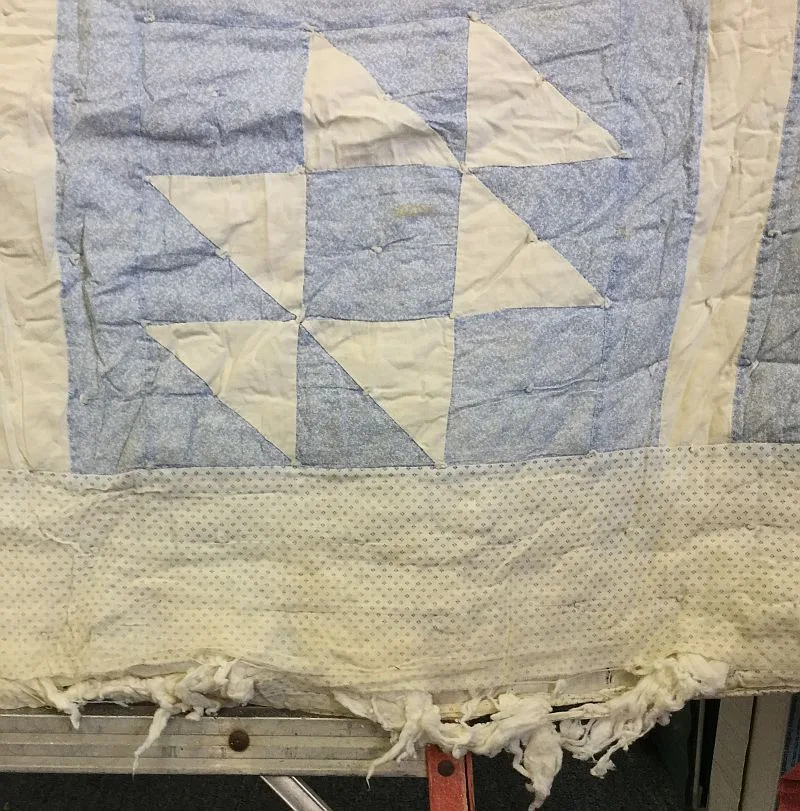
Have a problem and I’m hoping that you all can help. I looked at this quilt today, blue and white, blue is solid navy and white is muslin like. Tons of quilting and flying geese around perimeter. Very well done but the batting has migrated in some spots and on the back (which is solid blue) there is fuzzy stuff, like batting coming thru. When I pulled it you could see if coming from the inside. I think this quilt is about 1920’s and believe that the fuzzy stuff is wool batting. How can I tell if it is poly or wool? Also is there any way to stop the fuzzy migration of the batting? Thanks for your help. I know someone out there can assist.
Sincerely, Susan C. Silva in Sunny Spokane
Date: Mon, 29 Mar 1999 20:47:02 -0600 | From: KAREN BUSH <Birdsong@>
Hi ya’ll!!! And WELCOME Bill!! are you still sleeping on the Couch??
haha…WHAT cakes of dye?? I always used Rit when I was just playing around with the dyes, ran out of Procion…so, is this a new dye on the market ? See, Alan, you have a ‘soul’ mate! Another Male species!!
I can’t type much yet,..yeah, RIGHT! haha…but, I wondered if there are any handquilters out there that I can refer my ‘customers’ to that are still calling. I had to ‘close up shop’ as of a week ago, and I feel like there’s Some hand quilters out there that I could refer these people to..?? If so, please e-mail me privately, and I’ll have some info for the ones that are calling and e-mailing. It’s been kind of a bummer, but, had to be done. I’m trying to read the digests, I’m way behind…again, still…so, I’ll end this now..canya Believe it! It’s not l4 pages long this time! hahaha…(got a ‘time limit’ on the keyboard) …( kb —
Birdsong@
Date: Mon, 29 Mar 1999 20:50:33 -0600 | From: KAREN BUSH <Birdsong@>
forgot…SEE,..thought you’d heard the last of me for a while, huh?
WELL…I was reading my Country Alamanc “Small Room Decorating” magazine I just got yesterday, thoroughly enjoying the articles, and reading about the ‘Iris” lady, and lo and behold…There in a mention of the “friend of the interviewee” our own Debbie Kratovil! I’m Not gonna tell ya what it says, either! Got to get your Own magazine! ))) kb — Birdsong@ ~*~*~*~*~*~*~*~*~*~*~*~*~*~*~*~~*~* –