November 1 – 4, 1997
These restored messages come from the Quilt History List, an online forum where quilt historians, collectors, researchers, appraisers, and enthusiasts discussed antique quilts and related textiles. The archive dates from 1996 through approximately 2016 and is being restored gradually. Sign up in the form at the bottom of the page if you want to know when a new page is added. Original spelling, opinions, formatting, and inactive links may remain unchanged.
Primary topics of this QHL Digest:
- Musty Smell Remedies Continued — Additional suggestions for removing musty odors from quilts, including fresh-air techniques and warnings against dry cleaning.
- Anne Orr Biography and Works — Growing research thread on needlework designer Anne Orr, her Nashville roots, and her published designs; a member asks for a basic introduction.
- Amish Quilting Patterns and Iowa Communities — Detailed response about Amish quilting and the distinct communities in Iowa, drawing on personal family history.
- Prussian Blue in Quilts — A member shares a literary reference to Prussian blue dye from a Civil War novel, adding cultural context to the color discussion.
- Color Naming and Paint Charts — Suggestion to use historical paint company color charts as a standardized reference for quilt fabric colors.
- Soundex for Genealogical Research — Discussion of using the Soundex system for tracing quiltmaker family names in genealogical research.
- QHL Pin Design — Baglady111’s enthusiastic response to Kris’s design for a QHL membership pin, reflecting on the community’s bonds.
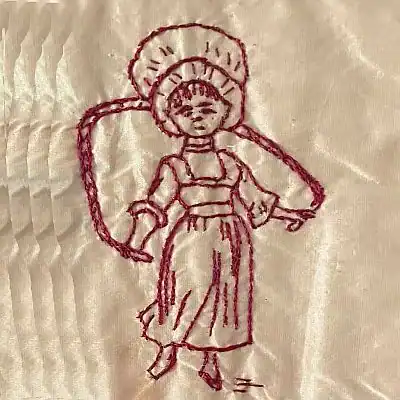
- 1930s Embroidered Quilt Top Identification — A guild member brings in a 1930s quilt top with embroidered squares of girls in sunbonnets for identification and dating.
- Donating a Family Quilt to a Museum — A member wrestles with whether to donate an 1850 appliqué family heirloom to Old Sturbridge Village for better preservation and display. (see the article on quilt museums)
- Estate Sale Appraisal Experience — A member asks about experiences doing informal quilt appraisals for estate sales without formal certification. (see the article on quilt appraisers)
- America’s Glorious Quilts Book — A recommendation and pricing note for the book America’s Glorious Quilts, with advice on finding it at discount.
- QRS Tucson Seminar Planning — Logistics discussion for the upcoming Quilters Research Society seminar in Tucson, Arizona.
Date: Sat, 01 Nov 1997 12:00:17 | From: rshink
In regard to musty smells I have been told that it sometimes works to put
the quilt in with some kitty litter. I also find that a good airing will
sometimes work. Diane in MontrealAt 06:55 PM 10/31/97 -0800, you wrote:
Date: Sat, 01 Nov 1997 12:05:34 | From: rshink
At I would be interested in more information about Anne Orr . I recently
bought an Applique quilt made from a kit, it may have been one of
hers?
Date: Sat, 1 Nov 1997 10:17:52 -0500 | From: debatqps [at] juno [dot] com
I have found that if I lay a clean sheet on the grass in a sunny area,
then lay the quilt on top and then cover with another clean sheet, turn
it every few hours and leave it for the day, somehow the combination of
the grass, sun and the air does a better job of removing musty odors than
laying it between the sheets on my open porch. Must be some type of
reaction from the grass??????????? All I know is it works.
I haven’t written about my fascination with quilt kits from the 30s and
40s for awhile. I have noticed, not from this group but quilters in my
travels, that some turn their noses up at them – one lady sniffed and
said (at a trunk show I was doing) “thats quilt by number!” I had to
laugh. I have added 3 more to my collection bringing my total to 5 now,
two are still in the original packaging!
In my very uneducated experience, the dogwood quilt sounds like one that
Marie Webster did. Its in her book “A Joy Forever”. Really nice book,
one of my favorites and I sell quite a few of them. My first full isze
quilt I ever did was a VERY poor copy of Marie Websters dogwood quilt.
It was the mid seventies and I used a poly blend . . . . . we used poly
for everything then, thread, batting, fabric, hey it was the 70s, we
didn’t iron! The thing is still on my Mom’s bed pilling away . . . .
VBG
I have a customer restoring a quilt just like Merry described, 5 million
triangles, scrap, all done by hand. Some of the original fabrics were
ones Harriet Hargrave must have copied for her lastest line of repro
fabrics. Its really neat.
Debbie in NJ
Date: Sun, 26 Oct 1997 13:05:23 -0800 | From: Biz Storms & Alan Hibben
Greetings all. This is a response to a request from Nancy in VA asking
about Amish quilting patterns. Nancy, there are several books available
that cover this subject. A terrific book is “The Amish Quilt” by Eve
Wheatcroft Granick. She covers Amish quilts by region and by evolution
of design, technique, fabric, etc, over identifiable time-spans. Really
fascinating read and the author knows her stuff. There also three other
books that I would recommend, not for their direct information, but to
see the quilts in the books broken down by region. Have a magnifying
glass handy and do your own detective work. You’ll see that the uqilting
designs correspond to what Eve Granick mentions in her book. These books
are: A gallery of Amish Quilts: Design Diversity from a Plain People, by
Robert Bishop and Elizabeth Safanda; The World of Amish Quilts, by
Rachel and Kenneth Pellman; and lastly, the book on the Esprit quilt
collection, whose name and author I cannot remember, but someone else
might.
Offhand, you’ll discover that many of the favorite quilting designs
include: pumpkin seeds, feather wreaths, single/double/triple cables,
cross hatching, feather vines, parallel lines and stylized leaves,
vines, flowers and baskets. It varies by region, from Lancaster to the
Iowa and Ohio settlements, and then within individual communites in
those regions. Often, the local “belief” structure will/would dictate
what was acceptable to their interpretation of the “ordnung”. Hence, one
community would lean heavily to feathers and cables with a neighbouring
group preferring pumpkin seeds and cross hatching. Of course, there are
exceptions that will pop up that all the authors acknowledge.
Nancy, hope this helps. Cheers, Biz from Toronto – madly trying to hide
Hallowe’en candy from last night’s rainy walk-about.
Date: Sat, 1 Nov 1997 11:55:45 -0500 | From: Merry May
Alan wrote:
>I had a correspondence with a woman researching her ancestress’ 1735
>will. Kris had posted a copy of another message from this same lady
>last week. She (Hugenot) had asked me if I could verify that broderie
>perse was being done and was it a predominantly Southern tradition…..
>I went home and searched my books. Barbara Brackman’s “Clues” said the
>earliest dated broderie was around 1775 (can’t remember exactly ). All
>the photographs were between 1800 and 1845. The districts I found were
>from about Virginia through Massachussets……
Alan- Why is this lady asking about an early Broderie Perse? Has she
found documentation in the will of a quilt made with this technique? MY
gut feeling is that, if this is the case, and she IS referring to
documentation of such a quilt, the will could be referring to a broderie
perse quilt which was NOT dated at the time. After all, BP had to start
SOMEWHERE, and 40 years (1735-1775) is not a big gap in dates.
I don’t know if 1735 was the date her ancestress died, or if that’s when
>the will was written. I went on the assumption her death was circa 1735
Most of the time when people speak of “a …. 1735 will,” it refers to the
date when the will was written. It’s pretty unusual to write a will AFTER
you’ve already gone to heaven (or whatever)! 🙂
Merry May (a.k.a. Inspector Cluesew and/or Jessica Four-Patch) 🙂
Schoolhouse Enterprises
gridgees [at] algorithms [dot] com
http://quilt.com/GG
Date: Sun, 26 Oct 1997 13:24:40 -0800 | From: Biz Storms & Alan Hibben
Sharon, great idea on a colour “name” chart. A good source would be the
various paint companies that specialize in historical paint colours.
Para, Pratt & Lambert, etc. Since I’m mainly familiar with the Canadian
companies, I’m sure that you have many US paint companies that would
have the same info. Would be extremely interested in your project /
idea. Would be willing to investigate what Canadian museums, mennonite
communities and various companies have to offer. If someone wants to
spearhead US, Australia info, please advise. Cheers, Biz from Toronto (
Just a 1 hour drive from a nearby mennonite community. )
Date: Sat, 01 Nov 1997 12:19:37 -0800 | From: Sharon Harleman Tandy
How embarassing, I double-clicked and sent it twice! Apologies, Sharon.
Date: Sat, 1 Nov 1997 13:19:52 -0500 (EST) | From: “Edna K.”
“baglady” had some coments last night about Anne Orr and email that I
received regardingmy query. Let me try to clear up her concerns!
1) When I thanked people for their responses I was responding to many words
of encouragement that I received via email from people in this digest.
2) baglady emailed me and asked me to post my email on the digest. I
refused since it had been sent privately and didn’t contain relevant
information regarding Anne Orr.
3) Hazel Carter, President of the Quilter’s Hall of Fame in Marion, In did
send me a letter and included the following:
Anne Champe Orr was born in Nashville, Tennessee on april 17, 1876. She
passed away October, 1946. She was a quilt pattern designer, needlework
editor for Goodhousekeeping as well as other women’s magazines. Her parents
were Benjamine Franklin Champe and Emma Claiborne Champe. She married John
Hunter Orr December 12, 1894 and had 3 children, Anne Champe Orr Callahan,
Mary Hunter Orr Grigdby, and Virginia Claiborne Watkins.
Just in case “baglady” is writing a paper I hope she will find this
information helpful and I hope this is the end of the issue!!!!
eak [at] inet [dot] net
Date: Sat, 01 Nov 1997 12:18:26 -0800 | From: Sharon Harleman Tandy
To Alan and all QHLers,
Alan said it very well, and I agree wholeheartedly. I’ve waited to put
my 2c. worth in until Sat. am so I could think about it and observe
others’ responses. Some very basic concepts: 1. Remember, at some
point, we were all beginners. And someone you consider to be an expert
might think of themselves as beginners! Especially in certain areas;
for instance, I’m still learning about dyes, as fast as I can. 2.
Questions answered privately deny the rest of us the knowledge. This is
one of the places where the stuff we know is shared without charge;
conferences being the other examples I can think of. Just try taking
stock of how much you’ve learned since joining QHL, and then try to put
a price to it. 3. If you have personal business, chat, or plans to
carry on with someone, then do it privately and we won’t have missed
something important.
Another reason I waited is that I’ve been cleaning the computer
room/office for the last three days. (Boy, am I tired, hence sleeping
in this am, and the dust bunnies and paper fibers have kept me sneezing
and wheezing since I started.) YES, I finally have a filing system;
assuming I don’t fail the system, maybe it won’t fail me. In sorting
out all the paper, most of which were hard copies of things learned on
QHL, I discovered the equivalent of about two semesters’ knowledge.
Where else can you do that without tuition? Another small request: If
your question will require more than a few minutes in research, then how
about an offer of an SASE to send back photocopies, etc? I promised
Alan I would keep this short, so that’s it. Sharon, Quilts & Answers,
Boise, Idaho.
Date: Sat, 01 Nov 1997 12:50:12 -0800 | From: Sharon Harleman Tandy
Nancy, I well remember the dry shampoo for our hair for long hospital
stays back in the ’70s. Seems it was oatmeal based. Never mind, can’t
be the same stuff. But, wouldn’t it attract our little many-legged
friends? Probably not a first choice? Sharon, Quilts & Answers, Boise,
Idaho.
Date: Sat, 01 Nov 1997 13:28:25 -0800 | From: Sharon Harleman Tandy
I, too, am interested in any information on Anne Orr. Have been asked
about her locally and hearing about her at QRS and AQSG; but not enough,
I’m very curious. Someday I hope to own one of the kits made from her
1933 Sears Contest quilt, the one with the successive borders of vines
with leaves of a wide variety of prints. Sharon, Quilts & Answers,
Boise, Idaho.
Date: Sat, 1 Nov 1997 14:19:05 -0500 | From: Merry May
I have a quilted crazy quilt in my collection… dated 1904, and mostly
wools. It’s large – at least double bed size. It’s outline quilted inside
each patch of fabric. The embroidery isn’t elaborate, but does outline
each patch also. It’s an interesting piece, especially when compared with
an older crazy quilt I have. The 1904 quilt has a “lighter” look to it…
the reds are not as dark, it includes some light-colored flannels, and is a
little more “cheery” looking (even though the older one has a stick figure
of a person who’s smiling – it’s really cute!). BTW, the older one is
neither tied nor quilted.
Merry in “down Jersey”
gridgees [at] algorithms [dot] com
Date: Sat, 01 Nov 1997 13:54:47 -0800 | From: Sharon Harleman Tandy
Check out: http://www.arizona.edu/~uaextend/arts/quilt BUT, let’s
remember, our own Mary Bywater Cross is the Keynote Speaker. I am going
as much to learn as to present my own slides on the Historic Quilts of
Idaho. There will be a Tucson Guild q. show @ same time and many other
activities. I can’t wait for the historic tour. “Credit where credit
is due, etc.” ‘Nuff ’bout me. Sharon.
Date: Sat, 1 Nov 1997 14:39:21 -0500 (EST) | From: Baglady111 [at] aol [dot] com
what would any of our members of QHL meeting in Tucson if they are heading to
the seminar in Jan..if anyone is unaware of it..SHARON, will you post so all
can see/read/plan?? Jane of THE FEEDSACK CLUB
Date: Sat, 1 Nov 97 16:24:24 PST | From: John & Cinda Cawley
Kris asked about experiences using the Soundex. I am of the opinion that
the Soundex ranks right up there with the wheel and the VCR as the greatest
inventions of humankind. (G) Without the Soundex I would never have
discovered that Indiana Co., PA was the place where my Keystone Friendship
quilt was made.
The Soundex is a coding system which groups together surnames that
sound alike but are spelled differently. It was devised for indexing the
1880, 1900, 1910 and 1920 U.S. Federal Cenususes. To search for a
particular name a Soundex code consisting of a letter and three numbers
needs to be worked out. This is not hard to do. The first letter of the
surname is the letter. The letters A,E,I,O,U,Y,W and H are not coded. All
other letters (as they appear in the name) are assigned a number from 1 to
6. If you run out of letters before reaching three numbers you use zeroes at
the end of the code. For instance the code for Cawley is C400 (the L is the
only letter which is coded). There are a couple of other details about how
to get the code but they are very simple. The Soundex is on microfilm;
grouped with Cawley would be names that sound the same, e.g. Calley, Cali,
Cauley, Cowley with the first names listed alphabetically; each name is
referenced to the page on which it will be found in the census. You have to
scroll through the list, but it’s a lot faster than looking for a needle in
the haystack of the census. I zeroed in on the Keystone Friendship quilt by
checking the Soundex for the 1920 census for the name Gaston which accounts
for 35 of the 250 names on my quilt.
The Soundex came through for me again last week at the State Library of PA;
I located the woman whom I think is “Quilt Moyer” who quilted Sally
Albright’s Star of Bethlehem, the cover quilt of our book Saved for the
People of Pennsylvania.
Cinda, looking forward to a concert by the Royal Philharmonic tonight at the
Scranton Cultural Center
Date: Sat, 01 Nov 1997 17:39:56 -0600 | From: Alice & Norman Hsu
I’m new to this list but wanted to respond to the request for info about
the Iowa Amish/Mennonite communities. I grew up in the Wayland
Mennonite community, went to school in the Kalona community and then on
to college in Virginia and Indiana. All of these were Mennonite schools
in Mennonite communities. My first year of teaching back in the 60s was
at Honeyville, an Amish community near Shipshewana. After that I
married my DH a Taiwanese, Presbyterian and moved to LA were we have
lived ever since. I do go back to Iowa each year to visit family and
friends.
I mention the different communities because each community has name
differences. For example, there were Wengers in Wayland but not in
Kalona, etc. About the Dogwood quilt I would start with the grandma’s
name and location and then talk to the older people in these
communities. It definitely would not be Amish as it would not fit into
what was acceptable, and Amish quilts back then were not being made for
resale. Yes, there are those in the Mennonite communities who are
exAmish especially in the Kalona Community. While growing up I attended
many quilting parties and church sewing circles but never once did I see
an applique quilt. Most were typical style 30s pieced quilts which
were still popular from the 40s to the 60s.
More later about the “Pennslyvania Amish Friendship Quilt” a part of
the Amish quilt exhibit at UCLA’s Fowler Museum last year that turns
out to be an Iowa Mennonite quilt. In September I interviewed the 83
year-old maker of one of the blocks when I was in Iowa, who gave me the
scoop on the quilt.
Alice Wenger Hsu in Los Angeles
Date: Sat, 1 Nov 1997 18:37:21 -0600 (CST) | From: Nancy Evans
At my local guild Tues. night, a guest brought an old quilt top for us to
see. It is 1930 or earlier, and is perfectly pieced, never washed fabric.
She was asking me what she should do with the top – have it quilted, tied,
or what, and although I couldn’t take the time to examine it closely, I
could definitely see that the sashing fabric was a low thread-count griege,
that was given its body soley by the sizing/starch in the fabric
(depression/Nile green, and perfect!).
I’m going to consult with her soon on this and other pieces, and I am torn
about what to tell her to do with this top. It was pieced by her GGma and
she wants so much to have it out. It won’t take quilting, (the frame for
just basting would kill it). But leaving it as a top is likely to lead to
deterioration if it’s displayed. I am leaning toward telling her to line it
with white cotton and secure it around each block with a quilting stitch,
then turn the green to the back to bind, and she should be OK then to use
as a summer-spread type of piece – in a guest bedroom, taking it off the bed
when it is in use. I think her idea of hanging it on the wall is probably a
bad idea, and I’d like to find her some alternatives.
So, what do you think? What other ways can we finish this oldie without
destroying it? The other fabrics seem sturdier than the green. I’m thinking
the other fabs were made of dressmaking scraps, then the green purchased (at
the lowest possible price) to set the quilt together. Any suggestions
GREATLY appreciated – and TIA!
Nancy Evans – Nebraska Quilter
Date: Sat, 1 Nov 1997 19:42:39 -0800 | From: Quilting Heritage ListServ
From: gilsons [at] mail12 [dot] voicenet [dot] com (by way of Quilting Heritage ListServ)
>
>Here are a few ways to remove a musty smell. All have worked for me.
>Lay the quilt outside on a clean white sheet. Cover with another clean sheet,
>and let it air. I’m fortunate to have an screened porch which works nicely for
>this purpose in bad weather.
>
>If airing outside is not an option, lay the quilt out on the floor, cover it
>with old newspapers (the ink is good and dry on them), fold the quilt
>loosely and place in a large, clean box. Change the newspapers every few days
>until the odor disappears. Something about newsprint absorbs musty odors.
>An open box of baking soda inside the box also helps.
>
>Good luck with your find,
>
>Peg G.
>
>
>
Date: Sat, 01 Nov 1997 22:28:38 -0600 | From: Laura Hobby Syler
Nancy Evans wrote:
>
> At my local guild Tues. night, a guest brought an old quilt top for us to
> see. It is 1930 or earlier, and is perfectly pieced, never washed fabric.
> She was asking me what she should do with the top – have it quilted, tied,
> or what, and although I couldn’t take the time to examine it closely, I
> could definitely see that the sashing fabric was a low thread-count griege,
> that was given its body soley by the sizing/starch in the fabric
> (depression/Nile green, and perfect!).
>
> I’m going to consult with her soon on this and other pieces, and I am torn
> about what to tell her to do with this top. It was pieced by her GGma and
> she wants so much to have it out. It won’t take quilting, (the frame for
> just basting would kill it). But leaving it as a top is likely to lead to
> deterioration if it’s displayed. I am leaning toward telling her to line it
> with white cotton and secure it around each block with a quilting stitch,
> then turn the green to the back to bind, and she should be OK then to use
> as a summer-spread type of piece – in a guest bedroom, taking it off the bed
> when it is in use. I think her idea of hanging it on the wall is probably a
> bad idea, and I’d like to find her some alternatives.
>
> So, what do you think? What other ways can we finish this oldie without
> destroying it? The other fabrics seem sturdier than the green. I’m thinking
> the other fabs were made of dressmaking scraps, then the green purchased (at
> the lowest possible price) to set the quilt together. Any suggestions
> GREATLY appreciated – and TIA!
>
> Nancy Evans – Nebraska Quilter
Nancy: I think you are on the right track with one exception. Bring the
muslin backing to the front to “bind”. We had one that was
purchased-finished in this manner. It had about 4 inches of muslin
brought over from the back, corners mitered and a decorative fly stitch
embroidered to “finish” the inside edges of the border. This protected
the edge of the vintage border.
Laura
Date: Sat, 01 Nov 1997 23:01:39 -0600 | From: Laura Hobby Syler
by way of Quilting Heritage ListServ wrote:
>
> When was Clues in the Calico written? I think we need to realize that things
> have been unearthed from closets and musuems since then, so it is a good
> reference but not the be all and end all. Lynn in NC (This sounds curt and
> I don’t mean for it to—am in a big hurry)
Lynn: Another topic at QRS…Barbara wrote the book 10 years ago.
AND…she will be the first to say that there are some facts in the book
that have changed and more information available. She told us that her
plans are to do a revision to be released in 2000. It’s just like
Orlofsky’s Quilts In America. Soooo much of that information that was
the only written work on quilt history we know now is not right. I
guess we all should just take it all with a grain of salt and with the
gratitude that we are all able to continue to research and learn.
Laura
Date: Sun, 2 Nov 1997 05:16:04 EST | From: Baglady111
In a message dated 97-11-01 13:45:26 EST, you write:
<<
Thanks to Xenia and Sharon for explanations about Lancaster, Lafayette, and
Prussian blues. As a child, it was Prussian blue was one of my favorite
color crayons. 🙂 I also appreciate the bit of quilt history background
concerning the Lafayette Orange Peel design.
>>
In regards to ELISABETH’s remark on the LAFAYETTE ORANGE PEEL..I had read
somewhere, possibly QNL, and part of the story had to do with a party held in
Lafayett’s honor and oranges had been broughjt in,,quite a treat for the
area..it would have been like US having a french delicacy from Paris..she was
so impressed with the entire evening that she took her orange home and in
order to have a commemorative of teh event that as she peeled it into
sections..she drew the design and made a quilt of that pattern..neat
story..Jane of THE FEEDSACK CLUB
Date: Sun, 2 Nov 1997 05:41:12 EST | From: Baglady111
SHARON HARELMAN TANDYsent me a post of a WONDERFUL SOUNDING event in
az, Jan. of ’98..featured speaker will be MARY CROSS who wrote TREASURES in
the TRUNK and another book WOMEN of the MORMON MIGRATION..what a treat!! I’m
excited about it tho because SHARON, a quilt researcher from IDAHO ,
“DISCOVERING IDAHO’S QUILT HISTORY..
Sharon has been a constant source of information openly given on any subject
she has knowledge of….if interested in terh event/program, you can email her
at or better yet..Sharon..post to all..it would be GREAT
FUN for those who on these digests, QHL, KK, and OZZ..to meet up if
attending..and go in group to the various programs..there are others involved
in lectures as well..Jane of THE FEEDSACK CLUB
Date: Sun, 2 Nov 1997 06:00:16 EST | From: Baglady111
In a message dated 97-11-01 19:29:33 EST, you write:
<<
Apparently I was not specific enough in my query about the quilt that came
from BaltimorePA. I was just hoping to find a person in the
area who might give me some advice about where to go in that immediate area
f >>
Lynn, how many quilt digests, such as QHL, do you belong to?? Possibly you
can post to them as well,,maybe you already have..possibly you don’t know of
some..also, JEANNETT LANSKY..hope I haave the spelling right..is very
knowledgeable on eastern Pa..she has written numerous books..I’ll bet you will
find names in those (I know I did as my mother’s family is from mid-Pa>) and
our own CINDA CAWLEY is always a wealth of info..and was very instrumental in
the new book out about PA quilts..and yues indeed..go back to the BEYOND
COMPARE info from the MORMONS..hope this helps..Jane of THE FEEDSACK CLUB
Date: Sun, 2 Nov 1997 07:42:53 -0500 (EST) | From: Baglady111 [at] aol [dot] com
I have a friend from the Chicago area..and she has a terrific collection of
pattterns and if I recall correctly..they are ANNE ORR’s..but I have to
admit..I get her confused with RUBY McKIM.
Did Anne actually quilt also…or did she strictly design? and were her
patterns in a newspaper? JANE of THE FEEDSACK CLUB
Date: Sun, 02 Nov 1997 08:37:04 -0500 | From: “Miklos B. Lukacs”
Hi All, hope you all have a good Sunday. Are we quilting or having
company/visiting. Let’s have an old fashioned day! Enjoy Sunday as a
day of rest and socializing.
Question- are there any books of Anne Orr, are there any repro
patterns? I am very curious now that the discussion has come up. Tell
about her, remembering that there are lots of people like myself who
have only become interested in quilt history in the last year or so. We
know practically a teaspoon worth. I have been building a fair sized
library but still so much to learn and so little time. When one of you
make a capsillized account, many of us rush out and buy a book that some
good quilt historian has written. Connie L.
Date: Sun, 2 Nov 1997 08:24:49 -0500 (EST) | From: Baglady111 [at] aol [dot] com
I am looking for JEAN BILLSTRAND from the Chicago area..near Dekalb..Jean is
a collector or ANNE ORR or possibly another leading quilter/designor..she had
talked of moving and trying the various avenues in searching, turns up
nothing..she is a guild member..anyone know her? She will be an excellent
source for history on ANNE ORR..
Also, wonder if AQSG has any articles written about her?? Jane of THE
FEEDSACK CLUB who is’nt into Ann Orr..but sure have heard from plenty who
are..so we’ll see if we can help you out..
Date: Sun, 2 Nov 1997 10:57:57 EST | From: CToczek
Hello everyone,
I received my copy of Barbara Brackman’s Quilts from the Civil War yesterday.
What a fascinating book! It will appeal to history buffs as well as quilt
enthusiasts.
I wanted to point out the Blue and Gray Battle Quilt on pages 35 and 36, a
reproduction of the original made by Susan Robb of Texas in 1864. The quilt
was first documented in Quilts of the South Texas Plains, from the Prairie
Windmill Quilt History and Research Chapter of the National Quilting
Association. (1986) Barbara included directions for making your own
reproduction of this interesting quilt. Though only a temporary West Texan,
I enjoyed seeing such a classic from ‘our neck of the woods.’
Best wishes to all,
Carla in Lubbock where the wonderfully cool wind doeth blow
Date: Sun, 02 Nov 1997 12:56:06 -0600 | From: Angie Helman
I realize that this is not true “scholarship”, but since Prussian blue
has been recently discussed on the list, I thought I’d pass this
anecdote along…
While hunting antiques yesterday I picked up the local antique
advertising guide. This particular issue featured a story about
Parlange Plantation – “A French Colonial House Built on Point Coupee’s
False River” (Louisiana). The article contains descriptive information
about the house and its contents, as well as anecdotal history passed on
by descendants of the original owners…
One such story relates that indigo was one of the crops raised at
Parlange during the early 18th century (although the house itself was
not completed until 1750). The indigo was grown under contract with the
Prussian Army and used to color its uniforms.
Angie – enjoying a cool and sunny South Louisiana Sunday
Date: Sun, 2 Nov 1997 19:19:07 -0500 (EST) | From: SAERoy [at] aol [dot] com
DH and I had a great time antiquing around some small towns in TX yesterday.
No great quilting finds except a handpieced double wedding ring quilt top
for $35. There were quilts in all price ranges from $100 to $875! Anyway,
in my travels I came across two items that I have questions on for this
group.
One was a quilt that the dealer says was given to a soldier during WWI per
family history. The quilt was square, about 70 x 70. It had a large red
cross (like the Red Cross symbol) machine appliqued on muslin for both the
front and the back. The binding was a cadet blue color that was also put on
by machine. The batting was medium weight, but I really didn’t have a way to
tell the fiber content. The quilt was very dirty, but otherwise in good
shape. Because all the fabrics were solids, I didn’t see that there was any
way to determine if the dealer’s (and family’s) story was accurate or not.
So, I didn’t buy the quilt. What do other members of this group do in
situations like this? I don’t know if I passed up a bit of history or was
smart enough not to get ripped off.
My second question is about quilts that are made of just tan and white
solids. I’ve had several dealers tell me that monochromatic quilts were made
that way. It’s pretty obvious in designs with flowers that the brown leaves
were originally green, not tan. But, how do you tell if a tan and white
quilt was made that way or if it was originally a green and white quilt?
Any information you have on these items would be greatly appreciated.
Sharon in Ft. Worth
Date: Sun, 2 Nov 1997 21:47:34 -0500 (EST) | From: Palampore [at] aol [dot] com
Clues in the Calico was published 1989, but what I was saying was only that
it got lots of people thinking and many quilts have been unearthed since
then. Therefore it has much to offer but we must also consider discoveries
made from 1989 to present.
Lynn in NC
Date: Sun, 2 Nov 1997 22:25:21 -0500 (EST) | From: QuiltCat26 [at] aol [dot] com
In a message dated 97-11-02 21:57:29 EST, QHL-Digest-request [at] cue [dot] com writes:
<< Question- are there any books of Anne Orr, are there any repro
patterns? I am very curious now that the discussion has come up >>
Connie et al –
I too have perked up my ears regarding Ann Orr. Seems that a friend of mine
has discussed her frequently over the past few years. I will have to call
her and ask. She has been quilting for a lot longer than I have, and may
have some info to add. As soon as I know anything further, I will post what
I find out.
Nancee
Grand Rapids, MI
Date: 97-11-03 05:47:58 EST | From: Baglady111
kRIS..
I think the pin looks great..how funny that it came about over a
discussion..very unique..you did great Kris..it will mean alot to many of
us..I think some of us are more closely connected than what we thought..Alan
seemed to bring this out..we have alot and had a lot of those who opo by,
probably told by someone ‘what great info you can obtain on this site’..they
come, get their info they need, and they are gone..but most of the ones who
began on here..are still here..possibly not participating, but I think they
are inthe background observing..we all do at one time or another..it’s nice
to have this bond..Jane of THE FEEDSACK CLUB
Date: Fri, 31 Oct 1997 10:35:30 -0500 | From: Alan
I do have a question. A friend of my daughters would like me to do
> > “something” with a top her grandma made. It is made of 12 squares of
> > white material which have little girl type scenes outline embroidered on
> > them. Each square is sashed with a bubble gum color of pink. She would like it tied. The squares are
> > about 18″. Any suggestions would be appreciated.
> Connie,
> If she wants it tied, I’d go with that! Why put in extra work, if she
> doesn’t think it’ll be an improvement?Jocelyn
One suggestion. If you’re going to tie this, use floss/thread to match
the fabric you’re tying on. Otherwise it’s gonna get really busy and
difficult to look at!
What color are the figures embroidered in? Just curious.
Alan
who’s going to practice what he gripes – I mean preaches! – about ……
Date: Mon, 3 Nov 1997 15:54:15 -0500 | From: debatqps [at] juno [dot] com
I have a book, paperback, 14 pages or so, done by Anne Orr that I found
at the Feedsack Club convention last April. Its called Anne Orr Quilt
Patterns done by Lockport Cotton Batting Company copyrighted 1944. There
are applique quilt designs and cross stitch quilt designs in it. I paid
$3 for it and I don’t think the ladies realized what it was till I got so
excited. I also have a Dover Needlework Series book called Quilting with
Anne Orr published in 1990 which is the same book with a different cover.
(I was very disapointed when I figured that out.) I paid $3.50 for it
this summer sometime through mail order.
Has anyone else sent for The Kansas City Star Classic Quilt Patterns
Volumes I – XII? I sent for all and am enjoying them immensely. I don’t
think that some of them are actually usable, the pieces seem to be off
but they are pretty neat to look at and read.
Debbie in NJ
Date: Mon, 3 Nov 1997 15:14:04 -0600 | From: cabhoney [at] juno [dot] com (Cindy A Honeycutt)
Someone a while back was talking about doing fabric crayon rubbings of
leaves on muslin. I tried it, but the leaves would fall apart. My family
has just moved and I would have loved to make my husband like a fabric
scrapbook of his favorite trees. Any suggestions to help the leaves not
fall apart? I am talking about green leaves, too, not dried ones. Thanks!
Cindy Honeycutt in Norman, Okla where the leaves have just started
turning recently
Date: Mon, 03 Nov 1997 22:49:53 -0800 | From: The Waites I would like to hear from people that have done appraising for estate
sales. I have hesitated getting certified since living in a small town
I don’t think I would have enough work to make it worthwhile.However, I have been asked by people running estate sales if I would
come and give them an idea of what to charge for antique quilts. Is
this a wise thing to do and if feasible, what do you charge?Appreciate your opinions.Audrey Waite in Sedona, AZ (awquiltr [at] sedona [dot] net)Date: Tue, 04 Nov 1997 07:52:45 -0600 | From: Karen Benson Alright, I’ll admit it. I haven’t a clue who Anne Orr is. Could someone
please tell me? Thanks.
Karen Benson
University of Minnesota Foundation
benson [at] mailbox [dot] mail [dot] umn [dot] edu
(612) 624-1568
Date: Tue, 4 Nov 1997 09:32:38 -0600 | From: QLTRSTORE [at] harlannet [dot] com (Perkins, Phil)As I was doing some research on my binding question I looked up Anne Champe
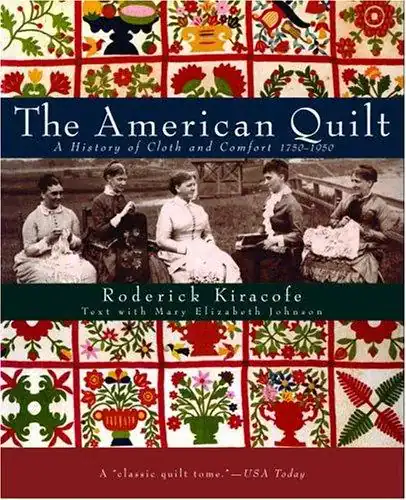
Orr in “The American Quilt” by Rod Kiracofe (beautiful book!). It gives her
dates as 1875-1946 and says…Art needlework editor of Good Housekeeping
from 1919 to 1940, this Nashville native also designed quilts, and had a
successful business in kits and finished quilts, hiring quilters in Kentucky
to execute the patterns she had developed. She designed booklets of quilt
patterns that were marketed under her name for Montgoemry Ward and Lockport
Batting. Hope that helps!Now about that binding question!! I didn’t get any responses when I asked
before about a starting date for the French double fold binding. Who
knows?? I looked in Clues in the Calico, and all it talks about is straight
vs. bias binding, and binding width. What is the earliest dated quilt on
which you have seen the double binding?Was shopping in Waldenbooks or another mall chain the other day and ran
across a coffee table sized quilt book filled with huge pictures of antique
quilts! It’s called “America’s Glorious Quilts” by Dennis Duke and Deborah
Harding. Even better- it was on sale from $75 down to $24!! It does have a
small section of contemporary quilts, but mostly wonderful antiques! Maybe
you can watch for it.Jennifer in weird weather Iowa-when it stayed so warm in Oct. that the
leaves didn’t change color, and now it has snowed twice on green leaves!
alb
Date: Tue, 4 Nov 1997 12:28:08 -0600 (CST) | From: [from unknown, signed “nancy Schott”]I am in a quandry. I have a quilt that was made in 1850 by my great
great grandmother. I am taking proper care of it but it always bothers
me that it just sits, here, in my house, no one ever sees it, etc. It
is very well done – an applique.I keep thinking I should give it to a museum where it can be stored in
even better conditions, occasionally exhibited ( it should be seen),
etc. I have talked to Sturbridge Village about it. I trust them.But then there is that feeling that I’m giving away a piece of my
family. But then there is that feeling that the village could protect
it better. I go back and forth.What would you do?nancy Schott
Date: Tue, 04 Nov 1997 16:32:44 -0600 | From: Angie Helman In an earlier note Jennifer mentioned the book “America’s Glorious
Quilts”. This is indeed a beautiful book – I bought a copy 5 or 6 years
ago and haven’t seen it for sale recently – but I have always seen it at
discount places – so just be warned NOT to buy it for full price!!!!
($25 seems to be the typical “discount” price) I got mine at Sam’s –
strange place to pick up a quilt book!Angie – enjoying a perfect October day in New Orleans
angel [at] communique [dot] net
Date: Tue, 4 Nov 1997 18:37:28 -0500 (EST) | From: Baglady111 [at] aol [dot] comIn a message dated 97-11-04 06:27:02 EST, you write:<<
I’m at work and don’t have access to my books, but I know
that there is a chapter on Ann(e) Orr in one of Merikay
Waldvogel’s books, I want to say Soft Covers for Hard
Times, but it could be Quilts of Tennessee that she
>>
BINGO, MARY,,it is indeed SOFT COVERS..AND alot of into to boot..a chapter
from page 24 thru 37..lots of great info..plus reference on pages 1, 14, 41,
42, 46, 47, & 92..then for an added treat..her daughter ANNE CHAMPE ORR..there is info on pages
35 and 37..and also the HUNTERS.. Anne had married JOHN HUNTER ORR, from a
wealthy TN family..and they had three daughters..MARY HUNTER, VIRGINIA
CLAIBORNE, & ANNE CHAMPE. So the info in this book touches on them as
well..I KNEW in the back of my mind I had seen/read/had this info..and thanx
to you, MARY..it jogged my memory..sitting here right on my bookshelf!!I also know that Kris has the book for sale..for anyone interested in reading
or if any one is doing research…or let me know how much I can post from
the book without a problem..Jane of THE FEEDSACK CLUB