October 12 – 13, 2004
These restored messages come from the Quilt History List, an online forum where quilt historians, collectors, researchers, appraisers, and enthusiasts discussed antique quilts and related textiles. The archive dates from 1996 through approximately 2016 and is being restored gradually. Sign up in the form at the bottom of the page if you want to know when a new page is added. Original spelling, opinions, formatting, and inactive links may remain unchanged.
Primary topics of this QHL Digest:
- AQSG Conference Recap — Members swap detailed recollections, study-center reports, and reactions from the just-completed American Quilt Study Group conference.
- Feedsack Program Presenters Wanted — A thread seeking speakers and presenters for guild programs on feedsack fabric history. (see the article on the feedsack story)
- Old Quilt Books Roundup — Continued recommendations for out-of-print and historic quilt reference books.
- Royal School of Needlework Archive Appeal — A UK researcher’s request, relayed to the list, for help locating rare Royal School of Needlework instruction booklets.
Date: Tue, 12 Oct 2004 12:48:17 -0400 | From: “J. G. Row” <JudyGrow@>
Marcia,
Many of us who post regularly were at AQSG in Portland, where we all saw the two wonderful WW II service quilts you loaned to Sue Reich for her Study Center. Wish we could have seen you there too.
Judy, aka the Ringoes Kid judygrow@
From: “Candace Perry”
I would say that crazy quilts were rather universal throughout the middle class, in rural and urban areas. In our collection we have two good examples with solid provenance, neither of which came from women of wealth. One was made by a seamstress (most likely from her scraps) and the other was made by a woman of rural middle class background. On top of that, I’ve got several examples of crazy patchwork that were certainly not from the top of the socio economic heap. Candace Perry Schwenkfelder Library & Heritage Center
From: “Alice Kinsler” <alicek@>
I am a member of AQSG, but unfortunately had not the time or plane fare to get there (am saving it for the “Collectors, Collections, Collecting” seminar at UNL in February). Please give details! Alice
From: “Rosie Werner”
I have recently come across the Dutch Girl Quilting Scrapbooks, edited by Edna Van Das. Each scrapbook features about 25 patterns printed by the Chicago Tribune under the name Nancy Cabot. Edna Van Das researched the Nancy Cabot patterns, the Progressive Farmer, and other related materials and sources. There are 79 scrapbooks – I have the complete set plus some of the other offerings of Dutch Girl Crafts and Publications. Does anyone know of these scrapbooks? Are they a reliable resource? Is Edna still alive? I’d appreciate your comments. Rosie from Minnesota
Date: Wed, 13 Oct 2004 00:11:17 EDT | From: “Karen Evans”
Pretty please with a cherry and sprinkles on top? Even if I’d had the time to go, I’m unemployed and don’t have the money….
Karen Evans
Date: Wed, 13 Oct 2004 | From: Litwinow@
Good Morning, A few quick note as I’m off to pool therapy. AQSG is the most wonderful gathering of quilters, willing to share, inform and entertain! Cinda Cawley (on the eastern coast) delighted us with her paper on PA-German quilts. I had the honor of winning the antique dye packets from Teddy Pruitt’s “Way Down South” quilts. Who else had a magnolia center piece? My round table with Connie Nodstrom on Reproduction Fabrics and her absolutely charming miniature quilts. Of course, my head is too big to be held by my thin neck-with the compliments of the 2-color study-WOW. The only down part was to be wheeled to the wrong gate at O’Hara and miss my flight back to Moline-fortunately there was another flight. Off to hang the local guild show. Anyone in the Quad-Cities (5 actually-Davenport, Bettendorf, Rock Island, Moline and East Moline) Friday or Saturday, at the River Center in Davenport. AQSG Euphoria is keeping me going. Catherine Litwinow
From: Judy Schwender
Something to think about: Many of you seem to have some wonderful collections of quilt reference books, and these early quilt books. You need to think about where they will end up after you are gone. Likely your children will have no interest in them beyond their monetary value. Let me strongly suggest you consider the library at the University of Nebraska-Lincoln when it comes time to disburse your collections. There are good reasons for this: 1- The American Quilt Study Group and the International Quilt Study Center are both located on UNL’s East Campus. These two groups are nurturing quilt scholarship, and will continue to do so. 2- The AQSG archives are in the UNL library system. 3- If the book(s) you donate are rare, they will be placed in Archives and Special Collections for use on-site. Whether in the regular library or Spec Coll, your books will be properly cared for. 4. UNL is located in the middle of the country, so access, while not a couple of hours away, is central for mostof us. 5. You will have the satisfaction of knowing that future quilt researchers will have access to your books. 6. UNL already has a HUGE number of quilt and textile books at C.Y. Thompson Library on East Campus. If you go to visit the International Quilt Study Center, you should also take to time to visit this library and wallow in what they have available. Naturally, as a non-student, you can’t check books out, but boy, oh, boy, what a great collection! You can get an idea of what they have by searching the UNL libraries on-line. Go to: http://iris.unl.edu/. Judy Schwender
From: “sue reich” <suereich@>
Is anyone out there studying basketry in quilts? If you are, can you email me privately? Thanks, sue reich
Date: Wed, 13 Oct 2004 09:51:04 -0700 | From: <chrisa@>
To add to Judy’s wonderful suggestion, the library also has magazines and pamphlets or thin booklets- ephemera related to quilts, sewing, clothing, the kind of things we collect in addition to books. Since I don’t work there, only visit, check with them for specifics before flooding them with potentially undesirable items.
Kim Wulfert www.antiquequiltdating.com
—– Original Message —– From: “Judy Schwender” <sister3603@>
Something to think about: Many of you seem to have some wonderful collections of quilt reference books, and these early quilt books. You need to think about where they will end up after you are gone. Likely your children will have no interest in them beyond their monetary value. Let me strongly suggest you consider the library at the University of Nebraska-Lincoln when it comes time to disburse your collections. There are good reasons for this: 1- The American Quilt Study Group and the International Quilt Study Center are both located on UNL’s East Campus. These two groups are nurturing quilt scholarship, and will continue to do so.
From: “Candace Perry”
In conjunction with our exhibit Cotton in PA German Life, the Schwenkfelder Library & Heritage Center is interested in hosting a feedsack-related program during the run of the exhibition in spring/summer 2005. I’m looking for a good all-around presenter on the topic who can appeal to a knowledgeable AND a general audience. There’s lots of enthusiasm for feedsack locally; a lot of folks have stories and I’m thinking it would be a crowd-pleaser. We can offer a small (hmmm, very small) stipend and overnight lodging if necessary. If any QHLers have ideas about someone who might be a good fit, or you yourself are interested, please let me know ASAP! Candace Perry Schwenkfelder Library & Heritage Center Pennsburg PA (about 1 hour north west of Philly)
From: SadieRose@
Candace, I have heard Jane Clark-Staple (or is it Staple-Clark) speak twice on feedsacks, she was great!! She used to be on QHL, so I hope you hear from her. Although, I did hear that many of her feedsacks were stolen, so don’t know if she is still doing programs. Karan
Date: Wed, 13 Oct 2004 14:16:15 -0400 | From: Kathie Holland <kathieholland@>
Candace What about Barb Garrett? and she lives right near you! Kathie in NJ
From: Joan Kiplinger
Karan — through the kindness of Jane’s many fans, she received feedsack contributions of all kinds, and is still holding her annual retreats and doing other public speaking engagements.
From: “Susan Wildemuth”
Does the Quilter’s Hall of Fame accept donations of quilt books, pamphlets, or catalogs too?
Sue in Illinois
From: Feedsackfanatic@
Candace,
Jane Clark Staple is the No.1 Baglady. I forwarded your message to her, but if you don’t hear back, her email address is: jane.clark.stapel1@. As far as I know she is still speaking at functions and can fly free as long as US Air is in business. Another knowledgeable person is Georgina Fries in Midlothian, MD: http://www.bellwetherdrygoods.com/. Barb Garrett, who is on this list, is also very knowledgeable in feedsacks and lives just outside Lancaster County, PA.
Paula in GA
Date: Wed, 13 Oct 2004 11:46:32 -0700 (PDT) | From: Dana at Material Pleasures <danabalsamo@>
Hi Candace, I highly recomment Barb Garret on this list. I have heard her speak twice, most recently about feedsacks and the lecture was wonderful: informative, easy going, a few chuckles…you will not be disappointed. And she is in PA. My best, Dana
From: “sue reich”
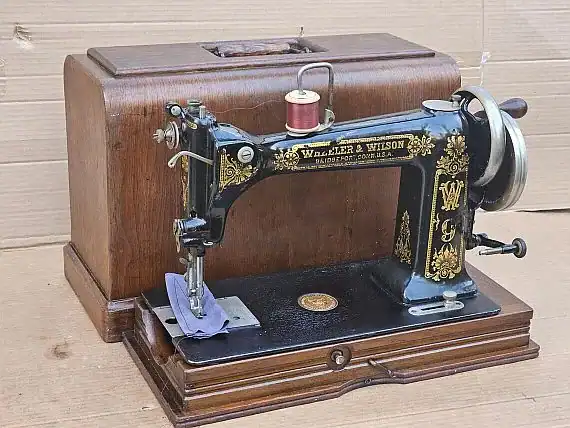
If anyone out there in QHL land is researching the sewing machine, can you email me privately. Thanks, sue reich
From: “Candace Perry”
Huh, how funny…Barb is a good friend of the Heritage Center (and me!) and it didn’t occur to me, as we’ve had her here in non-feedsack capacities! Barb, if you read this, you’ll be getting a phone call 🙂 Thanks for everyone’s quick responses. I’m going to show feedsack examples in the exhibit, and we wanted something for a program that was interesting to many audiences… Candace Perry
Date: Wed, 13 Oct 2004 13:14:20 -0700 (PDT) | From: Dana at Material Pleasures <danabalsamo@>
Hi Judy, A wonderful idea… I do include a piece of paper with a note stating when and how much and from who I bought each book or ephemera piece. I am only 33 and plan to be around awhile, but still, God Forbid my Florence Peto, or Marie Webster wind up in a yard sale for a quarter! I am trying to teach my girls an appreciation for all things quilt related. One can only hope they will treasure my collection as I treasure it. My best, Dana
From: “Lucinda Cawley”
What Miss Teddy did not tell you in her all too brief report was that her study center “Way Down Yonder: Quilts of the Deep South” was fabulous. As Catherine Litwinow mentioned she did actually have a center piece of magnolias and Spanish moss (other icons too). I walked out of that room after two hours of laughter thinking “Wow, did I learn a lot!”. I’m looking at my little bag of cotton seeds, my swatch of Allamance plaid, a fragment of a thick, ugly quilt with fan quilting and the handout based on Teddy’s observations of thousands (her estimate) of ordinary, working southern quilts. The powers that be said they could have filled that class four times over; I’m just glad that I got my registration in the mail the day the brochure arrived. I was really lucky because I got into Pam Worthen and Lorie Chase’s session on New England Signature Quilts. These girls are demon researchers and they had great tips on working effectively to document signature quilts (information that is useful wherever you’re working). I did hear the ladies from Texas chortle when Pam mentioned that New Hampshire has eight counties. Size isn’t everything! The two-color study was exquisite. Connie Nordstrom’s directions last year in Dallas were to interpret a two-color antique quilt. Dimensions could not exceed 200″ around and a photo of the original should accompany the new quilt. Catherine Litwinow chose my favorite quilt from Small Endearments; Sue Reich’s Rob Peter to Pay Paul has a back that Sue hand inked to duplicate what was block printed on the original. Karen Portwood made a wonderful rendition of her neighbor’s family treasure. Denise Nordberg, one of five sisters of French Canadian descent, was probably the most innovative. She was inspired by a quilt made by five French Canadian sisters pictured in the Rhode Island book to split the quilt diagonally making one half a reproduction (handquilted), the other a modern variation (machine quilted). The only criticism I have of the two-color study was that it didn’t get enough attention. It deserved a study session all its own. I could say the same about Show and Tell. There were treasures shared, but by the time we got to them it was late and everybody was tired. Skip the keynote and go straight to Show and Tell, I say. The live auction was the great entertainment event of the weekend. Julie Silber was the auctioneer and she was was so good that she’ll be stuck with that job for life. If Julie can’t make you laugh you must be unconscious. If you’re on QHL and don’t belong to AQSG you’re making a huge mistake. I listened to Margaret Ordonez and Mary Gale talk about Eighteenth-Century Indigo-Resist Fabrics and thought this is IMPORTANT and I’m hearing it literally from the source. The local committee in Vancouver-Portland were wonderful. They were hospitable, helpful, friendly. They had a delightful welcome reception at the local historical society (delicious snacks–salmon, of course). Each of us found a housewife (in Civil War repros) in our welcome packet! This was above and beyond the call. From the minute I met Gail Ingram in the airport and kidnapped her to come with me to see the Pacific on Wed. until Sunday when I saw Mount St. Helens from the plane I was in Quilt Nirvana! Let’s hear from somebody else. Cinda on the Eastern Shore but only until Friday. There are antique quilts to be seen in Rochester, NY.
Date: Wed, 13 Oct 2004 21:49:25 -0400 | From: “J. G. Row” <JudyGrow@>
What Cinda didn’t tell you was that HER paper presentation at AQSG on fraktur writing on signature quilts from Lehigh county Pa and surroundings was fabulous too. Cinda had four actual quilts for us to study after her well researched presentation. She didn’t just read her paper, but gave us the background information with slides of the houses and churches that the makers probably knew. It was a wonderful presentation and I could probably listen to Cinda speak on this subject that interests her so much time and time again. Her enthusiasm was/is catching. At show-and-tell we saw a quilt top that Cinda had commissioned a contemporary fraktur artist to write on and sign. Continuing the tradition.
Xenia Cord made a 4-block quilt which she donated to the auction to benefit AQSG. It was an HIPV myth-buster! I think Madam X makes and donates a quilt every year! Kudos to Madam X!
The food at the hotel was delicious at every single meal, the ones we bought on our own before and after the actual conference, and the ones paid for by our conference fees. The New England clam chowder was at least 3000 calories on its own, and an appetizer portion was a bowl, not a cup as I had imagined. I also had smoked sturgeon for the first time, and a new cereal mixed with our rice, named Quinoa. Read about it here:
http://www.wholehealthmd.com/refshelf/foods_view/0,1523,74,00.html
We all wore name tags around our necks all the time, and it was truly funny to watch folks that we’d met at the last conference give us a big “Hi!”, stumble a bit, look down at our chests, and then say our name. We all did it, and we’ll all probably have to do it again next year. I think I heard that there were 196 attendees. Lots of chest watchers.
I’ve made a CD from my many photos which I will send to Kris. She can make the decision as to whether or not she’ll want to put the pictures up. We saw many, many friendship and signature quilts and the most memorable one had inking on it in one block that will forever be inked in my memory. Both a husband and wife signed that one block, the wife on the left side: “Love me as I have loved you, continue ye in my love. Laura E. Walker”
Lovely, right? Read on, McDuff!
On the right side these educational words —
“But I suffer not a woman to teach, nor to usurp authority over the man, but to be in silence. For Adam was first formed then Eve. Nathaniel Walker”
Now don’t you just want to kick old Natty Walker in the pants? I do!
Our own Eileen Trestain mounted a beautiful show for us at the Clark County Historical Society that included quilts, embroidered mottos on paper, lace and lace-making of all kinds, and some clothing. Eileen showed up for one entire day at the conference in her re-enactor costume, complete with hoop skirt and undersleeves and a hair snood, and looked wonderful.
Some attendees took a tour and saw many nice quilts while the others of us were in study centers that filled up right away. I hope that AQSG can find a solution to the problem of too many attendees and not enough openings in the study centers for them all. They were all wonderfully interesting, and prepared for us by folks just like you and me; folks who get interested in a certain quilt or type of quilt and go about learning all they can about it, and then want to share the information with others of like mind and interest.
Next year the conference will be in the Denver area, Golden Colorado actually. Start putting you pennies away now!
Judy, aka the Ringoes Kid judygrow@
—– Original Message —– From: “Lucinda Cawley” <lrcawley@> To: “Quilt History List” <qhl@> Sent: Wednesday, October 13, 2004 8:58 PM Subject: [qhl] AQSG musings (long, of course)
> What Miss Teddy did not tell you in her all too brief report was that > her study center “Way Down Yonder: Quilts of the Deep South” was fabulous.
Date: Wed, 13 Oct 2004 22:29:20 -0400 | From: “Karen Evans”
God, I’m envious. It sounds marvelous. *sigh* I’m hoping to have something to present next year, possibly on Henry VIII’s quilts (he had several dozen, some of them worked with his arms quartered with those of “Queen Katherine.” Problem: his inventory doesn’t specify *which* Katherine of the three he married….)
In the meantime, I found an interesting tidbit while doing some research into Italian interior design…back in the 1420s the Marquesa of Padua had a professional quilter on staff, Niccolo de la Coltra (“Nicholas the Quilter”). She thought so highly of him that she referred to him as “our master of quilts.”
And if I’m not mistaken, Nick the Quilter might, just might, be the quilter whose name we know. I wonder if any of his works survive in a dusty chest in Padua…nice to dream, no?
Karen Evans
From: “J. G. Row”
Karen,
Your topic sounds so very interesting. How difficult is it to do the research on European quilting from the US?
Judy, aka the Ringoes Kid
From: “Lynne Z. Bassett”
Just a quick note to add my encouragement to list members who are not already members of AQSG to join! I learned a great deal at this conference and had a great time besides. Some highlights for me were the wonderful tour of the Columbia River Gorge and Pendleton mill tour on Friday, and being able to show my great-grandmother’s quilt in Sue Reich’s workshop on WWII quilts. The lectures were very good–well researched and well presented. Congratulations to the list members who presented papers! Cinda gets the prize for the most effective ending to her lecture! (sniff) Teddy, Anita, and Laurie–I loved having dinner with you Sunday night! Trish–thanks for ducking out for a glass of wine with me–I hope you didn’t miss too much of your meeting! Judy the Ringoes Kid–I enjoyed our quiet cup of tea together. Kathy and Chris–you guys are the best! Thanks for lunch (and everything)! Jane–I value our time sitting together on the bus, chatting about non-quilt stuff. Jan–thanks for the whole-cloth quilt lead. Barbara–thanks for writing such a nice inscription in your new book for me. Anita–thanks for being my roomie! I enjoyed our political discussions (okay, tirades).
Thanks to everyone who made this such a wonderful experience, all the way around!
Best, Lynne
Date: Wed, 13 Oct 2004 23:53:45 -0400 | From: “J. G. Row” <JudyGrow@>
Me again.
Last Sunday’s NY Times quarterly magazine “Style” has an interesting article by Susan Fair, the self-styled Samurai Shopper. The Sunday before my husband had met her for the first time and had had dinner with her at her cousin’s home. They had gotten into some pretty intense political arguments. (Thank goodness I was at my guild’s quilt show while this was going on.)
We made it a point to look for Ms Fair’s article. The article was on shopping in Santa Fe, with Ali McGraw (“yes, that Ali McGraw”) who guided her to the finest shops. Although most of the article was too “too” for my taste, I found a couple of lines she wrote most to the point and pretty much described my shopping experience with the AQSG vendors.
With your forbearance I’d like to quote from the article (I will change some single words to reflect quilt collecting and I will put those words in parentheses) and get your viewpoint on collecting or not, and the habit of shopping.
“You might assume the Samurai Shopper went to Santa Fe mining for deep discounts, but no; samurai do not obsess over rock-bottom prices, and besides, the price of authenticity is steep. (Quilt) freaks are a discerning lot, highly competitive, pouncing on items of homely eloquence, redolent of faraway (times)……… Everything I admire is as much as a single share of Berkshire Hathaway. But that doesn’t mean the Samurai Shopper can’t shop.”
“In the same way that wanting isn’t getting, shopping isn’t buying. Shopping can exercise the imagination, refine judgment, hone the mind’s edge by concentrating on pure form, color, light, texture…….Peering intently into the nature of (a quilt) can nullify the need to own it. That is true samadhi: a state of selfless, concentrated absorption.”
“……their bounty is the ultimate in wabi-sabi — wabi, perfect imperfection; sabi, beauty that comes with age.”
So, tell me, what happens when you ultimately come out of the state of samadhi? Can you learn all there is to know and to satisfy just by looking and studying intently? Is she talking about counting coup? It doesn’t always work for me. The covetousness doesn’t go away. How about you?
Judy, aka the Ringoes Kid judygrow@
From: “Karen Evans”
Not easy. Especially when it comes to really early stuff – to research early pieced clothing, for instance, I’ve had to flip through nearly a hundred books on individual artists looking for any evidence of patchwork clothing (and it *is* out there).
Right now I’m digging into medieval and Renaissance noble inventories to see just what they had. Henry VIII’s inventory darn near blinded me because the !#$!$$! scholar who edited the edition at Smith used the originale spelinge ande punktooashun. *shudders*
But I’m having fun, and that’s what counts, I suppose…
Karen Evans —–
From: “Peter LEATE”
Judy said We all wore name tags around our necks all the time, and it was truly funny to watch folks that we’d met at the last conference give us a big “Hi!”, stumble a bit, look down at our chests, and then say our name. We all did it, and we’ll all probably have to do it again next year. I think I heard that there were 196 attendees. Lots of chest watchers
Excuse the frivolity How about some creative wearing of the name tags next time. What about
– wearing it on the back – imagine the different approaches here – skirting around the target ,sneeking up and patting on the back while frantically trying to get a hold on the tag
– on top of the head- much tippy toeing here perhaps even a crick in the neck after acknowledging 196 people
-on the forehead. The procedure here could be- Hi ..er..(eyes up strain to read name) ..er (eyes down to look approachee in the eye) er..Judy- lovely to see you again.
-lengthen the strap to waste level- approach with genuflection – the mind just boggles here! perhaps this could be an idea for recognising seniority or some other worthiness. If everone had long straps every one could feel important as they progressed form curtsy to curtsy. the cracking knees would be another feature – baiting security with the pistol cracks
– diagonal or sash, tucked under the left arm, (maybe a paper on deodorant there), or else sidle up and slip into the arm in arm routine – a renewal of the promenade, very friendly
-the helpful approach- hold at eye level and just the right distance to overcome the myopia- could be called flashing
what about first names in letters 6 inches high- not much fun there though
Just as well I was not there – I may have wound up with a dubious reputation! Peter from OZ
From: Gail Ingram
In response to Cinda’s call for impressions of last week’s AQSG Seminar in Vancover, WA: it was indeed a heady experience, especially for someone like me, who, unlike the Easterners, has fewer opportunities to learn about historic textiles and quilts and to lay eyes on same. This was only my second seminar, and I rue having missed so many before.
Unlike Cinda, I wouldn’t omit the keynote address, not if keynoters do what Barbara Brackman and Laurel Horton did these past two years. Barbara’s clear-headed words on the need to hew to high standards of evidence in quilt scholarship were bracing and timely reminders for all who strive for truth in an age of political correctness. And Laurel’s discussion of the quilts of Mary Black and their roles in defining their maker and her family through generations suggested new ways to “read” and appreciate quilts. It also set the tone for the seminar, which emphasized the relationship between quilts and their makers.
I was particularly impressed with this year’s papers, which were founded in solid scholarship and delivered with animation. Whether the subject was indigoes, fraktur quilts, signature quilts, or other, the presentations were informative and interesting. Cinda’s paper on the use of fraktur particularly intrigued me because I knew so little about the subject (and she knew so much!). Last summer, I had found myself wondering what there was to say about fraktur quilts. A lot is what I learned last week as I sat mesmerized by Cinda’s presentation.
I always look forward to the study centers because they afford the opportunity for in-depth learning about topics of individual interest. My only wish is that each could last just 30 minutes longer! Pam Worthen and Lorie Chase’s signature quilt session was a testimony to what happens when solid research, deep knowledge, and good scholarship are combined with imagination. Even if the presenters had said nothing, the treasury of materials they gave participants would have been worth the cost of the session. I came away not only knowing a lot about all 8 counties of New Hampshire, but having learned some valuable new ways to trace the lineage of people and their quilts.
And talk about learning—well, that’s what went on in J. G. Row’s innovative study center on framing. Who but a devoted sharer of ideas would have shipped all those frames and materials across a continent for such a short presentation? I am so pleased this center was offered, for now I know how to tell my framer what I want. I see the framing of textiles in an entirely new way. Not only will I be more imaginative in my plans for framing, but I will also be able to convey my wishes intelligently to the framer—and even to do part of the work myself, thereby lowering the costs involved.
Sue Reich’s center on quilts made during WW II determined me to do something I’ve wanted to do for a long time—document the quilts from that war made in my own community. Pam Worthen had emailed all the participants in that center, encouraging them to wear red, white, and blue and to say nothing to Ms. Reich about their plans. I purchased a red “I Like Ike” bandana from Julie Powell’s vendor booth for this purpose and brought with me a red, white, and blue umbrella hat, so I felt particularly well attired. The room was ablaze with the colors of our flag. Finally, Pam made a grand entrance, her hair in a red bandana, as Rosie the Riveter. I think it took Sue a while to catch on to the fact that something was a little different, because everyone looked quite serious and as if it were not at all unusual to see a woman wearing an umbrella hat or flag shirt. In any case, Sue’s presentation was carefully researched and planned, and it was perfectly articulated. From her own and friends’ collections, she laid before us representative textiles from an era in which quiltmaking was supposed to be asleep. The session transported all to a different world, I think, and showed us how quilts were used in that world. Xenia Cord’s story of her own family’s escape from Norway on the eve of the Nazi occupation, told following Sue’s presentation, reminded me why war is ever justified or supportable. I am sorry anyone had to miss this center.
I don’t think anybody did miss the auction, conducted by that awe-inspiring auctioneer Julie Silber, whose quick wit kept everyone bidding way past reasonable. Watching a pro in action is purest delight, and on that evening, Julie could have sold the Iraq war to France and made the French pay big $$ for it. Who knew? Certainly not the Vancover owners of surplus cats—or they would have donated them and Julie would have sold them, leaving folks with cat allergies complaining that they had lost their bid on one.
When all is said and done, of course, the parts of the seminar that are not scheduled are almost so important as those that are scheduled. Networking at its best. Friendship at its best. Getting to know people who had previously been printed names. Sharing fabrics and quilts. So much “unscheduled” going on all the time! For instance, this year’s host hotel had prominently displayed in its lobby a queen-size bed (Yes, I know, but a bed it was), and in between events, some of the southern contingent piled their sweet Southern bodies onto it to do some impromptu planning for the Conference on Southern Quilts, to be held Sept 16-17, 2005 in Nashville. Because I missed my 7 a.m. flight out of Shreveport, LA, I was late arriving in Portland. Not to worry, there were Cinda and Phyllis Twigg at the baggage check, and they invited me to join them in a drive to see the Pacific Ocean before the sun set. Once the ocean found us, I recited Keats’ poem re Balboa’s similar experience, “Standing on a Peak in Darien,” and Cinda struck a fetching pose that rivaled any Balboa could have managed. I’m sure Phyllis made Ansel Adams look like an amateur with her camera.
And everywhere there was quilt talk. Ideas, techniques exchanged. Questions posed and sometimes answered, always honored. Meetings planned, invitations offered.
Flying home to Louisiana, I thought of what the women whose work and lives we study would think of us, how their quilt talk compared with ours. We are still lusting after beautiful fabrics, still talking about new techniques, still finding friendship and support through our work in an old medium. When all the degrees and superfluities are stripped away, I think we might not be so very different from those we study. Luckier in many ways, perhaps, for we can indulge our desire to see quilts and quilting friends from many regions. And perhaps more of us are better able to afford the textiles of our dreams. But that luck also limits us, for as Laurel Horton pointed out nearly 2 decades ago, sometimes being unable to afford a wide variety of fabrics is a blessing to the designer.
Personally, I am grateful to all in AQSG who work to make this annual seminar such a pleasure. I cannot imagine who I was before I joined this group.
Thank you also to the local members who saw that all of us were well housed, really well fed with local specialties, including some fine apples, and well guided. It was a delightful conference.
Gail Ingram
P.S.
From: Laura Robins-Morris
I’m on digest, so excuse me if this is a repeat:
What J. G. Row left out of her report was her own wonderful study center To Frame or Not To Frame. She had shipped several cartons of samples to Vancouver and you would be amazed at all the different and beautiful ways she has devised to display textiles. She had extensive handouts for us, take-home samples of mounting materials, and described in detail many methods of mounting, protecting and framing textiles. Our heads were swimming by the end – twice the alloted time wouldn’t have been enough! (And I’ll need another house or two to have enough wall space to accommodate all those great ideas.)
I echo what others have said about joining AQSG — it’s a must. Seminar is fun and interesting, the people are great, and there is so much to learn and enjoy. I also echo what someone else said – additonal study centers are needed for that number of attendees. Perhaps some of the round tables could have become study centers? Or better yet, could there be repeat sessions of some/all of the study centers? The presenters are very generous of their time to give a study center in the first place; but having gone to such efforts, perhaps a second session would make the effort even more worth while? Please forgive me if I’m begin too presumptuous of their hard work. Anyway, the study centers, round tables, and papers were all excellent — thank you all.
One more suggestion, mentioned several times during the weekend – LARGER LETTERING ON THE NAME TAGS !!!
Seminar was great. Many many thanks to all the many people who worked so hard both in front and behind the scenes.
Laura in Seattle
From: deedadik@
Hi all, If Jean Ray Laury is on the list, would you contact me privately, pleasse. Dee
— Dee Dadik Certified Appraiser of Quilted Textiles 5689 Concord Hill Dr. Columbus, Ohio 43213 614-861-0478
From: Laura Robins-Morris <lrobins@>
Oops, I sent the last too quickly and missed a couple things — Sherry Cook had arranged for a wonderful collection of antique quilts in an old grange hall, as part of the Columbia Gorge tour, and another collection for the lecture hall. I can’t do a Cinda-logue, but they included a fragile and unusual flag quilt with signatures, an 1850’s Bethlehem Star, a mid(or early?)-19th century candlewick top, red and green quilts, crazy quilts, and a wonderful range of quilts dating the last half of 19th century and first half of 20th century. It’s just too bad that more people weren’t able to see the ones in the grange hall. I understand that she did a lot of travelling to collect all of those for us to see. Also, Ann Bodle Nash had hung a lovely sampling of contemporary quilts from the Northwest. The lecture hall was a blaze of color. Laura in Seattle
From: “Newbie Richardson”
Sue and list, The authority on the history of the sewing machine is Costume Society founding member and sewing machine collector ‘par excellance’: Elizabeth Brown. Mrs Brown is a very energetic 80 something with so many examples of old machines and all the related materials on them that there are now only narrow paths through her house! Her knowledge and enthusiasm in sharing it is boundless. She can be contacted by phone :908-359-3395, or fax; 908-874-7590 – no email. She lives in Belle Meade, NJ – not far from Princeton. Her husband has been ill, and I know that talking about her beloved history of the sewing machine would brighten her day! Feel free to use my name. Meanwhile, I just mounted a dress from 1847/8 which I discovered on close examination was entirly sewn by machine. It is a period dress, for sure. Everything about it it right for the period. I double checked to be sure it was not made in the 1890’s as a costume to celebrate a town’s 50th anniversary ( a common practice and many vintage dealers are fooled by these). My partner, Colleen and I are sure it dates to 1847/8. So that makes it the earliest machine made garment either of us has seen to date – and we have seen many. As I recall there was a machine in the White House in 1846(?) and I know that a certain number of the verifiable 1840’s quilts at the International Quilt Study Center were machine quilted. The sewing machine was a labor saving device that took over just as quickly in the mid 19th century as the microwave oven did in the last third of the 20th. And like the microwave, was a status symbol in it’s early days. Joan Severa talks about it extensively in her book “Dressed for the Photographer: Ordinary Americans and Fashion 1840-1900.” Newbie Richardson
From: “Karen Erlandson” <quilter@>
Pardon the interruption, Months ago (probably years), a new member posted to the group from Celina, Tx – said she did quilt restoration. If you are still on the list, can you contact me off list at quilter@
Thanks, Karen
From: “Molly” <ddiamond@>
Where does one find out when and where the study groups are meeting. I live in central N.Y. and do not know of any in my area. Does anyone.??? Thanks. MW
From: “Celia Eddy” <celia.eddy@>
I’m looking for examples of OLD NZ quilts. Are there any Galleries or Museums who have collections?
Many thanks for any info. Celia Eddy
From: Judy Kelius <quilts@> D
Kris maintains a list on the web site – http://www.quilthistory.com/study/. It is not unusual for some folks to travel two-three hours, even more, to get to a good study group!
From: “Jan Drechsler” <quiltdoc@>
Molly,
Kris, our list mom, has held several study groups in NY state. Check her web site for info.
Jan — Jan Drechsler in Vermont Quilt Restoration; Quilting teacher www.sover.net/~bobmills
From: Julie Silber
Gail wrote:
I don’t think anybody did miss the auction, conducted by that awe-inspiring auctioneer Julie Silber, whose quick wit kept everyone bidding way past reasonable. Watching a pro in action is purest delight, and on that evening, Julie could have sold the Iraq war to France and made the French pay big $$ for it. Who knew? Certainly not the Vancouver owners of surplus cats—or they would have donated them and Julie would have sold them, leaving folks with cat allergies complaining that they had lost their bid on one.
Julie says:
Don’t get me wrong. I truly appreciate the compliments, and I am so, so happy to know that the AQSG auction was a success, both financially and as entertainment. And Gail, you know I love you. And at the risk of getting “political” on QHL, your compliment threw me. I can not find any humor in a completely unjustified war in which our soldiers as well as tens of thousands of absolutely innocent Iraqi children, women and men are dying. My wit may be quick, but I am cut to the quick with sorrow over this war, and simply can not make a joke of it.
Sincerely,
Julie Silber